Visualização de leitura

4 Tesla owners react to their FSD dreams getting crushed: 'It feels like a bait and switch'

Tesla Model 3
As far back as 2016, Tesla said all its vehicles have hardware capable of supporting unsupervised Full Self-Driving.

Bloomberg/Getty Images

  • Bought a Tesla before 2023? Bad news: your car won't be able to drive itself.
  • Elon Musk said last week that vehicles with previous-gen tech can't support full autonomy.
  • Longtime Tesla owners told Business Insider they felt let down by the company's announcement.

For years, Tesla sold its EVs with the promise of an autonomous future. Now, some owners face being left behind.

On Tesla's earnings call last Wednesday, Elon Musk said that Tesla vehicles shipped before 2023 — which are equipped with a previous-gen Hardware 3 computer — would not be able to achieve fully unsupervised Full Self-Driving (FSD).

"I wish it were otherwise, but Hardware 3 simply does not have the capability to achieve unsupervised FSD," said Musk.

The billionaire said that Tesla would offer Hardware 3 owners the choice of a "discounted trade-in" or a physical replacement of their car's computer and cameras at "micro factories" in major cities.

The announcement is a major blow for longtime Tesla owners, who paid thousands of dollars and have been waiting for years under the impression that their vehicles have the tech necessary to achieve fully autonomous driving.

As far back as 2016, Tesla stated in marketing materials that all its vehicles had the necessary hardware for "full self-driving capability at a safety level substantially greater than that of a human driver."

Elon Musk holding a microphone in front of a Tesla.
Elon Musk is known for his ambitious predictions about self-driving cars, some of which haven't panned out.

Christian Marquardt/Getty Images

In a 2019 tweet, Musk said that all Tesla vehicles produced since 2016 had the right hardware for FSD or were "trivially upgradeable."

"It feels like a bait and switch at this point," Andrew Apperley, who bought a used 2018 Model 3 with FSD for $53,000 in 2023, told Business Insider.

"They kind of shot themselves in the foot by saying that this is going to come, and then it never does," Apperley said, adding that he felt like Hardware 3 customers would find it hard to trust Tesla and Musk's promises in the future after waiting in vain for unsupervised FSD.

Tesla did not respond to a request for comment from Business Insider.

Autonomy angst

Rick Flashman, who paid $10,000 for FSD when he bought his Model 3 in 2022, told Business Insider that, despite receiving increasingly generous trade-in offers from Tesla, he was not interested in swapping out his EV for a vehicle with up-to-date hardware.

"My car's in great shape. It's got 73,000 miles, it's driving perfectly, so I have no reason to upgrade it," Flashman said.

The Florida resident said that FSD was one of the main reasons he bought a Tesla, adding that he uses it for "over 90%" of his driving.

Hardware 3 vehicles in the US run a more limited version of FSD, with Tesla planning to release a "lite" variant of FSD version 14 for older vehicles in June.

Despite his car's limited capabilities, Flashman said he was well satisfied with the tech and is happy to wait for the overhaul Musk promised on Wednesday.

"It might take another year, but I'm one of the ones who's just waiting it out," he said.

"I wish it were sooner, obviously. But I don't feel like I was ripped off," Flashman added.

Rick Flashman
Rick Flashman with his Tesla Model 3.

Rick Flashman

Matt Simmons, a Tesla owner who bought his Model 3 Performance in 2019, told Business Insider he added FSD for an extra $6,000 because he was curious about the hype. Seven years later, he says he rarely uses the feature.

"It kind of sucks, if I'm being honest," said Simmons, who said he doesn't use FSD on highway trips because of issues with the software's speed control.

Simmons said that he was not surprised by Musk's comments, pointing to the Tesla CEO's track record of making ambitious predictions for self-driving cars have often failed to fully pan out.

"We realize we're being strung along at this point," Simmons said.

The Pittsburgh resident described his Tesla as "long paid for" and said he had no intention of trading it in for a more advanced model.

"That would mean I'd have to buy another Tesla," said Simmons, who said he was hoping that rival EV maker Rivian would offer a similar deal for disenfranchised FSD owners.

Backlash goes global

Some Hardware 3 owners are done waiting for the software they paid thousands of dollars for years ago.

Tesla is already facing several lawsuits in the US from owners who say they were misled by the company's FSD marketing, and the backlash is starting to go global.

Earlier this month, Tesla finally received the green light to launch FSD in the Netherlands, marking the tech's debut in Europe after a yearlong campaign to woo regulators.

However, the rollout in the Netherlands excluded Hardware 3 owners, prompting Mischa Sigtermans, an executive at Amsterdam-based Ryde Ventures, to start a website to gather European Tesla owners for potential legal action.

Mischa Sigtermans Tesla
Mischa Sigtermans with his Tesla Model 3.

Mischa Sigtermans

Nearly 4,000 verified Tesla owners have now signed up to Sigtermans' website.

The Model 3 owner, who paid 6,400 euros ($7,530) for FSD in 2019, told Business Insider that Musk's comments confirmed many owners' worst fears, and said that the proposed solution of a discounted trade-in would simply make owners "pay for the same broken promise twice."

"Musk said out loud what many of us have been saying for months, if not years," said Sigtermans. "The admission is there, the solution isn't."

Read the original article on Business Insider

  •  

Watch the Cybercab robotaxi roll off Tesla's production line

A gold Tesla Cybercab drives down a city street.
Elon Musk posted a video on Friday that appears to show several production-level Cybercabs rolling off the factory line.

Andrej Sokolow/picture alliance via Getty Images

  • Elon Musk shared a video that shows Cybercabs rolling out of the factory.
  • The Cybercab is Telsa's upcoming two-seat, fully autonomous vehicle with no steering wheel or pedals.
  • It's a huge part of Tesla's multibillion-dollar bet that it can become an AI and autonomy brand.

Tesla says its dedicated robotaxi model is finally in production.

On Friday, Tesla and its CEO, Elon Musk, shared a video on X showing several Cybercab units rolling off the production line in Austin.

The footage was filmed from inside the vehicles as they moved through the factory campus — and suggests Tesla is moving the Cybercab closer to reality.

Purpose-built for autonomy

Cybercab in production now at Giga Texas pic.twitter.com/Y9qG3KyWBa

— Tesla (@Tesla) April 23, 2026

Tesla is making a multibillion-dollar bet that the company can pivot from traditional car sales to an AI-driven robotaxi and robotics business.

The two-door, two-seat Cybercab — which does not feature a steering wheel or pedals — is one of the major pillars of that bet.

Just over a month ago, the automaker said it had just built its first production Cybercab. Now, the videos suggest Tesla has built multiple units, with Musk also reposting footage of Cybercabs seemingly turning onto a public street.

Autobots, assemble! https://t.co/bnjXKLpOeK

— Tesla Optimus (@Tesla_Optimus) April 24, 2026

Starting production is only one step in a much larger challenge.

Tesla has yet to deliver fully autonomous driving at scale. During Wednesday's earnings call, the company removed specific timelines for robotaxi launches in five new cities.

Meanwhile, competitors like Waymo already operate driverless ride-hailing services in several cities.

Still, the videos suggest progress for a vehicle Musk has said would ramp "agonizingly slow."

The company didn't immediately respond to a request for comment from Business Insider.

Read the original article on Business Insider
  •  

Tesla is hiring for Elon Musk's Terafab chip moonshot. Here's how much it's paying.

Elon Musk
Elon Musk said that he is looking at xAI's interview history to scan for missed talent.

Fabrice COFFRINI / AFP via Getty Images

  • Elon Musk said that Tesla and SpaceX would collaborate on a moonshot Terafab chip-building project.
  • Tesla has posted its first Terafab roles in California and Texas, and is offering a wide salary range.
  • SpaceX is also ramping up hiring at its silicon division as it looks to bring chip production in-house.

Tesla and SpaceX are ramping up semiconductor hiring as Elon Musk's ambitious plans for a Terafab take shape.

Tesla is hiring Terafab engineers in Palo Alto and Austin, according to job listings on the company's website, after Musk said the company would collaborate with SpaceX to build what could be the largest chip manufacturing plant in history.

In California, the EV giant is looking for module process engineers with expertise in lithography, the highly technical discipline that uses ultraviolet light to etch chip designs onto silicon wafers at a molecular scale. It is offering a base salary of $88,000 to $240,000, depending on experience and other factors.

Applicants need to have at least 10 years of experience in cutting-edge semiconductor development.

The job listing suggests they would also need to be comfortable with Tesla's famously intense work culture, with expectations including a willingness to be on-call to "support 24/7 manufacturing operations" and respond rapidly to "critical production issues."

At the Terafab announcement on Saturday, Musk said the facility would create lithography masks — the quartz or glass template that contains the chip design imprinted onto the wafer — in-house, allowing Tesla and SpaceX to quickly iterate and improve chip designs.

"To the best of my knowledge, this doesn't exist anywhere in the world," said Musk, who added that the companies were exploring "some very interesting new physics" to make the project work.

Tesla's Terafab division is also hiring process integration engineers to build advanced logic chips, with base salaries ranging from $88,000 to $338,280. Musk has said Terafab will combine logic and memory chip production under a single roof, something that is highly unusual in the chipmaking industry.

The wide salary range is in line with Tesla's approach to compensation. Business Insider previously reported that the company offers lower base salaries than its tech giant rivals, but includes substantial stock grants.

Tesla is also advertising open roles for silicon engineers in Austin, and is looking to recruit a technical program manager with a proven track record of running "$100 million-plus capex projects" to oversee the design and construction of the fabs. Neither job listing includes base salaries.

Tesla faces talent scramble over Terafab

Recruitment will be one of the biggest challenges facing Musk's ambitious goal of building one of the world's largest semiconductor manufacturers from scratch. The industry relies on specialized knowledge that is carefully cultivated within leading companies like TSMC. It's also facing a global shortage of skilled workers.

SpaceX is scaling up its semiconductor hiring as the rocket maker prepares to launch up to one million orbital data centers, powered by AI chips built by Terafab that are specially adapted for the icy wastes of space.

The company has around 60 open positions in its Silicon division, according to SpaceX's website, though it's unclear which of these roles — if any — are directly related to Terafab.

They include assembly and packaging engineers at its Starlink factory in Bastrop, Texas, where the company invested $280 million last year to expand its semiconductor R&D and packaging facilities, as well as engineers in Washington and California to develop "cutting-edge" specialist chips for deployment in space and on Earth.

"In true SpaceX fashion, Starlink is taking the next step in vertical integration by bringing integrated circuit packaging and assembly in-house for development and manufacturing," read the descriptions on the Bastrop job listings, which do not include salaries.

SpaceX and Tesla did not respond to a request for comment.

Do you work at Tesla or in the semiconductor industry? Contact this reporter via email at tcarter@businessinsider.com or tcarter.41 on Signal. Use a personal email address and a nonwork device; here's our guide to sharing information securely.

Read the original article on Business Insider

  •  

SpaceX, de Elon Musk, prepara maior IPO da história

A SpaceX está avaliando uma meta de captação em sua oferta pública inicial (IPO) que pode superar com folga a maior estreia já registrada no mercado, segundo pessoas familiarizadas com o assunto. A movimentação ocorre enquanto a fabricante de foguetes e satélites do bilionário Elon Musk avança em seus planos de abertura de capital.

A empresa trabalha com um valor estimado em torno de US$ 75 bilhões para o IPO, de acordo com uma das fontes, que pediu anonimato por se tratar de informações ainda não públicas. Em conversas com investidores potenciais, a SpaceX também discutiu a possibilidade de levantar mais de US$ 70 bilhões.

Qualquer uma dessas cifras mais que dobraria o recorde histórico de abertura de capital — os US$ 29 bilhões levantados pela petroleira Saudi Aramco, em 2019.

A expectativa é que a SpaceX estreie na bolsa em junho, embora o cronograma ainda possa sofrer alterações, segundo as fontes. A companhia pode protocolar sua documentação de forma confidencial já neste mês, conforme reportado pela Bloomberg News em fevereiro.

O site The Information já havia antecipado a estimativa mais elevada de captação. Os preparativos para o registro confidencial seguem em andamento, mas a empresa ainda pode rever seus planos. Procurada, a SpaceX não respondeu imediatamente.

Segundo fontes, a SpaceX pode buscar uma avaliação superior a US$ 1,75 trilhão em seu IPO. A companhia adquiriu recentemente a startup de inteligência artificial de Musk, a xAI, em um acordo que avaliou o grupo combinado em US$ 1,25 trilhão, de acordo com a Bloomberg News.

Se atingir esse valor de mercado, a SpaceX passaria a valer mais do que todas as empresas do índice S&P 500 Index, com exceção de apenas cinco gigantes: Nvidia, Apple, Alphabet, Microsoft e Amazon. Nessa métrica, a empresa também superaria a Meta Platforms e a própria Tesla, outra companhia de Musk.

  •  

SpaceX, de Elon Musk, prepara maior IPO da história

A SpaceX está avaliando uma meta de captação em sua oferta pública inicial (IPO) que pode superar com folga a maior estreia já registrada no mercado, segundo pessoas familiarizadas com o assunto. A movimentação ocorre enquanto a fabricante de foguetes e satélites do bilionário Elon Musk avança em seus planos de abertura de capital.

A empresa trabalha com um valor estimado em torno de US$ 75 bilhões para o IPO, de acordo com uma das fontes, que pediu anonimato por se tratar de informações ainda não públicas. Em conversas com investidores potenciais, a SpaceX também discutiu a possibilidade de levantar mais de US$ 70 bilhões.

Qualquer uma dessas cifras mais que dobraria o recorde histórico de abertura de capital — os US$ 29 bilhões levantados pela petroleira Saudi Aramco, em 2019.

A expectativa é que a SpaceX estreie na bolsa em junho, embora o cronograma ainda possa sofrer alterações, segundo as fontes. A companhia pode protocolar sua documentação de forma confidencial já neste mês, conforme reportado pela Bloomberg News em fevereiro.

O site The Information já havia antecipado a estimativa mais elevada de captação. Os preparativos para o registro confidencial seguem em andamento, mas a empresa ainda pode rever seus planos. Procurada, a SpaceX não respondeu imediatamente.

Segundo fontes, a SpaceX pode buscar uma avaliação superior a US$ 1,75 trilhão em seu IPO. A companhia adquiriu recentemente a startup de inteligência artificial de Musk, a xAI, em um acordo que avaliou o grupo combinado em US$ 1,25 trilhão, de acordo com a Bloomberg News.

Se atingir esse valor de mercado, a SpaceX passaria a valer mais do que todas as empresas do índice S&P 500 Index, com exceção de apenas cinco gigantes: Nvidia, Apple, Alphabet, Microsoft e Amazon. Nessa métrica, a empresa também superaria a Meta Platforms e a própria Tesla, outra companhia de Musk.

  •  

Elon Musk has a history of doing the impossible. A Tesla Terafab may be his most difficult challenge yet.

Elon Musk
Elon Musk has said building a Terafab is critical to Tesla's future.

Harun Ozalp/Anadolu via Getty Images

  • Elon Musk is about to unveil his most challenging project yet: a giant semiconductor factory.
  • The billionaire has said Tesla needs to build a "Terafab" to churn out chips for its robotaxis and Optimus robot.
  • One analyst said to never rule Musk out, but that building a Terafab could be harder than sending rockets to Mars.

Self-driving cars, cyborgs, and catching rockets in midair: Elon Musk can't resist the lure of the impossible.

The world's richest man has made a habit of taking on the world's most difficult engineering challenges at Tesla and SpaceX — and has often proved the doubters wrong. His latest target is a tall order even by his standards.

For several months, Musk has been talking about building a "Terafab," a mammoth factory that would churn out semiconductors critical for Tesla's ambitious rollout of robotaxis and humanoid robots.

On Saturday, he teased that an announcement was imminent. "Terafab Project launches in 7 days," Musk wrote in an X post, without providing further details.

In a January earnings call, the billionaire cited chip production as the major long-term headwind to the company's growth, suggesting that output from suppliers Samsung, TSMC, and Micron would be nowhere near enough to meet Tesla's targets as the EV giant scales its robotaxi and humanoid robot programs.

"This is definitely going to be sort of a controversial thing, but I think Tesla needs to build a Terafab," Musk told investors, adding that such a facility would also protect Tesla against geopolitical upheaval.

The Tesla CEO suggested that the company would pursue the hardest possible version of that vision, a "very big fab" that would produce and package logic and memory chips entirely in the US.

Speaking at Tesla's annual shareholder meeting last November, Musk estimated the Terafab would aim to initially produce 100,000 silicon wafers a month and could eventually grow to 1 million.

SpaceX's Super Heavy booster as it returned to its launch site, with the sun rising in the background.
SpaceX made history by returning the Heavy Booster to its launch site.

SpaceX/Getty Images

Ahead of the Terafab announcement, Tesla has begun laying the groundwork for Musk's grand plan. The tech giant is hiring a semiconductor infrastructure manager to oversee factory design and construction, per a recent job posting. The role is based in Austin, suggesting the Terafab could be built near Tesla's gigafactory on the outskirts of the city.

However, analysts told Business Insider that Tesla would face enormous challenges — and a huge bill — as it tries to master one of the most complex technologies on the planet.

"It's Musk, so I would never count it out. But I suspect this is actually harder than sending rockets to Mars," Stacy Rasgon, managing director and senior semiconductor analyst at Bernstein, told Business Insider.

Semi-impossible?

The global supply of semiconductors is almost entirely produced by a small handful of companies, many of them based in East Asia.

Manufacturing them is an expensive, complicated, and time-consuming process. Deep within hermetically sealed factories, chip designs are etched onto thin silicon wafers at the molecular level by specialist lithography machines, which are almost entirely made by one company in the Netherlands and can have a waitlist of over a year.

Rasgon said that procuring these in-demand ASML-built machines was a critical roadblock for any would-be chipmaker.

"If you're a brand new customer, you're probably waiting a couple of years before getting your hand on one of those," he said.

Rasgon added that chipmakers usually split up production of logic and memory chips and semiconductor packaging across different factories.

Musk's suggestion that Tesla could integrate them all into one facility would make scaling the Terafab even more complicated, Rasgon said, as each product has wildly different processes and economics.

TSMC factory Arizona
TSMC broke ground on its factory in Arizona in 2021.

: Jim West/UCG/Universal Images Group via Getty Images

Musk is not alone in fearing geopolitical disruption. The threat of a Chinese invasion of Taiwan, which would plunge global chip supply into chaos, has prompted companies, including TSMC, to build new chip fabs in the US.

But the road to US-produced semiconductors has been far from smooth. TSMC's Arizona expansion has faced years of delays and a total price tag of around $165 billion across multiple facilities.

The industry runs on technical knowledge that is deeply embedded within leading companies. TSMC flew employees out from Taiwan to help the Arizona facility ramp production and brought US workers to its home country to train them.

The need for specialized knowledge will make recruitment critical for Tesla's Terafab hopes, Rasgon said, adding that the semiconductor industry is already facing a worker shortage.

"These guys don't grow on trees," he said.

A 'Herculean' challenge

Analysts warned that overcoming these challenges would add to the severe cash burn Tesla is set to face in the coming years.

The company said in January it would spend $20 billion on building out its robotaxi and Optimus production lines this year, a figure which does not include the Terafab project.

Ben Kallo, a senior research analyst at Baird, told Business Insider that investors would have questions about how Tesla plans to fund such an ambitious project — especially considering Musk has also said Tesla will build around 100 gigawatts of solar panel manufacturing.

"Where's the money coming from? I think that's going to be a question," said Kallo, who added that he wouldn't rule out Tesla raising outside capital for the first time since 2020 to fulfill Musk's ambitious targets.

Musk hasn't given a specific timeline for building the Terafab and producing chips, but he said in the January earnings call that he was building it to "remove a probable constraint in three or four years."

In a Tuesday note, Morgan Stanley analysts led by Andrew Percoco pointed to Micron's factory in Boise — which began construction in late 2022 but isn't expected to begin shipping chips until mid-2027 — as evidence of how long it can take to build semiconductor infrastructure in the US.

They estimated that building a factory capable of producing 100,000 wafers for cutting-edge logic chips a month could cost as much as $45 billion. A note from UBS analysts in January estimated that just getting to Musk's initial production target of 100,000 silicon wafers a month would cost $30 billion.

"Even understanding Elon Musk's history of doing difficult things, this seems like a Herculean task," the Morgan Stanley analysts wrote.

Read the original article on Business Insider

  •  

O que tem feito os lucros do S&P 500 crescerem e como a guerra no Irã pode impactar esse movimento

O ponto central da temporada de resultados do S&P 500 é simples: o índice entregou mais um trimestre muito bom de lucros, e o número agregado continua forte o suficiente para sustentar a narrativa de resiliência do índice.

Com quase todas as empresas já tendo divulgado os seus números, 73% bateram o mercado, e o lucro consolidado cresceu 13% a/a, bem acima dos 7% esperados no início da temporada.

A conclusão aqui é que a barra de resultados estava baixa demais, e o índice voltou a surpreender para cima.

Os resultados do S&P 500 estão crescendo de maneira consistente há mais de 1 ano

Esse resultado ganha ainda mais peso porque não foi um evento isolado: o 4T25 marca também o quinto trimestre consecutivo de crescimento de lucros acima de dois dígitos no S&P 500.

Em ciclos normais, cinco trimestres seguidos nessa faixa costumam vir acompanhados de uma narrativa de expansão de qualidade, difusão e confiança no crescimento da maioria das empresas.

A leitura prática, porém, é que o ciclo está forte, mas mais “seletivo” do que parece quando olhamos só as notícias mais recentes.

Como foi a performance das empresas em geral (excluindo as 7 Magníficas)

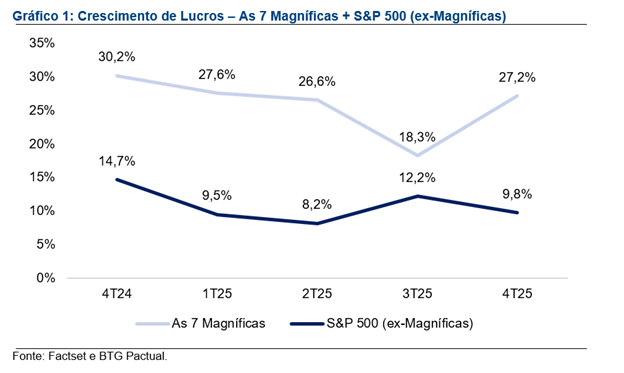
O principal alerta da temporada está na baixa difusão do crescimento de lucros, que não avançou, movimento que está oposto à performance de mercado do S&P 500 no ano, com mais de 300 empresas com uma performance acima do índice.

Quando excluímos as 7 Magníficas (Apple, Nvidia, Meta, Microsoft, Amazon, Alphabet e Tesla), o ritmo de crescimento do LPA (lucro por ação) das outras 493 empresas desacelerou para 9,8% a/a no 4T25, versus 12,2% no 3T25.

Ou seja: o S&P 500 continua crescendo bem, mas o crescimento não está sendo difundido entre as companhias.

E a rentabilidade das companhias aumentou

Do lado de rentabilidade, o trimestre trouxe um reforço positivo: a margem líquida do S&P 500 subiu 20 bps, de 13,1% para 13,3% nesse trimestre.

Isso sugere eficiência operacional, mas também uma composição cada vez mais favorável, dado o peso cada vez maior de tecnologia e comunicação no consolidado e as maiores taxas de crescimento desses setores versus o índice (excluindo as 7 Magníficas).

Uma nova América está nascendo: setor industrial foi melhor do que tecnologia

O dado setorial mais interessante do 4T25 foi o desempenho das empresas industriais, com surpresa de LPA de 28,6% versus o consenso, cerca de 3 vezes acima da surpresa de tecnologia (8%).

Em paralelo, saúde, consumo discricionário, materiais básicos, financeiro e consumo não discricionário ficaram essencialmente em linha (até 5% de surpresa), e serviços básicos foi o único setor com surpresa negativa (-1,6%).

Ou seja, o mercado pode estar concentrado em poucas narrativas, mas estamos observando cada vez mais a expansão dos investimentos nos EUA e a recuperação dos EUA como potência industrial e manufatureira após anos de baixos investimentos.

Por que as principais empresas do mundo de tecnologia estão performando mal em 2026?

O mercado parece ter olhado menos para a qualidade do trimestre e mais para dois pontos: investimentos maiores e menor clareza de monetização imediata dos investimentos em IA.

Em outras palavras, a temporada mostrou crescimento ainda sólido das principais companhias de tecnologia do mundo, mas com o investidor exigindo mais “prova de retorno” e menos disposto a pagar apenas por narrativa.

A conclusão é que, hoje, bater o consenso não é suficiente; o mercado quer entender a trajetória de fluxo de caixa e os retornos dos investimentos dessas companhias.

Em 2026 o mercado está mais cético com novos investimentos em IA, após 3 anos exuberantes de performance

Nos hyperscalers (Meta, Microsoft, Amazon e Alphabet), isso ficou explícito na revisão positiva de US$ 120 bilhões no capex para 2026 versus as estimativas iniciais do consenso.

Esse tipo de revisão costuma ser ótima notícia para a cadeia de infraestrutura de IA, mas tende a ser uma notícia ambígua para as próprias ações no curtíssimo prazo, porque aumenta a sensibilidade a qualquer frustração de monetização.

A conclusão é que o mercado está tratando capex como “risco de execução”, não como “garantia de crescimento”, pelo menos por enquanto.

A Meta foi a exceção e, por isso, virou o melhor exemplo do que o mercado quer ver, subindo 10%. O motivo foi a combinação de aceleração dos negócios tradicionais em anúncios com sinais mais claros de monetização de IA (anúncios, Reels e recomendação) — isto é, investimento alto, mas com retornos.

Por que a Nivida caiu mesmo após um resultado positivo?

A Nvidia também ilustra bem essa fase do ciclo de mercado. Os números foram fortes e acima do consenso, com receita de US$ 68,1 bilhões, mas a ação caiu 4% após o resultado.

A interpretação mais provável é que o mercado está precificando a hipótese de “pico de lucros” e que deveriam, no longo prazo, mostrar uma desaceleração devido aos menores investimentos em infraestrutura de inteligência artificial.

A nossa leitura é que esse ceticismo parece prematuro diante da elevada demanda estrutural por capacidade computacional e novas aplicações de IA artificial que ainda estão apenas começando, com destaque para a IA física.

E como a guerra atual no Oriente Médio influencia os meus investimentos?

Apesar da incerteza quanto à duração da guerra no Oriente Médio e aos seus impactos negativos sobre a inflação e o crescimento global, historicamente, conflitos geopolíticos tendem a não dominar a narrativa do mercado financeiro no médio prazo. Ou seja, os fundamentos econômicos tendem a prevalecer sobre as notícias.

Em outras palavras, em períodos de medo e incerteza, os retornos em ações podem ser maiores, justamente porque a aversão ao risco aumenta e os ativos são precificados com desconto.

É importante lembrar também que, em última instância, são os fundamentos econômicos que determinam a economia e os mercados.

E, quando olhamos para os EUA, os dados reforçam esse ponto: o Federal Reserve informou que os balanços patrimoniais das famílias estão sólidos, não apenas no agregado ou entre as famílias de maior renda, mas em todas as faixas de renda.

Para ilustrar, a dívida como percentual do patrimônio líquido das famílias mais pobres do país está atualmente em 16,1%, após recuar gradualmente de 20% no início da década e, tecnicamente, atingir agora o menor nível desde 1999.

E vale sempre lembrar o que, no fim do dia, move o S&P 500: o consumidor americano. O consumo nos EUA representa mais de dois terços do PIB do país (cerca de US$ 20 trilhões) e, se fosse uma economia separada, teria escala comparável à da China. Até aqui, essa força segue positiva, em expansão e com baixa alavancagem.

Concluindo…

Em conclusão, o cenário para o S&P 500 em 2026 revela um mercado de fortes fundamentos, mas que exige maior seletividade do investidor. Embora a resiliência dos lucros seja evidente, com o quinto trimestre consecutivo de crescimento de dois dígitos, o otimismo agora é temperado pelo ceticismo quanto ao retorno imediato dos investimentos em IA e pelas incertezas geopolíticas no Oriente Médio.

No entanto, o surgimento de uma “Nova América” industrial, a resiliência do consumidor americano e a eficiência operacional das companhias sugerem que, apesar do ruído das manchetes de guerra, os fundamentos econômicos tendem a prevalecer no médio prazo. O investidor que focar em empresas com capacidade real de monetização e fluxo de caixa sólido estará melhor posicionado para transformar o prêmio de risco atual em retornos consistentes.

  •  

Do ‘Twitter’ à Starlink: Elon Musk fecha acordo para unir SpaceX e xAI antes de mega IPO

O bilionário Elon Musk acertou nesta segunda-feira (2) a fusão entre SpaceX e xAI, segundo fontes ouvidas pela Bloomberg, em um acordo que engloba as ambições cada vez mais dispendiosas do bilionário de dominar a inteligência artificial e a exploração espacial.

O acordo foi anunciado em um memorando nesta segunda. A expectativa é que a empresa resultante da fusão precifique suas ações em cerca de US$ 527 cada e tenha uma avaliação de mercado de US$ 1,25 trilhão, disseram algumas das fontes.

Os representantes da SpaceX e da xAI não responderam imediatamente aos pedidos de comentários. 

A Bloomberg já havia noticiado as discussões. A SpaceX planeja uma oferta pública inicial (IPO) que pode arrecadar até US$ 50 bilhões, segundo a Bloomberg News. A empresa também discutiu uma possível fusão com a Tesla.

O acordo reúne duas das maiores empresas de capital fechado do mundo. A XAI captou recursos em janeiro com uma avaliação de US$ 230 bilhões, enquanto a SpaceX planejava realizar uma oferta pública inicial (IPO) em dezembro, com uma avaliação de cerca de US$ 800 bilhões, segundo a Bloomberg, e está explorando a possibilidade de um IPO.

Isso também complica ainda mais os diversos empreendimentos comerciais de Musk. O bilionário adquiriu a plataforma de mídia social Twitter no final de 2022, renomeou-a para X e, em seguida, fundiu o site com sua startup de inteligência artificial xAI em um negócio de US$ 33 bilhões .

A xAI, que também opera o chatbot Grok, é uma operação cara, consumindo cerca de US$ 1 bilhão por mês para alcançar sua ambição declarada de obter “uma compreensão mais profunda do nosso universo”. Uma fusão com a SpaceX reúne capital, talento, acesso a poder computacional — e dilui as fronteiras corporativas.

A parceria pode cristalizar a visão de Musk de colocar data centers no espaço para realizar computação complexa para IA. A SpaceX está solicitando permissão para lançar até um milhão de satélites na órbita da Terra para esse plano, de acordo com um documento apresentado na sexta-feira.

  •