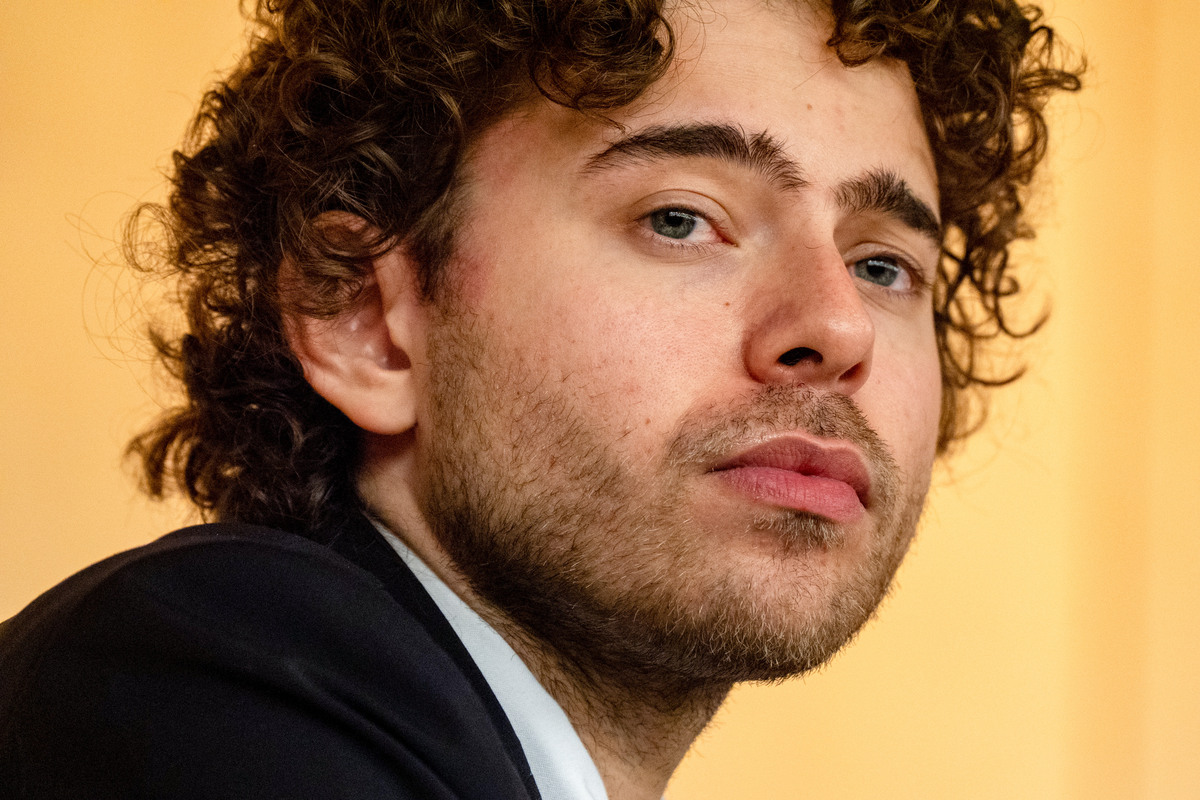
The resolution, sponsored by Sen. Bernie Moreno (center), passed the Senate via unanimous consent.
Chip Somodevilla/Getty Images
Senators and their staff are now banned from trading on prediction markets.
The change came via a unanimous addition to Senate rules on Thursday.
The resolution also urged the House, executive branch, and judicial branch to do the same.
As of Thursday afternoon, senators and their staff can't trade on prediction markets like Kalshi or Polymarket.
The Senate passed a resolution amending Senate rules to forbid members and Senate employees from making prediction market trades via a "voice vote" — meaning no senator objected, and a formal roll call vote was not taken.
The resolution was introduced by Republican Sen. Bernie Moreno of Ohio last week.
"Serving in Congress is an honor, not a side hustle," Moreno wrote on X after the resolution passed. "Americans deserve to know that their leaders are here for the right reason!"
The resolution also urged the House, the executive branch, and the judiciary to enact similar rules.
Kalshi CEO Tarek Mansour applauded the move, noting that his platform already bans members of Congress from trading.
I applaud the Senate for passing this resolution to ban Senators and their offices from trading on prediction markets.
Kalshi already proactively blocks members of congress and enforces against insider trading. This is a great step to increase trust in our markets by making it… https://t.co/fELpqZH5Cf
Polymarket also wrote on X that it's in "full support" of the resolution. Americans are currently forbidden from trading on the company's main international exchange, though many are known to use VPNs to do so anyway.
The resolution's passage comes amid broad public concerns about the risk of insider trading on prediction markets.
Lawmakers have introduced a variety of bills to regulate the industry, including some that also would've banned members of Congress from trading on the platforms.
Some lawmakers in both the House and Senate had also contemplated banning their own staff from prediction market trading without a broader change to Senate rules. Several governors have also signed executive orders banning state employees from trading on prediction markets as well.
Last week, the Department of Justice indicted a US Army soldier for using classified information about the raid to capture Venezuelan Leader Nicolás Maduro to make a lucrative trade on Polymarket.
He pleaded not guilty to the charges earlier this week in federal court, and a judge agreed to a $250,000 bail package that included travel restrictions.
"I don't like it, conceptually, but it is what it is," Trump said.
Will Oliver/EPA/Bloomberg via Getty Images
Trump weighed in on prediction markets — and didn't sound too happy about them.
"The whole world, unfortunately, has become somewhat of a casino," Trump told reporters.
It came after the DOJ indicted a US soldier for profiting off of the Maduro raid via Polymarket.
President Donald Trump sure doesn't sound like a prediction market enthusiast.
Asked on Thursday if he was concerned about the potential for insider trading on prediction markets, Trump told reporters in the Oval Office that he was "never much in favor" of betting in financial markets.
"The whole world, unfortunately, has become somewhat of a casino," Trump said. "I don't like it, conceptually, but it is what it is. No, I think that I'm not happy with any of this."
"They have all these different sites, they have 'predictive markets,'" Trump continued. "It's a crazy world. It's a much different world than it was."
Reporter: There are also bets being placed on the Iran conflict. People suspect there is insider trading happening. Are you concerned?
Trump: Unfortunately, the whole world has become somewhat of a casino. I don't like it conceptually. It is what it is. pic.twitter.com/t1OPOUWHub
Trump's comments came shortly after the Department of Justice indicted a US Army soldier who was involved in the planning of the US capture of Nicolás Maduro. Prosecutors say Gannon Ken Van Dyke used classified information to reap more than $400,000 in profit on Polymarket.
That trade caught the public's attention in early January, leading to the introduction of a raft of bills on Capitol Hill to both rein in the industry and protect against potential insider trading.
On Thursday, Trump said he wasn't aware of the indictment, but joked that the case sounded like when Pete Rose, the former manager of the Cincinnati Reds, was caught betting on his own team.
"Now, if he bet against his team, that would be no good. But he bet on his own team," Trump said.
Reporter: There was a special forces soldier involved in the capture of Maduro who was arrested on suspicion of insider trading. Are you concerned that federal employees are betting on these reduction markets and potentially getting rich?
Trump previously told The Washington Post that prediction markets are better than "fake polls," referencing the fact that both Kalshi and Polymarket gave Trump stronger odds of winning the 2024 election than traditional polling.
"They predicted me pretty right… by a landslide," Trump said at the time.
Trump's lament about prediction markets, which seemed to echo some comments that Democrats have made about the industry's impact on society, contrasts with the way his administration has approached the industry.
Commodity Futures Trading Commission Chair Michael Selig, the top federal regulator of prediction markets, has moved to defend prediction market companies in the midst of legal battles with states over sports and elections betting.
"It's something that I think is valuable to society," Selig said of prediction markets in a February podcast appearance.
The president's son, Donald Trump Jr., is also financially involved in the industry, serving as a strategic advisor to Kalshi while investing in Polymarket.
A Polymarket e a Kalshi começaram a adotar medidas para coibir certos tipos de uso de insider trading – informação privilegiada – à medida que as plataformas de mercados de previsão passam por um escrutínio crescente por suspeitas de manipulação.
A Polymarket atualizou suas regras na segunda-feira para deixar mais claro que determinados tipos de apostas são proibidos: usuários não podem agir com base em informação confidencial obtida de forma ilícita, apostar usando dicas ilegais nem operar se estiverem em posição de influenciar o resultado de um evento.
As mudanças afetam tanto a plataforma offshore da Polymarket — onde ocorre a maior parte das negociações — quanto sua incipiente bolsa regulada nos Estados Unidos. As duas passaram a exibir, também na segunda-feira (23), páginas dedicadas à integridade de mercado, com explicações sobre como as regras funcionam e formas de denunciar atividades suspeitas.
Horas depois, a principal rival da Polymarket, a Kalshi, afirmou em uma postagem no blog da empresa que está adotando medidas adicionais para evitar uso de informação privilegiada em eventos esportivos e políticos. A plataforma agora vai monitorar e bloquear políticos que apostem em suas próprias campanhas e atletas que façam apostas relacionadas aos esportes que praticam.
As duas empresas estão mirando tipos de negociação que, em geral, seriam proibidos em outros mercados regulados. Mas os mercados de previsão se desenvolveram mais rápido do que as regras criadas para regulá-los.
A Commodity Futures Trading Commission (CFTC), órgão que supervisiona os mercados de previsão nos Estados Unidos, publicou no início deste mês sua primeira orientação sobre uso de informação privilegiada em contratos de evento. Até aqui, o regulador vinha adotando uma postura relativamente distante em relação a essa indústria ainda nascente.
A Polymarket vem sendo perseguida por acusações de atividade privilegiada, inclusive em contratos ligados a geopolítica e guerra. Seis contas lucraram cerca de US$ 1 milhão apostando que os Estados Unidos atacariam o Irã até 28 de fevereiro. No ano passado, um reservista militar israelense e um civil foram denunciados por supostamente usar informação operacional sigilosa para apostar em operações de segurança.
Luana Lopes Lara e Tarek Mansour fundadores da Kalshi
O tema passou a chamar atenção em Washington, onde alguns parlamentares manifestaram preocupação com a possibilidade de autoridades públicas negociarem com base em informações obtidas no exercício do cargo. Democratas como o senador Richard Blumenthal e o deputado Ritchie Torres apresentaram projetos de lei concorrentes para proibir apostadores de participar de mercados em que tenham conflito de interesse.
Enquanto isso, usuários continuam monitorando os mercados de previsão em busca de possíveis sinais de informação privilegiada. No fim de semana, várias contas da Polymarket apostaram dezenas de milhares de dólares em um possível cessar-fogo entre Estados Unidos e Irã antes de meados de abril, despertando suspeitas entre observadores.
Segundo as regras atualizadas da Polymarket, os usuários não podem usar informações para apostar quando isso “violar um dever ou obrigação pré-existente de confiança ou confidencialidade em relação a outra pessoa ou entidade”. A empresa também acrescentou que os apostadores estão proibidos de usar informações de segunda mão vindas de alguém que, ele próprio, esteja impedido de operar com base nelas.
Em outros mercados de derivativos, operadores podem agir com base em informações obtidas de forma lícita sobre estratégia ou posição de empresas.
“Mercados prosperam com clareza”, disse em nota Neal Kumar, diretor jurídico da Polymarket. “Esses aprimoramentos nas regras deixam nossas expectativas abundantemente claras para todos os participantes nas duas plataformas e destacam a estrutura de compliance que já construímos.”
Alguns defensores dos mercados de previsão, entre eles Brian Armstrong, CEO da Coinbase, argumentam que o uso de informação privilegiada pode ter utilidade social, porque traz a público informações ocultas e melhora as previsões para todos os demais. Mas essa visão não é consensual nem mesmo dentro do setor.
A Kalshi tem sido mais proativa no enfrentamento do problema. No mês passado, a empresa multou e baniu um editor ligado ao MrBeast, que supostamente havia apostado sobre o que aconteceria nos vídeos do popular youtuber. O CEO da Kalshi, Tarek Mansour, já afirmou que o uso de informação privilegiada prejudica a capacidade da plataforma de garantir condições equitativas de disputa.
Shayne Coplan, fundador e diretor-executivo da Polymarket, durante uma mesa-redonda conjunta da SEC e CFTC na sede da SEC em Washington. Fotógrafo: Kent Nishimura/Bloomberg
As novas medidas se somam às políticas que a empresa já mantinha em vigor, proibindo o uso de informação privilegiada em todos os eventos, como exigem as diretrizes da CFTC. Antes, a operadora da bolsa investigava potenciais maus atores depois que as apostas já haviam sido feitas, em vez de bloqueá-los previamente.
A Kalshi disse que está trabalhando com a empresa de compliance IC360 para identificar e barrar “maus atores” e que também permitirá aos participantes do mercado sinalizar possíveis violações com base em dados públicos de negociação.
From banning lawmakers from using Polymarket and Kalshi, to getting rid of sports trades, to everything in between, lawmakers have a variety of proposals for prediction markets.
J. David Ake/Getty Images
Prediction markets like Kalshi and Polymarket are exploding in popularity.
Congress has been catching up, and there are now several bills related to prediction markets.
Here are the ones to keep an eye on.
Prediction markets are on the rise, and ideas have begun flying on Capitol Hill about all the ways to contain them.
None of these bills are close to becoming law. Congress is still catching up when it comes to prediction markets, and the Trump administration has taken a friendly regulatory approach toward the industry.
But they're worth keeping an eye on, especially as more Americans learn about prediction markets and as scrutiny over suspicious trades tied to war increases.
Banning insider trading by government officials
Rep. Ritchie Torres of New York
Tom Williams/CQ Roll Call via Getty Images
It's a fairly simple idea: ban insider trading by government officials.
The New York Democrat introduced the bill in January after an anonymous Polymarket user made a suspicious and well-timed trade on the political future of Nicolás Maduro in the hours before the Venezuelan leader's capture by US forces.
Torres's bill would ban federal elected officials, political appointees, executive branch staffers, and congressional staff from betting on outcomes when they have nonpublic information related to the transaction, or might be able to obtain it via their official duties.
Torres previously told Business Insider that he sees his bill "not as a ceiling, but as a floor" for prediction market regulation.
Kalshi has expressed support for Torres's bill and emphasized that its rules already forbid insider trading.
Keeping politicians off of prediction market platforms
Sens. Jeff Merkley and Amy Klobuchar
Nathan Posner/Anadolu via Getty Images; Anna Moneymaker/Getty Images
What if we banned the president, the vice president, and members of Congress from trading on prediction market platforms altogether?
That's what the "End Prediction Market Corruption Act," introduced by Democratic Sens. Jeff Merkley of Oregon and Amy Klobuchar of Minnesota, would do.
"When public officials use non-public information to win a bet, you have the perfect recipe to undermine the public's belief that government officials are working for the public good, not for their own personal profits," Merkely said in a statement at the time.
The bill would also prevent senior executive branch officials from trading on outcomes they're involved in or have influence over through their official duties.
In an appearance on Stripe's "Cheeky Pint" podcast, Kalshi CEO Tarek Mansour said it was "not a bad idea" to ban members of Congress from trading on Kalshi altogether.
Banning bets on government actions — and the Oscars
Sen. Chris Murphy and Rep. Greg Casar
Tom Williams/CQ-Roll Call, Inc via Getty Images; Aaron Schwartz/Getty Images
The bill would ban prediction market trading on non-financial government actions, terrorism, assassination, war, and any event where individuals know or can control the outcome.
That means not just a ban on war betting, but no more betting on the Oscars or the Super Bowl halftime show.
"When people get on their phone and see these prediction markets, they expect that there are rules to make sure the game isn't rigged against them," Casar said. "I think that voters would clearly stand with us, saying we want to make sure that you aren't betting on a rigged poker game."
Enacting comprehensive regulation of prediction markets
Sen. Richard Blumenthal of Connecticut
Tom Williams/CQ-Roll Call via Getty Images
Connecticut's other senator, Democrat Richard Blumenthal, introduced a bill that includes a comprehensive set of consumer protection measures for prediction markets.
The "Prediction Markets Security and Integrity Act," introduced in March, includes an explicit ban on insider trading, age verification to prevent people under 21 from using the platforms, and restricting the use of AI to target gamblers.
The bill would also reverse the Trump administration's move to assert jurisdiction over prediction markets, opening up the platforms to state laws.
Stopping sports betting on prediction markets
Rep. Dina Titus of Nevada
Bill Clark/CQ-Roll Call via Getty Images
There's an ongoing legal battle between states and prediction markets over sports.
States with their own sports betting revenue streams tend to view sports trades on prediction markets as a form of unregulated sports betting, and some have sued.
The Trump administration has sided with prediction market companies, but it's likely to be settled by the Supreme Court eventually.
Rep. Dina Titus, a Nevada Democrat, introduced a bill that would intervene in that legal fight by banning sports trades and "casino-style games" from prediction markets altogether.
Banning trading on terrorism, assassination, and war
Reps. Blake Moore and Salud Carbajal
Tom Williams and Bill Clark/CQ-Roll Call via Getty Images
There's just one prediction market bill on Capitol Hill that's been sponsored by a Republican: the "Event Contract Enforcement Act."
Introduced by Republican Rep. Blake Moore of Utah and Democratic Rep. Salud Carbajal of California in March, the bill would simply strengthen existing laws around prediction markets.
Specifically, it would ban trading on terrorism, assassination, war, sports or athletic competitions, and any illegal activities.
Moore said in a statement at the time that he introduced the bill in part to ensure that prediction markets "can continue to serve legitimate business interests while protecting Americans from risk."
Kalshi's cofounders said their platform was designed to help random people flourish.
They said their best market makers "may not actually be the experts or the authority figures."
One of their favorites is an "Ariana Grande superfan" who knows a lot about music charts.
The brains behind Kalshi say some of their best prediction market makers are "actually random people."
"The foundational principles around prediction markets, is like a lot of these markets, the people that will price them the best may not actually be the experts or the authority figures that you usually would think about," Kalshi CEO Tarek Mansour told Stripe cofounder John Collison during a recent episode of Collison's "Cheeky Pint" podcast.
Mansour said there's no single demographic for these "super forecasters," who comprise some of the prediction market giant's most important users. Out of the group, Mansour and cofounder Luana Lopes Lara have some favorites — including "a guy from Kansas."
"The best inflation forecaster on Kalshi over the last few years is not— none of the institutions or the big-name hedge funds," Mansour said. "It's this guy who lives in Kansas, never traded financial markets before, just likes to read the news, and just knows how to predict inflation. He can feel it."
Lopes Lara said his favorite user is an "Ariana Grande superfan."
"He found Kalshi during the election season, and he's like, 'I don't like the elections, whatever.' Then he found our Billboard ranking markets of like charts," she said.
The user, Lopes Lara said, has made over $150,000.
"He paid back student loans. He put himself through a master's degree, bought a car, and all those things," she said. 'And he just like loves these markets. And he's never really traded, never done anything like that before. But it's the first time that he actually has a way to monetize this very compulsive hobby that he had on music charts."
Mansour also shouted out Alan Cole, a 37-year-old economist in DC, who told The Wall Street Journal that he wagered his life savings against DOGE by betting on a Kalshi prediction market on whether federal spending would increase. (Mansour did not mention Cole by name, but the economist's story has been publicly reported.)
"Now you have a market that if you have that sort of knowledge, which maybe oftentimes is esoteric, like I'm assuming none of us have read all these tax codes, you can actually go out in the world, do research, get smarter about the world, and then get rewarded for that," Mansour said.
Kalshi has exploded in popularity since the 2024 election, when it successfully sued the US government to allow users to bet on the outcome of US elections, something that had previously been allowed only overseas.
The Trump administration has said it will ease up on prediction markets. Michael Selig, chair of the Commodity Futures Exchange Commission, has threatened to fight with state regulators who say they have the power to regulate sites like Kalshi or its rival Polymarket.
Congressional lawmakers are also looking to rein in prediction markets after high-profile news of potential insider trading as well as bets on events like the war in Iran. Kalshi has stressed that it has policies against insider trading and doesn't allow trades on war or death.
That's not quite as good as Polymarket's record with the Golden Globes in January — traders correctly predicted 26 out of 28 winners that night — but it nonetheless demonstrates the markets' ability to channel the wisdom of the crowds, at least most of the time.
And even the stars themselves are getting in on the action: Kevin O'Leary, the "Shark Tank" star who played a supporting role in "Marty Supreme," said he bet $1,000 on Kalshi that his costar Timothée Chalamet would win the Oscar for best actor.
He ended up being wrong: Michael B. Jordan of "Sinners" won, as both Kalshi and Polymarket predicted. But if Chalamet had won, O'Leary would have made a significant profit.
Prediction markets correctly identified the winner in all of the major categories, including best picture, best director, best actor, best actress, and best screenplay.
But in the following five categories, the winning film was not favored by prediction markets.
Best cinematography: "One Battle After Another" was the overwhelming favorite to win, with odds well over 75% on both Kalshi and Polymarket in the days leading up to the awards show. But the Oscar ultimately went to Autumn Durald Arkapaw from "Sinners."
Best animated short film: "Butterfly" was the favorite to win, with chances in the 50s and 60s in the days before the show. "The Girl Who Cried Pearls" got the Oscar.
Best live action short film: "Two People Exchanging Saliva" was favored to win on both platforms, though not by much. But it ultimately ended up being a tie, with both that film and "The Singers" winning an Oscar.
It was only the seventh tie in the history of the Oscars, and the first in over a decade. Kalshi allowed traders to choose "Tie" as an option, though the market only gave it a 2% chance of happening.
On Polymarket, the rules stipulated that in the event of a tie, the film whose "listed name comes first in alphabetical order" would be treated as the winner, meaning those who bet on "The Singers" received payouts.
Best documentary feature film: At 66% on both prediction markets, "The Perfect Neighbor" was the favorite. "Mr. Nobody Against Putin" ended up winning the Oscar.
Best casting: "One Battle After Another" won, despite the prediction markets putting the odds of a "Sinners" victory in the high 70s.
The Oscars, hosted this year by Conan O'Brien, will air on Sunday on ABC and Hulu.
And if bettors on Kalshi and Polymarket have it right, "One Battle After Another" will take home six Oscars, while "Sinners" will win four awards, and "Frankenstein" will walk away with three.
Where the odds stand for each category
Leonardo DiCaprio in "One Battle After Another."
Warner Bros.
Best Picture — "One Battle After Another"
Paul Thomas Anderson's "One Battle After Another" is the odds-on favorite to win best picture, standing at around 80% among Polymarket and 78% on Kalshi.
The next most likely winner is Ryan Coogler's "Sinners," which each platform gives a less than 20% chance.
Bettors have wagered more than $44 million on the Best Picture winner across the two platforms, the most of any category.
Best Director — Paul Thomas Anderson
The director of "One Battle After Another" is seen as the overwhelming favorite to win best director, with Kalshi and Polymarket pegging his chances of winning in the low 90s.
Best Actor — Michael B. Jordan
Michael B. Jordan, the lead actor on "Sinners," has an almost 60% chance of winning, according to both Kalshi and Polymarket.
That's a significant change from January, when Timothée Chalamet — the lead actor in "Marty Supreme" — was seen as the leading contender, with odds in the mid-70s at the time.
The change came after Jordan won "Outstanding Male Actor in a Leading Role" at the Actor Awards on March 1.
Chalamet's chances now sit in the low-to-high 30s on both platforms.
Best Actress — Jessie Buckley
According to bettors, Buckley — the lead actress in "Hamnet" — is likely to win best actress, garnering about 97% on both prediction market platforms.
Best Cinematography — "One Battle After Another"
"One Battle After Another" is seen as the overwhelming favorite to win best cinematography, with bettors on both Kalshi and Polymarket giving the movie roughly 76% chance of winning.
That's a change from January, when both platforms had "Sinners" with a 66% chance of winning at one point.
Best Production Design — "Frankenstein"
At over 90%, bettors on both prediction market platforms give "Frankenstein" an overwhelming chance of winning the award for best production design.
Best Adapted Screenplay — "One Battle After Another"
In addition to best picture and best cinematography, "One Battle After Another" is seen as overwhelmingly likely to win best adapted screenplay.
The movie now has a 96% chance of winning on both platforms.
Damson Idris as Joshua Pearce and Brad Pitt as Sonny Hayes in Apple Original Films' "F1 The Movie," premiering December 12, 2025 on Apple TV.
Apple
Best Sound — "F1"
Apple's sports drama film F1 is the overwhelming favorite to win best sound, according to bettors.
Both platforms give the movie a roughly 80% chance of winning.
Best Animated Short Film — "Butterfly"
Bettors are less certain who will win the award for best animated short film.
"Butterfly," a 15-minute film by director Florence Miailhe, has a 61% chance on both platforms.
But not far behind is "The Girl Who Cried Pearls," a 17-minute short film, which bettors give between a 21% and 22% chance of winning.
Best Live Action Short Film — "Two People Exchanging Saliva"
The French-language short film "Two People Exchanging Saliva" leads among bettors with about a 46% chance of winning on both Kalshi and Polymarket.
Another major contender is "The Singers," a musical short comedy film that has 29% chance on Kalshi and a 30% chance on Polymarket.
Additionally, "A Friend of Dorothy," a British short comedy drama film, has a 22% chance on Kalshi and a 21% on Polymarket.
Best Film Editing — "One Battle After Another"
The film leads the odds for best film editing winner, with an 84% chance on both platforms.
"Sinners" is leading in multiple categories, according to prediction markets.
Eli Adé
Best Original Score — "Sinners"
"Sinners" is the overwhelming favorite to win best original score, with bettors on both Kalshi and Polymarket giving the film a 94% chance of winning.
Best Original Song — "Golden"
"Golden," the viral hit from the film "KPop Demon Hunters," is the odds-on favorite to win best original song, with bettors on both platforms giving the song a 85% chance.
Best Supporting Actor — Sean Penn
Sean Penn, who plays Col. Steven J. Lockjaw in "One Battle After Another," is the favorite to win best supporting actor, with an over 70% chance on both Kalshi and Polymarket.
That's a dramatic change from January, when Stellan Skarsgård — who plays an estranged father in the Norwegian drama film "Sentimental Value" — had the highest odds, at roughly 64% chance on both platforms.
Best Supporting Actress — Amy Madigan
Amy Madigan, who portrays Aunt Gladys in the horror film "Weapons," is now the favorite to win best supporting actress on both platforms, hovering around 55%.
That's a change from January, when Teyana Taylor — who portrays Perfidia Beverly Hills in "One Battle After Another" — was the overwhelming favorite to win best supporting actress, sporting 75% on both platforms.
James Cameron's "Avatar: Fire and Ash" holds a commanding lead for the Best Visual Effects Oscar on prediction markets.
Disney/20th Century Studios
Best Visual Effects — "Avatar: Fire and Ash"
Bettors believe that James Cameron's "Avatar: Fire and Ash," the third installment in the "Avatar" series, is almost certain to win the award for best visual effects.
The movie's chances of winning stand at 94% on both Kalshi and Polymarket.
Best Original Screenplay — "Sinners"
"Sinners" is the overwhelming favorite to win best original screenplay, with roughly 95% odds on both Kalshi and Polymarket.
Best Documentary Short Film — "All the Empty Rooms"
Bettors on both Kalshi and Polymarket give "All the Empty Rooms" a roughly 70% chance of winning the award for best documentary short film.
The movie follows a journalist and photographer as they memorialize the empty bedrooms of school shooting victims.
Best Documentary Feature Film — "The Perfect Neighbor"
"The Perfect Neighbor," a documentary about Florida's "Stand Your Ground" laws, is the odds-on favorite to win best documentary feature film, with bettors on both platforms giving the film a roughly 66% chance.
Best International Feature Film — "Sentimental Value"
"Sentimental Value" is the favorite to win best international feature film, with bettors on Kalshi and Polymarket giving the film 67%-68% odds of winning.
Oscar Isaac stars as Victor Frankenstein in Guillermo Del Toro's "Frankenstein."
Netflix
Best Costume Design — "Frankenstein"
"Frankenstein" is the overwhelming favorite to win best custom design, sporting roughly 90% on both platforms.
Best Makeup and Hairstyling — "Frankenstein"
Similarly, "Frankenstein" is seen as a lock for best makeup and hairstyling, sporting probabilities in the low 90s on Kalshi and Polymarket.
Best Animated Feature Film — "KPop Demon Hunters"
"KPop Demon Hunters" is the prohibitive favorite to win best animated feature film, with a roughly 94% chance on both prediction markets.
Best Casting — "Sinners"
"Sinners" is seen as most likely to win best casting, with Kalshi and Polymarket bettors giving the film a 77%-78% chance of winning.

 Entrar