Visualização de leitura

Goldman says the US could lose 10,000 jobs a month this year as the oil shock ripples through the economy

People walking in front of the New York Stock Exchange

Spencer Platt/Getty Images

  • The effects of higher oil prices could cut slash 10,000 jobs a month, Goldman Sachs says.
  • The bank said it expects the unemployment rate to rise to 4.6% by the end of the year.
  • Higher oil prices can raise inflation and hurt consumer spending, which could worsen the hiring slowdown.

The oil price shock could cost the US economy thousands of jobs a month, according to a new analysis from Goldman Sachs.

In a note to clients on Thursday, a team of economists at the bank said they anticipate higher unemployment and slower job growth through the end of the year as the impact of higher oil prices ripples across the US economy. In the bank's baseline scenario, the oil price shock could shave off around 10,000 new jobs a month through the end of the year, even after accounting for expected job gains in the energy sector.

While higher oil prices have historically led to new jobs in the energy sector, those gains could be more muted this time around, given how the oil extraction business has become more efficient in recent years, Goldman said.

The bank also said it expects the unemployment rate to tick higher to 4.6% by the end of the third quarter. The unemployment rate rose unexpectedly to 4.4% in February, while the economy lost 92,000 jobs, according to the latest nonfarm payrolls report.

"The upward pressure on unemployment primarily reflects lower hiring, with a smaller contribution from higher layoffs, in industries most exposed to weaker consumer spending," the economists wrote.

Markets have been anxious about how much damage the Iran war could cause to the US economy. Higher oil prices could push up the prices of other goods and raise inflation — but the fallout could extend much further, given that consumers are likely to pull back spending in other areas, hurting growth and potentially causing hiring to slow.

Goldman said it expected the hiring slowdown to be the most pronounced in leisure and hospitality. In the bank's baseline scenario, the sector could lose around 5,000 jobs a month through the end of the fourth quarter.

Retail trade, manufacturing, and education and health services were also among the bank's most affected sectors.

The risks stemming from higher crude prices are coming at a time when the labor market has already been steadily cooling, with hiring slowing for most of the past year while job cuts have crept higher. After accounting for downward revisions, the US added 181,000 jobs last year, down from the 1.4 million added the year prior, according to the Labor Department.

Read the original article on Business Insider

  •  

I've upgraded to concierge level on 4 Disney cruises. It's really only worth it for one perk.

Author Jill Robbins and her husband smiling at a beach in the bahamas
After many Disney cruises, there's just one concierge perk that really stands out to me.

Jill Robbins

  • I've been on many Disney cruises and have upgraded to its concierge class four times.
  • It's pricey, but it comes with complimentary bites and drinks, a spacious room, and other benefits.
  • To me, the most valuable perk is priority access for booking cabanas on Disney's private islands.

I've been on about 15 Disney cruises. Of those sailings, I've booked concierge four times.

It's the most luxurious tier available and is substantially more expensive than other staterooms. Prices vary, but in general, I've found concierge staterooms are about double the price of a deluxe verandah (balcony) stateroom.

For example, on a recent five-night sailing aboard the Disney Dream, we spent $10,000 on a one-bedroom concierge stateroom for our family of four. A deluxe verandah room would've been about $5,000.

With that in mind, I'm often asked if concierge is worth the splurge. Personally, there's just one benefit that makes it feel worth it for my family.

Concierge comes with many perks, but they don't necessarily make up for the high price tag

Author and her family on Disney Dream cruise
Our family has sailed in concierge with Disney a few times.

Jill Robbins

In addition to priority boarding and larger, upgraded rooms, concierge passengers have access to exclusive lounge areas and a private sun deck on their ship.

They can order complimentary alcohol and specialty drinks at the embarkation-day lunch and during the nightly happy hour in said lounge.

Plus, they receive free popcorn and bottled sodas for the on-board theater shows, complimentary mini-bar items in their room, and a more robust, high-end selection of bathroom amenities.

The rooms are really nice, but we typically don't spend much time in them since there's so much to do on and off the ship. And, if you add up every drink and bucket of popcorn, the difference between a verandah and a concierge stateroom still doesn't come close to evening out.

However, what really makes concierge special is the white-glove attentive service and front-of-the-line access for everything.

That's where my favorite perk comes in: priority access to the elusive beach cabanas on Disney's private islands.

For me, priority cabana access is the only reason to book concierge

Row of cabanas at Lighthoues Point
A row of cabanas at Lookout Cay at Lighthouse Point.

Jill Robbins

Many Disney cruises stop at at least one of its private island destinations in the Bahamas: Castaway Cay and Lookout Cay at Lighthouse Point.

Each location has around two dozen cabanas available for rent, and they're really exclusive since Disney ships have thousands of passengers.

This scarcity is why concierge status can make all the difference. They get first crack at booking all activities and experiences, including cabanas.

Cabana at Lighthouse point
The cabanas offer a lot of privacy and great beach views.

Jill Robbins

In my experience, the cabanas go fast and can fill up before the booking window even opens to all guests, including those at the highest Disney Cruise Line loyalty tier who are in line after concierge.

I've found it's rare for a non-concierge guest to get a cabana unless they're on the waitlist and get lucky with a last-minute cancellation.

On top of that, concierge guests don't have to compete in the "log in at midnight when your booking window opens" game to get the amenities they want.

Instead, they have a dedicated email they can use to communicate their wishes, and a concierge handles it for them.

On our first concierge sailing, we requested a cabana and it was reserved for us well before our departure. On the second, we got wait-listed, then were notified that we'd gotten a cabana while aboard the ship.

a disney cabana at castaway cay
Typically, the cabanas have lots of space and seating options.

Jill Robbins

To be clear, these cabanas are not free or discounted for concierge passengers. We've paid between $700 to $900 a day for ones that fit up to six guests.

They're more than just a place for privacy and shade, though: The elevated spaces have dedicated hosts, lots of seating, and complimentary non-alcoholic drinks and snacks.

On Castaway Cay, the cabanas include access to snorkel gear, beach floats, and one-hour bike rentals, which would normally all cost extra.

No matter what you spend, good weather is never gaurunteed. On one trip, I was disappointed when one of our cabana beach days was cut short by a storm — mostly because I didn't feel we got our money's worth.

However, our host was quick to bring rain ponchos, and our kids thought our private golf-cart ride back to the ship was the best part of the day.

Concierge may not be a great value for everyone, but for travelers like me, it's a worthy splurge

Author Jill Robbins posing with cabins at Castaway Cay
Concierge passengers get priority access to booking many things, including cabanas.

Jill Robbins

Paying double for a cruise to be able to spend an extra almost-thousand dollars on a beach day is certainly not worth it for everyone.

I could see concierge being a great splurge for fellow Disney cruisers chasing privacy and front-of-the-line access. After all, if you're not in concierge, it's almost impossible to secure a cabana.

Ultimately, the value of this upgrade depends on which perks you plan to use and how important they are to your group. (And whether or not your ship is stopping at one of Disney's private islands.)

Sailing concierge really does feel luxurious and occasionally upgrading so we can score a precious cabana has been worth it.

However, my family's also been perfectly happy in the interior staterooms on a Disney cruise.

Read the original article on Business Insider
  •  

This 16-year-old refused a $300,000 offer to drop out of high school and now runs his own AI company

Rudrojas Kunvar
Rudrojas Kunvar built Evion, an AI farm tool, while in high school.

Rudrojas Kunvar

  • Rudrojas Kunvar, 16, built Evion, an AI tool that helps farmers analyze crop health.
  • The tool collects aerial crop data from drone-captured images.
  • Kunvar created Evion to make that data more accessible to small and midsize farms.

While meeting with a venture capitalist last year, 16-year-old Rudrojas Kunvar received an offer that would excite even the most nonchalant teens: accept $300,000 to drop out of high school and run his AI startup full-time.

"It was definitely a rough couple of weeks of contemplating," Kunvar, who lives in Germantown, Maryland, told Business Insider. "That's a lot of money."

Kunvar had spent the summer before building Evion, a free AI crop-analysis tool that uses images taken by basic camera drones that farmers can purchase themselves.

The AI model analyzes images and generates a crop health map that farmers can integrate into their existing platforms or access via a dashboard. Green means healthy, while red means unhealthy.

Evion
Evion is an AI crop analysis tool.

Evion

"Farmers can use that to predict the future of their crops," Kunvar said. "You can see what areas need more water or fertilizer, rather than just spraying everywhere."

Like construction and defense, drones are reshaping America's agriculture industry. There were about 5,500 agricultural drones registered with the Federal Aviation Administration in 2025, up from about 1,000 in 2024, according to Michigan State University researchers.

Kunvar said Evion can help farmers save money because the targeted data can eliminate crop health uncertainty, meaning they'll be less likely to waste water or fertilizer.

Kunvar says Evion is positioned as an alternative to companies that market pricey agricultural drone products or services. Instead, farmers can buy cheap camera drones, take their own photos, and upload the information themselves.

"It's meant to be a more affordable plan for these low to mid-scale farms," Kunvar.

After building Evion, Kunvar partnered with Jacob Lee, who has experience creating tech tools, to expand its reach. Kunvar launched the initial pilot in the fall.

Ultimately, Kunvar declined the $300,000 drop-out offer, saying he wanted to ensure his product remained accessible and didn't get wrapped up in chasing profits.

It all started with a question

The idea behind Evion came during Kunvar's sophomore year at Poolesville High School in Montgomery County while attending a community festival. One-third of Montgomery County is designated as an Agricultural Reserve, or protected local land meant to preserve rural space.

"I asked a farmer about how they're able to tell when a disease is coming or what slight discoloration means," Kunvar said. "Essentially, he said he's guessing. I spoke to a few other farmers, and I realized there was a common thread among all of their responses."

Kunvar, who said he's had a lifelong love for technology, was surprised.

"We've had a lot of AI advancements in various verticals and various industries," he said. "Why isn't there much happening for agriculture?"

Initially, Kunvar wanted to make his own fleet of fully autonomous drones that could capture the data, but went a different direction after talking with mentors and crunching the numbers. Instead, he studied drones and pinpointed what's driving their cost: the multispectral camera.

"The camera was the leading cost. I wondered, 'What if there's a way to get similar data without needing this camera? What if I could use a simple camera?'" Kunvar said.

He pointed toward Tesla and its autonomous vehicles as proof it work. Unlike Waymo and other companies that use lidar, Tesla relies on cameras.

After setting up the logistics and AI model, the founders sought clients by sending cold emails and LinkedIn messages. They found better luck, however, partnering with agriculture-oriented nonprofits and organizations to reach farmers.

Now, the technology is helping farmers in North America, Southeast Asia, and India.

As for his future plans, Kunvar wants to continue growing Evion while exploring opportunities in different fields, including AI infrastructure.

"There's so much ambiguity in entrepreneurship, especially in startups, but I've learned there's beauty in ambiguity," Kunvar said. "There's been times where nothing's working out, and then you have the tiniest win, and it's like, 'wow, maybe I can do this.'"

Read the original article on Business Insider

  •  

Conflito de interesses impulsiona migração da assessoria para consultoria. O fee fixo é para todo mundo?

Até poucos anos, o assunto consultoria de investimentos vinha sempre acompanhado do questionamento se o investidor brasileiro estaria disposto a pagar pelo serviço com uma taxa fixa. Não é que antes o atendimento fosse gratuito, mas predomina no mercado o modelo de assessoria, em que a remuneração do especialista ocorre via comissionamento da venda de produtos e nem sempre fica clara para o cliente.

Mas hoje aquela dúvida sobre a viabilidade do modelo consultivo parece superada. O investidor amadureceu – por vontade ou por consequência dos episódios de conflitos de interesses, em que acabou empurrado para um investimento desencaixado de seu perfil de risco por um assessor incentivado pela comissão oferecida pelas distribuidoras. A norma CVM 179, que desde novembro de 2024 dá transparência a essas taxas, também acelerou o processo.

O mercado percebeu isso. O cliente estaria disposto a pagar uma taxa fixa pelo atendimento, o chamado fee-based ou fee fixo, desde que enxergasse valor no serviço.

Publicidade

Com a bandeira de atender melhor o investidor, casas que surgiram e cresceram como assessoria deram início a uma transição nos seus modelos. Primeiro, passaram a oferecer o serviço via taxas fixas. Depois, principalmente em 2025, foi a consultoria de investimentos que ganhou destaque.

“Está acontecendo uma migração para o modelo híbrido no que tange a cobrança, com grandes players, inclusive os bancos, oferecendo as duas opções. É o que deve ficar na estrutura do Brasil, semelhante ao que é nos Estados Unidos“, diz Cassio Bariani, sócio fundador da SmartBrain.

Com base nos seus dados internos, a SmartBrain estima que 20% das assessorias já tenham migrado para a consultoria ou para o modelo híbrido. O número de consultores certificados pela Comissão de Valores Mobiliários (CVM) teve uma alta de magnitude semelhante, enquanto o número de agentes autônomos se manteve igual.

Publicidade

Outro sinal de que esse mercado está aquecido e ganhando cada vez mais concorrência vem da evolução do fee por AuM (ativos sob gestão), a taxa cobrada pelo serviço com base no patrimônio do cliente. A média praticada pela indústria nacional era de 0,78% no início de 2025. Neste início de 2026, já caiu para 0,62%, indicam os dados da plataforma.

Mercado em transição

O fee-based não é uma novidade. É o principal modelo de remuneração dos profissionais há anos nos mercados desenvolvidos e já é bastante popular no Brasil no atendimento às famílias ricas nos multi family offices. Mas foi só recentemente que os players de varejo passaram a olhar para isso, com negócios que já estão nascendo 100% no modelo consultivo e um redirecionamento nas corretoras tradicionais.

A XP, pioneira na assessoria de investimentos, fez esse movimento com maior foco no ano passado, quando reduziu a aplicação mínima para acessar a consultoria para R$ 1 milhão. Nesse modelo, especialmente no atendimento a clientes de patrimônio elevado, os players oferecem serviços que vão além dos investimentos, como planejamento sucessório e tributário, offshores e outros.

A corretora já oferecia a opção do fee-based desde 2020, mas não via demanda para focar os esforços no modelo consultivo. “Há dez anos, talvez fosse improvável falar sobre planejamento tributário, sucessão, investimentos no exterior. Agora a demanda pelos serviços de assessoria está mais sofisticada, principalmente entre os investidores de maior faixa de renda“, explica Bruno Ballista, sócio e head de segmentos de clientes da XP.

A XP quer ser líder no mercado de investimentos nacional até 2032 e, por ser a pioneira na disrupção das plataformas abertas, não quer ficar de fora da onda das consultorias. Mas não acha que o novo direcionamento tenha a ver diretamente com conflito de interesses, presentes em qualquer modelo ou indústria.

“Acreditamos que a ausência de conflito é a opcionalidade, ter múltiplas alternativas para o cliente escolher aquilo que o deixa mais confortável. Somos absolutamente agnósticos em relação ao modelo“, afirma Ballista.

Publicidade

O fee-based já corresponde a 23% do AuC (ativos sob custódia) de varejo na plataforma.

Na Monte Bravo, a quarta maior assessoria do Brasil, a bandeira do fee fixo veio pelo lado dos profissionais. O CEO Filipe Portella acredita que o momento de mercado do Brasil tem muitas semelhanças ao que, anos atrás, impulsionou a migração para o fee-based nos EUA. O desgaste dos assessores quando o mercado tem menos liquidez, como nos últimos anos, deixa os problemas da assessoria via comissões mais evidentes.

As carteiras ficam com pouco risco, é difícil rentabilizar, o profissional se vê pressionado para vender produtos com rebates mais altos para garantir seu salário no fim do mês e acaba cada vez mais distante do propósito do trabalho.

“Muito tem se falado sobre ser para todo mundo, se é barato ou caro, mas o ponto não é esse. É o alinhamento real de interesses entre o profissional e o cliente”, diz Portella.

Já estão sob o fee-based 42% dos ativos sob custódia da corretora e a empresa está apostando na expansão do segmento para que ele corresponda a 80% do todo em alguns anos. Para isso, reestruturou todo o ecossistema, centralizando a inteligência de alocação de ativos e dando prioridade a produtos de investimento mais alinhados ao modelo para que os profissionais tenham mais tempo para focar no relacionamento. E anunciou um investimento de R$ 300 milhões para formar e treinar os assessores para essa transformação.

Na visão da Monte Bravo, a disrupção de plataformas abertas que aconteceu entre 2014 e 2018 se deu muito por conta dos profissionais. Agora, a popularização do fee fixo também será. “Não é uma mudança reativa, estamos reestruturando tudo para daqui a três anos sermos a principal casa fee-based para o assessor trabalhar”, afirma o CEO.

Quem também promoveu uma reestruturação interna nesta direção foi a Suno. A empresa surgiu em 2017 inicialmente como uma casa de análise, mas foi expandindo os ecossistemas até abarcar assessoria, consultoria e wealth management (gestão de fortunas). Em fevereiro, unificou tudo no modelo consultivo a taxas fixas.

Publicidade

A demanda veio dentro de casa. Já há algum tempo, os novos clientes da assessoria Suno já entravam com a cobrança no fee fixo, conta o CEO Gian Kojikovski. “Sempre fomos uma empresa de inteligência, de produto, que inclusive comprou muitas brigas com outras assessorias falando sobre conflito de interesses”, diz. “Unificamos como consultoria, porque entendemos que é o modelo que melhor atende o nosso cliente.” Veja detalhes da nova operação da Suno aqui.

Os desafios (e as críticas)

Número de consultorias de investimento cresce; e veio para ficar, dizem especialistas.

Os negócios que levantaram a bandeira do fee fixo lá atrás agora veem seu modelo ser chancelado com a chegada da concorrência. Mas têm algumas críticas pela forma que essa transição está acontecendo.

Renato Breia, sócio-fundador da Nord Investimentos e responsável pela Nord Wealth, uma das primeiras consultorias para investidores de alta renda, vê a mudança de posicionamento do mercado como o resultado de uma combinação de fatores. O exemplo dos países desenvolvidos, os avanços na regulação, além das polêmicas recentes – como COEs de Ambipar, CDBs do Master e do Will Bank, que deixaram os investidores machucados.

Mas é também uma reação das empresas aos resgates sofridos nos últimos anos, diz. “As casas começaram a ver que estavam perdendo clientes para o modelo. Muita gente montou suas consultorias por isso”, diz Breia.

Há ainda uma outra questão. O timing da migração dos clientes do regime de comissão para o consultivo acontece em um momento em que as carteiras de investimento estão muito concentradas na renda fixa e em ativos bancários.

Na assessoria tradicional, o profissional ganha dinheiro quando um cliente compra um ativo, a chamada comissão “na cabeça”, e quando ele roda a carteira; por exemplo, se convence o investidor a fazer um resgate antecipado de um título, trocar uma posição por outra. Mas, com os juros em dois dígitos, boa parte dos investidores está levando as aplicações até o vencimento.

Publicidade

A receita dos negócios caiu e migrar essa base para o fee fixo seria uma forma de garantir um rendimento mais previsível mesmo nesse novo cenário. Mas também acabaria onerando o cliente duas vezes pelo mesmo produto.

“Não dá para acreditar que os grandes bancos e corretoras que rodam o modelo comissionado há 30 anos estão fazendo essa transição por uma motivação que não seja financeira. Eles enxergaram no modelo de taxa fixa uma alternativa de recuperar a receita, não um modelo mais alinhado para o cliente”, diz Lucas Taxweiler, assessor CFP na Warren, uma das assessorias pioneiras no fee-based no Brasil.

Para os executivos, esse é um desafio para a nova fase do mercado financeiro brasileiro: provar o valor do modelo consultivo e de taxas fixas para o cliente final. Se as empresas focarem apenas no lado dos negócios, mudando a forma de cobrar, mas não de atender, não vão reter os investidores.

“Quando o modelo migra, o assessor vai ter um trabalho mais ativo e precisa envolver o cliente. Se não, ele não percebe o valor”, explica Lucas Ferraz, CEO da Faz Capital, que também opera no fee-based há anos. “É aí que as consultorias têm errado, porque cobram uma taxa maior e as entregas continuam as mesmas da assessoria. Quem não mudar isso, vai ficar para trás.”

O fee-based é para todo mundo?

Enquanto a transição do mercado ainda está no início, os players tentam fazer a conta fechar. Ou seja, chegar a um meio termo de preço cobrado e patrimônio atendido que consiga fazer o negócio prosperar, escalar, sem perder a qualidade do atendimento.

Não há um consenso sobre a melhor forma de fazer isso. Há quem cobre uma taxa fixa igual para todos os clientes, como há casos em que o fee vai caindo a depender do patrimônio. Tampouco existe uma regra sobre qual tipo de cliente atender. Algumas casas só oferecem a consultoria para quem tem um valor mínimo investido de centenas de milhares ou milhões de reais, enquanto em outras é possível ser atendido no fee-based com qualquer montante.

Publicidade

Isso abre espaço para uma outra discussão maior, que também vai envolver o investidor. Afinal, muitas oferecem as duas opções e cabe a ele decidir em qual modelo quer ser atendido. E não existe uma resposta única para isso.

A Warren, por exemplo, atende clientes a partir de R$ 100 e só na cobrança fixa. “O modelo comissionado não faz sentido para ninguém. Se o investidor está buscando o serviço de gestão de patrimônio, precisa ser no fee fixo”, diz Lucas Taxweiler.

Gian Kojikovski, da Suno, destaca que é uma falácia dizer que a consultoria não serve para investidores pequenos, como costuma circular no mercado. “O cliente de patrimônio menor obviamente precisa fazer a conta, mas tenho certeza absoluta que faz sentido pagar por uma melhor alocação de produto.”

Se não é uma decisão que passa pelo tamanho da carteira, pode ser sobre o perfil de investidor. Pense em um conservador, com pouco patrimônio, que compra apenas títulos do Tesouro Direto para levar até o vencimento. Ou em alguém que investe em ações para receber dividendos e deseja manter a custódia para o resto da vida. “Não tem porque cobrar um fee fixo sobre isso”, diz Filipe Portella, da Monte Bravo. É por isso que a casa, ainda que aposte no fee-based, não acha que o modelo vai representar 100% da indústria.

Renato Breia, da Nord, destaca que a discussão do mercado vem sendo pautada por preço; se o modelo for mais barato, é melhor. Mas a resposta não é tão simples. “Depende muito. Você precisa de um profissional para te ajudar a construir o seu patrimônio? Essa é a pergunta que precisa ser feita”, diz.

  •  

I took my first in-person Peloton class. It felt like an exclusive event — which was the point.

Two women in a Peloton class
I took an in-person Peloton class with Jess King. I appreciated how intentional every detail was.

Joi-Marie McKenzie

  • I took my first Peloton cycling class ever — in person.
  • Led by Jess King, the 30-minute workout flew by and felt like a party.
  • Despite the popularity of its virtual classes, Peloton is finding other ways to grow its business.

Admittedly, I missed out on the pandemic-era Peloton hype.

Even though most of my friends couldn't fit the iconic exercise bikes into their cramped New York City apartments, they still enjoyed the perks of a membership.

They'd do audio-only classes and keep up with the brand's rising stars. By osmosis, I knew who Ally Love was, and that she was teaching a themed ride to celebrate her wedding.

Years later, Peloton has had to adjust to a changing market. It reopened its in-person classes in 2022, launched AI-powered coaching features, and recently announced the launch of commercial gym bikes and treadmills.

After a pandemic-era subscriber surge and subsequent slowdown in growth, Peloton worked to find new ways to compete with in-person gym offerings, while also dealing with direct at-home workout competitors like Echelon and Tonal.

Amanda Hill, Peloton's SVP of Global Content Strategy and Programming, told Business Insider that the brand plans to triple its in-person events in 2026, including collaborations with SXSW, F1, and the London Marathon.

"Human connection is an essential part of our magic formula," Hill said. "Stoking community fuels our strong membership retention."

So when I got an invite from Culturelle Probiotics to try an in-person cycling class with Jess King, their chief wellness ambassador, I was intrigued. Having never taken a Peloton class before, I was curious: Would the experience feel as dazzling to someone who hadn't developed an attachment to its instructors?

I was starstruck despite being unfamiliar with Peloton

Before the class, the group of journalists and wellness influencers received a brief tour of Peloton's facilities. It has the feel of a traditional gym and polished content operation — where small, in-person classes double as live broadcasts to its global subscriber base.

Located in the Hudson Yards neighborhood of Manhattan, the studio spanned two floors and was probably the most pristine gym I've ever been in.

Peloton stairs
The studio, opened in 2020 and reopened in 2022, looked spotless, thanks to some housekeeping rules.

Joi-Marie McKenzie

We glimpsed into one production room for the brand's virtual yoga class, a lone mat in front of loads of film equipment.

I could imagine the excitement of someone who took years of Peloton classes — to them, this would be the equivalent of a Hollywood tour.

Peloton yoga class studio
Behind-the-scenes of Peloton's yoga class.

Joi-Marie McKenzie

The class felt like a production, too. The lights were dimmed to a universally flattering purple, and a Peloton employee adjusted everyone's bikes and helped them lock their shoes to their pedals.

Before King, who's one of the brand's stand-out personalities, emerged, an announcer mentioned going on the "ride of our lives." I turned to the woman next to me, who blurted out exactly what I was thinking: "This is like Disney World."

Peloton bike in class
The bikes were sleek and easy to adjust to as a total beginner.

Joi-Marie McKenzie

While I'm personally used to a lot less fanfare in my fitness classes, the intentionality felt nice. This wasn't just another workout squeezed in between waking up and hustling to work. It was 30 minutes of intense cycling mixed with the brand's signature affirming energy.

Peloton fans who attend these classes typically register up to six weeks in advance. The ones visiting New York treat signing up similarly to getting rush tickets to Broadway, employing all the tricks to ensure they snag a spot to see their favorite Peloton stars.

It isn't a class: It's an event, after all.

The class flew by because it felt like a party

Never having taken a virtual class with King, who, before Peloton, was a professional dancer and even a finalist on "So You Think You Can Dance," I still felt like I was in the midst of a celebrity when she entered the stage in fully bedazzled cycling shoes.

Jess King teaching Peloton class
Jess King entering the class.

Joi-Marie McKenzie

King seamlessly walked us through how to adjust our bikes' resistance with the muscle memory of someone who's done this since 2014. She possessed the same charisma and discipline of a seasoned actor. King also emphasized letting go and having fun with her EDM soundtrack — a less common gym class instruction, in my experience.

The 30-minute class zoomed by. Even as a complete newbie, the gear was easy to use, and there was enough variety to keep the class neither too boring nor tediously challenging.

King's words of encouragement, delivered with the cadence of a fitness star, also helped everyone relax into the workout.

It was a well-oiled production, which, ironically, is what made it feel so organic and fun.

Peloton isn't building more studios anytime soon

Peloton store
Despite waitlists for its in-person classes, Peloton is not investing in more studios.

John Smith/VIEWpress

That being said, at this time, the brand isn't investing in building more studios outside its existing ones in New York and London.

I can understand the move. As someone who's attended my fair share of classes at both luxury gym franchises and mom-and-pops, many have fallen into the same trap: wanting to make more money through rapid expansion at the expense of gym-goers.

Eventually, this can lead to more squished and precarious circumstances. Three people sharing a strength training station. Rushing to snatch the last pair of dumbbells that work for you. Suddenly, you feel less like a member and more like a body to stuff into a studio.

Peloton exploded in popularity because of its personalities and how safe they made their fans feel during an otherwise unstable time in their lives. I appreciate Peloton holding on to that magic like a card to its chest — even when it's tempting to just be like every other fitness brand.

Read the original article on Business Insider
  •  

Even if AI doesn't take your job, it might dent your paycheck

A keyboard with a wallet on top. The wallet has cash peeking out.

imageBROKER/Turgay Koca/Getty Images

  • Companies are spending big on AI, but research shows most haven't seen measurable ROI.
  • To offset those costs, employers can do layoffs — or trim line items like bonuses and stock awards.
  • Workers can still make a case for a pay bump by emphasizing their value and AI chops.

AI may be putting more than just jobs on the line.

Companies are investing heavily in the technology and top-tier AI talent, and layoffs aren't the only option for offsetting those costs. At least one survey of US business leaders suggests that some are planning to cut workers' compensation.

"They have to pay for AI somehow," said Rocki-Lee DeWitt, a management professor at the University of Vermont's Grossman School of Business. "It ain't cheap."

Research firm IDC says companies with more than 1,000 employees are expected to spend an average of $13.7 million on AI hardware, cloud infrastructure, software, and services this year, a 78% increase from 2025, based on a global analysis.

Nvidia CEO Jensen Huang said on a recent episode of the "All-In Podcast" that he would be "deeply alarmed" if one of the chip giant's top engineers spent too little on AI tokens. In another episode of the same program, venture capitalist Chamath Palihapitiya expressed concern about ballooning AI bills at his startup.

Yet despite all that outlay, 95% of organizations reported no measurable ROI from AI in the first half of 2025, according to an MIT study based on reviews of publicly disclosed AI initiatives and executive interviews.

Until companies see tangible gains from their AI investments, they may need to rein in other expenses, especially as tariffs, high inflation, and other factors also strain budgets.

Cost-cutting options

Several companies have announced layoffs tied to AI in recent months — including Block and Atlassian and others may be tempted to follow suit, Business Insider previously reported. In November, HP said in an earnings report that it planned to cut between 4,000 and 6,000 jobs by the end of 2028, saving the company roughly $1 billion.

Cuts to employee compensation may be next.

More than half of 866 executives and senior managers polled earlier this month by ResumeBuilder.com, 58%, said they plan to reduce employee compensation by the end of this year to help fund their AI investments. Bonuses and stock awards will be affected the most, followed by raises, benefits, and base salaries, the findings show.

Though such cuts could hurt morale, "employees don't have any leverage" due to the tight job market, said Jessica Kriegel, chief strategy officer at workplace consulting firm Culture Partners in Sacramento, California. "They will push back less, and they will accept smaller raises to avoid risk that feels real."

ResumeBuilder didn't cite the size of the companies where the respondents work, though small businesses are the most likely to take a hammer to employee pay or perks in lieu of making job cuts, said Kriegel.

"You can't just lay off 10% of your organization when you have, say 20 people, and everyone has got their hands in a million different pots," she said.

Another option for companies grappling with AI and other costs can be to hold compensation steady. The Conference Board, a nonprofit provider of data and insights for business leaders, expects average salary increases to stay at 3.4% this year, the same as in 2025.

Getting a raise anyway

Workers can still make a case for a pay bump amid the AI boom, said Kris Erickson, cofounder of consulting firm Workforce Science Associates in Lincoln, Nebraska.

"When budgets are tight, and the economy is uncertain, you have to get into sales mode" to successfully secure a raise, she said. "You have to make yourself invaluable."

Given how much money companies are spending on AI in search of productivity gains, highlight any you've realized from using it. Merely saying you know how to use AI is not enough, said David Gaspin, an HR professional and executive coach in New York.

"Asking for a raise because you're proficient in AI is not the strategy," he said. "That proficiency is table stakes at this point."

It's also important to show why AI can't fill your shoes.

"The key differentiator today is becoming: What can you do that can't be replaced with technology? Where is your experience, your judgment, your unique point of view adding tangible, quantifiable value to the business?" said Gaspin. "Because that's where companies are going to see risk in you leaving."

Read the original article on Business Insider

  •  

Actually, Mark Zuckerberg didn't burn $80 billion on the metaverse

Meta CEO Mark Zuckerberg onstage at the company's 2024 developer conference, September 2024
Meta CEO Mark Zuckerberg's Reality Labs unit has lost more than $80 billion. But only some of that money was spent on metaverse projects. Much of it went to hardware projects like the Orion prototype he wore onstage in 2024.

Andrej Sokolow/picture alliance via Getty Images

  • It's easy to dunk on Mark Zuckerberg and Meta for burning $80 billion on the metaverse and then moving on.
  • But that's not exactly true.
  • What is true is that Zuckerberg used to spend a lot of time talking about the metaverse. Now he talks about AI instead.

Nearly five years ago, Mark Zuckerberg told us the future was the metaverse — an idea that seemed to involve all of us strapping on virtual reality goggles and interacting with digital versions of ourselves.

Now, reports say Zuckerberg's Meta is bailing on the metaverse after losing more than $80 billion on the project.

This is a fun story for people who like stories about Big Tech tripping on itself.

But it's not really true.

Start with the $80 billion that publications like The New York Times and others say Zuckerberg has lost chasing the metaverse. Meta has indeed generated losses of at least $80 billion via its Reality Labs unit, which lost more than $19 billion in 2025 alone.

But Reality Labs is not going away. That's because Reality Labs makes lots of things beyond Horizon Worlds, the virtual reality space Zuckerberg told us that we would work and play in, but that almost no one actually visited.

Reality Labs also develops all the hardware Meta has been selling over the years, including its Quest virtual reality goggles, and its Ray-Ban AI glasses, which seem to have at least some consumer uptake (whether that's good for the world is a different issue).

At some point in the next couple years, Meta will roll out yet another set of glasses, purportedly designed to let you stream movies at home. (These are the same glasses Netflix co-CEO Ted Sarandos recently said director James Cameron can't stop talking about.)

It's entirely possible that all of Meta's device efforts will amount to very little. Efforts to get anyone but gamers to buy virtual reality headsets really haven't panned out, and while Meta, Apple, and others are now racing to bring the same tech to lightweight glasses, we have no idea if these things will ever be more than a novelty.

But for now, Meta is still plugging away at this stuff. Which means Reality Labs will continue to generate billions of dollars in losses this year and beyond.

OK. What about the idea that Meta is no longer interested in the metaverse — a notion Zuckerberg said was so important that he re-named his company after it?

That's a little trickier to assess. Meta is quite prickly about the notion that it's bailing on the metaverse: Its argument is that the metaverse doesn't have to involve headsets, and that you could do all kinds of metaverse-y things on your phone — or maybe your phone paired with some new glasses.

That's what Meta CTO Andrew Bosworth is getting at with this tweet he put out this week (and which Meta comms directed me to when I asked them for comment for this story):

Seems like this is pretty much an annual tradition now so putting this here so I can tap the sign later... pic.twitter.com/qS9jagFQEn

— Boz (@boztank) March 19, 2026

Could be! But it's also true that Zuckerberg's public interest in the metaverse seems to have dramatically tapered off since 2021, when he told us the future was all about living in virtual space. (Zuckerberg had very different hair back then, too.)

Now, of course, Zuckerberg spends most of his time talking about AI, and Meta's ambitions to build "superintelligence." Which is why he's spending gazillions on AI talent and datacenters.

It's possible that all of those efforts get replaced by something else, too. Everyone in tech swears that the current AI boom really is a world-reshaping moment, and maybe it will be. But if you're still wondering what happened to all those NFTs you bought in 2021, I'll forgive you if you're going to remain in a wait-and-see on this one.

There is another way to think about Meta's interest in both the metaverse and AI. They're both shiny new things that offer Zuckerberg the promise of something he's wanted for a very long time: a way to run a business without having to rely on Google or Apple as his intermediaries.

Right now, Meta reaches people through phones and operating systems it doesn't control. At peak metaverse hype, Zuckerberg was clearly hoping to replace the iPhone with devices of his own. And in an AI-first world, it's possible the phone matters a lot less — or gets displaced by a new set of devices and interfaces.

That doesn't mean AI is just the metaverse with a new label. But it does suggest the through line here isn't the technology. It's Zuckerberg's recurring search for a platform he owns.

Read the original article on Business Insider

  •  

I'm an ICU nurse in New York City. I start my day at 5:30 am with a prayer, a cup of coffee, and rounds with my trauma patients.

Nancy Hagans
Nancy Hagans, president of the New York State Nurses Association, at a recent union rally.

Paul Frangipane/Photo by Paul Frangipane, Courtesy of the NY Nurses Association

  • Nancy Hagans is an intensive care unit nurse in NYC and union president.
  • She told Business Insider about how health tech has changed during her 39-year career.
  • Each shift is intense, but Hagans said nursing is the most rewarding job she's ever done.

This as-told-to essay is based on a conversation with Nancy Hagans, a nurse in the intensive care unit at New York City's Maimonides Medical Center and president of the New York State Nurses Association. The union ended a 41-day strike in February, securing raises and layoff protections for staff. This conversation has been edited for length and clarity.

I wake up 5:30 a.m. each morning, say my daily prayer, have a cup of coffee, and arrive at work at least half an hour early.

I've been a registered nurse for the past 39 years, and most of my work is in the surgical intensive care unit. I start my shift by greeting the night nurses and checking on my patients, but there's rarely a routine day at the ICU — it could be quiet one minute and the next minute, everything is happening. My hospital is a trauma center, so I could walk into an emergency before I even put my coat down.

I decided to become a nurse because I'm from Haiti, and my Haitian patients were discriminated against. Going to the hospital was very hard, and I wanted to be in a situation where I could make a difference for immigrant communities.

The profession is extremely rewarding. The nurse is the first person patients see when they walk in, and the last person they see when they leave. In stressful situations, the patient depends on their nurse. I may have to walk away, wipe my eyes, and take a deep breath, but then I go back to their room and think: What is it that I could do to make this person better? How can I alleviate their anxiety?

If you're nervous, odds are the patient is nervous, and the family is nervous. I have to be the advocate for my patients. It's my job to make sure they are receiving the proper medications and are seen quickly by the doctors. Every patient is a VIP, and I treat them with the highest quality of care — regardless of their religion, background, and immigration status.

Technology has changed throughout my career, and I welcome the help. When I first became a nurse, I had to do everything myself. I calculated medication doses and hand-wrote patient reports. Computers are much faster at organizing these treatment notes, doing math, and protecting sensitive information. It's not a replacement for the human touch, but it helps us document our care more effectively and spend more time with patients.

When it comes to care, we are not going to cut corners. We're not going to stop fighting for our patients, our colleagues, our pay, and safe staffing ratios at our workplaces — because more nurses means better care. I need people to know that nurses are the front line, they're the backbone of every hospital. The medical field can't operate without us. We keep our patients alive.

I would encourage students to think about nursing as a profession. About a year-and-a-half ago, I ran into a former patient in a supermarket. Standing in the aisle, this former patient told me, "You don't remember me, but I could never forget you."

It's the most rewarding job I've ever done.

Read the original article on Business Insider

  •  

Young founders share 12 pitch decks that raised millions in the AI boom

Ditto cofounders Eric Liu and Allen Wang. Courtesy of Ditto

Courtesy of Ditto

  • Young tech startup founders are having a moment in the AI era.
  • From teenagers to 20-somethings, these founders are raising millions.
  • Take a look at the pitch decks some of these founders shared with Business Insider.

Tech is no stranger to young founders.

Steve Jobs was 21 when he cofounded Apple in 1976. Mark Zuckerberg was 19 when Facebook launched. Whitney Wolfe Herd was 25 when she unveiled Bumble.

Many of today's startup founders are still young and scrappy. And in the age of AI, they're even more empowered to barrel ahead.

Some are following the footsteps of tech titans before them and dropping out of college. Others are opting out of the undergraduate experience altogether, with a few ditching high school to pursue careers in tech.

Arlan Rakhmetzhanov, founder of AI coding startup Nozomio, told Business Insider that he dropped out of high school in Kazakhstan after getting accepted into the competitive startup accelerator program, Y Combinator (YC). At the age of 18, he raised $6.2 million for Nozomio.

Rakhmetzhanov isn't the only teenager finding success in AI. There's also Toby Brown, a UK teen who raised $1 million for his AI project. There's also Zach Yadegari, the teenage cofounder of Cal AI, a nutrition app.

College-aged founders are also building companies and raising capital, such as the Yale students behind Series AI, a new social networking startup.

Alyx van der Vorm (25) and Faraz Siddiqi (23) both raised capital for their startups this year.

Kevin Farley; Muhammad Anjum

The median age for YC participants is now 24 years old, compared to 30 in 2022, YC's Pete Koomen told The New York Times in August.

Business Insider has interviewed the founders of 12 startups who are 25 years old or younger and have raised millions in funding since 2024 about the pitch decks they used to impress investors.

Read 12 pitch decks founders who are 25 years old or younger used to raise millions:

Note: Founders were 25 or younger when Business Insider published the following articles.

Series A

Seed

  • Ditto, an AI dating startup founded by UC Berkeley dropouts, raised $9.2 million when the founders were 23 and 24. Read its 12-page pitch deck.
  • Lyra, an AI video call startup, raised a $6 million seed out of YC when its founder was 23. Read the 8-slide pitch deck it used.
  • Nexad, an AI adtech startup, raised a $6 million seed after wrapping up A16z's Speedrun accelerator. Nexad's CEO was 25. Read the 10-page pitch deck.
  • Orange Slice, a YC-backed sales tech platform, raised $5.3 million when its founders were 23. Read the 7-page pitch deck.
  • Golpo, a generative AI video startup, raised a $4.1 million seed out of YC when its founders — who are also brothers — were 19 and 20. Read its 7-page pitch deck.
  • Bluejay, an AI agent startup, raised a $4 million seed coming out of YC when its founders were 23. Read its 9-page pitch deck.
  • Novoflow, an agentic AI startup building tools for medical clinics, raised $3.1 million when its founders were 18 and 19. Read its pitch deck.
  • CodeFour, an AI police tech startup, was founded by two 19-year-old MIT dropouts and raised $2.7 million coming out of YC. Read the pitch deck.
  • Cerca, a dating app that connects people with mutual friends, raised a $1.6 million seed when its CEO was 23. Read the 10-slide deck.

Pre-seed

  • Series, an AI social networking startup, raised a $3.1 million pre-seed when its founders were 21.

This story has been updated with additional examples.

Read the original article on Business Insider
  •  

Vale (VALE3): Como a guerra no Irã impacta a mineradora

Para a Vale (VALE3), as implicações envolvendo a guerra no Irã giram principalmente em torno dos custos de combustível e de frete, que a mineradora disse monitorar de perto, de acordo com analistas do BTG Pactual.

A companhia opera com cerca de 75% de sua exposição a combustível protegida por hedge, política que já estava em vigor antes da guerra, o que ajuda a mitigar a volatilidade de curto prazo por meio de estruturas de collar de custo zero, disse o banco.

Como regra geral, a administração, de acordo com o banco, indicou que um movimento de US$ 10 por barril no preço do petróleo se traduziria em aproximadamente um aumento de US$ 1 por tonelada nos custos totais (em base anualizada).

A exposição ao frete também está amplamente protegida, com quase 100% dos volumes contratados, conforme analistas.

Do lado da oferta, eventuais interrupções envolvendo o Irã poderiam retirar cerca de 10 milhões de toneladas por ano (Mtpa) de material transportado por via marítima do mercado.

No entanto, o impacto final dependerá da duração do conflito e, mais importante, das implicações para a demanda global, acrescentou o banco.

O BTG segue recomendando a compra de Vale, com o preço-alvo de US$ 15, citando melhora nas perspectivas para cobre e níquel, boa geração de caixa mesmo com o minério perto de US$105/t e valuation ainda atrativo.

  •  

Tombo do Ibovespa, conflito no Irã e dividendos da Petrobras (PETR4): o que bombou na semana

O derretimento de 5% do Ibovespa na semana com a aversão a risco, diante do conflito no Oriente Médio, e o anúncio do pagamento de juros sobre capital próprio (JCP) de R$ 8,1 bilhões pela Petrobras (PETR4) foram o centro das atenções entre os leitores.

Entre os temas mais lidos aqui no Money Times, estão também a ação que pode ser beneficiada pelo conflito no Irã, segundo o BTG Pactual, e a data de divulgação das regras para o Imposto de Renda (IR) de 2026. Confira o que mais ganhou destaque nos últimos dias:

Ibovespa tomba 5% na semana

Diante do sentimento de aversão a risco, com a escalada de tensão no conflito dos Estados Unidos e Israel com o Irã, o Ibovespa, o principal índice da bolsa brasileira, caiu 5% nesta semana.

Um dos destaques positivos na bolsa, porém, foi a Petrobras (PETR4), com as ações ordinárias e preferenciais fechando em alta de 5% nesta sexta-feira (6), entre as maiores altas do índice, em reação ao balanço do quarto trimestre (4T25), ao anúncio de dividendos e à disparada do petróleo.

Petrobras (PETR4) paga R$ 8,1 bilhões de JCP

Na quinta-feira (5), a Petrobras (PETR4) informou que seu conselho de administração aprovou o encaminhamento à assembleia de acionistas da proposta de distribuição de R$ 8,1 bilhões em remuneração aos acionistas, referentes ao quarto trimestre de 2025.

A proposta será analisada na Assembleia Geral Ordinária (AGO) marcada para 16 de abril de 2026.

Caso a proposta seja aprovada, os proventos serão pagos em duas parcelas, ambas na forma de juros sobre capital próprio: R$ 0,31311454 por ação em 20 de maio de 2026; R$ 0,31311454 por ação em 22 de junho de 2026.

Disparada do Brent pode beneficiar uma ação, segundo o BTG

Na semana, o petróleo Brent acumulou alta de 27%, superando os US$ 90 com o fechamento do Estreito de Ormuz, uma das principais rotas marítimas de transporte de petróleo bruto.

Nesse contexto, o BTG Pactual, recomenda a compra e preço-alvo de R$ 56 para a Prio (PRIO3), considerada a principal escolha do banco no setor. Segundo os analistas, apesar das discussões recentes sobre o grau de captura da alta do petróleo pela companhia, o papel tende a acompanhar o movimento do Brent.

O resultado do quarto trimestre de 2025 e o início da produção em Wahoo reforçam a tese, que ganha ainda mais força com preços mais elevados da commodity — ao menos nos mercados futuros.

Receita Federal anuncia regras em 16 de março

Receita Federal comunicou que a divulgação das normas para a Declaração de Ajuste Anual do Imposto de Renda 2026 ocorrerá no dia 16 de março, às 10 horas, durante coletiva de imprensa.

O anúncio, que habitualmente acontece na primeira quinzena do mês, foi postergado para o início da segunda quinzena, o que deve resultar em um período menor para o envio do documento pelos contribuintes em comparação a anos anteriores.

Como o dia 15 de março cai em um domingo e a divulgação das regras está agendada para o dia 16 (segunda-feira), a expectativa é que o início das transmissões das declarações ocorra apenas a partir do dia 17 de março.

O encerramento do prazo de entrega está previsto para o dia 29 de maio, uma vez que os dias 30 e 31 de maio coincidem com o final de semana,. Essa configuração resultará em menos tempo para preencher e transmitir a declaração do que o registrado em 2025.

XP aumenta projeção do Ibovespa

XP Investimentos revisou o preço-alvo do Ibovespa para 196 mil pontos, aumentando a projeção anterior de 190 mil, ao levar em conta o início do ciclo de cortes de juros e revisões positivas de preço-alvo de ações pelos analistas.

Durante o mês de fevereiro, o fluxo de capital estrangeiro para fora dos Estados Unidos se manteve. Além das tensões geopolíticas que envolveram o presidente dos EUA, Donald Trump, a insegurança sobre uma bolha de IA criou um cenário favorável aos mercados emergentes, incluindo o Brasil.

Ao longo do mês o Ibovespa atingiu máximas históricas, com um forte rali, que a XP acredita que pode “persistir no curto prazo”. Ainda assim, os analistas ressaltam a possibilidade de que os investidores migrem para um “trade de convergência, buscando nomes e setores que ficaram para trás”.

  •  

Aluguel de galpões pode subir até 40% e beneficiar FIIs, diz BTG; Mercado Livre lidera ocupação

O mercado brasileiro de galpões logísticos vive um ciclo de forte expansão: nos últimos 11 anos, a área bruta locável (ABL) do setor saltou de 23 milhões para 53 milhões de metros quadrados (m²), um crescimento de cerca de 130%, segundo relatório do BTG Pactual.

No mesmo período, os preços pedidos de aluguel avançaram 43%, enquanto a taxa de vacância caiu de 12,9% para 7,1%, chegando a um dos níveis mais baixos da série histórica.

Para o banco, porém, o movimento não terminou. A combinação de demanda elevada e oferta limitada ainda pode abrir espaço para novos avanços. E um dos principais motores é o e-commerce.

E-commerce: o motorzinho

O relatório mostrou que a indústria de galpões passou por diferentes ciclos ao longo da última década. A partir de 2018, após a crise econômica entre 2014 e 2017, quando preços e ocupação foram pressionados, o mercado iniciou uma forte recuperação.

Esse movimento ganhou força principalmente durante a pandemia de covid-19, quando o crescimento do comércio eletrônico (e-commerce) elevou a necessidade de centros de distribuição.

Para se ter uma ideia, em 2020 o segmento registrou absorção líquida de cerca de 2,5 milhões de metros quadrados, o maior nível desde 2014 e bem acima da média histórica anual, de aproximadamente 1,2 milhão.

Paralelamente, os valores dos aluguéis recuaram naquele período, saindo de R$ 18,9/m², no 4T17, para R$ 18,2/m², no 2T21, num movimento que, segundo o BTG, contribuiu para o avanço da demanda e para a redução da vacância nos trimestres seguintes.

Desde então, o setor logístico se mantém aquecido, com absorção média anual de 3,1 milhões de metros quadrados e aumento relevante nos preços das locações, que, atualmente, giram em torno de R$ 28,4/m².

“As transformações nos hábitos de consumo, associadas à tendência de entregas cada vez mais rápidas no varejo on-line, levaram empresas a assumir maior protagonismo nas ocupações, tanto em empreendimentos a mercado quanto em projetos construídos sob medida”, explicaram os analistas do banco no documento.

Mercado Livre lidera ocupação de galpões

De acordo com o relatório, entre os inquilinos, companhias de varejo, indústria e operadores logísticos concentram justamente a maior parte das áreas alugadas.

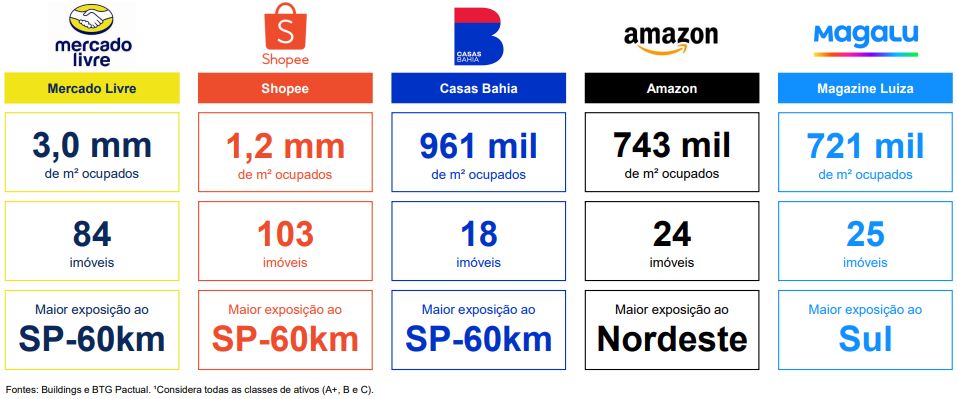
No ranking de empresas, o destaque é o Mercado Livre, responsável por cerca de 6,7% da ABL total nacional, com aproximadamente 3 milhões de metros quadrados ocupados e distribuídos em 84 imóveis.

Isso é mais que o dobro da área alugada pela segunda colocada, a Shopee, que tem 1,2 milhão de metros quadrados ocupados em 103 galpões diferentes.

Mesmo com esses números, as duas companhias seguem avançando com projetos built-to-suit (BTS) — quando o ativo é construído sob medida para atender às necessidades do locatário  — para ampliar a presença logística no país.

Ocupantes do Mercado Logístico brasileiro (Imagem: divulgação BTG)
Ocupantes do mercado logístico brasileiro (Imagem: divulgação BTG)

Alto padrão domina o mercado

O relatório também aponta outra mudança relevante no setor: a evolução da qualidade dos imóveis.

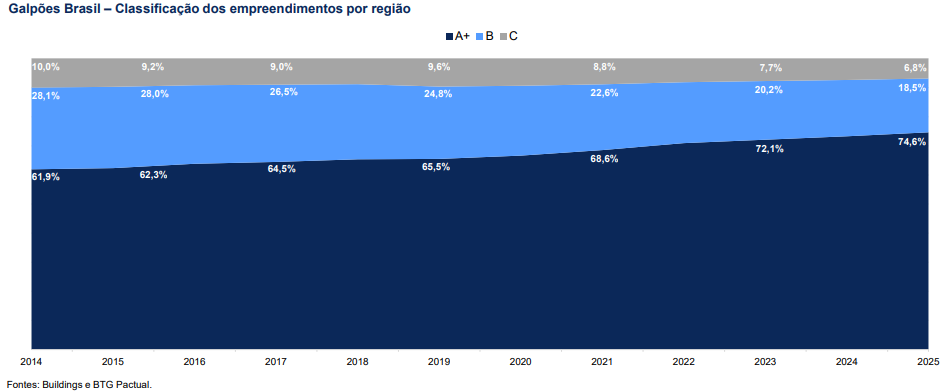
Na última década, os galpões logísticos de alto padrão, que são chamados de classe A+, ganharam espaço de forma consistente:

  • Em 2014, representavam 61,9% do estoque;
  • Em 2021, 68,6%;
  • Em 2025, 74,6%.

Segundo a análise, a maior parte dos empreendimentos em desenvolvimento também pertence a essa categoria, indicando que a qualificação deve continuar nos próximos anos.

Galpões Brasil – Classificação dos empreendimentos por região
Galpões no Brasil – classificação dos empreendimentos por região (Imagem: divulgação BTG)

As regiões que devem crescer mais

Hoje, o estoque de galpões logísticos no Brasil soma cerca de 53 milhões de metros quadrados, com forte concentração no Sudeste, que segue como o principal polo do país.

Por outro lado, o BTG destaca que o crescimento mais acelerado deve ocorrer em outras regiões, com projeções de expansão de ABL de até 80% no Sul e 74% no Nordeste nos próximos anos — percentual que pode ser ainda maior à medida que novos projetos avancem.

“O estoque atual é majoritariamente composto por ativos de alto padrão, participação que tende a continuar crescendo, dado que a maior parte dos empreendimentos em construção está concentrada na classe A+”, afirmou o banco.

“A região Sul deve se destacar como uma das principais beneficiadas desse movimento de qualificação, uma vez que concentra um volume relevante de projetos A+ em desenvolvimento”, acrescentou.

Aluguel pode subir até 40%

Mesmo após as altas recentes, o banco também avalia que ainda existe espaço para novos reajustes nos aluguéis.     

Isso porque o custo de construção e de capital segue elevado, o que tem limitado o lançamento de imóveis. Com menos oferta, e demanda alta, os preços tendem a continuar subindo.

Dependendo da região, o relatório estima que seria plausível um ajuste potencial de até 40% no preço médio pedido.

Fundos imobiliários (FIIs) podem se beneficiar

Para o BTG, esse cenário tende a favorecer especialmente os fundos imobiliários (FIIs) que investem no segmento logístico.

Com contratos passando por revisões periódicas, há a expectativa de aumento da receita de locação nas próximas janelas, o que pode aumentar os dividendos distribuídos aos cotistas.

Além disso, muitos fundos do setor ainda negociam com desconto em relação ao valor patrimonial (P/VP) e ao custo de reposição dos ativos, o que pode abrir espaço para uma reprecificação da indústria.

  •  

China ou retenção? BTG vê incerteza na alta do boi, mas já projeta margens menores para frigoríficos

Desde o começo de 2026, os preços do boi subiram 10% em reais e 14% em dólares. Para o BTG Pactual, é difícil dizer se a recente alta nos preços do gado reflete sinais iniciais de retenção de vacas para abate, uma corrida para antecipar embarques para a China diante de uma cota mais apertada em comparação com os volumes exportados no ano passado, ou uma combinação desses dois fatores.

Segundo Thiago Duarte e Guilherme Guttilla, se a retenção ganhar força a partir de agora, apostar em uma reversão significativa de preços parece uma decisão difícil.

“Isso deve resultar em um ambiente de margens mais pressionado para frigoríficos, e por isso projetamos queda nas margens em 2026 em relação a 2025”, explicam.

De acordo com os dados mais recentes do Instituto Brasileiro de Geografia e Estatística, o abate de bovinos atingiu 42,7 milhões de cabeças em 2025, alta de 7,6% ano contra ano, com crescimento de 13% apenas no 4º trimestre.

Ao mesmo tempo, os preços de bezerros subiram de forma agressiva, fortalecendo o incentivo para os pecuaristas iniciarem a retenção de vacas.

O que é o ciclo do boi?

Embora pareça complexo, o ciclo pecuário é essencialmente determinado pela oferta de gado. Os preços tendem a se mover de forma inversa à proporção de vacas abatidas — ou seja, quanto menor o abate de fêmeas, maior tende a ser o preço do boi.

Quando menos fêmeas são enviadas aos frigoríficos, a oferta de animais para abate diminui, pressionando os preços para cima. Quando ocorre o contrário, com maior envio de vacas para o abate, a oferta aumenta e os preços geralmente recuam.

Nos últimos anos, a oferta atingiu níveis historicamente elevados, o que pressionou os preços do gado para baixo até meados de 2024. Desde então, porém, os preços voltaram a subir — um movimento que chama atenção porque o ritmo de abate continua forte.

Além disso, um ambiente favorável para exportações, puxado pelos Estados Unidos e pela China, provavelmente ajudou a sustentar a disposição dos frigoríficos em pagar mais pelo gado, mesmo com a recente valorização dos preços.

  •