O anúncio de que a colombiana Ecopetrol fechou um acordo para adquirir 26% da Brava Energia por R$ 2,8 bilhões e realizar uma oferta pública de ações (OPA) para atingir 51% do capital social da companhia não caiu bem entre os investidores. Por volta das 12h06, as ações da petroleira independente caíam 3,87%, a R$ […]
The US Navy, if it were to take on an escort mission for tankers in the Strait of Hormuz, might need to lean heavily on destroyers like the one seen here launching a Tomahawk missile.
U.S. Navy photo
Cheap drones, missiles, and mines make chokepoints like Hormuz harder for the US to secure quickly.
The US Navy could need weeks or months to fully secure shipping lanes.
Even limited transit disruptions can spike oil prices and rattle global markets.
The "load-bearing assumption" among some investors that US Navy warships can easily keep vital chokepoints like the Strait of Hormuz open in times of conflict is slowly crumbling, steadily driving oil prices higher, a leading energy consultant said this week.
Robert McNally, a former Bush administration energy advisor and president of Rapidan Energy Group, told Business Insider on Wednesday that the market situation could worsen as US efforts to reopen the Strait of Hormuz, which handles 20% of the world's oil flows, drag on and as the potential scale of the looming energy crisis hits investors.
There is a "belief that something like this either can't happen, which was the belief before, or can't go on for long," McNally said, but as time goes on, "the remaining reservoir of just disbelief" that an essential energy chokepoint could be restricted for this long "is going to drain away," pushing prices higher in "the world's, by far, largest energy disruption in history."
To militarily secure the oil route for tanker movement, US forces will first need to substantially degrade Iran's missile, drone, and mine threats, the oil consultant and a military analyst said. That campaign could take weeks or months — long enough to significantly drive up oil prices and rattle global markets.
Surging prices and bleak predictions
The US has already been at war with Iran for weeks now. Over a dozen foreign oil tankers have been struck amid the fighting, and Brent crude prices have been climbing, jumping recently to over $100 per barrel, up from about $70 just before the conflict began, briefly surging toward $120 in the latest spike before edging back down. Year to date, oil prices have risen 78%, largely driven by disruptions created by the Iran war.
McNally predicted bleaker market outcomes if the war continues or if the conflict's combatants — the US, Israel, and Iran — target the so-called "crown jewels" of the global energy system, escalating the crisis rather than reining it in.
Israeli strikes on the South Pars Gas Field in Iran on Wednesday and Tehran's retaliatory strike on Qatar's LNG gas facility have set the stage for that kind of tit-for-tat escalation, even as President Donald Trump attempts to manage the increasingly volatile situation via his social media accounts.
Map showing the Strait of Hormuz
Graphic by JONATHAN WALTER,ANIBAL MAIZ CACERES/AFP via Getty Images
Despite growing market concerns, the US Navy hasn't stepped in to escort oil tankers the way it has in past periods of conflict and tension in the Middle East. Trump administration officials have said that escorts might be an option when it's "militarily possible."
"It takes a while to secure a strait. Iran has a lot of asymmetric layered capabilities," McNally said, pointing to "potent" weaponry ranging from coastal defense missiles to mines to mini-submarines. An escorting warship accompanies a tanker to protect it from threats like missiles, small boats, and even attack drones that Iran can use with little notice in the strait or on the approaches to it.
Escort missions come only "after you pummel Iran for weeks," he said.
US Central Command, which oversees American operations in the Middle East, said on Tuesday that US forces had dropped 5,000-pound bunker busters against hardened anti-ship cruise missile targets along the Iranian shoreline. And on Thursday, the command released video footage of strikes on Iranian naval targets that "threaten international shipping in and near the Strait of Hormuz."
U.S. forces are destroying Iranian naval targets that threaten international shipping in and near the Strait of Hormuz. pic.twitter.com/qR6FJyI5ZS
US armed forces have so far sunk over 120 Iranian naval vessels while also targeting naval drone facilities, storage centers for sea mines, and torpedo production sites. Additionally, A-10 attack aircraft are in the fight, gunning for Iranian fast boats.
The US military is "zeroed in on dismantling Iran's decades-old threat to the free flow of commerce through the Strait of Hormuz," CENTCOM commander Adm. Brad Cooper said on Monday.
"And we're not done," he said.
A process, not a quick fix
Assumptions that the US can quickly and easily secure vital sea lanes have been shaped by past conflicts where American naval power restored order relatively quickly.
During the Tanker War in the 1980s, US-led escorts helped keep oil flowing despite attacks in the Gulf between Iran and Iraq, and in later conflicts, the US military demonstrated the ability to rapidly overwhelm adversaries.
Those experiences, McNally said, have reinforced a broader expectation in certain markets and policy circles that any disruption to key chokepoints would be short-lived and manageable. That assumption is now colliding with very different threats.
Iran has fired more than 2,000 drones in its war against the US and Israel. A pick-up truck carried a Shahed drone during a 2025 parade of Islamic Revolutionary Guard Corps troops and paramilitaries.
Hossein Beris / Middle East Images / Middle East Images via AFP via Getty Images
"The weapons proliferation has just dramatically expanded," Bryan Clark, a retired US Navy officer and a defense analyst at the Hudson Institute, told Business Insider on Wednesday.
"You can sort of hang on forever by just using Shahed drones and little drone attack boats," he said, adding that "drones are going to be the biggest threat."
In heavily constricted waterways, like the Strait of Hormuz, which is just 21 nautical miles across at its narrowest point, state and non-state actors can "basically create an ambush situation where you can target shipping," he said.
An Iranian anti-ship cruise missile could hit a tanker in the strait within seconds, giving warship crews very little time to react. And that is only one potential threat.
The Houthis, an Iran-backed militant group in Yemen, seized on that exact opportunity in recent years, targeting both military and commercial vessels around the Bab al-Mandab Strait.
To forcefully curb the Houthi threat, the US launched Operation Rough Rider in March 2025. That effort took 52 days and more than $1 billion to get the rebels to stand down — and shipping still hasn't fully recovered, as many commercial shipping companies have opted for higher prices and longer transit times rather than face the elevated security risks.
The current situation carries greater complexities. Iran has a much deeper arsenal than its proxies, and it has leverage as long as it is willing and able to fight. There are no alternative routes to the Strait of Hormuz for oil tankers loaded with crude oil or LNG.
Launching a naval escort mission in the Strait of Hormuz "would pretty much take up all of our deployed forces in that region," Clark said. Without allied support, which isn't coming together, "it's going to take at least a dozen destroyers to do the escort mission."
"They would be all tied up doing that," he said.
In addition to warships, a US escort mission could demand regular combat air patrols.
U.S. Navy photo
Israel, waging war against Iran alongside the US military, has a small surface fleet. US European allies have balked at entering the conflict, though some have deployed ships to defend their assets in the region. Some allies have shown support in condemnations of Iran, but for a potential escort mission, the US could be forced to go it alone, relying on a mix of combat air patrols and naval power.
Clark warned that the mission could go on for months because the Iranians "can hold out for a long time, given the number of weapons they've squirreled away." The Pentagon has acknowledged the challenge of weaponry buried over decades.
As cheap weapons like Shahed drones lower the barrier to entry for precision strike for countries like Iran and aggressive non-state actors like the Houthis, McNally said that it looks like oil disruption is increasingly becoming a tool of coercion in modern conflict. These vessels are being targeted, not merely caught in the crossfire, and that will demand shifts in strategic-level thinking.
Even without a full shutdown of important chokepoints, any disruption alone can shake global markets. In energy markets, delays and uncertainty can trigger price spikes. That's leverage for malign actors, even those limited in conventional military might.
McNally said that "folks will be watching very closely how successful we will be in the coming weeks in suppressing that."
Jerome Powell will lead his second-to-last Federal Reserve meeting as chair this week.
Kevin Dietsch/Getty Images
The Federal Reserve will announce its March interest rate decision on Wednesday afternoon.
It's likely the FOMC will hold rates steady, especially as the Iran war has sent oil markets into chaos.
The Fed will also release its first economic projections of 2026.
It's been a tumultuous few weeks for the US economy, and the Federal Reserve is paying attention.
The central bank will announce its second interest-rate decision of 2026 on Wednesday afternoon, with CME FedWatch predicting a near-total chance of a rate hold based on market moves. The Fed cut rates three times in the second half of 2025, and has penciled in at least one rate cut for the new year. For consumers, these policy decisions affect inflation, the job market, and borrowing costs.
At the March meeting, Fed leaders will consider the dismal February job growth report, steady inflation rate up through last month, first-quarter business outlook, and the budding energy and oil crisis in Iran. This is also Jerome Powell's second-to-last meeting as chair. He's set to be replaced by ex-Wall Streeter and Trump appointee Kevin Warsh in May if Warsh is confirmed by the Senate.
Here's what you need to know ahead of the decision.
The Fed has a near-total chance of holding rates
It's likely that the Fed will take a conservative approach to monetary policy in March. Holding rates steady could help control inflation. The ongoing Iran war has raised the price of gas and oil — something that's likely to impact everything from plane tickets to grocery costs over the next several months unless the situation improves. The February consumer price index, released March 11, increased 2.4% year over year, the same rise as in January. However, this figure doesn't yet reflect the spike in energy prices, as the overwhelming majority of the data predate the start of the conflict.
The Strait of Hormuz — a major trade throughfare between the Persian Gulf and the Gulf of Oman — has been largely closed by Iran's leadership since early March. The move is cutting off about 20% of global oil production, causing market volatility. Oil prices recently surged past $100 a barrel, and while they've calmed slightly, the key commodity is still far more expensive than it was before the war.
Mark Hamrick, senior economic analyst at Bankrate, told Business Insider the oil shock "creates a real problem for consumers in the broader economy at a time when affordability challenges have already been first and foremost in terms of the major issue that voters and consumers have been railing against."
Oil isn't the only commodity choked off by the closure of the Strait — the hit to fertilizer prices could soon cause food costs to rise if the war continues.
The job market, meanwhile, is showing clear signs of weakness. The disappointing February jobs report showed that US lost 92,000 jobs that month. The unemployment rate also inched up to 4.4%. This is a contrast from January growth and the central bank's optimistic employment outlook at their last meeting.
"The January report saw a really stark reversal from the slow movement in 2025, and there was a lot of expectation that this momentum would continue and keep pace. And that was not the case for February," Nicole Bachaud, an economist at ZipRecruiter, said.
Cory Stahle, an economist at Indeed Hiring Lab, advised people to look at the broader job market trend after the US got one good January report and a bad one in February. Still, as Stahle pointed out, the US basically hasn't created jobs in the past six months.
The Fed will also release its quarterly economic projections on Wednesday, offering a window into its rate decisions for the remainder of the year. With a recent track record of policy disagreements among Fed leaders, it's possible there will be a wide range of predictions.
What the Fed's decision means for consumers
Fed decisions impact mortgage and credit card rates, auto loans, inflation, and job market churn over time. Lower rates may juice a sluggish job market, at the risk of pushing consumer prices higher. Powell and the Federal Open Market Committee will weigh which side of their dual mandate to prioritize. The bank's inflation goal is 2%.
If the Fed holds rates, Americans' finances will remain largely unchanged. Mortgage, auto, and credit rates tend to fluctuate alongside the federal funds, though it takes a pattern of decisions before interest rates change noticeably for consumers. Businesses and job seekers hoping for cheaper borrowing and a hotter labor market might have to wait until later this year.
Powell said at the last Federal Open Market Committee press conference in January that America's economy is coming into the year "on a firm footing," but "policy is not on a preset course, and we will make our decisions on a meeting-by-meeting basis."
Leadership changes are imminent
Trump has nominated Warsh, a former bank executive and central bank governor, to succeed Powell as Fed chair. Warsh has a reputation for hawkish monetary policy and for being tough on inflation, and it's unclear whether he will follow through on Trump's request for more rate cuts.
Matt Colyar, an economist at Moody's Analytics, said the inflation story will be interesting to follow.
"You got a Fed chair tapped because he got the job because of his stated intention of lowering interest rates, and now you're going to get an inflationary shock that's going to push up prices with no real clear end game in sight," Colyar said about the oil shock and spillover effects from the Iran war.
Warsh's nomination is shadowed by tensions between the central bank and the White House. Fed Governor Lisa Cook's case was heard by the Supreme Court earlier this year after Trump accused her of mortgage fraud, which her legal team denies. Powell also announced in January that the Department of Justice launched a probe — which is still ongoing — into the Fed's handling of construction at its Washington, DC, buildings.
The probe sparked major concerns about political pressure on interest rates and Fed independence. Last week, federal judge James Boasberg squashed two subpoenas from the DOJ as part of the probe.
"A mountain of evidence suggests that the Government served these subpoenas on the Board to pressure its Chair into voting for lower interest rates or resigning," Boasberg said.
Senators from across the aisle, including retiring North Carolina Republican Thom Tillis, who sits on the Senate Committee on Banking, Housing, and Urban Affairs, have signaled that they will oppose a confirmation vote for Warsh or any of Trump's Fed picks because of the DOJ probe. These confirmation hearings have not yet been scheduled, though Powell's term ends May 15.
The president hopes to see a rate cut sooner rather than later.
"Where is the Federal Reserve Chairman, Jerome 'Too Late' Powell, today?" Trump posted on March 12. "He should be dropping Interest Rates, IMMEDIATELY, not waiting for the next meeting!"
Delta Air Lines' service from New York's JFK Airport (pictured) to London Heathrow is up from $285 to $553 over a month.
CHARLY TRIBALLEAU/AFP via Getty Images
War in the Middle East has pushed fuel costs, and therefore airfares, sharply higher.
Business Insider charted the increase in ticket prices for three major flight paths in recent weeks.
Fares from New York to LA, New York to London, and from the US mainland to the Caribbean have jumped.
Your next flight could be twice as expensive because the Iran war is causing volatility in oil prices.
Brent crude is up more than 50% over the past month, to around $101 a barrel. Jet fuel costs are rising faster. The Argus US Jet Fuel Index is up 72% over the same period.
That spells difficulty for airlines because jet fuel is typically their biggest expense after labor. While many airlines around the world hedge against fuel costs, most American ones do not.
Using data from Deutsche Bank, Business Insider charted rising airfares in three major markets.
The data looks at the lowest available published fares 21 days in advance of the flights. The published fare doesn't necessarily mean a ticket has been purchased for that amount, the Deutsche Bank research analysts said.
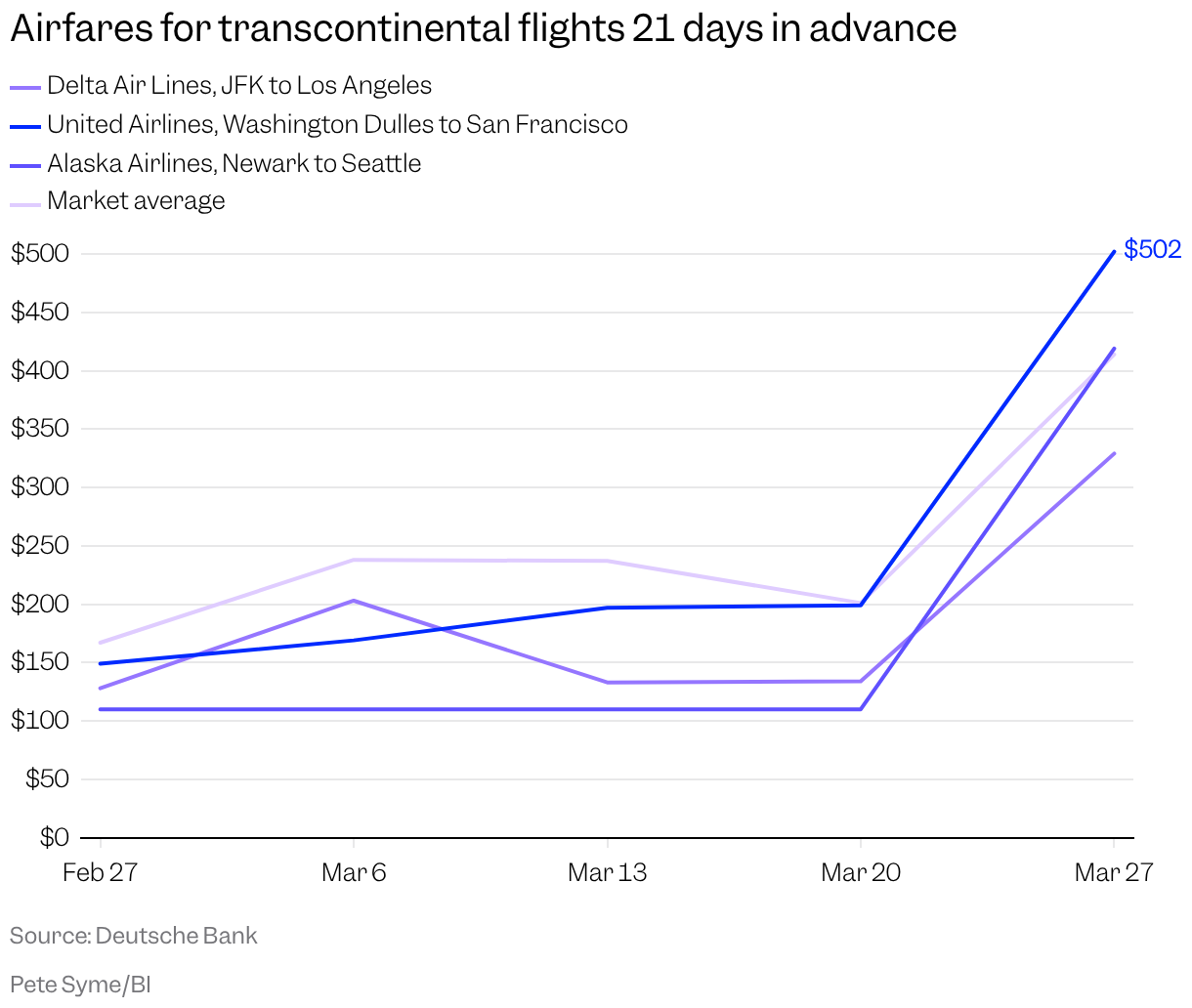
Cross-country flights, often known in the industry as transcontinental flights, have seen the biggest week-over-week spike — more than double, on average.
New York to Los Angeles is the country's busiest domestic route, with a capacity of 3.4 million seats out of JFK Airport last year, according to OAG data.
The average price of a transcontinental flight has risen from $167 to $414, Deutsche Bank's analysis showed. In the past week, the average has spiked 107%.
United Airlines is offering flights from Washington Dulles Airport to San Francisco for $502, up from $149 a month ago.
International business travellers are also seeing flight prices rise.
New York to London is the country's most popular international route, and the 10th-busiest in the world. Nearly 4 million seats were scheduled on flights between JFK and Heathrow last year, per OAG.
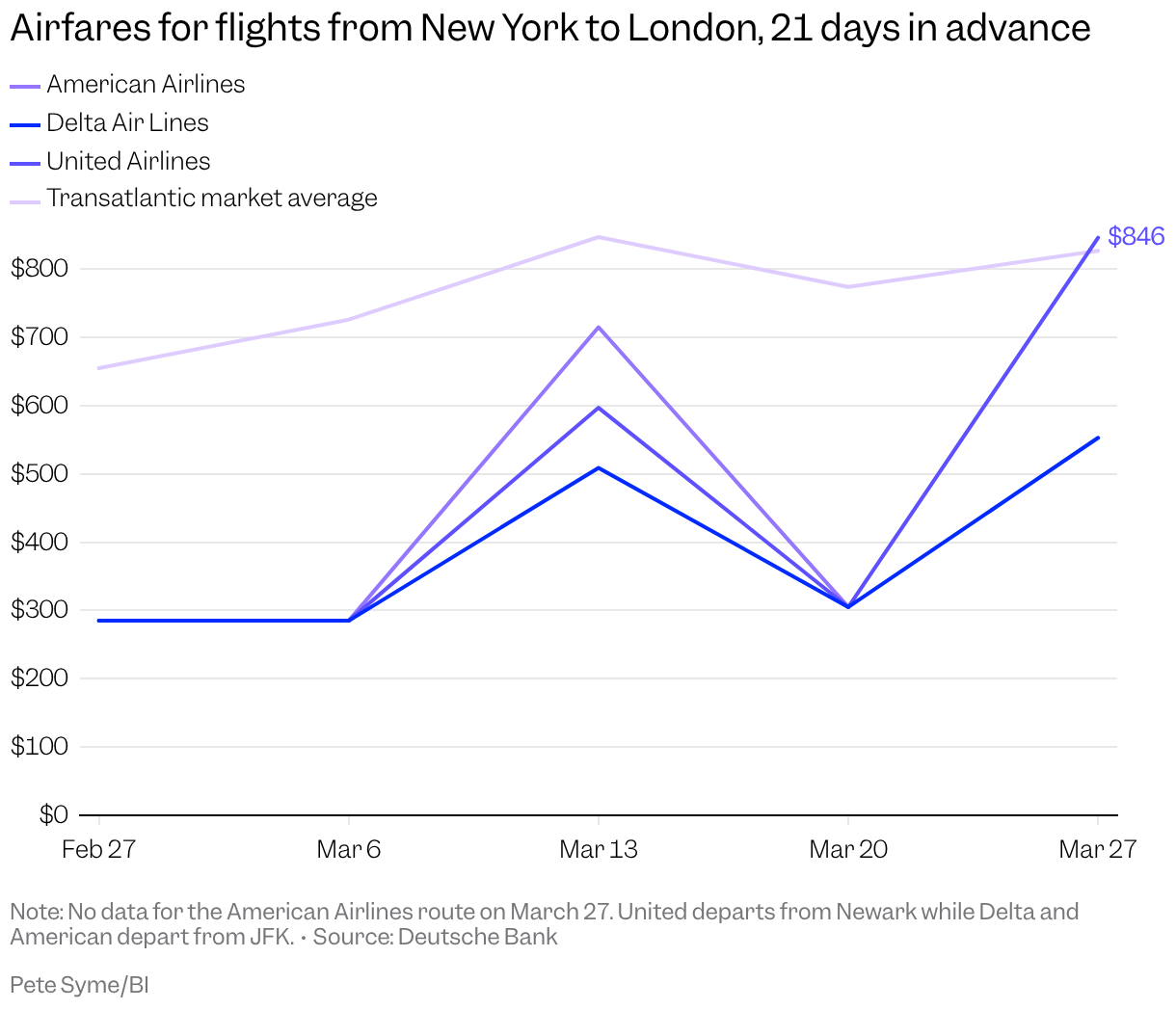
While the average Transatlantic flight is some 40% more expensive than a month ago, there are bigger rises for the New York-London route. However, it also appears more volatile here with a big dip last week.
Delta Air Lines' service is up from $285 to $553 over the past month, while United's is up to $846. That's a 177% rise compared to a week earlier, according to Deutsche Bank's analysis.
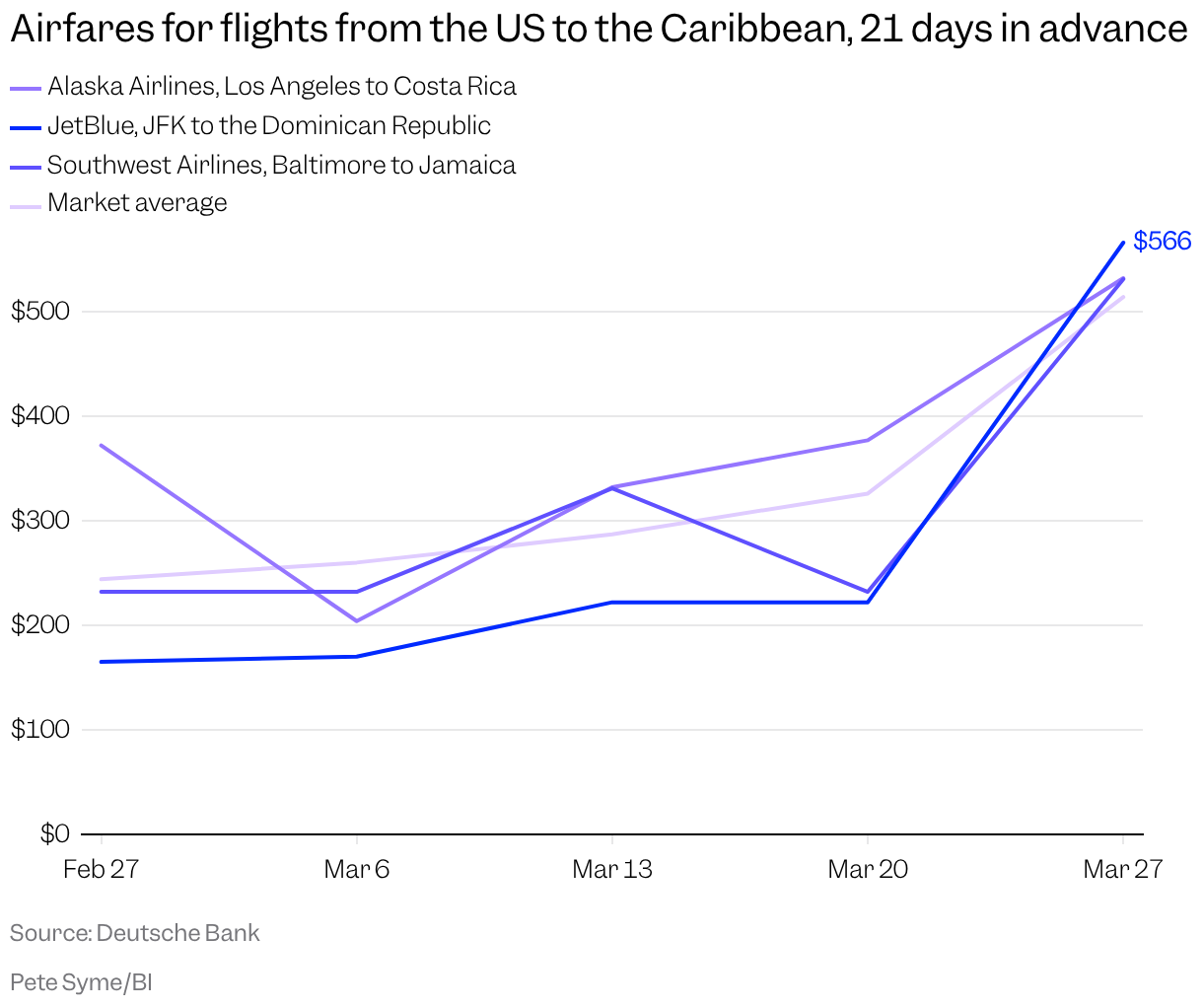
JetBlue's flight from New York to Santo Domingo, Dominican Republic, has risen from $165 to $566 on March 27.
Compared to a year earlier, that's a more than fourfold rise, Deutsche Bank found.
Southwest Airlines' flight from Baltimore to Montego Bay, Jamaica, has more than doubled over the past week. And Alaska Airlines' service from Los Angeles to San Jose, Costa Rica, is up 40% compared to a week earlier or 120% versus a year ago.

 Entrar