❌

Visualização de leitura

Wall Street's rising stars say these skills matter more than ever in the AI era

Kate Casey, David Oppenheim, and Asher Hect
Business Insider's Rising Stars of Wall Street include KKR's Kate Casey, Evercore M&A banker David Oppenheim, and private equity investor Asher Hecht from General Atlantic.

Ray Dak Lam for BI

  • AI is changing what it takes to stand out as a newbie on Wall Street.
  • We asked our Rising Stars of Wall Street to share the skills workers need to thrive in this era of work.
  • Here's what they said, from practicing soft skills to

AI is raising the bar for entry-level Wall Street workers.

With technology taking over more of the grunt work, early success depends less on how many hours an analyst has spent meticulously formatting pitch decks or compiling reports. Instead, it's more about how well they communicate what's in that deck or model, and how good they are at generating ideas or building relationships.

We asked the latest class of Business Insider's Rising Stars of Wall Street what skills those on the finance path need to master in the AI era. Their answers suggest that the technology has not necessarily changed the skills needed to succeed on Wall Street. Instead, it's making those skills more important earlier in their careers.

Here's what they said someone starting out on Wall Street should zero in on.

Don't let AI do your thinking for you

What Jim Tilson, a 35-year-old senior managing director at Evercore, stresses to his junior team is that they be active learners.

He sees the biggest risk for juniors using AI is that they rely on the tech too heavily, which could prevent them from developing pattern recognition.

Jim Tilson
Jim Tilson, a senior managing director at Evercore.

Courtesy of Jim Tilson; Ray Dak Lam for BI

"The best performers are going to leverage it as a tool and get way smarter, and the worst performers are going to let AI do their job and be replaced," the banker said.

Blue Owl Capital investor Diana Liu recently heard someone complain that young employees are increasingly asking AI to solve problems rather than developing their own approaches.

Her advice is to develop a framework for solving a problem, then use AI to refine the solution.

"Let it be your helper, not a replacement," the 33-year-old principal and data center investor said.

Analytical skills will be tremendously valuable, said Asher Hecht, a principal at General Atlantic, echoing some of Tilson and Liu's concerns.

"The ability to drive insight from what that tells you and the right questions to ask and observing the shapes of data and trends, I think that is something that people risk losing sight of."

Have your own point of view

Evercore banker David Oppenheim, a 35-year-old managing director, said that in his experience, "some of the highest performing juniors tend to be those that are thinking about the bigger picture rather than necessarily just performing the task that they've been asked to perform."

Daniel Borkenstein, a 31-year-old private equity principal at Apollo Global, said he's been using AI as a thought partner to help him think through a thesis, its risks, and the best way to communicate nuanced topics.

"In no circumstance was AI able to tell me the answer," he said. "I needed to come with a point of view and work with AI to refine what that answer was and be prepared for whatever conversations I had with people about the deal."

Judgment is your value add, said Borkenstein.

"No one's going to sell their business to Claude," he said. "If you say 'because Claude said so' at the investment committee, that's an unacceptable answer for hopefully obvious reasons."

Make people want to work with you

The ability to connect with people will become an even bigger differentiator, Kate Casey, a 32-year-old principal at KKR, told Business Insider.

"What differentiates you and why a management team would want to work with you is your ability to connect as a person," she said.

Fiona Ismail, global head of investment-grade private credit at JPMorgan, recommends that young professionals double down on listening. That means paying attention to colleagues as they explain their work and understanding what clients are ultimately trying to accomplish.

"AI can answer what you've told it, but it can't get to the crux of what someone is actually trying to say," the 34-year-old executive director said.

Her colleague, John Ballard, a 28-year-old executive director at JPMorgan, believes being in sync with managers will also become increasingly important.

"The people who will succeed are the ones who are incredibly in tune with their direct managers: what they need, what they like, how to navigate situations where you're being asked to do things, and maybe the timeline isn't clear," he said.

Ryan Febles
Ryan Febles of $15 billion hedge fund manager at Capstone Investment Advisors.

Courtesy of Ryan Febles; Ray Dak Lam for BI

Ryan Febles, the global head of equity capital markets at hedge fund Capstone Investment Advisors, recommends putting yourself in situations outside your comfort zone to work on your emotional intelligence. Company leaders want to know that the person they've hired can thrive in a situation outside the confines of a cubicle.

The 31-year-old said leaders would ask themselves, "Who am I confident I can put in front of a management team to represent our business?"

Master the basics before automating them

While AI can accelerate much of the work traditionally performed by junior employees, several Rising Stars warned against neglecting the technical skills that are core to their investments, deals, or the financial solutions they structure.

Jake Epstein, a 28-year-old investor at Blackstone, tells first-year analysts that they have two jobs: producing the work they're assigned and, arguably more importantly, learning.

"It's always worth doing something yourself at least once to learn how," he said.

In real estate investing, that might mean learning how to conduct due diligence or order environmental reports and property condition assessments before turning to AI to help with subsequent tasks.

Epstein also sees AI as an opportunity to learn about parts of the business that junior employees might not otherwise have time to explore.

For example, a first-year analyst may not be responsible for negotiating purchase agreements, but can use AI to understand the back-and-forth between lawyers and learn more about the process.

Maya Venkatraman, a 34-year-old managing director at Morgan Stanley, similarly stressed the importance of mastering the fundamentals.

"You still need the technical understanding to know when an assumption is weak, when an answer doesn't make sense," the US head of transportation and infrastructure leveraged finance said.

A willingness to experiment

For young professionals willing to put in the time to master AI, the technology could also provide an opportunity to stand out early on.

Mike Washington, a 32-year-old managing director at Goldman Sachs, recommends learning how to use large language models and experimenting with vibe coding, or using AI to write software and automate everyday tasks. He said some of Goldman's best young analysts are getting more exposure to senior team members because they are "fluent" in how AI processes work.

Mike Washington
Mike Washington, the co-head of Goldman's Americas Equities High Touch Sales Trading business.

Courtesy of Mike Washington; Ray Dak Lam for BI

"Taking some of these external courses, spending the extra five, six hours a week in an already busy schedule will pay dividends and then some down the road," he said.

Bridget Chaudhry, also a managing director at Goldman Sachs, believes the ability to teach yourself new skills has always been an important predictor of success for junior employees.

"One of the mindset shifts when you start as a junior person on Wall Street is that you shouldn't expect people to teach you, but you should expect to be in an environment where you learn," the investment banker said.

Get comfortable solving unfamiliar problems

Cody Kiechle, a 33-year-old managing director at Bank of America, sees AI as an opportunity for bankers to spend more time on creative work, to develop better ideas, advice, and deal structures.

"It pushes us further into the creativity element, as opposed to some of the more rote tasks that we've done historically, which is really exciting," he said.

For Matthew Caltabiano, a 31-year-old portfolio manager at Millennium Management, problem-solving is the most important skill young professionals can develop.

He recommends that students publish some of their work online to put them on the radar of innovative investors and companies.

"Come up with one good idea and execute it incredibly well," he said.

Venkatraman, who is helping finance the unprecedented data center build-out, also emphasized the importance of becoming comfortable with uncertainty. She said often, the most interesting work happens when there isn't a template or a precedent.

"Get comfortable with ambiguity, get comfortable with the unknown," she said.

For Rex Johnson, the head of equity volatility at Walleye Capital, success in market-facing roles requires learning how to operate without perfect information.

The 32-year-old recommends being willing to make mistakes, learn from them, and move on.

"Be good at failing quickly — and get up when you get knocked down," he said.
Read the original article on Business Insider
  •  

Mini-índice (WINZ26) busca confirmar reação após seis quedas do Ibovespa

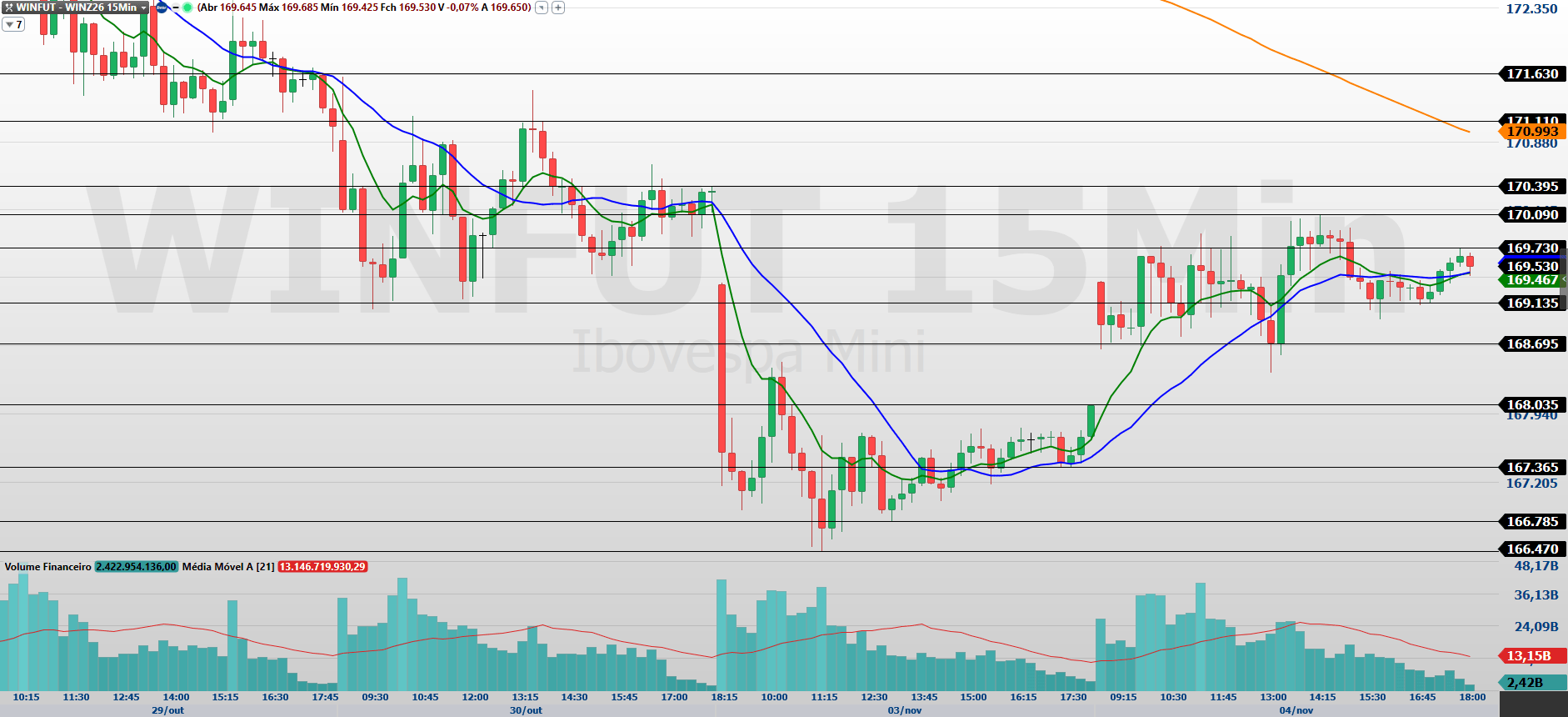
Os contratos de mini-índice WINZ26, com vencimento em dezembro, encerraram a última sessão (04/11) em alta de 0,91%, aos 169.530 pontos, interrompendo a sequência recente de quedas.  Os contratos de mini-índice deverão refletir a recuperação do Ibovespa, que avançou 1,23%, aos 167.563,47 pontos, interrompendo uma sequência de seis quedas. O movimento foi impulsionado pela forte alta de Wall Street após a vitória democrata nas eleições norte-americanas, além dos ganhos de bancos, B3 (B3SA3), Vale (VALE3) e Magazine Luiza (MGLU3). Em sentido contrário, a queda do petróleo pressionou Petrobras (PETR3; PETR4) e PRIO (PRIO3), limitando uma valorização mais ampla da Bolsa brasileira.

Para os traders de mini-índice, o foco nesta quinta-feira estará na repercussão da decisão e do comunicado do Copom. A reação da curva de juros será decisiva para medir o fôlego de bancos, varejistas e demais empresas sensíveis às taxas. O comportamento de Petrobras, diante da queda do petróleo, e de Vale, apoiada pelo minério de ferro, também deverá indicar se o contrato prolonga a recuperação ou passa por nova realização.

Saiba mais:

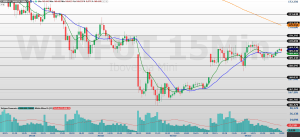
Análise do gráfico de 15 minutos

No gráfico de 15 minutos, observo que o mini-índice encerrou em alta e voltou a negociar acima das médias móveis de 9 e 21 períodos, ainda que muito próximo dessas referências. O movimento sinaliza uma reação compradora no curto prazo, mas o ativo precisará romper as resistências seguintes para confirmar a continuidade da recuperação.

Para avançar, será necessária a entrada de fluxo comprador capaz de superar a resistência de 169.730/170.090 pontos. O rompimento dessa faixa poderá abrir espaço para um teste de 170.395/171.110 pontos. Acima dessa região, o alvo mais distante estará em 171.630/172.380 pontos.

No cenário negativo, uma retomada da pressão vendedora dependerá da perda do suporte de 169.475/169.135 pontos. Se essa faixa for rompida, o mini-índice poderá recuar em direção a 168.695/168.035 pontos. Em uma extensão das vendas, o próximo objetivo ficará em 167.365/166.685 pontos.

No gráfico diário, vejo a alta da última sessão como um possível repique após o movimento de baixa bastante esticado. O índice ainda negocia abaixo das médias de 9, 21 e 200 períodos, com afastamento expressivo dessas referências, e por isso a estrutura principal permanece negativa.

Para transformar o repique em uma recuperação mais consistente, será necessária uma forte entrada de fluxo comprador e a superação das resistências em 170.090/178.700 pontos. Caso esse movimento seja confirmado, os próximos objetivos estarão em 181.185/186.275 pontos.

Por outro lado, a retomada da baixa dependerá do rompimento dos suportes de 166.470/162.145 pontos. A perda dessa região poderá intensificar o fluxo vendedor e levar o índice em direção a 156.720/150.485 pontos.

O IFR de 14 períodos está em 27,70, dentro da região de sobrevenda. O indicador reforça a possibilidade de repiques técnicos, mas, isoladamente, não confirma a formação de um fundo nem uma reversão da tendência.

Fonte: Nelogica. Gráfico 15 minutos. Elaboração Rodrigo Paz

Saiba mais:

WINZ26: Gráfico de 60 minutos

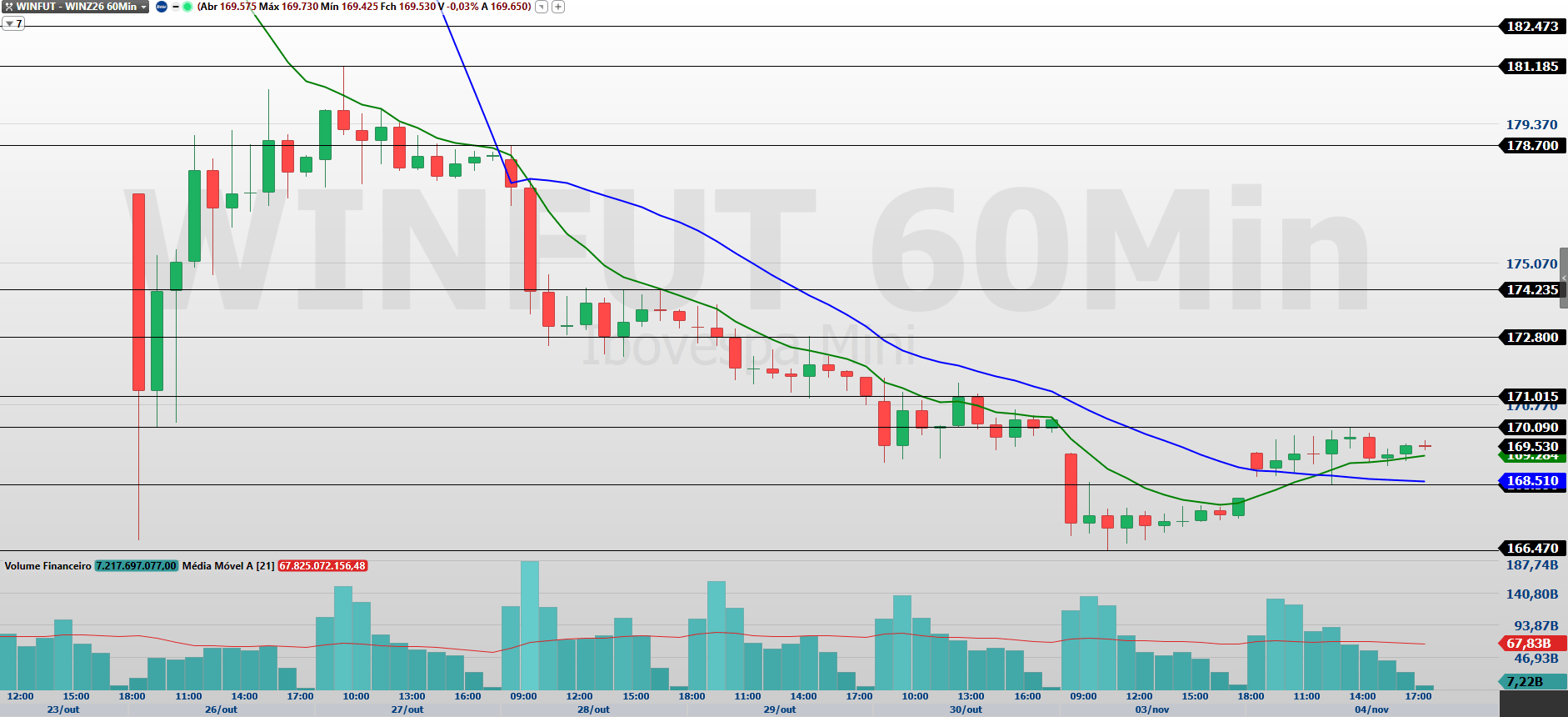
No gráfico de 60 minutos, observo que o mini-índice encerrou a última sessão em alta e acima das médias móveis de 9 e 21 períodos. Essa configuração melhora o cenário de curtíssimo prazo e indica potencial para continuidade da recuperação, desde que o movimento seja acompanhado por volume comprador.

Para prolongar a alta, o índice precisará superar a sequência de resistências em 170.090/171.015/172.800 pontos. Acima dessa faixa, poderá buscar 174.325/178.700 pontos e, posteriormente, 181.185/182.490 pontos.

No campo negativo, a retomada da pressão vendedora dependerá do rompimento dos suportes de 168.390/166.470/166.020 pontos. A perda dessa região poderá levar o mini-índice em direção a 165.390/164.020 pontos. Os alvos mais longos estarão em 163.125/162.660 pontos.

Fonte: Nelogica. Gráfico 60 minutos. Elaboração Rodrigo Paz

(Rodrigo Paz é analista técnico CNPI-T)

Guias de análise técnica:

Confira mais conteúdos sobre análise técnica no IM Trader. Diariamente, o InfoMoney publica o que esperar dos minicontratos de dólar e índice. 

The post Mini-índice (WINZ26) busca confirmar reação após seis quedas do Ibovespa appeared first on InfoMoney.

  •  

A vida após o ataque hacker: BMP refaz gestão e prepara novo negócio

A BMP esteve no centro do maior ataque hacker contra o sistema financeiro nacional e sofreu um prejuízo de mais de R$ 540 milhões em junho de 2025. O evento exigiu que a empresa de infraestrutura financeira acelerasse uma reorganização, que envolveu a contratação de executivos, a ampliação da equipe de controles e mudanças na […]

O post A vida após o ataque hacker: BMP refaz gestão e prepara novo negócio apareceu primeiro em NeoFeed.

  •  

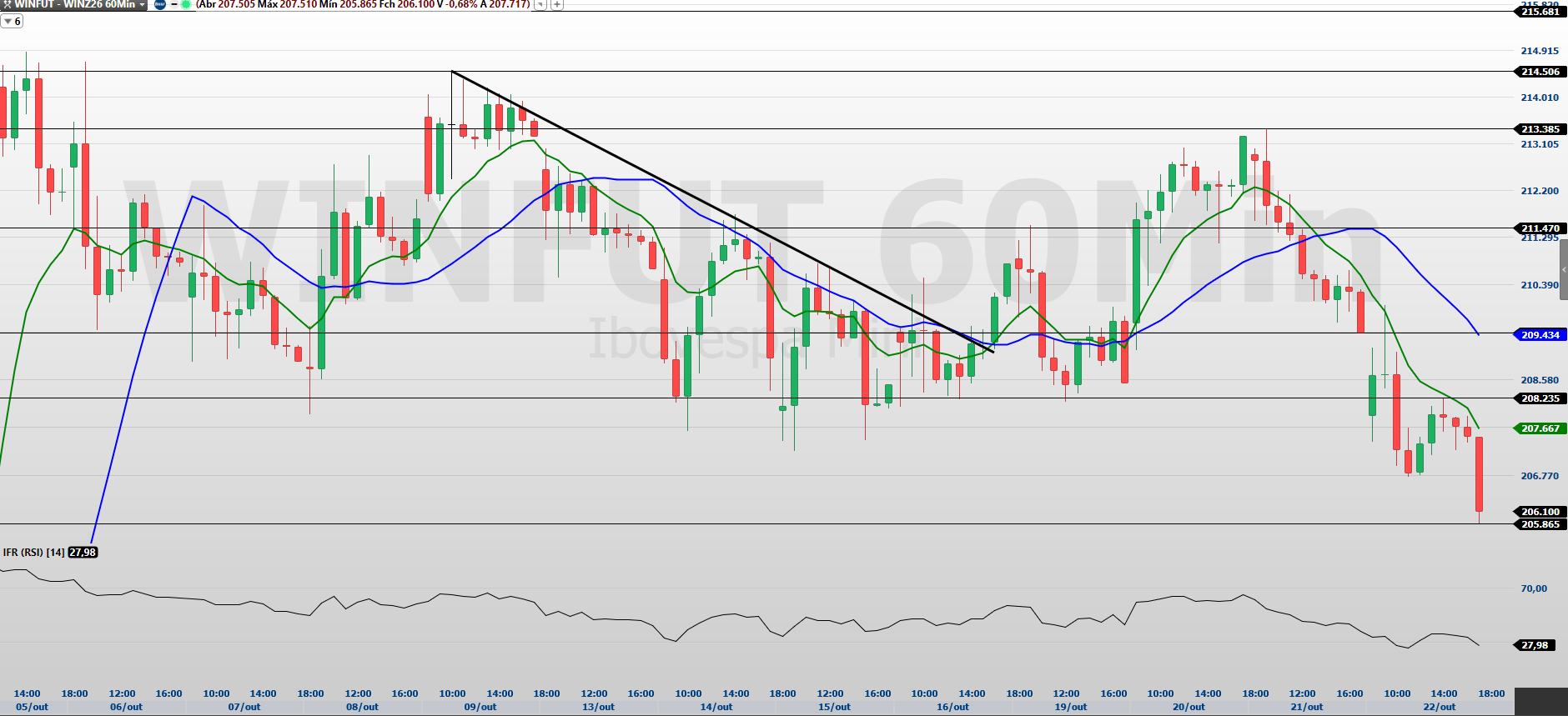
Mini-índice (WINZ26): inflação e debate eleitoral prometem forte volatilidade

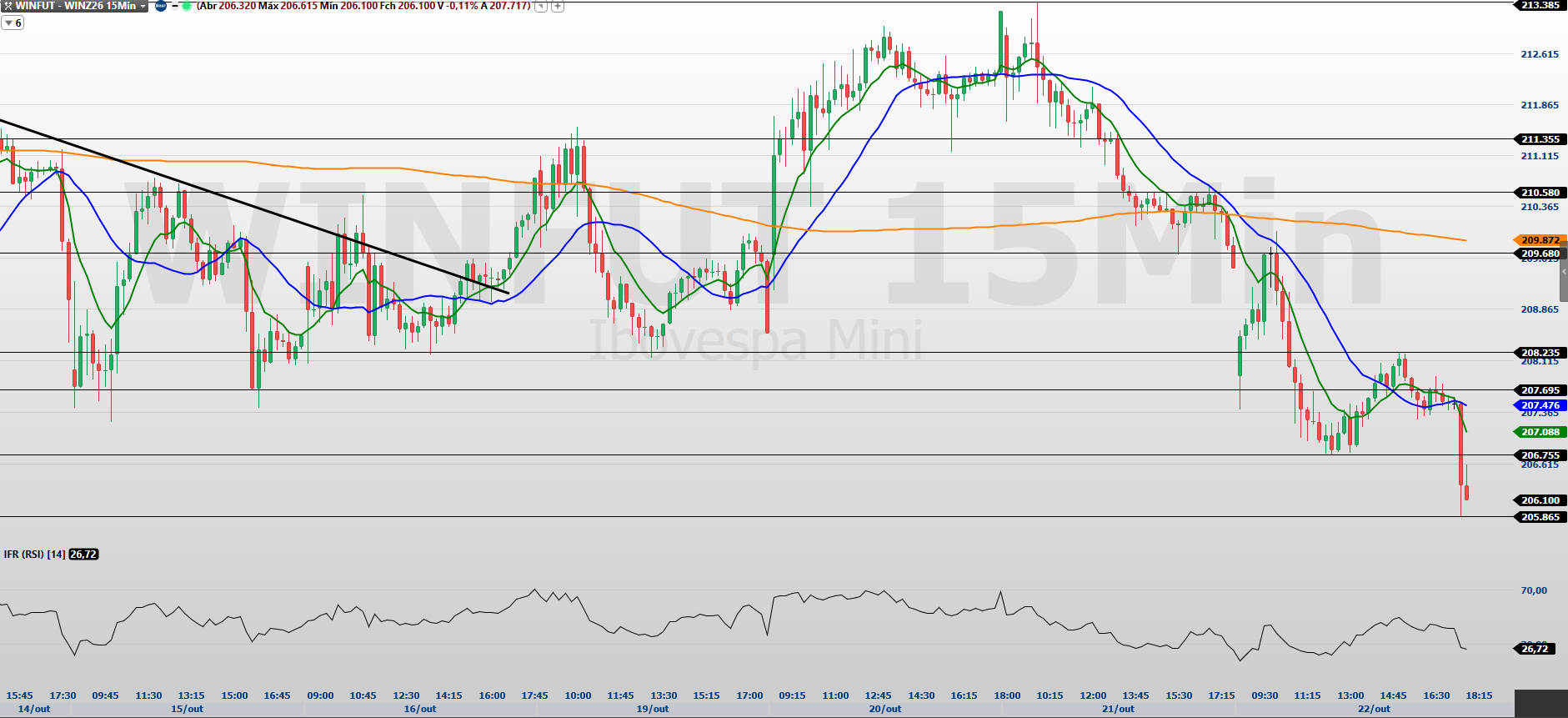
Os contratos de mini-índice (WINZ26), com vencimento em dezembro, encerraram a última sessão (22/10) em queda de 1,49%, aos 206.100 pontos. Os contratos de mini-índice deverão refletir a queda de 1,15% do Ibovespa, aos 204.120,12 pontos, em uma sessão marcada pela cautela antes do segundo turno e pela piora do exterior. O avanço dos juros futuros, as quedas de Vale (VALE3), bancos e varejistas e a fraqueza de Wall Street pressionaram a Bolsa, enquanto Petrobras subiu apenas 0,14%, apesar da valorização do petróleo. Nos Estados Unidos, Nasdaq e S&P 500 recuaram diante das preocupações com os custos dos investimentos em inteligência artificial.

Para os traders de mini-índice, o foco nesta sexta-feira estará no IPCA-15, na repercussão do Datafolha e no último pregão antes da eleição. O balanço do Bradesco (BBDC4), o comportamento de Vale e dos demais bancos e a reação de Petrobras à alta do petróleo deverão ajudar a definir a direção do contrato. O debate presidencial na TV Globo e a volatilidade internacional também poderão aumentar a cautela e favorecer movimentos mais bruscos.

Bolsa antes da eleição: vale carregar ações do último pregão até segunda-feira?

Análise do gráfico de 15 minutos

No gráfico de 15 minutos, observo que o WINZ26 encerrou a última sessão no campo negativo e abaixo das médias móveis de 9 e 21 períodos. O segundo fechamento consecutivo em queda amplia a pressão vendedora e mantém aberta a possibilidade de continuidade da correção.

Para que o mini-índice prolongue o movimento de baixa, será necessária a perda da faixa de 205.865/205.290 pontos. O rompimento desse intervalo poderá intensificar o fluxo vendedor e levar o contrato em direção a 204.770/204.115 pontos. Em uma correção mais extensa, o alvo ficará na região de 203.570/203.120 pontos.

Para retomar o fluxo de alta, o ativo precisará superar inicialmente a resistência em 206.755/207.695 pontos. Acima dessa região, vejo espaço para uma recuperação em direção a 208.235/209.680 pontos. O objetivo mais longo desse movimento está em 209.875/210.580 pontos.

No gráfico diário, vejo o mini-índice aprofundar o movimento de baixa e ganhar força na correção. Com o recuo, o contrato passou a negociar entre as médias móveis de 9 e 21 períodos, região que poderá definir a continuidade das quedas ou uma tentativa de retomada compradora.

Para recuperar o fluxo de alta, o WINZ26 precisará superar a região de resistência em 213.385/215.685 pontos. Confirmado o rompimento, os próximos objetivos estarão em 218.825/221.400 pontos.

Na direção contrária, acompanho a região de médias e suportes em 205.865/204.770 pontos. A perda dessa faixa poderá aprofundar o movimento vendedor e abrir caminho para 198.215/192.730 pontos.

O IFR de 14 períodos está em 55,90, em região neutra e sem indicar sobrecompra ou sobrevenda. Na minha avaliação, o indicador confirma a perda de força do impulso comprador, mas ainda não aponta uma condição técnica extrema.

Fonte: Nelogica. Gráfico 15 minutos. Elaboração Rodrigo Paz

Saiba mais:

WINZ26: Gráfico de 60 minutos

No gráfico de 60 minutos, observo que o mini-índice também fechou em baixa e abaixo das médias móveis de 9 e 21 períodos. Essa configuração mantém a pressão vendedora no curto prazo e pode favorecer a continuidade da correção.

Para retomar o fluxo comprador, será necessária a entrada de volume suficiente para superar a região de resistência em 208.235/209.600 pontos. Acima dessa faixa, o contrato poderá avançar em direção a 211.470/213.260 pontos. Em um movimento mais amplo, os próximos objetivos estarão em 214.510/215.685 pontos.

No cenário de baixa, acompanho os suportes em 205.865/204.770 pontos. A perda dessa região poderá intensificar o fluxo vendedor e levar o ativo até 203.540/201.620 pontos. Se a correção ganhar força, os alvos mais longos estarão em 199.950/196.655 pontos.

(Rodrigo Paz é analista técnico CNPI-T)

Guias de análise técnica:

Confira mais conteúdos sobre análise técnica no IM Trader. Diariamente, o InfoMoney publica o que esperar dos minicontratos de dólar e índice. 

The post Mini-índice (WINZ26): inflação e debate eleitoral prometem forte volatilidade appeared first on InfoMoney.

  •  

Sebastian Stan says playing Trump made him realize Hollywood is 'hypocritical'

Sebastian Stan Roleplay
Sebastian Stan's latest role is in "Fjord."

The Apprentice/Braircliff Entertainment; Dominique Charriau/Getty Images; Bucky Barnes/Marvel Studios; BI

Sebastian Stan isn't afraid to make people uncomfortable.

The 44-year-old actor, who earned an Oscar nomination for playing a young Donald Trump in "The Apprentice," watched in 2024 as his movie encountered roadblock after roadblock — a cease-and-desist letter from Trump, struggles landing a distributor, and hesitance from other actors to discuss the film with him in press— in its journey to screen.

But the headache hasn't deterred him from taking risks on projects that challenge the audience.

"It's not even about Trump anymore. We should be able to explore anything and everything that is uncomfortable," Stan told Business Insider. "We can't become so sensitive to the point where we're actually depriving ourselves of elevated thought about anyone or any matter. Certainly not in the hands of fear."

Stan's latest film, "Fjord," delivers on that promise, telling a subversive, provocative story about a conservative Romanian-Norwegian couple whose parenting methods are called into question after they move to a progressive Norwegian town.

For Stan, the film wasn't just an opportunity to play nuanced, thought-provoking material. As a Romanian-American who fled the country as a boy in the late 1980s, working with Romanian filmmaker Cristian Mungiu ("4 Months, 3 Weeks and 2 Days") was also a long-awaited homecoming.

Sebastian Stan in a winter jacket in Fjord movie
Sebastian Stan plays a Romanian who moves to Norway in "Fjord."

Neon

Stan immersed himself fully in the role, sporting a shaved head with a massive bald spot and speaking most of his lines in Romanian. He and Renate Reinsve, who plays his wife, were so locked in during production that they would go out to dinner together, still dressed in the clothes they shot their scenes in that day. Stan said the experience brought him closer to his homeland.

"A lot of people go, 'Great, you want to come back to Romania, and you want to do movies, but you didn't grow up here, you don't know what our experience is. You were lucky you got away,' so I was a little apprehensive," Stan told Business Insider about working with Mungiu's Romanian-heavy crew. "But, honestly, on the last day of this movie, they wrapped the Romanian flag around me, and they were so proud to kind of take me back in a way and welcome me home." 

For the latest interview in Business Insider's Role Play series, Stan talks about his failed "American Idol" audition, where he thinks Bucky Barnes fits in the current MCU, and realizing how "hypocritical" Hollywood is after playing Trump.

On sleeping on the street to audition for 'American Idol' and losing out on 'The O.C.'

Sebastian Stan in a white shirt
Stan in 2006.

Chance Yeh/Patrick McMullan/Getty Images

Business Insider: What are your recollections of auditioning for "American Idol" back when you were 19?

Sebastian Stan: It was my friend Justin; we both went to Rutgers for the acting program, and he said, "I'm going to New York City to try out for this new show, 'American Idol,'" and he said, "Want to come?" And I was like, "Fuck it, why not."

I remember I had on leather pants; I don't know why I thought that was gonna make a difference. We got there and it was in Times Square, and I see this huge line around the block, and I'm like, "What's going on?" He's like, "No, no, the audition is tomorrow," but it was like 6 p.m., and he tells me we're going to sleep on the street.

So we went to a McDonald's in Times Square, slept barely in this line, and in the morning we got in to these auditions. And what they did was they took five or six of you at a time; they lined you up. I didn't meet any of the judges; it was just some guy. The five of us did 20 seconds of a capella; I think I sang the medley from "Moulin Rouge!," and they were like, "Next." So it didn't work out. 

You start building credits, and then you go on this five-year run of playing the obnoxious jerk roles: "The Covenant," "The Education of Charlie Banks," "Rachel Getting Married," "Hot Tub Time Machine." Was there a point when you were worried about getting typecast as the 2000s-era jerk?

My mindset was, get a job. I was just trying to get a foot in the door. And by the way, I was getting close to a lot of other kinds of roles. At the time, there was that movie "Alpha Dog" — I tried out for that and didn't get it.

But in that era were the "American Pie" movies and "Not Another Teen Movie," which Chris Evans did; they were these movies that had the stereotypical jock asshole guy, and people would always take a look at me and go, "That's the guy." And in "Gossip Girl" I played that, too. But I was just trying to get a start. It wasn't who I felt I truly was. 

I remember I tried out for "The O.C." and got very close. "Star Trek," didn't get that. "Green Lantern," "John Carter," "The Lone Ranger" — so I was going out for big stuff; I just wasn't getting it.

On why he believes Bucky Barnes needs to stay grounded and the 'education' Marvel gave him

Sebastian Stand in a leather coat as Bucky Barnes in Thunderbolts
Stan as Bucky Barnes in "Thunderbolts*."

Marvel Studios

Looking back, do you think your career could have went down a different path if being cast as Bucky Barnes didn't hit the way it did?

What's funny is you go to acting school, and you're being taught the craft, but then there's the learning that you do on set — having the experience of being on set with a camera, learning the lenses, what everyone does. So in some ways, Marvel was a real education in moviemaking and acting. It also allowed me to go back over and over and have some consistency in my life, which I didn't have. I grew up in that period. I got more focused. And it freed me.

The role, which I thought was complex, this character is very different now than when we started out. That character had PTSD, had gone through things; there was a lot to play there. So that box was checked.

Looking outside of that, it became: what were the things I could do that were so far away from that? I don't know if I would have pursued those things as aggressively if I didn't have this lane where I was getting to play more of the straight man.

Are there tweaks you've done to the Bucky character over the years that you're surprised fans haven't caught on to yet?

We've tried, and I make an emphasis on we because it's not just me. I have had to adjust to Marvel changing and evolving and becoming a bigger world. The Captain America franchise, when we started, they were very grounded. "Captain America: The Winter Soldier" is kind of a suspense thriller; "Civil War" had more personalities, but at the heart it was serious, so this character, at its core, is a very serious character.

Maybe people would argue differently, but things have gone more into an expansive, integrative place of how does everybody fit in, and I think humor is a big part of making that happen. We have, and I have, tried to adapt to those things. So the question then became, What's funny about this guy? What is there to play? Some of it has been explored, but not entirely.

It's trying different things. At this moment in time, the character adopted this sort of Clint Eastwood, crusty old man humor. Dry —been there, done that, Why are we fucking doing this again — that kind of thing. I don't know if the character will stay there, but it's not a character who can suddenly go big.

On realizing Hollywood is 'hypocritical' after playing Trump and collaborating with great directors

Sebastian Stan in a suit and tie smiling on a staircase in The Apprentice
Stan as Donald Trump in "The Apprentice."

Briarcliff Entertainment

Going to acting school is one aspect of building a career, and you mentioned another is learning what it's like working on sets. But yet another is understanding the Hollywood game. What was the biggest thing you learned about Hollywood after playing Donald Trump in "The Apprentice"?

Um [Laughs.] It's quite hypocritical in a lot of ways. Everybody has good intentions, I think, about saying the right things, but they don't always do the right thing. I'm not saying it's gaslighting, but there's something to it, because there's often times you end up asking yourself if you're the one that's crazy.

There are many times — and I'm not saying it was just related to "The Apprentice" or Trump — there are other things even now where I've been in rooms and talking to people who will say things in private that they will never say publicly.

As it pertains to that movie, that was the experience, which was everybody loved the movie that I talked to; everybody wanted to support it, but yet nobody wanted to step up to the plate.

Now here we are today, where the trailer for the Elon Musk documentary is struggling to be shown online, so now this kind of thing is pretty normalized. Can you imagine that happening ten to 20 years ago?

Back in 2018, I spoke to you for "Destroyer." At that time, you hadn't landed lead roles yet. I asked what you were looking for when that happens, and you said, "Down the line I want to be remembered for being part of specific works and visions of directors rather than a group of characters."

Is that still your mindset? Because with roles like Jeff Gillooly in "I Tonya," Tommy Lee in "Pam & Tommy," Edward in "A Different Man," you are building an incredible stable of memorable characters. 

It's crazy to hear that quote. Back then, I think that was where I was starting to go because I had come off of "I, Tonya" and I'd learned the value of having a good director and how it influences your work and the performance. Karyn Kusama, who did "Destroyer," was someone I really respected.

And also, before that, you mentioned "Rachel Getting Married" — my whole plan back then was to just get one scene or a little part in a big director's movie. So that was Jonathan Demme. "The Martian," I got to work with Ridley Scott. I took those parts because this is a director's medium. 

Since then, I've tried to stick to that, and these performances you've mentioned, to some extent, they've worked because of those collaborations where you need to have the captain of the ship. You need to have those directors who know how to communicate. I've found myself better when I am in trusted hands, when it's someone that I really allow myself to let go with.

Because if you can't trust a director, what happens is you start to be worried about what's happening on the other side of the camera, and you're then not involved in the experience of the role you're playing. I think that shows when that happens. 

This interview has been condensed and edited for length and clarity.

"Fjord" is in theaters now.

Read the original article on Business Insider

  •  

The 25 biggest documentary film openings of all time

Two men in suits shake hands.
Nathan Fielder and Lance Oppenheim directed "You Can See Everything," a documentary that centers on Theranos founder Elizabeth Holmes in the 34 days before reporting to federal prison.

JC Olivera/Getty Images

  • The Elizabeth Holmes documentary "You Can See Everything" earned $15.6 million in its debut weekend.
  • That makes it the second-highest-grossing traditional docufilm opening weekend of all time.
  • Business Insider compiled the 25 biggest documentary opening weekends using Box Office Mojo data.

Something unusual is happening right now: a documentary is drawing crowds to theaters at a level rarely seen for the genre.

The Elizabeth Holmes documentary "You Can See Everything," directed by Nathan Fielder and Lance Oppenheim, grossed $15.6 million in the US and Canada during its opening weekend in October.

That makes it the second-biggest theatrical docufilm debut ever, behind director Michael Moore's "Fahrenheit 9/11," which saw a nearly $24 million opening in 2004. "You Can See Everything" was filmed in the month before Holmes reported to prison in May 2023 after she was convicted of defrauding investors in connection with her now-defunct blood-testing company, Theranos.

Theatrical documentary premieres have become rarer since the streaming era began, as the genre has found a major audience on streaming services such as Netflix and Hulu. Besides the new Holmes docufilm, only two others on the list were from this decade: "Melania" debuted to $7.1 million in January 2026, and "After Death," a documentary about near-death experiences, opened to $5 million in 2023.

Still, theatrical docufilms were once a cultural force, especially in the 2000s and 2010s, when a wave of nature-, political-, and celebrity-focused ones premiered in theaters to much fanfare.

Here are the 25 highest-grossing traditional documentary film openings at the box office, using data from Box Office Mojo. Several hit concert docufilms, like "Taylor Swift: The Eras Tour" and "Justin Bieber: Never Say Never," earned more but were omitted from this list to focus on traditional nonfiction documentaries.

25. Whitney (2018)
Two people attend a movie premiere.
Director Kevin MacDonald and Executive Producer Pat Houston attend the "Whitney" premiere on June 27, 2018, in New York City.

Theo Wargo/Getty Images

Opening weekend domestic gross: $1,265,572

Directed by Kevin Macdonald, "Whitney" chronicles the life and career of singer Whitney Houston.

The documentary uses archival footage and interviews with people close to Houston to explore her rise to fame, personal struggles, and her death in 2012.

24. Imagine: John Lennon (1988)
Two men pose for a photo.
Richard Gere and photographer Herb Ritts attend the "Imagine: John Lennon" premiere on October 6, 1988 in New York City.

Ron Galella, Ltd./Ron Galella Collection via Getty Images

Opening weekend domestic gross: $1,412,213

The documentary, directed by Andrew Solt, looks back on John Lennon’s life and career through archival footage, home movies, interviews, and recordings.

It covers Lennon's time with the Beatles, his solo work, and his relationship with Yoko Ono.

23. That's Dancing! (1985)
Two people attend a movie premiere.
Actress Lindsay Wagner and American director and producer Jack Haley Jr. attend the premiere of 'That's Dancing!' on January 18, 1985, in New York City.

Vinnie Zuffante/Getty Images

Opening weekend domestic gross: $1,506,802

Directed by Jack Haley Jr., "That's Dancing!" chronicles how dance evolved in Hollywood films through clips from musicals.

It features performances by Fred Astaire, Gene Kelly, Judy Garland, and more.

22. Rize (2005)
Two people attend a movie premiere.
Christina Aguilera and David LaChapelle attend the premiere of "Rize" on June 21, 2005, in Hollywood.

Jeff Kravitz/FilmMagic

Opening weekend domestic gross: $1,574,787

David LaChapelle directed the documentary that focuses on the different dance styles across Los Angeles, including krumping and clowning.

It follows dancers who use dance as an outlet in South Central LA.

21. Babies (2010)
Two people attend a movie premiere.
NEW YORK - APRIL 27: Hoda Kotb and Bobbie Thomas attend the premiere of "Babies" at the Tribeca Grand Screening Room on April 27, 2010 in New York City. (Photo by Jerritt Clark/WireImage)

Jerritt Clark/WireImage

Opening weekend domestic gross: $2,160,460

Directed by Thomas Balmès, the documentary follows four infants from birth through their first year in Namibia, Mongolia, Japan, and the US.

20. Penguins (2019)
People attend a movie premiere.
Jeff Wilson, Ed Helms, Dr. Jane Goodall, Alastair Fothergill, and Roy Conli attend DisneyNature's "Penguins" premiere on April 14, 2019, in New York City.

Roy Rochlin/Getty Images for Disney Studios

Opening weekend domestic gross: $2,282,593

Directed by Alastair Fothergill and Jeff Wilson, the Disneynature documentary, narrated by Ed Helms, follows a penguin as he searches for a partner and starts a family in Antarctica.

19. The Real Cancun (2003)
A man in a suit.
Rick De Oliveira during "The Real Cancun" Premiere at The Egyptian Theater in Hollywood, California, United States. (Photo by Jon Kopaloff/FilmMagic)

Jon Kopaloff/FilmMagic

Opening weekend domestic gross: $2,300,000

"The Real Cancun" follows 16 American college students on spring break in Mexico.

The documentary captures the students as they party, hook up, argue, and more during a 10-day stay in Cancún's Hotel Zone.

18. Death of a Nation (2018)
A movie theatre.
Death of a Nation was written and directed by Dinesh D'Souza and Bruce Schooley.

Greg Doherty/Getty Images

Opening weekend domestic gross: $2,356,522

Conservative commentator Dinesh D'Souza co-directed "Death of a Nation" with Bruce Schooley.

The documentary uses reenactments and interviews to argue that Donald Trump is comparable to Abraham Lincoln and that the Democratic Party has historical ties to racism and fascism.

17. Meet the Mormons (2014)
People attend a movie premiere.
The cast of "Meet the Mormons" attend the documentary's premiere on October 7, 2014, in Sandy, Utah.

Photo by The Church of Jesus Christ of Latter-day Saints

Opening weekend domestic gross: $2,509,808

Produced by The Church of Jesus Christ of Latter-day Saints, the documentary follows six church members around the world, including the US, Costa Rica, and Nepal, to depict their daily lives and beliefs.

16. Expelled: No Intelligence Allowed (2008)
A man in a suit speaks.
WASHINGTON - OCTOBER 19: Actor Ben Stein speaks during the Family Research Council's 2007 Washington briefing October 19, 2007 in Washington, DC. The legislative action arm of the Family Research Council held the yearly event at which 2008 U.S. presidential hopefuls spoke, including Rep. Tom Tancredo (R-CO), former Massachusetts Gov. Mitt Romney and others. (Photo by Brendan Smialowski/Getty Images)

Brendan Smialowski/Getty Images

Opening weekend domestic gross: $2,970,848

Directed by Nathan Frankowski, "Expelled: No Intelligence Allowed" challenges the teaching of evolution and includes interviews with scientists, writers, and religious figures.

15. Fahrenheit 11/9 (2018)
A man in a suit smiles.
Michael Moore, Director/Writer/Producer, seen at Michael Moore's 'Fahrenheit 11/9' Los Angeles Premiere at the Samuel Goldwyn Theater, Beverly Hills, CA, USA - 19 September 2018 (Photo by Eric Charbonneau/Getty Images for Briarcliff Entertainment)

Eric Charbonneau/Getty Images for Briarcliff Entertainment

Opening weekend domestic gross: $3,008,563

Director Michael Moore's "Fahrenheit 11/9," a follow-up to his 2004 documentary "Fahrenheit 9/11," examines the political climate surrounding Donald Trump's election and presidency.

The documentary ranges from the Flint water crisis to the Parkland school shooting and criticism of Democratic leaders.

14. Religulous (2008)
Two men speak.
TORONTO, ON - SEPTEMBER 07: (L-R) Director Larry Charles and Bill Maher speak at the "Religulous" press conference during the 2008 Toronto International Film Festival held at the Sutton Place Hotel on September 7, 2008 in Toronto, Canada. (Photo by Malcolm Taylor/Getty Images)

Malcolm Taylor/Getty Images

Opening weekend domestic gross: $3,409,643

Comedian Bill Maher travels the world questioning believers, clergy members, and religious institutions in "Religulous," directed by Larry Charles.

The documentary takes a comedic and confrontational look at Christianity, Judaism, Islam, and other religions.

13. Terror in the Aisles (1984)
New York streets in the 1980s at night.
People standing on the street in front of the Criterion Center Movie Theatre marquee in Times Square in New York City, New York in 1984. (Photo by Thomas McGovern/Getty Images)

Thomas McGovern/Getty Images

Opening weekend domestic gross: $4,009,866

Directed by Andrew J. Kuehn, "Terror in the Aisles" dives into the history of horror cinema.

Actors Donald Pleasence and Nancy Allen introduce clips from films including "Psycho," "The Exorcist," "Halloween," and "The Shining," while discussing why audiences enjoy being scared.

12. Monkey Kingdom (2015)
People pose at a movie premiere.
LOS ANGELES, CA - APRIL 12: (L-R) President of the Environmental Media Association (EMA) Debbie Levin, Conservation scientist and writer M. Sanjayan, and director Mark Linfield attend the world premiere Of Disney's "Monkey Kingdom" at Pacific Theatres at The Grove on April 12, 2015 in Los Angeles, California. (Photo by Charley Gallay/Getty Images for Disney)

Charley Gallay/Getty Images for Disney

Opening weekend domestic gross: $4,577,861

"Monkey Kingdom" follows Maya, a toque macaque, as she raises her son within the Sri Lankan jungle.

Mark Linfield and Alastair Fothergill directed the Disneynature documentary, narrated by Tina Fey.

11. Tupac: Resurrection (2003)
Men in suits smile.
LOS ANGELES - NOVEMBER 4: Producers David Gale (L) and Van Toffler (R) arrive at the premiere of "Tupac: Resurrection" at the Cinerama Dome on November 4, 2003 in Los Angeles, California. (Photo by Kevin Winter/Getty Images)

Kevin Winter/Getty Images

Opening weekend domestic gross: $4,632,847

Director Lauren Lazin's documentary examines the life of Tupac Shakur through archive footage, home videos, interviews, and Shakur's own voice recordings.

The documentary lets Shakur's recordings guide the audience through his childhood, music career, activism, legal troubles, and his death in 1996.

10. Bears (2014)
People speak at a movie premiere.
NEW YORK, NY - APRIL 15: (L-R) Producer Alastair Fothergill, Dr. Jane Goodall and producer Keith Scholey attend Dr. Jane Goodall, Alastair Fothergill, and Keith Scholey, Disneynature's "Bears" at Apple Store Soho on April 15, 2014 in New York City. (Photo by Monica Schipper/FilmMagic)

Monica Schipper/FilmMagic

Opening weekend domestic gross: $4,776,267

"Bears" follows a brown bear mother as she emerges from hibernation in Alaska with her two cubs.

Directed by Alastair Fothergill and Keith Scholey and narrated by John C. Reilly, the Disneynature documentary tracks the family's search for food and protection as they face wolves, rival bears, and the wilderness.

9. Born in China (2017)
People pose at a movie premiere.
NEW YORK, NY - APRIL 08: Producer Roy Conli, Primatologist Jane Goodall and Director Lu Chuan attends the Disneynature With The Cinema Society Host The Premiere Of "Born In China" at Landmark Sunshine Cinema on April 8, 2017 in New York City. (Photo by Nicholas Hunt/Getty Images)

Nicholas Hunt/Getty Images

Opening weekend domestic gross: $4,790,367

Director Lu Chuan takes viewers across China's mountains and forests in "Born in China," a Disneynature documentary narrated by John Krasinski.

It follows a giant panda mother and cub, a golden snub-nosed monkey family, and a snow leopard raising her young in the highlands.

8. After Death (2023)
Angel logo.
"After Death" was released through the American media and technology company, Angel.

Angel

Opening weekend domestic gross: $5,051,950

"After Death" interviews people who say they had near-death experiences and returned to life.

The documentary, co-directed by Stephen Gray and Chris Radtke, also includes interviews with doctors, scientists, and others about consciousness, death, and the possibility of an afterlife.

7. African Cats (2011)
People speak at a film premiere.
LONDON, ENGLAND - APRIL 25: A general view of the Q and A session after the "African Cats" UK film Premiere in Aid of Tusk at the BFI Southbank on April 25, 2012 in London, England. (Photo by Jon Furniss/WireImage)

Jon Furniss/WireImage

Opening weekend domestic gross: $6,003,200

Set in Kenya, the Disneynature documentary, directed by Alastair Fothergill and Keith Scholey, focuses on a family of lions and a cheetah raising her cubs.

It was nominated for documentary awards by the Environmental Media Awards and the Phoenix Film Critics Society.

6. Oceans (2010)
People pose at a movie premiere.
HOLLYWOOD - APRIL 17: (L-R) Disney Studios CEO Robert Iger, Consul General of Monaco Maguy Maccario-Doyle, President of The Walt Disney Studios Alan Bergman, musician Kevin Jonas, Chairman of The Walt Disney Studios Rich Ross, and musicians Joe Jonas and Nick Jonas arrive at the premiere of Walt Disney Pictures' 'Oceans' at the El Capitan Theatre on April 17, 2010 in Hollywood, California. (Photo by Mark Sullivan/Getty Images)

Mark Sullivan/Getty Images

Opening weekend domestic gross: $6,058,958

"Oceans," directed by Jacques Perrin and Jacques Cluzaud, is a portrait of marine life around the world.

The documentary is largely filmed underwater, showcasing whales, sharks, schools of fish, and more.

5. Melania (2026)
Two people attend a movie premiere.
President Donald Trump and First Lady Melania Trump attend the world premiere of "Melania" at the Kennedy Center in Washington, DC, on January 29, 2026.

Alex WROBLEWSKI / AFP via Getty Images

Opening weekend domestic gross: $7,161,605

Directed by Brett Ratner, "Melania" follows first lady Melania Trump during the 20 days before Donald Trump’s second presidential inauguration in January 2025.

The film offers behind-the-scenes footage of her preparations to return to the White House, including meetings, travel, and intimate moments among family members.

4. Earth (2009)
Men pose at a movie premiere.
HOLLYWOOD, CA - APRIL 18: Disney's Mark Zoradi, DisneyNature Jean-Francois Camilleri, Disney's Dick Cook, Disney's Robert Iger, Director Alastair Fothergill and Director Mark Linfield at the World Premiere of DisneyNature's "EARTH" on April 18, 2009 at the El Capitan Theatre in Hollywood, California. (Photo by Eric Charbonneau/Le Studio/Wireimage)

Eric Charbonneau/Le Studio/Wireimage

Opening weekend domestic gross: $8,825,760

Disneynature directors Alastair Fothergill and Mark Linfield directed "Earth," which follows polar bears, elephants, and humpback whales across the different seasons.

The documentary was the first release from Disneynature in the US and was among the highest-grossing nature documentaries at the time.

3. Chimpanzee (2012)
People pose at a movie premiere.
LAKE BUENA VISTA, FL - APRIL 13: (L-R) Alan Bergman, President The Walt Disney Studios, Mark Linfield, Director and Producer, Alastair Fothergill, Director and Producer, Dr. Jane Goodall, founder of the 'Jane Goodall Institute', Bob Iger, President and CEO The Walt Disney Company and Don Hahn, Executive Producer attend the World Premiere Of Disneynature's Chimpanzee on April 13, 2012 at Disney World in Lake Buena Vista, Florida. (Photo by Gerardo Mora/Getty Images for Disney)

Gerardo Mora/Getty Images for Disney

Opening weekend domestic gross: $10,673,748

"Chimpanzee" centers on a young chimp living in the forests of Ivory Coast who is orphaned after a rival troop attacks his group.

The Disneynature documentary was directed by Alastair Fothergill and Mark Linfield, with Tim Allen as the narrator.

2. You Can See Everything (2026)
People stand at a movie premiere.
NEW YORK, NEW YORK - SEPTEMBER 30: Nathan Fielder and Lance Oppenheim speak onstage at the "You Can See Everything" premiere during the 64th New York Film Festival at Alice Tully Hall, Lincoln Center on September 30, 2026 in New York City. (Photo by Cindy Ord/Getty Images for FLC)

Cindy Ord/Getty Images for FLC

Opening weekend domestic gross: $15,601,418

Directed by Nathan Fielder and Lance Oppenheim, the documentary offers a revealing portrait of Elizabeth Holmes, who was convicted of fraud and conspiracy connected to her fallen company, Theranos.

Holmes allowed the directors into her life during the 34 days before she reported to federal prison to serve an 11-year sentence. It's receiving wide critical acclaim and sparking online debate about its portrayal of Holmes.

1. Fahrenheit 9/11 (2004)
A man stands in front of two movie posters.
Michael Moore during "Fahrenheit 9/11" Press Conference - July 6, 2004 at Essex House Hotel in New York City, New York, United States. (Photo by J. Countess/WireImage)

J. Countess/WireImage

Opening weekend domestic gross: $23,920,637

Director Michael Moore's "Fahrenheit 9/11" takes a close look at President George W. Bush, the September 11 attacks, the war in Iraq, and the connections between American political and business leaders.

The documentary won the Palme d'Or at the Cannes Film Festival and became the highest-grossing traditional documentary in US box-office history.

Read the original article on Business Insider

  •  

Mini-índice (WINZ26): reta final eleitoral mantém volatilidade elevada

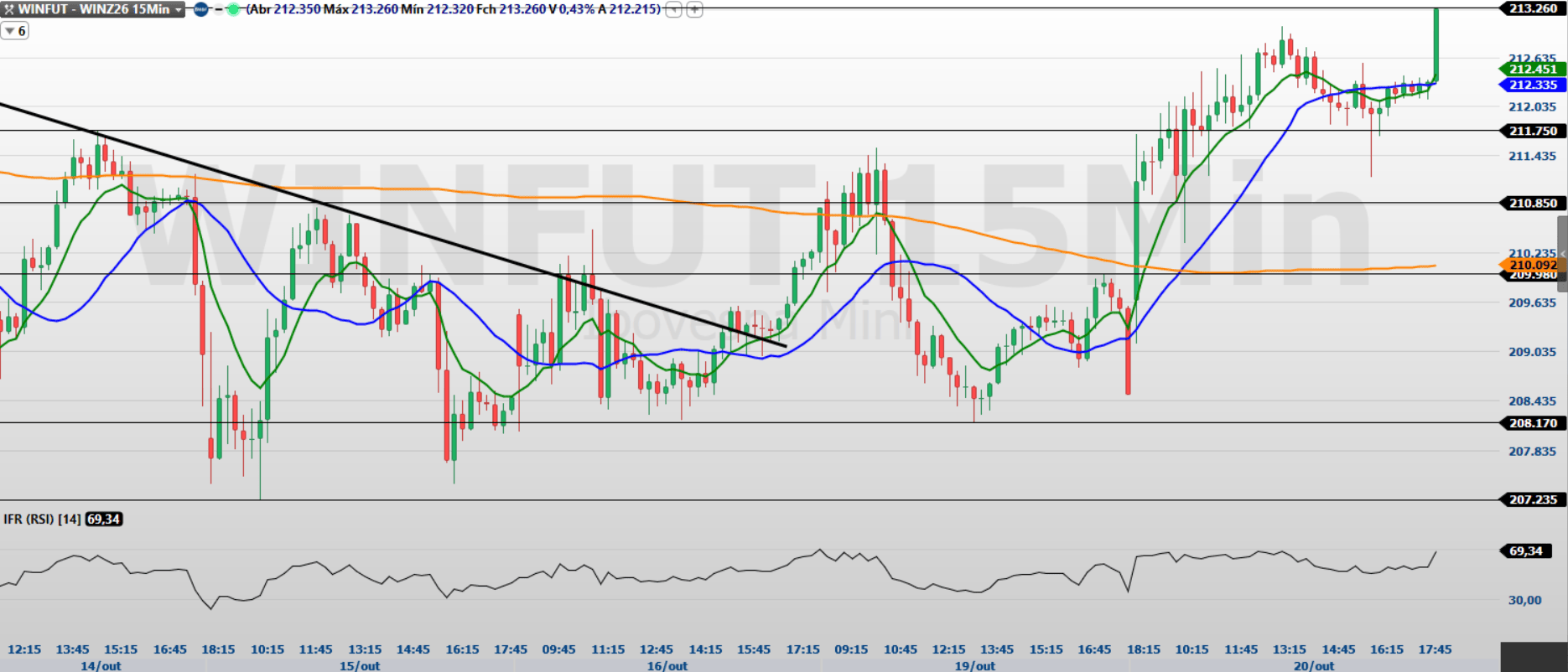
Os contratos de mini-índice (WINZ26), com vencimento em dezembro, encerraram a última sessão (20/10) em forte alta de 2,06%, aos 213.260 pontos. Os contratos de mini-índice deverão refletir a alta de 1,57% do Ibovespa, aos 208.295,98 pontos, sustentada pelo trade eleitoral e pelo recuo dos juros futuros. Bancos, B3 e varejistas lideraram os ganhos, enquanto Vale pressionou o índice e Petrobras avançou apenas 0,36%. No exterior, Wall Street terminou sem direção única, com o Nasdaq afetado pelas ações de inteligência artificial, enquanto o petróleo oscilou acima de US$ 100 e encerrou em queda.

Para os traders de mini-índice, o foco nesta quarta-feira estará no início da temporada de balanços, com os resultados da WEG (WEGE3) antes das negociações, e na expectativa pela pesquisa Quaest após o pregão. A reação de bancos, varejistas e B3 ao comportamento dos juros futuros será importante para medir o fôlego comprador, enquanto Vale, Petrobras, petróleo e Wall Street poderão determinar se o contrato volta a testar as máximas ou passa por realização.

Análise do gráfico de 15 minutos

No gráfico de 15 minutos, observo que o WINZ26 encerrou a última sessão no campo positivo e acima das médias móveis de 9 e 21 períodos. A forte valorização devolveu força aos compradores e mantém a possibilidade de continuidade do movimento, desde que o contrato consiga superar as barreiras mais próximas.

Para prolongar o fluxo de alta, o mini-índice precisará romper a região de 213.260/214.070 pontos. Caso avance acima dessa faixa com volume comprador, poderá buscar 214.510/214.900 pontos. O objetivo mais longo está localizado em 215.335/215.685 pontos.

Na direção contrária, acompanho o suporte em 212.335/211.750 pontos. A perda dessa região poderá favorecer uma realização de lucros e ampliar a pressão vendedora em direção a 210.850/209.980 pontos. Se a correção ganhar força, o alvo mais distante ficará em 208.170/207.237 pontos.

No gráfico diário, vejo o mini-índice fechar com forte alta e ampliar o impulso comprador. O contrato permanece acima das médias móveis de 9, 21 e 200 períodos, configuração que preserva a tendência principal de alta e favorece novos avanços.

Para consolidar a continuidade do movimento, o ativo deverá superar a faixa de resistência em 212.720/215.685 pontos. Acima dessa região, projeto como próximos objetivos 218.825/221.400 pontos.

Para uma reversão do fluxo, será necessário perder os suportes em 207.235/204.770 pontos. O rompimento dessa faixa poderá aprofundar a correção e levar o contrato em direção a 198.215/192.730 pontos.

O IFR de 14 períodos está em 69,18, próximo da região de sobrecompra. O indicador confirma a força recente dos compradores, mas também recomenda atenção a eventuais realizações de lucros após a forte valorização. Essa leitura, isoladamente, não representa um sinal de reversão.

Fonte: Nelogica. Gráfico 15 minutos. Elaboração Rodrigo Paz

Saiba mais:

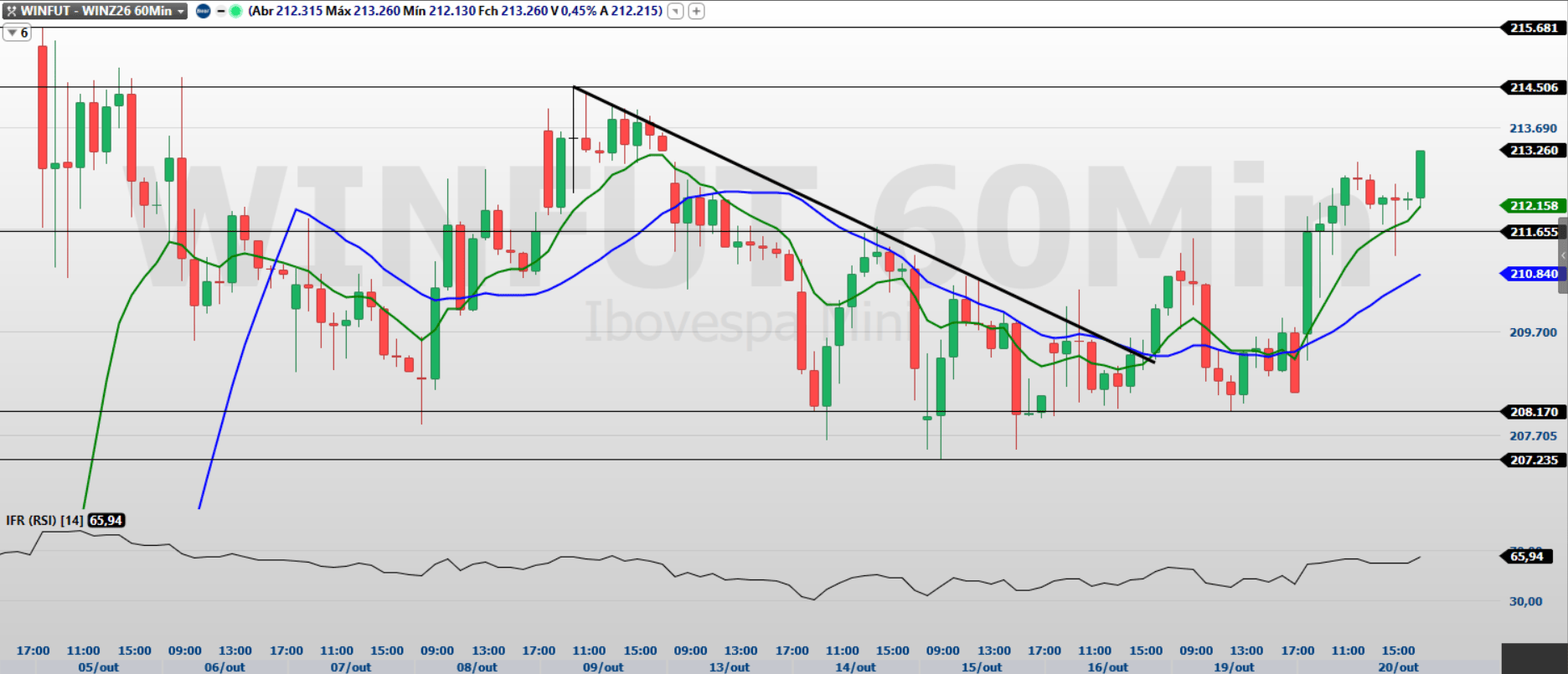
WINZ26: Gráfico de 60 minutos

No gráfico de 60 minutos, observo que o mini-índice também encerrou a sessão em alta e acima das médias móveis de 9 e 21 períodos. A configuração favorece os compradores e mantém o potencial de continuidade, mas o avanço dependerá da confirmação dos rompimentos com volume.

Para seguir com o fluxo de alta, o WINZ26 precisará superar a resistência em 214.510 pontos. Confirmado o rompimento, os próximos objetivos estarão em 215.685/216.720 pontos e, em um movimento mais amplo, em 218.825/220.935 pontos.

No cenário de baixa, acompanho inicialmente os suportes em 211.655/208.170 pontos. A perda dessa região poderá intensificar a pressão vendedora e levar o ativo até 207.235/204.770 pontos. Se o movimento corretivo se aprofundar, os alvos mais longos estarão em 203.540/201.620 pontos.

Fonte: Nelogica. Gráfico 60 minutos. Elaboração Rodrigo Paz

(Rodrigo Paz é analista técnico CNPI-T)

Guias de análise técnica:

Confira mais conteúdos sobre análise técnica no IM Trader. Diariamente, o InfoMoney publica o que esperar dos minicontratos de dólar e índice. 

The post Mini-índice (WINZ26): reta final eleitoral mantém volatilidade elevada appeared first on InfoMoney.

  •  

A era de “comprar tudo de IA” passou. E as neoclouds estão pagando a conta

A sul-coreana Elice decepcionou em sua estreia no mercado de capitais. Após captar US$ 151 milhões em seu IPO, com a demanda superando a oferta em cerca de 400 vezes, a empresa viu suas ações despencarem 32% no primeiro dia de negociações na Korea Exchange, na terça-feira, 20 de outubro. Longe de uma exceção, a […]

O post A era de “comprar tudo de IA” passou. E as neoclouds estão pagando a conta apareceu primeiro em NeoFeed.

  •  

Privatto, o family office dos herdeiros da Ipiranga, quer “pescar” em mar aberto

Eduardo Tellechea Privatto

A Privatto aumentou a frequência das viagens entre Porto Alegre, onde está a sua sede, a Faria Lima e outros centros financeiros do País. Com R$ 1,5 bilhão em patrimônio sob gestão e aconselhamento, concentrado em clientes do Rio Grande do Sul, o multi family office quer, agora, conquistar famílias empresárias em outras regiões brasileiras. […]

O post Privatto, o family office dos herdeiros da Ipiranga, quer “pescar” em mar aberto apareceu primeiro em NeoFeed.

  •  

BTG Pactual escala family office e traça plano para liderar wealth na América Latina

Pouco mais de um ano após comprar a operação brasileira do banco suíço Julius Baer e a área de wealth da JGP, de André Jakuski, o BTG Pactual concluiu a integração das duas aquisições que mudaram seu tamanho no segmento de grandes fortunas e começa a traçar uma estratégia para ganhar ainda mais espaço na […]

O post BTG Pactual escala family office e traça plano para liderar wealth na América Latina apareceu primeiro em NeoFeed.

  •