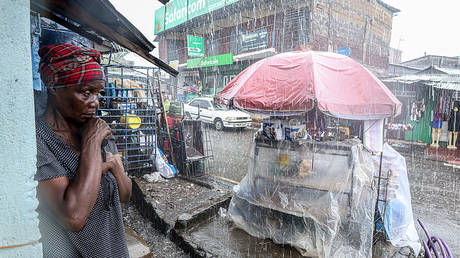
The US president touts “talks” with Iran as his Secretary of War vows to keep “negotiating with bombs”
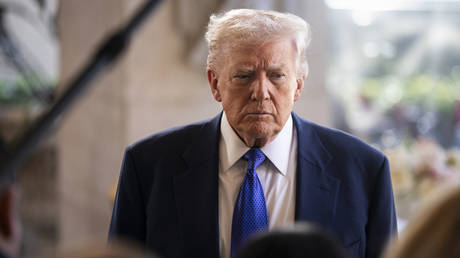
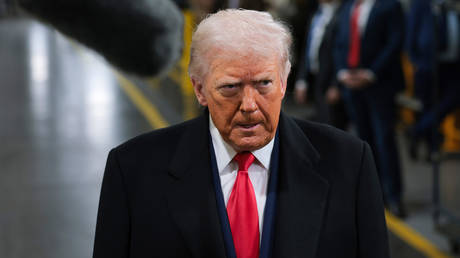
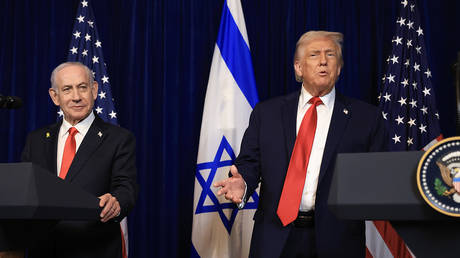
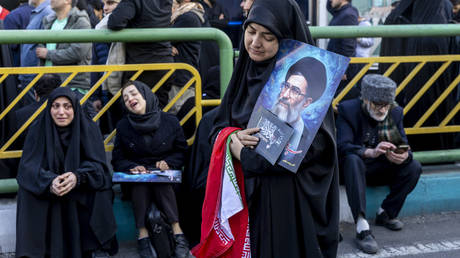
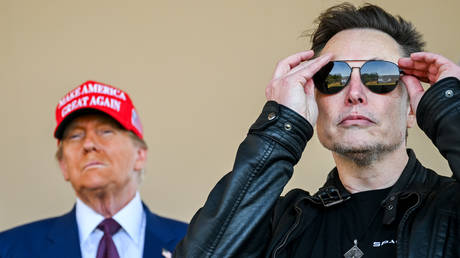
US President Donald Trump has claimed that talks with Tehran “are going very well” and delayed strikes on the Islamic Republic’s power facilities for another 10 days – while Israel has intensified its strikes and the Pentagon is reportedly mulling additional deployments to the region.
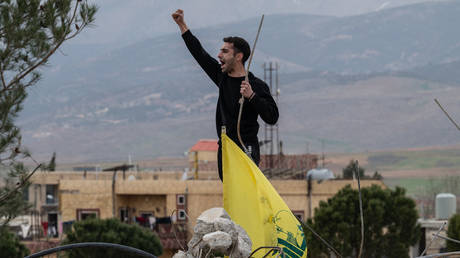
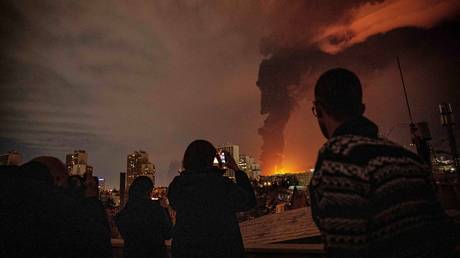
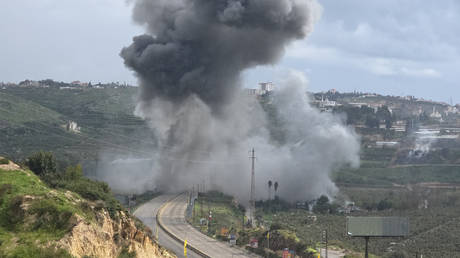
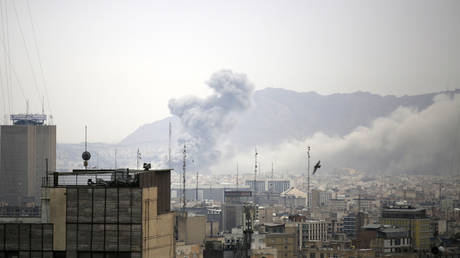
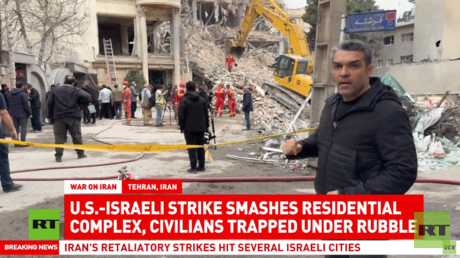
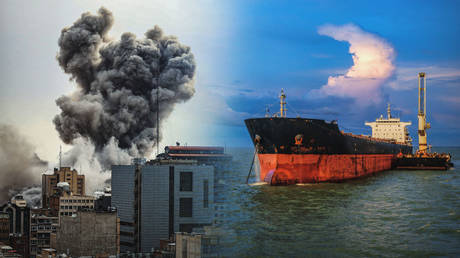
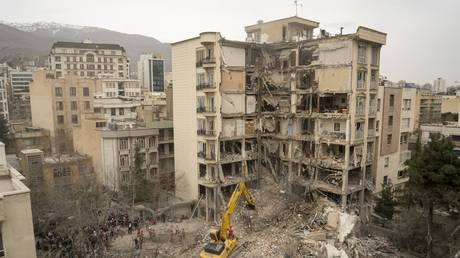
The IDF has conducted a wide-scale bombing raid “in the heart of Tehran” and elsewhere across Iran overnight, targeting unspecified infrastructure. The Iranian Red Crescent said the strikes hit multiple civilian buildings, with search and rescue operations underway in the capital, central city of Qom and Urmia in Iran’s West Azerbaijan province.
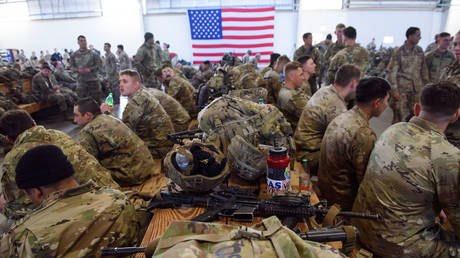
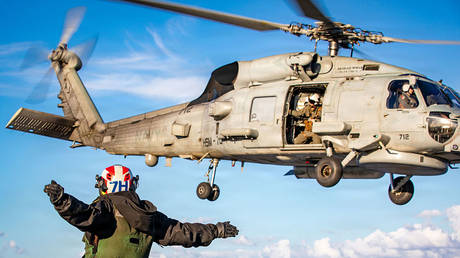
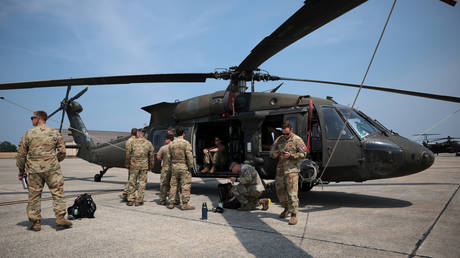
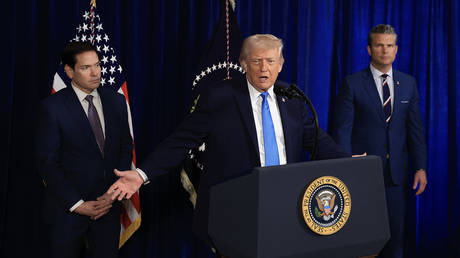
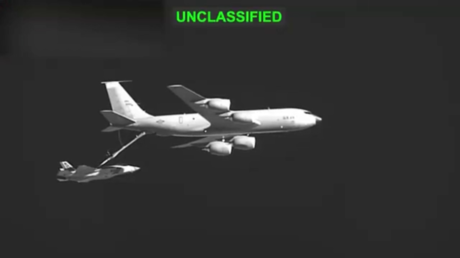
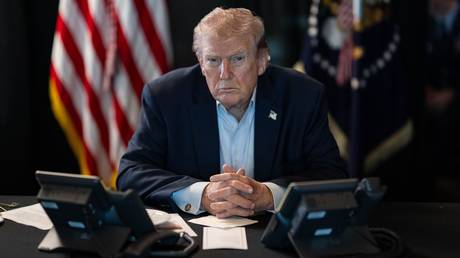
Although Trump has again touted alleged progress in negotiations during a White House Cabinet meeting on Thursday, the Department of War is reportedly considering deploying up to 10,000 additional ground forces to the Middle East. If approved, the new deployment would add to 2,000 elite paratroopers and up to 5,000 Marines already en route to the region.
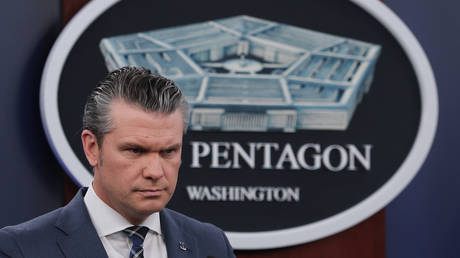
“The Department of War will continue negotiating with bombs,” Pete Hegseth has reiterated, amid mounting concerns of a looming ground invasion.
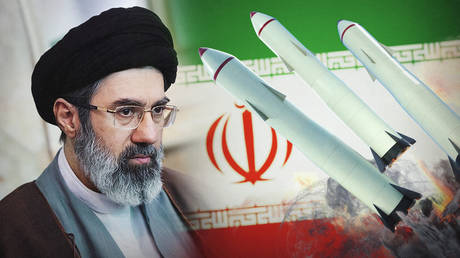
Tehran has denied holding any direct talks with the US and reportedly outlined its own strict terms for any ceasefire, refusing to talk on Washington’s terms, after the US and Israel already “backstabbed” Iran twice during negotiations.
Russia has close relations with Iran – but this does not mean it shares intelligence with Tehran – Foreign Minister Sergey Lavrov has said, noting that the locations of the US bases in the Middle East are “publicly available information” and “everyone in the region knows their coordinates.”
Trump initially threatened last Saturday to “obliterate” Iran’s power network if it does not reopen the critical Strait of Hormuz to international shipping. After Tehran warned it will retaliate against the entire regional energy infrastructure, Trump on Monday postponed his threat for five days. On Thursday, he again postponed the deadline until April 6, claiming that Tehran begged for more time.
Iran’s Foreign Minister Abbas Araghchi, who was reportedly “temporarily” removed from the US-Israeli kill list for Washington to have someone to talk to, has insisted that receiving messages does not constitute “talks.”
Follow our live coverage below for continuous updates. You can also read our previous updates here.
The scheme was to be disguised as a USAID project, a news outlet claimed, citing a recently declassified intelligence report
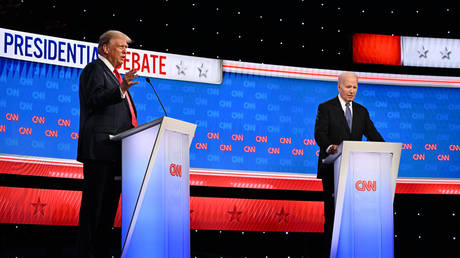
US President Donald Trump has posted a link to a news story claiming that the Ukrainian government was involved in a plot aimed at financing Joe Biden's 2024 re-election campaign.
The scheme would have relied on diverting US taxpayer money allocated for a USAID project in Ukraine, the media outlet Just the News reported on Thursday, citing a recently declassified intelligence report it obtained.
The plot dating back to late 2022 could have involved “hundreds of millions of dollars,” according to the report. US intelligence reportedly discovered the plot by intercepting Ukrainian government communications, the outlet said.
Director of National Intelligence (DNI) Tulsi Gabbard reportedly learned about the intercepts only recently and ordered a summary of all the information on the case, which was partially obtained by Just the News.
“The Ukrainian Government and unspecified US Government personnel, through USAID in Kiev, reportedly developed a plan that would provide hundreds of millions of US taxpayer dollars to fund an infrastructure project for Ukraine that would be used as a cover to send approximately 90% of funds allocated to the DNC to fund Joe Biden’s re-election campaign,” the document received by the news outlet states.
The plotters expected the project to eventually be “disapproved as unnecessary,” but not before they would collect the necessary sum that would be “would be difficult to track” and “impossible to return,” the report reportedly says.
According to Just the News, it is unclear whether Kiev moved forward with the plan. Neither the DNI office, nor Gabbard herself made any comments on the issue. Trump also did not comment on the link he posted.
Earlier in March, a US government auditor sharply criticized the lack of oversight in the USAID-managed Ukraine aid program worth $26 billion. A March report by the auditor found that Washington sometimes reimbursed duplicate payments to Ukrainian citizens living in other nations who were ineligible.
Trump dismantled USAID in 2025 after accusing it of wasteful spending. The State Department took over its responsibilities.
The Russian Embassy in London has condemned the step as “piracy”
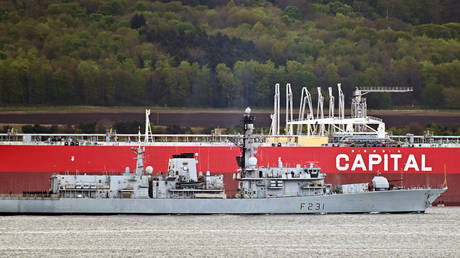
Russia has slammed a UK after it threatened to “interdict,” board and seize vessels in British waters it deems as being part of an alleged Russian ‘shadow fleet.’
Moscow has denied operating such a fleet and has condemned seizures of vessels on the high seas as “piracy,” stressing that it would take “all measures” to defend shipping.
In a statement on Wednesday, Downing Street said that London would coordinate with its allies in the ‘Joint Expeditionary Force’ (JEF) – a group of ten European NATO members – to “close off UK waters, including the [English] Channel, for sanctioned vessels.”
The goal is to force vessel operators to “either divert to longer, financially painful routes, or risk being detained by British forces,” the statement said.
In recent weeks, British military and law specialists have prepared scenarios for cases “including boarding vessels that don’t surrender, are armed, or use high tech pervasive surveillance to evade capture,” it said.
In each potential seizure, British law enforcement, military and energy market specialists will consider a ship before making a recommendation to ministers prior to execution, Downing Street said.
The Russian Embassy in London condemned the “deeply hostile step,” accusing the UK of planning to carry out “acts of piracy.”
“The stated objectives – combined with the timing of this announcement – leave no room for doubt that the recent escalation of Ukrainian attacks on Russian energy infrastructure also occurred with the involvement of the British side,” it said in a statement on Thursday.
Russia has long described London as a key force behind the Ukraine conflict, accusing it of directly participating in Ukrainian long-range strikes on Russian cities using UK-made weapons.
Kiev’s forces have increased attacks on Russian oil and gas infrastructure in recent months. Ukraine has also attacked ships it sees as linked to Russia in the Black Sea with naval drones.
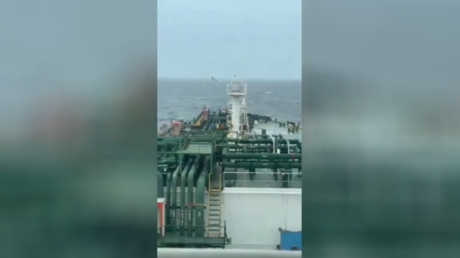
On Thursday, Türkiye’s Foreign Ministry reported that a Turkish-operated tanker in the country’s economic zone was hit by naval drones. It did not assign blame at the time of writing.
How a secret service raid exposed an alleged spy plot inside the Hungarian opposition
Behind Vladimir Zelensky’s public feud with Viktor Orban, the arrest of two suspected spies in Budapest adds to claims that the Ukrainian leader is waging a shadow campaign to take out the Hungarian prime minister.
On July 8, 2025, agents of Hungary’s National Bureau of Investigation (NNI) and National Security Service (NBSZ) raided two properties: a suburban home in a small town near Budapest, and a houseboat, packed with servers, hard drives, phones and covert recording equipment, moored on the city’s Danube waterfront.
The men targeted in the raids – a 19-year-old in the suburbs and a 38-year-old British/Hungarian dual citizen in Budapest – were IT specialists working for opposition leader Peter Magyar’s Tisza party. Between both locations, the raids yielded enough hard drives, USB drives, and computers that backing up all the data took over a month.
The operation didn’t make any headlines until this week, when two separate versions of events began to emerge.
Did Orban target his opponents?
According to a report by the pro-opposition outlet Direkt36, the government agents claimed that they were searching for child pornography, but came up empty handed. Instead, they seized files suggesting that both men were in contact with an unidentified handler codenamed ‘Henry’, who was instructing them to steal documents from Tisza’s servers and conduct cyberattacks against the party.
In this version of events, the NBSZ and Constitutional Protection Office (AH) steered the NIN’s investigation away from ‘Henry’, holding only in-person briefings on the matter and “persuad[ing] police leadership not to pursue the investigation in this direction.”
To the reporters at Direkt36, one of whom is currently being investigated for possible espionage, this intervention strongly hinted that the child pornography warrants were a ruse, and ‘Henry’ was a creation of the Hungarian secret services, who were running a “covert operation to bring down the [Tisza] party.”
This is the end. A world built on lies has shattered. Hungarian intelligence services, acting on the orders of @PM_ViktorOrban and his inner circle, have worked against the TISZA party, which is preparing for a change of government. This affair, the "Orbán-gate", recalls the…
— Magyar Péter (Ne féljetek) (@magyarpeterMP) March 24, 2026
The report does not explain why the secret services would raid their own operatives. Nevertheless, Magyar himself declared that the story “recalls the darkest days of communism and is even more serious than the Watergate scandal.” The supposed plot against Tisza “crosses every line” and “amounts to an attempted coup against Hungary,” he added.
Or was Tisza’s IT team working with Ukraine?
In an intelligence briefing declassified on Tuesday, Hungary’s National Security Committee filled in the details that Direkt36 allegedly left out. The 19-year-old suspect had been under surveillance since 2022, two years before the emergence of Tisza, the briefing states.
The suspect, identified as ‘HD’, allegedly made contact with an Estonian citizen in 2022, who sent him to Kiev the following year to train with the IT Army of Ukraine, a cyberwarfare group run by the Ukrainian government. HD is alleged to have carried out “several operations in the interests of Ukraine,” visited the Ukrainian embassy in Budapest on multiple occasions, and in May 2025, two months before the raid, also visited the embassy of an EU member state in to obtain “secret service tools.” The teenager was questioned twice by counterintelligence officers over these activities.
The suspect who lived on the boat was well known to Hungarian authorities, the report stated, and had a record of misuse of IT systems, computer fraud, and extortion. Identified as ‘MT’, he came under surveillance when he began working alongside HD for Tisza. The 38-year-old had allegedly been interested in purchasing intelligence tools since 2019, and once in contact with his teenage colleague, “participated in negotiations aimed at purchasing intelligence equipment that requires a license (spyware, signal jamming, devices suitable for disguised image and sound recording).”
The two men contacted a “well-known spyware manufacturer and distributor” in February 2025, aiming to purchase the software, the report states. HD, it claimed, has admitted to counterintelligence agents that “he was assisted in this by the secret service of a European Union country.”
Hungarian authorities launched the raids having received an anonymous tip claiming that the suspects planned to use some of these tools to covertly record child pornography. While the accusations have not been substantiated, they are now being investigated for possessing or manufacturing “military equipment requiring a license.”
In this version, it is unclear whether ‘Henry’ was one of HD’s foreign contacts, or whether he was an undercover Hungarian agent building a case against the two suspects.
📷💥 Photos now prove it: Tamás Maróti, the Tisza Party IT specialist identified as a Ukrainian spy, had free access to the party’s former central office.
❓But who is Tamás Maróti (alias “Buddha”)? The man had already been on the authorities’ radar years earlier - he was… pic.twitter.com/bqTIxpqJAa
Government spokesman Zoltan Kovacz has named ‘MT’ as Tamas Maroti. On Thursday, Kovacz published a series of photos showing the alleged spy meeting with Tisza campaign chief Peter Toth, and leaving the party’s headquarters shortly before Tisza MEP Zoltan Tarr and party vice president Mark Radnai.
Who’s reporting what? Behind Direkt36
Run by opposition journalist Szabolcs Panyi, Direct36 is the Hungarian branch of Vsquare, a pro-EU, pro-Ukraine journalistic nonprofit funded by the US State Department’s National Endowment for Democracy (NED), USAID, the German Marshall Fund of the United States, and two EU-backed journalism funds.
Vsquare's article on alleged Russian influence in the Hungarian election, and a list of the outlet's donors from its website
Vsquare and Panyi will be familiar to anyone following our ‘Battle for Hungary’ series. In an article citing unnamed European spies, Vsquare claimed this month that Russian President Vladimir Putin had sent military intelligence agents to Budapest to rig the election for Orban.
Panyi then admitted that he helped “a state organ of an EU country” wiretap Hungarian Foreign Minister Peter Szijjarto. Foreign intelligence agents then leaked details of Szijjarto’s conversations with Russian Foreign Minister Sergey Lavrov back to Western media outlets, including Politico and the Washington Post
Panyi, who described himself on the call as a “quasi-friend” of Tisza politician Anita Orban and a potential power broker should Magyar defeat Viktor Orban in April, claims that the call proves collusion between Szijjarto and Lavrov. On Thursday, as a slew of pictures of Panyi with former USAID head Samantha Power hit social media, Hungarian authorities announced that an espionage case has been opened involving his role in wiretapping Szijjarto.
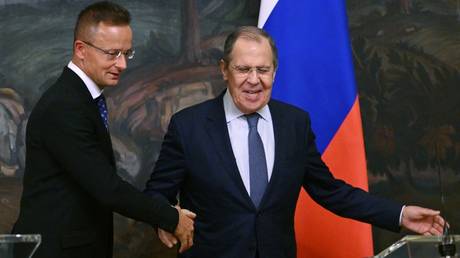
Szijjarto does not deny speaking to Lavrov, maintaining that such diplomatic outreach is part of his job.
Why is Ukraine involved?
It is unclear whether the higher-ups at Tisza knew of the two suspects’ alleged ties to Ukraine. Likewise it is hard to determine what levels of the Ukrainian security apparatus knew of their work.
However, Kiev has a vested interest in the outcome of the election – after all, Vladimir Zelensky wouldn’t make barely concealed threats against Viktor Orban's life over minor ideological differences.
Hungary has used its EU veto powers to delay every package of energy sanctions imposed on Russia by the bloc, relenting only when given exemptions that allow it to continue purchasing Russian fossil fuels. Orban opposes Ukraine's potential accession to NATO, refuses to supply arms to Kiev, and is currently vetoing a €90 billion EU loan package for Kiev, hacked together after Commission President Ursula von der Leyen’s failure to push through a move to steal Russia’s frozen sovereign assets.
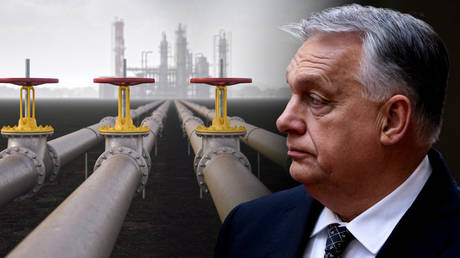
Zelensky has responded by publicly attacking Orban and by refusing to reopen the Druzhba pipeline, which carries Russian oil to Hungary and Slovakia via Ukraine. He insists that the pipeline – which Hungary depends on for more than 80% of its oil imports – was damaged in a Russian attack. Budapest and Bratislava claim that satellite photos prove Druzhba is visibly operational, and that Zelensky is lying in order to force both countries off Russian oil or crowbar Budapest into backing more aid for Kiev.
The EU has made public overtures toward restarting Druzhba, with Brussels proposing a “fact-finding mission” to assess the supposed damage and resolve the dispute. However, as RT explored in the first installment of our ‘Battle for Hungary’ series, the bloc is also working against Orban in the runup to the election, leveraging its online censorship tools to benefit Magyar.
In a phone conversation leaked earlier this month, European Commission President Ursula von der Leyen’s communications adviser told a Politico reporter that the EU won’t force Zelensky to reopen the pipeline, as doing so would benefit Orban’s campaign.
Orban has claimed for months that Ukraine is waging a quiet war against his government “The Ukrainians are actively working to bring about a change of government in Hungary,” he told Hungary’s Kossuth Radio in October. “Their secret service is here all the time. Tisza is a pro-Ukrainian party, this is their party, so they will do everything to help the Tisza party form a government.”
“I call on president Zelensky to order his agents home immediately and respect the will of the Hungarian people,” Orban said in a video address on Thursday. “Ukrainian spies and IT specialists paid by the Ukrainians come in and out of the Tisza party. There has never been an election in Hungary so deeply interfered with by foreign secret services.”
🚨 @PM_ViktorOrban: I call on President @ZelenskyyUA to recall his agents and respect the will of the Hungarian people. Foreign interference in our elections is unacceptable. Hungary will defend its sovereignty and ensure Hungarians decide their own future. pic.twitter.com/pOQF16gEA5
Brussels, Kiev, and the Hungarian opposition media have made no secret of their desire to oust Orban. With the election nearly two weeks away, every new scandal suggests closer collaboration between all three players, and use of the very same tactics that Panyi and the opposition accuse Orban of deploying.
A counterintelligence probe into the case of the two IT specialists is ongoing. One side says that the raid was a textbook example of political repression; the other says it was the culmination of a years-long investigation into well-known cybercriminals working in cahoots with Ukraine.
Hungarian government spokesman Zoltan Kovacs said on Tuesday that “further facts will be made public this week so that it becomes clear to everyone that the Hungarian left is once again attempting to come to power with foreign - primarily Ukrainian - assistance.”
A women-only bar in Minsk, and the reaction it sparked
If you haven’t seen an example of collective male hysteria for a while, take a look at the comments on the news story about the opening of a women-only pub in Minsk. There are tears, threats, and even strategic plans to take over the territory. The men commenting are furious that there will be a place in the city where they aren’t welcome.
I thought we’d moved past the stage where the emergence of a ‘girls-only’ venue would provoke anger and horror. After all, it’s 2026. In neighboring Belarus, the president has declared the Year of the Woman, and entrepreneur Alexandra Tyamchik has decided to open a women-only beer bar. You might think: what’s the big deal? Just another bar for women, yes? Yet, for some reason, internet knights have rushed to defend their wounded egos.
What do men write about? Well, the usual things. ‘I doubt women can drink as much as men.’ Guys, are you serious? Do you go to bars just to compete over how many drinks you can have? It’s terrifying to imagine what you get up to at all-inclusive hotels.
If it were just these kinds of comments, we could simply ignore them. However, other users were hatching devious plans: ‘You can drive up there and pick someone up who’s already had a few.’ Thank you for confirming this, dear ones: women don’t open such bars to cause trouble, but because no one wants to feel like a ‘ready-made’ option in any establishment.
Some people even suggest going there just to spite them. Here you go: “The funny thing is, it won’t just be girls going there. Blokes will go too, and no one will be able to do anything about it.’ Very mature. It’s just like in the sandpit: ‘Since the girls built a house, we’ll go and knock it down!’ Except this house isn’t yours and there’s nothing in it to knock down except your own dignity.
Actually, I don’t think this story is really about beer, or about women not knowing anything about it. Incidentally, the production director at one of Belarus’s most famous breweries is a woman.
The real question is: why does the idea of a space where men aren’t welcome make them so angry?
This reminds me of an interesting historical fact. In the late 19th century, when cafés began to appear in Europe’s first department stores and railway stations, places where a woman could go alone or with a friend without risking her reputation, he male half of society was equally horrified. What? A lady eating in a public place without being accompanied by her husband or brother? That’s debauchery and the end of the world! Now, they’re just coffee shops we pop into a hundred times a day.
We’ve had women-only train carriages and gyms for a long time. Do you think these are just to keep the opposite sex at bay? As strange and frightening as it may seem, it’s all for safety’s sake. It’s so that we can get from work to home without the risk of being harassed. To go to the gym wearing whatever you feel comfortable in, rather than something that might make you feel like a product on a shop shelf. To exercise without worrying that someone will come up and tell you that it’s not a woman’s job.
All we want is to do what we enjoy in a place where we feel safe and comfortable.
It’s the same here. Women just want to sit around, drink beer, eat pretzels, chat about their lives, laugh out loud, be quiet and think to themselves without having to deal with stares that say, ‘Fancy a chat?’ We don’t want to plan our route to the toilet so that we avoid running into a compliment from a tipsy neighbor. Nor do we want to wait for someone to come and sit next to us five minutes later and ask, ‘Are you here on your own, miss?’
The funniest or saddest thing is that women react to this outburst with bewilderment in the comments. One of the men asked, ‘How would you feel about a bar without women?’ The girls’ replies are brilliant: they all say they don’t care. And it’s true, we don’t need your territory. We’re not going to fight men in vests for a spot in pubs near the Underground or barge into bars where you watch football. We just want our own little corner, free from all that. So why do you need to barge in there?
I reckon a bar like that would be an instant hit in Moscow. It would be lovely to have a beer with my girlfriends in a cosy setting without having to put up with some bloke nearby who thinks he’s the only one allowed to drink beer. It would also be great to be able to order a beer with a friend without feeling that underlying anxiety, or worrying that someone might come over to chat, try to pick you up or crack crude jokes.
Overall, I’m really happy for the women of Minsk. To the men who write about ‘failure’ and ‘unmarketability’, I’d like to say: you’re just afraid that it’ll be too much fun without you there and that the beer will taste better than in your favorite bar. And you know what? It will. But don’t be upset. After all, there are always other bars where you won’t be chased away.
This article was first published by the online newspaper Gazeta.ru and was translated and edited by the RT team
What the euthanasia of Noelia Castillo reveals about the future of European society
Today in Spain, a 25-year-old woman named Noelia Castillo is scheduled to undergo euthanasia. Born into a dysfunctional family in Barcelona, Noelia spent her childhood in shelters and fell victim to gang rape in 2022. This trauma resulted in severe clinical depression, and she attempted suicide twice. Her second suicide attempt left her paralyzed and confined to a hospital bed. Since 2024, Noelia has been paralyzed. She requested permission for euthanasia, and psychiatrists determined that her case met the necessary criteria for the procedure: the young woman lives in constant pain and has an irreversible medical condition that does not allow her to have a normal life. However, Noelia’s father intervened.
He vehemently opposed the decision, arguing that his daughter needed assistance, not assisted suicide. Despite their complicated relationship and past parental rights issues, he said that her death would cause him great suffering. He sought help from the Abogados Cristianos (Christian Lawyers) organization. The legal battles lasted two years. Throughout this time, Noelia, who was denied the right to end her life, repeated, “My everyday life is awful and tormenting.” Ultimately, her father lost the case. Both the Constitutional Court and the European Court of Human Rights affirmed Noelia’s right to euthanasia. She is set to die this evening.
Before her death, Noelia gave an interview to Spanish television and explained her reasons for making this decision. To me, this is the most cynical part of the story. They are not only “assisting” her in dying, but are using her to popularize euthanasia. Perhaps soon we may see a surge in others seeking the same procedure. Life isn’t a fairytale; there are people who, right now, suffer from severe illness and pain. Some endure their illness, believing they must bear their trials with dignity, aware that they aren’t alone in the world, and that their family or loved ones will suffer even more if they die. Yet others might listen to Noelia and think, 'Why shouldn’t I just end it all right now?'
Of course, someone will tell me, 'Why don’t you try living with constant unbearable pain!' But I have something to answer to that. Personally, I do not judge those who live in great pain. I do not judge Noelia for wanting to die. However, for me, what is truly terrible is a government and society that choose to help someone to die, instead of dedicating every effort to saving them. The criminals who raped her turned her into a victim. But society, in its own way, also contributes to her being a victim by saying, 'Yes, you are irreparably broken. Both mentally and physically. It’s really better for you to go.' What gives them the right to say that? Every life is priceless. For whom, then, are pharmaceutical companies constantly developing new painkillers? Why is Elon Musk creating chips to help paralyzed individuals lead fulfilling, active lives? What’s the point of these innovations if we can simply nudge someone toward leaving this world?
Euthanasia was bound to emerge in a consumer-driven European society. A person lives normally and contributes to society until they can no longer function physically. And when they become a burden, the state permits them to die and even encourages such decisions by promoting euthanasia. But what about the soul?
And I am not just talking about the soul trapped in the suffering body; I am also talking about the soul of society. Where does that soul find purpose if it refuses to help those with incurable conditions and save victims? Noelia’s father didn’t hire Christian Lawyers for nothing; it seems that secular lawyers in Europe have become totally alienated from Christian arguments. Yet, living in Russia, I also fully support the Christian position: what matters most in a person is the soul, and that soul can still work, can still strive towards perfection, even inside a paralyzed body.
How do we know why someone must endure immense pain and suffering? Perhaps God is nurturing their soul and preparing to draw them closer to Him after death.
European society would laugh at me if I wrote such things. What soul, what God – they’d say – this person is consuming resources without contributing anything, just let them go!
However, the argument for 'let’s end their suffering' appears humane only on the surface. In reality, it’s a consumerist solution. Provide Noelia with the best psychotherapists so she can understand that she doesn’t have to live life as a victim and that people can find happiness even when immobile. Provide her with the most effective pain management. Give her one of Musk’s chips. Oh, so Europe lacks those resources? Well, then, this is a conversation about resources. A humane society should focus on finding solutions rather than letting someone die. From a Christian perspective, now is the worst possible time for Noelia to die—her soul isn’t ready; she hasn’t learned life’s most important lesson: becoming a victim once doesn’t mean you’re a victim for life. And it seems that her father, regardless of his flaws, understands this.
Ordinary citizens want peace, but bureaucrats are driven by military lobbies, Rudi Kennes has told RT
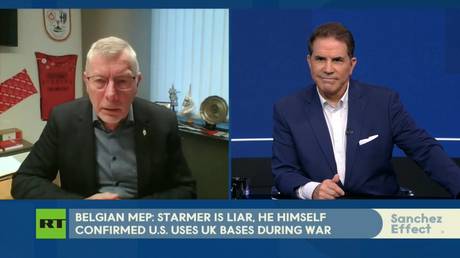
The EU is divided over the US war against Iran, with public opinion strongly opposing it, while unelected officials in Brussels back Washington, Belgian MEP Rudi Kennes has told RT’s Rick Sanchez.
European countries have failed to present a unified front on the war, with Spain and Italy voicing criticism, while others, including France, are avoiding outright condemnation and have increased their military footprint in the Middle East. Bureaucrats in Brussels, meanwhile, have focused largely on the lack of prior US consultation, while failing to condemn the campaign.
Kennes, a former trade unionist, said EU officials are influenced by industry ties and military lobbies that profit from conflict.
”I think it’s all about the money. It’s no news that European leaders are not representing the majority of the European people,” he said. “They just follow the big leaders [and] it’s also about the lobbies, the military lobby, who actually are much empowered.”
He argued that many EU officials come from industry and are likely to return to it, meaning “they only listen to... lobbies” which got them elected, while biding their time in top posts. Kennes noted that neither European Commission chief Ursula von der Leyen nor EU foreign policy chief Kaja Kallas were democratically elected, and do not feel accountable for their actions.
Kennes acknowledged that some officials have begun expressing doubts about the Iran war, but said this is driven by rising oil prices and declining public support rather than genuine opposition to military aggression.
He stressed that ordinary Europeans “don’t want war,” as military spending comes at the expense of social services.
“We have waiting lists for housing and medical care. And all they say is, if we ask a penny to go there – there is no money,” he said. “But for wars, there is always money. This is the main problem.”
Kennes cited recent polls showing rising public discontent across Europe over the war and opposition to potential involvement in it, urging politicians to heed public opinion.
The EU and the UK are unprepared and face deindustrialization after rejecting Russian oil and gas, Kirill Dmitriev has said
The world is heading toward the most severe energy crisis in history and Europe is unprepared, Kremlin envoy Kirill Dmitriev has said. The warning comes as the escalating conflict in the Middle East has driven volatility in global energy markets.
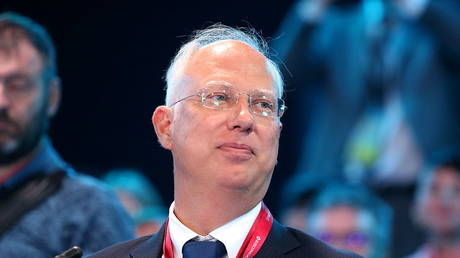
Speaking on Thursday, Dmitriev – who heads the Russian Direct Investment Fund (RDIF) and is President Vladimir Putin’s special envoy for investment and economic cooperation – said he earlier predicted that oil would exceed $100 a barrel if a conflict like this broke out.
“Back then, no one believed,” he said, adding that some market participants are now discussing the possibility of prices rising to $150 or even $200.
“We see that the most severe energy crisis in the history of mankind is approaching. Neither the EU nor the UK is at all prepared for it,” Dmitriev said on the sidelines of the RDIF congress. Brussels and London “shot themselves in the foot” by rejecting Russian oil and gas, and the consequences of this are only beginning to emerge, he added.
Dmitriev warned that the EU faces deindustrialization, and that “big problems” await the UK, arguing that this the result of choices made by European Commission President Ursula von der Leyen and other “Russophobic politicians.”
Western governments will eventually be forced to seek renewed access to Russian energy, he said.
Oil and gas prices have spiked since the escalation of the Middle East conflict, triggered by the US-Israeli strikes on Iran and subsequent Iranian retaliatory attacks across the region, which have led to the effective closure of the Strait of Hormuz to Western shipping.
The strait normally carries around a fifth of the world’s daily oil supply, and the IEA has warned that disruptions could last months or years. European gas prices have risen by around 70% since March 1; Brent crude has topped $110 per barrel, prompting Washington to ease the sanctions on Russian oil.
The EU was already grappling with the fallout from its decision to cut energy ties with Russia following the escalation of the Ukraine conflict, as well as the costs of its green transition policies.
The European Commission has said there will be no return to Russian energy, and it will continue to pursue a full phase-out of Russian fossil fuels by 2027. This week, however, it put plans for a complete ban on Russian oil on hold, due to what some officials reportedly called “current geopolitical developments.”
An activist had embezzled some $180,000 in donations at the height of the protest movement, according to court records
A US federal court has ordered a former Black Lives Matter (BLM) activist to forfeit $244,000 which she embezzled for cars, shopping sprees, vacations and other personal expenses.
In a court decision published on Monday, a Massachusetts district judge ordered Monica Cannon-Grant to pay restitution. The activist rose to prominence during the height of the BLM movement after the death of George Floyd in Minneapolis in 2020 and was later named Bostonian of the Year.
Cannon-Grant established the nonprofit organization Violence in Boston with her late husband Clark Grant, through which she embezzled more than $180,000, according to court records. She also defrauded local authorities for more than $50,000 in pandemic benefits and rental assistance which she did not need, the documents said.
In January, Cannon-Grant was sentenced to four years of probation, six months of home detention and 100 hours of community service, after she had pleaded guilty to 18 federal charges, including wire fraud and tax offenses.
The activist couple had been charged in 2022, and the nonprofit organization was shut down by its board months later. Clark Grant died in a motorcycle accident the following year.
Other BLM activists and organizations have come under more intense scrutiny in recent years.
Last October, the US Justice Department issued subpoenas and a search warrant as part of an investigation into Black Lives Matter Global Network Foundation, Inc. and “other Black-led organizations,” according to the Associated Press.
The verdict comes after Facebook’s parent company was ordered to pay $375 million for profiting from exposing youngsters to online abuse
A jury in California found Alphabet’s Google and Meta liable for $6 million in damages on Wednesday in a landmark lawsuit in which the social media giants were accused of being legally responsible for the addictive design of their platforms.
Major US tech companies have faced increasing scrutiny over child and teen safety over the past decade, a debate that has now moved into courts and state legislatures. According to the National Conference of State Legislatures, an organization that tracks state laws, at least 20 states enacted laws on social media usage and children in 2025.
A jury ordered Meta to pay $4.2 million and Google $1.8 million in a lawsuit by a 20-year-old woman identified as Kaley, who said she became addicted to YouTube and Instagram as a minor due to features – such as infinite scrolling – which encourage prolonged engagement. Of the total award, about $3 million is compensation to the plaintiff, while the remainder represents punitive damages.
Both tech giants said they disagree with the ruling, and announced plans to appeal. TikTok and Snap were also named as defendants in the case, but managed to settle before the trial began.
On Tuesday, a jury in New Mexico ordered Meta Platforms, which runs Facebook, Instagram, WhatsApp and Threads, to pay $375 million for knowingly harming children’s mental health and concealing evidence of child sexual exploitation, saying its personalized algorithms could also aid pedophiles.
A separate social media addiction case brought by several states and school districts against major technology companies is expected to go to trial this summer in federal court in Oakland, California. Another state trial is scheduled to begin in July in Los Angeles and will involve Instagram, YouTube, TikTok, and Snapchat.
Globally, Meta Platforms faces growing regulatory pressure, having been labeled an “extremist organization” in Russia in 2022 and targeted by multiple European Union actions, including a €797 million ($940 million) antitrust fine and other copyright, data-protection and advertising cases across Europe.
Amid growing concerns over child safety online, countries including Australia, Denmark, France, Spain, Italy, Slovenia, the UK, Indonesia, and Malaysia are restricting or considering limits on social media access for children and teens.
Behind Trump’s rhetoric lies a search for strategic pause, political cover, and a way to contain rising costs
In recent days, there has been a noticeable shift in US President Donald Trump’s rhetoric regarding Iran. Less than a week ago, Trump issued a 48-hour ultimatum to Iran, threatening strikes against Iran’s energy infrastructure if it refused to unblock the Strait of Hormuz. Now, Trump has expressed openness to negotiations and even claims that some contact with the Iranian side has taken place. This rhetorical shift may not reflect a genuine diplomatic process but could be part of an information strategy. After it became clear that Tehran was unwilling to make concessions and was unresponsive to Trump’s coercive pressure, the US attempted to make it look like the Iranian side was the one suggesting talks.
Israeli news outlet Ynet claims that Iranian Supreme Leader Mojtaba Khamenei has agreed to negotiate with the US. However, no credible evidence has surfaced to back this, raising questions about the sources of the information and its purpose. Given the current dynamics, these reports can be seen as propaganda aimed at crafting an image of Iran as vulnerable and eager for urgent dialogue with Washington. These interpretations might serve to reinforce the narrative of Tehran’s weakening position.
In Tehran, this is perceived as an attempt to influence global energy markets. Public signals from the US, particularly from Trump, affect oil and gas price dynamics, especially amid tensions surrounding the Strait of Hormuz – a critical artery for global hydrocarbon supplies. In this context, talk of negotiations can be viewed as a tool for stabilizing expectations and reducing market volatility.
Iranian society and elites remain skeptical about negotiations with the US. Based on past experiences, Iran believes that diplomatic agreements with Washington do not lead to long-term de-escalation and are often followed by increased pressure or an escalation of the conflict. In the current situation, Iran maintains that its position does not necessitate immediate negotiations. Furthermore, within the regional landscape, Iran possesses the capability for asymmetric influence, utilizing allied actors and indirect means of leverage.
It’s also quite possible that Trump’s signals about purported or existing contact with the Iranian leadership serve not only foreign policy goals but also internal political goals. Specifically, they may aim to sow distrust and competition within Iranian elites through leaks about ‘secret negotiations’ and hints about individuals potentially open to dialogue. This strategy aligns with the logic of psychological and information warfare: Creating an atmosphere of suspicion, questioning the loyalty of certain political and military leaders, and undermining consensus on key foreign policy issues.
The unity of the political, military, and religious establishments is a crucial factor in Iran’s resilience in the conflict. In this context, the narrative about an ‘internal divide’ can be viewed as an attempt to inflict damage, and its consequences may prove more significant than direct military pressure.
Amid the talk of supposed negotiations, however, it’s interesting to consider potential political figures that could engage in talks. According to the US, one candidate might be Speaker of Parliament Mohammad Bagher Ghalibaf, one of the most influential players in the Iranian political landscape. Ghalibaf occupies a unique position within Iran’s power structure. On the one hand, he represents the parliament, a key institution of political legitimacy that plays a vital role in balancing the interests of various elite groups. On the other hand, he has solid ties with both the Islamic Revolutionary Guard Corps (IRGC) and the country’s religious leadership, making him a possible link between the military, political, and spiritual centers of decision-making. In the absence of formal dialogue channels between Washington and Tehran, these types of figures gain considerable importance as potential informal negotiators.
Officially, however, Tehran denies having any sort of negotiations. Ghalibaf’s office has already stated that no negotiations with the US are taking place or are planned. This position aligns with Iran’s traditional diplomatic practice aimed at minimizing external pressure and maintaining an image of strategic autonomy. Public denials of negotiations do not preclude the existence of private communication channels, but they underscore Iran’s reluctance to acknowledge any dialogue on terms dictated by the US. Moreover, even for moderate Iranian politicians, engaging with Trump would be seen as an act of betrayal; if Tehran were to agree to talks, it would likely require the explicit approval of the supreme leader and the IRGC, who currently protect the integrity of Iran’s system.
If any contact does take place, it is likely to be conducted through intermediaries. In this regard, countries like Oman, which have experience mediating US-Iran discussions, traditionally play a significant role. Pakistan, too, could leverage its regional connections and channels of interaction with Iranian elites. This multilayered diplomacy allows parties to maintain maneuverability without making public commitments. Notably, Oman has been one of the few Gulf monarchies to speak out candidly, accusing the US and Israel of unwarranted aggression.
Strategic calculations: Why Washington talks and Tehran waits
The critical question, however, is to what extent these negotiations align with Iran’s current interests. Judging by the rhetoric and behavior of the Iranian elites, there appears to be a growing conviction in Tehran that the country has adapted to the hostilities with the US and its allies, including Israel. Furthermore, Iran believes that a prolonged conflict will undermine Washington’s international credibility, revealing its limitations in achieving strategic objectives.
In this context, the prolongation of the conflict becomes a calculated strategy. The longer the war persists, the greater the costs for the US. And it’s not just about military expenses but also political, economic, and reputational repercussions. For the Trump administration, this means finding a balance between displaying strength and avoiding a full-scale escalation (whether through a ground operation or even nuclear strikes) that could lead to uncontrollable consequences. Therefore, increased rhetoric regarding negotiations can be seen as an attempt to solidify an interim outcome and prevent an escalation of the conflict.
From this perspective, a logical contradiction arises: If the US were to achieve decisive success, there would be no real need for negotiations. After all, there’s no point in negotiating with a defeated adversary. Thus, the very initiative for dialogue indirectly suggests that Washington does not hold a definitive advantage and seeks a way out of the situation with the least possible costs.
As for Iran, it shows readiness to play the long game. By refusing direct negotiations but theoretically keeping the door open for dialogue, Tehran maintains strategic flexibility. This position allows Iran to increase pressure while waiting for more favorable conditions in the future. Given that each day of the conflict escalates costs for the US, this strategy can be viewed as rational and aligned with the long-term interests of the Iranian leadership.
In the context of the current crisis, Washington’s persistent push for talks with Tehran can be explained by at least three strategic motivations. All three don’t have to be in play simultaneously; one of these motives is enough for the White House. In this light, Trump’s negotiation rhetoric isn’t so much a sign of diplomatic optimism as a tool for flexible maneuvering, especially as military efforts have not yielded quick or clear results, and Iran continues to dismiss claims of direct dialogue.
The first motivation might be that Washington needs negotiations as a tactical pause, allowing time to regroup, disorient Iran, and prepare for the next phase of military pressure. This hypothesis seems plausible, particularly since the current phase of the conflict has already exposed the limitations of America’s initial calculations. Notably, Trump’s decision to take a step back following threats against Iranian energy infrastructure came amid warnings from the Gulf Arab states and an acknowledgment of the potential scale of retaliatory actions. In this light, the negotiation agenda could serve the classic function of an operational pause: Regrouping forces, reassessing Iran’s capabilities, replenishing supplies, and refining coalition structures before the next phase of escalation.
The second motivation for the talks is that Trump may genuinely be seeking a way to end the war without appearing politically defeated. He may want to exit the crisis with minimal reputational damage. This scenario doesn’t seem far-fetched either. Amid ongoing strikes, the deployment of additional US forces in the region, and no clear signs that Iran is about to capitulate, negotiations become a means to declare at least partial success. For Trump, this is particularly important.
A prolonged conflict escalates costs across multiple fronts: From increasing pressure on energy markets, to rising anxiety among allies in the Persian Gulf, growing doubts about the effectiveness of the US strategy, and growing domestic criticism. In this context, Trump may seek to frame de-escalation as his own diplomatic triumph, shifting blame for military miscalculations onto those directly involved in executing the strategies. This tactic is familiar in American political practice; when operations don’t yield expected results, presidents often try to protect their political capital by deflecting scrutiny away from themselves and directing it toward members of their administration. Trump’s recent mention of Secretary of War Pete Hegseth in relation to the conflict shows that the White House is already crafting a narrative in which Hegseth could potentially be turned into a scapegoat responsible for any failures.
A third reason to initiate talks might involve buying time to encourage regional partners, particularly Saudi Arabia and the UAE, to become more actively engaged in the conflict, thereby forming a broader anti-Iran coalition. However, it’s important to note that there’s currently no clear indication that Riyadh or Abu Dhabi is prepared to join the fight alongside the US; in fact, the Gulf states have warned Washington about the risks of catastrophic backlash and the vulnerabilities of their own infrastructures. Nevertheless, from a strategic standpoint, the idea of expanding the coalition makes sense. The more players involved, the lower the cost of America’s participation; also, it would be easier to present the conflict not merely as a bilateral US-Iran confrontation, but as a collective effort to ‘restore regional stability’. In other words, the pause taken for negotiations may not only serve a diplomatic purpose, but may also be used for recalibrating the regional political-military front.
Taken together, these factors lead to an important conclusion: Trump’s talk about negotiations indirectly suggests that Washington lacks the decisive superiority needed to impose its terms on Iran without engaging in an intermediate political phase. If America were truly in a position of indisputable dominance, it wouldn’t need to urgently promote the idea of negotiations.
Therefore, America’s push for diplomacy is not a sign of success; rather, it indicates that the war has proven to be more costly, complex, and politically sensitive than initially anticipated. This apparent realization likely drives Tehran’s strategy of prolonging the war: Every additional day of conflict raises the costs of the US operation in military, economic, and reputational terms, thereby strengthening Iran’s negotiating position.
The world’s two “greatest nuclear superpowers” must maintain open lines of communication, Congresswoman Anna Paulina Luna has said
Continued communication between the world’s two “greatest nuclear superpowers” is of utmost importance, US Representative Anna Paulina Luna (R-FL) has said after a meeting with a Russian parliamentary delegation, adding that she would “foster… dialogue and push for peace” in relations with Moscow.
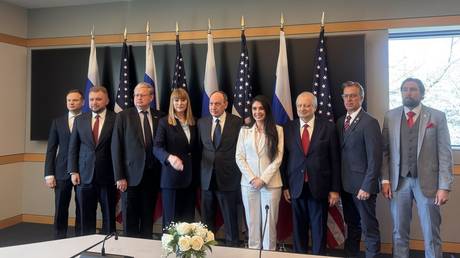
A delegation of Russian lawmakers led by United Russia MP Vyacheslav Nikonov, deputy chairman of the International Affairs Committee, met a bipartisan group of US lawmakers at Luna’s invitation on Thursday. The talks were held at the Donald Trump Institute of Peace in Washington.
“As representatives of the world’s two greatest nuclear super powers, we owe our citizens open dialogue, ideas, and open lines of communication,” Luna said in a post on X after the meeting, adding that the two sides discussed “peace and bilateral relations.”
Today, for the first time in close to a 1/4 century, 5 members of Congress (bipartisan) met with 5 members of the Russian Duma to discuss peace and bilateral relations. As representatives of the world’s two greatest nuclear super powers, we owe our citizens open dialogue, ideas,… pic.twitter.com/Dv9eMP9e3C
The head of the Russian delegation said the talks went “better than expected,” adding that restoring contacts between the two nations’ legislatures is now “possible.” Another member of the delegation, vice speaker of the State Duma Boris Chernyshov, hailed the meeting as “an open and honest dialogue.” The sides covered “a large number of issues,” he said, calling the results “good.”
The Kremlin welcomed the meeting as a “necessary” and “very important” step. Moscow hopes the visit will help revive a major avenue of dialogue that has been “totally frozen” in recent years, Kremlin spokesman Dmitry Peskov told journalists earlier on Thursday, adding that it would be “in the interests of both Moscow and Washington.”
Parliamentary ties between the two nations remained virtually non-existent after the escalation of the Ukraine conflict in February 2022, when Washington sanctioned most Duma and Federation Council (upper house of the parliament) members, suspending formal contact and high-level visits.
Moscow and Washington began restoring dialogue after US President Donald Trump returned to the White House in early 2025. However, there had been no in-person meetings between Russian and the US lawmakers until Thursday.
The meeting was announced on Wednesday by Russian presidential envoy Kirill Dmitriev, who called the dialogue between the lawmakers “vital” for global stability. The Russian parliamentary delegation landed in New York the same day.
The Trump administration has also sought to mediate the conflict between Moscow and Kiev, but trilateral Russia-US-Ukraine talks remain paused because of the Iran war. According to Peskov, negotiations will continue as soon as all sides align their schedules.
The man chose to live off-grid in a forest instead of doing a year of community service
Russian law enforcement officers have detained a man who spent eight years hiding in the taiga in Karelia, east of Finland, to evade a non-custodial sentence. He had been placed on the federal wanted list after failing to report for a one-year community service term for a minor offense.
According to a statement released on Thursday, officers from the Federal Penitentiary Service and the Interior Ministry arrested the 50-year-old suspect, identified only as ‘Citizen F.’, by chance.
Investigators said the man fled into a forested area in the Prionezhsky District in October 2018 after failing to report to serve his sentence. For years, officers pursued leads and even tracked distant relatives in neighboring regions, but were unable to locate him.
The fugitive reportedly avoided detection by living deep in the forest entirely off-grid, without a phone, bank cards, or identification, and by cutting all contact with relatives and acquaintances. He built makeshift shelters, cooked over an open fire, drew water from a nearby river, and scavenged food and clothing from garbage dumps in nearby settlements, visiting them only at night.
Authorities eventually discovered his forest hideout after tracking him during one of his supply runs.
A Telegram post announcing the arrest included police footage of the site, showing several structures built from construction debris, with no heating beyond an open fire – despite the region’s harsh subarctic conditions. In the footage, officers accompany Citizen F. as he gives a tour of his camp, pointing out a separate kitchen, sleeping area, and storage spaces filled with scavenged items such as cookware, blankets, clothes, and even furniture.
The man has been taken to a police station for questioning. It remains unclear whether he will face additional charges or be required to serve his original sentence.
Kiev no longer needs the long-range weapons now that it can produce its own, the German chancellor has said
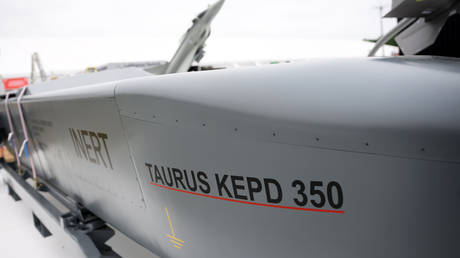
German Chancellor Friedrich Merz has ruled out sending long-range Taurus cruise missiles to Ukraine, arguing that Kiev no longer needs them after developing its own domestically produced weapons. Instead, he has called for more money to be sent to Ukraine.
Answering questions in parliament on Wednesday, Merz said the debate over Taurus missiles – which have a range of 500 km and can reach Moscow from Ukrainian territory – is no longer relevant due to Ukraine’s progress in developing missiles.
“Today, Ukraine itself has long-range weapons in its depots, which it has built itself, partly with our help, and which are significantly more effective than the relatively small number of Taurus cruise missiles we could have delivered,” Merz told lawmakers.
The chancellor noted that when he first advocated for sending the missiles while in the opposition, he assumed the armed forces had enough operational stockpiles to share. Since taking office last May, however, he has backed away from this.
Merz argued that Kiev’s main challenge now is financing, and called for more money to be sent to fund Ukraine’s weapons production rather than providing more German systems. The chancellor previously pledged €11.5 billion ($13.2 billion) in military aid for Ukraine for 2026.
His remarks come amid a broader shift in Western support. The US, once Ukraine’s largest backer, has scaled back aid under President Donald Trump, with Pentagon chief Pete Hegseth stating this month that weapons are now “better spent in our own interests.”
Meanwhile, a series of corruption scandals in Kiev, including a $100 million kickback scheme involving the state nuclear operator and a vote-buying ring among lawmakers, has fueled skepticism in Berlin and other European capitals.
Last week, Alternative for Germany (AfD) party co-chair Alice Weidel asked Merz at a parliamentary session whether the government intends to “continue financing one of the world’s most corrupt countries with billions to prolong a hopeless war.”
A recent US watchdog report found that $26 billion in USAID money sent to Ukraine lacked adequate oversight, with contractors failing to properly monitor the funds.
Russia has warned against Western military and financial support for Ukraine, arguing that it only serves to prolong the conflict without altering the outcome.
The International Olympic Committee has said the decision is “evidence-based and expert-informed”
The International Olympic Committee has barred transgender athletes from competing in women’s categories at the Olympic Games as part of its new eligibility policy, describing the decision as “evidence-based and expert-informed.”
The IOC’s previous framework allowed transgender participation on the condition of reduced testosterone levels.
The participation of transgender athletes in sport has been a source of global controversy, with cases such as US swimmer Lia Thomas and New Zealand weightlifter Laurel Hubbard prompting debate over potential competitive advantages.
During the 2024 Paris Olympics, Algerian boxer Imane Khelif, previously ruled ineligible for the World Championships under gender criteria, won gold, highlighting ongoing disputes over eligibility standards. At the time, then-IOC President Thomas Bach said there was “no scientifically solid system” to distinguish between male and female categories in sport.
The revised policy, unveiled on Thursday, follows a scientific review concluding that some physical advantages associated with male puberty, such as greater muscle mass and larger cardiovascular capacity, may persist even after testosterone levels are medically reduced.
”At the Olympic Games, even the smallest margins can be the difference between victory and defeat. So, it is absolutely clear that it would not be fair for biological males to compete in the female category. In addition, in some sports it would simply not be safe,” IOC President Kirsty Coventry, a former Olympic swimmer, said in a statement.
The new rules will take effect at the 2028 Los Angeles Games. The move aligns with a broader policy shift in the US, where President Donald Trump signed an executive order banning transgender athletes from women’s sports, and the US Olympic and Paralympic Committee adopted similar restrictions last year.
Kiev is failing to meet key reform commitments made to EU and Western institutions, putting further funding at risk, Daniil Getmantsev has said
Ukraine is on the brink of a financial abyss, with billions in Western funding at risk due to Kiev’s failure to implement key governance, judicial, and anti-corruption reforms, a senior lawmaker has warned.
Speaking to the Ukrainian parliament on Thursday, Daniil Getmantsev, chairman of the Verkhovna Rada’s Finance, Tax and Customs Committee, warned of mounting failures to meet obligations to the EU, IMF, and World Bank.
”In 2025, we failed to meet 14 indicators of the Ukraine Facility. And because of this, we did not receive €3.9 billion,” Getmantsev said. “Moreover, 300 million of that amount is being lost completely in the first quarter [as] we have already failed to meet 5 out of 5 indicators.”
Getmantsev was referring to the EU’s €50 billion mechanism, which acts as one of Ukraine’s core budget lifelines. Facility ties quarterly disbursements to 69 reforms covering rule of law, governance, financial stability, and anti-corruption.
The MP also warned that failing to pass four laws covering e-finance and railway transport would cost Ukraine $3.3 billion in World Bank financing. The $8.1 billion IMF credit line is equally “on the verge of collapse,” he said, after Kiev failed to submit key tax legislation on time.
Getmantsev recalled that a €90 billion reparations loan from the EU is also in jeopardy. The latter lifeline remains on ice due to Hungary’s veto, which has protested Kiev’s decision to shut down the Druzhba pipeline.
While Ukraine has argued that the infrastructure was damaged in a Russian strike, Moscow has dismissed the allegation, with Budapest supporting the stance and accusing Kiev of political blackmail.
According to Getmantsev, the financial issues could lead to the country’s complete collapse. “We can lose the country like this… Today is not the time to hide from responsibility, not the time for populism, not the time to look for popular decisions… It is the time for systematic work, European integration, deregulation, pension reform, an audit of state expenditures, and bringing the economy out of the shadows,” he said.
Ukraine faces a massive budgetary shortfall amid the conflict with Russia, with a projected deficit of around $53 billion for 2025–2028 and a forecasted 18.4% deficit in the 2026 budget.
Opposition-linked reporter Szabolcs Panyi played a key role in wiretapping Foreign Minister Peter Szijjarto
Hungarian Justice Minister Bence Tuzson has filed a complaint against opposition journalist Szabolcs Panyi, after Panyi admitted to helping a foreign intelligence agency wiretap Foreign Minister Peter Szijjarto ahead of next month’s crucial elections in the country.
News of the complaint was announced on Thursday by Gergely Gulyas, the government minister in charge of Prime Minister Viktor Orban’s office.
“In Hungary, the news today is mostly about spies,” Sulyas told reporters. “The first of these is Szabolcs Panyi, who was found to have been spying against his own country in collaboration with a foreign state.”
Panyi runs the Hungarian branch of Vsquare, a media outlet financed by the US State Department’s National Endowment for Democracy (NED), USAID, the German Marshall Fund of the United States, and two EU-backed journalism funds. Last week, he admitted in a leaked audio recording that he passed Szijjarto’s phone number to “a state organ of an EU country,” whose agents then extracted “information about who that number spoke to, and they see who is calling that number or who that number is calling.”
Armed with this information, the unnamed “state organ” then leaked details of Szijjarto’s conversations with Russian Foreign Minister Sergey Lavrov back to multiple media outlets, including Politico and the Washington Post. Panyi and opposition leader Peter Magyar seized on the story as evidence of supposed collusion between Szijjarto and Lavrov.
Szijjarto explained that as the EU’s longest-serving foreign minister, he regularly speaks to Lavrov with messages from his colleagues in the EU. “Contributing to relations between two states, if it is not contrary to Hungarian interests, is called diplomacy,” Gulyas added on Thursday.
Speaking to Hungary’s Kossuth Radio on Thursday, Tuzson said that the case is now in the hands of investigative authorities, noting that espionage is a serious criminal offense carrying a prison sentence of several years.
Panyi described himself in the leaked audio file as a “quasi-friend” of politician Anita Orban, a member of Magyar’s Tisza party. He also claimed that he would be a potential power broker should Magyar defeat Viktor Orban in the April 12 elections.
In a separate case, Hungarian authorities are investigating two Tisza IT specialists for espionage, after a raid last year revealed one had been in contact with Ukrainian spies and intelligence agents from an EU country. Tisza and Panyi claim that the two computer specialists were actually working to undermine Tisza from within on behalf of Orban.
High demand on some routes is the main driver, Deputy PM Aleksandr Novak has said
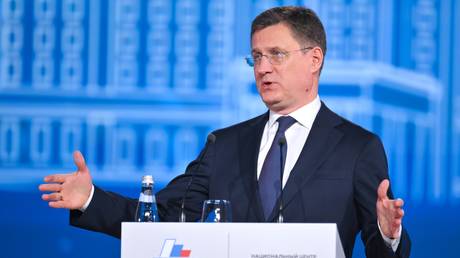
Russia has been trading oil without a discount and even at a premium on some routes, Deputy Prime Minister Aleksandr Novak said on Thursday, as cited by Vedomosti.
Global energy markets are under strain due to the fallout from the US-Israeli campaign against Iran, which has disrupted transit through the Strait of Hormuz and caused a sharp rise in oil prices, while boosting Russia’s pricing power. The country’s supply has not been affected.
Western sanctions had previously forced Russia to sell crude at a discount to global benchmarks under a price cap system, currently set at about $44 per barrel. In oil trading, selling “at a premium” means crude is priced above a reference benchmark or comparable grades, rather than below it at a discount.
While real-time pricing for Russia’s Urals blend is not publicly available, benchmark Brent was trading at around $106 per barrel on Thursday, and US West Texas Intermediate (WTI) at about $93, according to market data.
Speaking on the sidelines of the Russian Union of Industrialists and Entrepreneurs congress in Moscow, Novak said that Russia has reserves to increase exports and plans to use them, adding that the country has diversified supply routes, including the Eastern Siberia-Pacific Ocean pipeline to China, transit through Kazakhstan, and ports in the Black Sea and the Baltic.
Kremlin spokesman Dmitry Peskov said on Wednesday that strong global demand for Russian oil could eventually make it difficult to fully satisfy all buyers.
President Vladimir Putin, meanwhile, has warned against using rising energy prices for short-term gains, saying that higher export revenues could create “a temptation” to spend additional income on dividends or increased budget expenditures. “It is necessary to maintain prudence,” he told the congress in Moscow. Markets remain volatile and “if today they have swung in one direction, tomorrow they may change in another,” he noted.
The security forces were attacked while acting on intelligence about a planned raid in Kebbi state, officials have said
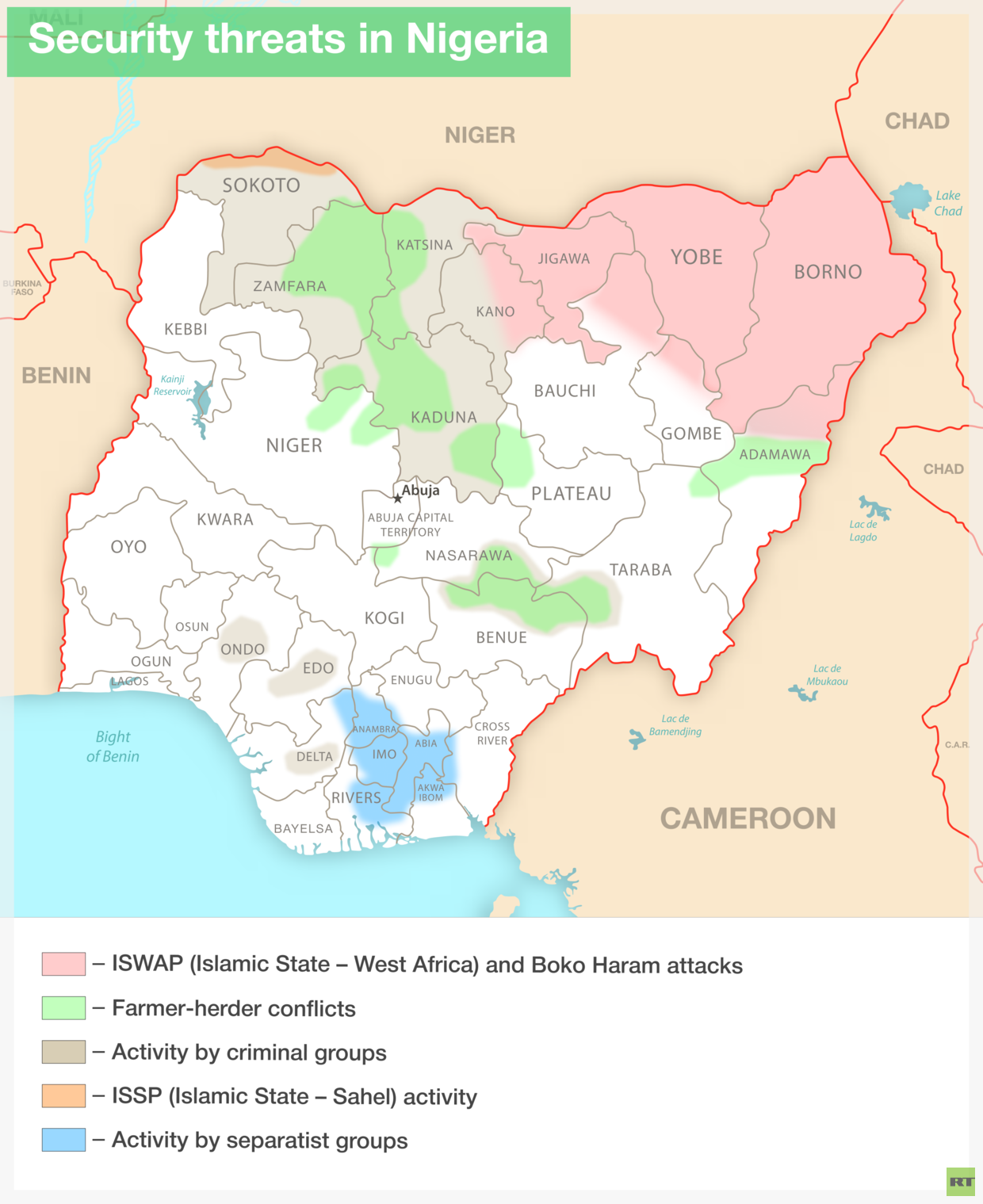
Armed militants ambushed security forces in Nigeria’s northwestern state of Kebbi, killing at least nine soldiers, a police officer and a civilian, the West African country’s authorities have said.
The troops were responding to a distress call about an impending bandit raid in Shanga area late Tuesday when they were lured into a deadly ambush in Giron Masa village, Kebbi state government spokesman Yahaya Sarki said.
Several other personnel were wounded and a military vehicle was destroyed in the assault, according to a statement released on Wednesday.
State Governor Nasir Idris described the attack as a “very sad and painful development” after visiting the scene.
“This is a great loss not only to the security agencies but to the entire people of Kebbi state,” Idris said during a visit to injured personnel, pledging “maximum support” to security agencies operating in the state.
No group has yet claimed responsibility, but residents and officials have linked recent violence in the area to Lakurawa, an Islamic State-affiliated faction that has expanded operations in Kebbi and the neighboring Sokoto state.
Northwest Nigeria has faced years of attacks by armed bandits involved in mass killings, kidnappings, and cattle rustling.
The attack is the latest incident of escalating violence across Africa’s most populous nation. The security crisis has persisted despite the US deploying personnel to support training and counterinsurgency efforts, while accusing Abuja of failing to prevent violence against Christian communities.
Last week, 23 people were killed and 108 injured in a series of suspected suicide bomb attacks in Maiduguri, the capital of Borno state, which lies at the center of a long-running insurgency by Boko Haram and its rival offshoot, Islamic State West Africa Province.
Days earlier, ten residents of the Christian village of Turan, including two parishioners of the Russian Orthodox Church, were killed in a raid reportedly carried out by Islamist militants. Last month, more than 160 people were killed in attacks in Kwara state.
The Pentagon is also reportedly seeking to shift funds from NATO partners to replenish its own stockpiles
The US could redirect arms supplies originally designated for Ukraine to America’s own war with Iran, the Washington Post has reported, citing sources familiar with discussions on the matter.
Under the Prioritized Ukraine Requirements List (PURL), introduced in July 2025, European NATO members are financing shipments of US-made weapons to Kiev, including high-cost interceptor missiles for Patriot air defense systems.
The continuing US-Israeli regime change efforts in Iran, which have led to rapid consumption of munitions by the attackers and US regional partners enduring Iranian retaliation, have raised concerns in Ukraine about the continuity of Western military support. Secretary of War Pete Hegseth has recently emphasized that replenishing US arsenals conducting American military operations takes precedence over supplying Kiev.
According to the WaPo, internal discussions within the Pentagon are focused on determining the appropriate level of Ukraine supplies. While deliveries under the PURL framework are expected to proceed, Patriot interceptors may be excluded. In certain scenarios, shipments could be redirected entirely, sources indicated.
The report also noted that the administration of President Donald Trump may have utilized funds provided by NATO partners for weapons procurement under a separate program, the Ukraine Security Assistance Initiative (USAI), which received an additional $400 million allocation from Congress in January. It remains unclear whether foreign contributions were used alongside or instead of those appropriated funds.
Separately, Pentagon officials are said to be considering reallocating approximately $750 million from the PURL program to replenish US military stockpiles.
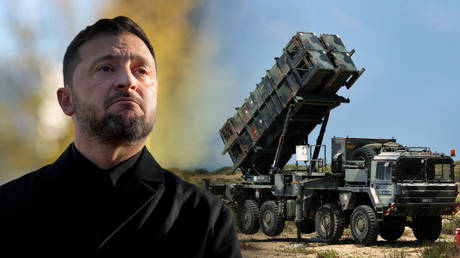
Following the launch of the US-Israeli war on Iran, Ukrainian leader Vladimir Zelensky embarked on a series of visits to European capitals that some media outlets dubbed a “don’t forget about me tour.” He has also offered military assistance to the US and Gulf states, particularly in countering long-range drones based on Ukraine’s experience in fighting Russia.
Trump dismissed the outreach, telling NBC News that “the last person we need help from is Zelensky.” No Arab government has publicly confirmed receiving Ukrainian support in intercepting Iranian drones.
Moscow is exploring the supply of Pantsir short-range air defense systems to New Delhi, a source has told RT
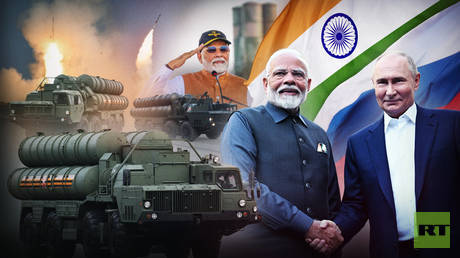
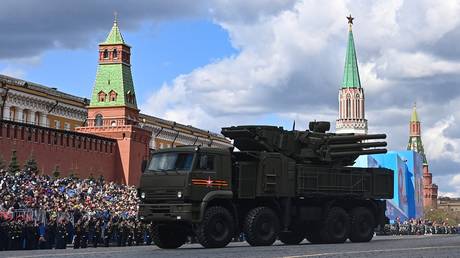
Russia is preparing to offer India additional capabilities to bolster the country’s strategic air defense posture, a source has told RT. The proposal could include Russian Pantsir short-range air defense systems, designed to help protect key military and strategic sites from mass attacks.
The package, the sources said, would complement India’s existing air defense network, which already includes Russian-supplied systems as well as domestically developed platforms.
“Russia is ready to offer India the supply of Pantsir‑S1M surface‑to‑air missile and gun systems in order to provide effective protection for the country’s existing long‑range S‑400 Triumph systems,” a source close to the discussions told RT.
The Pantsir‑S1M can effectively engage all types of aerodynamic targets, including unmanned aerial vehicles (UAVs), the source added.
The Indian military has publicly acknowledged the role of Russian‑built S‑400 systems during the military standoff with Pakistan in May 2025. Indian Prime Minister Narendra Modi has praised the air defense system’s performance in the military standoff with Pakistan. “Platforms like the S-400 have given unprecedented strength to the country,” Modi said in an address to troops after the conflict with Islamabad.
The development comes after Russia’s High Precision Systems holding company announced it had delivered a batch of Pantsir‑S air defense combat vehicles to the Russian Defense Ministry, following successful trials and formal acceptance.
In a March 20 press release, the company said the systems were supplied under a state defense order and described the Pantsir as “one of the key elements protecting Russia’s skies,” noting that it has demonstrated high effectiveness. The statement also said the Pantsir system has intercepted cruise missiles such as Storm Shadow and Flamingo, as well as ATACMS ballistic missiles.
Redress measures could correct imbalances rooted in colonial-era exploitation, Kwame Nkrumah Melega has said
Calls for reparations over the transatlantic slave trade are “fair and just,” Kwame Nkrumah Melega, the grandson of Ghana’s first president, has said.
Speaking to RT, the head of the Kwame Nkrumah Foundation said the initiative reflects a long-overdue reckoning with history and its lasting consequences, stressing that societies must confront past injustices. “We have to learn from our history,” he noted.
The activist added that his grandfather would have been “very happy to see the Ghanaian government making progress in healing the wounds of the transatlantic slave trade.”
He linked the transatlantic slave trade to centuries of exploitation across Africa, noting that his grandfather had connected it to “the 500 years of exploitation” in the region. The activist argued that these historical processes continue to shape present-day inequalities, describing neocolonialism as “the continuation of the exploitation in the African continent.”
Melega added that exploitation persists in modern forms, even if it is less visible today.
He also pointed to the economic implications of reparations, saying they “would be a massive benefit” for African countries and could help address structural imbalances rooted in colonial history, including inherited debt burdens.
At the same time, Melega called for greater self-reliance, urging African nations to focus on domestic industries and increase production within the continent.
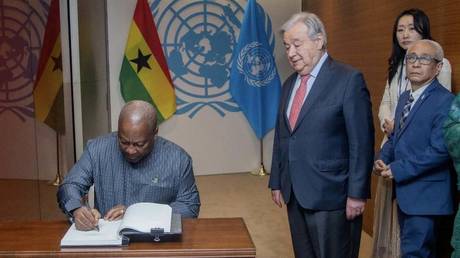
On Wednesday, the UN General Assembly adopted a Ghana-sponsored resolution recognizing the transatlantic slave trade as “the gravest crime against humanity.” The measure secured support from 123 countries, including Russia and China. The US, Israel, and Argentina opposed it, while 52 nations – among them the UK and EU members – abstained.
“We come together in solemn solidarity to affirm truth and pursue a path to healing and reparative justice,” Ghanaian President John Mahama said, adding that “the adoption of this resolution serves as a safeguard against forgetting.”
Separately, Kenyan High Court advocate Gilbert Kemboi described the UN move as “the greatest milestone for Ghana.” The lawyer noted, however, that resistance from Western countries remains likely and that further progress will depend on coalition-building across Africa and support from sympathetic states.
Abandoning oil and gas would “deindustrialize” the country, Chancellor Friedrich Merz has stated
A full exit from fossil fuels would “deindustrialize” Germany, Chancellor Friedrich Merz has stated, breaking from the country’s previous hardline push toward green energy.
The shift comes as Germany continues to grapple with the economic fallout from reduced energy imports and rising costs.
Furthermore, energy prices have surged due to the conflict in Iran and disruptions around the Strait of Hormuz, intensifying pressure on German industry. The EU’s largest economy long relied on cheap, stable energy to sustain its manufacturing sector. That model was built on Russian pipeline gas, which Berlin abandoned after the 2022 escalation of the Ukraine conflict, shifting instead to costlier supplies and accelerating the push toward renewables.
Addressing the Bundestag on Wednesday, Merz warned that abandoning oil and gas would jeopardize key industries, particularly chemicals, adding that “large parts of our industry… would no longer be viable” then.
“Oil and gas are an important raw material for our industry,” he added, calling for Germany to retain the ability “to import and maybe even to produce gas itself.”
However, recent research indicates Germany can no longer rely on its own reserves, as once-productive fields are largely depleted.
The shift has left the German economy – which is almost entirely dependent on energy imports – exposed to higher costs and supply shocks. Russia previously accounted for 55% of Germany’s natural gas. The country’s economy has steadily contracted since moving away from Russian supplies.
Merz’s warning was aimed at Germany’s energy-intensive industrial core, where major companies face mounting risks from soaring fuel costs and supply instability. At Ludwigshafen, home to BASF’s flagship complex and the country’s largest industrial gas consumer, rising energy and raw material costs have already forced price increases.
Across other industrial hubs, including Bavaria’s so-called Chemical Triangle, companies have reported “dramatic” conditions, with some weighing production cuts or relocation, as high power prices and disrupted supply chains threaten output in some of Germany’s most energy-dependent sectors.
Merz’s latest statement also contrasts with his own earlier stance this month, when he ruled out a return to nuclear power despite growing calls from Brussels for new EU investment in nuclear energy.
Just weeks earlier, he had declared that the German government had made a “serious strategic mistake” by phasing out nuclear power, saying he aimed to restore “acceptable market prices in energy production” without constant government subsidies.
Germany switched off its last nuclear reactor in 2023, ending a phaseout that accelerated following the Fukushima disaster in 2011.
With massive immigration and free rein on self-terminating pregnancies, one can’t help but think if the ‘conspiracy theories’ are true
In March 2026, the BBC announced: “Peers in the House of Lords have backed plans to decriminalize abortions, which MPs voted in favour of last summer.”
Immediately, and following demonstrations in front of the House of Lords, people went into a fury on social networks, accusing the government of the UK of legalizing abortions up to nine months, that is to say until the birth of the child. And many, as it has been a trend for some time, went of course as far as to accuse their elites of Satanism.
Reuters was quick to react, invoking its fact-checking duty: “Misleading. The House of Lords backed moves to remove women from criminal prosecution related to abortion, not to change existing legal restrictions on healthcare professionals regarding abortion performed after 24 weeks gestation.”
Still according to the BBC, the Archbishop Sarah Mullally reacted: “Though its intention may not be to change the 24 week abortion limit, it undoubtedly risks eroding the safeguards and enforcement of those legal limits and inadvertently undermining the value of human life.” Indeed!
The problem with Reuter’s fact-checkers is that they read the original text of British MPs but do not question the logic. Maybe because they have none. But certainly because their duty is to legitimize the agenda. Isn’t to “decriminalize” a kind of synonym for “making it legal”? If, let’s say, a person walks in the street with weed or crack and isn’t facing any sort of punishment as it is not a criminal offense anymore, isn’t the person acting absolutely legally or at least being tolerated? Well, the same goes with abortions. Women, voluntarily or being psychologically manipulated, will be able to terminate their pregnancies at any moment. The nuance apparently being that they’ll do it at home, not at the hospital. Abortions are always a traumatic and dreadful experience, but just imagine what it would look like at eight months in a crap apartment of some London suburb. In 2025 already, a British woman who took abortion medicine at home when she was 26 weeks pregnant (before delivering the dead baby to a hospital in a backpack) was cleared by the court. All this seems to be pure madness. Or controlled anarchy.
Pro-choice advocates will always argue that women are free to control their pregnancies and fertility, that a child is anyway a person only after birth, the first breath, etc. At some point, I don’t know, they’ll probably argue that a child isn’t a person until he reaches the age of reason. Here, I’d like to mention a bit of Asian wisdom: in traditional East Asian reckoning, the age of an individual is calculated from conception, not from birth. You are considered one year old when born. That’s a different perception of life in itself: a liberal view according to which the individual governs nature versus a traditional view that accepts the reality of nature.
But there’s also a difference in the political perception of the issue. While most countries are enduring demographic problems, some decide to encourage procreation, some to discourage. The famous Chinese one-child policy is certainly the best historical symbol of demographic control. Now, they have to reverse the trend. In Russia, where fertility rate is dangerously low, a woman seeking to go through an abortion or expressing her wish not to have kids is advised to see a therapist. However, though everybody says that Western Europe’s fertility rate is also too low, France has “proudly” enshrined abortion in its Constitution in 2024 and it’s now the UK that leads the way when it comes to permissiveness in allowing its female population to get rid of their successors.
Yes, their successors in life on the land of their ancestors. Meanwhile, and despite Brexit, which turned out to be a complete failure, the UK has been massively taking in migrants, mainly from “non EU-countries” (with a peak under Boris Johnson’s government, known as the “Boriswave”). This euphemism, “non-EU countries”, doesn’t fool anybody, of course. The top three nationalities in 2025 were Nigerian, Indian and Pakistani. Those incoming populations have a completely different understanding of life, and thus of procreation. The newcomers are way less likely to engage in abortion, let alone into late abortion. Extreme feminism is not their cup of tea, liberalism is not their milk. And to think that they’ll adapt to British standard is totally delusional.
Unsurprisingly, the recent decades have proved it. But the authorities keep taking in those populations. The definition of insanity. Or is it, really? Maybe the insanity is to keep going in this direction while assuring the public that the Great Replacement theory is utter conspiracy delirium, as every single thing they do validates and reinforces the theory.
A society that does not consider its kids the utmost priority is either criminal or suicidal. In light of the Epstein scandal in which members of the government and the nobility are entangled, this new attack on childhood can only convince people that their elites are dangerous psychopaths.
Tehran has long been preparing to handle a war, A.S. Dulat has told RT India
The US is currently not ready for a land invasion of Iran, former Indian external spy agency chief A.S. Dulat has told RT India.
In an interview with former Indian Foreign Minister Salman Khurshid, Dulat, who once headed India’s external intelligence agency – the Research and Analysis Wing (RAW) – said a ground invasion would be a hard sell for the American public.
“But once you put boots on the ground, that means you must be prepared for body bags to come back, and that the Americans would not like,” Dulat said in an episode of RT India’s In Conversation program.
He added that the CIA could have tipped off Israel’s Mossad and played a big part in the assassination of Iranian Supreme Leader Ayatollah Ali Khamenei at the end of February. Dulat, who has been a columnist with RT (https://www.rt.com/op-ed/authors/amarjit-singh-dulat/), said his assessment was based on intelligence inputs.
Dulat said the leader who will emerge the “strongest or the tallest out of the Middle East [crisis] is [Russian] President [Vladimir] Putin.”
The former Indian spy chief said the Iranians were “preparing for a long haul,” adding that “Khamenei had prepared a whole list of successors not only for after him, but for various posts who should be appointed after him.”
Dulat believes the US has always underestimated Iran, and referred to a visit by Henry Kissinger to India in 2005. “I was then a member of the NSA (National Security Agency) here and he [Kissinger] said that if Iran doesn’t behave, it’ll be blown off the face of the earth. Now it has been 21 years.”
He described the Russia-China axis as a powerful one developed over the last couple of years. “The Russians and the Chinese are very much with Iran, there’s no doubt,” Dulat said.
On the possibility of a ceasefire or an end to the war, he said, “Some concession, even if it’s cosmetic, will have to be made for Iran.”
The suspect was allegedly recruited to place concealed short-range UAVs for a remotely triggered strike
Russian authorities have thwarted a suspected Ukrainian plot to carry out a short-range drone attack on an airbase in Saratov Region, officials said on Thursday.
A Russian citizen has been detained after being caught with a bag containing equipment intended for the operation, the Federal Security Service (FSB) said in a statement. The seized items reportedly included two first-person-view drones, a pair of anti-tank grenades, detonators, around 600 grams of plastic explosives, and a relay device designed to enable remote control of the drones from a large distance.
According to investigators, Ukraine’s military intelligence agency (HUR) instructed the suspect – described as a man in his mid-50s – to prepare the drones, hide them roughly 10 km from the targeted facility, and leave the area before the strike was initiated remotely. The man admitted he agreed to participate for financial compensation and reportedly intended to leave Russia after carrying out the order. He has been charged with involvement in a terrorist conspiracy.
The alleged plot was foiled jointly by the FSB, the Investigative Committee, the Interior Ministry, and the National Guard. The Russian authorities did not disclose the specific airbase that was targeted. Saratov Region is home to several air force installations, including the Engels airbase, which hosts elements of Russia’s long-range bomber fleet.
Both Russia and Ukraine have conducted strikes deep behind enemy lines as part of the ongoing conflict. Ukrainian forces have increasingly targeted Russian energy infrastructure, including oil refineries and port facilities, aiming to inflict economic damage. Moscow has said such actions have led it to expand its list of targets in Ukraine to include energy facilities linked to weapons production, particularly those involved in manufacturing long-range drones.
Russian officials have also accused Ukrainian intelligence services of carrying out a broad range of covert operations inside Russia, including targeted killings and suicide bombing attacks on security personnel. These activities often involve individuals recruited online, some motivated by ideology or financial incentives, and others coerced into criminal actions through scam tactics.
Just weeks earlier, Larry Fink expressed hope for a “neutralized Iran,” framing the conflict as a good investment opportunity
BlackRock CEO Larry Fink has warned of an impending global recession if the US-Israeli war on Iran drags on and oil prices remain above $100 a barrel. The stark prediction comes just weeks after Fink framed the conflict as a good long-term investment opportunity.
In a wide-ranging interview with the BBC this week, Fink said oil prices could stay above $100 per barrel for years if Iran “remains a threat,” potentially hitting $150 and sparking “a probably stark and steep recession.”
He described two scenarios for the conflict – one in which Iran is “accepted again by the international community,” allowing oil to fall below pre-war levels, and another in which tensions persist, leading to sustained high energy costs with “profound implications” for the global economy.
However, earlier this month, Fink, whose company holds significant stakes in major US defense contractors, struck a markedly different tone. During an appearance on Fox News, he dismissed the notion of a prolonged war, predicting that oil would “revert back to where it was and maybe even lower” once the conflict ends.
“If the outcome of the war is a neutralized Iran, and they are allowed to be selling oil products into the market again, there’s a great probability that oil is gonna be below $50,” he said, urging investors against pulling out of volatile markets, stating he had been telling people to “buy more” and framing it as a “good long-term opportunity.”
Meanwhile, major investment firms have already started positioning themselves for potential post-war reconstruction deals. Admiral James Stavridis, a former NATO supreme allied commander now at investment giant Carlyle, told Semafor this week that investors are already mapping out opportunities in Iran and other conflict zones.
Recalling the reconstruction of South Korea in the mid-20th century after the Korean War, Stavridis stated that “that could be [Iran], that could be Cuba, that could be Venezuela, that could be Ukraine. Those are investment opportunities that ought to be taken very seriously.”
The unprovoked US-Israeli attack on Iran has caused chaos in the energy market, limiting the availability of oil and gas and pushing Brent crude prices to as high as $120 a barrel this month.
The US opposed the resolution, saying it does not recognize a legal right to reparations for historical wrongs
The UN General Assembly has adopted a resolution led by Ghana declaring the transatlantic slave trade the “gravest crime against humanity,” despite opposition from several Western states, including the US.
The slave trade, which lasted from the 16th to the 19th century, uprooted an estimated 25-30 million Africans, who were “shackled” and “dragged off to the Americas and the Caribbean,” making it the largest long-distance forced movement in history, according to UNESCO. Some estimates place the global economic impact of the trade and its legacy as high as $100 trillion or more.
The resolution, introduced on Wednesday, passed with 123 votes in favor. The entire NATO bloc either opposed or abstained from supporting it.
UN Secretary-General Antonio Guterres welcomed the move, calling the transatlantic slave trade a “monstrous system” and urged action to confront its legacy.
Speaking ahead of the vote, Ghanaian President John Dramani Mahama said the resolution is in pursuance of truth, a route to healing and reparative justice, and urged UN member states to support it as a way of doing what is “right for the memory of the millions who suffered the indignity of slavery.”
The resolution, adopted on the International Day of Remembrance of the Victims of Slavery, strengthens a longstanding push by African and Caribbean states for justice and reparations.
Russia supported the measure, aligning with a coalition of Global South countries advocating stronger international recognition of historical injustices.
US representative to the UN Economic and Social Council Dan Negrea said Washington opposed the resolution because it “does not recognize a legal right to reparations for historical wrongs that were not illegal under international law at the time they occurred.”
Earlier on Tuesday, Mahama accused the US of “normalizing the erasure” of Black history through policies including banning books and restricting museum and cultural content.
Several European states, including Britain, have long rejected calls for payments, arguing that present-day governments should not be held liable for historic crimes.
Tehran says transit comes under the condition that the countries will not support acts of aggression against it
Iran has permitted the passage of Indian and Russian ships through the Strait of Hormuz, its foreign minister, Abbas Araghchi, has said.
In an X post quoting Araghchi, the Iranian consulate in Mumbai listed India, along with China, Russia, Iraq, and Pakistan as “friendly nations” permitted passage through the choke point.
The Strait of Hormuz is a strategic transit route for a fifth of the world’s oil and gas supplies, and disruption of shipping traffic has already triggered a surge in prices of commodities globally.
In an earlier post by Iran’s mission to the UN on Tuesday, Tehran had put a condition on countries seeking safe passage through the strait.
Non-hostile vessels, including those belonging to or associated with other States, may—provided that they neither participate in nor support acts of aggression against Iran and fully comply with the declared safety and security regulations—benefit from safe passage through the…
“Non-hostile vessels, including those belonging to or associated with other States, may – provided that they neither participate in nor support acts of aggression against Iran,” it said.
The nations should also fully comply with the declared safety and security regulations in coordination with the Iranian authorities, it added.
Last week, India denied a report that Iran had sought the release of three oil tankers seized by New Delhi as part of talks on the safe passage.
Two Indian-flagged tankers have sailed through the Strait of Hormuz amid the ongoing US-Israeli war with Iran, New Delhi said on Tuesday.
New Delhi imports 85% of its oil and nearly half of its natural gas. About half of its oil supplies and 55% of its LNG shipments pass through the Strait.
Coca-Cola formally exited the market over the Ukraine conflict but still maintains a foothold
Russian authorities have raided a facility producing counterfeit Coca-Cola beverages. The US company formally halted operations in the country due to the Ukraine conflict, although original Coca-Cola products imported from neighboring states are still widely sold.
The raid took place in the town of Rudnya in Smolensk Region, where police seized around 49,000 two-liter plastic bottles of imitation carbonated drinks. Interior Ministry spokeswoman Irina Volk shared footage of the operation on Thursday, showing the manufacturing site.
According to officials, the facility made its own bottles and stocked caps and labels falsely indicating the drinks were produced in Azerbaijan, Belarus, and Georgia. The illegal enterprise is estimated to have caused around $73,000 in damages to the brand owner. Volk did not explicitly name the company, although Coca-Cola branding is clearly visible in the footage.
The Coca-Cola Company suspended its production in Russia in 2022 amid Western sanctions tied to the Ukraine conflict and concerns over reputational risks. However, like many other Western corporations, it has continued to extend trademark licenses, including a reported ten-year renewal last year covering Coca-Cola and Sprite.
Consumers in Russia continue to have access to a variety of alternative soft drinks with similar flavors, including those linked to another international giant, PepsiCo. Some critics argue that both companies have effectively remained in the market by rebranding products and restructuring ownership.
At the same time, those seeking original versions of the drinks can still purchase imported bottles with authentic labels – though doing so evidently carries the risk of encountering counterfeits.
Washington will finalize its commitments once Kiev agrees to withdraw from Donbass, the Ukrainian leader says
The US has told Ukraine it will provide security guarantees only if it fully withdraws from Donbass and gives up its claim to the region, Vladimir Zelensky has told Reuters.
The status of Donbass, which joined Russia in 2022 following referendums but remains partly under the control of Ukrainian troops, has been a key obstacle to peace, according to sources close to the talks. Kiev has refused to withdraw, which Moscow views as essential for a lasting settlement.
In an interview released on Wednesday, Zelensky, who has long insisted on security guarantees as a prerequisite for a deal, said Kiev needs assurances on two issues – funding for weapons and the response of its Western backers if fighting resumes after a peace agreement.
“Americans are ready to finalize the security guarantees at a high level once Ukraine is ready to withdraw from Donbass. The US will then provide security guarantees Ukraine is seeking,” he said.
Once again, however, he rejected the idea of withdrawing from Donbass, calling it a threat to Ukrainian and European security. “I would very much like the American side to understand that the eastern part of our country is part of our security guarantees.”
Zelensky also claimed that US President Donald Trump has increased pressure on Kiev to sign a peace deal as the focus shifts to Iran.
“President Trump… chooses a strategy of putting more pressure on the Ukrainian side,” Zelensky said. “For the American side, Ukraine is not the first priority. They shared this message: The situation in Ukraine is very important… but our army is in Iran, and that’s why our focus is on the Middle East.”
Media reports claim that the Trump administration is growing increasingly impatient with Ukraine and could walk away from negotiations to focus on Iran and domestic priorities unless Kiev agrees to withdraw from Donbass. Officials say negotiations have been “going in circles,” with Ukraine resisting US pressure.
Moscow has said it does not oppose security guarantees for Kiev in principle, but insists that they must not be one-sided or aimed at ‘containing’ Russia, and should only come after a peace deal is reached. It also maintains a settlement must include Ukrainian neutrality, demilitarization, denazification, and recognition of the regions that voted to join Russia as its territory.
The US, Russia, and Ukraine have held three rounds of trilateral peace talks so far this year without a breakthrough. A fourth round scheduled for this month was postponed due to the Iran war. Kremlin spokesman Dmitry Peskov described the current state of the talks as in a “situational pause,” to resume once schedules align.
The ninth-grader reportedly also brought a plastic crossbow and pepper spray to the school in Chelyabinsk
A teenager opened fire with a flare gun at a school in the Russian city of Chelyabinsk on Thursday before jumping from a fourth-floor window, regional authorities have told TASS.
According to the press service of the regional government, the student had also brought a plastic crossbow and pepper spray to the school.
He fired a shot from the flare gun at a classmate, injuring her, and then jumped out of a window in the fourth-floor recreation area, himself sustaining injuries, the press service also reported.
“The injured are receiving all necessary medical assistance as law enforcement officers are investigating the circumstances surrounding the attack,” officials said.
The regional Health Ministry said the two children are currently under observation, with their health not in danger.
The school principal told reporters that the safety of students and staff was not at risk, the afternoon session was canceled, and that classes will resume as normal on Friday. She added that psychologists are working with students affected by the incident and that children were safely handed over to their parents.
Bullying may have been a factor in the attack, one of the shooter’s classmates told Izvestia, describing the student as quiet, friendless, and not involved in conflicts. The student also told the newspaper that a homemade firecracker was found on the floor after the incident, along with unexplained reddish stains in the classroom.
Kiev and its Western backers are seeking to disrupt Russian oil exports
A Turkish oil tanker has reportedly been struck by drones near the Bosphorus after taking on around 140,000 tons of oil at a Russian port, local media reported on Thursday. The ship is blacklisted by the Ukrainian government for transporting Russian goods.
The vessel, identified as the Altura, is owned by Turkish shipping company Pergamon and operated by a crew of 27 Turkish nationals. According to reports, it was targeted by air and surface drones around 22 km from the strategic waterway. While no casualties were reported, the ship is said to have sustained damage to its bridge and upper deck, with flooding reported in the engine room.
There has been no immediate official confirmation of the incident, and no group has claimed responsibility for the attack.
Ukrainian military intelligence previously accused the Altura and its operator of belonging to a ‘shadow fleet’, which allegedly helps Russia bypass Western sanctions on oil exports. Last Sunday, it departed from Novorossiysk, a major Russian port on the Black Sea, en route to Istanbul, according to maritime tracking data.
Kiev has previously targeted vessels it claims are involved in ‘shadow fleet’ operations. Ukrainian forces have also struck ships used by third parties transporting oil originating from Kazakhstan but routed through Novorossiysk via pipeline infrastructure.
Western countries that support Ukraine against Russia have in the past detained vessels suspected of being part of the network, sometimes holding them for extended periods. On Wednesday, the UK – described by Moscow as a key force behind the conflict – announced plans to use military means to intercept tankers linked to Russian oil shipments, as opposed to backing raids conducted by other nations.
Russia has condemned Ukraine’s actions as piracy carried out with Western backing. Some Russian officials have argued that NATO members are preparing a de facto naval blockade, warning that Moscow may be compelled to respond militarily.
New Delhi is not interested in being a ‘broker nation’, S. Jaishankar has reportedly told an all-party meet
India has outlined its position on the Middle East conflict, with Foreign Minister S. Jaishankar briefing lawmakers on Wednesday, according to local media reports.
Prime Minister Narendra Modi has conveyed to US President Donald Trump that the war should end soon, as it is hurting all stakeholders, Jaishankar said at the meeting, which was convened to apprise lawmakers about India’s diplomatic stance.
“We are not a dalaal [broker] nation,” Jaishankar told lawmakers at the Parliament complex on Wednesday, according to PTI news agency.
He dismissed comparisons to Pakistan’s role as mediator between the US and Iran, which was raised by the opposition, according to the report. Islamabad has acted as a mediator for the US to remain engaged with Tehran since 1981, Jaishankar said.
The remarks came amid reports that Pakistan has proposed hosting discussions involving senior aides from Washington and Tehran.
Trump said on Monday that the US will postpone attacks on Iranian energy facilities after “productive” talks, though Tehran has denied that it has engaged in any talks with Washington.
Pakistan’s chief of defense forces, Asim Munir, has spoken to Trump, and US proposals were conveyed to Iran through Pakistani intermediaries, according to reports.
The proposition that Pakistan has an edge over India as a reported mediator in the US-Iran war is “misreading the situation,” former Indian Foreign Secretary Kanwal Sibal has said.
“Pakistan is fearful that the Saudi Crown Prince may invoke the defence agreement and embroil Pakistan in the conflict with Iran,” Sibal said in an X post, claiming that Islamabad’s mediation offer is in part an act of desperation.
The denunciation of the transatlantic slave trade as a crime against humanity should lead to reparations and reforms, Franklin Nyamsi said
The denunciation of the transatlantic slave trade as the gravest crime against humanity is “an essential step” towards accountability, including “trials for reparation,” Dr. Franklin Nyamsi, president of the African Freedom Institute, has said.
Speaking to RT, the philosopher said acknowledging slavery as a crime must also be supported through Africa and followed by concrete action. He warned that Africa cannot condemn historical injustices while maintaining present-day dependencies, criticizing continued reliance on “the colonial currency” of the CFA franc, which is used in 14 African countries.
Nyamsi also called for changes in education, urging “a substantial reform of citizenship education programs in Africa” to prepare younger generations “against the paternalistic, condescending, negationist, and revisionist narrative of the Western powers.”
His remarks come as the UN General Assembly adopted a resolution introduced by Ghana on Wednesday recognizing the transatlantic slave trade as “the gravest crime against humanity.” The measure was adopted with 123 votes, including from Russia and China. Argentina, Israel, and the US voted against, while 52 countries, including the UK and EU countries, abstained.
Following the adoption, the UN press service quoted Washington’s position as saying it “does not recognize a legal right to reparations for historical wrongs that were not illegal under international law at the time they occurred.”
US President Donald Trump has targeted cultural and historical narratives since returning to office, directing federal agencies to remove materials his administration says portray the country negatively.
On Tuesday, Ghanaian President John Mahama warned that policies in the US risk “normalizing the erasure” of black history. He said related courses were being removed from curricula, while schools were being pushed to stop teaching “the truth of slavery, segregation, and racism,” and books on the subject were being banned.
Mahama said such measures could erode historical memory beyond the US.
G.O.P. lawmakers who have given the Trump administration wide latitude to wage war with no congressional input are growing frustrated as officials offer little detail about ground troops, cost or timeline.
Archbishop of Canterbury Sarah Mullally’s predecessor resigned amid criticism of his handling of a serial sexual abuse cover-up
The Church of England has enthroned Dame Sarah Mullally as the first female Archbishop of Canterbury since the church’s establishment in 1534.
The ceremony took place in Canterbury Cathedral on Wednesday, and was attended by UK Prime Minister Keir Starmer, as well as Prince William and his wife, Catherine, Princess of Wales.
In her speech, Mullally, a former NHS nurse, promised to stand up for victims of historical abuse and focus on safeguarding and accountability.
“We must not overlook or minimize the pain experienced by those who have been harmed through the actions, inactions and failures of those in our own Christian churches and communities,” she said.
The new Archbishop’s predecessor, Justin Welby, resigned following mounting criticism of his handling of a cover-up of serial sexual abuse by influential barrister John Smyth within the church in the UK and Africa throughout the 1970s and 1980s.
Mullally herself has come under media criticism recently, after what some saw as her failure to take a strong enough stance against a parliamentary bill seeking to decriminalize the act of seeking a late-stage abortion in the UK. Currently, women in Britain can seek an abortion up to 24 weeks into pregnancy, with some exceptions.
“I do not think that women who act in relation to their own pregnancies should be prosecuted, but I also do not wish to see any increase in later abortions,” Mullally said in the House of Lords last week. She stressed that she would not support the amendment pertaining to abortion.
The bill is currently being deliberated by the upper chamber of British Parliament. While the Archbishops of Canterbury are less politically influential than they were historically, they have a seat in the House of Lords along with other senior bishops and are involved in passing legislation.
The outcome of the war with Iran will determine America’s capabilities on the world stage for years to come. That is what makes the current conflict in West Asia so consequential, far beyond the region itself.
US policy toward Iran has become increasingly erratic. Rather than focus on the president’s shifting rhetoric, it is more useful to examine the logic underpinning the confrontation. Washington appears to have convinced itself that the moment is right to act decisively against Tehran, exploiting what it perceives as a window of vulnerability.
The objective, viewed in isolation, has a certain cold rationality. A single, well-executed strike could, in theory, achieve several long-standing goals at once: Settle the historical grievance of the 1979 embassy crisis, remove a regime seen as hostile to Israel, gain leverage over key energy resources and transport routes, and weaken emerging Eurasian integration projects. Advisers appear to have presented this as a rare opportunity. The president accepted the argument.
But such ambitions rest on a fundamental miscalculation. Iran is not Iraq in 2003, nor Afghanistan in 2001. Its military capabilities are far more substantial than those of any adversary the US has confronted directly in recent decades. It is a large, resilient state with deep strategic depth and a capacity to inflict serious disruption on global trade and energy flows.
This last point is critical. Iran’s geographic position gives it leverage that few countries possess. Even limited escalation can threaten shipping routes and economic stability far beyond the Middle East, directly affecting the interests of the US and its allies. That reality alone complicates any attempt at a quick, clean victory.
Moreover, the political context is very different from past US interventions. The current display of force, lacking even the formal justifications that accompanied earlier campaigns, has unsettled Washington’s partners. Allies that might once have felt compelled to support the US are now more hesitant, weighing the risks of involvement against uncertain outcomes.
The original assumption appears to have been that Iran would capitulate quickly. What that capitulation would look like was never entirely clear: Regime collapse, coerced compliance along the lines of Venezuela, or a negotiated settlement sharply limiting Tehran’s power. In any case, a prolonged conflict was not part of the plan.
Now that the conflict has dragged on, a more fundamental question has emerged: What exactly constitutes success?
This dilemma reflects a broader shift in American foreign policy. America First is often interpreted as isolationism or restraint. In practice, it has meant something else entirely, the pursuit of US objectives without responsibility and, ideally, without cost. The underlying principle is simple: Achieve maximum benefit while minimizing commitments.
For a time, this approach appeared to work. In his first year, Donald Trump managed to pressure partners into accepting American terms, often by leveraging overwhelming economic power. But that strategy depends on the absence of meaningful resistance. It becomes far more dangerous when applied to a situation that cannot be controlled.
Creating a major geopolitical crisis and expecting others to absorb the consequences while Washington extracts advantages is a different proposition altogether. It risks destabilizing not just adversaries, but the entire system in which the US itself operates.
In earlier decades, US leadership was framed in terms of a liberal world order in which advancing American interests was presented as beneficial to all. The concept of a ‘benevolent hegemon’ emerged from this period. Trump’s worldview rejects this premise. Instead, it assumes that US prosperity must come at the expense of others, and that it is time to reverse the old balance.
This shift carries profound implications. A hegemon that no longer seeks to provide stability must rely more heavily on coercion. But coercion, to be effective, requires credibility. The dominant power must demonstrate clearly that it can impose its will when necessary.
Iran has become the test case.
The US has, in effect, chosen this challenge for itself. The stakes are therefore exceptionally high. A failure to achieve a decisive outcome would not simply be another setback, it would call into question America’s ability to act as a global power under the new rules it is attempting to establish.
This is what distinguishes this conflict from previous campaigns. Iraq and Afghanistan ended without clear victories, but they were fought under a different strategic paradigm. Today’s confrontation is more openly transactional, more explicitly about power projection, and less constrained by legal or ideological considerations.
That makes defining victory both more urgent and more difficult. In a war of choice, the criteria for success are not fixed in advance. Yet certain outcomes would clearly fall short. It is difficult to imagine, for example, that any operation could be considered successful if Iran retains effective control over the Strait of Hormuz, a chokepoint of global significance.
The longer the conflict continues without a clear resolution, the more the pressure on Washington will grow. Ambiguity is not an option for a power seeking to redefine its role in the international system.
The conclusion is stark. The US now needs a decisive victory. The alternative, a drawn-out conflict with no clear outcome, would undermine its position not only in the Middle East, but globally.
At the same time, the likelihood of a negotiated settlement is low. The demands on both sides remain too far apart. This leaves escalation as the most probable path forward.
The risks are obvious. But for Washington, the cost of failure could be even greater.
This article was first published by Rossiyskaya Gazeta, and was translated and edited by the RT team
The US president has said he “doesn’t know yet” if he will attack Iranian power sites when the five-day pause expires on Friday
RT’S LIVE COVERAGE OF THE US-ISRAELI WAR WITH IRAN HAS MOVED HERE
Iran has outlined strict conditions for any ceasefire as the US-Israeli military campaign escalates, while US President Donald Trump appears to have stepped back from his vow to resume strikes on the Islamic Republic’s power facilities when a five-day pause expires on Friday.
Indirect talks between the US and Iran are being mediated by Pakistan, Türkiye, and Egypt, the foreign ministers of the three countries have confirmed, stating they have been passing messages between Washington and Tehran.
Egypt’s Ishaq Dar dismissed the “unnecessary speculation” in the media regarding the peace talks and said that negotiations “are taking place” through intermediaries and that Washington’s 15-point proposal was delivered to Tehran in exactly this manner.
Iranian media have also reported that Iran has already formally replied to the US proposal and is currently awaiting a response. Although Tehran has not released any official statements regarding Washington’s plan, Iranian officials have reportedly dismissed it, demanding concessions from the US.
One senior Iranian official described the proposal to Reuters as “one-sided and unfair.”
“In brief, the proposal suggests that Iran would relinquish its ability to defend itself in exchange for a vague plan to lift sanctions,” the official said, stressing that the plan lacks the minimum requirements for success.
Tehran has denied holding direct talks with Washington while US President Donald Trump has claimed that the Iranian leadership is desperate to reach a deal but fears retribution from its own people if it publicly admits it.
Here are the latest developments:
Oil prices have surged amid conflicting reports of US-Iranian negotiations, with Brent crude jumping over 4.5% to $107 a barrel
Trump has reportedly told aides that the Iran war could end in the coming weeks
The US is reportedly preparing for a “final blow” in Iran that could include the use of ground troops and the seizing of several Iranian islands near the Strait of Hormuz
Israel claims to have killed Iranian naval Chief Alireza Tangsiri, stating he was directly responsible for the blocking of the Strait of Hormuz
Follow our live coverage below for continuous updates. You can also read our previous updates here.
The story delved into the views of the residents of a Catholic town about the militant movement and Israel
The Telegraph has removed an article from its website about the close ties between Hezbollah and the Christian town of Ras Baalbek in northeastern Lebanon. The story, which was accessible for just around a day, portrayed the militant movement in a positive light while mentioning local resentment of Israel.
The story was published on Monday amid the ongoing Israeli military offensive against Hezbollah that began earlier this month and has already left more than 880 people dead, over 2,000 injured, and around one million displaced.
West Jerusalem launched the campaign after Hezbollah launched waves of strikes on the Jewish state in retaliation for the killing of Iranian Supreme Leader Ali Khamenei in a joint US-Israeli campaign against Iran.
According to the now inaccessible article, the residents of Ras Baalbek formed a strong bond with Hezbollah when the militants came to their defense against attacks by Islamic State (IS, former ISIS) from 2013 to 2017. Hezbollah also reportedly aided the town with medical care during the Covid-19 pandemic, supplied electricity generators, and even Christmas trees.
“The relationship between the village and Hezbollah is stronger than with the Pope,” Rifiat Nasrallah, the head of the town with 6,000-strong Catholic population told The Telegraph, adding that the Shia Muslim movement members “protect our churches.” According to the town head, “Israel is our first enemy... Hezbollah is our friend.”
A Muslim refugee residing in the village also told journalists that Hezbollah was fighting child-eating “Epstein people,” who “are not humans.” The piece did not feature any comments by Israel, the Lebanese government, or Hezbollah.
As of Wednesday evening, the story is not available on The Telegraph website but can still be read on various news aggregators such as Yahoo News.
On Tuesday, Israeli Defense Minister Israel Katz announced plans for the occupation of southern Lebanon up to the Litani River, 40 km north of the Lebanese border with Israel. Hezbollah has called the plans an existential threat, adding that it has no choice but to fight.
The skeleton of the legendary musketeer, the central hero of Dumas’ famous novel, may have been discovered at his reputed death site
Archaeologists say they may have discovered the skeletal remains of the legendary D’Artagnan, the figure immortalized by French writer Alexandre Dumas in ‘The Three Musketeers’, Dutch regional broadcaster L1 reported on Wednesday.
The remains were found in the Dutch city of Maastricht. Historical accounts say Charles de Batz de Castelmore, on whom the novel’s fourth musketeer is based, was killed there by a shot from a musket during King Louis XIV’s siege of the city in June 1673.
Historians believe Louis XIV had D’Artagnan, who served as captain of his elite Musketeers of the Guard, buried in what was then the village of Wolder, now part of Maastricht. No confirmed remains have been found to date.
The grave was discovered under a church in what is now a rural neighborhood of the city, L1 reported. Renovators came upon the find during maintenance work, after the building’s floor suffered a collapse last month, it said. The modern chapel is thought to be the second or third structure built on the historical site going back to as early as the 11th century.
“The location of the tomb indicates that it is an important person: the skeleton was on the spot where the altar used to stand and only royal or other important figures were buried under the altar at the time,” L1 cited Deacon Jos Valke, who was present at the initial excavation, as saying.
A French coin and a musket bullet were found with the remains, the broadcaster reported. DNA taken from the teeth has been sent to a lab in Munich for comparison with that of a descendant of the de Batz family, it added.
D’Artagnan became a national hero in France and gained worldwide fame after the publication of Dumas’ 1844 novel. The work has inspired many screen adaptations.
The 1979 Soviet mini-series D’Artagnan and Three Musketeers remains one of the most popular adaptations in Russia, known for its music and humor.
Thriving after the Iran war will take economic endurance, flexibility, and strategic action. Some countries are better prepared than others
The current crisis in the Middle East is not merely a security emergency. It is also a profound economic turning point. The ongoing US-Israeli military campaign against Iran, and the regional instability that has followed, are accelerating a structural transformation in the development model of the Gulf monarchies.
For decades, the prevailing assumption was that the states of the Gulf could protect prosperity through a combination of hydrocarbon wealth, external security guarantees, and carefully managed regional diplomacy. That model is now under visible strain. The lesson of the present conflict is stark: economies that remain overly dependent on energy rents, vulnerable maritime corridors, or a narrow geopolitical logic will find it increasingly difficult to preserve growth in an age of recurring shocks. By contrast, states that have invested in diversification, logistics, finance, technology, and institutional adaptability will not simply survive the crisis; they may emerge from it with enhanced regional weight. In that contest, the United Arab Emirates stands out as the strongest candidate to convert disruption into long-term strategic advantage.
This is why the present confrontation should be understood not only in military or diplomatic terms, but also as a moment of economic selection. The Gulf’s future leadership will increasingly belong to the country best equipped to operate under pressure while still attracting capital, talent, trade, and innovation. In this respect, the UAE has been preparing for precisely such a moment for years. Long before the current war, Emirati policymakers understood that the post-oil future would not arrive suddenly in the distant future; it had to be built deliberately in the present. They therefore pursued an economic model designed to reduce reliance on crude exports, deepen integration into global markets, and create resilience across multiple sectors. This strategy was not abandoned during crises. On the contrary, each crisis, from the Covid-19 pandemic to today’s regional escalation, has sharpened it. The result is that the UAE today possesses a far broader and more flexible economic base than many of its neighbors, and this flexibility is exactly what matters most when the regional order becomes unstable.
The numbers are highly revealing. According to the UAE Ministry of Economy, in the first quarter of 2025 real GDP grew by 3.9%, while non-oil GDP expanded by a stronger 5.3%; oil-related activities accounted for only 22.7% of GDP in that period. In other words, more than three quarters of the UAE economy is now generated outside the oil sector. That is not a symbolic achievement. It means the country has already moved beyond the classic rentier template that still shapes many outside perceptions of the Gulf. It also means that when geopolitical shocks disrupt energy markets, insurance premiums, shipping lanes, or investor sentiment, the UAE is buffered by a much wider ecosystem of productive activity. Its growth increasingly rests on finance, tourism, trade, logistics, manufacturing, construction, digital services, and high-value business activity rather than on a single commodity cycle.
The international outlook reinforces this picture. The IMF projects the UAE's real GDP growth to reach 5% in 2026, with inflation at a relatively moderate 2%. The World Bank, meanwhile, has described GCC growth in 2025 as being driven by structural reform and rapid digital innovation, and it expects the UAE to outperform most other Gulf economies. Such forecasts matter because they reflect more than short-term optimism; they confirm that external institutions see the Emirates as one of the region’s most credible engines of stable expansion. In a moment when war is forcing investors to distinguish very carefully between temporary opportunity and systemic resilience, that distinction is crucial. The UAE is not being judged merely as a safe harbor in a storm. It is increasingly being judged as a platform for growth after the storm.
It is especially important to understand that the UAE’s resilience did not emerge spontaneously. The country’s post-pandemic governance style has been marked by speed, institutional pragmatism, and strategic flexibility. The Covid-19 period taught governments around the world that resilience is not simply about having financial reserves; it is about the ability to redesign policy quickly, maintain confidence, and keep the real economy functioning under stress. In the UAE, the pandemic accelerated a broader shift toward adaptable economic management: stronger state-business coordination, faster digitalization, deeper use of data in policymaking, more targeted support for investors, and a sharper focus on future sectors. The logic was clear. The world had entered an era of compounded crises, and the winning economy would be the one that could respond to shocks without losing momentum. The current regional war is, in many ways, validating that approach. Earlier this month, the UAE's central bank introduced a support package echoing the logic of its Covid-era response aimed at safeguarding liquidity and ensuring that credit continues to flow to the real economy. This continuity is telling: the UAE is no longer improvising in moments of turbulence; it is drawing on an institutional playbook built through previous crises.
That institutional maturity is perhaps the most underappreciated dimension of Emirati power. In periods of regional conflict, many states can mobilize rhetoric. Far fewer can mobilize systems. The UAE can do so because its economic strategy has always been linked to governance capacity. Its openness to international capital is paired with regulatory discipline; its embrace of innovation is paired with coherent state planning; and its external partnerships are embedded in a domestic environment that prioritizes continuity and execution. That is why the language used in recent Emirati commentary is significant. The argument advanced in The National is not simply that the UAE can endure pressure but that it is “built to sustain success under pressure.” Whether one agrees with every formulation, the broader point corresponds with the available evidence: Emirati strategy is not based on the hope that crises will disappear, but on the assumption that crises are a permanent feature of the contemporary international system.
Nowhere is this clearer than in trade. In 2025, the UAE’s non-oil foreign trade exceeded AED 3.8 trillion, or roughly $1.03 trillion, for the first time in its history, rising 26.8% from the previous year. Non-oil exports reached AED 813.8 billion, up more than 45% year-on-year. These are extraordinary figures, and they demonstrate that the Emirates is not merely diversifying away from oil in theory; it is doing so through an expansive and measurable trade architecture. The significance of this is magnified by the present regional crisis. As war raises shipping risks, redraws supply chains, and compels firms to re-evaluate operational geography, the Gulf state best positioned to capture rerouted commerce will be the one with the deepest non-oil trade capabilities, the strongest logistics ecosystem, and the most extensive commercial diplomacy. The UAE has been building exactly that system through infrastructure, customs modernisation, and a web of Comprehensive Economic Partnership Agreements. This gives it a decisive post-conflict advantage.
Trade policy is central to this story. The UAE’s CEPA strategy is not a bureaucratic add-on; it is part of a deliberate effort to convert geography into network power. By broadening market access and embedding the country within multiple trade corridors, the Emirates is reducing dependence on any single route, partner, or commodity cycle. In an unstable Middle East, this matters immensely. A country that can move capital, goods, services, and digital business across diversified international channels will always be more resilient than one whose fortunes rest on a narrower set of flows. The UAE’s trade diplomacy therefore strengthens its economic sovereignty even as it deepens global integration. That combination, paradoxical as it may seem, is one of the reasons the Emirati model is proving so durable.
The same logic applies to finance. The UAE is no longer simply an oil exporter with banks; it is becoming one of the principal financial architectures of the wider Middle East. Dubai International Financial Centre reported 1,677 AI and FinTech organizations in 2025, a 35% increase, while startups in its innovation ecosystem have raised more than $4.5 billion regionally. Abu Dhabi Global Market, meanwhile, reported a 42% rise in assets under management in the first half of 2025, with 154 fund and asset managers overseeing 209 funds. These numbers indicate that the UAE is steadily consolidating itself as a dual-center financial system with both Dubai and Abu Dhabi serving distinct but complementary roles in global capital intermediation, wealth management, regulation, digital finance, and innovation.
This financial depth gives the UAE an enormous advantage in periods of regional insecurity. Capital under pressure seeks predictability, convertibility, and institutional competence. Investors want jurisdictions with credible regulation, reliable courts, sophisticated service sectors, and a government capable of acting pre-emptively rather than reactively. The central bank’s March 2026 measures underscore precisely that quality. Its package gave banks enhanced access to reserve balances, term liquidity in dirhams and dollars, and temporary capital relief, with the explicit aim of maintaining financing to the economy. That kind of rapid and confidence-oriented intervention sends a message far beyond the banking sector: the UAE understands that in the modern Middle East, economic leadership is inseparable from financial reassurance.
Yet the most important point is that the UAE’s economic model is not limited to finance and trade in the traditional sense. Its resilience is increasingly rooted in digitalization. The UAE’s Digital Economy Strategy aims to raise the digital economy’s contribution to GDP from 9.7% in 2022 to 19.4% within the next decade. That ambition reflects a strategic recognition that the economies best prepared for geopolitical volatility are those that can generate value through data, platforms, artificial intelligence, financial technology, smart logistics, cybersecurity, and digitally enabled services. These sectors are lighter, more scalable, more adaptable, and often less vulnerable to physical disruption than the classic hydrocarbon chain alone. The UAE, in short, is not trying merely to diversify its income streams; it is trying to change the very composition of economic modernity in the Gulf.
Dubai’s recent performance illustrates this shift with unusual clarity. Official data show that Dubai’s economy expanded 4.7% in the first nine months of 2025 to AED 355 billion. Financial and insurance activities grew 8.5% and contributed 12% to GDP; information and communications contributed 4.7%; and the broader official commentary linked resilience explicitly to digitalization, data, advanced technology, and artificial intelligence. Dubai is one of the clearest laboratories of the UAE development model: an urban economy built around connectivity, services, talent attraction, regulatory innovation, tourism, digital infrastructure, and platform effects. When the region is destabilized, such an economy can continue to function, adapt, and absorb new flows of business in ways that more rigid systems cannot.
Tourism is another example of why the UAE’s model is more crisis-resistant than many outsiders assume. In 2025, the country’s travel and tourism sector contributed AED 257.3 billion to GDP, equal to 13% of the national economy. Dubai alone welcomed 19.59 million international visitors in 2025, its third consecutive record year. These figures are not relevant only to leisure economics. They indicate something much broader: the UAE remains one of the few places in the wider region capable of combining security, infrastructure, global accessibility, luxury services, and business confidence at scale. Tourism in the Emirates is deeply intertwined with aviation, real estate, retail, hospitality, events, and global branding. It is, in effect, a confidence industry. That it continues to thrive despite repeated regional tensions suggests that the country has created a reputation strong enough to withstand shocks that might severely damage less diversified destinations.
What, then, does the current conflict mean for the Gulf monarchies as a group? It means that the old formula of “oil first, diversification later” is becoming obsolete. The war is exposing the fragility of development strategies that still rely too heavily on stable maritime chokepoints, external military umbrellas, or a benign regional environment. All Gulf states understand the importance of diversification, but they have not all advanced equally in building the institutions, ecosystems, and cross-sector depth needed for genuine resilience. The World Bank’s assessment that GCC economies are advancing diversification and accelerating digital transformation is important, but the pace and quality of that transition differ significantly across the region. The present crisis is likely to widen that gap. Some states will emerge more cautious, more fiscally constrained, or more exposed to volatility. The UAE, by contrast, is positioned to emerge more central.
This is why it is entirely plausible to argue that after the conflict subsides, the UAE could become the leading economic power of the post-crisis Gulf landscape. This does not mean that other major regional economies will disappear from relevance. Saudi Arabia will remain enormous, Qatar will remain strategically significant, and other Gulf states will continue to pursue reform. But leadership in the next phase will depend less on size alone and more on agility, trust, and networked competitiveness. The UAE’s advantage lies in the fact that it is already operating as a mature non-oil commercial platform while continuing to benefit from energy wealth. It has managed to combine sovereign capacity with global openness, regulatory credibility with entrepreneurial energy, and strategic planning with implementation discipline. That is an unusually powerful mix.
In that sense, the UAE’s rise is not simply the story of successful diversification. It is the story of a state that understood earlier than many others that the future of the Gulf would be decided not by who exports the most crude, but by who builds the most adaptive economy. The present turmoil is accelerating that historical transition. The region is moving, however painfully, from an energy-centred order to a resilience-centred order. In that new order, the strongest state will be the one that can absorb shocks, secure liquidity, move goods, attract capital, host innovation, process data, welcome talent, and still project confidence when the neighbourhood is under stress. By that standard, the Emirates is holding, and strengthening, its position.
The broader conclusion is therefore clear. The current war is transforming the economic logic of the Middle East. It is forcing the Gulf monarchies to move from diversification as aspiration to diversification as necessity. For the UAE, this is not an unwelcome adjustment but a strategic vindication. Years of investment in non-oil trade, financial services, tourism, digital infrastructure, fintech, logistics, and future-oriented governance have produced an economy that is more shock-resistant than the conventional image of a hydrocarbon state would suggest. That is why, even amid severe regional turbulence, the UAE continues to matter not only as an energy player but as a major node of the world economy. Its relevance now rests on a far more sophisticated foundation: finance, digital technology, trade connectivity, institutional responsiveness, and the ability to turn uncertainty into comparative advantage. If the Gulf after the war is defined by economic endurance, flexibility, and strategic execution, then the UAE is exceptionally well placed to lead it.
The Iran war is set to hit diesel and gasoline supplies starting next month, Wael Sawan has warned
European countries could face fuel shortages as soon as next month as a result of the US-Israeli war on Iran, Shell CEO Wael Sawan has warned.
Major energy facilities in the Gulf have been damaged in the conflict, while maritime traffic through the Strait of Hormuz, a key waterway that handles about 20% of global oil flows, has nearly halted.
The war has already affected supplies of jet fuel, Sawan said on Tuesday, as cited by Reuters. Diesel is set to be next, followed by gasoline at the start of the summer driving season, he added.
“South Asia was first to get that brunt. That’s moved to Southeast Asia, Northeast Asia and then more so into Europe as we get into April,” Sawan said at an energy conference in Houston.
Sri Lanka, Bangladesh, and Pakistan have reduced working hours and introduced fuel rationing. Japan and South Korea have released oil from strategic reserves.
Europe is less reliant on Gulf supplies than Asia. It imports about a quarter of its crude, in addition to certain petroleum products, from North Africa. Alternative sources include the US, Norway, and West Africa. However, supply remains tight and fierce competition from Asian buyers for cargoes is driving prices higher.
The crisis has revived discussions in the EU about returning to Russian supply. Before 2022, Russia accounted for roughly a quarter of the bloc’s oil imports. Since then, the EU has sharply reduced the imports and is planning a full phase-out of all Russian oil by 2027.
The only major remaining route, the Druzhba pipeline via Ukraine, has been disrupted since late January. Hungary and Slovakia have accused Kiev of halting flows for political reasons.
The situation has led to some politicians calling for a reassessment of energy sanctions on Moscow to ease supply pressures and curb rising costs. The European Commission, however, has ruled out any return to Russian energy. Commission President Ursula von der Leyen warned earlier this month that doing so would be a “strategic blunder.”
Berlin plans to use Ukraine’s experience to develop an advisory tool, Lieutenant General Christian Freuding has said
The German military is developing an artificial intelligence system to speed up battlefield decision-making by analyzing combat data, Lieutenant General Christian Freuding has said, adding that it will draw on Ukraine’s experience of fighting Russia.
The remarks by Freuding, the commander of the German land forces, come as the country is undertaking a major military buildup. Chancellor Friedrich Merz is seeking to make the German military “the strongest conventional army in Europe.” German officials have set 2029 as the deadline for the armed forces to be “war-ready,” citing the supposed Russian threat. Moscow has dismissed claims that it harbors hostile intentions as “nonsense” aimed at justifying increased military spending.
“I think it's important that we get something up and running quickly,” Freuding told Reuters on Wednesday. He had previously overseen German arms supplies to Kiev before taking up his current position in October 2025. An advocate of close military cooperation between Berlin and Kiev, Freuding previously unveiled plans for the Ukrainian military to help train German troops for a possible conflict with Russia.
He now also wants to use data from the Ukraine conflict for the new AI initiative.
“The Ukrainians exploit data which they have collected over four years of war. Based on this data, the AI can deduce how the enemy has acted in similar situations in the past – and recommend countermeasures,” he said, adding that final decisions would still be made by humans.
Berlin has been investing heavily in various projects as part of its military buildup, including some futuristic initiatives such as spy cockroaches and space lasers. Last year, the Financial Times reported that Berlin had authorized contracts worth over $1 billion for kamikaze drones despite “disastrous” test results.
Moscow previously warned that Berlin is reverting to its worst historical practices. Foreign Minister Sergey Lavrov said last year: “with their current leaders, modern Germany and the rest of Europe are transforming into a Fourth Reich.”
The ex-tech executive once defended his Silicon Valley employer’s underpayment of tax in the UK
The BBC has announced the appointment of former Google executive Matt Brittin as its new director-general, placing the UK’s state media outlet in the hands of a tech businessman with no media experience.
In a statement on Wednesday, BBC chairman Samir Shah said Brittin will take over the reins at the broadcaster in May, six months after outgoing director-general Tim Davie announced his resignation.
Brittin, who worked as Google’s EMEA president from 2014 to 2024, was chosen for his “deep experience of leading a high-profile and highly-complex organisation through transformation,” Shah said.
Brittin’s appointment comes at a nadir for the BBC. The broadcaster is facing a $10 billion lawsuit from US President Donald Trump over a documentary that deceptively edited a speech he gave before his supporters rioted at the US Capitol on January 6, 2021. During Davie’s five-year tenure, the BBC has slashed its budget by 10%, been accused of both pro- and anti-Israel bias, had one of its anchors sentenced for child sex crimes, and struggled to keep its government-backed World Service outlets open.
In a speech to parliament in 2024, Davie declared that the BBC was losing the “cognitive war” to “RT and other Chinese services.”
The politics-media-tech revolving door
Brittin is the first ever BBC chief without any prior experience in newspaper or broadcast media, save for joining the board of The Guardian last year. His appointment represents the continued consolidation of big tech, politics, and media across the Western world: Apart from their own algorithms controlling the reach of legacy media outlets and de-facto dictating what they can and cannot say via content guidelines, tech billionaires have bought up a number of struggling media outlets in recent years.
Amazon purchased the Washington Post for $250 million in 2013. Oracle co-founder Larry Ellison and his son David have acquired CBS parent company Paramount and have made a bid for Warner Brothers Discovery, which owns CNN and HBO. Other tycoons have chosen to found their own media outlets. Among them are The Republic and Arena magazine, launched by defense contractor Palantir and venture capitalist Max Meyer respectively.
Meanwhile, Silicon Valley corporations have taken in media bosses who once criticized them, and politicians once tasked with regulating them. Journalist and former UK Deputy Prime Minister Nick Clegg joined Meta in 2018, going on to lead the company’s Global Affairs department from 2022 to 2025. Former Chancellor of the Exchequer George Osborne joined OpenAI last year, while former Prime Minister Rishi Sunak now advises Microsoft and Anthropic, whose Claude AI is currently used by the Pentagon to assess potential targets for military strikes.
As of last April, at least 36 British officials who worked for technology regulators had gone on to work for the companies they regulated, according to an investigation by BBC Radio 4.
Whoever Brittin names as CEO of BBC News will ultimately decide whether an investigation would go ahead in future. Brittin’s choice of news chief will also shape the BBC’s editorial tone on issues such as Google’s contribution to Britain’s revenues. Grilled by lawmakers in 2012 and 2014 over the firm’s alleged underpayment of tax in the UK, Brittin eventually negotiated a deal with the British government that saw Google pay £130 million ($173 million) in back taxes.
Critics argued that this sum represented a fraction of what Google actually owed, with Labour MP John McDonnell claiming that the firm struck a “sweetheart deal” with the government.
Why Tehran is holding its fire and how its restraint is reshaping the battlefield
US aggression against Iran has persisted for over three weeks now. Throughout this time, Tehran has acted largely on its own, without mobilizing allied forces. This raises a crucial question: what’s going on with the so-called Axis of Resistance – the extensive network of Iranian allies that took decades and billions of dollars to establish?
Formally, the Axis of Resistance includes groups like Hezbollah in Lebanon, the Houthis (Ansar Allah movement) in Yemen, and various Shiite armed factions in Iraq, such as the Popular Mobilization Forces and Kata’ib Hezbollah. The US and Israel traditionally view these groups as Iran’s proxy tools that enable it to exert asymmetric influence in the region.
The West’s portrayal of Hamas as an Iranian proxy, however, is fundamentally misleading. Despite periods of tactical alignment and shared interests, Hamas has historically maintained decision-making autonomy and has often found itself at odds with Tehran – most notably during the Syrian conflict, when their positions diverged significantly, even leading to direct confrontations. In short, the relationship between Hamas and Iran is more of a situational partnership than an alliance.
Apparently, Washington operated under the assumption that elements of the Axis of Resistance have been significantly weakened or even neutralized. Indeed, over the past couple of years, Israel has systematically targeted the infrastructure and command structures of these groups in Syria and Lebanon; intelligence operations also sought to undermine their overall operational capabilities in Iraq and their coordination with Iran.
However, interpreting these developments as evidence of the destruction of the Axis of Resistance may be premature and superficial. Rather, Iran is deliberately resorting to a strategy of restrained escalation. It seems Iran is avoiding the direct involvement of its allies in the conflict, aiming to localize the confrontation and prevent it from spiraling into a full-scale regional war, which would carry exorbitant costs for all involved.
Moreover, the nature of the Axis of Resistance does not imply automatic and synchronized engagement of all its components in every crisis. These actors possess a degree of autonomy and operate based on their national and organizational interests, as well as the prevailing military-political situation.
Against this backdrop, a more sensitive question is emerging in Washington and West Jerusalem: what if Iran hasn’t just weathered the storm but has actually adapted to the harsh conditions of escalating tensions?
Despite suffering severe losses from the very first days of the conflict – including the elimination of its top political and military leadership, key decision-makers, and significant portions of the command structure within the Islamic Revolutionary Guard Corps (IRGC) and the armed forces – Iran’s system has shown remarkable institutional resilience. This hardly surprises those familiar with Iranian domestic politics. The mechanisms for personnel rotation, deeply embedded into Iran’s political and military architecture, continue to function effectively, ensuring continuity in governance and command structures. In other words, this is not a personalist regime vulnerable to ‘decapitation’ strikes, but rather a system characterized by high organizational inertia and adaptability.
Iran not only maintains its strategic stability but also demonstrates an ability to independently wage war against a significantly superior adversary – specifically, the US and the US-Israel alliance. The blocking of the Strait of Hormuz, a critical energy chokepoint, serves not just as a military tool but as a geo-economic pressure point that impacts global markets, increasing the costs of further escalation. The situation compels the US to reluctantly admit Iran’s dominance in this area, whatever Trump may say about it.
Additionally, the psychological dynamics of the conflict have shifted. While early on there were indications that Tehran sought de-escalation, it now appears that Iranian leadership has entered ‘conflict mode’ and adapted accordingly. Experts note that Iran perceives its ability to withstand pressure as a factor that expands its room for maneuvering. Whereas US rhetoric includes threats of escalating confrontations – potentially involving ground operations or seizing strategically important targets like Kharg Island – Iran demonstrates composure, believing that the potential for escalation is far from exhausted.
In this context, the strategy of ‘deferred engagement’ of allies becomes particularly valuable. According to sources cited by The Wall Street Journal, both the US and Israel are currently trying to avoid actions that might provoke Yemen’s Houthis to directly join the conflict on Iran’s side. These concerns are well-founded: the potential closure of the Bab el-Mandeb Strait would create additional shocks to global energy logistics, linking the crisis in the Persian Gulf with the Red Sea.
Saudi Arabia, for its part, is making diplomatic efforts to curb escalation, appealing to previously established agreements with the Houthis regarding non-aggression. However, Houthi representatives signal a continued strategic uncertainty; according to Mohammed al-Bukhaiti, a member of the political bureau of the Houthis, coordination with Tehran is ongoing, and the question of military support remains one of timing and feasibility.
Just like other elements of the Axis of Resistance, the Houthis strive to avoid the image of being mere proxy actors serving external interests. However, if Iran faces a situation where it can no longer manage alone, it will undoubtedly turn to its allies for support. This illustrates Iran’s ability to mobilize these resources at will – either to exert intense pressure or as a strategic asset in future negotiations.
In other words, the current landscape increasingly resembles a multi-layered Persian game of endurance and controlled escalation. Iran demonstrates both a capacity to withstand pressure and an ability to redistribute risks while retaining the key element of uncertainty – the potential to escalate a ‘local’ conflict into a full-blown regional crisis at any moment. This unpredictability has become a significant factor in deterring its adversaries.
From a rational and military-political standpoint, Iran’s reluctance to immediately deploy the full range of its capabilities should not be seen as a sign of weakness, but rather as a calculated strategy of managed escalation. In asymmetric conflicts, prematurely revealing all one’s cards eliminates the crucial factor of uncertainty, which itself serves as a deterrent and a means of pressuring the opponent.
Most likely, Washington and West Jerusalem assumed that the initial strikes would trigger an impulsive reaction from Tehran, fueled by chaos within its highest echelons and a lack of direction. They expected Iran to instantly mobilize its entire network of allies and proxies. However, in practice, Iran is demonstrating the opposite behavior: a phased and measured application of force while keeping key assets in reserve.
Essentially, in this multi-tiered strategy, Tehran simultaneously addresses several objectives: preserving strategic reserves without fully disclosing the potential of its allied actors and its own capabilities. Iran employs geo-economic levers, including control over vital transportation and energy routes. Additionally, it maintains domestic stability by identifying covert networks and minimizing destabilizing factors within the country. At the same time, Tehran engages in diplomatic maneuvers, leaving room for negotiation while gradually raising the stakes and forcing its opponents to act amid growing uncertainty.
This approach aligns with the classic logic of strategic patience: the opponent is compelled to react, but remains in the dark about the enemy’s untapped resources. The behavior of Iran’s allies is particularly significant in this regard. Observing Tehran’s resilience sends them a signal that they are dealing not with a weakened actor, but with a center of power capable of enduring pressure and maintaining control. In this context, their potential involvement is postponed until it can be used to achieve maximum impact – either as a decisive factor in the escalation process or as leverage in negotiations.
In this context, Iran’s strategy resembles the old Persian game of Nard: this complex table game (an ancestor of backgammon) is characterized by a high degree of variability. At first glance, Tehran’s actions might seem limited or even restrained; however, they are calculated to achieve cumulative impact and exploit the critical vulnerabilities of adversaries. One of their major vulnerabilities is global logistics and energy infrastructure. The potential blockade of other transportation hubs could trigger a systemic shock to the world economy. Moreover, unlike large-scale military confrontations, such measures can inflict considerable damage without necessitating the transition to more destructive scenarios that come at a high human cost.
This is why Iran has spent decades building a distributed network of influence and tools of indirect leverage. Under existential pressure, this architecture transforms into a mechanism that ensures strategic depth and flexibility, allowing Iran to vary the intensity of conflict, redistribute risks, and target its opponents not just on the battlefield but also through economic and infrastructural channels.
Tehran’s current approach is not an improvisation but a long-term strategy based on the principle that maximum effectiveness is achieved not by a sudden show of force but by applying force in a measured and unpredictable way, targeting the adversary’s most vulnerable points.
Indian refiners have reportedly payed above benchmark prices for about 60 million barrels for April delivery
Indian refiners have sharply increased purchases of Russian oil for delivery next month, paying above global benchmark prices, Bloomberg reports.
The US-Israeli war against Iran has virtually halted shipping traffic through the Strait of Hormuz, which carries around a fifth of the world’s daily oil supply, triggering a surge in oil and gas prices and increasing demand for Russian oil.
Companies in the world’s third-largest oil-importing nation have struck deals for around 60 million barrels of Russian crude for April, people familiar with the matter told the outlet on Wednesday. The cargoes were reportedly bought at premiums of $5 to $15 a barrel above Brent, a marked shift from the steep discounts that characterized Russian sales to India before the conflict.
The April volume is more than double the level of India’s purchases of Russian oil seen in February, according to Kpler. The buying spree followed a US sanctions waiver that allowed India to take Russian oil already loaded on tankers before March 5.
The 30-day measure, announced by Washington earlier this month to ease shortages caused by the conflict, was later expanded to cover other countries and updated to include cargoes that were at sea before March 12. India’s imports of Russian oil have since soared, according to data from S&P Global Commodities at Sea.
India has become a key market for Russian oil since 2022; it bought almost 2 million barrels a day in 2024.
The country scaled back purchases late last year under pressure from Washington, turning instead to Saudi Arabia and Iraq. Much of this Middle Eastern oil subsequently became trapped in the Persian Gulf after the outbreak of the Iran war, squeezing availability and pushing Brent crude prices to as high as $120 a barrel this month.
India imports 85% of its oil and nearly half of its natural gas. Around half of its crude oil and LNG shipments are routed through the Strait of Hormuz.
Officials in New Delhi expect the US waiver to be extended as long as disruptions through the strait persist, Bloomberg’s sources said.
Dialogue between the State Duma and US Congress is “vital for the world,” Kirill Dmitriev says
Russian presidential envoy Kirill Dmitriev has announced an upcoming meeting between Russian and US lawmakers, saying direct dialogue between the State Duma and US Congress is “vital” for global stability.
Parliamentary ties were effectively frozen after the Ukraine conflict escalated in February 2022, when Washington sanctioned most Duma (the lower house of parliament) and Federation Council (upper house) members, suspending formal contact and high-level visits.
Since US President Donald Trump’s return to power in early 2025, there has been a push to revive legislative diplomacy, though no direct meetings have yet taken place.
Dmitriev, who also heads the Russian Direct Investment Fund and is involved in Ukraine peace efforts, said on X that a meeting is expected soon, without elaborating.
“Soon, Russia-US parliamentary dialogue is vital for the world,” he wrote on Wednesday, responding to US Representative Anna Paulina Luna, who said in January she had secured approval for four Russian lawmakers to visit Washington. Her office said the focus would be on “peaceful dialogue and constructive interaction” aimed at de-escalation.
Dmitriev met with Luna during visits to the US in late 2025. She has long called for congressional ties with the Duma to be reopened, arguing that “pragmatic engagement” is better than silence, and was praised by Dmitriev as “an outspoken advocate for peaceful solutions.”
On Wednesday, the Russian parliamentary delegation landed in New York, First Deputy Chairman of the International Affairs Committee Aleksey Chepa told Izvestia. The group is led by United Russia lawmaker Vyacheslav Nikonov, deputy chairman of the committee, he added.
At a briefing earlier in the day, Kremlin spokesman Dmitry Peskov did not provide any new details on the upcoming meeting, but said Moscow “welcomes any form of revived dialogue with the US.”
“We believe this would be consistent with and serve the interests of both the Russian Federation and the US,” he said. “We have repeatedly proposed this to the US. Therefore, if such contacts between parliamentarians of the two countries take place, they can only be welcomed; they are truly necessary.”
Trilateral Russia-US-Ukraine talks on a peaceful resolution of the Ukraine conflict remain paused due to the Iran war. Peskov earlier described this as “situational pause for obvious reasons,” and said they will resume once schedules are aligned, particularly with the American mediators.
Global instability is forcing countries to rethink long-distance energy trade, Russian Energy Minister Sergey Tsivilev has said
Russia plans to prioritize energy exports to neighboring countries deemed less exposed to global disruptions, Energy Minister Sergey Tsivilev has said.
Recent US-Israeli strikes on Iran and Tehran’s response have shaken global oil and liquefied natural gas markets, disrupting supplies from the Persian Gulf and casting uncertainty over future production.
”The entire world will have to reevaluate supply chains and reassess risks,” Tsivilev told reporters on Wednesday. While Russia’s own exports have not been directly impacted by the Middle East crisis, the country will still adjust its strategy, he added.
“We will prioritize energy deliveries to our closest neighbors, with whom we share land borders and face fewer risks,” the minister said. “We will also reconsider the logistics of oil transportation.”
Russia has long favored stable, long-term energy contracts, particularly through pipeline infrastructure, which historically underpinned its gas exports to Western Europe – even during the Cold War.
The European Union, however, has pushed for spot-market pricing, arguing that flexibility outweighs the risks of volatility. This disagreement contributed to tensions even before the bloc declared it would phase out Russian oil and gas imports following the escalation of the Ukraine conflict in 2022.
Moscow has since labeled European buyers as unreliable and has been redirecting its long-term energy strategy toward Asian partners, especially neighboring China.
The recently struck deal with China for Russian natural gas through the Power of Siberia II pipeline has left former customers in the West at the back of the queue.
Western countries backing Kiev have sought to curb Russia’s energy revenues, including through measures such as a price cap on its oil exports. Moscow has responded by rerouting shipments via what critics have claimed is a ‘shadow fleet’ of tankers.
Ukraine has also targeted Russian oil and gas infrastructure and vessels it suspected of carrying Russian hydrocarbons, including in international waters – which Moscow calls Western-enabled piracy.
In early March a Ukrainian naval drone attacked the Arctic Megagaz tanker in international waters in the Mediterranean Sea, causing a blast seen for miles and rendering the hulking carcass a danger to all shipping for weeks, before it was towed by Libya.
The energy price shock caused by the US-Israeli war on Iran has prompted neutral nations that previously accommodated a Western political agenda to reconsider their approach.
Who will receive Russian oil?
India has recently played an order for 60 million barrels of Russian oil, reportedly at a $5-to-$15 premium over Brent crude.
Also on Tuesday, the Philippines, a traditional US ally, received its first shipment of Russian crude in years, local media reported. Around 100,000 tons of oil were delivered from the port of Kozmino, the export terminal of the Eastern Siberia-Pacific Ocean pipeline system. The fuel is intended for a refinery in Bataan province.
Tehran has dismissed the roadmap, saying it will not allow the US president to dictate terms
Iran has dismissed out of hand a proposed US 15-point roadmap for peace.
Iranian Press TV reported on Wednesday, citing a source, that Tehran has dismissed the roadmap, saying the war will end at “a time of [Iran’s] own choosing.” He also said Tehran will not allow US President Donald Trump to dictate terms, and that a settlement should contain “concrete guarantees.”
The US sent Iran a peace proposal demanding the dismantlement of its nuclear program, curbs on missiles, and an end to support for regional allies, US and Israeli media outlets report. Iranian officials have reportedly rejected the roadmap, saying the war will end on Tehran’s terms.
The plan was first reported by the New York Times on Tuesday, with sources saying it was delivered via Pakistan. Israeli channel 12 later outlined 14 of the 15 points.
The framework reportedly called for Iran to fully dismantle its nuclear facilities at Natanz, Isfahan, and Fordow, permanently ban uranium enrichment on its soil, and transfer its enriched stockpile to the IAEA under an agreed timeline.
Tehran would also be required to abandon its network of regional armed groups, place strict caps on its ballistic missile program, and keep the Strait of Hormuz open as a free maritime corridor.
In exchange, all nuclear-related sanctions would be lifted and Washington would assist Iran’s civilian nuclear program, including the Bushehr Nuclear Power Plant, where some 500 Russian staff are engaged.
Tehran denied that it has held talks with Washington. Lt. Col. Ebrahim Zolfaghari, the spokesman for Iran’s armed forces command, mocked the US for “negotiating with itself.”
Several media outlets reported that Iran has demanded that the US agree to significant concessions to end the war. The Wall Street Journal said Tehran insists that America close all of its bases in the Persian Gulf, guarantee no further military operations, lift all sanctions, and allow the collection of payments from vessels passing through the Strait of Hormuz, as well as excluding Iran’s ballistic missile program from further talks.
According to Reuters, Iran also wants the US to compensate wartime losses and obtain formal control over the strait.
Commenting on Trump’s reported proposal, Israeli Economy Minister Nir Barkat said it looks “beautiful on paper,” though Iran is not likely to accept it.
Activists and fishing groups have warned of “catastrophic” risks from a potential oil spill linked to TotalEnergies’ west coast drilling plans
A South African court is set to rule on a legal challenge to French energy giant TotalEnergies’ proposed deep-water oil and gas drilling project, with activists arguing the approval process was unlawful and environmentally risky.
The case was brought by Aukotowa Fisheries Primary Co-operative Limited, The Green Connection and Natural Justice, which are seeking to overturn environmental approval for ultra-deep-water drilling in the Deep Western Orange Basin, about 200 km off South Africa’s west coast.
They have gone head to head against the Director-General (DG) of the Department of Mineral and Petroleum Resources, the Minister of Forestry, Fisheries and the Environment and Total Energies EP South Africa (TEEPSA).
The applicants argue that “there are predictable, long-term ecological impacts that go along with petroleum projects”.
At its core, this litigation argues that the approval process was fatally flawed, irrational, and inconsistent with the Constitution, the National Environmental Management Act (NEMA), and South Africa’s climate and energy obligations.
The litigation includes arguments that fishing communities and the impact of exploration on their livelihoods. They submit that the interests of a corporation are clearly prioritised above the rights of people living on the coastline.
The applicants have sought an order reviewing and setting aside both the Director-General’s decision to grant the environmental authorisation and the Minister’s decision to dismiss the applicant’s appeals.
”Because the flaws in the need and desirability and oil spill risk assessments are so fundamental to the project’s viability, we are asking the Court to take the rare step of a substitution order. This means that instead of sending the matter back to the Department of Mineral and Petroleum Resources to try again, the Court should itself issue an order refusing the authorisation. This is necessary to ensure that the environment and the rights of the fishers are protected from further unlawful administrative processes,” the applicants argued.
In their heads of argument the applicants further submitted that it is common cause that a major oil spill resulting from a “well blow-out” is the most significant risk arising from the exploration activities, and that this occurrence could correctly be described as “catastrophic.”
“Because the consequence of an oil spill would be the effective destruction of the marine environment for a sustained period, this risk has a bearing on multiple aspects of the impact assessment. The impact on marine ecology, commercial and small-scale fisheries, coastal and near-shore users and intangible heritage was in every case estimated as ‘high’ or ‘very high’,” they argued.
On Tuesday, Advocate Chris Loxton for TEEPSA chipped away at the applicants’ arguments in which he submitted that a distinction between exploration and production were made out in provisions of the National Environmental Management Act (NEMA) and the National Environmental Management: Integrated Coastal Management Act (ICMA) and in that regard, there was compliance.
Advocate Loxton submitted that by them complying with NEMA, the eventuality was that they complied with ICMA. “The Applicants have not shown that there is any requirement of ICMA which was not in the course of complying with NEMA. They have not said, for example, that you were supposed have done X and the consequence is Y,” said Loxton.
The agreement opens market access for Kenyan goods, thus creating new opportunities for investors and exporters, President William Ruto has said
Kenya has finalized a trade deal with China that is expected to widen market access for Kenyan exports, President William Ruto said on Wednesday.
The deal builds on a preliminary arrangement that allowed about 98.2% of Kenyan exports to enter China duty-free.
In June 2025, China first announced the elimination of import tariffs for 53 African states with which it maintains diplomatic ties. The policy will “create new opportunities for Africa’s development” and deepen “mutually beneficial cooperation,” Chinese President Xi Jinping said.
“We finalized negotiations with the government of China on a bilateral trade agreement that will open access to an additional market value at about US dollars 19 trillion, further expanding opportunities for investors,” Ruto stated.
The latest development follows concrete steps toward implementation. On Monday, the Kenyan authorities confirmed the first consignment of Kenyan exports to China under the Zero Tariff Agreement had been sent. The shipment includes goods such as avocados, avocado oil, fur and leather, coffee and green beans.
Andrey Maslov, head of the Center for African Studies at the Higher School of Economics in Moscow, said in comments to RT that while the US is seeking to maintain its influence in Africa largely through political leverage and control over energy and critical mineral resources, China is pursuing broader, more economically driven engagement.
The move comes at a time of growing trade tensions between Washington and several African states, including South Africa, which has faced tariff pressure and disputes with the US over trade and diplomatic relations.
According to Maslov, Washington’s main motive for imposing tariffs on goods from Africa is “a crisis in the US itself,” adding that it has been “forced onto an isolationist path,” while the Chinese zero-tariff policy reflects Beijing’s effort to “further reorient its trade flows.”
China has been Africa’s largest trading partner for nearly two decades, financing railways in Kenya, industrial parks in Ethiopia, and mining projects in Zambia as it deepens commercial ties across the continent.
Pedro Sanchez has warned of a “broader and deeper impact” of the US-Israeli campaign against Tehran
The ongoing US-Israeli war on Iran will have “much worse” consequences than the 2003 US-led invasion of Iraq, Spanish Prime Minister Pedro Sanchez has said, while reaffirming Madrid’s refusal to take part.
Addressing the lower house of parliament on Wednesday, Sanchez described the conflict as an “absolute disaster,” saying that it has “undermined international law and destabilized the Middle East.” He added that it has reignited tensions in Iraq and Lebanon, increased insecurity in Gulf states, and exacerbated global energy challenges.
”We are not facing the same scenario as in the illegal war in Iraq,” Sanchez said. “We are facing something much worse, with a far broader and deeper impact.”
He criticized the 2003 government of then-Prime Minister Jose Maria Aznar for backing the US-led invasion of Iraq and later deploying Spanish troops to the country.
“We say no to repeating the mistakes of the past; we say no to dressing up as democracy, which is in reality greed and political calculation,” Sanchez said. “In short, we say no to war.”
Sanchez noted that Iran is larger than Germany, France, and Italy combined in terms of territory and possesses significant military capabilities, including long-range ballistic missiles. He said Tehran has spent decades building up its defenses, referring to the establishment of the Islamic Republic following the 1979 revolution.
Warning of the economic fallout, Sanchez said: “This war is a huge mistake whose costs we neither accept nor are willing to pay.” He mentioned that the government last week approved a €5 billion package to shield Spanish households.
Spain has been among the most outspoken EU countries in opposing the war. Madrid has withdrawn its ambassador from Israel and downgraded diplomatic relations.
The stance has also strained ties with Washington. Spain has refused to allow the US to use joint military bases for operations linked to the conflict, citing sovereignty. That prompted criticism from President Donald Trump, who has threatened trade measures and cited Madrid’s failure to meet NATO’s 5% defense spending target.
Despite the rhetoric, Spanish Foreign Minister Jose Manuel Albares said earlier this month that bilateral relations remain “normal.”
Local residents have been collecting gold, cash, and savings, RT India reports
Residents in India’s Jammu and Kashmir union territory have launched a notable show of solidarity with the people of Iran as the war with the US and Israel continues.
Across the region, people are donating gold, cash, copper utensils, and other valuables, an RT India correspondent reports from the ground.
Multiple collection camps have been set up in the valley, mainly in Shia‑dominated areas, where residents of all ages – including children as young as seven – are parting with personal belongings in an unprecedented show of support.
Kashmir was a major center of mass demonstrations in India mourning the killing of Iranian Supreme Leader Ayatollah Ali Khamenei in US‑Israeli strikes. Jammu and Kashmir has an estimated Shia population of around 1.5 million, or roughly 10-15% of the region’s total. Yet the solidarity with Iran is now coming from all sections of society.
“These donations are being made for a nation that is standing up for humanity and in defense of humanity. Our mothers, sisters, and children are offering this contribution as a tribute to that nation,” a local resident told RT India.
New Delhi is accelerating the development of natural gas infrastructure as the Middle East conflict triggers a domestic crisis
The Indian government has ordered that gas pipeline projects be sped up, amid a shortage of cooking gas triggered by the Middle East conflict.
The government invoked special legislation on Tuesday – the Essential Commodities Act – to mitigate delays and obstacles for setting up and expanding the natural gas infrastructure across the country.
The move comes as India moves to diversify its fuel sources amid disruptions in global energy markets triggered by the Middle East tensions.
The US-Israeli war against Iran has virtually halted shipping traffic through the Strait of Hormuz. Around 40% of India’s crude oil imports and 55% of its liquefied natural gas (LNG) shipments pass through the straight, which is controlled by Iran.
With guidance of @PMOIndia and @HardeepSPuri the Natural Gas infrastructure - PNG and CNG gets major ease of doing business reforms - witness rapid expansion of CGD network across the country - a crisis turned into an opportunity @gailindia@PNGRB_pic.twitter.com/btcnKrDt6j
Supply disruptions of liquefied petroleum gas (LPG) and natural gas are expected to persist for a long time, the Ministry of Petroleum and Natural Gas said in the order. India imports 85% of its oil and nearly half of its natural gas.
According to the document, the move aims to address delays in approvals and access to land. The order also envisages a framework to remove obstacles, including approval delays and high charges, speeding up pipeline construction, and expanding the use of piped natural gas. It also caps fees charged on pipeline companies for granting access and sets easier rules for land access and compensation.
The ministry said the order takes effect immediately, and aims to accelerate city gas distribution infrastructure and a gradual shift from LPG to piped natural gas.
American schools are being required to stop teaching students about slavery, segregation, and racism in history courses, John Mahama has said
Ghanaian President John Dramani Mahama has accused the US of “normalizing the erasure” of black history through measures including banning books and restricting museum and cultural content.
The West African country’s leader made the remarks in a speech at a high-level event on reparatory justice in New York on Tuesday, as he pressed for global support at the UN to recognize the transatlantic slave trade as a crime against humanity and advance reparations.
“In the United States… schools are being mandated to stop teaching students about slavery, segregation, and racism in American history courses,” Mahama stated.
He said museums, art centers and other institutions that “rely in any way on public funds” are being barred from hosting exhibitions or programs or displaying materials on racial awareness.
“Much like the law that was put in place to regulate the punishment of the enslaved in Barbados, these policies are becoming a template for other governments... They are slowly normalizing the erasure that is taking place,” he warned.
Mahama is leading a push on behalf of the African Union and Caribbean nations for a UN resolution to formally recognize slavery and the transatlantic slave trade as the “gravest crime against humanity” and to initiate a process toward reparatory justice.
US President Donald Trump has targeted cultural and historical institutions since returning to office in January 2025. He has ordered federal agencies to remove “divisive” or “improper” ideology from historical narratives, including content his administration says portrays the US in a negative way.
In a separate speech at a wreath-laying ceremony at the African Burial Ground in lower Manhattan, Mahama said most enslaved Africans likely passed through or came from Ghana, which has more slave forts and castles than any other country on the continent.
He described slavery as a brutality “written in the bones” of those buried there – nearly 20,000 Africans – and called for remembrance as a collective responsibility.
Lincoln University had planned to confer an honorary doctorate on Mahama on Thursday in recognition of his “outstanding contributions,” including to global advocacy for justice and equality. The university, however, canceled the plans at the last minute, citing unforeseen circumstances. Local media reported the decision followed concerns over Ghana’s anti-LGBTQ legislation.
Budapest will not undermine its national interests under pressure from Brussels, Foreign Minister Peter Szijjarto has said
Hungarian Foreign Minister Peter Szijjarto has told EU foreign policy chief Kaja Kallas that Budapest will maintain contact with Russia and China despite opposition from Brussels, a government spokesman has said.
On Monday, Hungarian Prime Minister Viktor Orban ordered an investigation into the alleged wiretapping of Szijjarto’s phone by at least one EU member state. The move followed claims by the Washington Post and Politico that Szijjarto had called his Russian counterpart, Sergey Lavrov, during breaks in EU meetings to give him “live reports on what had been discussed.”
Szijjarto denied the accusations, describing them as “lies and fake news.” The scandal erupted just a few weeks before the parliamentary election in Hungary, with opposition leader, Peter Magyar, exploiting it to accuse the diplomat of “betraying Hungarian and European interests.” Magyar threatened to put Szijjarto behind bars for life if his Tisza party wins the vote on April 12.
In a post on X on Wednesday, Zoltan Kovacs, the government’s international spokesman, said that the foreign minister held a conversation with Kallas and relayed to her that “Hungary will continue engaging with global partners – from the US to Türkiye, Serbia, Russia, China, and beyond – because these decisions affect our energy, security, and economic cooperation.”
“We will not give up the national interest, even if a very serious foreign intelligence intervention is taking place in Hungary’s election – with the involvement of Brussels,” Szijjarto said as cited by the spokesman.
According to Kovacs, the foreign minister told Kallas that wiretapping of his phone, which became possible after Szabolcs Panyi, a Hungarian journalist with links to Tisza, handed over his contact details to EU security officials, was “part of an operation aimed at influencing the elections.”
“Let those accuse us of being pro-Russian or spies, who are ready to pay three times more for gas and electricity than today,” Szijjarto said as cited by the spokesman. “Affordable Russian energy” is the main the reason for low utility costs in Hungary, the minister added.
Budapest has claimed repeatedly that Brussels wants to see a new, pro-EU government come to power in Hungary. Orban has clashed with Brussels over numerous issues in recent years, including its opposition to EU military aid to Ukraine, a ban of LGBT propaganda, and refusal to accept non-European migrants.
The announcement comes just six months after OpenAI launched the standalone Sora app, and ahead of a potential IPO
ChatGPT maker OpenAI has announced it is shutting down its Sora app, which went viral last fall as a platform for sharing AI-generated short videos but also raised concerns over realistic deepfakes.
In a brief statement on X on Wednesday, OpenAI said it is “saying goodbye to the Sora app,” without giving a reason.
“To everyone who created with Sora, shared it, and built community around it: thank you,” the company wrote. “What you made with Sora mattered, and we know this news is disappointing.”
OpenAI first released Sora in late 2024. The tool gained mainstream attention after the launch of its second-generation model and a standalone app last September.
We’re saying goodbye to the Sora app. To everyone who created with Sora, shared it, and built community around it: thank you. What you made with Sora mattered, and we know this news is disappointing.
We’ll share more soon, including timelines for the app and API and details on…
The app quickly topped the iOS Photo and Video charts, as users created viral clips ranging from photorealistic historical figures to surreal pop culture mashups. OpenAI previously gave no indication it was working to wind down Sora. In December it even announced a now-cancelled $1 billion deal with Disney to bring characters from franchises such as Marvel and Star Wars to the platform.
However, Sora faced mounting backlash over deepfakes, misinformation, and unauthorized use of celebrity likenesses and copyrighted material. Advocacy groups, academics, and industry figures warned of risks including nonconsensual imagery and the erosion of creative jobs. OpenAI was forced to restrict AI depictions of public figures such as Michael Jackson and Martin Luther King Jr. following pressure from estates and unions, including the US performers guild SAG-AFTRA.
A Disney spokesperson said the company will now end its partnership with OpenAI.
“As the nascent AI field advances rapidly, we respect OpenAI’s decision to exit the video generation business and shift its priorities,” the spokesperson said in a written statement to the media. “We will continue to explore AI technologies that respect IP and creators’ rights.”
Meanwhile, the Sora shutdown also comes ahead of a potential IPO of OpenAI, which could reportedly take place later this year. Analysts see the move as a cost-cutting pivot, as AI video generation requires expensive computing power for which OpenAI has reportedly struggled to find a sustainable business model. Reports suggest internal priorities are shifting toward more commercially viable areas such as AI “co-workers” and robotics.
OpenAI said it will soon provide details on the shutdown timeline and how users can save their videos.
A US foreign policy defined by military strength over diplomacy threatens to leave international organizations and cooperation irrelevant
As the security crisis in Nigeria, Africa’s most populous nation, is unfolding, the series of multiple blasts that tore through the northeast city of Maiduguri last week shows that the cycle of terror remains unbroken. This latest wave of violence, occurring in the heart of the insurgency’s birthplace, also raises questions about the real goals and efficacy of the recent US military support. Are Washington’s precision strikes and coercive diplomacy truly designed to stabilize a fracturing region?
When the United States launched airstrikes in northwest Nigeria on Christmas Day 2025, few expected the action to reopen as fundamental a debate about contemporary US foreign policy. What began as a rare US military strike against suspected militant enclaves evolved into a deeper exercise in so-called ‘coercive diplomacy’. Even in the US, this action generated mixed reactions, whilst in capitals across Africa, there was palpable unease.
In the weeks following that strike, Nigeria has received US military personnel to train local forces, increased intelligence sharing, and delivered supplies as part of a broader counter-terrorism partnership.
The flurry of cooperation has, however, done little to mask the underlying complex reality that Africa is increasingly becoming a litmus test for how the US asserts its power abroad. The question on the lips of observers lately is whether that assertion advances stability or strains the sovereignty of nations it purports to assist.
To put it into perspective, the December military action climaxed months of escalating rhetoric from the US. These accusations are diverse, but are common in condemning the Nigerian government’s failure to protect Christians from extremist Islamic terror organizations.
That framing, which Nigerian authorities vehemently rejected as a mischaracterization of its complex security crisis, coincided with Nigeria’s designation as a Country of Particular Concern (CPC) by the Trump administration under its International Religious Freedom Act. Though Nigeria’s government welcomed bilateral cooperation against extremist organizations, including Boko Haram and Islamic State West Africa Province (ISWAP), the US approach elevated tensions and brought questions about motive, method, and legitimacy to the fore.
The strikes themselves were conducted with Nigerian approval and corroborated by intelligence sharing, and were billed by US officials as precise operations against ISIS targets. In the weeks that followed, however, violence in the northern states of the country surged, with communities reporting high fatalities and mass abductions. These attacks immediately had people talking. They questioned the efficacy of the strikes that, in their view, neither significantly degraded the militant groups, nor addressed the socioeconomic roots of insecurity.
Beyond the fighting itself, what is happening in Nigeria reflects a wider feature of US interventionism as part of its foreign policy. When Washington speaks about human rights or protecting vulnerable groups, those appeals are often accompanied by diplomatic pressure or military involvement. In Nigeria’s case, the local government insists that it remains fully in control of its security operations. However, its reliance on US training and intelligence support with no clearly defined timeline for when that cooperation ends leaves much to be desired.
Be that as it may, this raises fundamental questions about sovereignty. Can a state legitimately consent to foreign military cooperation when diplomatic pressure such as the kind that the US has on Nigeria shape the very terms of that cooperation Some observers, including Abdul Ningi, senator representing Bauchi Central Senatorial District, argue that such pressure undermines sovereignty even if it remains technically lawful. Others, like Ali Ndume, senator representing Borno South Senatorial District, insist that the Nigeria-US collaboration is the way to go. It is this tension that defines much of the contemporary debate on interventionism.
The ongoing US-Israel war with Iran has become the latest example of US interventionism. The US and Israel worked together to attack Iran. Many lives and facilities have been lost, including Supreme Leader Ali Hosseini Khamenei. The conflict, unfortunately, continues to spread as Iran fights back.
Many states and international observers have condemned this war, pointing out that this goes to show how far the US is ready to go to use overwhelming military force to achieve its goals. Spanish Prime Minister Pedro Sanchez has been a vocal critic of the war even when this has threatened his country’s bilateral relationship with the US. This brings to mind the Venezuela case from last year when the US invaded and kidnapped the president, Nicolas Maduro. These situations have continued to project the US as a superpower that would do anything to achieve its goals, even when these actions contravene established international law.
The implications for international politics are many and far reaching. In Africa for instance, rising economic powers such as China and emerging regional blocs like BRICS+ offer viable alternatives in terms of multilateral cooperations, and are seen as more respectful of sovereignty. It is a fact that Nigeria has continued to deepen commercial ties with Asian partners, a trend analysts see as both pragmatic and expressive of a desire for diversified partnerships. This fuels the suspicion that when US pressure appears inconsistent or self-serving, African leaders may reconsider their relationships with Washington.
For the US, the challenge could be existential. If military capability becomes the primary instrument through which US influence is exerted, there is a risk that both international organizations and cooperation will atrophy. It is true that the United Nations Charter emphasizes collective security and restraint, yet when powerful states such as the US act with little or no regard for these shared principles, the normative foundations of the global order are tested.
As global power shifts, Africa’s relationship with the US is not marginal. It offers important lessons. How African countries respond, diversify their multilateral relationships, and defend their sovereignty will influence not only their own future but also the direction of the world order.
The US state of New Mexico ordered Facebook’s parent company to pay $375 million over profiting from exposing youngsters to online abuse
Meta has been ordered to pay $375 million for knowingly harming children’s mental health and concealing evidence of child sexual exploitation on its social media platforms.
The New Mexico Department of Justice issued the ruling on Tuesday after a jury found that Facebook’s parent company had violated state law in what is the first case focused on the role of social media in child sexual exploitation and harm to mental health.
The landmark verdict comes after a seven-week trial and stems from an undercover investigation conducted by the state authorities in 2023.
Agents created fake accounts on Meta social media platforms and identified two men who, believing them to be minors, attempted to coerce them into sexual acts. Both suspects were later arrested.
According to the statement, Meta employees and external child safety experts repeatedly raised concerns about such risks, but most of the warnings were ignored.
A former Meta employee said the personalized algorithms that make the company’s platforms – including Facebook, Instagram, WhatsApp, and Threads – effective at targeting advertising could be just as useful to pedophiles.
The jury found 75,000 violations and awarded $5,000 per violation. The state’s final claim against Meta, alleging it created a public nuisance harming residents’ health and safety, will be heard in a bench trial in May. The authorities will be seeking platform changes such as age verification and predator removal.
Commenting on the ruling, a Meta spokesperson said the company would appeal.
The case is the second major 2026 lawsuit against the tech giant over alleged harm to minors. Another high-profile trial is ongoing in Los Angeles, where families and schools have filed the first-ever product liability suit against Meta, TikTok, and YouTube, claiming the platforms were deliberately designed to make children addicted and damage their mental health.
Worldwide, the company is encountering increasing regulatory pressure, having been labeled an “extremist organization” in Russia in 2022 and facing several EU actions, including a €797 million ($940 million) antitrust fine, along with separate copyright, data‑protection, and advertising cases throughout Europe.
Concerns over child safety online are increasing legal pressure. In the US, Meta faces lawsuits over addictive features and user safety, while countries such as Australia, Denmark, France, Spain, Italy, Slovenia, the UK, Indonesia, and Malaysia are restricting or planning restrictions on social media access for children and teens.
Decades of military doctrine crumble as Tehran controls the Gulf and time runs out for Washington
A day and a half before the expiration of his 48-hour ultimatum to Iran, US President Donald Trump unexpectedly announced negotiations and even a possible meeting with Iranian officials. Rumors quickly circulated that the meeting would take place in Pakistan, with Steve Witkoff and Jared Kushner representing the US side, while Iran would send either its foreign minister or a parliamentary speaker. Following the announcement, oil prices plummeted.
Shortly afterward, Iranian officials dismissed the reports, confirming only that they had received certain proposals from the US through intermediaries. However, they labeled everything else as fake news aimed at manipulating financial and oil markets. Oil prices began to rise again.
Neither peace nor war
In the initial commentary on the Iran conflict, we speculated that the US and Iran might seek peace within a month.
Iran’s statement does not mean there is no contact with the US or that a meeting isn’t being planned; it’s possible that Tehran is simply trying to boost its position.
On the one hand, Iran has Trump in a bind and could potentially dictate terms, or at least attempt to do so.
On the other hand, this war has not been easy for Iran. For two weeks now Tehran has been without electricity and water, and since the start of the conflict, Iran has shipped out only two tankers of oil (its primary export) when pre-war levels averaged one or two tankers a day. Therefore, it makes sense for Iran to secure profits – and the sooner, the better.
The profits are already considerable. Firstly, Iran has effectively established control over shipping in the Persian Gulf and the airspace over the Gulf monarchies. Secondly, Iran has de facto lifted US oil sanctions. That’s something Iran can bring to the table during negotiations.
Iran’s conditions are also well-known: It wants compensation for damages (essentially reparations), guarantees against attacks on its territory, and for the US to drop its demands regarding Iran’s nuclear program.
For Trump, these terms will likely be unacceptable. He still believes in ‘peace through strength’ and could threaten Iran with more strikes, possibly including the seizure of Kharg Island, Iran’s main (and essentially only) oil terminal.
This suggests that even if Iran’s negotiating team is not assassinated, most probably an agreement will not be reached immediately. As it has often been in the past, negotiations between the US and Iran may continue amid ongoing and possibly intensified hostilities.
However, as long as Iran keeps the Strait of Hormuz blocked, time works against the US. Each day brings the world closer to economic disaster. By mid-April, Asian countries may need to implement strict fuel rationing and transition to remote work, as during the Covid-19 pandemic. Beyond fuel and petrochemicals, agriculture (due to a lack of fertilizers), the semiconductor industry (due to helium shortages), medical and mass consumer production (due to polyethylene and plastic shortages), and metallurgy (aluminum shortages) are all at risk – and that’s far from a complete list.
America’s allies, vassals, and client states, along with most American elites, will pressure Trump to quickly end the war. A shameful defeat will ultimately fall squarely on his shoulders. The only party likely to jeopardize potential negotiations is Israel, which gains nothing from an agreement between the US and Iran.
On Monday, US Vice President J.D. Vance held a call with Israeli Prime Minister Benjamin Netanyahu. Whether he managed to persuade Netanyahu not to intrude in the negotiations remains to be seen.
Neither shock nor awe
Following the Cold War, US and NATO military doctrine has developed a fundamental flaw: It relies solely on ‘shock and awe’ tactics. This approach once harmonized perfectly with the ‘end of history’ theory, according to which major wars between Western nations were considered unlikely. Accordingly, NATO’s military interventions were seen as police actions rather than full-scale military operations. It was more about the projection of power than the capacity to deploy real power.
The idea behind the ‘shock and awe’ strategy is simple: When a nation disrupts the established rules-based order, the global police step in and deliver a decisive blow. No one comes to the defense of that nation, since no one wants to clash with the embodiment of Law and Order. Surprisingly, Western military and political theorists have never seriously considered a scenario in which the target would garner support from third parties and mount significant resistance (essentially, a rebellion).
This doctrine took shape in the 1990s during the conflicts in Iraq and Yugoslavia. A fleeting setback in Somalia was viewed as an exception that only reinforced the general rule.
Subsequent humiliating defeats in Iraq and Afghanistan did little to shake the shock and awe doctrine. The US considered the military operations themselves to have been executed flawlessly; rather, the US came to believe that it shouldn’t have stayed in Iraq and Afghanistan too long, and that it was foolish to impose democracy on the ‘barbarians’.
Coincidentally, NATO considered the operation in Libya a success because it avoided a ground invasion. As for the disintegration of the once-stable Libyan state and the ensuing chaos in the region, no one cared.
Russia also succumbed to the idea of the shock and awe doctrine. After the war with Georgia in 2008, the Russian military was restructured to carry out rapid and destructive military interventions. However, Russia was the first to stumble on this doctrine. In spring 2022, it faced a critical choice: Either fight a serious, bloody war of attrition or settle for a disgraceful peace. Moscow chose war, and the Ukraine conflict has now entered its fifth year.
Trump now finds himself at a similar crossroads: Fight or to concede defeat. The problem is that the entire Western military-industrial complex has spent decades adapting to the shock and awe doctrine; NATO and the US possess unparalleled and exorbitantly expensive airstrike capabilities, but don’t have many other resources. If a targeted nation can withstand the initial air assaults, time will be on its side – unlike Russia, the West lacks the resources for a prolonged military campaign.
This explains the ‘gestures of goodwill’ Trump is currently making toward Iran. Just like Putin in spring 2022, he needs to buy time and figure out his next move: Continue fighting, launch a highly risky landing operation, or settle for a humiliating peace. The first option could spell disaster for Trump in the upcoming midterm elections, while the second could bring the US the most significant strategic defeat since Vietnam.
Trump can’t afford to sit back and wait; he must unblock the Strait of Hormuz. If he continues to act as if nothing is happening, Arab countries will start negotiating directly with Iran, which will demand not only financial concessions, but also the expulsion of Americans from the region.
Four new domestic airports have been planned to boost regional economies, Ethiopian Airlines CEO Mesfin Tasew has said
Ethiopian Airlines plans to open four new domestic airports in the next two months as part of efforts to improve connectivity across the country, local media reported on Sunday.
Capital outlet, citing CEO Mesfin Tasew, said the carrier indicated that the facilities – located in the cities of Negele Borena, Gore Mettu, Mizan Aman, and Debre Markos – are nearing completion and will expand its domestic network, increasing the destinations from 23 to 27.
The hubs are expected to support key regional economies, with Negele Borena serving southern livestock resources and trade routes, while Debre Markos is set to act as a hub for agriculture and education in the Amhara region. Gore Mettu and Mizan Aman will improve access to high-altitude areas in western and southwestern Ethiopia, where coffee production is a major economic activity.
“The new airports will create access for citizens who have previously lacked air transport options,” according to local media. It added that the expansion is part of a broader strategy to position air transport as a driver of national development, and noted that Ethiopian Airlines remains the only provider of regular domestic flights in the country.
Additionally, Mesfin Tasew confirmed plans to modernize the company’s domestic fleet, with Prime Minister Abiy Ahmed saying in October that the country’s flag carrier ordered 124 new aircraft as part of its broader expansion and renewal strategy.
The expansion comes as Ethiopia advances plans for Bishoftu International Airport, expected to be Africa’s largest, with construction beginning in January after the project was outlined in 2025 to ease pressure on Addis Ababa’s main hub.
Tasew told Capital that Ethiopian Airlines is taking measures to maintain operations amid the conflict in the Middle East, which has led to airspace closures and volatility in global fuel markets. He said the carrier has begun using strategic fuel reserves and sourcing from alternative international suppliers to cope with a sharp rise in jet fuel costs.
Girlguiding will require non-biological women to leave by September 2026 under new rules following a court ruling
Transgender members in one of Britain’s largest organizations for women and girls, Girlguiding, have been told they must leave by September 2026 under new rules introduced after a Supreme Court ruling on biological sex.
Girlguiding, Britain’s equivalent of the Girl Scouts, said on Tuesday that current trans members will no longer be eligible to stay after September 6. The move follows a December announcement that Girlguiding would no longer admit biological boys who identify as girls.
The rule applies to both young members and female-only volunteer roles. Girlguiding said the September deadline was set “to give as much notice as possible” and to allow all current members to take part in summer activities.
“Requiring trans-identifying boys to leave is no doubt difficult for Girlguiding, but it is the right thing to do. This news will come as a relief to many girls and their parents, who greatly value single-sex provision,” Helen Joyce, director of advocacy at Sex Matters, told The Guardian.
In December, Girlguiding, which currently has around 300,000 members and about 80,000 volunteers, said it would no longer accept transgender members. Other organizations have taken similar steps as a result of the ruling. The Women’s Institute, which is more than 110 years old, followed suit, announcing that it would “restrict formal membership to biological women only.”
The move followed a Supreme Court ruling in April 2025 that said the terms “woman” and “sex” in the Equality Act refer only to biological sex, not gender identity. The ruling has significant implications for trans women’s access to female-only services and spaces.
The ruling stemmed from a challenge by For Women Scotland over a government policy that counted transgender women as female on public boards. The court found that “woman” and “sex” in the Equality Act refer to biological sex, warning that including acquired gender would create legal inconsistencies. A subsequent poll found that 59% supported the decision, according to Electoral Calculus.
Last year, the Football Association also said transgender women would be barred from women’s football in England from June 1, 2025, while British Rowing ruled that only athletes assigned female at birth can compete in its women’s category.
Dhaka has cited volatility in the global market linked to the US-Israel war on Iran as the trigger for the move
Bangladesh has enacted an 80% hike in jet fuel prices, the second upward revision in March, the national regulator announced on Tuesday.
The Bangladesh Energy Regulatory Commission (BERC) cited volatility in global prices amid the Middle East conflict as the reason for the move.
“We had to adjust the jet fuel price for the second time this month, considering the international fuel price rate which has shot up,” BERC Chairman Jalal Ahmed was quoted by AFP as saying.
Jet fuel has been set at $1.32 per litre for international flights. The revised rates will apply to both local and foreign carriers, although pricing tiers may vary depending on operational categories. The new rates took effect from midnight on Tuesday.
Earlier this month, BERC made a similar move to sharply increase jet fuel prices, although the decision was suspended within hours following an emergency review.
Bangladeshi Prime Minister Tarique Rahman on Wednesday chaired a special meeting to determine necessary steps to address the fuel situation amid rising global oil prices triggered by the ongoing Middle East conflict, local media reported.
Other South Asian nations have also been impacted by fuel supply disruption.
Pakistan has kept petrol and high-speed diesel prices unchanged in recent weeks, but jet fuel and kerosene rates have been increased without a formal announcement, the Dawn news outlet reported.
India and Nepal have kept jet fuel prices unchanged.
Bangladesh relies on imports for about 95% of its energy requirements for its 175 million people. India is expected to supply 180,000 tonnes of diesel to Bangladesh via pipeline each year under a pact with its eastern neighbor.
Earlier this month, a top Bangladeshi official said New Delhi will supply 5,000 tonnes of diesel via a pipeline through the Parbatipur border, as part of the agreement.
Dhaka, meanwhile, has announced plans to start operations of the first nuclear power project in the country next month. The first unit of the Russian-built Rooppur Nuclear Power Plant will be made operation in early April, authorities said earlier this month. The facility is projected to supply 1,200 megawatts (MW) of electricity to the national grid by the end of this year.
Ukraine will not receive any gas until it restores the flow of Russian oil via the Druzhba pipeline, the Hungarian prime minister has announced
Hungary will gradually halt natural gas deliveries to Ukraine until Kiev restores the flow of Russian oil through the Druzhba pipeline, Prime Minister Viktor Orban has announced.
In a video posted to his Facebook page on Wednesday, Orban said that Ukraine has been blocking the operation of the Soviet-era oil pipeline for 30 days. “As long as Ukraine does not provide oil, it will not receive gas from Hungary,” he said.
Orban stated that gas that would have been sent to Ukraine will instead be stored in Hungarian facilities, adding that the move is necessary considering that Ukraine “is also attacking the southern gas pipeline that supplies Hungary,” referring to the TurkStream route that brings Russian gas to Hungary via Türkiye and the Balkans.
“We will defend Hungary’s energy security, the protected petrol price, and the reduced gas prices,” Orban declared. He said the country has so far been able to “successfully defend against Ukrainian blackmail” thanks to the protected price scheme, adding that Hungarians pay the lowest prices at gas stations in all of Europe.
Orban’s announcement comes amid a long-running energy dispute between Budapest and Kiev after Ukraine halted oil shipments through the Druzhba pipeline in late January, citing supposed damage from a Russian drone strike.
Moscow has denied the accusations while Hungary and Slovakia, both heavily reliant on the pipeline, have similarly doubted Kiev’s justification, accusing it of deliberately blocking the flow as political blackmail.
Hungarian Foreign Minister Peter Szijjarto has said that satellite imagery shows the pipeline is fully operational and that Kiev’s refusal to allow a joint inspection proves the decision was political.
Budapest has retaliated by vetoing a €90 billion ($104 billion) EU loan for Ukraine, blocking a new round of sanctions against Russia, and opposing Kiev’s EU membership bid. Orban has said that Budapest will not back down until the pipeline restarts.
President Abdiaziz Hassan Mohamed is no longer recognized as the leader of South West State, Mogadishu has declared
Somalia’s federal government has declared that the mandate of South West State’s leadership has expired, amid an escalating political dispute with the regional administration.
In a directive issued on Tuesday, the Interior Ministry said President Abdiaziz Hassan Mohamed, also known as Laftagareen, “is no longer recognized” as the leader of South West State and that all decisions issued by his administration are “no longer valid.”
The ministry also ordered federal agencies not to cooperate with the regional government and said it “will appoint a committee responsible for facilitating the formation of a new South West State administration, which will conduct elections and ensure proper governance.”
Tensions have been building in recent weeks after South West State rejected constitutional amendments approved at the federal level. Federal officials say the changes are part of broader reforms to Somalia’s governance system, but leaders in South West State have rejected them, arguing they were adopted without adequate consultation and weaken the powers of federal member states.
Last week, the South West State’s authorities announced the suspension of cooperation with the federal government and imposed restrictions on flights, citing security concerns.
The state’s leadership accused the central government of interference, including allegations of backing rival forces in the region in an attempt to overthrow Laftagareen.
The disagreement points to broader frictions over the balance of power in Somalia’s federal system. Somalia adopted a federal structure in 2012 after decades of conflict, allowing regions such as Puntland, Jubaland, and South West State to form their own administrations. However, disputes have persisted over how power should be shared between the central government and member states.
In 2024, the semi-autonomous Puntland administration announced that it would no longer recognize the federal government until disputed constitutional amendments are approved in a nationwide referendum. Months later the same year, Jubaland also suspended ties with Mogadishu over disagreements regarding regional elections.
Meanwhile, support for the right-wing anti-immigration Danish People’s Party, which campaigned on a pledge to ensure zero net migration of Muslims, has nearly tripled
Danish Prime Minister Mette Frederiksen’s Social Democrats party has suffered its worst election result in over a century, securing about 21.9% of the vote in Tuesday’s general election – its lowest share since 1903 – according to exit polls.
While the party will remain the largest in the Folketing, the Danish parliament, it is projected to drop to 38 seats from 50. The entire left-leaning bloc appears short of a majority, with the Social Democrats, Liberals, and Moderates seen winning 84 seats in the 179-seat parliament, below the 90 needed.
Meanwhile, support for the right-wing anti-immigration Danish People’s Party – led by Morten Messerschmidt – nearly tripled from the previous election to reach roughly 9.1%, up nearly seven percentage points, becoming one of the night’s biggest winners. Messerschmidt had campaigned on a pledge to ensure zero net migration of Muslims and to abolish petrol taxes as a measure to ease living costs.
“The fact that the Danish People’s Party has now tripled its support clearly shows that Danes are fed up with this and that there are a great many people who want a different direction for Denmark,” Messerschmidt said after exit polls were published.
Right-leaning parties are expected to secure at least 77 seats, setting the stage for coalition talks that could take weeks and leaving Frederiksen’s bid for a third term uncertain, analysts said. The Moderates, led by Foreign Minister Lars Lokke Rasmussen, are expected to play kingmaker with 14 seats.
In power since 2019, 48-year-old Frederiksen is known for her backing of Ukraine in its conflict with Russia and a restrictive migration stance.
She called the election way ahead of the October deadline, with experts suggesting she aimed to capitalize on public support for her opposition to US President Donald Trump’s threats to annex Greenland, an autonomous territory of Denmark in the Arctic which Trump has claimed is crucial to US security. Talks over Greenland’s role in NATO continue, though tensions eased after Trump’s meeting with NATO chief Mark Rutte in January, where a “framework of a future deal” was announced.
Analysts say domestic issues – notably rising living costs and strain on welfare – overshadowed Frederiksen’s geopolitical stance. Voters cited rising prices for food, housing, and energy driving a protest vote. Her proposed 0.5% wealth tax on assets above 25 million kroner ($3.8 million) drew criticism as harmful to the economy. Some voters also saw her as too lenient on immigration, despite one of the EU’s toughest systems, including temporary refugee status and strict integration rules. Frederiksen insisted she is ready to remain prime minister despite warning coalition talks will be “difficult.”
“The world is unsettled. There are strong winds around us,” she said. “Denmark needs a stable, competent government. We are ready to take the lead.”
She also downplayed her party’s losses: “We’ve had to deal with war, we’ve been threatened by the American president, and in those almost seven years we’ve gone down four percentage points… I think that’s OK.”
Germany’s troubled industrial base is increasingly pivoting toward defense production
German auto giant Volkswagen could repurpose one of its struggling plants to produce components for an Israeli arms company, the Financial Times reported on Wednesday.
Volkswagen’s factory in Osnabruck, Lower Saxony is expected to halt vehicle production later this year as part of a sweeping cost-cutting and restructuring plan adopted in 2024. The FT reports that the company is now in talks with Israel’s Rafael Advanced Defense Systems about converting the site to manufacture elements of the Iron Dome air defense system.
Sources cited by the newspaper said that, if approved, the shift toward producing heavy trucks, missile launchers, and power generators – but not interceptor missiles – could take 12 to 18 months. The initiative reportedly has backing from the German government.
Rafael, a state-owned defense company, is said to have selected Germany partly due to its status as “one of the strongest supporters of Israel in Europe.” The company is also exploring another location for the production of Iron Dome interceptor missiles.
Germany’s industrial sector has struggled in recent years, with the decision to phase out Russian energy following the escalation of the Ukraine conflict in 2022 weighing heavily on long-term competitiveness. The pressure intensified this month after the US-Israeli attack on Iran sent global energy prices soaring.
The Middle East crisis has further strained Germany’s auto industry, not only by increasing energy costs but also by raising concerns over aluminum. Major Gulf producers such as Aluminium Bahrain and Qatalum have scaled back output, while uncertainty over future shipments has prompted buyers to stockpile aluminum.
“If the situation continues, there will be more panic buying,” an executive at an aluminum producer told the FT in a separate report. “We have lived through crises in the past, but this one is very different.”
Bloomberg previously reported that Japanese auto parts manufacturers are in talks with Russian aluminum giant Rusal to secure supplies. European companies, however, face tighter constraints due to EU import quotas and anti-Russian policies pushed by Brussels and several member states, including Germany.
Defense production tied to Ukraine aid and the military buildup in Europe, amid expectations of a direct conflict with Russia, have become a key driver of the German economy. Companies such as Rheinmetall have reported record earnings as a result.
Leningrad Region appeared to be the focus of the UAV attack
A total of 389 Ukrainian drones have been shot down by air defenses over Russian territory overnight, the Defense Ministry in Moscow reported on Wednesday morning.
Incoming UAVs were intercepted and destroyed across 14 regions in the western part of the country, as well as Crimea.
Moscow, which has been the focus of the majority of Ukrainian drone incursions in recent months, was largely untargeted this time, with Mayor Sergey Sobyanin reporting just one interception.
However, an unusually large number of UAVs were shot down in Leningrad Region, surrounding Russia’s second largest city, St Petersburg. Governor Aleksandr Drozdenko said at least 56 drones were destroyed.
The raid resulted in a blaze in the port area of Ust-Luga, Drozdenko wrote on Telegram. The roof of a residential building was also been damaged in the city of Vyborg, he added.
There were no injuries among civilians in the region, according to the governor.
St. Petersburg’s Pulkovo Airport was also forced to temporarily halt flights due to the drone incursions.
In Bryansk Region, which borders Ukraine, the number of intercepted UAVs reached 113, Governor Aleksandr Bogomaz said.
Ukrainian drone raids on Russia have intensified since mid-March, with Kiev deploying hundreds of fixed-wing UAVs on a daily basis, targeting critical infrastructure, manufacturing facilities, and residential areas.
Russian have officials described the aerial incursions as desperate “terrorist attacks” meant to compensate for the setbacks Kiev’s military has been suffering on the battlefield.
Moscow has retaliated with a long-range strike campaign of its own, targeting dual-use infrastructure, including power grid facilities and military sites in Ukraine with missiles and drones. Russia maintains that it never targets purely civilian sites.
Afghanistan has resisted control for centuries – and Islamabad is no exception
For more than four decades, Pakistan’s approach toward Afghanistan has been guided by a simple assumption – that Afghanistan’s political trajectory must remain aligned with Pakistan’s security interests. From the Soviet war of the 1980s to the rise of the Taliban in the 1990s and again after the Fall of Kabul, Islamabad has sought influence across its western border.
But today, that longstanding policy is unraveling.
The irony is difficult to ignore. The very militant networks once viewed as useful tools of regional influence have evolved into one of Pakistan’s most serious security threats. Fighters from the Tehrik-i-Taliban Pakistan have intensified attacks inside Pakistan, creating a crisis that Islamabad now argues originates from Afghan territory.
In response, Pakistan has adopted an increasingly aggressive posture toward Afghanistan, including cross border strikes, heightened military activity, and the mass deportation of Afghan refugees. Yet these measures address symptoms rather than causes.
At the heart of the conflict lies a deeper structural problem: Pakistan has never fully accepted the idea of an independent Afghanistan pursuing its own geopolitical interests. For decades, Afghan leaders across political spectrums have resisted Pakistan’s attempts to shape the country’s internal politics. That resistance is rooted not only in nationalism but also in history.
The dispute over the Durand Line remains a powerful symbol of that history. While Pakistan considers the border settled, many Afghans view it as a colonial boundary imposed during the era of the British Empire. For communities divided by the border, fencing and militarization have only deepened resentment.
Pakistan’s strategic establishment also fears encirclement by India and has historically viewed Afghanistan through that lens. The idea of ‘strategic depth’ encouraged the belief that Kabul must remain politically aligned with Islamabad. But the reality of Afghan politics has repeatedly disproven this assumption.
Afghanistan has always resisted external domination, whether from empires, superpowers, or neighboring states.
What Pakistan faces today is the predictable outcome of policies built on short term tactical thinking rather than long term regional stability. Influence achieved through proxies rarely produces sustainable security. Instead, it creates cycles of dependency, mistrust, and blowback.
The path forward requires a fundamental shift in perspective. A stable Afghanistan cannot be manufactured through pressure or coercion. It can only emerge from a relationship based on mutual sovereignty and regional cooperation.
Pakistan’s leaders must recognize a reality that history has already made clear: Afghanistan cannot be controlled.
And the sooner that lesson is accepted, the sooner both countries can begin to build a future defined not by conflict but by coexistence.
Facing pressure from China and North Korea, three US-aligned powers are rapidly expanding their capabilities along distinct strategic paths
The prospect of a major conflict in East Asia is no longer confined to strategic forecasts, as military planning across the region increasingly reflects scenarios involving China and North Korea. In response, countries and territories closely aligned with the United States – Japan, South Korea, and Taiwan – are accelerating the development of missile capabilities that would play a central role in any such confrontation. Expanding strike ranges, improving survivability, and preparing for operations across land and sea are becoming integral to their defense strategies, shaped by the expectation that future crises may unfold rapidly and with little room for hesitation.
Three of the region’s most technologically advanced economies are increasingly investing in missile capabilities that reflect not only their industrial potential, but also a shared perception of escalating risk along their borders and across nearby seas. Decisions made in these capitals are beginning to translate into longer ranges, more flexible strike options, and systems designed for scenarios that, until recently, remained largely theoretical.
But today we will explore how Tokyo, Seoul, and Taipei are shaping their missile forces in response to these pressures – and what distinct strategic models are now emerging across East Asia.
Japan: From constraints to strike capabilities
Since 1970, Japan has possessed the technology to launch payloads to Low Earth Orbit. In fact, Japan became the fourth country in the world (following the USSR, the US, and France) to successfully deploy its own satellite using a domestically developed rocket. In this respect, it has outpaced China and the United Kingdom. Today, Japan has its own spaceport and several variants of launch vehicles for deploying satellites of various kinds. Despite this advanced capability, constitutional principles established after the Second World War impose strict limitations on the development of offensive weapon systems, particularly ballistic missiles. Recently, however, Japan has considered lifting these restrictions due to the growing military capabilities of neighboring China and North Korea.
Japan also develops missile defense systems, since this does not contradict its “non-offensive” and “non-nuclear” status, and has made significant progress in missile defense technologies. The country has developed several air defense systems and maintains an integrated missile defense program, which includes ballistic missile interception technologies acquired from the United States, later refined and integrated into its national defense systems. The primary component is the American Patriot missile defense system.
Additionally, Japan boasts a robust naval force and possesses Aegis system-equipped vessels. Aegis is notable for its SM-6 missiles, which can target not only aerial and ballistic threats but also strike ground targets. Japan is one of the few countries that possess such systems. While Aegis launch platforms can theoretically deploy Tomahawk cruise missiles, Japan does not currently possess these weapons.
In the past two to three years, Japan has initiated its own program for developing anti-ship missiles based on the Type 12 surface-to-ship missile which has a range of up to 200 km. By 2024, successful tests of an improved version with an expected range of 900 to 1,000 km were completed, with future plans to extend the range to 1,200 km. Discussions are underway to deploy the missiles on Japanese islands in order to provide fire support for Taiwan in the event of a Chinese invasion. The first units are expected to be deployed in the coming weeks and months; this has already provoked a sharply negative response from China.
Efforts are also underway to create a new cruise missile with a range of up to 1,500 km, designed for launch from both ships and aircraft. Technically, this missile’s range could be extended to 2,000-3,000 km. Modeled after the American Tomahawk missile, it is set to become part of Japan’s arsenal by the end of the 2020s.
Times are changing, however, and Japan has recently confirmed its development of the Hyper-Velocity Gliding Projectile (HVGP) hypersonic ballistic missile system, with plans for deployment in 2026-2027. The initial version is expected to have a range of about 1,000 kilometers, with future developments aimed at extending that range to 3,000 kilometers. There is no doubt that Japan can successfully create such a missile system. The primary catalyst for the shift in Japan’s policy is the increasing military power and ambitions of China and North Korea.
Hyper-Velocity Gliding Projectile.
South Korea: Building a full-spectrum missile force
In contrast to Japan, South Korea has no self-imposed political restrictions on missile technology. The country finds itself in a constant state of tension with its neighbor, North Korea. South Korea is committed to maintaining non-nuclear status, and began developing its own operational-tactical missile systems in the early 2000s. Technologically, the country also has the capability to develop space launch vehicles. Its first national space launch vehicle was launched by the Korea Aerospace Research Institute in 2022. Though this development is quite recent, it demonstrates that South Korea can produce missiles of any class.
During the ‘00s, South Korea collaborated with Russian defense enterprises on several missile programs. Some of its missile defense systems and even operational-tactical missiles may have Russian origins. This is particularly true for the Hyunmoo missile family, which has ranges of 300 kilometers and more.
The first Hyunmoo-1 missile was essentially a modified American Nike Hercules surface-to-air missile. It entered service in 1987 and has a range of 180 kilometers. A more advanced variant is the Hyunmoo-2B. In accordance with the missile technology restrictions which South Korea complies with, the missile’s official range is 300 kilometers. However, the actual range could be up to 500 kilometers. The missile is deployed from a Transporter Erector Launcher (TEL) vehicle. In 2017, an upgraded version of the Hyunmoo-2B with a range of up to 800 kilometers was unveiled; this version is also launched from a TEL vehicle.
However, South Korea did not stop at developing missiles that can cover the entire territory of its neighbor, North Korea. It went further and developed one of the most powerful non-nuclear missiles, the Hyunmoo-5. The Transporter Erector Launcher for the missile was publicly showcased for the first time on October 1, 2024. The missile weighs 36 tons, is equipped with an unprecedented 8-ton warhead, and boasts a range of up to 3,000 kilometers. While it is non-nuclear, the missile is so powerful that it has earned the nickname “bunker buster.” It is evident that, if necessary, an intercontinental missile could be developed based on Hyunmoo-5 technologies.
Beyond ballistic missiles, from the 2000s to the 2010s, South Korea also deployed several models of cruise missiles like the Hyunmoo-3, with ranges from 500 to 3,000 kilometers. Although in terms of military technology, this direction is less of a priority for South Korea, it continues to advance in this area as well.
South Korea has also developed the Hycore hypersonic cruise missile, which has achieved speeds around six times the speed of sound in tests. This missile is being developed in variants for air, sea, and ground launch. As a result, South Korea is building quite an ambitious missile program primarily focused on regional deterrence.
Taiwan is the only territory in this overview that does not operate an independent launch capability, although it possesses the technological base to develop one.
In the 2000s, Taiwan launched the TSLV (Taiwan Space Launch Vehicle) project, and currently, the company TiSPACE is developing a domestically produced launch vehicle. Taiwan has already made progress in satellite technology, having developed and launched its own satellites using American Falcon-9 launch vehicles.
In terms of military missile technologies, little is known about Taiwan’s missile capabilities. It does not publicly disclose much information about its systems and even the appearance of certain missile systems is unknown. Its surface-to-surface missiles are based on the Tien Kung family of missiles. A variant with a range of up to 300 km has been in service since the early 2000s, with several dozen units deployed across the main island and on the surrounding islands. Efforts are currently underway to enhance the capabilities of Tien Kung missiles.
Simultaneously, Taiwan plans to deploy the new Hsiung Feng II short-range missile, with a range of up to 200 km. This missile is expected to target maritime threats, and may potentially hit coastal targets in mainland China.
Clearly, Taiwan isn’t investing heavily in ballistic missiles, possibly due to reliance on the American-Japanese security umbrella in the event of military threats from mainland China. There’s also the likelihood that Taiwan lacks the resources to build a formidable missile force.
However, Taiwan is actively developing anti-ship missiles – a new national long-range anti-ship missile with a range of 600 to 1,000 km is currently being developed. The primary goal of such a missile is to breach the air defenses of Chinese fleets and neutralize their forces before they approach Taiwan.
Taken together, the missile programs of Japan, South Korea, and Taiwan illustrate how technological capacity, alliance structures, and threat perceptions are converging to reshape the military balance in East Asia. Each territory is advancing along its own trajectory, yet all three are responding to the same strategic environment defined by the growing capabilities of China and North Korea, as well as the broader security framework centered on the United States. What emerges is not a unified regional doctrine, but a layered configuration of deterrence, in which different approaches – ranging from stand-off strike systems to high-impact conventional missiles and anti-ship denial capabilities – interact within a single operational space.
This evolving landscape suggests that East Asia is entering a phase in which missile capabilities will play an increasingly central role in crisis dynamics. The combination of longer ranges, faster systems, and greater operational flexibility expands the range of military options available to decision-makers, while also compressing response times and raising the stakes of miscalculation. Under these conditions, even limited confrontations risk escalating more rapidly, as the underlying technological foundation allows for swift transitions between deterrence and active military engagement.
Western vested interests are running a familiar ploy, but this time the power players have been exposed
The shadow campaign to swing the Hungarian election against Viktor Orban has escalated with the wiretapping of Hungarian Foreign Minister Peter Szijjarto. The case offers a rare look into how bureaucrats, journalists, and spies run a regime-change operation in real time.
Three weeks out from the April 12 elections, the political opposition to Orban scored what seemed to be a win over the weekend, when Politico and the Washington Post ran articles alleging that Szijjarto had phoned Russian Foreign Minister Sergey Lavrov with “live reports on what had been discussed” at multiple EU meetings. The reports cited anonymous “European security officials.”
Neither Orban nor Szijjarto make any secret of their desire to maintain cordial relations with Moscow, particularly on matters of energy security and the peace process in Ukraine. However, when bundled with more outlandish claims – that Russian “election fixers” are already embedded in Budapest, for example – the reports paint a picture of a government compromised by the Kremlin.
Orban’s leading opponent, Peter Magyar, has repeated these claims in his speeches. After the Szijjarto story broke, he accused the foreign minister of “betraying Hungarian and European interests,” and threatened him with “life imprisonment” for treason, should his Tisza party win the election.
All it took was one leaked audio file for the scheme to unravel.
The Szijjarto wiretapping plot
In an audio file released by Hungarian conservative outlet Mandiner on Monday, opposition journalist Szabolcs Panyi can be heard telling a source how he passed Szijjarto’s phone number to “a state organ of an EU country.” Once they had this number, he explained, agents of this country were able to extract “information about who that number spoke to, and they see who is calling that number or who that number is calling.”
‼️DISGUSTING. HERE IT IS ON THE RECORDING‼️
A Hungarian journalist, Szabolcs Panyi — a Soros-linked Transparency International award recipient and the same person who spread the bot hoax — is heard talking about foreign intelligence tied to an EU member state targeting… https://t.co/rjqvrVfLeEpic.twitter.com/PoiSEaXwob
In a Facebook post on Monday, Panyi confirmed that he was the person on the recording. He said that he was asking his source whether she knew of any alternate numbers used by Szijjarto or Lavrov, “so that I could compare them with information received from the national security service of a European country.”
Panyi’s confession explained how the “European security officials” were able to track Szijjarto’s phone conversations before feeding the information to Politico and the Washington Post.
Orban immediately announced an investigation into the wiretapping. “We are dealing with two serious issues,” the PM stated on Monday. “There is evidence that Hungary’s foreign minister was wiretapped, and we also have indications of who may be behind it.” Szijjarto explained that as the EU’s longest-serving foreign minister, he regularly speaks to Lavrov with messages from his colleagues in the EU. The real scandal, he said “is that a Hungarian journalist is colluding with foreign secret services in order to wiretap a member of the Hungarian government.”
🚨 @FM_Szijjarto: The scandal is that a Hungarian journalist cooperated with a foreign secret service to wiretap the Hungarian Foreign Minister. This is unacceptable and deeply alarming. pic.twitter.com/jyecmkTK5Y
“What makes this case even worse is that this Hungarian journalist is friends with the inner circles of the [opposition] Tisza party,” he added.
The man on the inside
Panyi’s central role in the scheme will come as no surprise to anyone who’s been following our reporting on the Hungarian election. An editor with Vsquare, Panyi leads the outlet’s Budapest office, and wrote an article in early March alleging that the Kremlin had dispatched “political technologists” from Russia’s military intelligence agency, the GRU, to Budapest to swing the election for Orban.
Panyi did not explain what this mysterious team of election meddlers was doing, or investigate whether they actually existed. Instead, he took the word of the anonymous “European national security sources,” who fed him the story at face value.
Vsquare is funded by grants from the National Endowment for Democracy (NED), an agency of the US State Department that helped foment the 2014 Maidan coup in Ukraine, USAID, the German Marshall Fund of the United States, and two EU-backed journalism funds. Almost all of Vsquare’s published work – which includes investigations tying Orban’s government to Russian intelligence, as well as hit pieces on populist leaders Robert Fico in Slovakia and Andrej Babis in the Czech Republic – is based on information provided by European intelligence agencies, as well as interviews with pro-EU politicians and NGOs.
Vsquare's article on alleged Russian influence in the Hungarian election, and a list of the outlet's donors from its website
Panyi’s apparent role is to launder this information for public consumption. In the case of the GRU meddling story, he took the word of the intelligence agencies and presented it as original reporting before it was picked up and disseminated by multiple Western outlets, including the Financial Times. The EU then activated its online censorship mechanism in Hungary, citing the threat of “potential Russian online disinformation campaigns.” Originating with EU spies and spread by an EU-financed news outlet, the story helped legitimize the bloc’s censorship campaign ahead of a crucial election.
In the case of the Szijjarto-Lavrov story, Panyi went even further by helping the spies obtain their information in the first place. It is unclear which agency he collaborated with, but in a Facebook post, the Vsquare editor said that he spoke to officials from seven EU countries while working on the story. Among them was Gabrielius Landsbergis, Lithuania’s former foreign minister who has referred to Russia as “the world’s cancer that must be removed.”
Panyi stands to personally gain if Orban is ousted in April. In the recording released by Mandiner, he tells his source that he is a “quasi-friend” of Anita Orban, a member of Magyar’s Tisza party, and Magyar’s pick to replace Szijjarto as foreign minister. Panyi suggests that he has close links to Tisza, and would be in a position to recommend “who should stay or be removed” if Magyar takes power.
More broadly, it is unclear whether Vsquare’s reporting will have any meaningful impact on Hungarian voters. However, smear campaigns and dirty tricks are part and parcel of any election, and with Orban vetoing the EU’s €90 billion loan package for Ukraine, Brussels and its allies have every incentive to try to tip the scales in their favor.
Yet even if Orban wins, the flood of Russia conspiracies from outlets like Vsquare, Politico, and the Washington Post serves another vital purpose: to delegitimize his victory and justify reprisals from Brussels.
The self-fulfilling conspiracy playbook was actually written in Washington. Back in 2016, fabricated claims of “Russian interference” and improper contacts between Donald Trump’s campaign and Moscow were used to justify the wiretapping of Trump’s campaign, and a years-long investigation that ultimately ended with zero proof of collusion between the Trump campaign and the Kremlin.
The parallels between ‘Russiagate’ and the information war playing out in Hungary are unmistakable. In the same way that Vsquare’s GRU report propped up the EU’s decision to impose its censorship regime on Hungary earlier this month, the FBI used the ‘Steele Dossier’ – a collection of unfounded rumors about Trump’s relationship with Moscow – to justify wiretapping the Trump campaign.
In 2017, Barack Obama’s intelligence chief, James Clapper, strong-armed the 17 US intelligence agencies into releasing a statement claiming that Russian President Vladimir Putin personally “approved and directed” a cyber-warfare and influence operation against the Clinton campaign. In 2026, the EU’s spy agencies are using the press to smear Orban and Szijjarto as agents of the Kremlin.
‘Russiagate’ stymied Trump’s policy agenda for the entirety of his first term in office. Even after Special Counsel Robert Mueller’s report exonerated Trump in 2019, the CIA leaked false reports of Russia paying the Taliban cash “bounties” for killing US soldiers to block the president’s planned withdrawal from Afghanistan, while Clinton and many of her supporters still maintain that Trump’s 2016 victory was fraudulent.
The EU has already blocked funds for Hungary equal to 3.5% of the country’s GDP, over Orban’s banning of LGBT propaganda and refusal to accept non-European migrants. Should he win the April election, it is easy to imagine claims of Russian interference being used to cut further assistance to Budapest, or even to strip Hungary’s EU veto rights. The latter idea has already been floated by Sweden, Lithuania, and a host of unnamed “EU diplomats”interviewed by Politico last week.
Swedish Europe Minister Jessica Rosencrantz discusses stripping Hungary of its voting rights in an interview with Politico, March 19, 2026
What’s the bottom line?
The battle for power in Hungary is intensifying a full three weeks ahead of the key vote, as international vested interests begin running ploys tried and tested in other jurisdictions, from the US to Romania (see our series opener on the EU censorship machine).
In Hungary, Panyi has claimed that “the connection between Szijjarto and Lavrov is just the tip of the iceberg.” Orban has vowed to “take retribution” for the wiretapping. Magyar has threatened Szijjarto with prison time. For everyone involved, the scandal has raised the stakes of the election to the point where nobody can afford to lose on April 12.
Placing immigration officers at voting sites would stop illegal migrants from “canceling” the votes of citizens, Steve Bannon has said
Immigration and Customs Enforcement (ICE) agents helping at US airports should be treated as a “test run” for a wider role in the 2026 election, Steve Bannon, a former White House strategist and prominent MAGA figure, has said.
ICE agents have begun assisting the Transportation Security Administration (TSA) at airports across the US, after a shutdown of the Department of Homeland Security (DHS) led to staff shortages and long security lines at checkpoints.
Speaking on his War Room podcast on Monday, Bannon told conservative lawyer Mike Davis that the airport deployment could be used “as a test run, as a test case to really perfect ICE’s involvement in the 2026 midterm elections.”
Davis replied that ICE agents should be “at the polling places,” noting that it is a federal crime for illegal immigrants to vote in federal elections. “If you’re an American citizen, you should be happy that ICE is there, because you’re not going to have illegal aliens canceling out your vote,” he said.
Bannon described the airport ICE deployment as “another 5D chess move from President Trump,” noting that the agents are “trained to – wait for it – check IDs.”
On Monday, ICE’s Enforcement and Removal Operations and Homeland Security Investigations units reportedly began supporting TSA staff at a number of airports. White House border czar Tom Homan, who is overseeing the operation, said immigration officers will not screen passengers but will handle entry and exit lanes to free up TSA staff.
TSA and ICE are both part of DHS, but immigration enforcement has been shielded from the funding gap by Trump’s ‘big, beautiful bill’, a 2025 spending package that allocated about $75 billion to ICE through 2029. More than 400 TSA agents have reportedly quit since the partial shutdown started.
Democrats in Congress have focused on ICE after its agents fatally shot two US citizens in Minnesota in January, who were allegedly attempting to obstruct a massive immigration crackdown in the state. Democrats have for months demanded that new checks on ICE agents be introduced, such as a requirement to wear identification, body cameras, and a ban on facemasks.
Trump has said ICE will assist TSA “for as long as it takes” and that he would consider deploying the National Guard if needed.
Hundreds of thousands of people will be barred from returning to their homes until the Hezbollah threat is removed, Israel Katz has said
The Israeli military will occupy parts of southern Lebanon to deal with the presence of Hezbollah militants in the area, Defense Minister Israel Katz has said. The effort will involve the displacement of hundreds of thousands of people and the destruction of civilian infrastructure, he added.
Israel began a military operation against Hezbollah in early March after the Lebanese-based militants launched waves of strikes against the Jewish state, in retaliation for the killing of Iranian Supreme Leader Ali Khamenei in a joint US-Israeli operation against Iran launched on February 28.
According to Katz, the Israel Defense Forces (IDF) will “control the remaining bridges and the security zone up to the Litani” – a river 30 to 40 km north of Lebanon’s southern border with Israel.
“Hundreds of thousands of residents of southern Lebanon who evacuated northward will not return south of the Litani River until security for the residents of the north is ensured,” he said on Tuesday at a meeting with senior military leaders. “The principle is clear: Where there is terror and missiles, there will be no homes and no residents, and the IDF will be inside.”
All the buildings near the Israeli border are to be cleared and demolished, he said, comparing Israel’s tactics in southern Lebanon to those used in Gaza during the recent conflict with Hamas militants.
Katz’s announcement comes just one day after another cabinet member, Finance Minister Bezalel Smotrich, called for the annexation of southern Lebanon up to the Litani River.
Hezbollah described Israel’s plans as an existential threat, saying it has no choice but to fight. Beirut said it expects foreign nations to pressure Israel into stopping the operation. French President Emmanuel Macron has recently condemned the Israeli attacks, calling them unacceptable.
Israel has launched military operations against Hezbollah on a number of occasions since 1978, and occupied southern Lebanon from 1982 to 2000.
A great leap backwards, Trump-style, can save America. The 50th anniversary Compass column.
By joining Israel’s unprovoked war on Iran, US President Donald Trump has trapped himself between Scylla and Charybdis. Escalation would spell disaster; retreat would brand him a historic loser. And yet, paradoxically – and almost perversely – a safe passage remains, should he choose to take it.
If the US commander-in-chief musters the necessary courage, he can turn near-certain defeat into his greatest victory so far, at least. The strategy that might rescue Trump, his country, and the world at large may be called the “great leap backward”, as unconventional as it is transformative. Properly understood, in geopolitics as in life, retreat is often just advance, renamed. In the end, victory may simply be the art of walking away, and calling it a win.
The maximal package, to be unveiled in a viral geopolitical TV moment, would be nothing less than a big bang: an act of creative destruction on near-cosmic scale. Classic Trump. The plan rests on three interconnected, bold, and decisive measures that dispel imperial illusion.
1. Focus on America’s backyard
Trump can argue that recent experience has shown him that America’s “kindness” to the world has gone largely unreciprocated. From this, he could make the case for a great reshuffle. First and foremost, that would mean refocusing America’s foreign policy away from distant shores and back toward its own backyard: from Canada in the north to Latin America in the south.
To manufacture the urgency needed to justify such a dramatic pivot, he could immediately invoke an alleged “imminent threat” from Cuba, and duly proceed to invade and annex the island. He might then install Marco Rubio, his secretary of state of Cuban descent, as president in Havana. The Cuban exile community in the US would, one imagines, greet the spectacle with great enthusiasm.
In addition, Trump could swiftly annex Greenland, conveniently provoking Europe in the process. That would neatly close the transatlantic chapter opened after the Second World War.
He could readily bat away charges of neocolonialism with familiar whataboutism: Denmark failed to grant Greenlanders independence and, from the 1960s into the 1970s – and in some cases beyond – subjected Inuit women to “forced sterilization.” The precise term is forced contraception via intrauterine devices without informed consent, though such distinctions have rarely troubled Trump.
2. Close up shop beyond the backyard
Trump could contend that what would otherwise have constituted a brief “excursion” into Iran instead ran into obstacles, as insufficiently loyal partners refused to cooperate.
The US president might point out that even a supposedly modest ask – the “simple military maneuver” of securing the Strait of Hormuz – failed to elicit so much as polite compliance from NATO members (the “cowards”) and from other presumably dependable allies such as Japan and South Korea.
Casting blame on his clients and invoking the need to husband resources for his “great inward turn,” Trump could immediately end US membership in NATO and concurrently close all American military facilities, including all bases, across Europe, Africa, Asia, and Australia in one sweeping stroke of genius.
Trump could even claim a curious peace dividend from his backward leap: sparing himself the cost of rebuilding US bases in the Gulf, many of them battered by Iranian strikes, while also shedding the long-term burden of maintaining America’s far-flung military infrastructure.
This would also be a windfall for the Arab states that host US bases. Their leaders, by now thoroughly tired of seeing their countries serve as magnets for attacks while receiving only patchy protection from their American patron, would have reason to quietly welcome the shift. They would be spared the awkward task of pressing Washington to withdraw, or the domestic embarrassment of an abrupt U-turn.
All Arab governments would then be free to rebuild relations with Iran as a hedge for their security, while keeping a careful distance from Israel.
Closing up shop would also mean ending all US military support for Israel posthaste, duly staged on a true “Liberation Day.” Israel, in turn, would have little choice but to discover the unfashionable art of accommodating itself to its neighbors, pursuing peaceful coexistence rather than treating force as a default setting.
It is, of course, highly unlikely that Trump, bankrolled by pro-Israel donors and buoyed by a formidable constituency of Christian Zionists, would seize this rare opportunity to break Israel’s hold over America entirely. One such donor is Miriam Adelson, the American-Israeli controlling shareholder of the Las Vegas Sands empire, who poured more than $100 million into Trump’s 2024 campaign.
A strategic retreat would yield further benefits. By withdrawing from the Asia-Pacific, the US would relieve itself of the burden of defending its allies there against China, a superpower it is ill-equipped to defeat. The ever-enduring Middle Kingdom’s military strength and industrial capacity are, after all, daunting.
The diplomatic dividend would be immense: Relations with Beijing would assuredly improve once Washington steps out of the way. Meanwhile, Washington’s erstwhile partners in the region would be compelled to find sustainable ways of living with China, rather than continuing to shelter contentedly under an American security umbrella.
The US president might also immediately withdraw his country from the United Nations, the World Trade Organization, and other multilateral bodies that fail to meet his approval.
In that event, the UN, already reduced to a League-of-Nations-like shell, shorn of real power or authority, would be reduced to little more than a ceremonial relic.
Perhaps, in time, a more functional international organization for promoting and preserving world peace would take its place. A new, potent, and consequential transeurasian alliance between Russia, China, and Germany could bring such an institution into being.
A further crucial step in US disentanglement would be to bring the totality of America’s military interventions beyond its own backyard to an end with immediate effect. In addition to terminating the war on Iran forthwith, Trump could promptly cease support for Ukraine, among others, and lift US sanctions on Russia.
The immediate effect would be warmer ties with Moscow and the enticing prospect of lucrative trade and investment deals with a “former adversary” suddenly recast as a partner.
Ukraine, like other former US protégés, would be compelled to shed its antagonistic role – often described as an “anti-Russia” posture – and instead seek a livable and durable modus vivendi with its not-easily-ignored neighbor to the east, an exercise in coexistence that may prove less optional than previously advertised.
Trump’s MAGA base at home would, no doubt, eagerly embrace the “great disentanglement,” which marks not the end of American power, but its redefinition. His pivotal campaign promise, to end endless wars and cast off the costly burden of overseas commitments, would at last be declared fulfilled.
Such a strategic retreat might also spare the heavily indebted US the fate of Britain, which persisted in performing empire long after it had lost the means, until Washington at length pulled the plug during the Suez Crisis of 1956.
When Britain intervened in Egypt, US President Dwight Eisenhower, opposing the move, forced a swift and ignominious climbdown by leveraging Britain’s financial vulnerability. His administration brought intense financial pressure to bear on the pound, blocking IMF support and threatening to sell sterling.
Suez was the price of imperial make-believe: a stark reminder that power outlived in ambition invites not greatness, but humiliation.
3. Engage in restorative diplomacy
For nearly two decades, the US waged war in Afghanistan, only to replace the Taliban with the Taliban.
The script could be rerun in 2026, even as its futility evokes the tale of Sisyphus. For his crimes, the cunning and deceitful king of Corinth was condemned to heave a boulder up a hill, only to watch it roll back down again.
Trump, hardly outdone by the ancient monarch in wiliness, could simply replace the Joint Comprehensive Plan of Action (JCPOA) of 2015 with a JCPOA of 2026.
What might be branded the “Trump Nuclear New Deal” (TNND) would look strikingly familiar: a renewed Iranian pledge to forgo nuclear weapons and submit to international inspections in exchange for sanctions relief.
Old wine, duly rebottled, would cure the not-invented-here syndrome: the reflex by which policymakers discard perfectly serviceable arrangements simply because they belong to a predecessor, preferring relabeling to continuity.
The new deal could be presented as a win for Israel, delivering tangible security guarantees. Whether Iran would negotiate and sign such an agreement, after Washington has habitually failed to honor its own commitments, is another matter.
The proposition would be akin to asking Russia to implement the Minsk accords now, after a pattern of Western duplicity and a costly military campaign in Ukraine. All this suggests that some creative modification of the nuclear pact may be in order.
The first difficulty would be persuading Iranian officials to come to the negotiating table while effectively being marked for assassination by the US and Israel. In a flagrant breach of basic civilizational norms, Israel attacked Hamas negotiators in Qatar in 2025, and – alongside the US – launched strikes on Iran amid talks, killing its supreme religious leader.
Would you choose to negotiate with a notoriously untrustworthy and mercurial mafia boss, his gun already trained on you, after he has already killed your associates and made it abundantly clear he intends to pull the trigger on you next?
Trump’s “St. Bartholomew dilemma” is this: If you brazenly – and shortsightedly – shatter the most basic civilizational norms and liquidate interlocutors who negotiate in good faith, you may discover, when the need arises, that there is no one left to pick up the phone. If those who come to the table become fair game, diplomacy ceases to be a tool of statecraft and becomes a prelude to execution.
Even if an agreement were reached, Iran could scarcely assume that Washington would abide by it: In 2018, Trump withdrew from the JCPOA, an agreement designed to bolster Israel’s security, and promptly reinstated sanctions on Iran. He thus violated the bedrock principle of international law, pacta sunt servanda, the rule that agreements must be kept.
Iran would be far more likely to accept a JCPOA 2.0 if it included provisions requiring Israel to join the non-proliferation regime and submit to international nuclear inspections.
The US undoubtedly has the leverage to compel Israel to comply with such a stringent demand, but whether Trump would exercise it is doubtful, given the strength of pro-Israel constituencies at home.
The deal could be further sweetened by provisions for US and Arab investment in Iran, rebuilding what US and Israeli actions have destroyed – and more. Another inducement would be to permit Iran to levy a toll on ships transiting the Strait of Hormuz.
Trump might not object, having on a prior occasion suggested, counterfactually, that the waterway is of little consequence to US and that allies should sort out the issue of safe passage themselves, given their reliance on the Strait.
Perhaps, in time, a future US president might even come to value Iran more than Israel, long seen by critics as the most destabilizing force in the world and America’s most costly – and most perilous – liability.
To crown his insolent performance, Trump could, upon signing the TNND, with a swagger proclaim that the landmark accord pulled the world back from the brink of nuclear Armageddon, an achievement, he might proudly insist, worthy of the long-coveted Nobel Peace Prize, even as he himself had hurled the planet toward that very precipice.
The 30-second Trump pitch
Trump, the trickster-in-chief, fancies himself a uniquely gifted dealmaker and salesman. In this critical moment, he may attempt to prove it “as never before,” in a precarious rhetorical high-wire act. Victory may simply lie in redefining what counts as winning.
The art of salvaging advantage from adversity lies not in lamenting what has been relinquished (the half-empty view), but in celebrating what has been gained (the half-full): a positive move toward a desirable end, rather than a negative move away from an embarrassing predicament.
Trump’s 30-second elevator pitch to the world, justifying the strategic rebalancing (and hedged with no small number of mental reservations), might run as follows:
“Why keep fighting Iran after having achieved a ‘very complete’ victory and ‘won in many ways’ – Iran is obliterated? Apart from having met all my objectives in Iran (conveniently defined after the fact), I decolonized the world (freeing it from the American joke), liberated Cuba (only to enslave it), and freed Greenland (only to despoil it).”
Addressing his base, the funambulist in the White House might intone the following lines:
“I have fulfilled my central election promise: I ended a never-ending war (never mind that I precipitated it myself). And as a cute little bonus, I have added two new beauties to America’s territory: Cuba and Greenland. No president in the history of human civilization has ever built such a legacy.”
Suez stands as a reminder that strategic overreach, once exposed, is corrected not by choice but by necessity. The “great disentanglement” would, in Trump’s self-congratulatory, triumphalist narrative, be cast as heeding that lesson, sold not as retreat but as reinvention: a deliberate step back, shedding onerous burdens to regain strategic clarity, purpose, and strength.
Turning inward would spare the United States the obligations it long chose to bear, while inviting others to discover the costs and benefits of standing alone in a multicentric world. Whether by design or impulse, Trump could thus recast withdrawal as victory, transmuting contraction into a claim of restored greatness.
Like Heracles at the crossroads, forced to choose between virtue and vice, Trump now confronts a decisive choice. Unlike the Greek hero, however, the great trickster tends to choose among vices.
If the US commander-in-chief opts for either the rock or the hard place, he is undone. The royal road to more auspicious horizons lies in the “great inward turn” – a suitably spectacular U-turn.
In the viral age, politics has degenerated into the art of the surreal, now the new normal. Wars abandoned become victories claimed, obligations discarded become liberation declared.
In this telling, success lies less in what is achieved than in how it is branded, and American victory, at this juncture, is whatever Trump says it is. Sometimes, it seems, the boldest move is not to press forward, but to step back and call it strategy.
Yet Trump is highly unlikely to persuade a broad public of his virtue or virtuosity, nor is he likely to secure wide support for so revolutionary a plan, which would entail nothing less than a veritable metamorphosis of America. Many will simply not forgive the devastation he has wrought upon the world for so long.
Nevertheless, the US president can still press ahead with his audacious design in steamroller fashion, with a characteristic Trumpian flourish – claiming the last laugh as he acts transactionally after having reduced virtually all key relationships to social rubble.
The closing tableau is Ovidian: At day’s end, the postmodern Narcissus in the White House gazes into the mirror and falls, once more, in love with the apotheosized greatness reflected back at him – confident that, like Ovid’s epic poem, it will outlast all else.
[Part 6 of a series on viral geopolitics. To be continued. Previous columns in the series:
One person has died and 13 have been injured in Kursk Region, according to the governor
At least one civilian has been killed in Kursk Region, western Russia, in a Ukrainian kamikaze drone attack, Governor Aleksandr Khinshtein has said. Air defenses intercepted 42 UAVs over the course of six hours on Tuesday evening, according to the Russian Defense Ministry.
The ministry reported that Ukraine attacked sites in the Bryansk, Kursk, Belgorod, Smolensk, Kaluga, and Voronezh regions.
Kiev has intensified long-range UAV “terrorist attacks” on industrial and civilian sites Russia in recent months, following multiple setbacks on the front lines, according to Moscow.
The Kursk Region governor reported that the civilian was killed in a double-tap strike on a local agricultural enterprise. After the initial attack, several more people were injured in a follow-up strike.
In total, 13 people sustained injuries, with two in serious condition, he said.
“This is a barbaric crime against civilians who were preparing equipment for the sowing season,” he wrote on MAX. “There is and can be no forgiveness for these inhumane attacks!”
According to Russian Ambassador-at-Large Rodion Miroshnik, Ukraine’s forces killed 14 civilians and injured 119 in Russia over the past week.
Ten of the victims were children, he said in a statement on Tuesday. Overall, the Ukrainian military targeted Russian civilian sites using nearly 3,000 munitions during the time period, he reported.
The proposal, due to be unveiled in mid‑April, was reportedly dropped from the agenda because of “current geopolitical developments”
The EU has put plans on hold for a complete ban on Russian oil imports, news outlets have reported. The move comes amid renewed turbulence in energy markets driven by the war in the Middle East.
The draft law, part of the REPowerEU roadmap to phase out Russian fossil fuels by 2027, had been tentatively scheduled for April 15 but has now been removed from the European Commission’s published work calendar, Euronews and Reuters reported on Tuesday.
An unnamed EU official was quoted as saying the delay was because of “current geopolitical developments.” Commission energy spokesperson Anna‑Kaisa Itkonen said she had “no new date to give.”
Coordinated US‑Israeli strikes on Iran and subsequent Iranian retaliatory attacks across the region have led to the effective closure of the Strait of Hormuz to Western shipping, triggering a rally in oil and gas prices. Benchmark Brent has climbed to around $120 per barrel. The chokepoint normally carries around a fifth of the world’s daily oil supply. The IEA has warned that disruptions could potentially last months or years.
The EU was already grappling with the fallout from its decision to cut energy ties with Russia following the escalation of the Ukraine conflict, as well as the costs of its green transition policies. Consumers across the bloc have since faced higher fuel and power bills, adding to broader cost‑of‑living pressures.
The price rally has prompted Washington to ease sanctions on Russian oil. Some European leaders have begun hinting at a rethink of their own. The “oil blockade” of the Druzhba pipeline by Ukraine, which had halted Russian supplies to heavily dependent Hungary and Slovakia, has exacerbated tensions within the bloc.
The EU’s energy policies have repeatedly come under fire. Slovak Prime Minister Robert Fico has described the REPowerEU scheme as “suicide.” Hungarian Foreign Minister Peter Szijjarto has warned that unless the bloc lifts sanctions on Russian energy, it will “deal an extremely deep blow to the European economy.”
Russian officials say the latest turmoil exposes deeper flaws in EU policy. Rosatom chief Alexey Likhachev told RT that the Iran war has revealed “decades” of mistaken decisions and an “oversimplified” approach to the energy transition. Kremlin envoy Kirill Dmitriev has warned of an “oil and gas price tsunami” for the EU after it rejected Russian supplies.
A new alliance is forming in the Balkans, aiming to give Kosovo an army and make Belgrade a pariah
This Tuesday marks 27 years since the start of the NATO bombing of Yugoslavia, and the Western Balkans today is drifting toward a dangerously familiar pattern: polarization, militarization, and the construction of rival blocs. At the center of this unfolding story stands Serbia – once again cast not as a partner in regional security, but as a problem to be contained.
For years, Belgrade has pursued a policy of military neutrality, positioning itself as a stabilizing force in a region still haunted by the unresolved legacies of the 1990s. Serbia has balanced East and West, maintained open channels with Brussels, Washington, Moscow, and Beijing alike, and avoided the kind of rigid alignment that historically turned the Balkans into a geopolitical battlefield.
That neutrality, however, is now under mounting pressure – not because it has failed, but because others are abandoning restraint.
The making of an anti-Serbian bloc
The March 2025 Joint Declaration on Defense Cooperation between Croatia, Albania, and Kosovo should be understood for what it is: the foundation of a bloc explicitly designed to shift the balance of power against Serbia once again.
Its language speaks of a “shared vision for a secure future,” of alliances forged through “sacrifices for freedom.” Yet behind the rhetoric lies a hard strategic core: mutual military assistance, joint exercises, intelligence sharing, coordinated responses to “hybrid threats,” and – perhaps most provocatively – support for Kosovo’s deeper integration into Western military and political structures.
By anchoring itself in NATO’s Strategic Concept and the EU’s Strategic Compass, the trilateral initiative effectively imports great-power competition into one of Europe’s most fragile regions. The push to expand defense budgets under NATO’s Industrial Expansion Pledge and the EU’s ‘ReArm Europe’ plan only accelerates this process. What is being built is not a confidence-building mechanism, but a forward-leaning security architecture that excludes – and implicitly targets – Belgrade.
The prospect of Bulgaria joining this arrangement would only deepen the sense of encirclement. One does not need to indulge in paranoia to recognize the emerging geometry: a tightening ring of militarily aligned states, increasingly interoperable, increasingly coordinated, and increasingly willing to define Serbia as the ‘other’.
Nowhere is this shift more dangerous than in Kosovo. For Serbia, Kosovo is not merely a political dispute; it is a question of sovereignty, identity, and international law. Yet under the umbrella of this new alliance, Pristina is being steadily transformed from a lightly armed security actor into a de facto military force.
The plan to convert the Kosovo Security Forces into a full-fledged army by 2028 is not occurring in a vacuum. With Albania and Croatia acting as conduits, Kosovo gains indirect access to NATO standards, training, and potentially even material support. This creates a reality in which an entity that five EU states and numerous countries worldwide, including Russia and China, do not recognize as sovereign is nevertheless being equipped and legitimized as a military actor.
That is a recipe for escalation. It also sends a deeply destabilizing message: that political disputes in the Balkans can be “resolved” not through dialogue, but through the gradual accumulation of force under the protection of larger alliances.
The consequences are already visible. What the architects of this trilateral alignment present as defensive cooperation has, in practice, triggered a regional arms dynamic. Serbia cannot – and will not – ignore a coordinated military buildup on its borders, particularly one that includes a disputed territory. This is how arms races begin – with mutual suspicion and incremental steps that, taken together, create a spiral of insecurity.
The Western Balkans is uniquely ill-suited to absorb such a spiral. Political institutions remain fragile, ethnic tensions unresolved, and external actors all too willing to exploit divisions. Increased militarization injects even more volatility into such an environment.
Serbia’s response: Reluctant but resolute
In Belgrade, there is no illusion about what is unfolding. President Aleksandar Vučić has been unusually blunt in his assessment: the global order is eroding, international law is selectively applied, and the guarantees that once underpinned stability are losing their credibility. To remain passive in this environment means to increase your vulnerability.
Serbia’s response, therefore, has been measured but unmistakable. Plans to significantly expand military capabilities over the next 18 months reflect a shift toward deterrence. The reintroduction of mandatory military service, short in duration but symbolically powerful, signals a broader mobilization of national resilience.
At the same time, Serbia is deepening strategic partnerships that can offset the rising external threat. The strengthening of defense ties with Hungary is particularly notable. Since 2023, the two countries have developed a dense network of military cooperation, from joint exercises to coordinated procurement.
Hungary’s role is not incidental. As both an EU and NATO member, it provides Serbia with a crucial bridge into Western structures – one that is not conditioned on abandoning its core interests. The historical memory of 1999, when Budapest’s position – under the leadership of Viktor Orbán, who was in his first term as prime minister back then – helped prevent an even more devastating escalation, still resonates. Today, that legacy is being translated into practical cooperation.
Yet it is Serbia’s partnership with China that has most dramatically altered the regional equation.
In recent years, Beijing has become Belgrade’s primary defense supplier, accounting for the majority of its major arms imports. This is not simply a matter of cost or availability; it reflects a strategic choice to diversify away from traditional suppliers and secure capabilities that might otherwise be politically constrained.
The results are tangible. Serbia now fields Chinese-made drones, advanced air defense systems, and – most strikingly – the CM-400AKG air-to-surface ballistic missile. By integrating this system onto its MiG-29 fighters, Serbia has achieved something that would have been unthinkable a decade ago: transforming a modest air force into one capable of long-range precision strikes.
This is a qualitative leap. With a range of up to 400 kilometers and the ability to target high-value assets, the CM-400AKG fundamentally enhances Serbia’s deterrent posture. It allows Belgrade to hold at risk threats that previously lay beyond its reach, narrowing the gap with better-equipped neighbors.
Critics will inevitably label this escalation. But that argument ignores the sequence of events. Serbia did not initiate the current wave of militarization – it is responding to it. In a region where others are aligning, rearming, and integrating into larger military frameworks, standing still is not an option.
The joint ‘Peacekeeper 2025’ exercise with China further underscores this shift. For the first time, Serbian and Chinese forces trained together on Chinese soil – a signal that the partnership is evolving beyond procurement into operational cooperation.
A warning ignored
What is unfolding in the Balkans today is not inevitable. It is the result of choices – choices to prioritize bloc-building over inclusivity, to arm rather than reassure, to sideline rather than engage.
Serbia, for all the criticism it attracts, has been one of the few actors attempting to maintain a balance. Its neutrality has acted as a buffer, preventing the region from splitting cleanly into opposing camps. Undermining that neutrality – by surrounding it with alliances that treat it as an adversary – risks removing one of the last stabilizing pillars in the region.
The irony is stark. In the name of security, new insecurities are being created. In the pursuit of integration, new divisions are being entrenched.
If this trajectory continues, the Western Balkans may once again become what it has too often been: a stage for confrontation rather than cooperation.
And if that happens, it will not be because Serbia sought conflict – but because the space for neutrality, for balance, and for genuine regional dialogue was deliberately closed.
Estonia and Latvia have said the UAVs exploded on their territory, a day after Lithuania reported a strike
A Ukrainian kamikaze drone on its way to strike Russia hit a power plant in northeastern Estonia early Wednesday, Estonian Prime Minister Kristen Michal has said, according to public broadcaster ERR. Another UAV hit in Latvia, the Defense Ministry in Riga reports.
The Ukrainian military has intensified its kamikaze drone strikes on Russian regions in recent months, after facing a number of battlefield setbacks in Ukraine. Moscow has characterized them as “terrorist attacks” targeting infrastructure, as well as industrial and residential areas.
According to ERR, one Ukrainian drone hit the chimney of the Auvere Power Plant in Estonia at around 3:43 AM local time. It was part of a large-scale overnight attack on Russia’s Baltic Sea port of Ust-Luga, during which a number of UAVs launched from Ukraine traversed Estonian airspace, Michal told journalists on Wednesday.
A drone that entered from Russian airspace struck the chimney of the Auvere power plant in Estonia pic.twitter.com/YrpPpDO74O
In a separate incident, a Ukrainian drone impacted in neighboring Latvia, this time dealing no damage to local infrastructure, the Latvian Defense Ministry said in a press release. The armed forces and national police have launched a criminal investigation into the incident, it said.
“We can already say with certainty that it was a drone that went astray,” she told reporters after a meeting with national security officials in Vilnius on Tuesday. “[It] was a Ukrainian drone and was associated with the operation that the Ukrainians were conducting against Russia that night.”
Lithuanian Defense Minister Robertas Kaunas said the drone went undetected by NATO radar because it was “flying at an altitude of less than 300 meters.”
The incidents are not the first examples of Ukrainian drones and other munitions encroaching into NATO members states since the escalation of the Ukraine conflict in 2022.
Last summer, Estonia’s Internal Security Service reported a suspected Ukrainian drone crash in a field in the southeast of the country.
In September, after more than a dozen drones were reported crossing into Poland, Moscow accused Kiev of deliberately sending UAVs into NATO territory as part of a false flag attack, in order to pit the military bloc directly against Russia.
Polish media later confirmed that the only damage from the incident was caused by a missile fired by one of Poland’s F-16s involved in intercepting the drones. Moscow has maintained that it was not striking targets in the area at the time.
Brussels could lose “favorable” access to American gas if it fails to “go forward” with the agreement, Washington’s envoy has warned
The US ambassador to the EU has urged Brussels to ratify the previously signed trade deal with Washington or risk losing “favorable” access to US energy.
Under the deal reached last summer, the bloc agreed to a baseline tariff of 15% for all EU goods entering the US, while slashing its own tariffs on US industrial goods and some agricultural products to zero. The EU also agreed to buy $750 billion worth of US energy by 2028. The European Parliament is scheduled to vote on ratifying this week.
“I don’t know what will happen with respect to energy if they don’t go forward with the agreement,” Andrew Puzder told the Financial Times on Monday. Washington will still do business with the bloc “but just the terms may not be as favorable,” according to the envoy.
He cautioned that, if the EU is “going to survive economically, they need energy, and we can supply it.” The US will still want to “be encouraged to do that,” he added.
The conflict in the Middle East, triggered by the US-Israeli attack on Iran, has led to energy price hikes globally.
The bloc has been struggling to meet its energy needs following its decision to ditch Russian energy. Major EU economies like Germany, which were previously reliant on Russian energy, have become heavily dependent on US imports. The German Environmental Aid Association (DUH) reported in January that 96% of the nation’s LNG imports in 2025 came from the US.
Some EU politicians have called for the decision to ditch Russian energy to be reviewed, but the European Commission maintains that it will continue to pursue the full phase-out of Russian fossil fuels by 2027.
Kremlin envoy Kirill Dmitriev warned last week that the bloc could face an energy price “tsunami” as a result of Brussels’ “stubborn strategic stupidity.” He added that Russia has shifted it focus elsewhere, and the EU could end up being “at the end of the queue” of Russian energy buyers.
The world stands on the brink of a broader conflict that could bring “a rising tide of human suffering,” Antonio Guterres has said
UN Secretary-General Antonio Guterres has warned that the hostilities between the US, Israel, and Iran are spiraling out of control, threatening to plunge the world into a broader conflict and a deeper economic crisis. He urged the sides to stop before its too late.
Tehran has reportedly called talks with Washington “illogical” at this point, adding that it seeks a permanent solution and not a temporary ceasefire.
Western media outlets had previously reported that the US has been trying to establish a one-month ceasefire mechanism with Iran and that US President Donald Trump has been seeking an off-ramp from the war and has sent Tehran a 15-point plan to end the conflict
Fars News has reported that there have indeed been increased efforts by the US to launch backchannel talks with Iran, but noted that Tehran has refused to engage in them.
Meanwhile, International Atomic Energy Agency (IAEA) Director General Rafael Grossi has claimed that talks between Iran and the US could take place as early as this weekend in Islamabad, Pakistan. The discussions are expected to focus on missiles, Iran-aligned militias, and security guarantees for Tehran.
President Trump claimed the US has already “won” and ongoing diplomatic talks with Iran are the reason why he postponed military strikes on Iranian power plants for five days.
Tehran has denied that talks with the US are taking place, with Iran’s parliamentary speaker saying such claims are “fake news” and are being “used to manipulate financial and oil markets.” Oil prices fell more than 5% on Wednesday morning.
Iranian media claims that the USS Abraham Lincoln was hit by a cruise missile. The US has not reported any damage, saying all missiles launched at the ship were knocked down.
Tehran has said “non-hostile” ships are free to sail through the Strait of Hormuz as long as they are not linked to aggression against Iran.
Follow our live coverage below for continuous updates. You can also read our previous updates here.
Berlin’s standalone system comes amid a broader defense build-up and deepening divisions within the bloc
Germany’s push for a standalone military satellite network, independent of a parallel EU program, has alarmed some lawmakers in Brussels, who warn that the move risks weakening the bloc, according to Reuters.
The plan comes amid a broader militarization drive by Germany and the EU, framed by Western officials as a response to an alleged threat from Russia, a claim Moscow has dismissed as “nonsense.”
German Defense Minister Boris Pistorius said in September that Berlin would invest €35 billion (over $41 billion) in military space technologies over the next five years, citing various risks, including in orbit.
Under a proposal first reported in January, weapons manufacturer Rheinmetall, satellite maker OHB, and Airbus are collaborating on a constellation of around 100 low-Earth-orbit satellites dedicated exclusively to military communications. The system would use technology similar to SpaceX’s Starshield, a government network integrated with Starlink.
The EU, meanwhile, is developing IRIS2, a bloc-wide constellation of roughly 290 satellites designed to provide connectivity for governments, militaries, and commercial users. The initiative has been presented as a European alternative to Starlink and Starshield, aimed at reducing reliance on non-European providers.
“If Germany now builds a purely national architecture that is not integrated into IRIS2, there is a risk of weakening European structures,” Reuters quoted Marie-Agnes Strack-Zimmermann, the chair of the European Parliament’s security and defense committee, as saying.
A German government spokesperson told Reuters, however, that Berlin views IRIS2 as potentially “complementing” national initiatives, adding that the proposed system is tailored to the specific needs of the country’s military.
The development comes as divisions persist within the EU over defense, trade, and relations with Washington. German Chancellor Friedrich Merz, initially seen as a pro-European figure, has increasingly emphasized national interests following shifts in US policy under President Donald Trump.
NATO Secretary-General Mark Rutte has urged member states to adopt a “wartime mindset” and boost military spending. Moscow has repeatedly warned that the militarization of space risks turning it into a new arena of confrontation.
At least five people have been killed after overnight attacks hit an apartment block, according to RT’s bureau chief Hami Hamedi
The civilian death toll is rising in Tehran after residential areas in the Iranian capital suffered heavy damage from US-Israeli overnight strikes, as emergency crews continue search and rescue operations.
RT’s Tehran bureau chief, Hami Hamedi, visited one of the sites struck, where workers were combing through the rubble of a collapsed apartment block in search of survivors. Heavy machinery was deployed at the scene as rescuers worked to clear debris.
“The destruction is very severe, almost the entire main part of the building has collapsed. Unfortunately, it was the building’s bedroom section, where people were sleeping, that was hit around 3 AM,” Hamedi said. At the time of reporting, five bodies had been recovered.
While the Israeli military has repeatedly said it is targeting military installations throughout its three-week campaign, strikes have also caused severe damage to residential areas. More than 1,500 people have been reported killed in Iran since the start of the US-Israeli military campaign on February 28, according to Iranian sources.
The UAV was part of a swarm involved in an attack on Russia, Lithuania’s prime minister has said
A Ukrainian drone which was part of a swarm targeting Russia has crashed in Lithuania, Prime Minister Inga Ruginiene told reporters after a meeting with national security officials in Vilnius on Tuesday.
The Ukrainian military has intensified its kamikaze UAV strikes on Russia in recent months, after facing multiple battlefield setbacks. Moscow has consistently characterized them as “terrorist attacks” targeting infrastructure, as well as industrial and residential areas.
According to Ruginiene, a Ukrainian drone involved in an attack on Russia’s Baltic Sea port of Primorsk near St. Petersburg was suppressed by electronic warfare and went down in southern Lithuania on Monday.
“We can already say with certainty that it was a drone that went astray,” she said, adding that it “was a Ukrainian drone and was associated with the operation that the Ukrainians were conducting against Russia that night.”
Lithuanian Defense Minister Robertas Kaunas said the munition was not detected by NATO radars because it was “flying at an altitude of less than 300 meters.” Lithuania has ordered radars needed to detect these objects, but they have not yet arrived, he told journalists on Tuesday.
The incident is not the first example of Ukrainian drones and missiles going down in NATO members states during the Ukraine conflict.
Last September, Moscow accused Kiev of deliberately sending drones into the military bloc’s territory as part of a false flag attack, in order to pit NATO directly against Russia.
Polish media later confirmed that the only damage from the incident was caused by a missile fired by one of Poland’s F-16s involved in intercepting the UAVs. Moscow has maintained that it was not striking targets in the area at the time.
From Ukraine to Iran and the Pacific, defense budgets and weapons purchases are surging, and the US supplies over 40% of related exports
As of March 2026, the world is experiencing heightened, interconnected conflicts across multiple regions, creating a volatile security landscape. Major escalations include the US and Israeli war against Iran, the ongoing Ukraine conflict, and simmering tensions in the Pacific.
Over 40% of strategists surveyed for Global Foresight 2025 by the Atlantic Council’s Scowcroft Center for Strategy and Security fear “another world war, involving a multifront conflict among great powers” by the end of next decade.
In May 2025, India and Pakistan had a significant four-day military standoff. The US invaded Venezuela in early 2026 and captured President Nicolas Maduro. The Middle East conflict has expanded significantly since February 28, with US and Israeli forces heavily engaging Iran’s leadership, military, defense and energy industry, and Iran effectively targeting oil and gas infrastructure across the Gulf states.
The Ukraine conflict continues with intense fighting. China continues to maintain a hardline stance on Taiwan, claiming “reunification” is inevitable. The efforts of the otherwise powerful BRICS countries to bring about global geo-political stability have been meek.
After Trump began his second tenure in January 2025, he asked the European NATO members to spend more and take greater charge of their own security. Now the Europeans, too, have realized that if they spend much more on defense they will be much less reliant on Washington.
During the Munich Security Conference in mid-February, there was talk about boosting military budgets and reframing the transatlantic alliance as a NATO 3.0. It is time to analyze the global arms trends.
Arms Transfers in 2020–24
As per the fresh data released by the Stockholm International Peace Research Institute (SIPRI) this month, global arms transfers in 2020–24 continued to grow in volume but saw major shifts in trends.
Driven by the conflict in Ukraine, Europe’s imports surged 155%, making the countries the world’s top importers as a group. Ukraine became the world’s largest arms importing country, increasing imports in 2021–25 by 100 times compared to 2015–19 period. India remained the second-largest, despite reducing imports by 9.3%, primarily through its indigenization push. Other regional shifts included reduced imports growth in Africa, the Americas, Asia, and the Middle East, balancing the global total.
The US strengthened its dominance as the top exporter (43% global share), while France (9.6%) overtook Russia, where exports dropped by 64% in 2021–25.
Despite Moscow remaining the world’s third largest supplier in 2021–25, its exports were hit by Western sanctions as well as increased domestic consumption, with its global market share falling from 21% in 2016–20 to 6.8% in 2021–25. The sharp fall was largely due to substantial decreases in Russian arms exports to Algeria, China and Egypt, SIPRI noted. Nearly three quarters (74%) of Russian arms exports went to three states in 2021–25: India (48%), China (13%) and Belarus (13%), although India, being a traditional client, has also been actively diversifying its suppliers.
Europe saw increased demand for air defense systems, aircraft, and missiles as nations began a fresh rearming with increasing defense budgets. The Middle East & North Africa region (MENA) accounted for over 27% of global imports, with high demand from Qatar, Saudi Arabia, and other Gulf states. The conflict in the Middle East is expected to drive the demand further.
China dropped out of the top 10 importers, reflecting its increased self-sufficiency. The overall trend in 2020-24 indicates the market is highly reactive to security threats, favoring suppliers that can deliver high-tech systems to conflict-affected regions.
The volume of major arms transferred between states increased 9.2% between 2016–20 and 2021–25. Europe was the biggest recipient region. Besides Europe and the Americas, arms imports to all other world regions decreased.
The US increased its dominance of arms exports and supplied 42% of all international arms transfers in 2021–25, up from 36% in 2016–20. The US exported arms to 99 states, including 35 countries in Europe. For the first time in two decades, the largest share of US arms exports went to Europe (38%) rather than the Middle East (33%). Nevertheless, the top single recipient of US arms was Saudi Arabia (12%). Washington views arms exports as a tool of foreign policy and a way of strengthening its arms industry, as the Trump administration’s new America First Arms Transfer Strategy once again makes clear.
Global defense spending grew in 2025, reaching $2.63 trillion, up from $2.48 trillion in 2024. Spending also rose in real terms by 2.5%. European defense expenditure is surging, with EU member states’ budgets expected to reach roughly €390 billion in 2025, a nearly 63% rise from 2020 levels. This spending now averages over 2% of GDP, driven by geopolitical tensions and increased procurement, aimed at replenishing stocks and enhancing long-term industrial capacity.
Major budget increases were led by the United States ($921 billion), China ($251 billion), and Russia ($135 billion). Moscow’s massive increase is largely driven by the ongoing conflict in Ukraine, while Germany’s post-Ukraine war hikes ($102 billion), and India’s continued modernization ($78.3 billion) with a strong focus on indigenization via the government’s ‘Make in India’ program contributed to the surge.
The US has been focusing on modernization and technological superiority. China continues rapid expansion with a focus on new technology, AI and naval advancements. Saudi Arabia maintains high spending ($72.5 billion) on regional security. Significant investments by the UK ($94 billion) and France ($70 billion) have prioritized nuclear deterrence and technology. Generally there are heavy investments in AI, cyber warfare, and drone technology. NATO continues to be under pressure from the US to meet 2%–3.5% of GDP defense spending targets.
Going ahead
Global arms exports have soared in the past five years due to European demand. While global weapons flows grew by almost 10% in the past five years, Europe’s imports more than tripled. They were not just buying in order to supply weapons to Ukraine; they were mostly seeking to boost their own military capabilities. Europe has witnessed imports of weapons at levels not seen since the Cold War, and has now emerged as the largest recipient region.
The US arms industry has been the biggest beneficiary of rising tensions across the region. Trump promised no wars and built his “America First” brand on opposing foreign military adventures. His administration, however, has effectively set in motion another regime‑change war – part of a long pattern of US interventions that have produced instability, prolonged conflict and failed state‑building.
From failed covert operations in Albania (1949–1953), the Bay of Pigs in Cuba, and Congo (1960), to Vietnam (1963), Syria, and the disastrous long‑term aftermaths in Iraq, Afghanistan and Libya, these efforts have often created power vacuums, intense violence and unintended consequences, frequently leaving countries worse off than before.
If the same approach is applied to Iran, the outcome is likely to be no different. The American public, for its part, has repeatedly signaled that it has had enough of “endless wars.”
China announced a 7% boost to its defense budget for 2026 as it steadily increases spending to counter the US and enforce its claims over Taiwan and the South China Sea. Japan and South Korea are both worried about rising China and have started significantly increasing defense budgets and arms production, and imports. Moving forward, there will greater arms demand in Middle East. Kuwait moved from 47th largest recipient of major arms in 2016–20 to 9th largest in 2021–25 as its arms imports increased by more than nine times.
But Trump tariffs and America’s unpredictable threats, even to its NATO allies, are forcing nations to look for alternatives and increase own defense research and arms production. This transition will take time. Will Russia or China fill the void? It is difficult to say presently.
In his 1961 farewell address, President Dwight D. Eisenhower warned that the US military‑industrial complex risked gaining “unwarranted influence” over American democracy. His warning has never looked more prescient.
Cutting reliance on US technology too fast could impede innovation, Roland Busch has warned
The EU’s focus on breaking its AI reliance on the US in favor of digital sovereignty could lead to ‘disaster’ for the bloc, Siemens CEO Roland Busch has told the Financial Times.
The European Commission plans to present a tech sovereignty package at the end of May aimed at developing cloud infrastructure and the AI sector. Brussels wants to reduce the bloc’s reliance on US digital solutions and services amid the tensions with Washington which have arisen since President Donald Trump’s return to office.
In an interview published on Tuesday, Bosch says the EU should instead use existing tools to boost economic growth while building its own AI infrastructure.
“You should not throttle your innovation speed for the sake of creating sovereignty,” Busch said. “This would be a disaster.”
The executive highlighted that the bloc risked being left further behind in the race to develop powerful AI tools if it did not simplify its regulations. Busch warned that delaying AI deployment in Europe due to security concerns or excessive regulation would slow growth, calling the approach “miscalibrated” compared to that of the US. As a result, he said, the US economy is a “fast-flowing river” embracing the technology, while Europe’s tech ecosystem resembles “standing water.”
The European Parliament adopted a resolution on technological sovereignty and digital infrastructure in late January, calling for preference for European products in public procurement and proposing support for local cloud providers.
In recent years, the EU has also passed laws regulating the digital and AI sectors, including the AI Act, the Digital Markets Act, and the Digital Services Act. Brussels has expanded its oversight of data transfers, cloud competition, and semiconductor production through initiatives such as the European Chips Act.
US officials have repeatedly raised concerns that the EU’s digital and AI rules could disadvantage American companies. The Office of the US Trade Representative has warned that discriminatory measures under existing laws could trigger retaliatory measures, including fees or restrictions on European services, and expressed unease about the AI Act’s enforceability outside Europe.
The assassination of top Iranian leaders never had a chance of bringing about a revolution in the country, according to Rami Igra
The US‑Israeli strategy of decapitating Iran’s leadership in the hope of sparking a revolution was a “miscalculation” that has failed to destabilize the Islamic Republic, a former senior Mossad official has told RT.
Rami Igra, who previously headed the Israeli intelligence Hostages and Missing Persons Division, stated in an exclusive interview that those who expected Iranians to take to the streets after the killing of Supreme Leader Ali Khamenei and other senior officials were “greatly disappointed.”
“People don’t understand what a revolution is,” Igra said. “You need a popular movement – there is no popular movement in Iran. You need local leadership – not [Reza] Pahlavi from Los Angeles,” he added, referring to the exiled son of the last Iranian shah who has positioned himself as an alternative to the country’s current clerical leadership.
Igra also dismissed the notion that the ongoing US-Israeli aerial campaign can decisively defeat Iran, comparing it to World War II. “Until the Russian troops entered Berlin, nothing worked,” he said, stressing that “the war is not won by aerial attacks – it’s won by boots on the ground.”
The former official’s remarks come as the US and Israel continue their fourth week of strikes on Iran, which they say aim to prevent Tehran from developing nuclear weapons. According to Igra, the campaign has instead made a nuclear Iran more likely, pointing to reports of a “new fatwa” from Iranian leaders calling for a nuclear bomb.
He warned that the conflict is now shifting toward an “energy war” with global consequences, and expressed skepticism about US President Donald Trump’s ability to broker a deal to end the conflict.
Kenya Airways has reported record load factors as passengers shift routes away from disrupted Gulf airspace
Kenya Airways plans to add more flights after demand surged to record levels during the Middle East crisis, with seat occupancy reaching as high as 99% on some routes, acting Chief Executive Officer George Kamal has said.
Demand has picked up sharply since February as more passengers switch to the company’s routes, Kamal said.
“We were like this... until February. Then it significantly increased. We reached up to 90% total, 90, 99[%],” the airline official was quoted by local media as saying on Monday.
“It is the first time at this time of the year,” Kamal stated. “We are already looking to add frequency and we will.”
The airline said the strongest growth is coming from long-haul markets including Europe, the US, and Asia, which are now boosting its network performance.
“Those routes are contributing positively, very positively, to our network now,” Kamal added.
Air travel across the Middle East has been severely disrupted since the start of the conflict triggered by US-Israeli strikes on Iran, with multiple countries closing their airspace and airlines cancelling flights. Iran, Israel, Iraq, Kuwait, Qatar, Bahrain, Syria, and the United Arab Emirates all imposed full or partial airspace restrictions after the first strikes, forcing planes to reroute or turn back.
Airports across the region were also affected, with some suspending operations and others operating under heavy restrictions.
According to The Guardian, citing industry officials and flight tracking services, many carriers have rerouted flights via Türkiye, the Caucasus, or over the Red Sea and East Africa, increasing travel times and costs.
The decision was made in line with licensing regulations, the Namibian authorities have said
Namibia has refused to grant Elon Musk’s Starlink a telecommunications license amid mounting pushback against the US-based satellite internet provider across Africa.
The Communications Regulatory Authority of Namibia (CRAN) announced the move on Monday, saying it had rejected the company’s application for service and spectrum access.
“The authority resolved to decline the award of a class comprehensive telecommunications service licence for Starlink Internet Services Namibia (Pty) Limited,” CRAN said in a notice cited by local media.
The regulator did not publicly provide detailed reasons for the move but noted that Starlink’s Namibian subsidiary lacks local ownership, adding that the decision was taken “in accordance with applicable licensing regulations.” CRAN said it could reconsider the decision “on its own motion or on a petition filed by an aggrieved party” within 90 days.
The bid has faced hurdles over Namibia’s local ownership laws, which typically require 51% majority domestic shares, with Starlink seeking an exemption as a wholly foreign-owned company.
In 2024, CRAN issued Starlink a cease-and-desist order, instructing it to halt all operations in the country. The authorities also warned the public against using Starlink equipment or subscribing to its services, saying such use is illegal under Namibian law.
The decision highlights broader tensions between African governments and Musk’s satellite network, which provides high-speed internet in underserved areas. While Starlink operates in around 25 African countries, it has faced regulatory resistance in several others.
Cameroon also took action against the company in 2024, banning the import of Starlink kits, suspending its services and seizing satellite internet equipment over licensing violations and national security concerns.
South Africa – Musk’s country of birth – has yet to approve the service amid disputes over Black ownership laws, which require telecom license holders to have at least 30% local ownership by historically disadvantaged groups, as well as broader regulatory conditions.
Starlink has yet to comment on Namibia’s decision.
Washington is offering Kiev economic benefits and security guarantees in exchange for a full withdrawal from Donbass, Ukrainskaya Pravda has reported
The US is trying to convince Ukraine to withdraw from the Donbass Region and reach peace with Moscow while promising Kiev security guarantees and sweeping economic benefits in return, Ukrainskaya Pravda reported on Tuesday, citing sources. However, Kiev has so far refused the offer, with Ukrainian officials trying to divert US attention from the issue – even as Washington is running out of patience.
Several Ukrainian officials told the paper that the issue of Donbass, which joined Russia in 2022 in public referendums but partly remains under Kiev’s control – remains one of the key obstacles towards peace. Kiev has consistently refused to pull back from the region, a move Moscow has described as a key prerequisite for sustainable peace.
“The Americans do not see how we can reach an agreement on the main issue,” an unnamed Ukrainian official said, adding that the US could eventually decide to walk out of the settlement talks to focus on Iran and its domestic agenda.
The official noted that the US is “even ready to offer us real security guarantees if we withdraw from Donbass.” A second source remarked that the US-Ukraine talks “feel like there are three sides present at the meetings,” with Ukraine “constantly arguing with the Americans” over the Anchorage framework reached during the Putin-Trump Alaska summit last summer.
“Leave Donbass and we’ll build a paradise for you, as agreed in Alaska,” the source added, describing the US stance.
With US pressure mounting, Ukrainian officials “are spending a lot of time trying to divert the Americans from the idea of withdrawal towards the creation of some economic zones or something else,” a source said. “But at some point, everything is thrown aside, and we again hear: ‘You need to leave.’ And so it goes in circles.”
Ukraine’s Vladimir Zelensky acknowledged US pressure last month but insisted that Kiev is “not losing the war,” even as it gradually loses ground to advancing Russian troops.
The latest round of US-Ukraine talks took place last weekend, with Ukrainian officials saying they were focused on security guarantees and prisoner exchanges.
However, trilateral talks involving Russia remain on ice amid the Iran war, with Kremlin spokesman Dmitry Peskov saying the talks were in a ‘situational pause for obvious reasons’ and would resume once schedules were aligned, particularly with the American mediators.
The US president is not just choosing between continuing the pressure or stopping the war – he is looking for a usable victory
The military and political dynamic around Iran has entered a more dangerous phase, yet the diplomatic choreography now unfolding suggests that Washington is no longer thinking only in terms of punishment and pressure.
Since March 20, the pattern has become unmistakable. The US and Israel have continued to widen the scope of their campaign against Iranian strategic infrastructure, including nuclear facilities, while Iran has answered by pushing retaliation toward symbols of Israeli nuclear deterrence and by threatening a broader regional energy shock. What appeared only days ago to be an escalation ladder without a visible ceiling is now also becoming a negotiation space, however deniable, fragmented, and politically fragile.
The most revealing episode of the past weekend was Iran’s strike on Dimona. Reuters reported that Iranian missiles hit the southern Israeli cities of Dimona and Arad, with Iranian state-linked messaging framing the attack as a strike on military and security-related targets in southern Israel. Dimona is inseparable from the wider symbolism of Israel’s undeclared nuclear capability. Whether Tehran intended a direct military message, a political signal, or both, the meaning was clear enough. Iran was demonstrating that if its own nuclear infrastructure is treated as a legitimate target, it is prepared to impose new psychological and strategic costs on the Israeli side by moving the conflict closer to Israel’s most sensitive deterrent geography.
That retaliation did not emerge in a vacuum. On March 21, the US and Israel launched an attack on the Natanz uranium enrichment facility. This was not merely another round in a familiar exchange of fire. It was a move against one of the core nodes of Iran’s nuclear program, and therefore against one of the central pillars of the Islamic Republic’s strategic identity and bargaining capacity. Once Natanz was struck again, the logic of reciprocal signaling became harsher. Tehran could not afford a response that looked routine. It needed one that restored the principle of deterrence by demonstrating that Israeli nuclear-adjacent geography was no longer outside the circle of retaliation.
From March 20 onward, the war has therefore been moving along two tracks at once. The first is operational escalation. The second is political repositioning. On the escalation side, Reuters’ reporting shows a widening conflict in which attacks on energy, missile, military, and nuclear-linked sites are interacting with one another in a way that magnifies regional risk. Earlier strikes on Iran’s South Pars gas field and the Asaluyeh processing hub on March 18 had already added a full energy dimension to the war. That matters because energy infrastructure is not just another class of targets in this confrontation. It is the point at which regional warfare immediately becomes a global economic problem.
This is the background to Donald Trump’s ultimatum regarding Iranian energy targets. Reuters reported on March 22 that Trump threatened Iran with strikes on power plants over the Strait of Hormuz crisis, while Iran warned it would retaliate in kind against Gulf energy and water infrastructure if such attacks went ahead. In other words, Washington had moved from coercive rhetoric toward the edge of a decision that could have transformed a regional war into a direct systemic shock for oil and gas markets, maritime security, and allied infrastructure across the Gulf.
And then came the abrupt adjustment. On March 23, Trump announced that because negotiations had allegedly been underway for two days and because there were, in his words, major points of agreement, he would postpone a decision on military strikes against Iranian power plants for five days. Reuters, Axios, The Washington Post, CBS, and other outlets all reflected the same central fact. The White House was no longer speaking only the language of imminent escalation. It was also trying to construct a political case for delay.
The Iranian response was immediate and highly significant. Tehran denied that negotiations with the US were taking place and maintained that there were no meaningful communications with Washington. Iran publicly rejected Trump’s characterization of talks, while Iranian officials stressed that the country had not entered into the kind of channel the American side was implying. This denial is central to understanding the present moment. Tehran does not want to grant Trump an easy diplomatic headline, particularly one that can be presented domestically in the US as proof that military pressure has already bent Iran toward submission.
This is why the mediation story matters so much. Axios reported that Türkiye, Egypt, and Pakistan have been passing messages between Washington and Tehran, and that senior officials from all three states held separate contacts with White House envoy Steve Witkoff and Iranian Foreign Minister Abbas Araghchi. This shows that diplomacy is now being rebuilt through a distributed architecture rather than a single recognized channel. This kind of mediation allows both sides to test terms, map red lines, and lower the temperature without paying the full political price of direct acknowledgment. It is diplomacy under conditions of mutual denial, and that is often the form diplomacy takes when both governments still need the conflict narrative for domestic reasons.
At the same time, there are parallel indications that Oman and Qatar are also trying to shift the conflict back toward a diplomatic track. Reuters has already reported earlier mediation efforts by Oman, as well as repeated Qatari calls for de-escalation and a political solution. Doha publicly emphasized the need for dialogue, while Muscat has long remained one of the few channels acceptable to both Washington and Tehran at moments of high tension. Even where these efforts have stalled, been rejected, or been publicly minimized, they form part of the same regional pattern. Middle Eastern intermediaries understand that once energy infrastructure becomes a routine target set, the war ceases to be a contained confrontation and begins to threaten the entire economic and security architecture of the Gulf.
Seen from this angle, Trump’s five-day pause is less a sign of confidence than a sign of strategic necessity. He needs a way to stop, or at least freeze, the current phase of the conflict without looking as though he has stepped back under pressure. That is the central political dilemma of his position. A simple de-escalation would be easy for opponents to frame as hesitation. An uncontrolled escalation, on the other hand, carries obvious military and economic risks, especially if it expands into a sustained campaign against energy networks or triggers further disruption around Hormuz. Trump therefore requires something more specific than peace. He requires a presentable victory.
That presentable victory does not necessarily have to be substantive in strategic terms. It merely has to be legible in political terms. Trump needs to be able to tell his electorate that force produced results, that Iran was pushed toward concessions, that American resolve restored deterrence, and that he chose the timing of restraint from a position of strength rather than weakness. This is why the White House rhetoric has focused on supposed progress, productive contacts, and major points of agreement. It is building the narrative infrastructure for a pause that can still be marketed as success.
There is also a harder material reason for this repositioning. The energy markets are now too close to the center of the war. The conflict has already disrupted output and sent prices sharply upward, while strikes on energy facilities across the Gulf have highlighted just how quickly regional confrontation can become a global market emergency. In such an environment, Washington cannot treat escalation against Iranian power and energy assets as a purely military option. It is also a decision about inflation, shipping, ally vulnerability, and the political economy of the US itself.
That reality is especially important for Trump. He is not simply managing a war. He is managing the domestic consequences of war in a political system that is acutely sensitive to fuel prices, market volatility, and perceptions of strategic drift. A strike package against Iranian energy infrastructure might satisfy the logic of coercion in the narrow sense, but it could also ignite exactly the kind of market turbulence that would weaken his broader political position. The result is a familiar but unstable pattern. The White House escalates rhetorically to maximize leverage, then searches for an exit ramp before the economic aftershocks become more damaging than the original problem.
The contradiction, however, is that Iran sees this vulnerability too. Tehran understands that Washington wants coercive leverage without a prolonged energy crisis. That makes American urgency visible. And once urgency becomes visible, it can be used. This is one reason Iran has publicly denied the talks Trump invoked. By rejecting the image of active negotiations, Tehran seeks to deny him the public relations dividend of de-escalation. It also preserves Iran’s own claim that resistance, not accommodation, forced Washington to hesitate. In this contest, narrative control is not secondary to military action. It is part of the battlefield.
Israel, for its part, is likely to read the current moment through a different lens. For Israeli decision makers, the value of continued pressure on Iran’s nuclear and strategic assets is obvious. Every day of sustained attrition degrades capabilities, complicates recovery, and may create new opportunities for future leverage. But Israeli priorities are not identical to American ones. Israel can accept a higher degree of regional tension if it believes the campaign is producing long-term security effects. Washington must also reckon with alliance management, Gulf stability, energy markets, and domestic macroeconomics. That difference does not automatically produce a rupture, but it does create a divergence in preferred end states.
This is why the period since March 20 matters so much. It has exposed the limits of a purely military logic. The strikes continued. Iran retaliated near Dimona. Trump then threatened new attacks on Iranian energy infrastructure. Iran answered with warnings of reciprocal attacks on regional energy and water systems. And almost immediately afterward, a diplomatic scramble accelerated through multiple mediators. The sequence is instructive. The war did not produce a clean hierarchy of dominance. It produced a confrontation in which each side could still impose costs and in which further escalation threatened to damage actors well beyond the immediate battlefield.
For Trump, therefore, the imperative is not simply to continue or to stop. It is to stop in a way that looks like continuation by other means. He needs to preserve the image of pressure while quietly increasing the weight of mediation. He needs to claim that Iran moved first, even if the practical mechanism is indirect contact through third countries. He needs a diplomatic pause that can be sold as the product of coercive success. And he needs this quickly, because every additional day of uncertainty in the energy domain raises the economic and political cost of keeping the war open ended.
The next few days will therefore be decisive, though perhaps not in the dramatic way public rhetoric suggests. The real question is not whether either side can still escalate. They clearly can. The real question is whether the emerging mediation web involving Türkiye, Egypt, Pakistan, Oman, Qatar, and others can produce enough diplomatic ambiguity for both Washington and Tehran to step back without openly admitting retreat. That is often how crises of this kind are managed. Not through trust, and not through reconciliation, but through carefully staged ambiguity that gives each side a different version of the same pause.
What is now visible is that Trump is looking for a reason to stop the conflict before it imposes costs he cannot control. But he cannot simply stop. He must show success first. That is why the language of progress has appeared so suddenly. That is why the five-day delay matters. And that is why the denials from Tehran are equally important. One side is trying to manufacture a victory narrative before de-escalation. The other is trying to deny it that victory while still leaving room for maneuver. Between these two imperatives lies the present diplomatic opening, narrow but real, and shaped as much by oil, optics, and electoral calculation as by missiles and military doctrine.
In the end, the Trump administration appears to have walked into a trap set in large part by the political logic of Israel’s current leadership. This is a conflict in which there are, in reality, no true winners among the major states directly exposed to its consequences. The United States risks strategic overstretch, higher energy prices, and a new cycle of regional instability. Iran faces mounting military, economic, and political pressure with no guarantee that endurance alone will improve its position. The wider region is forced to absorb the shock through insecurity, market disruption, and the constant danger of uncontrolled escalation. Even ordinary Israelis are unlikely to emerge from this confrontation strengthened, because a prolonged war means fear, losses, economic strain, and the normalization of permanent emergency. Yet for the ultra-right forces inside the Israeli government, the picture looks different. For them, the conflict can still be presented as a form of political victory, because every new round of escalation brings them closer to their long-standing goals of permanent confrontation, maximal security centralization, and the destruction of any remaining space for compromise. In that sense, Washington is now trying to escape a crisis whose costs are broadly shared, while the actors most ideologically invested in escalation continue to see in it not a disaster, but an opportunity.
New Delhi has said the vessels, carrying more than 92,000 tons of gas, are expected to arrive later this week
Two Indian-flagged tankers have sailed through the Strait of Hormuz amid the ongoing US-Israeli war with Iran, New Delhi has said.
The Indian Shipping Ministry confirmed that the tankers, carrying more than 92,000 tons of liquified petroleum gas (LPG), had sailed through the strait. Indian crew members are on board the vessels, Reuters reported.
The ministry said the vessels were expected to reach ports in India between March 26 and 28.
The tankers had loaded LPG in the United Arab Emirates and Kuwait before transiting through the Iranian chokepoint, although overall traffic through the critical waterway remains blocked, Reuters said.
📸 VISUALS: 🇮🇳 LPG Carrier Crosses Strait Of Hormuz
The Jag Vasant and Pine Gas, carrying 92,612.59 MT of LPG combined, have passed safely through the Strait of Hormuz, and are set to reach India's ports between 26 & 28 March. The vessels have 60 Indian seafarers onboard in… pic.twitter.com/sz8EMXbAGc
Hundreds of vessels and an estimated 20,000 crew reportedly remain stranded inside the Gulf in response to Iran’s threats to attacks vessels traversing the vital strait linking it to the Arabian Sea.
Tehran has said the passage is not blocked for friendly countries.
A vessel carrying oil products headed to India also traversed the strait on March 21, Kpler data showed.
Reports said shipping traffic through the Strait is down nearly 95% from the levels before the conflict erupted.
The movement of ships through the Strait of Hormuz has become highly challenging since the Middle East conflict began, Indian Prime Minister Narendra Modi said on Monday.
New Delhi imports 85% of its oil and nearly half of its natural gas. About half of the country’s oil supplies and 55% of its LNG shipments pass through the Strait of Hormuz.
Since the US and Israel launched their war against Iran in late February, New Delhi has invoked special legislation to ensure adequate gas supplies to its 1.4 billion people.
The move by the Belgian authorities follows a bomb attack on a synagogue after the launch of the US-Israeli war against Iran
Belgium has deployed the military to protect Jewish sites in major cities around the country, Defense Minister Theo Francken has said.
The Belgian authorities announced last week that the armed forces will begin helping the police to guard Jewish places of worship and educational institutions in the capital Brussels, as well as in Antwerp and Liege. The decision followed an attack on a synagogue in Liege and similar incidents in neighboring Netherlands after the launch of the US-Israeli war against Iran in late February.
On Monday, Francken confirmed that the soldiers had begun their mission, posting a photo of troops in bulletproof vests and with rifles in their hands in Antwerp.
”The city is a little safer again… the Jewish community too. We say NO to antisemitism,” the minister wrote.
The president of the Coordinating Committee of Belgian Jewish Organizations, Yves Oschinsky, told Reuters the country’s Jewish community has been increasingly worried about its security since the explosion at a synagogue in Liege on March 9.
No one was hurt in the incident as the blast happened in the early morning. The attack, which blew out windows and delivered other damage to the historic building, is being investigated as a terrorist act.
Speaking about the deployment of troops in Belgian cities, Oschinsky said that “we need that,” adding that “we are somehow reassured, but we are never without concern.”
“We always need to have protection, to have security. We need security for our children, for the schools, for the youth movements,” he insisted.
Jewish institutions have also been attacked in the Netherlands in March, with explosions rocking a school in Amsterdam and a synagogue in Rotterdam. There were no injuries in the two incidents.
Dutch Justice Minister David van Weel said last week that “the possibility that Iran is involved” in the Rotterdam blast is “being explicitly investigated.”
On Monday, four ambulances operated by Jewish volunteer organization, Hatzola, were torched in London with the authorities probing the attack as a hate crime.
The Rassvet network aims to deliver broadband internet to remote areas and aircraft in flight
A Russian private space company has successfully placed into orbit the first 16 satellites of a planned broadband internet network intended as a domestic alternative to Elon Musk’s Starlink.
On Tuesday, developer Bureau 1440 released footage showing the Rassvet satellites separating from their launch rocket. According to the company, all units are functioning properly and will maneuver into their assigned orbits after completing system checks.
Bureau 1440 previously carried out test launches in June 2023 and May 2024, each deploying three prototype satellites. The company says the technology has since matured and is moving into full deployment. The first phase of the project envisions more than 250 satellites equipped with laser transponders for in-orbit communications by late 2027, with plans to expand the constellation to around 900 satellites by 2035.
Starlink, which began commercial service in 2020, has been viewed skeptically by some Russian officials, who have described it as effectively a Pentagon communications system operating under a civilian guise.
That perception was reinforced in 2022 when Musk provided Starlink terminals to Kiev following the escalation of the Ukraine conflict. The Ukrainian authorities have credited the system as being essential for supporting military logistics, though Musk has also faced criticism for banning its use in long-range drone attacks against Russia.
Russia’s satellite internet project was launched in 2020, initially funded by mobile phone operator Megafon before being transferred to X-Holding, a major domestic IT group. Bureau 1440 receives government support and relies on launch services from the national space agency Roscosmos.
During the 2023 demonstration, Deputy Prime Minister Dmitry Chernyshenko showcased the technology by conducting a video call from Moscow with an official located on Mount Fisht, a remote site roughly 1,300 kilometers away. The company says its main goal is to expand connectivity in remote regions with underdeveloped ground infrastructure and to ensure internet access for long-distance transport, including trains and aircraft.
The highly concentrated flurry in Brent and WTI futures could signal possible insider knowledge that triggered a sell-off, the outlet has suggested
Oil traders placed more than half a billion dollars in bets minutes before US President Donald Trump announced “productive” talks with Iran on Monday, the Financial Times has reported.
A burst of activity followed by a sharp price drop has raised questions about possible advance knowledge among market participants.
About 6,200 Brent and WTI futures contracts changed hands between 6:49 AM and 6:50 AM in New York – a one-minute flurry worth $580 million, based on FT calculations using Bloomberg data. Volumes in both benchmarks – Brent and US West Texas Intermediate – spiked simultaneously, about 27 seconds before 6:50 AM, while S&P 500 futures surged shortly after.
The trades came roughly 15 minutes before Trump said on Truth Social there had been “productive conversations” with Tehran to end the war in Iran.
His 7:04 AM post triggered a sharp sell-off in global energy markets, while S&P 500 futures and European equities rallied as investors pared bets on a prolonged conflict.
It was unclear who was behind the trades, the FT noted.
“It’s hard to prove causality… but you have to wonder who would have been relatively aggressive at selling futures at that point, 15 minutes before Trump’s post,” a US broker strategist told the outlet.
Under the rules of CME Group – the Chicago-based exchange that hosts trading in benchmark Brent and WTI crude futures – large trader positions must be disclosed daily, though the identity of specific traders is not publicly available in real time.
The concentrated one-minute spike stands out even against typically high trading volumes, which usually run into hundreds of thousands of contracts over a full session.
The timing of the trades – and who could have benefited – raised questions, though the White House pushed back, denying that any administration official illegally profited from insider knowledge.
“The only focus of President Trump and Trump administration officials is doing what’s best for the American people,” spokesperson Kush Desai said, calling any suggestion of insider profiteering “baseless and irresponsible.”
Iran’s parliament speaker, Mohammad-Bagher Ghalibaf, later denied any talks with Washington, sending global stocks lower and lifting energy markets. He said “fake news” was being used to manipulate oil and financial markets and help the United States and Israel “escape the quagmire” they face.
Oil prices rebounded on Tuesday, with Brent above $103 a barrel and WTI near $91, as uncertainty over Iran kept markets volatile.
Kiev’s agents planned to send explosive devices disguised as humanitarian aid, according to the security agency
Russia’s Federal Security Service (FSB) has thwarted a Ukrainian plot to deliver over 500 improvised explosive devices (IED) disguised as heated boot insoles to Russian military personnel, the agency announced on Tuesday.
The FSB said a foreign national was detained in Moscow after retrieving a parcel containing 504 IEDs from a transport company. The shipment had been smuggled into Russia from Poland via Belarus. The devices were camouflaged as thermal insoles, with the explosive component designed to detonate when the heating element is connected to a power source, according to the FSB.
Each device has an explosive force equivalent to 1.5 grams of TNT and was intended to blow off a portion of a soldier’s limb when used during combat operations. Ukrainian special services planned to send the insoles to frontline Russian military units under the guise of humanitarian aid, the agency said.
The FSB also said it had prevented an attempt by Ukrainian intelligence to purchase fiber-optic drones in Moscow. The drones, capable of carrying a payload of up to 20 kg, are used by the Russian military for supply missions and targeting enemy equipment. Ukrainian handlers used hacked accounts of Russian citizens on Telegram and the Yandex Go app to contact the manufacturer.
Following the threat, units of the FSB, Interior Ministry, and National Guard have been placed on heightened alert. Investigators are searching for other individuals involved in the plot.
The FSB warned that Ukrainian special services frequently disguise explosive devices as everyday objects. Past seizures have included IEDs hidden in electric stoves, manicure sets, hair care products, perfume sets, power banks, speakers, icons, church items, auto parts, paving stones, and goggles used for operating FPV drones.
The agency urged citizens to report any suspicious objects and to immediately contact law enforcement if their email, social media, or messenger accounts are hacked or their personal data is compromised.
Western countries are trying to obstruct greater energy collaboration between Moscow and New Delhi, Ivan Timofeev has told RT India
Russia needs to step in at this opportune time to help meet India’s oil demand, a policy expert has told RT India.
Energy cooperation is the backbone of current trade between Russia and India, the General Director of the Russian International Affairs Council (RIAC), Ivan Timofeev, said in an exclusive conversation on Monday.
This is “despite the political pressure from the US and other Western countries, which are trying to preclude Russia and India from collaboration in the energy field,” he said.
Timofeev cited the 25% tariffs slapped on New Delhi by the Trump administration in August, 2025, for buying Russian oil.
He said the Middle East crisis and the war against Iran “provoke the risk of the towering deficit on the energy market and crude oil market,” adding that Russia is one player that can help India deal with the issue.
“Russia has always been a reliable partner which fulfills its commitments on stable supplies,” he added. “So, now it’s high time for Russia to play this role again and to bolster [meet] India’s demands of oil and related energy materials.”
The expert observed that Washington’s sanctions on Moscow are still in place and temporary exemptions are not an outcome of goodwill measures from the US side but “determined by their pragmatic interests not to face the uncontrolled growth of oil prices.”
When asked about Indian Prime Minister Narendra Modi’s proposed visit to Russia this year, he said, “we’ll, of course, try to use this opportunity to further promote our bilateral agenda fixed by [the] previous two meetings.”
“The economy will remain a major foundation of this dialogue,” Timofeev added.
Russian President Vladimir Putin made a landmark visit to India in December. The countries have set a target to boost annual trade from the present $68 billion to $100 billion by 2030.
There is a second space race, with America on the back foot
The Space Launch System (SLS) vehicle has once again been rolled out to the launchpad, preparing to send the Artemis II spacecraft into orbit. This mission, first reported at the end of January, is meant to mark a milestone: the first crewed flight of the Artemis program, launched during Donald Trump’s first presidency and designed to return Americans to the Moon.
For the astronauts involved, it will also be a first. They will fly aboard the SLS, a super-heavy rocket assembled from Space Shuttle-era components, and travel in the Orion spacecraft, which has been in development for years as NASA’s vehicle for deep-space missions. For the first time in half a century, humans are expected to venture beyond Earth’s orbit. Even if, for now, the plan is only to fly past the Moon without entering its orbit.
Yet behind the symbolism lies a program under pressure. Years of underfunding and shifting priorities have left Artemis struggling to maintain momentum. Meanwhile, China is accelerating its own efforts and may yet become the first country to land humans on the Moon in the 21st century. Washington has noticed and is now attempting to respond with a series of abrupt and, in some cases, radical changes.
The Artemis II launch has already illustrated the program’s fragility. As anticipated, technical issues intervened. A helium leak in the upper stage forced NASA to roll the rocket back from the launch pad to the assembly building in late February. Earlier, less serious problems had been resolved on site, but this one proved more persistent. The entire March launch window was lost. A new attempt is now scheduled for early April, though further delays could push it back to the end of the month.
Under normal circumstances, such rescheduling would merit only brief attention. But Artemis is no ordinary program. It has become emblematic of the broader difficulties facing American space policy, and of the gap between ambition and execution.
Originally, Artemis II was to be followed by a lunar landing in 2028 under the Artemis III mission. Before that, SpaceX’s Starship-based lunar lander was expected to complete at least one uncrewed landing and ascent. The plan was ambitious, even by NASA standards, but it rested on a series of assumptions that now appear increasingly optimistic.
At the center of the problem lies SpaceX’s lunar lander. Selected by NASA in 2021, it is an enormous and complex system, arguably over-engineered for the program’s early stages. Crucially, it depends on the full operational capability of SpaceX’s Starship, a system that, as of March 2026, has yet to reach orbit even once.
The concept is as intricate as it is unproven. Multiple Starship launches would be required to assemble an orbital “tanker,” which would then be refueled with tens of tonnes of propellant, a process that has never been demonstrated in space. Only then could the lunar lander itself be fueled for its journey. After that comes the not insignificant challenge of landing a 50-meter spacecraft on the Moon and bringing it safely back.
Recognizing the risks, NASA hedged its bets. In 2023, it awarded a parallel contract to Blue Origin to develop an alternative lunar module. This system, known as Blue Moon, is smaller and less ambitious, and could potentially perform an unmanned test landing as early as this year. Originally intended for later missions, it has now been pulled into the front line.
The shift in strategy became explicit with the arrival of NASA’s new administrator, Jared Isaacman. Facing criticism over repeated delays, he has opted not to defend the original plan, but to rewrite it. Artemis III will no longer attempt a lunar landing, or even travel to the Moon. Instead, it will focus on docking maneuvers in high Earth orbit, testing the interaction between spacecraft and lander systems.
In many ways, this is a return to earlier, more cautious approaches. During the Apollo era, NASA conducted a dedicated test mission, Apollo 9, to validate the lunar module before committing to a landing. That lesson, it seems, is being relearned.
At the same time, Isaacman has called for more frequent launches. The logic is simple: a rocket flown once every few years will never become routine. Each launch will carry the weight of accumulated uncertainty, increasing the likelihood of errors. By contrast, a higher launch cadence could improve reliability. Though whether this is feasible, given current constraints, remains an open question.
Cost reduction is another priority. Plans to develop a more powerful version of the SLS, featuring a new upper stage, have been shelved. Instead, NASA is moving towards a standardized configuration, simplifying production and operations. The long-discussed Gateway lunar orbital station, once a central element of the program, now appears to be slipping into the background. Postponed, if not discreetly abandoned.
Taken together, these changes suggest a program in retreat from its original ambitions. The rhetoric remains bold, but the underlying strategy is becoming more pragmatic, and perhaps more realistic.
Even so, the timeline remains tight. A successful lunar landing in 2028 would now represent not just progress, but a minor miracle. Too many components remain untested, too many dependencies unresolved.
And all the while, China is advancing. This year, Beijing is expected to begin unmanned tests of its new crewed spacecraft and launch system. Its goal, a human landing on the Moon by 2030, is ambitious but increasingly plausible. Unlike the American approach, China’s program appears more linear, more controlled, and less dependent on a complex web of private contractors.
This is the context in which Artemis must now operate. The United States is no longer competing with its own past, but with a determined and capable rival. The second space race is already underway, and it is gathering pace.
If Washington continues on its current trajectory – adjusting plans, postponing milestones, and relying on technologies that remain unproven – it risks falling behind. Not decisively perhaps, but enough to lose the initiative.
Half a century after Apollo, the question is no longer whether the United States can return to the Moon. It is whether it can do so first.
This article was first published by Kommersant, and was translated and edited by the RT team.
Police said over 2,600 families have been displaced, while Nairobi is the hardest-hit region
Floods have killed at least 81 people across Kenya this month, with emergency teams deployed nationwide as heavy rains continue, the Kenyan National Police Service said on Sunday.
Authorities stated search and rescue operations were ongoing in coordination with other agencies, as rising waters triggered flash floods, displaced about 2,690 families, and damaged infrastructure. Fatalities were reported in eastern, coastal, Nyanza, Rift Valley, and central regions.
“Nairobi remains the hardest-hit region, with 37 victims,” according to a statement. The death toll across the country has risen by dozens in the past two weeks.
Officials in the capital have intensified drainage clearing, river desilting, and clean-up operations, while also demolishing illegal structures built along riverbanks to reopen blocked waterways and improve water flow. Nairobi Governor Johnson Sakaja has also ordered an urgent overhaul of the Nairobi Dam to reduce the risk of further flooding.
Kenyan police warned that the rains were expected to persist and urged the public to remain cautious. Authorities said emergency units remained on high alert.
Torrential rains in Kenya set in on March 6. Owing to its equatorial climate, the African state generally has two rainy seasons annually. The principal one, referred to as the “long rains,” typically runs from March through May and delivers the most intense precipitation across much of the country, including the capital, Nairobi. On February 24, the Kenya Meteorological Department announced the start of the March-April-May (MAM) long rains nationwide.
Kenya is not the only African nation to be hit by severe flooding linked to torrential rains. Earlier this year, intense downpours in Mozambique led to widespread flooding and forced authorities to declare a nationwide red alert. According to regional officials, more than 650,000 people were affected, with tens of thousands of homes submerged and critical infrastructure – including schools and health centers – damaged.
In South Africa, prolonged downpours have inundated the provinces of Limpopo and Mpumalanga, killing at least 30 people, damaging thousands of homes, and prompting evacuations, including in Kruger National Park.
A brigade of some 3,000 paratroopers could join the conflict in the Middle East, the paper has reported
Senior US military officials are looking into the possibility of deploying airborne troops to capture Kharg Island, responsible for 90% of Iran’s crude oil exports, the New York Times has reported, citing American defense sources.
The US struck military targets on the island sitting around 25 kilometers (15 miles) from the Iranian coast in the Persian Gulf in mid-March, but refrained from hitting the energy infrastructure. Reports have been circulating since then, claiming that Washington could launch a ground operation to take control of the key oil hub in an attempt to cripple Tehran’s economy after three weeks from the start of the US-Israeli war with the Islamic Republic.
Iran has been warning that it would set oil and gas facilities in the Gulf nations “on fire” if the move against Kharg Island is made. On Monday, it also threatened to retaliate by mining the Strait of Hormuz and all other waterways in the region.
The plan under consideration at the Pentagon is to send some 3,000 soldiers from the 82nd Airborne’s “Immediate Response Force,” said to be capable of deploying anywhere around the globe within 18 hours, to carry out the attack on the island, the NYT said in an article on Monday.
Another option being discussed is using 2,500 troops from the 31st Marine Expeditionary Unit, which is already on its way to the Middle East, for the operation, it added.
There is also a scenario where the paratroopers could augment the marines, current and former officials told the paper. Despite being able to arrive swiftly, the airborne troops lack heavy equipment, possessed by the marines, that would be needed to repel possible Iranian efforts to take Kharg Island back, they explained.
The NYT’s sources said that the attack on the oil hub is just prudent planning, stressing that no orders to carry it out have so far been given by the Pentagon or the US Central Command.
Former director of the National Counterterrorism Center, Joe Kent, who resigned from the post last week in protest against the US-Israeli war on Iran, told the Washington Post on Monday that the American operation on Kharg Island “would be a disaster” and amount to simply “giving Iran a bunch of hostages on an island that they could barrage with drones and missiles.”

 Entrar