❌

Visualização de leitura

Wall Street's rising stars say these skills matter more than ever in the AI era

Kate Casey, David Oppenheim, and Asher Hect
Business Insider's Rising Stars of Wall Street include KKR's Kate Casey, Evercore M&A banker David Oppenheim, and private equity investor Asher Hecht from General Atlantic.

Ray Dak Lam for BI

  • AI is changing what it takes to stand out as a newbie on Wall Street.
  • We asked our Rising Stars of Wall Street to share the skills workers need to thrive in this era of work.
  • Here's what they said, from practicing soft skills to

AI is raising the bar for entry-level Wall Street workers.

With technology taking over more of the grunt work, early success depends less on how many hours an analyst has spent meticulously formatting pitch decks or compiling reports. Instead, it's more about how well they communicate what's in that deck or model, and how good they are at generating ideas or building relationships.

We asked the latest class of Business Insider's Rising Stars of Wall Street what skills those on the finance path need to master in the AI era. Their answers suggest that the technology has not necessarily changed the skills needed to succeed on Wall Street. Instead, it's making those skills more important earlier in their careers.

Here's what they said someone starting out on Wall Street should zero in on.

Don't let AI do your thinking for you

What Jim Tilson, a 35-year-old senior managing director at Evercore, stresses to his junior team is that they be active learners.

He sees the biggest risk for juniors using AI is that they rely on the tech too heavily, which could prevent them from developing pattern recognition.

Jim Tilson
Jim Tilson, a senior managing director at Evercore.

Courtesy of Jim Tilson; Ray Dak Lam for BI

"The best performers are going to leverage it as a tool and get way smarter, and the worst performers are going to let AI do their job and be replaced," the banker said.

Blue Owl Capital investor Diana Liu recently heard someone complain that young employees are increasingly asking AI to solve problems rather than developing their own approaches.

Her advice is to develop a framework for solving a problem, then use AI to refine the solution.

"Let it be your helper, not a replacement," the 33-year-old principal and data center investor said.

Analytical skills will be tremendously valuable, said Asher Hecht, a principal at General Atlantic, echoing some of Tilson and Liu's concerns.

"The ability to drive insight from what that tells you and the right questions to ask and observing the shapes of data and trends, I think that is something that people risk losing sight of."

Have your own point of view

Evercore banker David Oppenheim, a 35-year-old managing director, said that in his experience, "some of the highest performing juniors tend to be those that are thinking about the bigger picture rather than necessarily just performing the task that they've been asked to perform."

Daniel Borkenstein, a 31-year-old private equity principal at Apollo Global, said he's been using AI as a thought partner to help him think through a thesis, its risks, and the best way to communicate nuanced topics.

"In no circumstance was AI able to tell me the answer," he said. "I needed to come with a point of view and work with AI to refine what that answer was and be prepared for whatever conversations I had with people about the deal."

Judgment is your value add, said Borkenstein.

"No one's going to sell their business to Claude," he said. "If you say 'because Claude said so' at the investment committee, that's an unacceptable answer for hopefully obvious reasons."

Make people want to work with you

The ability to connect with people will become an even bigger differentiator, Kate Casey, a 32-year-old principal at KKR, told Business Insider.

"What differentiates you and why a management team would want to work with you is your ability to connect as a person," she said.

Fiona Ismail, global head of investment-grade private credit at JPMorgan, recommends that young professionals double down on listening. That means paying attention to colleagues as they explain their work and understanding what clients are ultimately trying to accomplish.

"AI can answer what you've told it, but it can't get to the crux of what someone is actually trying to say," the 34-year-old executive director said.

Her colleague, John Ballard, a 28-year-old executive director at JPMorgan, believes being in sync with managers will also become increasingly important.

"The people who will succeed are the ones who are incredibly in tune with their direct managers: what they need, what they like, how to navigate situations where you're being asked to do things, and maybe the timeline isn't clear," he said.

Ryan Febles
Ryan Febles of $15 billion hedge fund manager at Capstone Investment Advisors.

Courtesy of Ryan Febles; Ray Dak Lam for BI

Ryan Febles, the global head of equity capital markets at hedge fund Capstone Investment Advisors, recommends putting yourself in situations outside your comfort zone to work on your emotional intelligence. Company leaders want to know that the person they've hired can thrive in a situation outside the confines of a cubicle.

The 31-year-old said leaders would ask themselves, "Who am I confident I can put in front of a management team to represent our business?"

Master the basics before automating them

While AI can accelerate much of the work traditionally performed by junior employees, several Rising Stars warned against neglecting the technical skills that are core to their investments, deals, or the financial solutions they structure.

Jake Epstein, a 28-year-old investor at Blackstone, tells first-year analysts that they have two jobs: producing the work they're assigned and, arguably more importantly, learning.

"It's always worth doing something yourself at least once to learn how," he said.

In real estate investing, that might mean learning how to conduct due diligence or order environmental reports and property condition assessments before turning to AI to help with subsequent tasks.

Epstein also sees AI as an opportunity to learn about parts of the business that junior employees might not otherwise have time to explore.

For example, a first-year analyst may not be responsible for negotiating purchase agreements, but can use AI to understand the back-and-forth between lawyers and learn more about the process.

Maya Venkatraman, a 34-year-old managing director at Morgan Stanley, similarly stressed the importance of mastering the fundamentals.

"You still need the technical understanding to know when an assumption is weak, when an answer doesn't make sense," the US head of transportation and infrastructure leveraged finance said.

A willingness to experiment

For young professionals willing to put in the time to master AI, the technology could also provide an opportunity to stand out early on.

Mike Washington, a 32-year-old managing director at Goldman Sachs, recommends learning how to use large language models and experimenting with vibe coding, or using AI to write software and automate everyday tasks. He said some of Goldman's best young analysts are getting more exposure to senior team members because they are "fluent" in how AI processes work.

Mike Washington
Mike Washington, the co-head of Goldman's Americas Equities High Touch Sales Trading business.

Courtesy of Mike Washington; Ray Dak Lam for BI

"Taking some of these external courses, spending the extra five, six hours a week in an already busy schedule will pay dividends and then some down the road," he said.

Bridget Chaudhry, also a managing director at Goldman Sachs, believes the ability to teach yourself new skills has always been an important predictor of success for junior employees.

"One of the mindset shifts when you start as a junior person on Wall Street is that you shouldn't expect people to teach you, but you should expect to be in an environment where you learn," the investment banker said.

Get comfortable solving unfamiliar problems

Cody Kiechle, a 33-year-old managing director at Bank of America, sees AI as an opportunity for bankers to spend more time on creative work, to develop better ideas, advice, and deal structures.

"It pushes us further into the creativity element, as opposed to some of the more rote tasks that we've done historically, which is really exciting," he said.

For Matthew Caltabiano, a 31-year-old portfolio manager at Millennium Management, problem-solving is the most important skill young professionals can develop.

He recommends that students publish some of their work online to put them on the radar of innovative investors and companies.

"Come up with one good idea and execute it incredibly well," he said.

Venkatraman, who is helping finance the unprecedented data center build-out, also emphasized the importance of becoming comfortable with uncertainty. She said often, the most interesting work happens when there isn't a template or a precedent.

"Get comfortable with ambiguity, get comfortable with the unknown," she said.

For Rex Johnson, the head of equity volatility at Walleye Capital, success in market-facing roles requires learning how to operate without perfect information.

The 32-year-old recommends being willing to make mistakes, learn from them, and move on.

"Be good at failing quickly — and get up when you get knocked down," he said.
Read the original article on Business Insider
  •  

Should we panic and turn off the internet?

Stephanie Cohen speaks during the Web Summit conference in Lisbon in November 2025.
Stephanie Cohen, Cloudflare's chief strategy officer.

Zed Jameson/Bloomberg via Getty Images

  • This week's cyber freakout explained: AI is making software weaknesses easier to find and exploit.
  • The message from Cloudflare's Stephanie Cohen and Vercel's Tom Occhino: Don't panic!!!
  • Do we need everything connected to the internet? Paper bank statements work well.

A few weeks ago, I heard a strange story about a friend who works at one of the Big Tech companies in Silicon Valley.

She'd recently ripped out the connected devices in her home, ordered paper bank statements, and stocked up on canned goods in her basement.

Now, she's a very sane, experienced person, and quite senior at one of the largest internet companies on earth. Why was she disconnecting so much? Just to be sure, my family ordered paper bank statements, too. It was still a head-scratcher, though.

Fast forward to this week, and her actions look a little less crazy.

AI models have exposed serious security weaknesses in software used by roughly 70% of websites. Meanwhile, US banks are finding AI agents inside customer accounts, including some that appear to be acting without their owners' instructions, Axios reported.

'Black October'

The digerati have now entered full freakout mode. Much of the internet meltdown is happening on, well, the internet, my colleague Alice Tecotzky noted.

On X and Reddit, warnings of a looming “Black October” spiraled into visions of AI grinding civilization to a halt. One lengthy post on X warned of a potential “global cyberattack/AI swarm” and offered a survival checklist: Stockpile cash in small bills, print out your neighbors' phone numbers, download maps, buy a hand-crank radio, and stash a gallon of water per person per day.

Oh, and don't forget the manual can opener. You don't want to survive the AI apocalypse only to be defeated by a tin of beans.

Nikita Bier, a prominent app developer and former head of product at X, best captured the mood.

"It's time to turn off the internet," he posted Wednesday night.

A Cloudflare exec says it's 'a little bit scary'

If you're reading this, you haven't done that yet. But should we really be worried?

I put that question to Stephanie Cohen, chief strategy officer at Cloudflare, which helps protect about 20% of the internet.

"The world is a little bit scary right now," she told me on the side of Cloudflare's annual conference in San Francisco this week.

Here's the problem. The internet is built on decades of software, much of it riddled with security holes.

Some of these weaknesses have been known for years. However, fixing them takes time and money, and hackers often lacked the skills to exploit them anyway. So they were left alone.

AI changes that calculation dramatically. Someone who previously needed years of training to break into a computer system can now get help from an AI model. And these tools can search for weaknesses at a speed humans simply can't match.

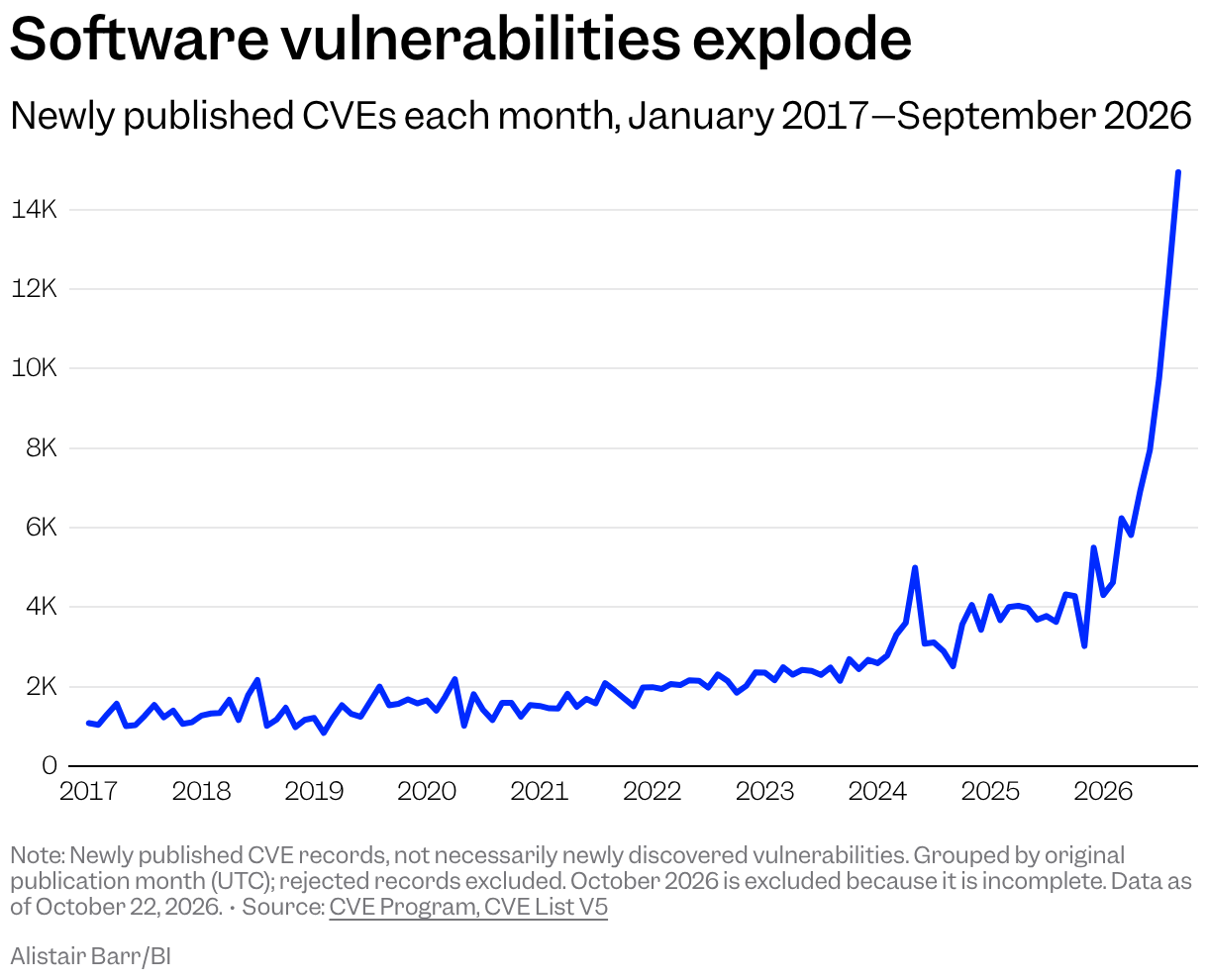
The result: The number of newly published software vulnerabilities (Common Vulnerabilities and Exposures in industry lingo) has exploded.

Line chart showing monthly newly published CVE records from January 2017 through September 2026. Counts rose from 1,083 in January 2017 to 14,934 in September 2026.

Now, there's a frantic race between people trying to break into systems and those trying to protect them.

Don't panic about AI

Cohen's message, though, was surprisingly reassuring.

AI helps the good guys find and fix these problems. Cloudflare, for instance, released protections for the latest vulnerability to customers, including those using its free service.

And there's a bigger effort underway.

OpenAI has launched an initiative called Patch the Planet, working with Cloudflare and other security professionals to use AI to find weaknesses in widely used software and help repair them.

Tom Occhino, chief product officer at Vercel, told me recently that his company has been talking with partners about launching a nonprofit that would fund a swarm of good AI agents that go out on the internet to find and fix software flaws.

Amazon is joining the fight, too. Its new Continuum service, available Thursday, uses AI agents to find security holes and propose fixes. Amazon said that people maintaining freely available software can use it to help protect the wider internet.

Humans may still have to check and approve these repairs, but the prospect of AI helping clean up decades of neglected software is encouraging.

The irony of this is not lost on some in the industry.

"The funny thing is everyone was saying AI slop code will cause a cyber crisis but it's actually all the old human slop causing it and the AI is just cleaning it up," software engineer Ben Kaufman wrote on X on Thursday.

Either way, Cloudflare's Cohen thinks these AI-inspired freakouts will push the industry to do better — by exposing issues and adding urgency to get them patched.

"We may end up in a world where actually we've become significantly more secure at the end," she said.

The trouble is getting there.

A fundamental question about the internet

Tom Occhino (left), chief product officer at Vercel, talks with Meta executive Prashant Ratanchandani at Vercel's Ship SF conference.

Alistair Barr/Business Insider

When I ran into Occhino recently at a Vercel conference in San Francisco, he described a world in which software that everyone assumed was safe suddenly looks vulnerable because increasingly capable AI models are scrutinizing the basic systems that underpin the internet.

That led to a more fundamental discussion between us: Why did we connect so many things to the internet in the first place?

For years, the technology industry has raced to put everything online. Thermostats. Refrigerators. Doorbells. Cars. Bank accounts.

We assumed that connecting something to the internet automatically made it better.

Perhaps we should reconsider.

Before the internet

I remember the world before the internet. It worked pretty well. We managed to buy groceries, pay bills, heat our homes, and generally get through the day without every appliance talking to a computer somewhere.

That doesn't mean abandoning online banking or throwing your smartphone into the sea.

Occhino, for one, isn't particularly worried about hackers wiping out his bank account. Modern banks have sophisticated protections, and he recommends everyone turn on additional login security.

Maybe the cybersecurity crowd, which spends its life immersed in online threats, is missing something obvious.

Not everything needs to be connected.

Occhino put it neatly: "There's certain things that don't make sense to be on the internet in the first place."

Perhaps that's the lesson from this week's panic. We don't need to turn off the internet.

We just need to remember where the off switch is.

Sign up for the AI Insider newsletter here. Reach out to me via email at abarr@businessinsider.com

Read the original article on Business Insider

  •  

Trump suggests a community 'dividend' to defuse data center backlash

President Donald Trump
Trump said that data center companies should pay a "dividend" to local communities.

Andrew Harnik/Getty Images

  • President Donald Trump said data center companies should pay a "dividend" to local communities.
  • In a Truth Social post, Trump said the payments could boost the controversial projects' popularity.
  • Data centers have sparked widespread public backlash, worrying some investors.

President Donald Trump said that data center companies should pay local communities a "dividend" to make their projects "popular."

In a Truth Social post early Wednesday, Trump urged companies to "MAKE DEALS," but did not provide details on how much money they should return to communities or individuals where data centers are being built.

"I have watched the process closely, and Data Centers that were highly unpopular in a certain area, have become extremely popular when a financial deal is struck," he wrote in the post.

There's been a growing backlash against data center construction across the US, with some saying the projects are noisy, raise electricity bills, and compromise the general quality of living.

Data centers are becoming an increasingly important issue in next month's midterm elections, and some politicians have shifted how they talk about the projects in recent months. Data Center Watch, a research project run by 10a Labs, found that in the first quarter of this year, at least 75 data center projects were delayed or canceled due to local opposition.

Some companies have already started trying to placate unhappy locals with money or discounts.

This summer, Elon Musk's SpaceX offered eligible Memphis residents a 50% discount on its Starlink internet service, tied to its growing AI build-out in the city. NorthPoint Development opted for a pure cash incentive and said it would pay every household in a Pennsylvania township $10,000 if it got permission to build a data center, the Wall Street Journal reported last month.

In his Wednesday post, Trump also referenced one of his previous efforts: having tech companies cover their power costs when they build data centers to help keep local electricity prices flat.

Several tech leaders agreed to do so in March, when they signed the "Ratepayer Protection Pledge," which mandates that companies provide or pay for the power generation and electricity needed for their AI projects, among other commitments.

Trump closed his Wednesday post by saying that building data centers under his newest stipulations would be "GREAT FOR THE U.S.A."

Read the original article on Business Insider

  •