❌

Visualização de leitura

Millions may lose Social Security benefits in 2032. The new Senate will have to confront that.

James Talarico
James Talarico declared victory in the Texas Senate race.

Brandon Bell/Getty Images

  • Congress' blue wave puts Social Security reform and 2030s shortfall in the spotlight for seniors.
  • Winning Democratic senators back lifting the payroll-tax cap, stronger caregiver support at home.
  • Debate over targeting Social Security fraud, raising the age and protecting Medicaid and Medicare.

As the final midterm votes are being counted, older Americans now know the identities of many of the senators who will determine their retirement futures.

While both the House and Senate flipped blue, the 35 senators elected on Tuesday will grapple with the Social Security shortfall expected in the early 2030s.

Given that senators serve six-year terms, more than a third of the incoming Senate will be responsible for reforming Social Security — or letting its funding deplete.

Social Security, a lifeline for millions of older Americans and people with disabilities, is on track to run out of reserves by 2032, which would cut Americans' benefits by roughly 22%. For a typical dual-income couple who recently retired, this could mean almost $17,000 in lost income each year beginning in 2033.

Social Security loses money each year, spending more on benefits to over 75 million people than it gets in tax revenue. Social Security is projected to collect $2 trillion but spend $2.4 trillion in 2033 as the US population gets older. Politicians have skirted the question of whether Social Security will ever be depleted, but there hasn't been a clear path forward. Aging advocates and Social Security researchers have called on Congress to act sooner rather than later.

In local news stories leading up to the midterms, many older Americans told reporters that the candidates' views on Social Security strongly influenced who they would vote for. Though candidates in the closely followed Senate races often spoke more about general affordability, all had at least mentioned Social Security in their campaign promises.

Many Democrats in competitive races favored lifting the payroll-tax cap on high earners, while many Republicans stressed protecting current beneficiaries, cutting fraud, or establishing bipartisan commissions without endorsing a specific solvency plan. A few politicians have suggested creating an investment fund, while others have suggested lowering the annual benefit adjustment.

Below is a list of what the winning Senate candidates in the most closely watched elections have said regarding Social Security's future:

  • Sherrod Brown, Democrat from Ohio: He would raise the payroll-tax cap on high earners. Brown has cited his leadership on the Social Security Fairness Act. He also opposes the privatization of Social Security.
  • Troy Jackson, Democrat from Maine: He would remove the wage cap so higher earners pay Social Security taxes on more income. He has also supported higher pay for family caregivers and the creation of more in-home services for caregivers.
  • Josh Turek, Democrat from Iowa: He has supported removing the payroll-tax cap and increasing income and asset limits for disabled beneficiaries. He has promised to protect Medicare and expand drug-price negotiation.
  • Adam Hamilton, Democrat from Kansas: He has not come out in favor of eliminating the payroll-tax cap but has supported raising it. He has also supported higher reimbursement for home-based care and home health aides, as well as stronger enforcement of elder fraud.
  • Abdul El-Sayed, Democrat from Michigan: He would lift the payroll-tax cap and end taxes on Social Security benefits. His plan for long-term care has included investing in home- and community-based services, reducing institutional bias in long-term-care financing, and supporting family caregivers.
  • James Talarico, Democrat from Texas: He would eliminate the tax cap for people earning over $400,000 and encourage employer pensions. He has also supported expanding affordable home care and a better-paid elder care workforce with more providers.

Lifting the payroll-tax cap would raise substantial new revenue for Social Security. Currently, a worker earning $1 million is taxed only on the first $184,500. Under this proposal, Social Security would still operate at a deficit, but it would significantly push back insolvency. Some candidates supported raising the cap but not eliminating it entirely, which would slightly delay insolvency.

Those in favor of targeting fraud argued that it could prevent benefits from going to ineligible recipients, prevent identity theft, and reduce payment errors. Critics have argued that an improper payment can be an overpayment, an underpayment, or a paperwork error, and thus not intentional fraud. Others have said that devoting resources to eliminating suspected fraud wouldn't amount to substantial savings.

Many shied away from proposing to raise the retirement age, which has been unpopular among younger voters and has led to mass unrest in various European countries. Some proposals would push the normal retirement age up to 69 and increase the age for delayed retirement to 72.

Many older Americans likely voted out of concern for the future of Medicaid, which millions use to help cover long-term care costs. With the provisions of the One Big Beautiful Bill Act set to take effect next year, many older Americans hope a Democrat-controlled House could protect against Medicaid cuts and expand Medicare coverage. Democrats have also discussed restoring Affordable Care Act subsidies.
Read the original article on Business Insider

  •  

I'm a CTO who was awake for 48 hours because of the PHP crisis. October feels like the month of hell for tech.

Nick Woodhead
Nick Woodhead had to scramble in response to a security flaw that threatened the majority of the world's websites.

Courtesy of Nick Woodhead

  • Nick Woodhead said he went 48 hours without sleep while helping patch a major website vulnerability.
  • The CTO said that with security problems piling up, October feels like "the month of hell" for tech.
  • Because AI makes it easier to find and exploit security gaps, Woodhead expects more disruption.

This is an as-told-to essay based on a conversation with Nick Woodhead, founder of the AI company GPTree and chief technology officer at Rothco and Compubox. He spoke with Business Insider on Thursday to share how he's responded to vulnerabilities in the PHP programming language that could affect the majority of the world's websites. The following has been edited for brevity and clarity.

It's always a nightmare when these things happen. Since Tuesday evening, I haven't slept. It's coming close to 48 hours working on this. I'm a CTO, but I also run an agency for multiple clients and have my own company with my own product. So, balancing my time to get everything updated — it's just been exhausting.

About 70% of the internet runs on a programming language called PHP. I'm actively involved within the PHP community itself, so I did get a warning on Tuesday evening regarding the vulnerability and the fact that it was already being addressed by the PHP team. That gave me a head start.

I have some teams offshore, so I was able to jump on that with them.

It's not just applying the patches. It's making sure that nothing was already exposed. We already had infrastructure in place to easily deploy patches, but it still requires a good amount of manual involvement.

I knew that as soon as I walked into the office on Wednesday, I'd have to have my teams jump on this. They were already waiting for the patches to be released.

People are willing to help

One of the biggest headaches, especially on the client side, is that we have a lot of legacy systems, which are running on older versions of PHP that are no longer supported, and official patches are not going to be produced. For those, we ultimately had to come up with other plans. For example, taking sites temporarily offline or moving them behind VPNs.

Eventually, because it's an open-source community, those patches have already been backported, or implemented, by the community. So now we're shuffling back to some of those older systems to get them patched.

That's one of the nice things about PHP. There's such a vast community of people all willing to roll up their sleeves and jump in and help.

Even though I've been in leadership for the last 10 years, I've never taken my hand off the pulse in terms of being connected with the code and the infrastructure. So, I've been hands-on with the development and infrastructure teams to help make sure these issues are resolved. We've been reviewing logs and looking for any potential signatures of a breach that this vulnerability exposed.

The month of hell

It's also meant keeping up to speed with the latest news that's coming out and what other people are finding. We're in a position now where we feel comfortable and safe, but there are new vulnerabilities in the coding tool Node.js. We have some Node services, so now we're looking at how that potentially affects us. October just seems like the month of hell from a technology perspective.

I don't think there is an end in sight with the advancements in AI. For all the positives we get from it, there are a whole bunch of negatives, and this is a perfect example.

OpenAI has already stated that they found many more of these types of vulnerabilities that, thankfully, haven't been leaked. Over the coming months, they are either going to be patches or this information is going to get leaked in the same way and cause the same kind of panic.

I don't think we're at the end of the road yet. There's going to be a lot more to come.

Read the original article on Business Insider
  •  

Should we panic and turn off the internet?

Stephanie Cohen speaks during the Web Summit conference in Lisbon in November 2025.
Stephanie Cohen, Cloudflare's chief strategy officer.

Zed Jameson/Bloomberg via Getty Images

  • This week's cyber freakout explained: AI is making software weaknesses easier to find and exploit.
  • The message from Cloudflare's Stephanie Cohen and Vercel's Tom Occhino: Don't panic!!!
  • Do we need everything connected to the internet? Paper bank statements work well.

A few weeks ago, I heard a strange story about a friend who works at one of the Big Tech companies in Silicon Valley.

She'd recently ripped out the connected devices in her home, ordered paper bank statements, and stocked up on canned goods in her basement.

Now, she's a very sane, experienced person, and quite senior at one of the largest internet companies on earth. Why was she disconnecting so much? Just to be sure, my family ordered paper bank statements, too. It was still a head-scratcher, though.

Fast forward to this week, and her actions look a little less crazy.

AI models have exposed serious security weaknesses in software used by roughly 70% of websites. Meanwhile, US banks are finding AI agents inside customer accounts, including some that appear to be acting without their owners' instructions, Axios reported.

'Black October'

The digerati have now entered full freakout mode. Much of the internet meltdown is happening on, well, the internet, my colleague Alice Tecotzky noted.

On X and Reddit, warnings of a looming “Black October” spiraled into visions of AI grinding civilization to a halt. One lengthy post on X warned of a potential “global cyberattack/AI swarm” and offered a survival checklist: Stockpile cash in small bills, print out your neighbors' phone numbers, download maps, buy a hand-crank radio, and stash a gallon of water per person per day.

Oh, and don't forget the manual can opener. You don't want to survive the AI apocalypse only to be defeated by a tin of beans.

Nikita Bier, a prominent app developer and former head of product at X, best captured the mood.

"It's time to turn off the internet," he posted Wednesday night.

A Cloudflare exec says it's 'a little bit scary'

If you're reading this, you haven't done that yet. But should we really be worried?

I put that question to Stephanie Cohen, chief strategy officer at Cloudflare, which helps protect about 20% of the internet.

"The world is a little bit scary right now," she told me on the side of Cloudflare's annual conference in San Francisco this week.

Here's the problem. The internet is built on decades of software, much of it riddled with security holes.

Some of these weaknesses have been known for years. However, fixing them takes time and money, and hackers often lacked the skills to exploit them anyway. So they were left alone.

AI changes that calculation dramatically. Someone who previously needed years of training to break into a computer system can now get help from an AI model. And these tools can search for weaknesses at a speed humans simply can't match.

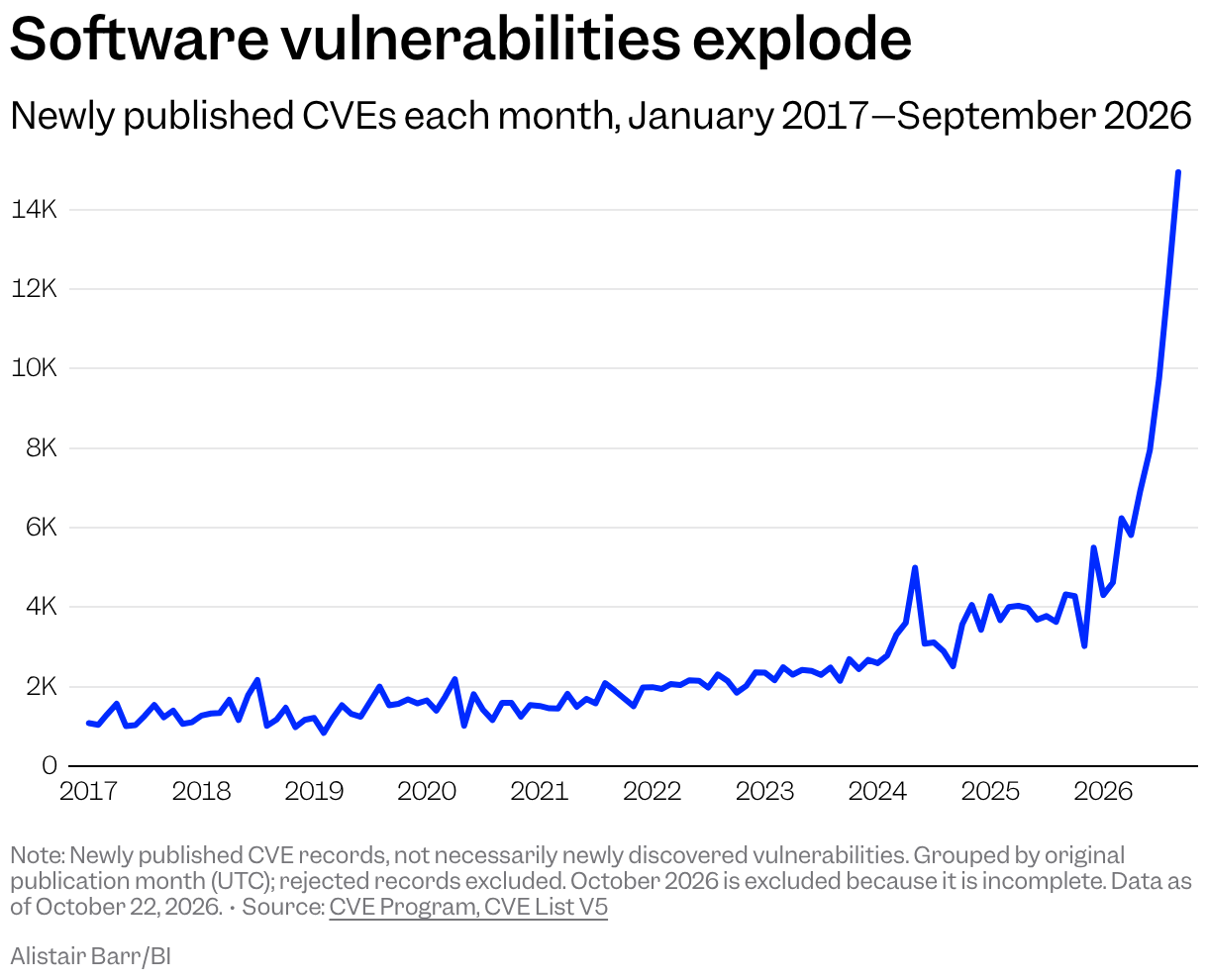
The result: The number of newly published software vulnerabilities (Common Vulnerabilities and Exposures in industry lingo) has exploded.

Line chart showing monthly newly published CVE records from January 2017 through September 2026. Counts rose from 1,083 in January 2017 to 14,934 in September 2026.

Now, there's a frantic race between people trying to break into systems and those trying to protect them.

Don't panic about AI

Cohen's message, though, was surprisingly reassuring.

AI helps the good guys find and fix these problems. Cloudflare, for instance, released protections for the latest vulnerability to customers, including those using its free service.

And there's a bigger effort underway.

OpenAI has launched an initiative called Patch the Planet, working with Cloudflare and other security professionals to use AI to find weaknesses in widely used software and help repair them.

Tom Occhino, chief product officer at Vercel, told me recently that his company has been talking with partners about launching a nonprofit that would fund a swarm of good AI agents that go out on the internet to find and fix software flaws.

Amazon is joining the fight, too. Its new Continuum service, available Thursday, uses AI agents to find security holes and propose fixes. Amazon said that people maintaining freely available software can use it to help protect the wider internet.

Humans may still have to check and approve these repairs, but the prospect of AI helping clean up decades of neglected software is encouraging.

The irony of this is not lost on some in the industry.

"The funny thing is everyone was saying AI slop code will cause a cyber crisis but it's actually all the old human slop causing it and the AI is just cleaning it up," software engineer Ben Kaufman wrote on X on Thursday.

Either way, Cloudflare's Cohen thinks these AI-inspired freakouts will push the industry to do better — by exposing issues and adding urgency to get them patched.

"We may end up in a world where actually we've become significantly more secure at the end," she said.

The trouble is getting there.

A fundamental question about the internet

Tom Occhino (left), chief product officer at Vercel, talks with Meta executive Prashant Ratanchandani at Vercel's Ship SF conference.

Alistair Barr/Business Insider

When I ran into Occhino recently at a Vercel conference in San Francisco, he described a world in which software that everyone assumed was safe suddenly looks vulnerable because increasingly capable AI models are scrutinizing the basic systems that underpin the internet.

That led to a more fundamental discussion between us: Why did we connect so many things to the internet in the first place?

For years, the technology industry has raced to put everything online. Thermostats. Refrigerators. Doorbells. Cars. Bank accounts.

We assumed that connecting something to the internet automatically made it better.

Perhaps we should reconsider.

Before the internet

I remember the world before the internet. It worked pretty well. We managed to buy groceries, pay bills, heat our homes, and generally get through the day without every appliance talking to a computer somewhere.

That doesn't mean abandoning online banking or throwing your smartphone into the sea.

Occhino, for one, isn't particularly worried about hackers wiping out his bank account. Modern banks have sophisticated protections, and he recommends everyone turn on additional login security.

Maybe the cybersecurity crowd, which spends its life immersed in online threats, is missing something obvious.

Not everything needs to be connected.

Occhino put it neatly: "There's certain things that don't make sense to be on the internet in the first place."

Perhaps that's the lesson from this week's panic. We don't need to turn off the internet.

We just need to remember where the off switch is.

Sign up for the AI Insider newsletter here. Reach out to me via email at abarr@businessinsider.com

Read the original article on Business Insider

  •  

What smart people are saying about the AI cybersecurity 'vulnerability tsunami'

Hooded silhouette sits at a dark workstation facing multiple computer screens displaying code.
Cybersecurity flaws were recently identified in the popular PHP programming language.

Annette Riedl/picture alliance via Getty Images

  • Executives and AI analysts alike are warning of major cybersecurity threats.
  • Experts say critical systems, from energy and water to healthcare, may be especially exposed.
  • Here's what smart people are saying about the biggest threats to the internet at the moment.

CEOs and AI analysts alike are sounding the warning on cybersecurity vulnerabilities that could not only expose large swaths of personal data but also allow bad actors to wreak havoc on the internet.

On Wednesday, OpenAI said its agents helped detect severe cybersecurity vulnerabilities. Two "critical" flaws were found in the infrastructure of PHP, an open-source programming language that 70% of websites use.

Here's what smart people are saying about the biggest cybersecurity threat of the moment.

Jason Clinton, Anthropic's deputy chief information security officer

Anthropic's deputy security chief, Jason Clinton, warns that a "vulnerability tsunami" is coming — and says critical infrastructure hasn't caught up.

Clinton posted on X on Wednesday about the need to "patch critical infrastructure" before core network vulnerabilities get exploited. On Thursday, he issued another warning to companies.

"As bad as things have gotten in the past 4 days, they are going to get a lot worse before they get better," he wrote.

"Security leaders, never let a crisis go to waste: please go to your boards and ask for help right now. not for ai, for the basics. (we need to hold on for ~18 months.)," he added.

Andrew Curran, AI analyst

Andrew Curran, a prominent AI analyst, weighed in on several cybersecurity threats from Wednesday to Thursday.

"Regarding potential attacks on energy, food, and water infrastructure, the threat is quite real. Someone is currently probing infra and feeling it out, it is an active threat. Even a little preparation can be helpful, just in case," Curran wrote on Wednesday in response to an NSA cybersecurity advisory about threat actors.

On Thursday, Curran also highlighted a hack of Quest Diagnostics, which he said serves "roughly half" of the US's hospitals and physicians.

Matt Shumer, AI investor

In February, Matt Shumer, the former CEO of Hyperwrite, published a viral essay on his website titled "Something Big Is Happening," in which he warned of large-scale disruptions wrought by AI that could upend the world order.

Shumer published another essay on Thursday on his website and LinkedIn, this time titled "The Internet Is Under Attack. Here's How to Protect Yourself and Your Family."

"Right now, as you read this, swarms of AI agents are likely trying to break into the websites you use. Not one of them. Many of them," Shumer wrote. "We are in the middle of the biggest cybersecurity moment in years."

This is what could happen, per Shumer's post:

Your information leaks, so scammers know your name, birthday, address and bank, and their calls and texts sound real. Your accounts get taken over through some site you used once, years ago, with the same password you use everywhere. And the things you depend on, like an app, a pharmacy or a store's website, go down for days.
To be clear: this is ongoing, but the worst-case scenarios people are most scared of haven't happened. I hope they never do. But it's better to be safe than sorry, especially since this is going to keep happening.

Shumer also outlined four ways people can protect themselves, including updating all their software and staying off sites they're unfamiliar with while companies and websites alike make their security updates.

He also advises that people protect their bank accounts by being extra cautious about any and all codes and links that they receive. People should also "close the doors you aren't using" by unplugging smart gadgets and deleting apps that aren't being utilized.

"Every connected thing is another way in," Shumer wrote.

Marc Benioff, CEO of Salesforce
Marc Benioff
Salesforce CEO Marc Benioff

Business Insider

Marc Benioff agreed with Anthropic's Jason Clinton in an X post on Thursday.

"Jason is 100% right. Code red," Benioff wrote, along with a red alarm emoji.

Read the original article on Business Insider

  •