Online sales growth is reshaping what seasonal hiring looks like.
Dominick Reuter/Business Insider
Americans are still buying plenty of stuff for the holidays.
Sales continue to shift online, and that calls for a shift in staffing.
Seasonal retail hiring is shifting from a sales-floor focus to more logistics and delivery roles.
The annual holiday shopping rush needs a lot of workers to keep everything moving.
In the last few years, that seasonal hiring spree has appeared to soften, at least when it comes to traditional brick-and-mortar retailers. One industry estimate projects this year will see about 450,000 seasonal jobs in the retail sector, the lowest gain in nearly 20 years.
But that's not the whole picture.
An analysis from Indeed last month found that retail jobs have slid from about two-thirds of all seasonal jobs in 2019 to around 61% this year. That five-percentage-point decline has mostly reappeared as an increase in loading and stocking roles.
Since that report came out, Amazon bumped up its hiring target to 300,000 seasonal workers, up 50,000 from the prior few years, and UPS said Monday it's looking to add 100,000 seasonal workers this year.
And while neither Walmart nor Target have announced similar companywide goals, both retailers say they've been staffing up ahead of the season with local stores hiring seasonal workers as needed.
Within stores, more of the work is shifting from traditional sales work like cashiering and more toward stocking and fulfillment to meet growing online demand.
For many Walmart stores, digital teams are some of the fastest-growing, and digital fulfillment is a common expectation on seasonal associate job listings. And on Target's jobs board on Wednesday, nearly all of the 4,000 seasonal job listings reference inbound restocking duties.
Some smaller retailers, like Five Below and Dick's Sporting Goods, are still aiming to hire thousands of seasonal workers this year, but across the industry those numbers are increasingly giving way to roles more focused on logistics and e-commerce.
Of course, in-store business is still king for retailers.
Foot traffic from location data firm Placer.ai shows that Walmart, Target, and other mass merchandise retailers had increases in visits during the week leading up to Black Friday. Other specialty categories saw surges of two to four times their average daily traffic on Black Friday.
Even so, as retailers use their stores to fulfill a growing number of online orders at increasingly fast speeds, seasonal hiring is likely to continue adapting to meet the new demand.
Microsoft's data center project in Mount Pleasant, Wisconsin.
Joe Timmerman/Wisconsin Watch via Getty Images
The midterm backlash against AI data centers could help the biggest cloud providers.
Amazon, Microsoft, and Google have existing capacity that smaller rivals are racing to match.
Limits on new construction could reduce competition and push up AI computing prices.
The backlash against AI data centers delivered a stunning political upset in Tuesday's midterm elections. But the biggest winners may turn out to be the tech giants that have already built many of these
Voters across the US sent a clear message Tuesday: They want to slow or stop the construction of new data centers. That could make it much harder for the AI industry to keep up with soaring demand.
The biggest shock came in Texas, where Democrat Gina Hinojosa defeated Republican Gov. Greg Abbott. Hinojosa has promised to immediately pause data center development in a state that's home to some of America's largest AI projects.
Yet their shares jumped on Wednesday, while smaller AI cloud providers, including CoreWeave and Nebius, were hammered.
The divergence highlights an important consequence of the election results: Making new data centers harder to build could strengthen the biggest tech companies while crushing some of their smaller rivals.
Amazon, Google, and Microsoft already operate enormous networks of data centers packed with expensive Nvidia chips that power AI services, including those offered by OpenAI and Anthropic.
Smaller competitors are racing to catch up, investing billions of dollars in new facilities and computing equipment.
But if newer projects are delayed or canceled, these challengers could be stuck with expensive expansion plans while their larger rivals continue to make money from facilities already operating.
That would mean less competition for Amazon, Google, and Microsoft.
It could also mean higher prices.
With demand for AI computing power still booming, restrictions on new data centers could make existing capacity more valuable. That would mean even bigger profits for Amazon, Microsoft, and Google.
Paul Golding, a Macquarie analyst, highlighted this dynamic in a note to investors on Wednesday.
"Approved, permitted pipeline becomes far more valuable," he wrote, predicting that demand for increasingly scarce data center capacity could drive prices higher.
There's already evidence of this supply-demand phenomenon. Silicon Data, which tracks the cost of renting Nvidia GPUs through cloud services, has recorded steadily rising prices this year for several popular chips.
"If demand keeps growing and protests delay new capacity, that could certainly help support GPU rental pricing," Brad Gastwirth, global head of research at Circular Technology, told me.
The irony is striking.
Voters trying to rein in the AI data center boom may have just handed Amazon, Google, and Microsoft an even stronger grip on the industry.
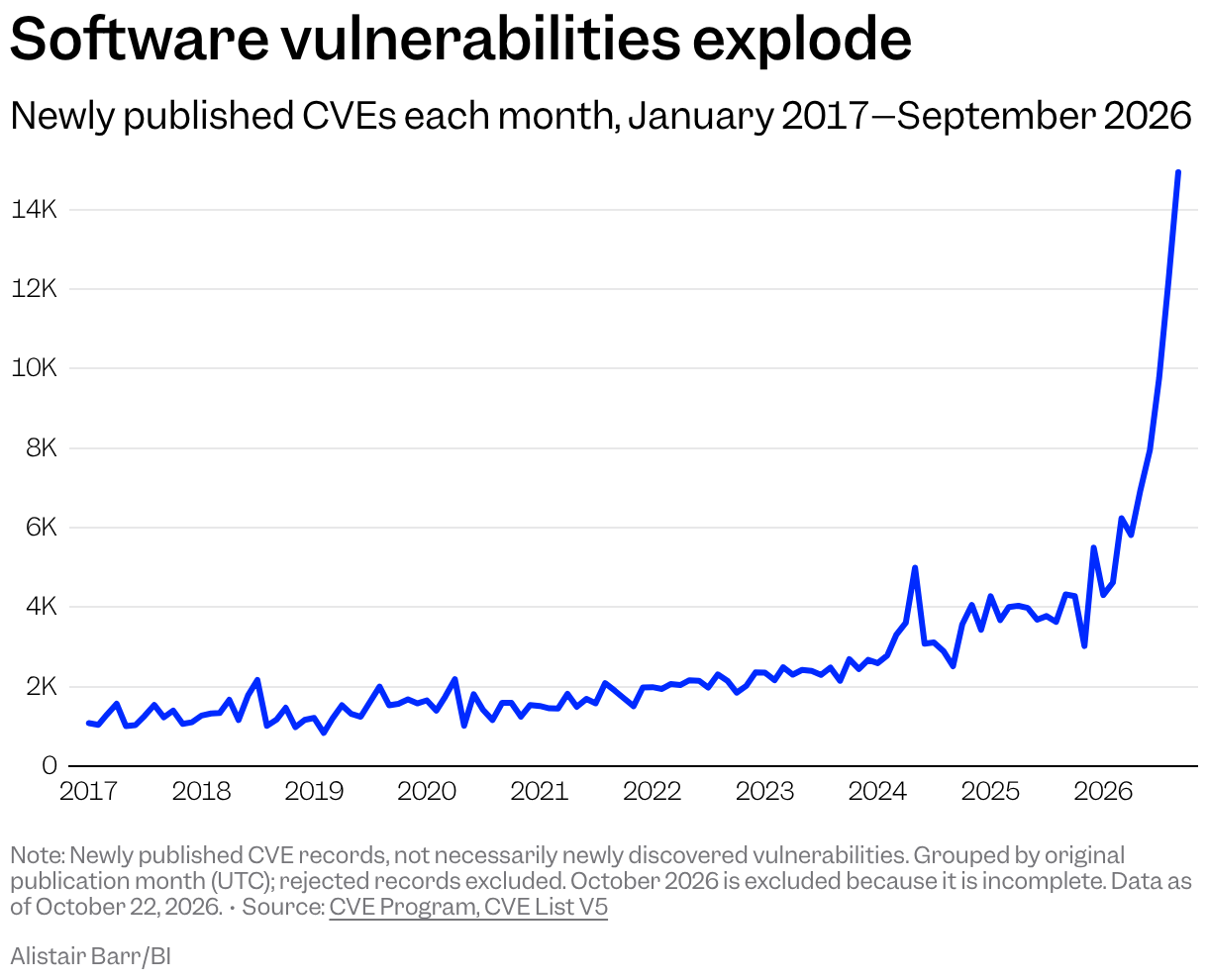
This week's cyber freakout explained: AI is making software weaknesses easier to find and exploit.
The message from Cloudflare's Stephanie Cohen and Vercel's Tom Occhino: Don't panic!!!
Do we need everything connected to the internet? Paper bank statements work well.
A few weeks ago, I heard a strange story about a friend who works at one of the Big Tech companies in Silicon Valley.
She'd recently ripped out the connected devices in her home, ordered paper bank statements, and stocked up on canned goods in her basement.
Now, she's a very sane, experienced person, and quite senior at one of the largest internet companies on earth. Why was she disconnecting so much? Just to be sure, my family ordered paper bank statements, too. It was still a head-scratcher, though.
Fast forward to this week, and her actions look a little less crazy.
The digerati have now entered full freakout mode. Much of the internet meltdown is happening on, well, the internet, my colleague Alice Tecotzky noted.
On X and Reddit, warnings of a looming “Black October” spiraled into visions of AI grinding civilization to a halt. One lengthy post on X warned of a potential “global cyberattack/AI swarm” and offered a survival checklist: Stockpile cash in small bills, print out your neighbors' phone numbers, download maps, buy a hand-crank radio, and stash a gallon of water per person per day.
Oh, and don't forget the manual can opener. You don't want to survive the AI apocalypse only to be defeated by a tin of beans.
Nikita Bier, a prominent app developer and former head of product at X, best captured the mood.
"The world is a little bit scary right now," she told me on the side of Cloudflare's annual conference in San Francisco this week.
Here's the problem. The internet is built on decades of software, much of it riddled with security holes.
Some of these weaknesses have been known for years. However, fixing them takes time and money, and hackers often lacked the skills to exploit them anyway. So they were left alone.
AI changesthat calculation dramatically. Someone who previously needed years of training to break into a computer system can now get help from an AI model. And these tools can search for weaknesses at a speed humans simply can't match.
Now, there's a frantic race between people trying to break into systems and those trying to protect them.
Don't panic about AI
Cohen's message, though, was surprisingly reassuring.
AI helps the good guys find and fix these problems. Cloudflare, for instance, released protections for the latest vulnerability to customers, including those using its free service.
And there's a bigger effort underway.
OpenAI has launched an initiative called Patch the Planet, working with Cloudflare and other security professionals to use AI to find weaknesses in widely used software and help repair them.
Tom Occhino, chief product officer at Vercel, told me recently that his company has been talking with partners about launching a nonprofit that would fund a swarm of good AI agents that go out on the internet to find and fix software flaws.
Amazon is joining the fight, too. Its new Continuum service, available Thursday, uses AI agents to find security holes and propose fixes. Amazon said that people maintaining freely available software can use it to help protect the wider internet.
Humans may still have to check and approve these repairs, but the prospect of AI helping clean up decades of neglected software is encouraging.
The irony of this is not lost on some in the industry.
"The funny thing is everyone was saying AI slop code will cause a cyber crisis but it's actually all the old human slop causing it and the AI is just cleaning it up," software engineer Ben Kaufman wrote on X on Thursday.
Either way, Cloudflare's Cohen thinks these AI-inspired freakouts will push the industry to do better — by exposing issues and adding urgency to get them patched.
"We may end up in a world where actually we've become significantly more secure at the end," she said.
The trouble is getting there.
A fundamental question about the internet
Tom Occhino (left), chief product officer at Vercel, talks with Meta executive Prashant Ratanchandani at Vercel's Ship SF conference.
Alistair Barr/Business Insider
When I ran into Occhino recently at a Vercel conference in San Francisco, he described a world in which software that everyone assumed was safe suddenly looksvulnerable because increasingly capable AI models are scrutinizing the basic systems that underpin the internet.
That led to a more fundamental discussion between us: Why did we connect so many things to the internet in the first place?
For years, the technology industry has raced to put everything online. Thermostats. Refrigerators. Doorbells. Cars. Bank accounts.
We assumed that connecting something to the internet automatically made it better.
Perhaps we should reconsider.
Before the internet
I remember the world before the internet. It worked pretty well. We managed to buy groceries, pay bills, heat our homes, and generally get through the day without every appliance talking to a computer somewhere.
That doesn't mean abandoning online banking or throwing your smartphone into the sea.
Occhino, for one, isn't particularly worried about hackers wiping out his bank account. Modern banks have sophisticated protections, and he recommends everyone turn on additional login security.
Maybe the cybersecurity crowd, which spends its life immersed in online threats, is missing something obvious.
Not everything needs to be connected.
Occhino put it neatly: "There's certain things that don't make sense to be on the internet in the first place."
Perhaps that's the lesson from this week's panic. We don't need to turn off the internet.
His company, Bed Scrunchie, generated about $4.5 million in 2024 and was on track for more, Nekhala said. However, Amazon deactivated its seller account just before the holidays that year, cutting off its biggest sales channel.
"Once the collapse happened through Amazon, it basically collapsed the entire business," Nekhala told Business Insider for our So Expensive video series.
That makes his next admission harder to say.
"I still shop on Amazon," Nekhala said. "I have a daughter. She needs bikes. She needs a scooter, she needs all sorts, she needs different things. And that's the place we go to."
He said he shops on Amazon two to three times a week and sometimes has several orders in a single day.
The habit bothers him more than he can explain, he said. "Continuing to shop there feels like being forced to sit down to dinner with the institution that upended your life."
Founders of the Bed Scrunchie: Jack Nekhala (left) and Michael Nusinkis (right).
Courtesy of Jack
The account shutdown, he said, left him and his business partner carrying debt and trying to rebuild the financial security they had spent nearly 20 years creating for their young families. "My life has not been the same," he said.
For Nekhala, his Amazon shopping habit reflects how deeply the online marketplace has become embedded in everyday life. In a recent survey of shoppers across the US and Europe, 75% of consumers said they buy from Amazon at least once a month.
"I do not shop there because I have forgiven what happened. I shop there because Amazon has made itself so convenient and embedded in everyday life that even people who feel harmed by it continue to depend on it," Nekhala said.
"It's crazy," he added of his own shopping habits. "It's really incredible what they've accomplished."
Amazon became the default
Jack Nekhala launched his Bed Scrunchie product in 2019.
Business Insider
The appeal of Amazon isn't just price. It's the convenience, Nekhala said.
Amazon already has his payment information, shipping addresses, and purchase history. Adding one more item to an order is often easier than creating an account somewhere else, he said.
"They remove all the friction," Michael Nusinkis, Nekhala's business partner, said.
"I think you just have this muscle memory. I need to buy something — Amazon," Nusinkis added.
The founders saw that same behavior from their own customers.
Before Amazon deactivated their seller account, the pair aired a national television infomercial directing viewers to a website where they could buy the Bed Scrunchie directly for $39.99.
On Amazon, the product sold for $44.95. And they said Amazon sales of the item consistently spiked whenever the infomercial aired.
"All advertising roads lead back to Amazon," Nekhala said.
Nekhala said customers would likely discover the product on television or the company's website, then go to Amazon to compare options, read reviews, and buy it—even at a higher price.
Surveys suggest up to three-quarters of Amazon shoppers start their product searches there.
Even after losing their account, the business couldn't leave Amazon
The bed scrunchie is designed to prevent sheets and mattress toppers from sliding off a mattress.
Business Insider
After months of disputes with Amazon, including allegations that the company had infringed its own patent and violated Amazon's review policies, Nekhala and Nusinkis lost their seller account. The founders dispute both allegations.
They now sell Bed Scrunchie to a third-party distributor, which keeps it available on Amazon for $49.99. Nekhala estimates that Amazon still accounts for 70% to 80% of the company's sales.
That means shoppers may see the Bed Scrunchie name on Amazon without realizing they are buying from a reseller—not the small business that created it, he said.
"Amazon shut out the people who invented and built the product, yet the product remains on its platform at a higher price," Nekhala added. "That contradiction is what makes continuing to shop there so painful."
Nekhala said the company would rather sell the product for less on its own website. But he believes Amazon's pricing policies make that difficult: Listing it more cheaply elsewhere, he said, could mean the product loses visibility or prominent placement on Amazon.
As a result, he said, sellers keep prices in line across retailers, even when it means customers pay more.
That's one of the practices at the center of a lawsuit California's attorney general filed against Amazon, alleging it pressures brands and third-party sellers to raise prices at competing retailers so Amazon isn't undercut.
In a statement to Business Insider, Amazon says its goal is to protect customers from overpaying and maintain trust in its marketplace by comparing prices with other reputable retailers. If a product is listed for less elsewhere, Amazon says it may choose not to prominently feature that offer, though it remains available for purchase. Amazon also argues California's case relies on a handful of emails taken out of context and says the challenged practices are common retail negotiations designed to deliver "low prices, vast selection, and unmatched convenience" for customers.

 Entrar