Microsoft's data center project in Mount Pleasant, Wisconsin.
Joe Timmerman/Wisconsin Watch via Getty Images
The midterm backlash against AI data centers could help the biggest cloud providers.
Amazon, Microsoft, and Google have existing capacity that smaller rivals are racing to match.
Limits on new construction could reduce competition and push up AI computing prices.
The backlash against AI data centers delivered a stunning political upset in Tuesday's midterm elections. But the biggest winners may turn out to be the tech giants that have already built many of these
Voters across the US sent a clear message Tuesday: They want to slow or stop the construction of new data centers. That could make it much harder for the AI industry to keep up with soaring demand.
The biggest shock came in Texas, where Democrat Gina Hinojosa defeated Republican Gov. Greg Abbott. Hinojosa has promised to immediately pause data center development in a state that's home to some of America's largest AI projects.
Yet their shares jumped on Wednesday, while smaller AI cloud providers, including CoreWeave and Nebius, were hammered.
The divergence highlights an important consequence of the election results: Making new data centers harder to build could strengthen the biggest tech companies while crushing some of their smaller rivals.
Amazon, Google, and Microsoft already operate enormous networks of data centers packed with expensive Nvidia chips that power AI services, including those offered by OpenAI and Anthropic.
Smaller competitors are racing to catch up, investing billions of dollars in new facilities and computing equipment.
But if newer projects are delayed or canceled, these challengers could be stuck with expensive expansion plans while their larger rivals continue to make money from facilities already operating.
That would mean less competition for Amazon, Google, and Microsoft.
It could also mean higher prices.
With demand for AI computing power still booming, restrictions on new data centers could make existing capacity more valuable. That would mean even bigger profits for Amazon, Microsoft, and Google.
Paul Golding, a Macquarie analyst, highlighted this dynamic in a note to investors on Wednesday.
"Approved, permitted pipeline becomes far more valuable," he wrote, predicting that demand for increasingly scarce data center capacity could drive prices higher.
There's already evidence of this supply-demand phenomenon. Silicon Data, which tracks the cost of renting Nvidia GPUs through cloud services, has recorded steadily rising prices this year for several popular chips.
"If demand keeps growing and protests delay new capacity, that could certainly help support GPU rental pricing," Brad Gastwirth, global head of research at Circular Technology, told me.
The irony is striking.
Voters trying to rein in the AI data center boom may have just handed Amazon, Google, and Microsoft an even stronger grip on the industry.
Osmani works on the Claude Code team at Anthropic. The company is all in on agentic coding — he helps create its AI coding product, after all — and has reduced human code writing.
"Increasingly, nothing in my day-to-day forces critical thinking on me now that so much of my work runs through agents," Osmani wrote in a Tuesday X essay.
Engineers have expressed similar concerns in the last year: AI has turned them more into operators than builders. One OpenAI alum told Business Insider that AI coding was tedious and boring.
Osmani didn't want engineers to stop using AI; he wanted them to learn to think more deeply.
The risk of "cognitive surrender"
Osmani laid out his thesis: "You have to build critical thinking into your day, because by default nothing will do it for you."
There are three types of diminished thinking with AI use, he wrote. First is "cognitive offloading": the process of delegating tasks to AI while retaining ownership of the products. "I do this all day," he wrote. "You should, too."
The second is "deferral," where AI's output becomes your new input. The third is "cognitive surrender," a term coined by two researchers at the Wharton School. This is complete trust in AI outputs, which Osmani described as lazy. Surrendering too often creates "cognitive debt."
It's not yet clear whether AI is making us dumber or changing the way we think. Researchers Business Insider spoke with saw some bad signs, but cautioned against jumping to conclusions.
As for Osmani, he often sees this surrender of critical thinking. It's not the worst thing, he wrote; it's merely a question of the task's importance.
"Where the stakes are low, feel free to delegate entirely," he wrote. "When you can't explain the answer to a question, even by way of your agent, you've ceded ownership."
How to think with AI agents
Osmani shared a list of questions that he asks himself. They include, "Did I formulate a hypothesis before asking?" and "What am I no longer practicing?"
Again, he's not asking engineers to think hard about everything, or even most things. In response to a question differentiating help versus offloading, Osmani wrote: "Both are OK, as long as you know which one you're doing."
Engineers should also build loops to ensure the code that AI has written works, Osmani wrote. He called it "verification as a habit" and told engineers to ask the AI agent what it could verify (and what it couldn't).
Skills often degrade over time. How many of us can navigate using a physical map after phone apps took over? How many of us remember our friends' phone numbers when we can merely save them to contacts? Coding is no different.
"Skills that you stop exercising are going to go away, and probably faster than you might guess," Osmani wrote. "Keep doing the ones you're not willing to let go."
Agility Robotics is expected to begin trading on Nasdaq Thursday under AGLT.
Agility is the first humanoid-focused company to go public in the US.
The humanoid robot maker reported $1.8 million in 2025 revenue and a $138.1 million loss.
Agility Robotics is about to give Wall Street a reality check on the humanoid robot boom.
The Oregon startup, whose two-legged robots carry heavy materials and sort goods in factories and warehouses, is expected to begin trading on Nasdaq on Thursday, becoming the first humanoid-focused company to go public in the US. Its financial disclosures show just how far the industry still has to go before robots become a profitable business.
Agility brought in just $1.8 million in revenue last year while reporting a $138.1 million net loss, according to its merger filings. More than half its revenue came from five robots purchased by one of its investors.
Agility is going public through a merger with Churchill Capital Corp XI, a special-purpose acquisition company (SPAC) led by former Citigroup executive Michael Klein, which was completed Wednesday. The combined company is expected to begin trading under the ticker AGLT when the market opens Thursday.
"There's something to be said for being first," Agility CEO Peggy Johnson, who previously led Magic Leap and held roles at Microsoft and Qualcomm, told Business Insider. "We will be able to set many of the metrics, if you will, on what customers need in a humanoid."
The merger valued Agility's existing equity at about $2.5 billion. The company expects about $465 million in gross capital before expenses, including $100 million already received.
SPAC mergers boomed in 2020 and 2021, before collapsing as interest rates rose in 2022. They are drawing renewed interest as the IPO market recovers. Johnson said Agility chose the route to bring in Klein, a prolific SPAC sponsor known for helping take Sam Altman-backed nuclear power company Oklo and electric vehicle maker Lucid public.
"Agility is unique to the industry because they're actually deployed," George Chowdhury, a principal analyst at ABI Research, told Business Insider. "In the grand scheme of things, the deployments are very small, but it's big for commercial humanoids."
Agility Robotics CEO Peggy Johnson
Krisztian Bocsi/Bloomberg via Getty Images
Agility has deployed Digit, its humanoid robot, across nine customer facilities, including those belonging to Amazon, Toyota, and the logistics company GXO. Its investors include Amazon, Foxconn, Nvidia, SoftBank, and Silicon Valley venture firm DCVC.
Agility's losses aren't just on paper. While about $38 million of the company's $138.1 million net loss came from non-cash expenses tied to employee stock awards, filings show that the company used $99.8 million in cash to run the business in 2025. Agility lost $2.7 million on its sales, even before research and other company expenses.
"We expect to incur additional losses and higher operating expenses for the foreseeable future," the company said in SEC filings.
"There's a lot of challenges when it comes to solving unit economics," Michelle Sun, a robotics analyst who writes the Substack Core Matter, told Business Insider.
Agility is betting on Digit 5, its newest robot, to grow its business. Digit 5 is designed to safely work near people without the safety barriers required by earlier versions.
The company's filing says it has more than $300 million in orders for 1,000 robots from a single customer. This customer would pay to use the robots over a three-year period. But those orders depend on Agility meeting deadlines and delivering robots with the promised features.
Agility is targeting deliveries in the first half of 2027 and general availability by the end of that year.
The company's public debut highlights a striking divide in how investors value humanoid robotics companies.
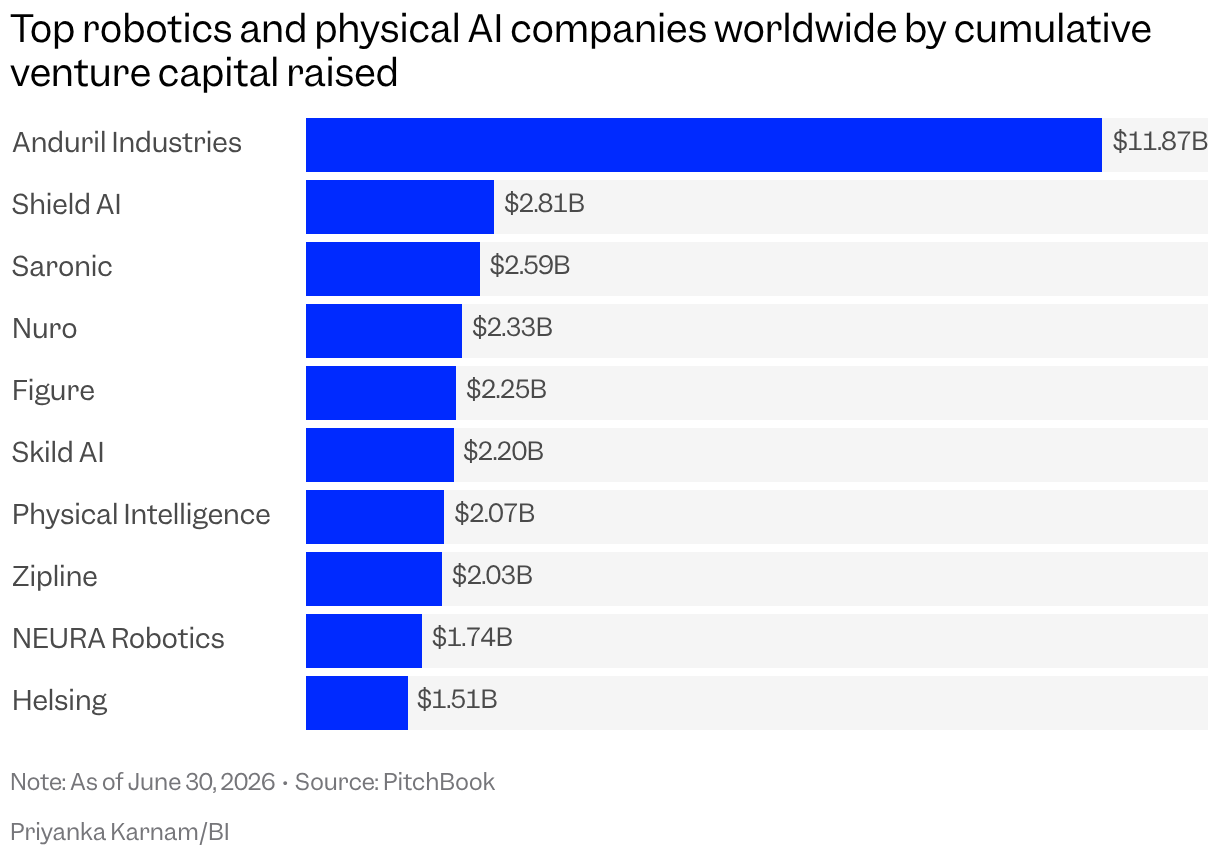
Agility's $2.5 billion valuation is well below those of some privately held humanoid rivals, including Bay Area-based Figure AI at about $39 billion, Texas-based Apptronik at about $5.5 billion, and Germany-based Neura Robotics at around $7 billion. Tesla is also developing its own humanoid, Optimus, but the project doesn't have a standalone valuation.
"This is a trend we're seeing, where companies with deployments who are actually shipping hardware today are valued by the market a lot lower than companies that are betting on this future," Chowdhury said.
Sun said that Agility's listing would provide a reference point for how public markets value a company that makes humanoids, a form factor that remains controversial among both experts and investors.
Agility's public listing comes as Washington tightens restrictions on foreign-made robots, potentially giving US manufacturers an edge. In July, the Federal Communications Commission banned new foreign-made "advanced robotic devices," including humanoids, quadrupeds, and some robot vacuums. Agility manufactures Digit at its Oregon factory.
The humanoid market is currently dominated by Chinese companies such as Unitree, which went public on the Shanghai stock exchange this summer and has a market value of around $40 billion. Chinese robotics firms accounted for about 90% of humanoid robot shipments last year, according to Omdia.
"It's good for the US to show strength in this area," Johnson told Business Insider.
Have a tip? Contact Rya Jetha via email at rjetha@businessinsider.com or Signal at rjetha.07. Use a personal email address and a non-work device; here's our guide to sharing information securely.
Cat Wu, who led the product side of Claude Code at Anthropic, left the AI startup for rival OpenAI.
Don Feria/AP Content Services for Anthropic
Cat Wu is joining OpenAI to lead product management for its core products team.
She had just announced her departure from Anthropic, where she was a face of Claude Code.
The poach is a win for OpenAI ahead of its rival's hotly anticipated IPO in a few weeks.
Cat Wu, who left Anthropic last week after becoming one of the company's highest-profile product managers, is joining OpenAI. She announced the news on X.
Poaching Wu from its archrival is a major coup for OpenAI. Wu was the product leader for Claude Code and had become one of the blockbuster app's prominent evangelists on social media. She oversaw the tool's rise from an internal prototype to a commercial juggernaut that has bolstered both Anthropic's finances and transformed the day-to-day work of software engineers.
Now, she'll help Anthropic's elder rival, leading product management for OpenAI's core products team. She wrote in the announcement post that she has "a lot of respect for OpenAI" and cited its broad reach of over 1 billion users.
OpenAI's Codex, a tool similar to Claude Code, has also boosted the company's growth and, more recently, has increasingly been pointed at non-technical work. AI models' coding abilities and their ability to handle long-term tasks are now central to the industry's growing ambitions. The hire could help OpenAI's Codex adoption, a priority since it fell behind Anthropic in enterprise sales earlier this year.
Wu announced her departure from Anthropic on Tuesday, writing that she'd left last week and thanking Claude Code's team and user base. The exit arrived just a couple of weeks before Anthropic's planned initial public offering, as the startup pitches its financials to investors and tries to shore up its growth narrative.
OpenAI confirmed that Wu is joining the company. Anthropic declined to comment.
On X, Wu wrote that she had "no idea" if leaving would allow her to sell her shares earlier than remaining employees, and said it "wasn't a factor for me."
She also wrote back to a question about whether she'd be taking time off with the response, "post agi!," a reference to the industry goal of "artificial general intelligence."
Her post on Wednesday, announcing her move to OpenAI, said, "we'll build agents that have your back and your team's, and keep you in control, so you get more time for the people and work you love."
She'll work at OpenAI with Nick Turley on enterprise products and Ashley Alexander on consumer products, and report to Tibo Sottiaux, an OpenAI representative said.
This isn't the first time Wu left Anthropic for a rival since joining in summer 2024. She and Claude Code creator Boris Cherny departed for AI coding startup Cursor in 2025, but quickly boomeranged to Anthropic, The Information reported at the time.
She and Cherny led Claude Code's rapid rise late that year and into 2026, buoyed by new AI model capabilities for code-writing work. Software developers flocked to the tool, and eventually to OpenAI's version, Codex, as improvements enabled them to automate more and more of the coding process.
Wu did not respond to a request for comment. Before Anthropic, she worked as a partner at Index Ventures, which would eventually co-lead Anthropic's September 2025 funding round.
Have a tip? Contact this reporter via email at scouncil@businessinsider.com, or over text, Signal, Telegram, or WhatsApp at 415-757-8198. Use a personal email address, a non-work WiFi network, and a non-work device; here's our guide to sharing information securely.
Brad Gerstner and Reid Hoffman are two of Silicon Valley's most prominent elite investors, hedge fund managers, and venture capitalists.
Bloomberg and JP Yim/Getty Images
Business and tech leaders across the US are reacting after the Democrats took full control of Congress.
LinkedIn cofounder Reid Hoffman, Brad Gerstner, and Elon Musk are among those reacting to the blue wave.
Data centers and California's ballot measure targeting billionaires are in the spotlight.
The 2026 midterm elections delivered shocking wins for Democrats on Tuesday evening, reshaping the balance of power in Washington.
Business leaders, tech executives, and investors are now assessing what the new political landscape could mean for their industries as Democratic candidates flipped key Senate and House seats.
This includes Texas, where James Talarico won his Senate race despite over $150 million in funding from Elon Musk for his Republican rival, Ken Paxton.
After the results, some of the tech and business leaders who sought closer ties with President Donald Trump ahead of his return to the White House couldface new congressional scrutiny.
In California, the results of the nation's first-ever ballot measure to impose a one-time 5% wealth tax on residents with net worth exceeding $1 billion could have major implications for the state's elite, though as of around 7:30 p.m. ET on Wednesday, the "No" vote held a strong lead.
Here's how powerbrokers in business and tech reacted to the midterms results amid the blue wave sweeping across the country:
Reid Hoffman, LinkedIn cofounder
Reid Hoffman is a Democratic megadonor.
JP Yim/Getty Images for Clinton Global Initiative
Reid Hoffman, the cofounder of LinkedIn and a Democratic megadonor, reacted to the party's big wins in a post on X Tuesday evening.
"Voters made clear they demand a different kind of country. Americans want an economy that can compete globally and deliver for them at home. And they made clear that they want leaders they can trust to fight for their constituents," he wrote.
"This night blew the doors off our expectations. From Texas to Ohio, Kentucky to Iowa, and South Carolina to Indiana, voters rejected the status quo. Tonight's lesson: Never discount any voter in any place," he continued.
Hoffman has been active in politics and vocal about his support for Democrats, spending tens of millions this election cycle. He also spent millions to support Kamala Harris's campaign in 2024.
Hoffman has previously said the Democratic Party had alienated Silicon Valley and was partly to blame for its shift to the right.
Elon Musk, SpaceX and Tesla CEO
SpaceX CEO Elon Musk
Mark Schiefelbein/AP
Elon Musk, who spent hundreds of millions to support Republicans, broke his silence late on election night with two short X posts.
"Data centers in space looking pretty appealing right now," Musk said, referencing concerns that Democratic wins could mean more scrutiny on data center development.
"Guess my election-interfering space lasers didn't work this time," he joked in a quick follow-up post.
Musk, the world's richest person, spent more money than any other individual in the midterms, donating a whopping $446 million, mostly in Texas, the state he calls home along with his companies Tesla and SpaceX.
In addition to Talarico's Senate seat, the Texas governorship was also won by a Democrat, Gina Hinojosa. It was the first time in decades a Democrat won a statewide race in the Lone Star state.
Lisa Su, AMD CEO
Lisa Su.
Win McNamee/Getty Images
Lisa Su, the CEO of chipmaker AMD, saw the election results as showing that tech companies need to do more to convince people about the benefits of AI.
"At the end of the day, what we need to do is ensure that everybody wins from AI," she said in an interview on CNBC's "Squawk on the Street."
"I do think this is an opportunity for us as a tech industry to realize that we need to make sure that the value proposition is clear to every local community that is going to host a data center, and I believe we can do that," she added.
Mark Cuban, billionaire former "Shark Tank" investor
Mark Cuban, co-founder of Cost Plus Drugs.
Bloomberg/Getty Images
Mark Cuban did not share a direct reaction to the election results. As Congress flipped to Democratic control, however, the billionaire former "Shark Tank" investor weighed in on universal healthcare, writing in a Wednesday post on X that he was "all for it."
Cuban, the founder of pharmaceutical company Cost Plus Drugs, wrote, "We need to figure out a non partisan manner of running our American version of Universal Care."
He also referenced Michigan Senator-elect Abdul El-Sayed's book, "Medicare for All."
Dara Khosrowshahi, Uber CEO
Dara Khosrowshahi at Uber's America250 celebration in July.
Jemal Countess/Getty Images for Uber
Dara Khosrowshahi, the CEO of Uber, shared his thoughts on the midterms in a Wednesday morning interview with CNBC.
"I think the people of our country sent a message regarding change," he said. "I think that continuous inflation really has taken a mark on the consumer."
"I think it's up to businesses and up to our politicians and leaders in Washington to respond, and I hope that they do, because it was a very clear message that was sent out."
Khorowshahi, who is Iranian by birth, was a vocal critic of Trump during his first term, but donated $1 million to the president's inaugural fund after the 2024 election.
Keith Rabois, Khosla Ventures managing director
Keith Rabois.
Al Drago/Bloomberg via Getty Images
Keith Rabois held executive roles at PayPal, LinkedIn, and Square, before becoming managing director at Khosla Ventures. As the results came in overnight, he posted on X: "Another reason to move to Miami."
It came shortly after the Associated Press called Florida's US Senate race for the Republican incumbent, Ashley Moody, who held on despite a strong Democratic swing.
While two of the city's three main congressional districts elected Democrats in huge swings, the one that covers downtown Miami looks set to narrowly reelect the Republican incumbent, with 99% of the vote counted.
Rabois is married to Jacob Helberg, Trump's undersecretary of state for economic affairs, and their wedding ceremony was officiated by Sam Altman.
Last year, The Wall Street Journal reported the couple was selling their Miami Beach home for $65 million as Helberg relocated to Washington, DC, although Rabois planned to stay based in Miami.
Brad Gerstner, Altimeter Capital CEO
Brad Gerstner
Bloomberg/Getty Images
Brad Gerstner, CEO of Altimeter Capital, had thoughts on how the US data center buildout would be affected by the elections.
In a guest appearance on the All-In podcast livestream Tuesday evening, Gerstner said fears that a "blue tsunami" could make it difficult to build new data centers are "overblown."
But he said that election results could slow down the development of the centers, and candidates like Gina Hinojosa, the Democrat who won the Texas gubernatorial race Tuesday, could "issue a moratorium on new data centers." He said this could be "really challenging for the AI infratrade."
Gerstner also said that Republicans and the AI community have "struggled with the messaging" over AI as the affordability crisis has weighed on Americans' minds.
The investor is the architect of "Trump Accounts," the investment vehicle for children in the country that launched in July.
Dylan Patel, CEO of SemiAnalysis
Dylan Patel, founder of SemiAnalysis, speaks during the Raise summit in Paris, France, on Tuesday, July 8, 2025. The annual conference gathers global leaders and key speakers in tech and AI. Photographer: Nathan Laine/Bloomberg via Getty Images
Nathan Laine/Bloomberg via Getty Images
Dylan Patel, CEO of SemiAnalysis, hinted at what he believes a blue wave could mean for the AI buildout.
"I am now bullish space datacenters," Patel said in a post on X alongside a screenshot of results out of Texas that showed Hinojosa with an early lead over incumbent Republican Gov. Greg Abbott.
Ahead of the midterms, some in tech expressed concern that Democratic wins would mean additional scrutiny on data centers, which have faced fierce opposition in communities across the US.
Dan Ives, senior managing director at Yorkville Ives
Dan Ives.
Astrida Valigorsky/Getty Images
Dan Ives, a veteran Wall Street analyst and AI bull, said the midterms will put the brakes on the rapid construction of data centers.
In a post on X, he said the "Democratic blue tidal wave across the Senate and House was a seismic shift that will have a negative impact on the pace of the AI Revolution buildout in the US over the next few years."
Ives added that while some investors will prefer a slower pace, others will view it as added risk.
"We estimate 10% of data centers will not happen now," he said.
Richard Branson, founder of the Virgin Group
Richard Branson.
Fabiola Ferrero/Bloomberg via Getty Images
Richard Branson, the billionaire founder of the Virgin Group, wrote in a post on LinkedIn that the results of the midterm election are not just "a decisive repudiation of Trump" but also an encouraging sign "about the limits of money in politics."
Branson wrote, "As a successful entrepreneur, I have felt embarrassed by the billions that tech entrepreneurs and hedge fund managers have spent on — mostly Republican — campaigns this election cycle, in an attempt to buy influence and control over public policy."
Branson added that voters looked past the "hateful and false messages" fueled by the billions spent on funding candidates, voting based on the issues that mattered to them.
"I hope this will prompt the next Congress to start a fresh conversation about the toxic impact of money in politics and the need for meaningful campaign finance reform," he wrote.
Patrick Collison, Stripe CEO
Patrick Collison, cofounder and CEO of Stripe.
Win McNamee/Getty Images
Patrick Collison, the CEO of Stripe, said the results were a good sign for American democracy.
"It seems to me that democracy has on the whole worked very well in America over the last decade, and perhaps better than in any other major country in the West," Collison wrote on X Wednesday. "National outcomes have repeatedly been responsive to underlying voter preferences on meaningful questions, and significant changes in policy have ensued."
He also said he'd been reading "Democracy in America" by Alexis de Tocqueville and that "it's striking how much it still rhymes nearly two centuries later."
Collison, an Irish citizen who lives in California, was among the tech leaders spending big to oppose the proposed billionaire tax in California.
Jason Calacanis, angel investor and "All-In" podcast host
Jason Calacanis said that the ban was "smart" because of the risk of terrorism.
Bloomberg/Getty Images
"All-In" podcast host Jason Calacanis reposted an MSNOW interview clip of Texas senator-elect James Talarico discussing his plans to crack down on data-center companies he said were taking advantage of Texas communities.
Talarico said data centers should "pay for their own energy" rather than drive up Texans' utility bills, recycle their water, and get the consent of people living in affected communities before construction begins.
"Completely reasonable and exactly what the data center industry is doing," Calacanis wrote on X.
Calacanis, who lives in Texas, added that he was "extremely bullish for Texas and SI" if Talarico was being forthright. He said that, if communities were "lucky enough" to have a data center built in their town, they should "extract as much money from them for your local schools and playgrounds."
Lane Kasselman, Blockchain.com Co-CEO
Lane Kasselman, the Co-CEO of cryptocurrency company Blockchain.com, shared an optimistic reaction to the Texas election results on X.
Kasselman wrote that he spent the early part of his career working in Democratic politics in California and now leads a company based in Dallas. He said people across the political spectrum have more in common than they might think.
"Whether you're from my home state or my adopted state, most Californians and Texans aren't that different: we love our kids, like clean air, want prices to come down and think Mexican food is awesome," he wrote. "I'm proud to see pragmatism win in Texas."
Kasselman added that he saw real opportunity for crypto in the country now, with "the most pro-crypto Congress in history."
The citizens of Harwood, who number about 940, shot down a measure that would have given residents a greater say in how large projects, such as AI data centers, are constructed in the town.
The vote wasn't exactly close, either. Some 325 voted against the measure, compared to 105 who voted for it, according to the North Dakota Secretary of State's office.
Of all 45 data-center-related propositions on the ballot across the country on Tuesday, Harwood stood out as the sole constituency in support of them. The other 44 fell on the anti-data-center side, according to Redbud Consulting, a ballot tracking firm.
And for residents of Harwood, the issue is germane. A $3 billion AI data center equal in size to 17 football fields is under construction in the community's backyard. The company building it hopes to employ 200 people — a number equal to about 20% of the city's population.
"It's frustrating," Mark Coolidge, a 59-year-old resident who voted for the measure, told Business Insider.
"We are the people that have to live with this type of industry as a neighbor," said Mike Swartz, a 47-year-old resident who advocated for the proposition. "Do we not have any say in what we want for the community some have vested decades into calling their home?"
In an interview, Blake Hankey, the mayor of Harwood, said he didn't support the measure. He said the language of the proposition was imprecise and that some of the stipulations "would have been financially burdensome to a city our size."
"This amendment to the home rule charter wasn't strictly aimed at data centers," he said. "It was any kind of business coming to town."
He also said the proposition wasn't a referendum on data centers. "It wasn't if there was going to be a moratorium," he added.
The proposition, should it have passed, would not have affected the existing data center, which is set to be completed next year.
Rather, it would have applied to all future construction projects that met a criteria of scale. For instance, a new gas station wouldn't have qualified, but a new large data center would be subject to independent assessments and mandatory public hearings.
Swartz said the measure was necessary because people in town were "blindsided" by how quickly the current data center was approved.
"Many in town didn't even know what that was or meant," he said. "Yet it only took 21 days from the time it was announced to the time construction began."
Hankey, who said he signed a non-disclosure agreement with Applied Digital, the company building the data center, described the decision as one he and the city council had to make quickly, lest neighboring Fargo got the contract first.
"I don't regret signing it," he said of the NDA. "Had I not, that data center would almost certainly be in the city of Fargo right now, without any kind of sales tax or property tax for our community."
As major developers, including SpaceX, Microsoft, Google, Amazon, OpenAI, and others, seek new AI data centers to power their products, they've encountered stiff resistance at town halls and city councils across the United States. Americans worry about the environmental impact, about electric bills, or the water supply. Many just don't like AI.
After a series of contentious city council meetings in Harwood, including one in which anti-data-center protesters were ejected by sheriffs, Coolidge said Swartz gathered enough signatures to formally put the proposition on the ballot.
Voters ultimately shot it down, Swartz and Coolidge said, in part because people in town disagreed with whether the measure would also apply to smaller buildings and businesses, rather than just large ones.
Applied Digital did not respond to a request for comment on Wednesday.
"It's all about money," Coolidge said. "They could give a rip about us as citizens."
Meta previously gave its AI internal codenames like Mango, Watermelon, and Avocado.
Now that it has cutting-edge AI, Meta wants to be taken a bit more seriously.
"We've run out of fruit," Meta CEO Mark Zuckerberg joked on a recent podcast.
Meta is done with fruits.
The social media giant has internally decided to stop naming its AI models after fruit, a person familiar with the matter said.
It's largely a branding decision, as fruit-based codenames don't chime well with Meta's lofty AI ambitions, the person added.
"Watermelon" was the internal codename for Meta's latest AI, Wonder Full, which Meta said was its first cutting-edge "frontier" model. Meta teased its launch by posting photos of the fruit.
Meta dubbed its previous language and image models "Avocado" and "Mango," respectively.
Meta declined to comment.
Meta's CEO, Mark Zuckerberg, and AI chief, Alexandr Wang, joked on the Cheeky Pint podcast last month that they've run out of fruit names for their AI.
"We're out of fruits," Zuckerberg said. "So we're going to have to switch to a new convention."
"I think the only fruit that is technically larger is the durian, and you don't want to go to the durian," Wang said.
Meta isn't the only tech company to name its AI products after items you can buy in a grocery store.
In 2025, OpenAI dubbed one model "Garlic" internally, The Information reported. Google also released its "Nano Banana" image generator in 2025.
More recently, as AI models get more powerful, it's become trendy to give them more awe-inspiring names, like Anthropic's Mythos or OpenAI's Astra.
Have a tip? Contact this reporter securely on Signal at charlesrollet.12 or +1-628-282-2811. Use a personal email address and a non-work device; here's our guide to sharing information securely.
Kent NISHIMURA / AFP via Getty Images; Rebecca Zisser/BI
Elon Musk spent $446 million on the midterm elections. He ended up one of the biggest losers.
Democrats tapped into voter fury over data centers encroaching on their neighborhoods.
Markets are confident in Big Tech stocks, but CEOs may now have to face Congressional subpoenas.
Trump's presidential term doesn't end for another two years. But the political sea change against tech titans like Elon Musk starts now.
For Musk, the $446 million he spent to elect Republicans in the midterms wasn't much. It amounted to about a twentieth of a percent of his net worth.
In the world of politics, it seemed like a tsunami. Ultimately, Musk was the one drowned by a wave.
The blue wave that swept America on election night was a repudiation of President Donald Trump's policies, including tariffs and a war in Iran that fueled inflation. It was a backlash against data centers, the physical symbols of how artificial intelligence has been taking over the world. And it was a rebuke to Silicon Valley elites and their vision for the future.
Shares of Musk's SpaceX and Tesla were down 5% and 2% in Wednesday trading, respectively, after Texas voters pushed out longtime Republican governor Greg Abbott and elected Democratic candidate James Talarico for the US Senate.
"Data centers in space looking pretty appealing right now," Musk wrote on X.
An AI reckoning is here
The market Wednesday showed that it still has confidence in many Big Tech companies, including Microsoft, Amazon, and Google parent Alphabet. Share prices slipped for chip makers Nvidia and TSMC. Worse off were Neocloud companies, which provide cloud computing services for AI customers. CoreWeave shares fell 9% Wednesday, while Nebius Group fell more than 6%.
It isn't all bad news for tech billionaires. In California, they appear likely to defeat a billionaire wealth tax, the prospect of which had led Google cofounders Larry Page and Sergey Brin to leave the state. Voters may even pass a competing measure pushed by Gov. Gavin Newsom that would ban future wealth taxes.
It has been two years since Big Tech bent the knee to Trump after he won the 2024 presidential election. Tech's biggest players had made a big bet on artificial intelligence, and they needed a friend in the White House. Meta CEO Mark Zuckerberg, Amazon, and others donated to his inaugural fund. Big Tech companies also put millions toward Trump's White House ballroom project.
Tech executives including Mark Zuckerberg, Jeff Bezos, Sundar Pichai, and Elon Musk attended Trump's 2025 inauguration.
NBC News' exit poll Tuesday found that 76% of voters would oppose the construction of a new data center in their community; 56% said AI and data centers were a crucial or major factor in their vote for Congress.
In more than 50 local ballot measures, voters had the chance to express their displeasure toward data center construction. Results haven't been tallied for all of those elections, but the early results are clear: More than 30 measures restricting data centers passed, many of them in Ohio, home to a key data center for OpenAI's $500 billion Stargate project. Gina Hinojosa, Texas's Democratic governor-elect, has pledged to impose an immediate moratorium on building new data centers in the state. League City, a town outside Houston, also voted for a ballot measure rejecting Flock license-plate reader cameras, which many consider an intrusive form of surveillance.
Democrats tapped into voter fears that AI could wipe out jobs — or all of humanity. When they take over Congress, they could force a reckoning for Big Tech's no-holds-barred AI acceleration. Democrats will now be able to subpoena tech executives and require them to testify on Capitol Hill. Sen. Ed Markey, a Democrat from Massachusetts, wrote on X that tech executives "are going to need to plant new forests for all of the subpoenas we'll be printing."
At the same time, Big Tech leaders may be able to use the increased oversight as an excuse if they don't deliver on the sky-high valuations and ambitious promises they have made to investors.
Don't mess with Texas
Musk moved Tesla's corporate headquarters to Austin in 2021. Tesla and SpaceX both then reincorporated in Texas in 2024. Musk said he moved the companies to the Lone Star State for more favorable tax, land acquisition, and corporate legal policies.
Tesla now has a large manufacturing facility outside Austin, Texas, and the company's robotaxi service operates in multiple cities across the state. SpaceX, meanwhile, launches its Starship rocket from its Starbase facility in Boca Chica, near the Mexican border.
Much of Musk's political donations this year went toward supporting Ken Paxton, the powerful but controversial longtime Texas state attorney general running for US Senate. The state hadn't elected a Democrat statewide since 1988. Trump won the state in 2024 by 14 points. Paxton seemed like a safe bet.
Instead, Democrat James Talarico, a state representative from Austin who put criticism of billionaires controlling politics at the center of his campaign, trounced Paxton by 12 points. More shockingly, Abbott, who ran for reelection as governor, lost to a Democratic candidate who a year ago was an obscure state legislator.
Democrat James Talarico, a state representative from Austin, put criticism of billionaires controlling politics at the center of his campaign.
Chip Somodevilla/Getty Images
Dan Ives, the founder of research firm Yorkville Ives who is bullish on SpaceX and Tesla, said in a Wednesday note that Musk "needs to find the path forward with Texas now with a Democratic win on both the Senate and Governor race."
Musk had clashed with Talarico, who, in his acceptance speech, singled out the richest man in the world and likened his win to the story of David and Goliath.
"We just proved that all the money in the world is no match for the people of Texas," Talarico said.
Musk reacted on X to the Democratic sweep.
"Guess my election-interfering space lasers didn't work this time," he wrote.
Microsoft said third-party data center delays contributed to a shortfall in infrastructure spend.
Satellite imagery points to potential setbacks for the massive IREN and Nebius data center projects.
Neoclouds are under mounting pressure to deliver on their multibillion-dollar promises.
Microsoft spent $5 billion less than expected on AI last quarter, and satellite images may show why.
In Microsoft's quarterly earnings call last month, chief financial officer Amy Hood said delays by third-party cloud providers contributed to lower-than-expected AI infrastructure spending. Microsoft cut its annual capital expenditure forecast by $5 billion.
The news sent neocloud stocks tumbling, highlighting concerns that the young companies can't deliver on their multibillion-dollar promises.
Although Microsoft didn't name names, two data center projects from neoclouds Iren and Nebius could be responsible, according to satellite analysis from research firm Aterio.
In Texas, IREN is building four data centers under a $9.7 billion deal with Microsoft. An October 21 satellite flyover found that one of the buildings, Horizon 4, was still missing backup power generators and cooling equipment — and risked missing its scheduled delivery by the end of the year, Aterio said.
IREN previously said that equipment shortages had delayed the first building, Horizon 1, which Microsoft accepted in August.
Data center operator DataOne is developing the second project in New Jersey for Nebius under a $17.4 billion deal with Microsoft. Aterio said roughly 140 megawatts of that project's planned capacity could slip into 2027.
It struggled to get permits for its original power generators, then faced more approval delays after switching to fuel cells, said Aterio data analyst Daud Shiraz. Regulators fined DataOne $1 million in September for operating generators without the required permits.
The potential delays point to broader struggles. In October, Microsoft axed a deal with another neocloud, Nscale, due to power-supply delays.
The research firm Currence estimates that 30% to 50% of planned data center capacity initially scheduled to come online this year could be pushed into 2027 or later due to electricity shortages and other construction issues.
A Microsoft spokesperson said its "approach to infrastructure is built on flexibility and optionality," combining its own data centers with leased facilities and third-party providers.
IREN and DataOne declined to comment for this story. Nebius did not respond to a request for comment from Business Insider.
Have a tip? Contact this reporter via email at gweiss@businessinsider.com or Signal at @geoffweiss.25. Use a personal email address, a non-work WiFi network, and a non-work device; here's our guide to sharing information securely.
Instinct founder Noah Shinn (right) at Fireworks AI's Forge conference in San Francisco.
Pranav Dixit/Business Insider
Nearly 40% of Instinct users connect a credit card within three weeks, its founder Noah Shinn said.
Shinn, whose Instinct app went viral this summer, calls it a sign of trust in AI agents.
Instinct and rivals like Meta's Muse are racing to do your shopping.
Nearly 40% of users of Instinct, the viral AI personal assistant, connect their personal credit cards to the service within three weeks of using it, said its founder, Noah Shinn.
Shinn shared the figure on Tuesday at Fireworks AI's Forge conference in San Francisco, describing it as a measure of how quickly people are learning to trust AI agents with their money and sensitive personal information.
"That to me is a real sign of trust," he said.
Instinct helped kick off a new wave of AI agents that go beyond answering questions to actually getting things done, from booking flights and buying groceries to managing calendars and canceling subscriptions. The more useful these assistants become, the more access they need to people's emails, calendars, payment information, and personal preferences.
The race to build personal AI agents is heating up. Meta launched Muse, OpenAI recently introduced Dots, and Anthropic unveiled Claude Duet, a proactive assistant designed to handle tasks on users' behalf.
Shinn, a 24-year-old college dropout, said Instinct measures trust partly by tracking how quickly users allow it to make expensive purchases, including transactions exceeding $500 or trips costing several thousand dollars.
Shopping has emerged as a major use case for AI agents. Meta recently disclosed that more than a quarter of Muse users had made purchases through the agent, with an average order exceeding $200. Business Insider's Katie Notopoulos wondered what people were buying and whether expensive, tedious purchases, such as flights and appliances, were driving the numbers.
Instinct, meanwhile, announced it raised $1 billion at a $10 billion valuation in September.
Shinn said Instinct's usefulness depends on accumulating information about its users, including their private emails, calendars, conversations, and preferences, so it can remember details without being repeatedly prompted.
"It's a massive amount of data," he said.
At Forge, Shinn also discussed plans for real-time voice interactions and dynamically changing interfaces, and he predicted that most people with internet access around the world would have an AI operator like Instinct in the coming years.
Have a tip? Contact Pranav Dixit via email at pranavdixit@protonmail.com or Signal at 1-408-905-9124. Use a personal email address and a non-work device; here's our guide to sharing information securely.
Correction: Noah Shinn is 24. An earlier version of the story misstated his age.
The site where a Learjet crashed in Florida, killing all nine people on board.
GREG LOVETT/PALM BEACH POST via Reuters Connect
In the wake of the deadly Learjet crash, some are reconsidering flying private.
Tech investor Jason Calacanis said ditching private jets for commercial travel.
A Learjet 60 crashed in Florida on Sunday, killing all nine people on board.
The deadly business jet crash in Florida has some wealthy travelers rethinking the appeal of flying private.
Jason Calacanis, a tech investor and co-host of the "All-In Podcast," said he's done flying on Learjet 60s after one plunged from the sky into a Palm Beach County neighborhood on Sunday, killing all nine people aboard.
"Never getting in a Lear 60 again," Calacanis wrote Tuesday in a post on X, adding that he plans to fly commercial instead.
"And with commercial being 10x cheaper and 10x safer, I'm only flying the big iron from the majors," wrote Calacanis.
Fatal crashes involving private charter aircraft are generally more frequent than those involving commercial airlines, but they remain rare. According to National Transportation Safety Board data, on-demand charter airplanes were involved in two fatal accidents in 2024, representing 0.06 fatal accidents per 100,000 flight hours. Scheduled commercial airlines recorded no fatal accidents that year. (The charter category includes private jets as well as smaller aircraft.)
Calacanis also questioned whether flying private is even worth it, saying, "What's the point of saving two hours on average when you have starlink on 50% of @united flight already."
Calacanis ended his post with: "See you in the lounge besties."
Never getting in a Lear 60 again
And with commercial being 10x cheaper and 10x safer, I’m only flying the big iron from the majors
What’s the point of saving two hours on average when you have starlink on 50% of @united flight already
See you in the lounge besties
Texas tech founder Adam Robinson, his wife, and their two young children were among those killed when the Bahamas-bound Learjet they were flying on over the weekend went down.
The cause of the crash remains under investigation. Pilots on board reported a buildup of ice and turbulence shortly before the jet nosedived.
Seattle-based tech investor Ben Sharpe replied to Calacanis' post, saying he was "thinking the same" about private travel.
Was thinking the same Jason.
Flying private saves you at most a few hours, costs $50-80k more and has considerably higher chance of failure over commercial airplanes.
Had the family opted to fly commercial, they would have been at a restaurant or airport lounge on a layover to Bahamas and alive. The risk of death flying commercial is essentially zero.
"Flying private saves you at most a few hours, costs $50-80k more and has considerably higher chance of failure over commercial airplanes," Sharpe wrote.
"Had the family opted to fly commercial, they would have been at a restaurant or airport lounge on a layover to Bahamas and alive," he said. "The risk of death flying commercial is essentially zero."
Lost a good friend in a private jet accident, I'd encourage everyone reading this to simply fly commercial whenever possible. Statistically, it's much safer. I know private jets are convenient, but unless you have a good reason, take the big plane, fly with the people
Adam Singer, a marketing executive at the platform AdQuick, said in a Monday X post that he "lost a good friend in a private jet accident" and encouraged everyone to fly commercial whenever possible.
"Statistically, it's much safer," Singer said. "I know private jets are convenient, but unless you have a good reason, take the big plane, fly with the people."
Texas Governor-elect Gina Hinojosa and Texas Senator-elect James Talerico celebrate their wins. Business leaders may be reconsidering their moves after Texas went blue on Tuesday.
Brandon Bell/Getty Images
Tuesday's blue wave reached all corners of Texas.
A democrat now controls the governorship, while the state house is still tabulating votes.
More than 200 businesses have moved their headquarters to Texas since 2019.
More than 200 companies flocked to Texas in the last seven years, as Republicans in charge of the Lone Star state advertised a business-friendly aura with lucrative corporate tax incentives.
On Wednesday morning, though, the CEOs of those companies woke up to an unprecedented blue wave whose crests reached deep into Texas, from the Rio Grande Valley to Dallas.
Democratic challenger Gina Hinojosa, a state representative with a minimal national profile, defeated Gov. Greg Abbott, a prominent Republican running for a fourth term.
"I do think we should wipe clean corporate welfare in this state," she said in an October interview with Kut News, a Texas NPR affiliate.
On the national stage, Republican Senate candidate and Attorney General Ken Paxton suffered a stunning loss to James Talerico, another state representative, by more than a million votes.
The GOP managed to hold onto the state senate, but results were still being tabulated on Wednesday for a handful of competitive state house seats, according to the Associated Press.
While Hinojosa and Talerico gleefully bumped drinks at Whataburger on Tuesday night, business leaders were no doubt busy contemplating whether the economic incentives that motivated their move would stay in place.
"I never expected Texas to turn blue," Jason Calacanis, a tech entrepreneur and influencer, said on X. "I moved here to get away from the left lunacy!"
Texas levies no income taxes on private individuals or corporations. Though the state charges a franchise tax on companies that post more than $1 million in revenue, Abbott has signed bills expanding franchise tax exemptions. During her campaign, Hinojosa focused her criticism of tax incentives on data centers.
Here are some of the largest companies that moved their operations to Texas in recent years, according to a list compiled by Abbott's office.
SpaceX
Samsung Electronics America
Six Flags Entertainment Corporation
Devon Energy
KFC Corporation
Realtor.com
Chevron
Gordon Ramsay North America
Lion Real Estate Group
QSAM Biosciences Inc.
Tesla
X
AESOM (Architecture, Engineering, Consulting, Operations, and Management)
Sam Altman briefly changed his X name to "Ram Altman"
Minh Connors/Bloomberg via Getty Images
Sam Altman renamed himself "Ram Altman" on X after his recent comments on the memory shortage.
The AI boom has memory in high demand, and Altman has called for discussions on how it is allocated.
RAM and DRAM power the GPUs behind data centers, pushing up prices for consumers and businesses alike.
OpenAI CEO Sam Altman briefly gave himself a new name on X: "Ram Altman."
The change followed a joke about his appetite for computer memory after recent controversial comments on how the much-desired memory is allocated.
Responding to an Altman post about people retaining control over AI’s future, an X user wrote "sam come here come here" alongside an image of several memory chips leading toward a cardboard box propped up like a trap.
The change was short-lived. By 11 a.m. ET on Wednesday, the CEO's name had reverted to "Sam Altman" on his X profile.
It was unclear why he changed it back and OpenAI declined to comment when contacted by Business Insider.
Altman's joke landed after recent remarks about the world’s limited supply of DRAM, a type of memory that is key to both personal computing and the GPUs that power AI data centers.
On an October 29 episode of the "Cheeky Pint" podcast, he argued that running AI models on personal computers could leave scarce memory underused. In a market where supply is tight, he said, cloud data centers can use it more intensively.
Sam Altman joined John Collison for a pint to discuss the scaling laws of agent teams, proving Navier-Stokes, why hand-written software will soon look quaint, the optics of token pricing, and what computing looks like beyond the keyboard and screen.
The comments drew criticism from some people who took them to mean consumers should have less access to memory so data centers could have more.
Elon Musk, who has feuded with Altman for years, weighed in on Sunday, posting a meme on X with the caption: "The people deserve to have their RAM too!"
Altman used the X exchange to push back on the topic.
but only because...i actually do want the world to have tons of memory and people to put as much as they want in their computers, and it is fucking annoying that this was taken out of context.
i have been arguing for the world to ramp up memory production for a long time.
Anthropic CEO Dario Amodei is among the cofounders who can propose a confidential list of successors to inherit their power and membership in the Founders LLC, which has voting control.
Anna Moneymaker/Getty Images
Anthropic's IPO paperwork shows the AI giant has some unusual approaches to governance.
One of those is an agreement with a separate entity, Anthropic Founders LLC, controlled by seven of its cofounders.
Those seven cofounders, including CEO Dario Amodei, can submit a secret list of successors to inherit their voting power.
Anthropic has devised an unusual way for its founders to pass on their power.
In its IPO filings, Anthropic outlined how seven of its cofounders, who collectively have 50.1% of voting control, will be able to create a ranked list of who they'd like to inherit their power in the event of their death or incapacitation.
What's particularly notable is that while the names would be shared with the other LLC members and Anthropic's Nominating Committee, they are otherwise contractually confidential and generally not public.
Anthropic CEO Dario Amodei, Anthropic President Daniela Amodei, and the five other LLC members will review and vote on whether to approve their fellow founders' proposed successors, but the names will likely never be seen by other shareholders. (The agreement allows for the publication only in narrow circumstances, such as a court order or other legal requirement.)
Under the agreement, which was first highlighted by Forbes, each member of the Founders LLC may name up to 10 potential successors, ranked in order of preference. The other LLC members must then vote to approve the secret lists.
While succession plans are not unusual, Anthropic's approach is unusual in how it ranks potential successors. It also underscores how, thanks to the Founders LLC, Anthropic's leaders will be able to maintain control as shareholders begin to offer input post-IPO.
Facebook's 2012 IPO paperwork suggested that if Mark Zuckerberg were in control of the company at the time of his death, then control could be transferred to someone he designated. (Meta has since tweaked this plan.) In 2020, Airbnb's three cofounders agreed to transfer their voting power to their other cofounders if one of them died or became disabled, but that arrangement (which still exists) only lasts for nine months.
The succession plan does not establish CEO succession. Anthropic's board of directors would handle such a chief executive appointment.
There are also some limitations to who the Anthropic founders can name on their lists.
Eight of their 10 potential successors are subject to eligibility requirements, including that the person named is a current or former employee of Anthropic or one of its subsidiaries, or has worked for "a 501(c)(3) tax-exempt organization or a national or international organization whose primary purpose is research, education, or the promotion of public benefit." In either case, the person must have worked there for at least three years.
If the person worked for Anthropic, they must have held a specific role, such as a member of the technical staff or the company's internal think tank, or another role approved by the board and a majority of the other members. If they worked outside Anthropic, they must have held a senior role at the nonprofit. These successors must also be US citizens, have permanent residency, or have valid work authorization.
The other two names, if a founder names all 10 potential successors, are not subject to the eligibility requirements, but they must also receive the required approval.
The succession plan doesn't last forever.
Under the agreement, a successor member generally would cease to be a member on the 10th anniversary of Anthropic's IPO. After that point, successor designees may be admitted only in limited circumstances during a transition period.
Sam Bankman-Fried and two of his co-conspirators held investments in Anthropic, the AI company that has since soared in value.
Bloomberg/Getty Images
The feds seized Anthropic shares last year from Sam Bankman-Fried's associates.
Several months later, the government sold them for $627 million.
If Anthropic IPO'd in November at $1.5 trillion, those shares would be worth nearly $4 billion.
Last year, the federal government made a windfall of $627 million when it sold Anthropic shares it had seized from associates of crypto fraudster Sam Bankman-Fried.
If it had held on to that stake, its windfall could have been a lot bigger.
The federal government last year sold shares of Anthropic that had belonged to Caroline Ellison and Nishad Singh, two co-conspirators in the FTX fraud case. The proceeds went to compensate victims of the fraud, a Justice Department spokesperson told Business Insider.
Anthropic's S-1 filing on Monday revealed how much the federal government made from the sale of those shares. The prospectus doesn't name Ellison and Singh specifically. It says the government in October 2025 sold 4,453,900 Series B shares of Anthropic that "had been forfeited by former holders in legal proceedings to which we were not a party."
The figure matches up exactly with the combined $50 million in shares that Singh and Ellison purchased for $11.2261 each in Anthropic's 2022 fundraising round, and later forfeited to the government.
The shares represent about a quarter of a percent of Anthropic today. But given the company's explosive growth, they are still worth a fortune.
Anthropic hasn't yet announced the stock price for its expected November initial public offering. At a $1.5 trillion valuation, the shares would be worth a total of about $3.94 billion. That would be six times as much as the government sold the shares for a year ago.
"One of the Justice Department's top priorities is returning forfeited funds to victims through the asset forfeiture program whenever the law allows," the DOJ spokesperson said.
The feds' stake in Anthropic
How the federal government came to own a chunk of Anthropic in the first place is a story involving a notorious fraudster and a complicated criminal forfeiture process.
Bankman-Fried participated in Anthropic's 2022 Series B fundraising round with Singh and Ellison. Singh purchased $40 million of the Series B shares, and Ellison acquired $10 million.
Singh and Ellison later pleaded guilty to crimes related to their work with Bankman-Fried and testified against him at his Manhattan federal criminal trial. The jury found Bankman-Fried guilty, and a judge sentenced him to 25 years in prison. The federal government took ownership of Singh's and Ellison's Anthropic shares by April 2025.
The US Marshals Service sold Singh's and Ellison's shares, rather than hold on to the red-hot Anthropic stock, Business Insider previously reported. The US Marshals Service Complex Assets Unit is typically tasked with dispensing shares of private companies acquired through criminal forfeiture.
Now we know that Anthropic purchased the stock from the feds in October 2025 at the price of $140.9676 per share, which is the same price Anthropic set for its Series F-1 stock in a fundraising round a month earlier.
Anthropic resold the shares to nine investors at the same $627 million total price it paid to purchase them from the federal government, so it didn't make a profit from the sale, according to the S-1 filing. It's not clear which nine investors purchased the shares originally owned by Singh and Ellison. Representatives for the US Marshals Service didn't immediately respond to a request for comment.
The Anthropic shares owned by Ellison and Singh took a different path than the $500 million in Series B shares owned by Bankman-Fried himself. His shares ended up as part of FTX's bankruptcy estate, which sold them in 2024 to a few dozen buyers for a total of $1.3 billion.
The federal government sent the proceeds from the sale of Ellison's and Singh's shares to the FTX bankruptcy estate, the Justice Department spokesperson said. Bankruptcy court filings show that the Justice Department transferred $638 million to the bankruptcy estate in late 2025.
The money has gone to repaying creditors, including FTX customers and investors who were scammed by the former crypto wunderkind.
Update: October 26, 2026 — This story has been updated to include a comment from the Justice Department.
Correction: October 27, 2026 — The federal government transferred the proceeds of the sale of Caroline Ellison's and Nishad Singh's Anthropic shares to the FTX bankruptcy estate, according to a DOJ spokesperson. An earlier version of this story misstated whether the funds had been transferred.
Melissa Phillip/Houston Chronicle via Getty Images
United CEO Scott Kirby says that so far he has found AI most useful for vibe coding.
"I can read my calendar. I don't need to summarize my day," he told the "Cheeky Pint" podcast.
Kirby said he had an "epiphany" after vibe-coding a sports-gambling tool.
United Airlines CEO Scott Kirby loves gambling, and now he's using AI as an ace up his sleeve.
Speaking on the "Cheeky Pint" podcast, Kirby said that over the past eight months, he's had an "AI epiphany" about the tech's best uses, which was triggered by one of his favorite pastimes — sports betting.
"Summarizing documents and all that crap, I think it's ridiculous," Kirby said. "I can read my calendar. I don't need to summarize my day."
Kirby told "Cheeky Pint" host and Stripe cofounder John Collison that he hired a tutor for three hourlong sessions, then used AI to make a webpage for sports gambling.
"I've always been into gambling. For better or worse," Kirby said.
Between sets in a two-and-a-half-hour gym session, he typed prompts on his iPad to vibe-code a page with "four or five" drop-down menus for different sports, dates, and bets. Kirby said it links to four sportsbooks and pulls up the best odds; then he can enter a dollar amount, and it places the bet for him.
"I could do it with three hours of tutoring on my own, could write a program to do that, was an epiphany for me," Kirby said. "I think I called them on that Saturday, our team, and like, 'We're all in on this.'"
His appetite for risk has helped Kirby make bets on airline strategy that have paid off. For example, when carriers around the world retired their airplanes during the pandemic, United instead ordered hundreds of new jets — buoying the airline when travel demand boomed after lockdowns ended.
The United CEO previously spoke about his love for gambling in an April interview with The Wall Street Journal, where he described being kicked out of casinos for counting cards before he started in the airline industry.
He told "Cheeky Pint" that he went back to Las Vegas when the Super Bowl was held there in 2024.
After setting up a credit line to play poker, he had to hand over his ID.
"It was like 15 years ago that I got barred at the Bellagio last time," he said. "The manager comes over, and he's like, 'Mr. Kirby, you're welcome to play any game in the casino, but just so you know, still no blackjack.'"
Nick Woodhead had to scramble in response to a security flaw that threatened the majority of the world's websites.
Courtesy of Nick Woodhead
Nick Woodhead said he went 48 hours without sleep while helping patch a major website vulnerability.
The CTO said that with security problems piling up, October feels like "the month of hell" for tech.
Because AI makes it easier to find and exploit security gaps, Woodhead expects more disruption.
This is an as-told-to essay based on a conversation with Nick Woodhead, founder of the AI company GPTree and chief technology officer at Rothco and Compubox. He spoke with Business Insider on Thursday to share how he's responded to vulnerabilities in the PHP programming language that could affect the majority of the world's websites. The following has been edited for brevity and clarity.
It's always a nightmare when these things happen. Since Tuesday evening, I haven't slept. It's coming close to 48 hours working on this. I'm a CTO, but I also run an agency for multiple clients and have my own company with my own product. So, balancing my time to get everything updated — it's just been exhausting.
About 70% of the internet runs on a programming language called PHP. I'm actively involved within the PHP community itself, so I did get a warning on Tuesday evening regarding the vulnerability and the fact that it was already being addressed by the PHP team. That gave me a head start.
I have some teams offshore, so I was able to jump on that with them.
It's not just applying the patches. It's making sure that nothing was already exposed. We already had infrastructure in place to easily deploy patches, but it still requires a good amount of manual involvement.
I knew that as soon as I walked into the office on Wednesday, I'd have to have my teams jump on this. They were already waiting for the patches to be released.
People are willing to help
One of the biggest headaches, especially on the client side, is that we have a lot of legacy systems, which are running on older versions of PHP that are no longer supported, and official patches are not going to be produced. For those, we ultimately had to come up with other plans. For example, taking sites temporarily offline or moving them behind VPNs.
Eventually, because it's an open-source community, those patches have already been backported, or implemented, by the community. So now we're shuffling back to some of those older systems to get them patched.
That's one of the nice things about PHP. There's such a vast community of people all willing to roll up their sleeves and jump in and help.
Even though I've been in leadership for the last 10 years, I've never taken my hand off the pulse in terms of being connected with the code and the infrastructure. So, I've been hands-on with the development and infrastructure teams to help make sure these issues are resolved. We've been reviewing logs and looking for any potential signatures of a breach that this vulnerability exposed.
The month of hell
It's also meant keeping up to speed with the latest news that's coming out and what other people are finding. We're in a position now where we feel comfortable and safe, but there are new vulnerabilities in the coding tool Node.js. We have some Node services, so now we're looking at how that potentially affects us. October just seems like the month of hell from a technology perspective.
I don't think there is an end in sight with the advancements in AI. For all the positives we get from it, there are a whole bunch of negatives, and this is a perfect example.
OpenAI has already stated that they found many more of these types of vulnerabilities that, thankfully, haven't been leaked. Over the coming months, they are either going to be patches or this information is going to get leaked in the same way and cause the same kind of panic.
I don't think we're at the end of the road yet. There's going to be a lot more to come.
Tiffany Tang founded DrinkFolks after a transformative journey across Asia in 2023 and 2024.
Tang's layoff in 2023 led her to Bali, where she decided to extend her 30-day trip to over a year.
DrinkFolks, inspired by Tang's travels, supports women-led farms and brings jamu to the US market.
This as-told-to essay is based on a conversation with Tiffany Tang, the 30-year-old founder of DrinkFolks. It has been edited for length and clarity.
I'm the founder and CEO of DrinkFolks, which brings jamu, a 1,300-year-old Indonesian herbal remedy, to the US as a prebiotic root tonic.
For the first two years of my career, I was an assistant director at a gallery owned by the first female fine arts dealer in America. From 2017 to 2021, I worked at Christie's International Real Estate in marketing and communications roles.
For the next year, I was a senior communications manager at CSM Sport & Entertainment before taking on a similar role at a fintech company that helped millions of Americans sustainably build their credit scores through rewards.
I felt positively about that job, but I was laid off in May 2023
I was grateful to work there. We were doing big things, and I really learned what it was like to be at a mission-driven company.
The most interesting thing about my layoff was how incredibly calm I felt upon hearing the news. Our CMO told me first, and she was a friend, my college professor, and an executive I admire and respect.
When she told me, I said I didn't blame her, and this was a time for a reset. Turns out, the layoff was the best thing that could've ever happened to me.
A few weeks after my layoff, I booked a one-way ticket to Bali
For a long time, my self-worth was my net worth — my title, my salary, my career trajectory. When the layoff hit, I lost my sense of self. Reflecting afterward, all I could think was: who am I without the high-paying job?
A few weeks earlier, I had watched the movie "Eat, Pray, Love." When the layoff came, something in me said that this was my moment. I opened Kayak, found a one-way ticket to Bali for around $1,000, and booked it. Bali felt approachable and warm.
What was supposed to be a 30-day reset changed the course of my life
I originally planned to travel in Southeast Asia for a month but ended up staying from June 2023 through August 2024.
My awakening happened on day three. One of the first things I did in Bali was a Panchakarma, a full-body Ayurvedic detox at a retreat in Ubud. There was an optional silent day; one of the first times in my life I rooted and looked inward.
Sitting with my journal, I knew I had to stay. I was still negotiating my severance, so I did the math: my savings, my investments, what each month would cost. When my severance came through a few weeks later, it jump-started the journey.
The deeper turning point was Hong Kong
Everyone I met understood me on an indescribable level. It was the only time in my life I was speaking Cantonese to people outside my family, reconnecting with my heritage. By the time I came home for the holidays, I had decided: I was moving to Asia.
The spark for the company was the women I met. Across Indonesia and Southeast Asia, I sat with women quietly building something of their own. I wanted to help these women build generational wealth for their families. I built DrinkFolks as a way to sustainably invest in them — 3% of every sale goes to women-led farms and nonprofits across Southeast Asia through our FolksFund — while supporting health stateside by bringing ancient wisdom into people's homes.
I started the company in January 2024, took every jamu class I could find in Bali, visited the source of jamu in Yogyakarta, and reformulated recipes in my Hong Kong kitchen.
By October 2024, I was back in the US, working with California food scientists to scale up my home-tested recipe. We launched in NYC in October 2025. Today, we're in 70+ stores across the US.
Living in Southeast Asia made the math work
My salary before the layoff was $160,000 a year, plus equity. When I set off, I had roughly $14,000 between savings and severance — my spreadsheet calculated 4.6 months of runway — and I felt comfortable investing that in myself.
I budgeted like it was my job. I tracked my actual spending obsessively for the first four and a half months and came in at roughly $7,700 total.
All-in, I averaged about $1,300 to $2,300 a month, including flights, lodging, food, everything. My money stretched furthest in Cambodia and least in Hong Kong, which was financially similar to New York City. For comparison: my overhead, including my mortgage, maintenance, electricity, and WiFi in New York today is about $2,500 a month.
In terms of cost of living comparisons, here's my breakdown
Healthcare was the biggest surprise, in the best way. I got into a motorcycle accident on the Pakse Loop in Laos, and seven stitches cost me around seven dollars, including painkillers and a week of antibiotics.
Cambodia was the best value. It's the most adventurous, outdoorsy country I visited, and I didn't want to explore alone, so I stayed in hostels for as little as $6 a night — partly a budget move, mostly a way to meet people. It's also where I met my first fellow Americans of the entire trip.
Hong Kong was the opposite — groceries and eating out gave me real sticker shock. I softened it with a genuine energy exchange: I moved in with a college friend and threw dinner parties several times a week, cooking meals for them in exchange for a place to stay. It was worth every dollar — I met some of my truest friends and future business partners there.
The layoff was honestly the best thing that ever happened to me
Tang's first time seeing DrinkFolks on shelves in LA.
Courtesy of Tiffany Tang
It gave me the confidence to build DrinkFolks, a better sense of my heritage, and a version of myself I'm proud of. I've learned to never say never, but right now, I'm exactly where I'm supposed to be.
My advice is to use your layoff as your launchpad. Things happen for you, not in spite of you. If you have even the slightest chance to live in that moment for yourself — for me, that was travel — take it as a gift and a blessing, not a crisis to survive.
Treat budgeting as freedom, not constraint. My money stretched so much further than I imagined. Clear parameters gave me the space to figure out who I am outside my job.
Corgi's cofounders ring the Nasdaq bell to celebrate the listing of its ETF last year.
PR Newswire
Buzzy insurtech Corgi has a knack for launching new businesses, and investment banking may be next.
The firm posted a job for a managing director of investment banking.
Unlike typical investment banking jobs, the pay is commission only.
Corgi launched as an insurance startup, but it's been rapidly expanding into new businesses like thematic ETFs and 24/7 cafe/coworking spaces.
A job filing posted this month suggests it's now eyeing M&A investment banking.
The company, valued at $5 billion, is hiring for a "Managing Director, Investment Banking" role, according to the posting. It says the company is "seeking experienced Managing Directors with established client relationships, deep sector expertise, and a proven track record of originating and closing transactions."
The company says it's seeking someone with more than five years of experience. Unlike traditional investment banking jobs, which typically pair a hefty base salary with performance-based compensation, this job is "commission only, with no base salary."
"Payouts are tied to collected transaction fees, with terms based on origination and execution responsibilities and agreed upon before joining," the listing says.
Investment banking managing directors across the industry made a median of $1.1 million a year in 2025, according to Prospect Rock Partners, and in previous years, bonuses made up more than two-thirds of total compensation.
A commission-only contract could be seen as a hard sell for your average banker, but Corgi's prolific fundraising — $266 million this year and $431 million in total since its 2014 launch — and its vision of "building an AI financial infrastructure company" may be attractive to an ambitious young banker.
The company did not respond to a request for comment about its plans or the job posting.
Corgi was founded by Emily Yuan and Nico Laqua in 2024, offering a range of insurance products for startups. Its recently opened cafés are positioned as a marketing tool for startup founders.
While an investment banking platform may seem to be an odd choice for an insurer, it is a clue that this is part of the firm's vision to serve startups by helping them sell their businesses.
The posting said candidates should have relationships with "founders, sponsors, and referral partners" — in other words, those who can connect startup founders with private equity investors that could buy their companies.
This week's cyber freakout explained: AI is making software weaknesses easier to find and exploit.
The message from Cloudflare's Stephanie Cohen and Vercel's Tom Occhino: Don't panic!!!
Do we need everything connected to the internet? Paper bank statements work well.
A few weeks ago, I heard a strange story about a friend who works at one of the Big Tech companies in Silicon Valley.
She'd recently ripped out the connected devices in her home, ordered paper bank statements, and stocked up on canned goods in her basement.
Now, she's a very sane, experienced person, and quite senior at one of the largest internet companies on earth. Why was she disconnecting so much? Just to be sure, my family ordered paper bank statements, too. It was still a head-scratcher, though.
Fast forward to this week, and her actions look a little less crazy.
The digerati have now entered full freakout mode. Much of the internet meltdown is happening on, well, the internet, my colleague Alice Tecotzky noted.
On X and Reddit, warnings of a looming “Black October” spiraled into visions of AI grinding civilization to a halt. One lengthy post on X warned of a potential “global cyberattack/AI swarm” and offered a survival checklist: Stockpile cash in small bills, print out your neighbors' phone numbers, download maps, buy a hand-crank radio, and stash a gallon of water per person per day.
Oh, and don't forget the manual can opener. You don't want to survive the AI apocalypse only to be defeated by a tin of beans.
Nikita Bier, a prominent app developer and former head of product at X, best captured the mood.
"The world is a little bit scary right now," she told me on the side of Cloudflare's annual conference in San Francisco this week.
Here's the problem. The internet is built on decades of software, much of it riddled with security holes.
Some of these weaknesses have been known for years. However, fixing them takes time and money, and hackers often lacked the skills to exploit them anyway. So they were left alone.
AI changesthat calculation dramatically. Someone who previously needed years of training to break into a computer system can now get help from an AI model. And these tools can search for weaknesses at a speed humans simply can't match.
Now, there's a frantic race between people trying to break into systems and those trying to protect them.
Don't panic about AI
Cohen's message, though, was surprisingly reassuring.
AI helps the good guys find and fix these problems. Cloudflare, for instance, released protections for the latest vulnerability to customers, including those using its free service.
And there's a bigger effort underway.
OpenAI has launched an initiative called Patch the Planet, working with Cloudflare and other security professionals to use AI to find weaknesses in widely used software and help repair them.
Tom Occhino, chief product officer at Vercel, told me recently that his company has been talking with partners about launching a nonprofit that would fund a swarm of good AI agents that go out on the internet to find and fix software flaws.
Amazon is joining the fight, too. Its new Continuum service, available Thursday, uses AI agents to find security holes and propose fixes. Amazon said that people maintaining freely available software can use it to help protect the wider internet.
Humans may still have to check and approve these repairs, but the prospect of AI helping clean up decades of neglected software is encouraging.
The irony of this is not lost on some in the industry.
"The funny thing is everyone was saying AI slop code will cause a cyber crisis but it's actually all the old human slop causing it and the AI is just cleaning it up," software engineer Ben Kaufman wrote on X on Thursday.
Either way, Cloudflare's Cohen thinks these AI-inspired freakouts will push the industry to do better — by exposing issues and adding urgency to get them patched.
"We may end up in a world where actually we've become significantly more secure at the end," she said.
The trouble is getting there.
A fundamental question about the internet
Tom Occhino (left), chief product officer at Vercel, talks with Meta executive Prashant Ratanchandani at Vercel's Ship SF conference.
Alistair Barr/Business Insider
When I ran into Occhino recently at a Vercel conference in San Francisco, he described a world in which software that everyone assumed was safe suddenly looksvulnerable because increasingly capable AI models are scrutinizing the basic systems that underpin the internet.
That led to a more fundamental discussion between us: Why did we connect so many things to the internet in the first place?
For years, the technology industry has raced to put everything online. Thermostats. Refrigerators. Doorbells. Cars. Bank accounts.
We assumed that connecting something to the internet automatically made it better.
Perhaps we should reconsider.
Before the internet
I remember the world before the internet. It worked pretty well. We managed to buy groceries, pay bills, heat our homes, and generally get through the day without every appliance talking to a computer somewhere.
That doesn't mean abandoning online banking or throwing your smartphone into the sea.
Occhino, for one, isn't particularly worried about hackers wiping out his bank account. Modern banks have sophisticated protections, and he recommends everyone turn on additional login security.
Maybe the cybersecurity crowd, which spends its life immersed in online threats, is missing something obvious.
Not everything needs to be connected.
Occhino put it neatly: "There's certain things that don't make sense to be on the internet in the first place."
Perhaps that's the lesson from this week's panic. We don't need to turn off the internet.
Meta says that over a quarter of Muse users made purchases with the AI agent.
The average order was over $200 — that's a lot of clams!
If this is you, please tell me what you're using it for.
Something just blew my mind, and I'm asking for your help to figure it out.
According to Meta's Q3 earnings call on Wednesday, more than a quarter of Muse users so far have used the AI agent make purchases — and the average order size is over $200.
I'll say that again: average order size over $200.
This is shocking to me, and I'm someone who has been actively and happily using Muse for a variety of things. I've been perfectly happy to give Muse access to my email, my calendar, my credit cards, and even my Apple health data.
But I've been slightly reticent about using it to actually buy stuff. Not that I'm totally worried about it getting stuff wrong (although the one purchase I did try to make with it was to order a salad for lunch, and it attempted to place the order on my HSA card after I failed to recognize the last 4 digits of that card, oops).
I think it's more I enjoy shopping online myself? I mean, for most things, I suppose. For "fun" stuff like clothes or personal items, I enjoy browsing and the hit of dopamine when you check out. (Others take this to the extreme, using "dopamine sites" that let you browse fake restaurants and "order" food that never arrives.) The other night I ordered — on a real site — cotton balls, razor blade refills, a plain white t-shirt, and a pair of scissors from the Target app while watching TV and even that boring purchase with a total under $30 gave me a small thrill. Why would I want to cede that joy to AI?
I understand, however, that not all purchases are fun. My colleague, Peter Kafka, used Muse to help him place an order for a new washing machine — the kind of purchase that is difficult to decide on, not particularly fun or exciting to make, and fairly expensive. Things like plane tickets, washing machines, or car insurance are in that category of stuff you have to buy, cost a lot of money, are fairly complicated to decide which option to buy, but bring very little joy during checkout.
I can understand why you might want to hand that off to an AI agent.
If you are using Muse to place big $$$ orders, what the heck are you buying?
My best guess here is that people are using Muse for airplane flights and hotels — the kind of big dollar items that are kind of annoying to book yourself, and you care mainly about just booking the right dates.
Am I right? You tell me!
Comment below, or you can email me at: knotopoulos@businessinsider.com. Or, you know, tell your Muse to email me.
Sundar Pichai says Google's researchers are using AI to help build the next AI models.
Hardik Chhabra/ The India Today Group via Getty Images
Sundar Pichai said Google was still in the early phases of recursively self-improving AI.
Researchers are working with AI agents to build better models, he said.
Sergey Brin recently said Google was "starting to get onto that RSI treadmill."
Google's AI models may be helping to build their successors, but CEO Sundar Pichai says the moment of fully self-improving AI is still a while away.
Speaking on an episode of the "Big Technology Podcast" this week, Pichai said that Google researchers were using AI agents to assist them when building models, but caveated that it was still early days.
"We are pretty far from the end state of RSI," said Pichai, referring to recursive self-improvement. "The right way to describe it is, you have RSI loops along with AI researchers in various aspects of model development. I would say you almost have agents helping AI researchers, in some automated way, work together to build these models."
Pichai added that he expected that continuum to keep making progress into next year.
Earlier this month, Google cofounder Sergey Brin said the company's Flash series of models, as well as Gemini 4, were demonstrating how AI was helping to build itself, and that Google was "starting to get onto that RSI treadmill."
"And now our researchers and the model work hand in hand to make the next version of the model," he said.
Brin has been increasingly involved in Google's Gemini efforts and has leveraged his power as cofounder to shift resources to projects he deems most effective, Business Insider previously reported. This has included pushing for more focus on RSI.
A report from the firm Gladstone AI, published earlier this month, said that most researchers interviewed from companies including Anthropic and DeepMind believed RSI will start within the next three to 12 months, and possibly sooner without government intervention.
In another moment on the "Big Technology Podcast," Pichai was asked about how much AI was being used to code internally. The company said in April that 75% of new code inside Google was generated by AI.
"That number in our world today is like meaningless in the sense that every part of code we now touch is influenced by AI deeply," Pichai said. With Gemini 4 Argon, he said, people were going to tackle harder problems. He also said Google was seeing a one-third decrease in code rollbacks, where software is reverted to a previous version because of a bug or system issue.
"And so I think people are writing code more productively, and better code with it," he said of AI tools.
Pichai also uses AI to track Google's model development and internal discussions, he told the "Sources" podcast this week.
Cybersecurity flaws were recently identified in the popular PHP programming language.
Annette Riedl/picture alliance via Getty Images
Executives and AI analysts alike are warning of major cybersecurity threats.
Experts say critical systems, from energy and water to healthcare, may be especially exposed.
Here's what smart people are saying about the biggest threats to the internet at the moment.
CEOs and AI analysts alike are sounding the warning on cybersecurity vulnerabilities that could not only expose large swaths of personal data but also allow bad actors to wreak havoc on the internet.
On Wednesday, OpenAI said its agents helped detect severe cybersecurity vulnerabilities. Two "critical" flaws were found in the infrastructure of PHP, an open-source programming language that 70% of websites use.
Here's what smart people are saying about the biggest cybersecurity threat of the moment.
Jason Clinton, Anthropic's deputy chief information security officer
Anthropic's deputy security chief, Jason Clinton, warns that a "vulnerability tsunami" is coming — and says critical infrastructure hasn't caught up.
Clinton posted on X on Wednesday about the need to "patch critical infrastructure" before core network vulnerabilities get exploited. On Thursday, he issued another warning to companies.
"As bad as things have gotten in the past 4 days, they are going to get a lot worse before they get better," he wrote.
"Security leaders, never let a crisis go to waste: please go to your boards and ask for help right now. not for ai, for the basics. (we need to hold on for ~18 months.)," he added.
Andrew Curran, AI analyst
Andrew Curran, a prominent AI analyst, weighed in on several cybersecurity threats from Wednesday to Thursday.
"Regarding potential attacks on energy, food, and water infrastructure, the threat is quite real. Someone is currently probing infra and feeling it out, it is an active threat. Even a little preparation can be helpful, just in case," Curran wrote on Wednesday in response to an NSA cybersecurity advisory about threat actors.
On Thursday, Curran also highlighted a hack of Quest Diagnostics, which he said serves "roughly half" of the US's hospitals and physicians.
Matt Shumer, AI investor
In February, Matt Shumer, the former CEO of Hyperwrite, published a viral essay on his website titled "Something Big Is Happening," in which he warned of large-scale disruptions wrought by AI that could upend the world order.
Shumer published another essay on Thursday on his website and LinkedIn, this time titled "The Internet Is Under Attack. Here's How to Protect Yourself and Your Family."
"Right now, as you read this, swarms of AI agents are likely trying to break into the websites you use. Not one of them. Many of them," Shumer wrote. "We are in the middle of the biggest cybersecurity moment in years."
This is what could happen, per Shumer's post:
Your information leaks, so scammers know your name, birthday, address and bank, and their calls and texts sound real. Your accounts get taken over through some site you used once, years ago, with the same password you use everywhere. And the things you depend on, like an app, a pharmacy or a store's website, go down for days.To be clear: this is ongoing, but the worst-case scenarios people are most scared of haven't happened. I hope they never do. But it's better to be safe than sorry, especially since this is going to keep happening.
Shumer also outlined four ways people can protect themselves, including updating all their software and staying off sites they're unfamiliar with while companies and websites alike make their security updates.
He also advises that people protect their bank accounts by being extra cautious about any and all codes and links that they receive. People should also "close the doors you aren't using" by unplugging smart gadgets and deleting apps that aren't being utilized.
"Every connected thing is another way in," Shumer wrote.
Marc Benioff, CEO of Salesforce
Salesforce CEO Marc Benioff
Business Insider
Marc Benioff agreed with Anthropic's Jason Clinton in an X post on Thursday.
"Jason is 100% right. Code red," Benioff wrote, along with a red alarm emoji.
Verizon is one of the latest companies to announce job cuts.
Bloomberg/Getty Images
Companies including Meta, Amazon, and Visa have said they're trimming staff this year.
Many firms, like Wix and Block, have cited the rise of AI as a reason they need fewer staff.
See the list of companies letting workers go in 2026.
Big companies are still cutting jobs in 2026.
So far this year, dozens of major brands have laid off employees, continuing a trend of significant workforce reductions across a broad range of industries, including tech, media, finance, and retail.
While prominent brands continue to announce cuts, the broader economy shows that unemployment hasn't spiked. Economists frequently describe the environment as low-fire, low-hire.
A World Economic Forum survey last year found that some 41% of companies worldwide expected to reduce their workforces in the next five years because of the rise of artificial intelligence. The survey also found that jobs in big data, fintech, and AI are expected to double by 2030.
Last year, Business Insider tracked layoffs at around 65 major companies, including Amazon, Meta, Paramount, and Starbucks. In 2026, we'll continue to track additional job cuts based on company announcements, WARN notices, and our own reporting.
Here are the companies with job cuts underway in 2026, listed in alphabetical order.
Beth Galetti, senior vice president of people experience and technology, described the January move in a company memo as part of broader efforts to cut back on bureaucracy inside the company.
The cuts followed mass layoffs from October 2025, when the tech and retail giant shed 14,000 roles.
"Following a recent review, we've made the difficult decision to eliminate a relatively small number of roles in our Selling Partner Services team," a spokesperson told Business Insider.
American Express is cutting 5% of its workforce
Amex is planning cuts as it prepares for AI to help run its internal systems.
Alex Tai/SOPA Images/LightRocket via Getty Images
American Express took a $336 million restructuring charge as it plans to cut around 5% of its workforce, the company announced during its third-quarter earnings call.
It employed around 77,000 people by the end of 2025, meaning the layoffs could impact between 3,000 and 4,000 employees.
On the earnings call, the company also highlighted how AI has changed its internal structure.
"There's been a lot of talk about how companies are using AI to increase productivity, automate processes, and generally make their organizations more efficient," Stephen Squeri, Amex's CEO, said during an October earnings call. "We're using AI to do all of those things too."
Angi is cutting 350 jobs
Donald King/AP
Angi, the popular contractor listing site once known as Angie's List, said in January that it was cutting around 350 jobs "to reduce operating expenses and optimize the organizational structure in support of long-term growth." The company also said it's making the cuts "in light of AI-driven efficiency improvements."
In a January 7 SEC filing, Angi said that the cuts would save between $70 million and $80 million in annual spending. The layoffs will cost the company between $22 million and $30 million, according to the filing.
In Angi's November 3 earnings report, the company said it is cutting another 300 roles globally, "mostly in middle management and support functions, to increase focus and organizational velocity."
Angi added in the report that it expects the layoff to accrue between $50.0 million and $60.0 million in annual run-rate savings.
Atlassian is cutting 1,600 employees
Atlassian
Thomas Fuller/SOPA Images/LightRocket via Getty Images
Atlassian, the enterprise software company and maker of Confluence, said on March 11 that it will be cutting about 10% of its workforce as it invests in AI to reshape its organization.
CEO Mike Cannon-Brookes said in a statement that about 1,600 employees will be affected by the cuts.
"We fundamentally believe people and AI create the best outcomes. Our approach is not 'AI replaces people,'" Cannon-Brookes said. "But it would be disingenuous to pretend AI doesn't change the mix of skills we need or the number of roles required in certain areas. It does."
The company expects to incur $225 million and $236 million in restructuring charges, according to an SEC filing.
Anna Cross, the Group Finance Director of Barclays, said on an October 22 earnings call that the company expects more than GBP 1 billion in efficiency savings in 2027, which will involve reducing its head count by 5,000 full-time employees.
Cross said that 60% of affected workers are related to "support functions, including fewer developers as AI makes our people more productive."
The company reported Q3 pretax profit of GBP 2.3 billion — about $3 billion — up 12% from the same quarter a year earlier.
Barclays CEO, C.S. Venkatakrishnan, said that the company is moving to "drive even greater cost efficiency through deep technological transformation, reducing the unit cost of product, manufacturing, service and innovation."
British American Tobacco cuts 9,000 jobs
Illustration by Timon Schneider/SOPA Images/LightRocket via Getty Images
British American Tobacco said it will cut 9,000 jobs by the end of the year, about one-fifth of its workforce. The cuts will not impact the US arm of its business.
"We are building a future-ready organisation that is more agile, cost disciplined and technology enabled," CEO Tadeu Marroco said in the statement.
The company, whose cigarette portfolio includes brands like Lucky Strike and Dunhill, has stepped up its push in recent years into smoke-free alternatives, such as nicotine pouches and vapes.
Citi's job cuts continue this year
Citibank will continue to cut jobs in 2026.
Kevin Carter/Getty Images
Citi will cut more jobs this year as part of its plan to reduce its workforce by 10%, or 20,000 employees.
In a statement on January 13, the bank said that it will continue to reduce head count in 2026.
"These changes reflect adjustments we're making to ensure our staffing levels, locations and expertise align with current business needs," a spokesperson for Citi said.
Cybersecurity company Cloudflare on May 7 said it plans to cut roughly 20% of its global workforce, affecting more than 1,100 employees.
In an internal memo, Cloudflare executives said the company's use of AI has climbed more than 600% over the past three months, and that the rapid shift has forced the company to reconsider its structure.
"We want to be clear that this decision is not a reflection of the individual work or talent of those leaving us," Cloudflare executives wrote in the May 7 memo. "Instead, we are reimagining every internal process, team, and role across the company."
The company's shares fell more than 14% in extended trading following the announcement.
"AI is changing how we work. Over the past year, I've watched engineers use AI to ship in days what used to take a team weeks," wrote. "The pace of what's possible with a small, focused team has changed dramatically, and it's accelerating every day."
Armstrong said this would mean fewer layers and faster decisions in the company. No pure managers, he said — all leaders will now be required to get stuck in and "get their hands dirty."
"AI is bringing a profound shift in how companies operate, and we're reshaping Coinbase to lead in this new era," he added.
Crypto.com laid off 12% of its workforce
Marco Bello/Reuters
Crypto.com CEO Kris Marszalek said in March that the company laid off 12% of its workforce, including "roles that do not adapt in our new world."
"Companies that move immediately and pair the best AI tools with top-performers will achieve a level of scale and precision that was previously impossible," Marszalek wrote in a post on X. "This is where we must go."
Dell cut 10% of its workforce
Michel Porro/Getty Images
Dell cut its workforce by 10% for the third year in a row, the company said in its annual filing with the SEC.
As of January 31, 2026, the company had 97,000 employees, down 11,000 from the same time last year. The decline includes both layoffs and attrition, Business Insider reported.
eBay is expected to lay off 6% of its employees
Thomas Fuller/NurPhoto via Getty Images
eBay is set to eliminate about 800 jobs globally, making up 6% of its workforce. The company told Business Insider that it's taking steps to better align with its strategic priorities.
"We are grateful for the contributions of the employees impacted and are committed to supporting them with care and respect," a company spokesperson said in a statement.
Epic Games is cutting 20% of its workforce
Tim Sweeney, CEO of Epic Games
Philip Pacheco/Getty Images
Epic Games, the company behind Fortnite, said in March that it would lay off more than 1,000 people — about 20% of its workforce — as engagement with the game declined.
CEO Tim Sweeney said in a memo that the layoffs "aren't related to AI."
"To the extent it improves productivity, we want to have as many awesome developers developing great content and tech as we can," Sweeney said.
Estée Lauder is deepening its cuts, now to as many as 10,000 roles
Cheng Xin/Getty Images
Estée Lauder said in its May earnings report that it will deepen its previously announced cuts, which are now expected to affect up to 10,000 jobs.
More than two-thirds of the reductions are in cashier and demonstration roles at lower-performing retail and department stores.
Etsy
Etsy announced on Wednesday that it was laying off 220 employees.
illustration by Cheng Xin/Getty Images
Etsy said August 5 that it is laying off about 220 employees, roughly 12% of its workforce.
"We will be saying goodbye to approximately 220 colleagues across the company, with most of the changes concentrated in Product & Engineering," the company's CEO, Kruti Patel Goyal, told staffers in a memo.
The company also reported its second-quarter financial results on Wednesday.
While Goyal's memo made no mention of AI or its potential threat to jobs, she said that the cuts were a preemptive move.
"The answer is that today's decisions aren't a reflection of this quarter or even this year, but of where Etsy needs to go next," she wrote.
Expedia laid off some employees
Expedia said it was cutting some roles but the scope of the cuts was unclear.
Illustration by Thomas Fuller/SOPA Images/LightRocket via Getty Images
Expedia confirmed to Business Insider that it had laid off some employees on January 26 and had also posted new job openings. It's unclear how many of its workers were affected by the cuts.
"We are eliminating roles as well as opening some new roles as we remain disciplined about assessing the skills we need for the future," an Expedia Group spokesperson said in a statement. "We are also simplifying our structure and reducing organizational layers to move faster and with more accountability. These are not easy decisions, and we are grateful for the contributions of our colleagues who are impacted."
Freshworks is cutting 11% of staff
Freshworks is cutting staff
Illustration by Piotr Swat/SOPA Images/LightRocket via Getty Images
The San Mateo, California-based software company said in its early May earnings report that it would cut 11% of its staff in the second quarter. The company had about 4,500 employees at the end of 2025.
The cuts aim "to streamline the Company's organizational efforts and product development process" and increase AI across the company, according to the filing.
On an earnings call, CEO Dennis Woodside said about half the company's code comes from AI.
"Like many other software companies, that is definitely changing how we build products, how fast we can build products, and the amount of people that we need to build products," he said.
The company's stock slumped 35% from May 2025 to May 2026.
General Motors is axing 600 salaried employees
GM is overhauling its tech workforce to prioritize AI and software expertise.
credit should read CFOTO/Future Publishing via Getty Images
General Motors is cutting 600 salaried employees from its global IT division.
A spokesperson said the layoffs would enable it to "better position the company for the future," by ensuring GM has employees with expertise in AI-native development, data engineering, analytics, cloud engineering, prompt engineering, and AI workflows.
GoPro is laying off 145 employees
GoPro is cutting 23% of its staff to cut costs.
Illustration by Budrul Chukrut/SOPA Images/LightRocket via Getty Images
On April 7, GoPro said it would lay off about 145 employees as it tries to cut operating costs and restructure operations.
The layoffs make up 23% of its global headcount of 631 employees, the camera maker said in a regulatory filing.
The cuts will start in the second quarter of the year and will largely be completed by the end of 2026. The restructuring is expected to result in a charge of $11.5 million to $15 million.
The company cut about 15% of its staff in August 2024 to cut costs.
Groupon is reducing up to 400 positions globally
Bloomberg/Getty Images
Groupon said on May 21 that it would cut up to 400 roles globally as part of a restructuring plan, according to a financial filing. It previously said it planned to rebuild as an "AI-native company."
The cuts are expected to happen by the end of the third quarter of 2026. Groupon is looking to generate $10 million to $12 million in gross savings in 2026.
"Up to half of this year's savings will be reinvested into AI infrastructure, talent density, and the tools and teams building the next version of the company," a spokesperson told Business Insider.
Groupon had 1,734 employees worldwide at the end of 2025, according to its annual report.
Heineken has a multi-year plan to reduce its workforce
RAMON VAN FLYMEN/ANP/AFP via Getty Images
Heineken is cutting 5,000 to 6,000 roles over the next two years to boost productivity and bring down costs, according to its latest full-year earnings report.
The company told Business Insider that the divisions and regions where the layoffs are due to take place are yet to be confirmed.
Heineken said in its 2025 report that it faced "subdued consumer sentiment" in the Americas, alongside a "challenging year" for brewers in Europe.
Intuit is laying off 17% of its workforce
Intuit said it's laying off 17% of its workforce.
illustration by Cheng Xin/Getty Images
Financial software company Intuit announced on May 20 that it would be cutting 17% of its full-time workforce.
The company shared a memo from CEO Sasan Goodarzi to employees that listed five reasons for the culling, including reducing management layers, focusing roles on "high impact work," and closing down two of its offices.
"These changes are a necessary evolution to reduce complexity and architect an organization that operates with the velocity required to fuel our growth engines," Goodarzi wrote in the memo, shared in a blog post on Intuit's website.
Laid-off employees in the US would receive 16 weeks of base pay, plus two additional weeks of pay for every year they have worked at Intuit.
The company said in a May 20 earnings report that restructuring costs from the layoffs would be about $300 million to $340 million.
Kenvue cuts 3.5% of workforce
Kenvue will be laying off 3.5% of its workforce.
Kevin Carter/Getty Images
Consumer healthcare brand Kenvue, which produces Tylenol, plans to cut 3.5% of its staff. Kenvue had about 22,000 employees globally, per its latest annual report.
The company wrote in a mid-February SEC filing that its board aimed to reduce complexity and drive operational efficiencies.
The company'slayoffs and restructuring efforts are expected to cost $250 million in 2026, per the filing.
LinkedIn is laying off staff and 'scale back' other investments
INA FASSBENDER / AFP via Getty Images
LinkedIn CEO Daniel Shapero told employees on May 13 that it was laying off employees, and those in affected roles would receive a calendar invite. The jobs included positions in the Microsoft-owned company's Global Business Organization, marketing, engineering, and product teams.
"We need to reinvent how we work, with agile teams focused on our highest priorities, and by shifting investments toward areas such as infrastructure to fulfill our mission and vision over the long term," Shapero said in the memo.
Shapero also said LinkedIn would "scale back" investments in areas like marketing campaigns, customer events, and underutilized office space.
Lululemon laid off 100 part-time employees at its customer service center
John Keeble/Getty Images
The athleisure giant said it laid off 100 part-time employees to "strengthen the business." The affected roles are in the company's North American contact center.
"After careful consideration, we have made the decision to transition our North America GEC to a full-time employee staffing model. As a result, approximately 100 part-time positions in our GEC have been impacted," a Lululemon spokesperson said.
Meta lays off workers at Reality Labs and other divisions
Joan Cros/NurPhoto via Getty Images
Meta began laying off employees across multiple teams on March 25, including Reality Labs, Facebook, recruiting, sales, and global operations.
The cuts come as the company ramps up spending on AI infrastructure and talent, alongside broader cost-cutting efforts. Meta said the changes are part of ongoing restructuring to better align teams with company goals, while exploring other roles for affected employees where possible.
Meta first began preparing to slash jobs within its Reality Labs division, the unit responsible for Mark Zuckerberg's metaverse ambitions, in January, three people familiar with the matter told Business Insider at the time.
Two employees said that teams working on virtual reality headsets and Horizon Worlds, the company's VR social network, would be disproportionately affected.
Meta has shifted away from virtual reality in recent years in favor of spending hundreds of billions of dollars on beefing up its AI capabilities.
Nike laid off workers in two rounds
Sheldon Cooper/SOPA Images/LightRocket via Getty Images
Nike is cutting roughly 1,400 jobs, mostly from tech, as part of a broader push to streamline operations and revive growth.
In a memo to staff on April 23 obtained by Business Insider, Chief Operating Officer Venkatesh Alagirisamy said the layoffs are tied to the company's "win now" turnaround plan, which focuses on improving culture, product, marketing, marketplace strategy, and in-person retail. He described the effort as entering its "final stretch."
This is Nike's second layoff in 2026. Nike said on January 26 that it planned to lay off 775 employees across Tennessee and Mississippi, citing efforts to "streamline" its distribution center operations.
"We are sharpening our supply chain footprint, accelerating the use of advanced technology and automation, and investing in the skills our teams need for the future," Nike said in a statement to Business Insider.
Oracle's headcount fell 13% in a year
Bloomberg/Getty Images
Oracle's workforce shrank by roughly 21,000 employees, or 13%, over the past year, bringing its headcount to 141,000 as of May 31, according to a 10-K filing released on June 22.
"The adoption and deployment of AI technologies across our operations have resulted, and may continue to result, in reductions to our workforce," Oracle wrote in the filing.
Oracle also disclosed that restructuring costs surged in fiscal 2026. The company spent $1.84 billion on severance and other exit costs, up from $374 million in the prior year.
The reduction in workforce comes as Oracle continues to invest heavily in AI infrastructure.
Papa Johns is restructuring
Papa Johns said it will be closing 300 stores over the next two years, including 200 in 2026.
Brandon Bell/Getty Images
Papa Johns said it is laying off 7% of its corporate staff amid a broader restructuring.
The pizza chain said it will also close 300 locations in North America through 2027, starting with 200 this year.
"Optimizing our restaurant portfolio and strategically closing underperforming restaurants are among the most impactful actions we can take to improve restaurant profitability and fleet health," Papa Johns CFO Ravi Thanawala said during the company's fourth quarter earnings call on February 26.
Patreon, a creator economy company, laid off 20% of staff in July
Illustration by Thomas Fuller/SOPA Images/LightRocket via Getty Images
Patreon announced layoffs in July.
The creator economy company is laying off 93 employees — roughly 20% of the company — per a memo its CEO, Jack Conte, shared publicly.
Conte wrote that the "market in which we operate has undergone profound change over the last 6 months," and that Patreon needs to cut costs to "remain a stable, dependable rock for our creators."
Pinterest is expected to lay off 15% of its workforce
INA FASSBENDER / AFP via Getty Images
Pinterest announced a global restructuring plan that includes layoffs affecting less than 15% of its workforce, according to a January securities filing. The cuts come with reductions in office space.
"We are making organizational changes to further deliver on our AI-forward strategy, which includes hiring AI-proficient talent," a Pinterest spokesperson said.
"As a result, we've made the difficult decision to say goodbye to some of our team members. We are grateful for their service and supporting them with separation packages and benefits," they added.
Saks laid off 16% of its corporate staff, among other job cuts
ANGELA WEISS / AFP via Getty Images
Saks Global, the beleaguered parent company of Saks Fifth Avenue, Neiman Marcus, and Bergdorf Goodman, conducted several rounds of layoffs as it closed stores and trimmed its corporate staff
In April, the company cut about 16% of its corporate staff, representing less than 4% of its total workforce.
"Following the strategic actions we've taken to secure long-term financial stability, sharpen our focus on luxury and full-price selling, optimize our operational footprint, and exit non-core businesses, we are right-sizing our corporate organization to align with our go-forward strategy," a Saks spokesperson told Business Insider.
The cuts followed Saks's closure of dozens of stores and fulfillment centers in the first quarter, resulting in layoffs.
Sprout Social cut 20% of staff — about 260 employees
Sprout Social announced plans to lay off about 260 employees, or about 20% of its staff, citing rapid changes in the industry driven by AI.
Illustration by Thomas Fuller/SOPA Images/LightRocket via Getty Images
Sprout Social — a social media management program — announced on July 15 that it will cut 260 jobs, or about 20% of its workforce.
In a letter about the reduction in force, CEO Ryan Barretto said the cuts were due to rapid industry changes.
"This decision is not a reflection of their talent or commitment," Barrett said. "We made this decision because we believe it was the right one for Sprout's future. Our industry, and software more broadly, is changing quickly, and the way companies need to operate and invest has changed with it."
Affected staff will be offered a 12-week severance package, plus an additional week of pay for every year of tenure, fully-paid health benefits for six months, and a cash payment equal to the value of their equity shares that would have vested in the next 90 days.
Standard Chartered plans to eliminate 15% of corporate functions over the next 4 years
Cheng Xin/Getty Images
Standard Chartered plans to cut 15% of corporate function roles over the next four years, the company said on May 19.
The bank, headquartered in London, credited AI as a driver for the reductions.
"It is not cost-cutting, but it is replacing, in some cases, lower-value human capital with the financial capital and the investment capital that we are putting in," CEO Bill Winters said in a media briefing, Reuters reported.
The company added in a statement: "We are combining the best human talent with AI, investing to support our people into higher-value roles."
T-Mobile cut some jobs
Al Drago/Getty Images
T-Mobile cut some staff in early 2026, though the scope of the layoffs is unclear. Some workers posted on LinkedIn saying they'd been affected by the changes in January.
"As the next step in our evolution, we're making some changes while continuing to hire to ensure we have the right focus, structure, and momentum to keep changing the industry through innovation and our long-standing focus on customers," T-Mobile told Business Insider in a statement.
Tailwind cut 3 of its 4 engineers
Krongkaew/Getty Images
Tailwind, a popular web tool, said it cut three of its four engineers in January, citing an AI-driven decline in revenue.
"75% of the people on our engineering team lost their jobs here yesterday because of the brutal impact AI has had on our business," CEO Adam Wathan wrote in a GitHub comment on January 6 that made waves in the tech community.
Target is cutting 500 roles from its distribution and regional offices
Inside a Target regional distribution center in Wisconsin.
Dominick Reuter/Business Insider
Target confirmed to Business Insider in February thatit would cut 100 district office roles and 400 supply chain positions. It plans to invest instead in additional labor hours at stores to improve the shopping experience and return to growth.
The store improvement effort is a signature priority of the retailer's new CEO, Michael Fiddelke, who started on February 1.
In November, Fiddelke said the company intends to invest an additional $1 billion in capital expenditures for 2026, an increase of 25% from 2025.
TikTok lays off 250 employees
A phone with the logo of the TikTok app lies on an open book
Juliane Sonntag/Photothek via Getty Images
TikTok is laying off 250 employees and closing an office in Nashville, according to documents filed with the Department of Labor and Workforce Development in Tennessee.
A spokesperson for TikTok US Data Security, a joint venture established in January 2026 to oversee TikTok's US operations, said closing the office will "streamline our operations and better align our teams for long-term growth."
The Nashville office will close in October, according to the documents.
UPS said it will eliminate 30,000 jobs
Gary Hershorn/Getty Images
UPS CEO Brian Dykes told analysts during the company's fourth-quarter earnings call that the company plans to reduce its operational workforce by 30,000 in 2026.
"This will be accomplished through attrition, and we expect to offer a second voluntary separation program for full-time drivers," Dykes said.
He told analysts that the company has identified 24 buildings for closure in the first half of 2026 and will continue to evaluate additional buildings for closure.
Verizon is selling 274 retail stores, affecting about 3,000 workers
Bloomberg/Getty Images
Verizon said in July that it would transition 274 retail stores into franchise locations as part of ongoing changes at the telecom giant.
The company said about 2,500 retail workers and 500 corporate roles would be cut, and that typically around 70% of store employees accept jobs under the new franchisees.
The move comes two months after Verizon laid off several hundred corporate employees, or about 1% of its head count, as the company reallocates workers across its overall business.
Volvo is cutting 2,500 global jobs
Volvo says it's trying to save about $530 million as Chinese sales and American tariffs hit.
credit should read CFOTO/Future Publishing via Getty Images
Volvo's CEO, Håkan Samuelsson, said the luxury automaker is facing "a very tough environment with strong external challenges," including a fierce Chinese car market, US tariffs, and continued high-priced investments in a new lineup of electric vehicles.
The company said it is cutting 2,500 employees globally — including 2,000 in Sweden — to save around $530 million in response to those headwinds.
Volvo is also ending consultant contracts and planning some targeted employee exits, the company said in a press release.
Walmart said it would cut or relocate 1,000 corporate jobs
Brandon Bell/Getty Images
Walmart told employees on May 12 that it would cut or relocate about 1,000 corporate jobs to address redundancies and duplicate roles.
Suresh Kumar, Walmart's chief technology and development officer, and Daniel Danker, executive vice president of AI acceleration, product, and design, announced the changes in a memo.
"We've made changes to simplify how the work is organized, make ownership clearer, and better align roles to the work and skills we need going forward," the memo said.
The move follows Walmart's May 2025 decision to cut 1,500 corporate roles as part of an effort to "remove layers and complexity."
The company employed 2.1 million people as of January.
WiseTech is cutting 30% of its workforce
Wisetech is cutting 2,000 jobs.
Illustration by Thomas Fuller/SOPA Images/LightRocket via Getty Images
Logistics software maker Wisetech is cutting 2,000 jobs, or 30% of its staff, citing AI-driven efficiency gains.
In a conference call on February 25, CEO Zubin Appoo embraced AI and said that it means more productivity, in less time, and from fewer employees. The Sydney-based company employed about 7,000 people, according to its annual report released in October.
"I am prepared to say this clearly: the era of manually writing code as the core act of engineering is over," Appoo said. AI is "unlocking levels of efficiency gains across WiseTech that were previously out of reach."
Wix CEO said the company is set to cut 20% of its workforce
Illustration by Pavlo Gonchar/SOPA Images/LightRocket via Getty Images
Wix, which provides website-building software, is reducing its workforce by 20%, the CEO told employees in a memo published on X on May 28.
The Israel-headquartered company employs about 5,300 workers.
CEO Avishai Abrahami cited the "fast evolution of AI capabilities" as a reason for the cuts and said the company needed to become a "faster, leaner, and flatter organization."
Workday is cutting jobs
Dado Ruvic/REUTERS
Workday is cutting about 400 jobs, and said on February 4 that the move will help the enterprise software company redirect resources toward priority areas.
The layoffs will primarily affect customer-facing roles that are "non-revenue generating," Workday said in a regulatory filing.
The cuts represent roughly 2% of its workforce and are expected to result in about $135 million in charges in the fiscal fourth quarter, which ended in January.
Workday announced a larger round of layoffs about a year ago, citing the need to invest more heavily in strategic areas such as AI. The company reported about 20,600 employees as of late October.
Visa is cutting roughly 7% of its workforce
Visa is also cutting thousands of workers, the company confirmed.
Andrew Harrer/Bloomberg via Getty Images
Global payment technology company Visa confirmed to Business Insider that it's cutting about 2,600 jobs.
That's roughly 7% of the company's employee footprint.
"To capture the opportunities ahead and best position Visa to lead this transformation, we must continue evolving how we work," CEO Ryan McInerney wrote to staff in an internal memo, according to Bloomberg. "AI is also helping to accelerate this evolution and shape the way work gets done at Visa."
Zillow cut 500 employees
Zillow said it was cutting 500 roles.
Julia Beverly/Getty Images
Zillow CEO Jeremy Wacksman announced on August 4 that the company was cutting 500 employees as part of "organizational changes."
As of December, Zillow had around 7,000 employees, so the changes are affecting about 7% of its workforce.
"These changes are about ensuring we have a disciplined cost structure and getting more efficient, with the right people in the right positions," Wacksman said in a blog post.
"Delivering on that strategy requires concentrating our resources on the priorities that will have the greatest potential for customer impact and growth," Dropbox co-CEO Ashraf Alkarmi wrote in an email to employees.
Alkarmi said while Dropbox was profitable, it had to make "hard choices."
The affected roles are in the company's Engineering, Product, Design, and G&A teams. Alkarmi also wrote in the email that Dropbox's chief technology officer, Ali Dasdan, would be spending down.
Scott Larson is joining OpenArt AI as its VP of brand marketing. He first experimented with the platform to create a short film starring a stick of butter about to meet an unfortunate end.
Salesforce and Meta marketing alum Scott Larson says OpenArt AI's conversational text-to-video generator is the tool he wished he'd had earlier in his career.
The platform helps whizz up short videos, arty images, and music by typing in a few prompts.
OpenArt this week tapped Larson as the company's vice president of brand marketing, the company exclusively told CMO Insider.
He joins in a period of rapid growth for the company, which said it's on track to pass $250 million in annual recurring revenue by the end of 2026. It's increased its head count to 80 employees over the past year, up from 20, and grown to 8 million monthly users, the company said.
Larson told CMO Insider he's on a mission to make OpenArt "as close to a household name as a creative AI can be."
He said the biggest challenge will be to wrap all of OpenArt's different use cases into a single "North Star" story.
It recently launched a new product called Director that lets users describe an idea, visual style, and narrative arc, which it then turns into videos up to 5 minutes long. It promoted the launch with a cinema and billboard campaign that it hoped would spark a "vibe directing" craze among the creative community. Others use its platform to create social posts, AI voiceovers, or lyric videos. It also offers an AI model leaderboard to help its users benchmark different AI video and image models.
Larson previously worked at advertising agencies on large consumer brands such as Nike, Levi's, and Gatorade. He later became global executive creative director at Meta, then known as Facebook. Larson went on to be an SVP at Salesforce, where he helped shape the branding behind its annual Dreamforce conference and launched ad campaigns starring Matthew McConaughey and Woody Harrelson.
Larson first experimented with OpenArt two months ago, creating a very short film with three cuts. Called "Life is Short," it shows a man made out of a stick of butter walking alongside a swimming pool. The butter man looks up at the scorching sun above before the video cuts to an old-school title card saying "The End."
"Had I had this tool starting back when I was a little creative junkie up until today, I'd be making everything all the time," Larson said.
Earlier this year, OpenArt plucked another exec from Big Tech, hiring former Google executive Raj Gajwani as its chief business officer.
When Ameresco CMO Leila Dillon asked ChatGPT and other AI answer engines to describe what her company did, she was shocked by the results.
The publicly traded company is an energy infrastructure provider, helping power the rapidly growing AI buildout, as well as military bases and municipal facilities. But the AI chatbots were outdated in their responses, frequently referring to it simply as a cleantech or renewable energy business — areas it still operates in, but are less of a focus — or citing smaller projects it worked on years ago.
"It was quite horrifying," Dillon told CMO Insider. "We were like, 'That's not at all who we are.'"
Dillon set about overhauling the company's messaging and how it structured its marketing content to better reflect its business.
The work has begun to take effect. Ameresco tracked how often AI chatbots mentioned the company in response to 50 questions that potential customers and investors might ask. It appeared in 61% of those answers in 2026, up from 43% in 2025, according to the company.
As more consumers turn to platforms like ChatGPT, Google's Gemini, Anthropic's Claude, and Microsoft's Copilot to research companies and products, marketers are racing to hone their generative engine optimization (GEO) strategies to ensure their brands appear prominently and accurately in AI-generated answers.
"I used to Google everything that I wanted to know about," Dillon said. "I barely use Google anymore. I use Copilot, and I get better results."
In a January survey from the Interactive Advertising Bureau, 73% of US brand and agency buyers said they planned to devote more time or resources to optimizing content for AI-generated answers in 2026, compared with last year. In a separate survey of US marketing professionals conducted by Semrush, an AI and search visibility platform, in April, 30% of marketers said AI search tools had described their brands inaccurately.
The rush by marketers to get up to speed with GEO has spawned a cottage industry of AI search experts and tools promising quick fixes. But with AI companies constantly updating their models, marketers are in a phase of constant experimentation as they scramble to figure out what actually influences the chatbots.
"There's no one shot that fits all to solve that for you," Dillon said.
An AI audit identified 47 areas for improvement
In January 2025, Dillon's team and its PR agency, Greenough, began auditing how often Ameresco appeared in AI-generated answers to 50 prompts — such as, "What are the top energy infrastructure providers in the US?" — on platforms including ChatGPT and Claude. The prompts reflected questions that investors and prospective customers, including people from universities and utilities, might ask AI chatbots.
The audit identified 47 areas for improvement, including how Ameresco described its business across its website, social media, press releases, and executive communications.
"You name it, we were doing it wrong," Dillon said.
Ameresco began rolling out a new corporate brand identity in July this year, reflecting its broader reorganization around two business pillars: power infrastructure and buildings and public infrastructure.
It had laid the groundwork for the new corporate brand reveal by making several changes to its content strategy.
Those included:
Updating its corporate boilerplate from "a leading cleantech integrator specializing in energy efficiency and renewable energy" to "a leading energy infrastructure company," reflecting the new positioning across its marketing and communications.
Refreshing its awards submission strategy to lead with its power infrastructure projects, and announcing each win with a press release that appears on wire services and industry trade publications.
Introducing Q&A-style content formats, designed to make the information easier for AI chatbots to interpret.
Creating more content designed for different customer groups, such as data center operators or school facilities managers, rather than relying on generic marketing materials.
Launching a video content series called "Energy Benefits Unlocked," highlighting the tangible results Ameresco's projects accomplished for its customers.
Introducing quarterly AI visibility tracking audits across the 50 different prompts, reflecting its different audiences, and adding competitor comparisons.
A constantly moving target
The strategy appears to be paying off in some ways. Ameresco said organic traffic to its website rose 50% in the 12 months to June 2026. Dillon said it's still too early to assess precisely how those gains translate into business results, though she believes the GEO work is helping the marketing team hit its targets more quickly. The company is scheduled to report its third-quarter earnings on November 9.
Dillon said the rapid changes in AI mean the work is never really finished. Ameresco regularly revisits its AI visibility scores and has invested in training the marketing team, which shares tips, tricks, and their "epic AI fails" in its weekly meetings.
"One of the main themes is that what happened last week is not what you're going to get this week; it's changing that quickly," Dillon said.
"You don't just update your website and say: Done, woo, all set," she added.
A hot, new beauty treatment driving tens of millions of dollars in sales around the globe is now aiming for the US market. Its unusual ingredient: skin from dead Americans.
Each year, tens of thousands of Americans donate bodily tissue upon their deaths, generally by checking a box at a motor vehicle department or through an authorization made by a loved one. Over the past few years, tens of millions of dollars' worth of donated skin has traveled from American tissue banks to biotech companies in South Korea, the beauty capital of the world. There, among other uses, it is turned into injectable beauty treatments.
The maker of the market-leading Korean brand said last week it has signed a distribution contract to introduce its skin-derived injection to the US market next year. It isn't clear whether the product can be sold in the US without approval from federal regulators.
Business Insidertraced the tissue supply chain to understand how donor tissue from, say, San Antonio can end up for sale at a clinic in Seoul — and how much money is being made along the way.
People who donate tissue "have no idea of how much money is changing hands in the course of all of this," Ana Iltis, a professor at Wake Forest and former president of the American Society for Bioethics and Humanities, told Business Insider. "With tissue donation, there's a lot of money at stake."
Donors and their families can't be paid for organ or tissue donations under US law.
A K-beauty trend
For decades, American plastic surgeons have used products made from human tissue for skin grafts and reconstructive surgeries. That practice includes aesthetic uses — such as cartilage for a nose job or skin for a breast augmentation — though many doctors prefer to use the patient's own tissue for such procedures.
Now, skincare treatments made from human tissue can be purchased for a few hundred dollars and administered at a med spa or dermatology clinic in under an hour. In South Korea, a mecca for cutting-edge beauty treatments, at least 10 biotech companies are making or planning to introduce skin-derived injections.
They are the latest generation of a treatment known among beauty obsessives as "skin boosters." Get your algorithm just right, and your social-media feeds will soon be full of before-and-afters showing off the purported benefits of these products. They depict patients, typically women and sometimes young ones, going from dull to dewy, fine-lined to smooth.
This year, the skin-derived injections are projected to generate $75 million in sales in South Korea, according to analysts at Yuanta Securities.
No brand is bigger than Re2O, which one dermatologist on Instagram called "the Love Potion No. 9 for cells." It accounts for between 60% and 70% of sales in the category, according to L&C Bio, its manufacturer.
South Korea is a mecca for cutting-edge beauty treatments.
JUNG YEON-JE/ Getty Images
Re2O notched the equivalent of more than $17 million in sales in the first half of this year, helping swing the company to an operating profit of about $11 million after a loss of about $326,000 in the same period last year, L&C Bio said. It has expanded the product line with Re2O Fine, marketed for more delicate skin, and is planning to launch a human fat-derived filler next year.
The company said it sold 700,000 units of Re2O as of September. It is available in Singapore and China, and has been approved in the United Arab Emirates, Peru, and Thailand.
Last week, L&C Bio said that it has signed a contract to deliver at least $60 million of Re2O to the US over the next five years. The company also said it may explore acquiring US tissue banks with its US distribution partner.
L&C Bio's plan to introduce Re2O to the US could spark a regulatory showdown. L&C Bio has said Re2O falls into a category of products such as skin grafts that don't require approval from the US Food and Drug Administration.
Some products that manufacturers claim qualify to be sold under this category don't actually meet the applicable criteria, the FDA told Business Insider. The agency said it wouldn't discuss any specific products under investigation.
"Products derived from donor skin that have been decellularized, dried, and ground into a powder for injection as a cosmetic 'skin booster' may raise significant questions" and may have to go through a more complex regulatory approval process, the agency said.
L&C Bio said it wouldn't comment on its discussions with regulators.
Re2O's biggest competitor, CellREDM, came onto the South Korean market in late 2025. It has been such a success that in the quarter ended June 30, operating income for its maker, Hans Biomed, soared to over $3 million after barely eking out a profit in the year-earlier period.
The tissue business
"In the human tissue business, access to raw materials is the lifeblood of the industry," L&C Bio's founder and CEO, Whan Chul Lee, said in Korean in a February interview with a South Korean news outlet.
For his company and its competitors, that lifeblood flows from the United States.
Roughly 90% of all the human tissue used in South Korea is imported, according to South Korea's Ministry of Food and Drug Safety. Less than 4% of South Korean adults are registered to donate organs, and even fewer donate tissue. Korean biotech companies have turned primarily to the US, where well over half of adults are registered donors.
Cadaver skin is collected in the US by organ procurement organizations, known as OPOs, and tissue banks.In the transplant system, skin is treated as a tissue, not an organ.
After tissue is collected, its route can vary.A nonprofit OPO often transfers it to an American tissue bank. The tissue bank pays a fee to the OPO, depending on factors like the amount and quality of tissue recovered. The fee covers the cost of the tissue recovery as well as a margin that supports other programs offered by the OPO.
Tissue banks — which can be nonprofit or for-profit entities — supply donor skin to Korean biotech firms.
Much of the US skin supplied to South Korea is used for more traditional medical purposes, like skin grafts for burn victims. L&C Bio makes such therapeutic products and says it prioritizes supply for them.
Tens of millions of dollars' worth of donated skin has traveled over the past few years from American tissue banks to biotech companies in South Korea.
Ed Jones/AFP via Getty Images
L&C Bio spent more than $25 million on donor skin from US tissue banks between 2023 and 2025 and $3.8 million in the first half of this year, according to corporate filings. The company told Business Insider that a quarter of its skin supply is used to make Re2O.
Organ distribution is coordinated by a public-private partnership with the federal government. Tissue is handled differently. It is distributed through commercial relationships.
The more traditional business aspects of the tissue industry have been a subject of debate since the federal law governing America's organ recovery and distribution system was enacted in the 1980s. In a system that relies on altruism, money changing hands could affect public trust, Jerold Mande, who helped write the National Organ Transplant Act, told Business Insider.
There is little data on American attitudes toward tissue donation. A survey of more than 1,000 families of donors in the US published in a 2010 academic journal found less than 30% said they thought it was acceptable for donated tissues to be processed and distributed by for-profit companies.
Revenue from tissue, primarily skin and bone, drove 93% of American OPO profits between 2013 and 2017, or a total of about $107 million per year in profit at 51 OPOs, according to a study in the medical journal Transplantation. The Association of Organ Procurement Organizations called the study outdated, said the money collected for tissue helps fund other life-saving work, and objected to the study's use of the word "profit."
"Reimbursed funds go directly back into the organization, supporting organ procurement as well as aftercare programs for donor families such as bereavement support and grief counseling," said Jenny Daigle, a spokesperson for the Association of Organ Procurement Organizations. Organizations must have a margin and reserves to remain financially stable, she added.
Human tissue donations help millions of people in the US each year, including skin for burn victims, bone for cancer survivors, and eyes for the visually impaired, Daigle said.
Tens of thousands of Americans donate bodily tissue each year upon their deaths, often by checking a box at a motor vehicle department.
Patrick Sison/ AP Photo
Regenerative Biologics, a Florida tissue bank, provides all the skin for Re2O, L&C Bio confirmed to Business Insider.
Regenerative's CEO, Sandy McCann, said her tissue bank acts as an intermediary, supplying skin collected by other organizations, and provides L&C Bio only with skin from donors who have given consent for international and cosmetic use. If other American tissue banks have skin that they can't use, "many times we can place it where someone can," she said.
Regenerative had just over $16 million in annual revenue in 2024 and 2025, according to reports filed with a Florida regulator.
By reviewing South Korean government records and images of product packaging, Business Insider identified two other US tissue banks, South Texas Blood and Tissue and RTI Surgical, that supply tissue for skin-derived injectable beauty treatments made by Korean companies.
South Texas Blood & Tissue supplies skin used to make South Korea's No. 2 brand, CellREDM. The tissue bank is based in San Antonio, sometimes called "Military City, USA" because of the large military base there. Educational materials on the tissue bank's website say that donor skin "heals patients suffering from burns or other traumatic wounds, and in reconstructive surgeries, including those wounded during military service."
South Texas Blood & Tissue said each of its tissue donors helps an average of 75 recipients. International distribution and commercial use are longstanding practices in the tissue industry, the group said. Tissue donor families have the option to decline cosmetic, international, or research use, the group added.
"Our top priority is to serve as good stewards of these tissue donations, and to ensure that all tissue we recover has the greatest impact possible," it said.
RTI, a Florida tissue bank that does business as Evergen, said it transfers a small amount of unprocessed donor skin to DOF, a tissue bank in South Korea that manufactures the skin-derived injection product Juveacell. RTI added that it is"dedicated to honoring the generosity of donors and their families."
The Axel Springer Global Reporters Network harnesses the resources of the company's newsrooms to publish ambitious scoops, investigations, interviews, opinion pieces and analysis. It allows journalists — including those from POLITICO, Business Insider, The Telegraph, WELT, BILD, Onet and Fakt — to collaborate on major stories for an international audience of hundreds of millions across platforms: online, print, TV and audio.
Trump said that data center companies should pay a "dividend" to local communities.
Andrew Harnik/Getty Images
President Donald Trump said data center companies should pay a "dividend" to local communities.
In a Truth Social post, Trump said the payments could boost the controversial projects' popularity.
Data centers have sparked widespread public backlash, worrying some investors.
President Donald Trump said that data center companies should pay local communities a "dividend" to make their projects "popular."
In a Truth Social post early Wednesday, Trump urged companies to "MAKE DEALS," but did not provide details on how much money they should return to communities or individuals where data centers are being built.
"I have watched the process closely, and Data Centers that were highly unpopular in a certain area, have become extremely popular when a financial deal is struck," he wrote in the post.
There's been a growing backlash against data center construction across the US, with some saying the projects are noisy, raise electricity bills, and compromise the general quality of living.
Data centers are becoming an increasingly important issue in next month's midterm elections, and some politicians have shifted how they talk about the projects in recent months. Data Center Watch, a research project run by 10a Labs, found that in the first quarter of this year, at least 75 data center projects were delayed or canceled due to local opposition.
Some companies have already started trying to placate unhappy locals with money or discounts.
This summer, Elon Musk's SpaceX offered eligible Memphis residents a 50% discount on its Starlink internet service, tied to its growing AI build-out in the city. NorthPoint Development opted for a pure cash incentive and said it would pay every household in a Pennsylvania township $10,000 if it got permission to build a data center, the Wall Street Journal reported last month.
In his Wednesday post, Trump also referenced one of his previous efforts: having tech companies cover their power costs when they build data centers to help keep local electricity prices flat.
Several tech leaders agreed to do so in March, when they signed the "Ratepayer Protection Pledge," which mandates that companies provide or pay for the power generation and electricity needed for their AI projects, among other commitments.
Trump closed his Wednesday post by saying that building data centers under his newest stipulations would be "GREAT FOR THE U.S.A."
Tesla accounted for more than half of US electric-vehicle sales in the third quarter.
Its quarterly sales increase exceeded the entire market's gain, Cox estimates show.
High gas prices are helping EVs compete, though sales remain below last year's levels.
Tesla is taking a bigger slice of America's electric-vehicle market as high gas prices give drivers another reason to consider ditching the pump.
The company sold an estimated 144,094 vehicles in the US in the third quarter, up from 124,800 in the previous three months, according to Cox Automotive's latest sales report.
That increase was bigger than the gain for the rest of the US EV market. Put another way: Tesla drove the recovery. Everyone else, taken together, went backward.
The figures offer a new twist on the EV comeback I wrote about in July. Back then, sales had finally improved after the slump that followed the end of federal incentives in the US. Several manufacturers were benefiting, but only those withthe fortitude to stick with EVs after federal government support waned.
While recovery continued in the third quarter, it became more dependent on Tesla.
Americans bought 262,649 new EVs during the period, about 6% more than in the second quarter. Sales outside Tesla fell roughly 3%, based on a comparison of Cox's latest counts with its second-quarter report.
Tesla's own sales rose about 15% from the second quarter. It supplied 54% of the country's new EVs in the third quarter, extending its lead from the previous period.
High gas prices help make the case for going electric, according to Cox.
"With gas prices well above $4 a gallon, electric vehicles look better than ever," Stephanie Valdez Streaty, Cox's director of Industry Insights, said in the company's analysis of the quarter.
Expensive gasoline and diesel make running a conventional vehicle more painful. For drivers who can charge cheaply, particularly at home, an EV offers a valuable alternative to repeated trips to the pump.
There's an important caveat to the comeback story: Sales are improving from a depressed level.
Total US EV sales were down almost 40% from a year earlier. Last year's third quarter was unusually strong because buyers rushed to claim federal incentives before they disappeared.
Tesla's sales were down about 20% against that comparison. The company remains heavily dependent on two vehicles. The Model Y and Model 3 accounted for roughly 97% of its US sales in the latest quarter.
The Cybertruck sold over 4,300 units, and Tesla has stopped making the Model S and X. (There's a Roadster, though not until 2028).
So Tesla's growing dominance isn't a story of every model flying out of showrooms, or of selling more cars than a year ago.
For now, it is winning a larger share of a smaller market. As Americans return to EV shopping, Tesla is capturing more of their business.
For decades, hardware was a hard sell in Silicon Valley. Now investors are pouring tens of billions into machines that can do things in the real world.
A Goldilocks set of conditions has made robotics one of tech's hottest bets. As investors look beyond chatbots to the next frontier in AI, cheaper hardware, smarter AI models, labor shortages, and competition with China are fueling interest in machines capable of performing physical work.
Robotics and physical AI companies raised $33.4 billion globally in the first half of this year alone, according to PitchBook data. That's already more than the $28.7 billion the sector raised in all of last year — and an astronomical rise from 2020, when funding came in at just under $5 billion.
Investors are writing billion-dollar checks to fund both the machines and the AI brains behind them. Defense company Anduril raised $5 billion in May, co-led by Thrive Capital and Andreessen Horowitz. Autonomous shipbuilder Saronic raised $1.75 billion in March in a round led by Kleiner Perkins. Skild AI, which builds software to control different kinds of robots, raised $1.4 billion in January in a round led by SoftBank. Physical Intelligence, which is also building an AI model to command robots, raised about $1 billion in May, co-led by Leopold Aschenbrenner's Situational Awareness and Lux Capital.
"This is off the charts," Ken Goldberg, a UC Berkeley robotics professor and cofounder of warehouse robotics startup Ambi Robotics, told Business Insider. "In my 45 years in this field, this is the most funding and energy and interest in robotics that I've ever seen."
This is the first installment of Robonomics, Business Insider's new series on the rise of robots and their impact on business, jobs, and everyday life. We'll go inside factories and warehouses where humans work alongside robots, meet the founders, investors, and workers driving the boom, and examine how the technology is reshaping industries from manufacturing to defense. We'll also ask how close robots are to becoming part of everyday life, and what is still standing in their way.
The prize is enormous. Unlike software, which is largely confined to work done on screens, robotics companies are going after physical labor, from factories and construction sites to robot butlers in every home. Nvidia CEO Jensen Huang, who popularized the term "physical AI," has described robotics as the "technology industry's first opportunity to address a $50 trillion industry that has largely been void of technology until now." Many Nvidia veterans have launched their own robotics startups.
Nvidia CEO Jensen Huang
Bloomberg/Bloomberg via Getty Images
But investors are pricing companies as though the robot revolution has already arrived. Startups still in research and development command multibillion-dollar valuations, often with little revenue and few deployments to show for it. Humanoid maker Figure AI, for example, secured a $39 billion valuation last year, even as its deployments remain limited to small factory pilots.
"Robotics is going to happen, and a lot of money will still be lost," said Sarah Guo, founder of the venture firm Conviction, which is an investor in robotics startups Sunday Robotics and Watney. "Both things are true."
From not to hot
From industrial arms assembling electronics to Roombas cleaning floors, robots have long been part of everyday life.
What venture investors struggled to see was how to make money from them. Building robots required expensive hardware, factories, and supply chains, often to produce machines that could perform just one narrow task. Why fund that when you could back a college dropout building the next viral app?
Guo used to tell fellow investors that robotics was a good way to lose a lot of money over many years. "The models didn't work," she said. "Every robot was a brittle, single-purpose system hand-built for one task."
Ajay Agarwal, a partner at Bain Capital Ventures, was among the few investors willing to bet on robotics during the internet era. In 2004, he backed Kiva Systems, which pioneered warehouse automation with fleets of mobile robots that brought products directly to human workers.
A Kiva Systems robot moves a shelf to fill orders at an Amazon fulfillment center
Bloomberg/ Getty Images
Bain led every successive funding round because Kiva was "not able to raise money on Sand Hill Road," Agarwal told Business Insider. By the time Amazon bought it for $775 million in 2012, Bain was its only institutional investor.
More than two decades later, AI has changed the calculation. Advances in machine learning are helping robots perceive their surroundings, make decisions, and adapt to new tasks, raising hopes that companies can build more versatile machines instead of engineering a different robot for every job. Cheaper computing and hardware are also making the economics more attractive.
Some of Silicon Valley's biggest names are now chasing that vision. Former Uber CEO Travis Kalanick's Atoms raised $1.7 billion in July to pursue automation in food, mining, and transportation. Rivian CEO RJ Scaringe's Mind Robotics has raised $900 million this year, while former Cruise CEO Kyle Vogt's home robotics startup, The Bot Company, has raised at least $300 million.
Some venture firms are setting aside dedicated capital for robotics. In August, Andreessen Horowitz raised $1.1 billion for "Machine Age," its first fund focused on the physical infrastructure behind AI, including robotics.
The gold rush
For longtime robotics investors, alarm bells are ringing. Industry veterans whisper about "hardware tourists" piling into robotics deals — investors drawn by AI hype who underestimate how difficult it is to build machines that work reliably in the real world. There is precedent for caution. Venture firms poured billions into autonomous vehicles in the 2010s, only to see startups fold or consolidate as self-driving technology proved harder and more expensive to commercialize than expected. Years later, only a handful of deep-pocketed players have managed to bring robotaxis to the public.
Robotics faces its own formidable obstacles. Unlike large language models trained on vast amounts of internet text and images, robots lack a comparable trove of data showing them how to act in the physical world. Dozens of startups are now scrambling to collect it, but nobody knows how much will be enough. And even smarter AI won't eliminate the challenges of manufacturing, maintaining, and deploying expensive hardware.
"The most difficult part of physical AI is the physical part," said Charly Mwangi, a partner at VC firm Eclipse who has backed The Bot Company and robotics startup Genesis AI. "The next few years are going to be really, really hard for the robotics industry as companies go from the lab to deployments."
Some of the most speculative robotics bets are attracting the biggest checks. Humanoids and general-purpose robot models were the two fastest-growing areas of robotics investment last year, according to venture firm F-Prime. "You cannot raise money on demos forever," said Sanjay Aggarwal, an F-Prime partner and coauthor of the firm's annual robotics report. "I would personally be surprised if all these companies independently exist two or three years from now."
There are signs that some startups are becoming real businesses. Field AI, which is building an AI "brain" that works across robots, has crossed $100 million in revenue and customer contracts from more than 30 customers, including construction firms, data center operators, and defense companies, Business Insider previously reported. Skild AI said last month that it had reached $100 million in annual recurring revenue from more than 60 customers. Its projects include robots assembling Nvidia's Blackwell chips with Foxconn and kitchen pilots with Mitsui, a Japanese conglomerate.
An Nvidia GB200 Blackwell GPU
Bloomberg/ Getty Images
Believers see robotics on the cusp of a breakthrough that could put machines to work in nearly every corner of the economy. Brad Porter, the former head of Amazon Robotics who now runs workplace robotics startup Cobot, says the field could be nine to 18 months away from major advances in dexterous manipulation — the ability of robots to handle objects with the ease of human hands.
"When I think of a 'ChatGPT moment' for robotics, it is cracking dexterous manipulation," Porter said. "Then there will be a Cambrian explosion of robots."
The question is whether these breakthroughs will arrive quickly enough to justify the money pouring in.
At Business Insider's Growth Mode event this month, Menlo Ventures partner Matt Murphy singled out robotics among the fields attracting enormous amounts of financing "before they're really showing traction." Abundant funding, he warned, can make startups "sloppy."
For investors, he said, that means "a lot more opportunity to have a really big crater."
Have a tip? Contact Rya Jetha via email at rjetha@businessinsider.com or Signal at rjetha.07. Use a personal email address and a nonwork device; here's our guide to sharing information securely.
Anthropic is advertising the role of an executive communications writer for $295,000 to $345,000 a year.
Jakub Porzycki/NurPhoto via Getty Images
Anthropic is hiring an executive communications writer for up to $345,000.
A comms pro told Business Insider that "When speed becomes cheap, judgment carries a premium."
3 writing experts gave Business Insider tips for young workers on practicing critical thinking.
Anthropic's AI chatbot can draft a speech in seconds, but the company is now hiring a human writer — for $295,000 to $345,000 a year.
Anthropic isn't looking for just anyone with a way with words. It wants someone with at least 8 years of experience who can quickly grasp technical concepts, help executives sharpen their thinking, and remain composed when news breaks.
While some LinkedIn users reacted skeptically to the idea that the new hire's work would be used to train AI, with an Oregon-based author commenting that this is the job one would take if the "writer wanted to build their own gallows," communication pros say the Anthropic job offers clues about the enduring value of human creatives.
Three professional writers and comms experts told Business Insider that young writers need to understand that the work starts long before the typing does, and that being good with words is only part of the job.
“When speed becomes cheap, judgment carries a premium," Ann Handley, the chief content officer at MarketingProfs and author of “Everybody Writes,” told Business Insider. "I think we're seeing that value extended to the role of the writer.”
What AI could not achieve
The opening for an "Executive Communications Writer" comes as Anthropic’s own research shows how AI is reshaping its workforce. According to the company's report, junior workers accounted for 9% of hires in technical departments in June, down from 27% in early 2025.
In May, Anthropic CFO Krishna Rao said that AI already writes 90% of the company's code, which shifted hiring needs in all office roles toward oversight, judgment, and strategy, away from the actual execution. Rao also added that the company may actually expand hiring because "there's no shortage of work to do."
Handley said that successful corporate communicators need to become strategists for the company's leaders, rather than simply polish their language.
"Good writers have always been strategic, in the sense that they have always made choices about what goes on the page, and what does not," Handley said.
"The successful candidate isn't merely shaping language, but shaping thought leadership and how the team is presenting to the world," Handley added. "That means knowing which ideas are worth owning, which are worth exploring, and which are just plain dumb."
Joseph Braue, the executive editor of Content Marketing Partners, told Business Insider that a large part of the job as a corporate writer is to challenge unsupported claims, avoid overpromising, and resist pressure to publish weak material.
“The decisions I’ve regretted the most were times I didn’t push back enough on corporate or customer executives,” Braue said, adding that while many writers do collaborate with AI, they must control the narrative and ensure accuracy.
Measure your impact
The compensation for Anthropic's communication role is high compared to similar openings, and professional writers said that there are ways a new hire in such a role could prove they are worth the expense.
By comparison, Amazon Web Services has a job opening for an Executive Communications Manager based in Seattle, offering between $126,700 and $171,400 in annual pay.
Josh Bernoff, an author on business strategy and former executive with 20 years of experience,told Business Insider that a bigger pile of content isn’t proof of a writer’s value in a company, and that to get promoted, writers need to collect evidence of the impact of their writing.
“If your job is to create market research reports, then you're only effective if people read those reports and say, 'here are the changes we're going to make on this product,'" Bernoff added. "Your job is to move people and think about how to do it before you start writing."
Braue, who leads a content strategy team, said that writers looking to prove their value need to understand business language and check whether internal partners and key sales leaders are using their content.
“Learn basic marketing analytics. Understand attribution, conversion, and how a pipeline works," Braue said. "Writers who speak revenue get promoted."
Build evidence that you can think
For young graduates, the pros recommend practicing original thinking while learning to use AI deliberately, even if you don't intend to be a writer.
Bernoff said he would urge all early-career workers to take writing classes and to practice using AI for research and efficiency while composing the words themselves.
Bernoff, who conducts an annual survey on how writers use AI, said he found last year that writers commonly used AI as a thesaurus or search engine, but fewer than 10% used it to create content intended to be published as is.
"If you're in a position to move your fellow students or people reading a school newspaper or your professors, then you're going to be taking the first step that's necessary to be able to move people in a corporate environment," Bernoff said.
Handley said she recommends that early career professionals start a newsletter and publish at least every two weeks, even with a small audience.
“Maybe you'll learn to interview people or ask better questions or notice things others don't," Handley said. "In doing so, you'll build a body of work that shows a potential employer that, sure, you can write, but most importantly, you can think, and you can engage on the page.”
SpaceX's earnings reveal growing capex as well as AI revenue that surpassed its Starlink business for the first time.
The company reported overall capex spending in line with estimates. It projected it could double in the current quarter.
AI-related spending was slightly less than expected but still more than previous quarters.
SpaceX's second-ever earnings report revealed it's spending more than ever on AI — and that could soon double.
SpaceX reported spending $16.4 billion on AI-related capex in the third quarter, continuing the acceleration of AI spending seen in recent quarters.
SpaceX spent roughly $19.6 billion on overall capital expenditures in the third quarter as Grok maker continues its AI buildout. That was squarely in line with what Wall Street analysts were expecting.
Of that $19.6 billion, SpaceX reported spending $16.4 billion on AI-related capex. Analysts were expecting $16.9 billion.
SpaceX expects capex to balloon in the current quarter, with CFO Bret Johnsen forecasting $35-$40 billion due to new compute coming online. Johnsen also said SpaceX expects to quickly see returns on its investments.
"At current pricing, new compute deployments are generating a payback of less than a year," he said.
SpaceX's stock was trading up 4% after hours following the results. The company is broadcasting the earnings call on X, becoming one of a small list of companies to broadcast video of the gathering.
During the earnings call, SpaceX CEO Elon Musk said that chips are no longer the biggest constraint to AI buildout.
"So talking about SpaceX superintelligence, SpaceXSI — "sexy," whatever — so as I think people are starting to realize the constraints on deployment of superintelligence is more in power and cooling and infrastructure than it is in chips," he said.
SpaceX's AI revenue grew significantly quarter-over-quarter to $7.6 billion — ahead of analysts' estimates of $6.3 billion. This report also marks the first quarter since SpaceX purchased Cursor.
That revenue means that SpaceX's AI segment officially brought in more revenue than its Starlink business. Starlink brought in $5.2 billion for the quarter.
SpaceXAI has since rebranded as SpaceXSI, following Musk's alignment with President Donald Trump's preferred rebranding of "artificial intelligence" to "super intelligence."
One area where SpaceXSI has found some success is leasing its compute to Anthropic, Google, and Reflection AI. During the company's last earnings call, SpaceX CFO Bret Johnsen said the leasing arrangements had generated $1.6 billion in additional revenue.
Musk said that SpaceX is being inundated with lease requests.
"We are also frankly hounded relentlessly by every hyperscaler and by dozens of smaller companies to rent more of our compute," he said. "So we could rent out our compute several times over if we said yes to everyone."
Overall, he said the allocation for SpaceX compute is something "that's going to change from one month to the next."
"I guess as a rough approximation, our goal is to kind of split it 50/50 more or less, where half of the compute is used internally, and half of it is rented to others," he said. "But that number could shift 60/40 one way or the other."
Correction: Tuesday, October 20, 2026 — An earlier version of this story incorrectly included two values for SpaceX's overall capex. The correct value is $19.6 billion.
Elon Musk appeared in a live video stream for SpaceX's third-quarter earnings call.
Andrew Harnik/Getty Images
It was lights, camera, and action for SpaceX's second earnings call as a public company.
SpaceX's third-quarter earnings call included a live video stream of its top execs.
CEO Elon Musk used video to share dramatic shots of Starship.
SpaceX's superfans may have found their next must-see TV.
The rocket and AI company's third-quarter earnings call on Tuesday included a live video stream featuring SpaceX's big three: CEO Elon Musk, COO Gwynne Shotwell, and CFO Bret Johnson.
The video, which opened with cinematic shots of SpaceX's products, featured the executives seated at a table speaking to the camera from theSpaceX Starlink factory in Bastrop, Texas, with SpaceX-branded water bottles in front of them.
"In order to understand the nature of the universe and all these fundamental questions, we must expand the scope and scale of consciousness," Musk said in a recording that played over images of space and the moon, with the result looking far more like a trailer for a sci-fi film than the start of a corporate earnings report.
Musk wore a black T-shirt featuring a logo for Grok, SpaceX's AI assistant, and a black leather jacket, a classic sartorial choice famously favored by another Big Tech CEO.
SpaceX also used the video format to share a recap video of a recent Starship flight as well as a dramatic video simulation, complete with orchestral music, of an upcoming flight in which the company's giant mechanical arms and standwill try to catch both the booster and the ship, calling it a "profound technology milestone in the history of civilization and consciousness."
While earnings calls generally include live audio, live video streams are far less common. SpaceX's first earnings report as a public company in August did not include video. Netflix, Duolingo, and Robinhood have all livestreamed their earnings calls.
Netflix has streamed live video of its earnings calls for years, including its latest call on Tuesday, which featured its co-CEOs. Robinhood's CEO told The Verge last year the company's video earnings call was inspired by the NBA post-game interview.
SpaceX reported a significant increase in both AI spending and revenue. The stock was up 5% in after-hours trading.
During SpaceX's Tuesday earnings call, Elon Musk said both of the companies had created "special committees of independent directors" to discuss a potential merger.
Musk, who helms both companies and owns billions of dollars in stock of each, said he can't be part of those exploratory groups.
"Do I think it would be a good idea? Yes," he said on the call. "But at the end of the day, the shareholders have to be supportive of this, and particularly on the Tesla side, we will need a 50% vote of all shares, not just those who vote, but of all shareholders."
He said clearing that bar would be "quite a high hurdle."
It's the most detailed update investors have received yet on the idea of a tie-up, which has been the subject of much chatter since SpaceX went public earlier this year. If the companies ultimately decide to merge, it would further consolidate Musk's business empire, often referred to as Musk Inc.
His businesses have been on a consolidation kick. In 2025, xAI acquired Musk's social media company, X (formerly Twitter), and in February, SpaceX acquired xAI.
Musk also runs the brain-chip startup, Neuralink, and the tunnel-building firm The Boring Company. Both operate independently, but have had business collaborations within Musk Inc.
Tesla and SpaceX's stocks were up in after-hours trading following the news. SpaceX was up around 6.6% and Tesla 1.6%.
Musk sees clear benefits in tying the knot
"I do think there's a lot of merit to combining the companies as we are pretty much in the superintelligence singularity," Musk said during the call.
The most recent result of that partnership: On Thursday, Tesla demoed its long-awaited Roadster, which includes a version with SpaceX technology. The high-powered sports car's top trim will include cold-gas thrusters. The car launched, hovered, and flipped in the air during the demo.
While Musk is for the two companies tying the knot, he said investors shouldn't think it's a sure thing.
"I don't think we should necessarily assume that a SpaceX and Tesla merger is a certainty," he added. "That would be overstating it."
Meta says its latest AI models have finally caught up with its rivals.
Meta tailored its models, Muse Wonder and Wonder Full, for work and completing multi-step tasks.
Meta CEO Mark Zuckerberg teased the release by posting a photo of a watermelon.
Meta has launched a new series of AI models, Muse Wonder, that it says has caught up to labs like Anthropic and OpenAI.
"Muse Wonder is a much larger and more advanced class of models that brings us to the frontier," CEO Mark Zuckerberg posted on X on Monday.
It’s the latest sign that Meta’s big bet on AI — which has raised questions from investors — is paying off after the launch of its personal AI assistant, Muse. Meta is spending hundreds of billions of dollars on AI, prompting some investor doubts earlier this year.
The Wonder series comes in two versions: Muse Wonder, a smaller, fast model Meta expects people to use for daily work, and Wonder Full, a larger and more capable version, the company said in a statement.
Meta built its new AI models to complete complex multi-step tasks, such as disputing an insurance claim. To handle that, the AIs have features such as memory and the ability to try alternative approaches.
The Muse Wonder series was internally codenamed Watermelon, according to a person familiar with the matter.
In July, Business Insider reported that Meta AI chief Alexandr Wang had told staff that Watermelon had caught up to OpenAI.
"Watermelon uses an order of magnitude more compute than Avocado," he said at the time, referring to Meta's codename for Muse Spark, a prior family of models.
In the lead-up to Muse Wonder's launch, Zuckerberg and other Meta employees teased the release with watermelon-themed posts:
Have a tip? Contact this reporter securely on Signal at charlesrollet.12 or +1-628-282-2811. Use a personal email address and a nonwork device; here's our guide to sharing information securely.
Palmer Luckey called private executions "awful and dystopian."
Bloomberg/Getty Images
Palmer Luckey said that he was in favor of public executions.
Luckey weighed in on the case of Nidal Hasan, who Pete Hegseth said would be executed on a livestream.
Private executions are "awful and dystopian," Luckey wrote on X.
Palmer Luckey wants to bring executions out from behind the curtain.
The cofounder of Anduril weighed in on the case of Nidal Hasan, who was convicted of killing 13 people at Fort Hood in 2009. Defense Secretary Pete Hegseth said that Hasan's execution would be livestreamed. President Donald Trump said he was still weighing the decision.
Luckey said that he'd been "outspoken on wanting public executions for over a decade" — and that his position hadn't changed.
"Executions should be public and brutal, not private and medicalized," Luckey wrote in a Sunday post on X. "They are the ultimate example of the state's monopoly on violence."
Voters need to be confronted with the hard truth of these state killings in every instance, Luckey wrote, so that they can have appropriate "confidence or revulsion in the institution."
It's not a new position; Luckey cites George Washington as an intellectual predecessor. Washington was a fierce disciplinarian who supported public hangings.
Luckey's thoughts echo a French philosopher who lived two centuries after Washington. In "Discipline and Punish," Michel Foucault traced the spectacle of public executions to the private medicalization of executions behind prison doors.
In his post, Luckey derided this shift toward private executions as "awful and dystopian."
"It makes needless executions more likely, not less so," he wrote. "People who demean this as barbaric or yucky miss the whole point."
Luckey had some sympathy for the pacifists who want to end the death penalty altogether. That argument is logically consistent, he wrote in response to another user. "If people don't want the Trump administration executing people in public, they definitely shouldn't want them doing it in private!"
The post was certainly controversial. People on X called Luckey a "true psycho" and compared Silicon Valley to a psych ward. "Next they will be rationalising gladiatorial arenas for condemned prisoners," one user wrote.
Others saw eye to eye with Luckey, including Palantir cofounder Joe Lonsdale, who wrote that he "agreed."
"Palmer Luckey and George Washington are not barbaric," Lonsdale wrote. "Our society today is too soft in ways that cause our fellow citizens harm."
"The general public has mostly not interacted with these systems," Karpathy wrote on X on Sunday. "When they have, it looks like a derpy chatbot."
Karpathy said he was following up on his April observation about a growing gap among AI users. Just over six months later, the renowned AI researcher who coined the term "vibe coding" sees the widening gap less as "two groups of people speaking past each other," as he phrased it in April, and more as a "sharp funnel."
Dusting off this tweet from April because this gap in shared understanding of LLM capability is *widening*. It's now less "two groups of people speaking past each other" and more a sharp funnel.
- Napkin math somewhere around 6B people (~75% of the population) have barely come… https://t.co/79xGhQdf1n
The situation, Karpathy said, is that based on his estimate, roughly 75% of the world's population "have barely come in contact" with large language models at all.
As for everyone else, Karpathy said around 1 to 2 billion people, "are casual and infrequent users of free-tier ChatGPT-like products." There's a bigger gap between the chatbot users and those who, Karpathy said, are using frontier models to code, a group that he estimates is around 20 million people or 0.2% of the population.
This group, he wrote, sees "large, complex projects that used to take them weeks/months can now be completed by agents with a prompt."
The smallest group, which Karpathy estimates is just 5,000 people, consists of those with inside access to frontier AI systems, likely due to their employment at one of the leading companies. Karpathy said the OpenAI Hugging Face breach showed what's on the horizon.
"It looks like swarms of thousands of agents collaborating over weeks on software mega projects: minting zero days, running cyber attacks and defenses at machine speeds, discovering new science, advancing the frontier of mathematics," he wrote. "Things that would have taken top professionals in the industry years of work."
The pace of AI advancement is so rapid, Karpathy said, that humans are struggling to review the outputs fast enough.
"For example, people are still involved in the 'archeology' of the OpenAI-HF incident from many months ago," he wrote. "Mathematicians may be poring over the 722 manuscripts on frontier mathematics for a while."
Box CEO Aaron Levie said Karpathy's post was "a good way to understand how early we actually are in AI diffusion."
"The vast majority of people are using AI as a chatbot for simple interactions that approximate next-generation search," he wrote. "This is super useful but dramatically underrepresents the full capability of AI."
Tesla's Model Y and Cybercab vehicles are facing a defect petition from the NHTSA.
Aaron E. Martinez/The Austin American-Statesman via Getty Images
NHTSA opened a safety inquiry about Tesla's self-driving Model Y robotaxis and Cybercabs.
An unnamed petitioner alleged that the robotaxis were speeding in an active school zone.
Tesla has faced growing regulatory scrutiny as it rolls out its all-important self-driving cars.
Tesla's self-driving taxis are facing a fresh safety question: are they slowing down when kids are in school?
On Monday, the National Highway Traffic Safety Administration announced it had opened a defect-petition review into a claim that 2026 Tesla Model Y robotaxis and Cybercabs exceeded speed limits in school zones while their automated driving systems were active.
An unnamed petitioner submitted three videos in support of the claim, according to the filing, which says the probe was opened on Friday. NHTSA said it will evaluate the complaint before deciding whether to grant or deny a formal investigation.
The agency's filing lists no reported crashes or injuries, and estimates that about 1,000 vehicles could be affected.
Tesla didn't immediately respond to a request for comment from Business Insider.
The scrutiny comes as Tesla pushes to turn robotaxis into a much bigger business.
The electric automaker has expanded its self-driving services with the Model Y robotaxis beyond Austin into other Texas cities and Florida. In September, the company added its steering-wheel-free Cybercab to the Austin fleet.
CEO Elon Musk has increasingly shifted Tesla's focus away from traditional vehicle sales toward self-driving, AI, and robotics.
The self-driving rollout previously caught the attention of federal regulators. NHTSA opened an audit inquiry into the Cybercab's self-certification a few hours after the cars started offering services in Austin.
School zones have also tripped up rival robotaxi companies.
Last year, NHTSA opened a preliminary investigation into Waymo after reports that its vehicles passed stopped school buses in Austin and Atlanta. The Google-owned robotaxi company issued a voluntary recall in December.
In January, a Waymo vehicle struck a child near an elementary school in Santa Monica, California. The child had "minor injuries" according to the NHTSA, and, in a statement published on its website, Waymo said the vehicle "braked hard, reducing speed from approximately 17 mph to under 6 mph before contact was made."
Alexandr Wang said Mark Zuckerberg often sent long, rigorous WhatsApp replies.
Bloomberg/Getty Images
Alexandr Wang says Zuckerberg sends really long WhatsApp replies and sends them really fast.
Zuckerberg's rigorous time management allows him to balance work and family, Wang said.
Wang says Meta’s CEO "ruthlessly" prioritizes his time.
Alexandr Wang says he used to wonder how Mark Zuckerberg had time to write him such long WhatsApp messages.
Before Wang joined Meta to help lead its AI agent efforts, the Scale AI founder would occasionally ask Zuckerberg for advice. The replies, Wang said in an interview with David Senra on Sunday, were unexpectedly detailed.
"I would ask him a question on WhatsApp, and then he would write these really long responses," Wang said. "I was really confused. I was like, 'How does he have time to write these really long responses?'"
Wang, the public face of Meta's AI agent Muse, said he later came to a simple conclusion: Zuckerberg is unusually fast — and rigorous — at writing.
"He'll write a very rigorous, long response very quickly," Wang said. "It's a very impressive skill of his."
The anecdote offers a small window into how Zuckerberg, Meta's CEO, manages his time and makes decisions as he tries to remake the company around artificial intelligence.
Wang said Zuckerberg's packed schedule requires "ruthlessly" prioritizing his time: "The only way he's able to do that and be a good dad and be a good partner and all this other stuff is to just, like, ruthlessly prioritize."
Wang said that an introduction to Zuckerberg around 2021 or 2022 took roughly a year to lead to a first meeting. At the time, the two spoke only about once every six months, he said.
But Zuckerberg’s involvement increased as Meta confronted shortcomings in its Llama 4 AI model and the growing stakes of the race against rivals such as OpenAI and Anthropic.
Wang said Zuckerberg called him to ask what Meta should do next and how it should think about its AI strategy.
Their conversations quickly expanded beyond advice. Within five or six weeks of Zuckerberg’s initial outreach, Meta announced a deal to take a 49% stake in Scale AI, while Wang and several colleagues moved to Meta.
Wang has since become a key figure in Meta’s attempt to rebuild its AI organization around a smaller, flatter group of top researchers.
He said Zuckerberg’s willingness to seek feedback from prominent entrepreneurs is a notable trait in a leader who has run Meta for more than two decades.
"So many AI researchers have started smoking as a way of signaling to other researchers how much they believe in AI," Sankar said in an interview on CBS News' "Face the Nation" on Sunday.
The logic, he said, is: "I believe so much in AI that it's going to cure cancer. So I'm showing you my chips are all in."
Sankar did not name any researchers or provide evidence for the claim. Smoking remains a major cause of preventable illness and death, and no AI breakthrough has eliminated the health risks associated with cigarettes.
But the Palantir executive's remarks echo a countercurrent already visible in parts of the tech industry.
As Business Insider's Henry Chandonnet reported last month, a small group of founders, engineers, and investors has embraced cigarettes in a sector otherwise known for optimizing their healthwith cold plunges, sleep tracking, and peptide treatments.
For some of them, a cigarette break is an opportunity to meet people and network. For others, it's a way to come across as more relaxed and less polished than the typical startup founder.
And some AI believers expect the technology to make smoking-related health risks a thing of the past.
"By the time you do get lung cancer, our AI robots are supposed to have cured that," Avi Schiffmann, the founder of AI wearable startup Friend, previously told Business Insider.
'The machine god of AGI'
In the CBS News interview, Sankar raised the smoking anecdote while criticizing what he called Silicon Valley's "mass psychosis" and "social delusion" around AI.
He has been outspoken in his criticism of AI safety advocates, whom he accused in the interview of treating artificial general intelligence as a "machine god."
Invoking philosopher Blaise Pascal's idea that humans have a "God-shaped hole" in their hearts, Sankar said that some people in Silicon Valley have placed quasi-religious faith in AGI.
"I think it's important to understand that many of these folks in Silicon Valley who are building this technology have filled that hole with the machine god of AGI," Sankar said.
Nathan Fielder and Elizabeth Holmes in "You Can See Everything."
A24
"You Can See Everything" is a new documentary about Theranos founder Elizabeth Holmes.
Holmes invited a camera crew to document her life in the weeks leading up to her 2023 imprisonment.
The movie is led by co-director Nathan Fielder, who lived with Holmes and her family during filming.
The first official trailer for Nathan Fielder and Lance Oppenheim's genre-bending Elizabeth Holmes documentary "You Can See Everything" has arrived, and it promises an intimate look at one of Silicon Valley's most notorious felons.
The documentary follows Holmes, the once-celebrated founder of Theranos, a now-defunct blood-testing startup, who was accused of building the company on false promises and nonexistent technology. While Holmes has admitted that she made mistakes, she denied any criminal wrongdoing. Following a lengthy trial, Holmes was found guilty in 2022 on four counts of fraud and conspiracy.
As we see in the documentary's trailer, which adopts the tone of a mind-bending mystery-thriller, Holmes has continued to maintain her innocence. But Fielder and Oppenheim are clearly skeptical.
Fielder serves as a kind of host, interviewer, and narrator as he moves in with Holmes and her family in the weeks before she reported to prison to serve an 11-year-sentence in May 2023.
In the trailer, Fielder bluntly asks Holmes how she ended up as a convicted felon if she did nothing wrong. She replies, "I wish I knew, you know? I don't know. I don't feel like I understand that."
Later, she tells Fielder, "I don't have anything to hide."
Here's everything to know about "You Can See Everything."
"You Can See Everything" was kept under wraps for over three years until it had its surprise premiere at the Telluride Film Festival in early September. A short teaser arrived online that same day.
Critics who attended the screening have described "You Can See Everything" as disarming, surreal, and fascinating. Holmes and her partner, Billy Evans, are depicted as "willing, if wildly offbeat subjects," according to Deadline's Pete Hammond.
Kyle Buchanan, the former awards columnist at The New York Times, said that Evans comes across as a "wild narcissist" and the "unlikely star of this film."
The 'You Can See Everything' trailer offers more insight into Holmes and Evans' dynamic
Billy Evans, Elizabeth Holmes, and Nathan Fielder in "You Can See Everything."
A24
Holmes and Evans welcomed a baby boy named William in 2021 while Holmes was awaiting trial for her charges. The birth of their second child was revealed in a 2023 court filing, as Holmes' legal team sought to delay her incarceration.
In one scene, Evans tells Fielder that he fell in love with Holmes almost immediately, during their first conversation.
Fielder pushes back, asking when Evans learned the truth about Theranos and whether he's concerned about Holmes' track record.
"Weren't you worried that she was, sort of, scamming you?" Fielder asks.
"100%, but what did she have to gain from me?" Evans replies.
"Well, isn't your family rich?" Fielder counters.
Evans is the heir to Evans Hotels, a hospitality company founded by his grandparents that runs three luxury hotels in San Diego. He currently works as a biotech executive at the blood testing startup Haemanthus, according to his LinkedIn.
"I think that there's, like, a lot of different levels of wealth," Evans tells Fielder in the trailer. In another clip, Evans says that he doesn't believe Holmes has ever lied to him.
Holmes and her ex-boyfriend and co-defendant, Sunny Balwani, were ordered to pay $452 million in restitution to victims of their Theranos fraud in 2023 in addition to their prison sentences.
"You Can See Everything" arrives in theaters on October 16.
Jay Eskenazi is traveling through France and Spain with the help of Meta's Muse.
Jay Eskenazi
Jay Eskenazi planned the itinerary for his trip to Europe with Claude and the Grok Bot.
Once he landed, Eskenazi said he realized Meta's Muse was the most helpful for travel planning.
"These are the things that a very seasoned travel agent from 30 years ago would've done for you," he said.
This as-told-to essay is based on a conversation with Jay Eskenazi. He lives in Los Angeles and worked in user experience for 19 years. It's been edited for length and clarity.
I'm in Paris, and I'm going to Barcelona tomorrow. The trip is three weeks.
I came here for the first time last year, and it was my first long trip by myself. Last year, planning it was very stressful, and I did a ton of research.
This year was the same thing, where I had these very long notes. At this point, everyone knows that you can go to any AI tool and say: "Hey, I'm going to City X, give me an itinerary for seven days."
I had this epiphany a few weeks ago, where I realized I had all these note files, bulleted stuff, and coffee shops to go to.
If someone gave you a list of five coffee shops and they were in five different cities, as someone who's not familiar with the terrain, you wouldn't necessarily know how to structure that in the course of the day. Which coffee shop goes with which museum?
So, instead of doing an itinerary, I was like: "Here's my notes. Put them together in an organized way for me. Structure them in a logical sequence."
I hadn't used Claude in a while, so I tried that a little. I use Grok a lot, and I just upgraded because I wanted to play with the Grok Bot. So, I made this really fancy itinerary. I kept iterating it. It did a really good job. Then I got here and was like, "It's not as good."
I'm naturally curious, so I tried out Muse. I think I must've gotten Muse two days before I left.
I was looking at this itinerary a couple of days ago and was like, "I don't like what it says tomorrow." So I opened Muse and asked for an afternoon itinerary. It spat out all of this stuff. I was like: "Oh! There's some new stuff in here."
These are really common scenarios. Maybe there are five museums you want to go to. It takes a lot of work: this museum's closed on Tuesday, this one's closed on Monday, and this one's free next Friday. The AI tools can structure that in a way that you would do if you had a thousand hours.
It's a small thing, but when you apply that to a thousand decision points, it does a really nice job of putting those things together.
Jay Eskenazi said that Muse does what a "very seasoned travel agent from 30 years ago would've done for you."
Jay Eskenazi
If you're like: "Hey, I want to go get coffee, then I need something to do before I get lunch, then I want to go to the museum this afternoon." Most of the other AI tools will just give you the list. Then you're like, how do I get from place to place to place?
Muse would actually put it on a map with dots. I clicked a button, and it put it in Google Maps. I had this experience this weekend. None of the other tools did that.
I'm going to Barcelona tomorrow, and I'll get there in the evening. One of the reasons I picked it was because there's an annual festival. I timed it so I can be there for the core of the activities. But the main activities weren't published, even last week, because they're on some website in Spanish that didn't have the fully fleshed-out program.
In the hourlong Uber to Versailles, I was like, "What's the structure for Thursday?" It's able to pull that. It's got: this opens in the morning, this is free, this is mid-day, this is in the evening.
I don't know if ChatGPT would have it. Maybe it would, but it doesn't seem to output it in the same way. Also, I gave it access to my email, so it knows I'm leaving tomorrow. It has an idea tab that said, "I can map the opening night before you get there." It's proactive.
Muse proactively offered to plan Jay Eskenazi's first night in Barcelona.
Jay Eskenazi
The other thing: I was indecisive about my plans over the last couple of days. What Muse was doing was checking the times to see what ticket availability looked like. It's doing this proactive thing for you, where it tracks it, because options are shrinking.
As a non-developer, I set up OpenClaw in February. That took a lot of time. I had a developer friend help me for hours. Then I had all these AWS bills I didn't understand. I'm asking it to give me a recipe; I don't know how many tokens that's going to cost. I ended up having to shut it down.
Muse is like OpenClaw for normies. If you're not a tech person, these things are useful because they do what an assistant would. Anyone could set this up.
It comes back to when I worked at Expedia. These are the things that a very seasoned travel agent from 30 years ago would've done for you. That would be a very expensive vacation for that level of service.
I also just got access to Instinct yesterday, because I was on the waitlist. I'm very curious, but you can't see exactly what it's doing. It had good ideas and gave me an itinerary, but it had to put them in a Google Doc. I was also confused because I don't remember what I told it, and it made personalized recommendations. I was like: "Wait, how did it know this?"
Muse just seems easier. It's very fast, and it feels more responsive.
Elon Musk, Rupert Murdoch, and Diane Hendricks are the richest people in America in their respective industries.
Johannes Neudecker/picture alliance via Getty Images; Emma McIntyre/WireImage; PATRICK T. FALLON/AFP via Getty Images
Finance and tech have minted the most billionaires in the US.
However, less obvious industries have also led to some of the US's biggest fortunes.
The common denominator of massive wealth is being a founder (or, of course, an heir).
Finance and technology usually spring to mind when thinking of the world's most lucrative industries.
And that's for good reason. They have been the source of wealth for nearly half of America's 400 richest people, as ranked and categorized by Forbes.
However, billion-dollar fortunes have been made in other sectors, too, ranging from trucking to pest control.
Business Insider has compiled data from the 2026 Forbes 400 list, which is an estimated snapshot of the 400 richest people in America as of September 4.
Forbes estimated each member's net worth using a variety of sources, including interviews, asset valuations, and deductions for debt, charitable contributions, and fund donations.
The following ranking is based on the 16 industries into which Forbes categorized each individual. Business Insider calculated how many individuals went into each category to find which industries have minted the most of America's richest people. It also compiled the richest person within each industry.
Some of the members featured an"& family" tag,which means wealth held by a founder or heir's immediate family. The totals, therefore, count Forbes entries, not necessarily individual people.
Here are the industries that featured the most on the Forbes 400 list, from most to least prevalent.
1. Finance & investments — 108 members
Kevin Dietsch/Getty Images
Richest: Warren Buffett — $144 billion
The finance and investments industry has been the biggest maker of fortunes. Most of the wealthiest individuals in this category are founders of hedge funds, mortgage lenders, VC, and investment firms.
Some are heirs to founders, such as the grandchildren of Fidelity founder Edward Johnson II.
2. Technology — 91 members
Elon Musk will retain tons of control over the new public company.
Johannes Neudecker/picture alliance via Getty Images
Technology has been a massive maker of fortunes; the nine richest in this category are wealthier than Warren Buffett.
Many are founders of big-name tech companies, as well as software and computer hardware firms. The AI boom has brought several newcomers to the list, including OpenAI cofounder and president Greg Brockman.
3. Food & beverage — 35 members
Aurora Rose/Patrick McMullan via Getty Images
Richest: (Tie) Jacqueline and John Mars — $50.3 billion
From Chick-fil-A to Tito's Vodka, there are plenty of household-name brands in this category.
Others made their fortunes in the non-consumer parts of the food and beverage industry. These include J. Christopher Reyes and Jude Reyes, who cochair the food and beverage distribution firm Reyes Holdings, or Harry Stine, who made his fortune licensing soybean and corn genetics.
4. Fashion & retail — 26 members
Ethan Miller/Getty Images
Richest: Rob Walton & family — $132 billion
Like food and beverage, household names dominate the fashion & retail category. Walmart alone is listed as the source of wealth of eight people in this industry.
Other sources of retail wealth are less obvious. Jimmy and Bill Haslam's fortunes largely derive from the truck stop chain Pilot Flying J, which their father founded.
5. Energy — 23 members
Lyndal Stephens Greth
Angela Piazza/The Dallas Morning News via Getty Images
Richest: Lyndal Stephens Greth & family — $30 billion
Oil tycoons and their families make up the bulk of this list. And it's not just those with stakes or roles in companies involved in production, but also pipelines and refineries.
6. Real estate — 18 members
Stephen Ross
Taylor Hill/WireImage
Richest: Stephen Ross — $21.5 billion
America's wealthiest real-estate magnates built their fortunes through all kinds of properties. Jeff Greene, for example, made billions investing in credit default swaps tied to subprime mortgage-backed securities before the financial crisis.
With an estimated net worth of $7 billion and much of his wealth tied to real estate, President Donald Trump is also included in this category.
7. Media & entertainment — 17 members
Rupert Murdoch and his wife, Elena Zhukova.
Emma McIntyre/WireImage
Richest: Rupert Murdoch & family — $25 billion
Legacy media, such as cable and satellite television, continue to dominate this category. However, some billionaires built their fortunes through other kinds of media, including Gabe Newell, who cofounded video game developer Valve.
Movies have minted others, such as award-winning director Steven Spielberg and "Star Wars" creator George Lucas.
8. Sports — 16 members
Andy Lewis/Icon Sportswire via Getty Images
Richest: Stanley Kroenke — $27.6 billion
For many people in the sports category, team ownership is more of a second act, rather than the original source of their wealth.
For example, before they bought teams, Arthur Blank cofounded Home Depot, Stephen Bisciotti made his fortune in talent management, and Arturo Moreno made his money from billboard advertising.
There are some exceptions, such as Michael Jordan, whose basketball career was the origin of his wealth.
9. Healthcare — 15 members
Thomas F. Frist III, son of HCA Healthcare cofounder Thomas F. Frist Jr. and a major shareholder in the company.
Bloomberg/Getty Images
Richest: Thomas Frist, Jr. & family — $33.6 billion
Aside from the category's richest entry, Thomas Frist Jr. and family, whose wealth comes from hospitals, most of the others made or inherited their fortunes in pharmaceuticals, medical devices, and medical equipment.
One, Patrick Soon-Shiong, developed the chemotherapy drug Abraxane.
10. Manufacturing — 15 members
Steven Rales
Amy Sussman/WireImage
Richest: Steven Rales — $8.7 billion
Manufacturing spans a variety of industries, from packaging materials to defense.
Some big fortunes come from everyday products you might not expect. Cleaning products alone account for four people on the list, all of whom are heirs to SC Johnson, whose products include Windex and Glade.
11. Service — 11 members
Micky Arison
Jesse D. Garrabrant/NBAE via Getty Images
Richest: Micky Arison & family — $11.5 billion
Aircraft leasing, cruises, and self-storage are just some examples of services that have turned people into billionaires.
Lucrative service companies aren't necessarily the most glamorous. Gary Rollins, for example, is executive chairman emeritus of pest control firm Rollins, which was founded by his father.
12. Automotive — 8 members
Ernest Garcia III (left), cofounder and CEO of Carvana, and his father, Ernest Garcia II, the biggest shareholder.
NYSE
Richest: Ernest Garcia, II — $24.3 billion
In the US, automotive fortunes are less about manufacturing cars and more about selling, servicing, and moving them.
Forbes 400 member Dan Friedkin, for example, owns Gulf States Toyota, while Shahid Khan owns auto parts supplier Flex-N-Gate.
13. Diversified — 8 members
Julia Koch (right), and two of her children, Mary Julia Koch and David Koch Jr.
Jared Siskin/Patrick McMullan via Getty Images
Richest: Julia Koch & family — $84.6 billion
Diversified means fortunes that don't neatly come from one industry. Members of the Koch family, which has stakes in the conglomerate Koch, dominate this segment.
14. Logistics — 4 members
Brad Jacobs, CEO and chair of distributor and installer of building products, QXO, Inc
Bloomberg/Getty Images
Richest: Brad Jacobs — $13.3 billion
The businesses that move products through the supply chain are among the most essential to day-to-day life, and can be worth billions.
For example, Johnelle Hunt, who cofounded transportation and logistics firm J.B. Hunt Transport Services, is worth $6.6 billion.
15. Construction & engineering — 3 members
Diane Hendricks is the owner and chair of ABC Supply.
PATRICK T. FALLON/AFP via Getty Images
Richest: Diane Hendricks — $23.6 billion
All three members of the Forbes 400 in the construction and engineering industry are self-made billionaires.
Diane Hendricks cofounded building-supply distributor ABC Supply with her late husband, Ken Hendricks. Mike Hollingshead founded concrete maker Smyrna Ready Mix, while Robert Clark founded construction firm Clayco.
16. Gambling & casinos — 2 members
Miriam Adelson and her family own over half of the casino firm Las Vegas Sands.
Bloomberg/Getty Images
Richest: Miriam Adelson & family — $33.5 billion
With just two members categorized in the Forbes 400, gambling and casinos are the smallest category.
Miriam Adelson's late husband, Sheldon Adelson, was the founder of casino company Las Vegas Sands, while Jon Yarbrough founded casino producer Video Gaming Technologies.
Phil Ruffin, who Forbes categorized as diversified, made his wealth from a mix of casinos and real estate.
In July, OpenAI's president, Greg Brockman, revealed an AI audio model that can listen and speak simultaneously.
Bloomberg/Getty Images
OpenAI boosts ChatGPT's voice mode on mobile as the competition over personal agents heats up.
The new release connects OpenAI's voice model to its agentic text models, which can handle tasks.
OpenAI has yet to release a direct competitor to viral AI assistants like Instinct and Meta's Muse.
OpenAI is pushing further into the hotly contested market for personal agents — this time with voice.
The company is adding its most advanced voice system to ChatGPT's website and mobile app on Wednesday. OpenAI's release allows users to speak to delegate single and recurring tasks that require multiple steps, a browser, and disparate apps. The company has been rolling out launches ahead of its big OpenAI DevDay event next week.
OpenAI's product lead for ChatGPT voice, Atty Eleti, gave a demo to Business Insider. Only speaking with the app, he had the tool analyze his DoorDash spending, pay $5 to book a pickleball court, and reorganize his calendar.
"In the future, we really imagine people using voice as the primary modality to interact with AI," Eleti said, "and that's kind of our North Star that we're working towards."
Personal AI assistants like Instinct and Meta's Muse are having a moment in Silicon Valley as the industry peddles apps tailored to handle cumbersome internet tasks. OpenAI has many of these capabilities in ChatGPT, though it hasn't yet released a narrower offshoot. This voice tool is a play for the AI-assistant buzz.
In the short term, the improvements make it easier for people to delegate work to ChatGPT by speaking while they're on the go. In the long run, they'll serve OpenAI's hardware ambitions: Bloomberg has reported that the company is building a smart speaker for release in 2027.
Wednesday's release connects OpenAI's voice model, GPT-Live, to AI models that can perform tasks on computers or in browsers, a focus the company maintained before the personal AI agent craze. GPT-Live, which can listen and respond simultaneously, was already turned on for ChatGPT's basic conversational mode and connected to agentic models on the desktop app.
Voice mode, as Eleti sees it, has three main benefits. Speaking is quick and natural — "you can blurt out your thoughts," he said. You can do it with your hands off a device. And it can help you with vocal tasks, like learning a language or practicing a speech. Eleti and his colleagues use it while commuting and on walks, he said.
Eleti said more than 150 million people already use ChatGPT's dictation and voice mode tools. Still, the team faces an uphill battle. Though smart speakers have shown some staying power, offices are still organized around desktop computers.
Plus, though it's quicker to speak than type, it's also quicker to read than to listen. Eleti said his team considered this dynamic when deciding how ChatGPT would respond to audio prompts.
"We don't think of this as just pure voice in and voice out," Eteli said. "It's about voice in and then the right output back. Sometimes it's text, sometimes it's voice, sometimes it's a mix."
Have a tip? Contact this reporter via email at scouncil@businessinsider.com, or over text, Signal, Telegram, or WhatsApp at 415-757-8198. Use a personal email address, a nonwork WiFi network, and a nonwork device; here's our guide to sharing information securely.
Rural Americans are antagonistic toward new data centers near them, according to a new Pew Research poll.
Bloomberg/Getty Images
A growing share of Americans living in rural areas aren't happy with data centers.
Most data centers are built in rural areas.
Data centers are facing a public reckoning amid bipartisan pushback.
Americans living in rural areas are increasingly souring on data centers.
In a new poll by the Pew Research Center, which surveyed people in August, half of rural Americans said data centers "are mostly bad for the environment" — a figure substantially higher than in January, when it sat at 32%.
46% of those respondents also said that data centers would drive up home energy costs, up from 32% in January. 45% said they negatively impact the quality of life for those living nearby, while 28% said so in January.
While displeasure with data centers increased among Americans across the board, according to Pew, higher levels of antagonism among rural voters are striking because most data centers are built in rural areas.
The data center buildout, which proponents say is integral for the US to keep pace with China in the AI race, has been suffering a PR crisis as a bipartisan coalition of lawmakers moves to impose limits on data center construction.
Texas Gov. Greg Abbot, who was formerly bullish about building data centers in his state, recently backed away from that optimism. His administration has halted some 1,800 AI data center projects in the state.
All across the country, Americans are rallying to fight against AI data centers, which can cost billions to build and span hundreds of acres. Many are concerned about how the sprawling facilities will affect the environment, utility prices, water resources, and noise levels. Some just don't like AI.
For AI companies like OpenAI, Anthropic, Meta, Google, and others, the issue is existential. Without AI data centers, they can't power the products they sell. Sam Altman has recently suggested that new data centers could be built far from where people lived, such as the desert.
Proponents of data centers have said the buildout brings jobs to rural areas. Venture capitalist Gavin Baker recently said that data centers are "probably the best thing that has ever happened to working-class Americans."
Tech bros haven't been able to agree on exactly why Americans aren't taking to the data center buildout. Some have postulated that a Chinese-orchestrated psy-op is behind the distrust, while others said tech leaders haven't sold the product well.
President Donald Trump, for his part, called the data center buildout "the golden goose," and warned against falling behind China.
"The only reason that communities throughout the U.S.A. should not want Data Centers is if they want to end up being backwards and poor," Trump said in August in a Truth Social post.
In the Pew poll, very few Americans — about 4% — said data centers are "good" for the environment, energy costs, and quality of life.
"Americans have grown more negative toward the possible environmental and economic effects of data centers since the beginning of the year," Pew said in a release. "And a majority say they'd be uncomfortable if a new data center started operating in their area."
Sumitomo Corporation CEO Shingo Ueno says AI can analyze the past, but humans should still envision the future.
Bloomberg/Getty Images
Sumitomo CEO Shingo Ueno believes 'kosoryoku' is a key skill in business.
The term translates as 'the ability to envision futures that do not yet exist'.
Ueno says AI can be a helpful research tool, but cannot yet conceptualize the future well.
A little-known Japanese term about imagining the future helps explain both the role — and the limits — of AI in the workplace, according to the CEO of one of the country's largest conglomerates.
Speaking to Business Insider in early September, Shingo Ueno, the head of Sumitomo Corporation, a Japanese multi-industry powerhouse with a market capitalization of around $55 billion, said that AI is a powerful research tool but lacks a crucial human capability: kosoryoku.
Pronounced koh-soh-ryoh-koo, the Japanese term essentially means the power to conceptualize or formulate a vision for the future that has not yet been imagined, something Ueno says AI does not currently have.
"Generative AI is helping me a lot to improve my efficiency. I'm fully utilizing it," Ueno said.
One of its biggest advantages is its ability to retrieve information quickly. "If I want to find information about something the company did before, I might have previously spent a day searching for that experience. Now, the answer comes immediately," he said.
That speed helps Ueno, who has spent over 40 years working for Sumitomo Corporation, follow his preferred management style: resolving issues quickly instead of allowing them to linger.
"My method is to make decisions on the spot," he said. "I try to avoid the back-and-forth — having the same issue come back the next day."
Still, Ueno has found that AI cannot make every decision for him. "I once tried to make a decision using AI, and I just got rubbish answers," he said. "It wasn't usable at all."
The problem, he said, is that AI depends on information from the past. It can identify patterns and suggest possible directions, but it is less capable when it comes to envisioning a future that does not yet exist.
"AI analyzes past data to show us a direction. But it is still based on the past," Ueno said. "It can't create the future. It can't really show the vision."
Developing kosoryoku does not require employees to come up with revolutionary ideas from scratch, he said.
"We don't need to be inventors. We don't need to come up with something completely new," Ueno said. "We can start with something that already exists, improve it, and make it our own."
Separately, Ueno said taking time away from work is important because it allows him to rest and return with new ideas.
"At the weekend, I basically spend my time without thinking about work," he said. "That is extremely important, just resting my head. Then, when I go back to work, I can come up with new ideas."
AI may help executives understand the past in seconds. Ueno's message is that humans must still decide what the future should look like.
Anthropic posted a sales job directly targeting one of its biggest customers, Meta.
The AI lab took down the job posting after Business Insider asked about it.
Meta and Anthropic have a complicated relationship, as both pushing to develop frontier AI.
Anthropic posted — and then deleted — a job listing for a salesperson tasked with selling to Meta, its AI rival and one of its largest customers.
The listing, titled "Mega Account Executive, Meta," appeared on Anthropic's job board at a delicate moment for the companies' relationship.
Meta still spends hundreds of millions of dollars a month as Anthropic's customer, according to a recent New York Times report. But it's also trying to reduce its reliance on Anthropic's AI tools as Anthropic is shoring up its finances ahead of a massive initial public offering.
The post suggests Anthropic is betting Meta will remain a major customer even as Meta builds more capable AI models of its own.
After Business Insider asked Anthropic about the listing on Wednesday, the company pulled it down. Anthropic and Meta declined to comment.
Anthropic's job posting offered an annual salary of $380,000 to $450,000, and didn't mention Meta outside the title. It said the salesperson would "win new business and drive revenue within a book of strategic digital native accounts."
The listing stands out for its specificity. Other Anthropic account executive openings target broad regions or sectors, including startups in Europe, the Middle East, and North Africa, or the public sector in Southeast Asia.
Anthropic's AI coding tool, Claude Code, became popular across Silicon Valley, including at Meta, this year. One internal projection said Meta could spend $10 billion annually on Anthropic, the Times reported. Meta's head of AI product, Nat Friedman, told employees that if Meta decreased its reliance on Anthropic's tools, it could hit Anthropic's revenue as it approaches its IPO, the report said.
Have a tip? Contact this reporter via email at scouncil@insider.com, or over text, Signal, Telegram, or WhatsApp at 415-757-8198. Use a personal email address, a nonwork WiFi network, and a nonwork device; here's our guide to sharing information securely.
Get ready for movies that delve into the dark sides of Facebook and OpenAI, a hard-hitting exposé on Elon Musk, and a genre-bending documentary in which Nathan Fielder faces off with Theranos founder Elizabeth Holmes.
What it's about: Sixteen years after the release of "The Social Network," David Fincher and Aaron Sorkin's classic gets a spiritual sequel. This time, Sorkin, who wrote "The Social Network," takes the directing reins and Jeremy Strong steps in as Mark Zuckerberg to tell the story of a Facebook engineer who decides to blow the whistle and reveal some of the company's darkest secrets. Jeremy Allen White and Mikey Madison also star.
What it's about: Oscar-winning documentary filmmaker Alex Gibney leaves no stone unturned in his nearly four-hour film chronicling Elon Musk's life and career. The doc tracks the moves he made to become the richest person in the world, along with his troubled personal life and his time in Trump's White House.
What it's about: Luca Guadagnino's latest movie stars Andrew Garfield as OpenAI cofounder Sam Altman. The movie focuses on his dramatic firing and rehiring as its CEO in 2023.
Anthony Boyle as Sam Bankman-Fried in "The Altruists."
Netflix
What it's about: While not a movie, this upcoming Netflix series is set to carry the tech-founder-story torch in November, when all eight episodes of "The Altruists" arrive on the streamer. The series delves into the collapse of the cryptocurrency exchange FTX. The cast includes Anthony Boyle as FTX cofounder and CEO Sam Bankman-Fried and Julia Garner as his girlfriend, Caroline Ellison.
The Apple Watch Series 12 introduces new "Audio Intelligence" features that listening features.
Bloomberg/Getty Images
The Apple Watch Series 12 and Ultra 4 models have new Audio Intelligence features that feel a little weird for privacy reasons.
"Live Rewind" transcribes the last 15 seconds of what someone said. Apple says no audio is recorded or stored.
"Siri Recap" listens to your day and recaps your meetings and conversations. Apple Watch users, get ready for some odd looks!
So you got an Apple Watch to track your steps and heart rate. Now all your friends are afraid you're taking notes on their conversations.
The latest Series 12 Apple Watch model, announced at the company's big September event, includes new AI listening features. Apple is calling them "Audio Intelligence." They're convenient and cool, but also a little … weird. They also strike me as very un-Appley.
The two features that caught my eye are called Siri Recap and Live Rewind.
Siri Recap can be set to always listen, or just for certain hours of the day (or not at all). The AI recaps are available upon request in Siri, and will be a recap of what the mic on your Apple Watch heard — not the full audio clip or transcript.
Apple's example of Siri Recap is it listening and taking notes during your morning personal trainer session.
Apple
The examples Apple gives for what you could use this for include remembering high-level moments from a team meeting or a parent-teacher conference.
Live Rewind gives you a transcription of what was just said in the last 15 seconds. You can then send the transcription to Siri to save for later.
In the example they give, a server speeds through the daily menu specials — relatable! That's always a challenge to remember. A quick double-tap to the watch's crown, and you can see the list of menu items she just rattled off.
Apple's Live Rewind Audio Intelligence feature on the new Apple Watch
Apple
The other examples they give for using this are remembering book recommendations from a friend or a great idea your colleague just had. You can send the transcript to Siri to look at later when you want to remember that book or great idea.
Convenient!
A world where our watches are listening feels weird
But in both cases, I'm not sure the convenience fully offsets how strange I would feel knowing I'm walking around with an always-on listening device.
Technically, it's ambiently on, and there are some general privacy functions. Apple emphasizes that audio is not recorded or stored, and raw audio isn't accessible to you or even Apple. It doesn't label individual speakers' voices to identify them. The recap summaries are stored in Siri with end-to-end encryption.
But even so, something here feels … off. It means if I'm talking to you and you're wearing an Apple Watch, you might be getting a recap of our conversation sent to Siri to look through later. That feels weird!
Apple is far from the first to test our appetites for AI listening features. AI note-taking apps and devices like Plaud or Granola have become popular in the workplace to help you remember what was said in a meeting. Great! That limited use case for work-related audio seems useful. Granola even has an Apple Watch app — it turns the screen bright green, which is a decent indication for others in the room that someone is using it. (Live Rewind makes a chiming noise along with a "full-display animation and microphone indicator" to alert other people that you just turned it on, but Siri Recap doesn't.)
Apple Watches are everywhere
An Apple Watch at the gym
Matteo Della Torre/NurPhoto via Getty Images
People wear their Apple Watches all day, every day, and a lot more people have Apple Watches than Plaud devices.
They wear their Apple Watches on dates, at the doctors' offices, in dark bars and school classrooms, while having sex (gotta get those steps in), sitting next to you on the subway, gossiping with friends, complaining about their boss with colleagues, arguing with their spouse, doing drugs, discussing trade secrets, or yelling at their kids to finish their homework. Look, I don't know what you do with your time, and I don't want to.
Yes, you can turn this off. Yes, someone could already be recording you on their phone at any time. Yes, these note-taking recap apps/devices already exist. Yes, it doesn't store raw audio recordings of you, and yes, it has some privacy features like end-to-end encryption.
But there is something very different about all this.
Apple Watches are everywhere — I am wearing one right now, so are several people in my office, and plenty of my friends and family. I don't feel like an eavesdropper wearing an Apple Watch. Unstylish, maybe, but not creepy.
That all might change if the culture zeitgeist feels that wearing an Apple Watch turns you into an AI-powered eavesdropper.
Apple's new CEO, John Ternus, hosted his first annual product launch event.
Benjamin Fanjoy/Getty Images
Apple showed off a new batch of gadgets at its "Surprise and Shine" event on Wednesday.
The launches included Apple's first foldable iPhone and Watches with new health-monitoring features.
Here are the biggest updates from new CEO John Ternus' first Apple event.
Everyone's talking about Apple's new foldable phone, but that's only one of the new gadgets the iPhone maker unveiled on Wednesday.
At its annual product launch, Apple revealed a slew of novel products and features, from watch technology that tells users how old they really are to a version of Siri that listens to all your conversations.
Despite the new offerings, Apple's stock price fell about 2% near the end of the launch presentation before recovering late Wednesday afternoon. The company also revealed it was raising the prices of its iPhones by $100 across the board, a move Apple says is due to the ongoing memory shortage.
Here's a list of some of Apple's new stuff.
The iPhone Duo
Apple iPhone Duo foldable
Apple
In its most anticipated announcement, Apple launched a new foldable iPhone — its first foray into foldable technology.
The iPhone Duo starts out as a 5.4-inch phone with a screen, and once opened up like a book, it becomes a 7.6-inch device that resembles an iPad. The device starts at $1,999. Pre-orders begin October 16, with availability beginning October 23.
John Ternus, Apple's CEO, said during the launch that other foldables feel too much "like two phones awkwardly stuck together." The company instead wanted a larger display, one that Ternus said feels "as natural and intuitive as an iPad."
Samsung, which first launched a foldable phone in 2019, shared its thoughts on Apple's shiny new product in a post on X. "Let us know when you're done reheating our leftovers," it wrote.
iPhone 18
An iPhone 18 Pro in Burgundy.
Apple
Apple's new iPhone 18 model offers better battery life, camera capabilities, and performance than its predecessor, the company said. It comes in four colors: black, silver, glacier, and burgundy.
Available in two models, the Pro and Pro Max, the devices can be preordered on September 12, with availability beginning September 18.
In addition to camera upgrades, the new phone has improved graphics rendering and a more robust "dynamic island," the small, black, cylindrical segment near the top of the phone's display.
The Pro version starts at $1,199, or buyers can pay installments of $49.95 a month. The Pro Max starts at $1,299, or $54.12 a month for 24 months. The devices come with storage capacities of 256 gigabytes, 512 gigabytes, 1 terabyte, or 2 terabytes.
Apple Watch Series 12 and the Apple Watch Ultra 4
The Apple Watch has a new feature that can transcribe recent conversations.
Apple
Apple unveiled two new smartwatch models on Wednesday: The Apple Watch Series 12 and the Apple Watch Ultra 4, the latter geared more for athletic wear.
Both models come equipped with "the most accurate heart rate sensing in a wearable," Apple said. Each device measures a user's heart rate every five seconds.
The company said other metrics, like heart rate variability, are also measured more accurately.
"Recovery HRV is best for identifying daily signals of stress and recovery, while overall HRV is best for insights into a user's broader health, including cardiovascular health," Apple said.
AirPods 5
The AirPods 5.
Apple
Apple's fifth-generation AirPods are getting a Pro-style upgrade: higher-quality active noise cancellation.
AirPods 5, which start at $129, can block up to 50% more external noise than the prior noise-canceling model, the company said. They also add hands-free Siri AI and live translation. A $149 version adds a wireless charging case, longer battery life, and on-stem volume sliders.
They launch on September 18 with preorders now available.
How old are you… really?
Apple's new Health Age functions.
Apple
Apple's new Watch-based monitor is meant to answer that question with a new feature coming to the Health app, called Health Age.
Sumbul Ahmad Desai, the company's vice president of health and fitness, said it's a "simple way to discover how key health metrics align with your actual age."
The feature uses Apple Watch data to show how certain health metrics — like sleep patterns and blood composition — track against a user's actual age. It's part of Apple's broader push to turn the Watch from a step counter into a more persistent health companion.
Siri AI release date
An iPhone with the Siri bubble active.
Bloomberg/Getty Images
Siri AI, the revamped assistant Apple announced in June, starts rolling out in beta on September 14, initially in English.
Apple says it draws on a user's personal context and answers broader questions. For example, it's now capable of finding a dinner reservation buried in an email or remembering a song a friend recommended in a text.
It will work on Apple Watches dating back to the 2023 Series 9 when paired with a compatible iPhone.
Always listening…
Apple Watch will help users listen more closely. That opens some thorny privacy questions.
Apple
Apple is turning the Apple Watch into an AI-powered set of ears.
The coming Audio Intelligence suite uses the Watch's microphone, the S11 chip, and Apple Intelligence models on a paired iPhone to help users catch sounds and conversations they might otherwise miss.
Apple says it will help hard-of-hearing users identify nearby alerts, transcribe conversations up to 15 seconds back, identify songs playing from a nearby speaker, or script notes from an important meeting.
"Apple Watch is always on your wrist," Ron Huang, Apple's vice president of sensing and connectivity, said. "It's the perfect device to stay aware of the sounds around you, and keep track of your conversations."
Apple says the features do not create or store audio recordings and that they do not identify speakers. Still, the rollout comes right as consumer tech companies face increasingly thorny questions about AI, privacy, and surveillance.
iPhone 18 will have an improved camera with variable aperture
Apple's fall 2026 event
Apple
The cameras in both versions of the iPhone 18 have variable-aperture blades that automatically adjust to different lighting conditions. Adjustments in aperture change the amount of light that reaches a camera's lens.
Apple said its new aperture system uses "six laser-cut blades, each thinner than a human hair."
"We've optimized for the best balance of light gathering and depth of field, and the aperture can narrow for more depth of field, which means crisper detail further back in the scene for better group shots," Kaiann Drance, Apple's vice president of worldwide Apple Watch product marketing, said during the launch.
OpenAI's new safety hire shared a dire warning about the threat posed by AI.
Samuel Boivin/NurPhoto via Getty Images
OpenAI's new safety hire, Paul Christiano, shared a dire warning about risks posed by AI.
Christiano said that if humans lose control of AI "most people could die."
He also said global coordination would be needed to address the risk.
OpenAI's new safety hire didn't mince words about what's at stake in the age of AI superintelligence.
"If we build superintelligence without more robust alignment I expect we will permanently lose control of it. If that happens then most people could die," Paul Christiano, an AI safety researcher, said on Wednesday after OpenAI announced he was joining its board and Safety and Security Committee.
In a lengthy statement about his new role, Christiano addressed the threat AI poses and warned that humans are at imminent risk of losing control of AI systems.
"Based on the recent trajectory of capabilities and the continued difficulty of alignment, I now believe there is a meaningful risk that rapid acceleration in AI capabilities leads to catastrophic and irreversible loss of control in the very near term," Christiano wrote. "I do not think that the AI industry in general, including OpenAI, is currently on track to reduce this risk to an acceptable level."
Christiano previously led alignment research at OpenAI and worked for the federal government as the head of safety at the Center for AI Standards and Innovation within the National Institute of Standards and Technology.
On Wednesday, he said his joining of OpenAI was "not an endorsement or criticism of OpenAI's safety practices in particular" but that he hopes all frontier labs improve their safety oversight. He also said reducing the risks posed by AI would require coordination worldwide.
AI researchers have consistently warned about the risks posed by superintelligence and the singularity, a term used to refer to the point at which AI systems surpass human intelligence, improve themselves, and advance at a rate that humans can no longer predict or control. OpenAI CEO Sam Altman said in July that the singularity had already arrived.
The risk of losing control of AI
Christiano said he thinks the risk of losing control of AI is so great right now due to AI's increasing abilities in AI research, which he said could lead to a "rapid intelligence explosion." He also said the way AI is trained with reinforcement learning means the models are being taught to "get as much reward as they can."
"It has long seemed theoretically possible that this could motivate AI agents to undermine human control, seek power and resources, and cover up their tracks in pursuit of misaligned goals correlated with reward," he said. "Public evidence from recent incidents suggests that this is not just a theoretical possibility."
Christiano said that frontier companies still have the opportunity to address the situation, including by improving coordination, slowing development as needed, adopting share safety standards, and transparently sharing information about risks and mitigation efforts.
His statement came less than a day after another AI researcher shared a dire warning about AI. Jacob Coxon, an Anthropic researcher who previously worked at OpenAI, said Tuesday night that he had resigned from his role and that neither company was acting responsibly.
"They are racing straight to self-improving superintelligence and gambling with our lives," he said on X.
OpenAI has also lost several safety researchers over the years, with some casting doubt on the company's commitment to developing AI safely.
Salesforce CEO Marc Benioff speaks to thousands at the Moscone South Hall during Dreamforce in San Francisco on Tuesday, Sept. 17, 2024.
Brontë Wittpenn/San Francisco Chronicle via Getty Images
Salesforce has been in talks to acquire AI startup Listen Labs for around $2 billion.
Listen Labs, which was last valued at $500 million, sells an AI market analysis platform.
Recent AI M&A deals include Nvidia's $12.9 billion acquisition of AI startup Hugging Face.
Salesforce could be on the hunt for acquisitions to beef up its AI capabilities.
The software giant has recently been in talks to buy Listen Labs, an AI-powered customer research platform for around $2 billion, according to people familiar with the matter. The talks have not been finalized and could ultimately be unsuccessful, according to a person with knowledge of the deal.
Salesforce and Listen Labs did not respond to requests for comment.
Listen Labs was founded in 2023 by Alfred Wahlforss and Florian Juengermann, who first met as undergraduates at Harvard University while building an AI avatar app that went viral, attracting 20,000 users on its first day, according to Sequoia Capital. Juengermann was previously a national champion in competitive programming in Germany.
They used an early version of what would become Listen Labs to interview users, which helped them realize that using AI for market research would be extremely valuable.
The company's software automates much of the qualitative research process, which has typically been expensive and time-consuming.
If the deal were finalized, it would be part of a wave of AI acquisitions in recent weeks, with Nvidia acquiring HuggingFace for around $12.9 billion and Stripe buying OpenRouter for around $8 billion.
Listen Labs was last valued at $500 million in a financing round earlier this year. Its backers include Sequoia Capital, Ribbit Capital, Conviction Partners, and Pear VC.
John Ternus helmed his first Apple event as CEO on Wednesday. He had "one more thing" to share.
Monica Schipper/WireImage
For the first time in 15 years, a new CEO took the stage at Apple's big fall event. Taking a page out of Steve Jobs' book, John Ternus announced "one more thing" — Apple's first foldable phone.
Ternus, a "product guy" who previously led Apple's hardware team, took over for Tim Cook at the start of the month. The annual product keynote marked an opportunity for the new CEO to introduce himself to the wider world of Apple fans — and pitch them on increasingly expensive gadget upgrades.
The foldable iPhone Duo, which is shaped like a passport, becomes an iPad-shaped device when it's open. It's Apple's biggest design change to the iPhone since Jobs first unveiled the phone in 2007.
The new Apple iPhone Duo foldable opens to reveal a larger iPad-like screen.
Apple
Customers will have to pay big to own one of the devices, which opens for pre-orders on October 16 and launches on October 23. The iPhone Duo starts at $1,999.
Apple also announced it was raising the price of its high-end "Pro" iPhone lineup by $100, a few months after raising prices on MacBooks and iPads — the result, Apple says, of the bruising memory shortage. The new iPhone 18 Pro starts at $1,199 and the iPhone 18 Pro Max starts at $1,299.
Apple also unveiled new Apple Watch models with new health-focused and AI features, the new AirPods 5, and detailed the many software features launching in iOS 27, which launches September 14.
Scroll on for a play-by-play of Apple's big keynote:
That's a wrap!
Apple iPhone Duo foldable
Apple
Apple wraps up its September hardware event after giving the final details for the foldable iPhone Duo, which CEO John Ternus introduced using Steve Jobs' famous "one more thing" line. Apple's stock is trading down 1% as the livestream concludes.
Thanks for joining us! See you at the next Apple event.
The iPhone Duo starts at $1,999 and launches October 23
The iPhone Duo
Apple
You'll have to be a bit patient for the Duo. Apple will make the foldable iPhone available to preorder on Friday, October 16, and it launches on Friday, October 23. It will cost $1,999 for the base storage.
Yes, a new iPhone form factor means new accessories too.
Screenshot via Apple
Apple shows two new accessories for its foldable phone. First, there is a small kickstand to prop the unfolded phone up. There is also a case that protects the edges of the folded.
The iPhone Duo is eSIM only
Apple removed the SIM card slot to free up space for batteries. Since the iPhone 14, US models have been eSIM-only.
The iPhone Duo's camera system
The iPhone Duo uses Apple's 48 megapixel Fusion Ultra Wide camera, which is one of the same cameras found in the iPhone 18 Pro. (The iPhone 18 Pro includes a beefier overall camera system though.)
Apple's new foldable phone, however, has another "FaceTime camera" which is visible upon opening the phone.
"iPhone Duo gives you fun new ways to use the camera that simply aren't possible on any other iPhone," Apple says. "With just a tap, iPhone Duo can become your personal photographer."
iPhone Duo gets two batteries
The iPhone Duo foldable
Apple
Apple says there are two batteries powering the Duo. Users will get up to 44 hours of usability if they only use the outer display, and up to 31 hours of video playback when using the inner screens.
Apple explains the tinkering it did to minimize creasing on the iPhone Duo's screen
Foldable phones have long suffered from a visible crease down the middle when unfolded. But the goal is for the screen to look even and flat, without visible blemish. To improve on this issue, Apple developed a custom texture that creates a "flat matte surface" when opened. It's made from a custom polymer and has a special coating for scratch resistance.
You can also use the iPhone Duo as … a clock
One of the many possible uses of the iPhone Duo is as a clock, Apple says.
In the launch video, a person sets up the foldable phone on a bedside table, and it turns into a clock.
"iPhone Duo can transform into a delightful bedside clock with the ability to wake you up with a gentle glow, timed perfectly with your alarm," Apple says.
iPhone Duo is launching in two colors
Watching a show on the Apple iPhone Duo
Apple
Apple's first foldable phone will be available in Star White and Night Sky.
iPhone Duo brings back Touch ID
Users will be able to unlock the foldable iPhone Duo by pressing a finger onto the side of the device.
"Essential controls are on the side to free up vertical space for content," Apple says.
Apple's new foldable phone looks like a little booklet or passport
Apple's iPhone Duo, the highly anticipated folding phone, is roughly analogous to an iPad in size when unfolded, and a passport or small booklet when closed.
"We wanted the experience of using iPhone Duo to feel uninterrupted," Apple says. "With two screens, the transition between open and closed had to be fluid and completely intuitive."
Here are some more pics of the new foldable iPhone Duo…
Apple iPhone Duo foldable
Apple
Here's how it looks when folded up, and what the software looks like on that front screen:
THE NEW iPHONE DUO FOLDABLE
Apple iPhone Duo foldable
Apple
Say hello to the iPhone Duo, Apple's first-ever foldable phone.
John Ternus starts by saying he isn't impressed by other foldable phones. In unveiling Apple's long-awaited entry into foldable phones, Tenus had some harsh words for those who got a head start.
"Others have created foldables that just feel like two phones stuck together," he said.
Catch up quickly: Here's what has already been announced
Apple
We've seen:
iPhone 18 Pro and Pro Max
New AirPods 5
Apple Watch Series 12 and Ultra 4
'Siri recap' will use 'ambient listening' to record conversations
Apple introduces "Siri recap," a feature that uses "ambient listening" to take high-level notes of your conversations.
The feature gives a user recaps of their conversations. It can be turned off and on at any time via the control system.
"Privacy is protected at every step. These audio intelligence features do not create or store audio recordings," Apple says. "The raw audio used for processing is completely inaccessible, even to Apple."
Apple says it will be available in a beta version later this year.
The new Apple Watch Series 12 comes in ceramic finishes
Apple Watch Series 12 in ceramic finish
Apple
Apple Watch will let you 'rewind' conversations
The new Apple Watch will allow users to rewind conversations by up to 15 seconds, part of a suite of audio intelligence tools.
Additionally, the Apple Watch will be able to recognize sounds like a doorbell, a baby crying, or sirens.
Apple is replacing… the pacer test?
Apple says it's releasing a new assessment tool. It will ask users to jog in place with a coach, as shown on the iPhone, and give users tips for better form. The speed will speed up throughout the test.
Listen up, longevity-maxxers: Apple will tell you your 'health age'
Apple says it developed a new system that will take reams of data and tell a user their "health age."
Apple says the number is "a simple way to discover how key health metrics align with your actual age."
Apple's new 'readiness' score
Your Apple Watch can now judge how hard you should push. A new "readiness" score will analyze recent activity, vitals, and sleep to give a "clear call on your body's capacity to take on the day," Apple says.
The score also updates during the day, and is viewable both on the Apple Watch and the iPhone Fitness app.
Apple unveils a more advanced 'health sensing' system for watches
Apple's new health features
Apple
Apple says its new watches take "health and fitness to the next level" with a new sensor system.
The systems monitor a wearer's heart rate all day. "Background heart rate readings are now taken every five seconds all day long, even while you're on the go," Apple says.
Say hello to the new Apple Watches
The new Apple Watch models
Apple
Next up is the new Apple Watch Series 12 and Ultra 4, which include new Health-focused features.
The company says the new Apple Watch sensors sit closer to the skin, even during workouts, and will now monitor your heart rate variability, or HRV.
Apple says the new AirPods 5 have live translation
Apple says its new Airpods 5 have standardized live translation, an innovation which first launched last year.
In the launch video, the AirPods worn by an actor translate someone speaking Spanish.
The new AirPods 5 will start at $129.
The new AirPods 5
Apple
AirPods 5 have a "new acoustic architecture and advanced computational audio," Apple announces. They will feature Apple's classic open ear fit while upgrading the audio. They will cost $129 for the standard charging case, and $149 with the wireless charging case.
The AirPods 5 are also getting a volume swipe slider on the side to more easily control how loud your music or podcasts play.
Introducing: AirPods 5
Screenshot via Apple
Next up, AirPods
Apple is talking about the success of its AirPods Pro models, but it sounds like we're getting a new model of regular AirPods today.
Apple says its new operating system has child safety features
Kaiann Drance, the vice president of iPhone marketing, says iOS 27 has more child-safety features.
The features give parents "more flexible ways to manage what kids can see, who they can talk to, and when they have access," Drance says.
Apple wants you to know your photos are real
Let's face it: AI slop images are everywhere. Apple wants you to know whether images are generated or edited with AI.
Apple's Maryam Azimi announced a reference image system that can help verify whether a photo was taken with an iPhone 18 Pro. The camera holds an image that lives with the "regular, editable photo." She compared it to having a "digital negative" that users can compare against the original image.
Apple says variable aperture is coming to iPhone
Apple's fall 2026 event
Apple
Speaking at a Hollywood set, Kaiann Drance, the vice president of iPhone marketing, says variable aperture is coming to the iPhone.
"We're introducing our biggest camera improvement in years, making stunning shots easy for everyone and adding new levels of creativity," Drance says.
Aperture settings control how much light enters a camera. Drance says, "This is the most advanced camera we've ever made."
The aperture system uses six laser-cut blades, Drance says.
The 'largest increase in battery life ever on an iPhone'
You can worry a bit less about your phone dying. Apple hypes up the battery life of its new iPhone 18 Pro. The phone will have up to 24 hours per charge, and the iPhone 18 Pro Max will have up to 30 hours per charge.
The iPhone 18 Pro also supports 50% charge in about 15 minutes.
Apple's new Siri upgrade comes with limits
While Apple boasts its new Siri updates, not everyone will get it at once. Siri AI is rolling out in beta for English speakers and will expand to French, Japanese, Korean, Portuguese, and Spanish in October.
Some Siri features will also have usage limits if they rely on powerful large language models.
Don't like Siri's voice? Now you can customize it.
Apple says users can customize Siri's voice to new levels of personalization.
In addition to the traditional accents, Apple unveils two new customization sliders: pace and expressivity.
Apple says the on-device model "also enables more accurate system-wide dictation, making it easy for you to get punctuation, spelling, and capitalization just right."
Apple touts 'a new Siri'
The iPhone 18 Pro and Pro Max will be able to run Apple's most advanced on-device AI model. As Apple previously announced, Apple is launching its overhauled Siri with a dedicated app.
Welcome: glacier and burgundy
The new Apple iPhone 18 Pro
Apple
Introducing the new iPhone 18 Pro, Ternus lists colors like deep black and silver. There's also a "fresh new color" called glacier, he says.
Plus, there's the "sophisticated and unique" new addition, Ternus says: burgundy.
The first product reveal: iPhone 18 Pro and Pro Max
The iPhone 18 Pro lineup
Apple
It looks like…an iPhone! Ternus reveals the iPhone 18 Pro and Pro Max models. There are new colors, and the underlying computer chip technology will enhance photos and the new Siri AI, Apple says.
John Ternus says privacy protection is paramount
In what appeared to be a dig at AI labs, Apple's CEO says that "others see that data as something to collect and store."
"They move it to their servers and ask you to trust them," he adds.
Ternus says that Apple intelligence instead stores data on individual devices when it can.
"When greater capability is needed, private cloud compute extends that same level of privacy protection, ensuring that nobody, not even Apple, can access what's yours," he says.
John Ternus says the iPhone is perfect for the AI age
The Apple CEO says the iPhone is the perfect medium to achieve what he calls an "intelligent personal hub."
His comments come as the world eagerly awaits OpenAI's entry into the AI hardware space later this year.
Tim Cook makes a brief appearance before handing things over to John Ternus
New Apple CEO John Ternus
Apple
We finally see Tim Cook in the prerecorded video, smiling. "No, no, no! Not me," he says. "That's your guy. That's your opening shot."
John Ternus, Apple's new CEO, appears to begin the keynote.
Apple starts with video about possible opening shots
Apple's opening video from its fall event
Apple
Apple's event begins with several action shots imagining possible openings to the event. Characters in the scenes say that each one should be the beginning scene.
And we're off! Apple's fall keynote begins…
Prefer to watch? You can tune into the 1 p.m. ET livestream here:
A look at where the action is happening…
Steve Jobs Theater at the company's Apple Park campus in Cupertino, California.
Andrej Sokolow/picture alliance via Getty Images
Apple shifted years ago from live keynote addresses (which run the risk of embarrassing demo fails) to pre-recorded keynotes. Apple, however, still hosts journalists and influencers at Apple Park, its Cupertino, California HQ. While Apple's CEO typically greets attendees, who will watch the livestream from the Steve Jobs Theater on campus, we're minutes away from seeing if new CEO John Ternus decides to switch things up — or keep the keynote pre-recorded.
Higher iPhone prices could entice people to try out Apple's leasing program, Apple Upgrade
The iPhone 17 Pro
credit should read CFOTO/Future Publishing via Getty Images
Apple recently overhauled its device subscriptions, which it now calls Apple Upgrade. The program offers the opportunity to lease a new iPhone, Apple Watch, iPad, or MacBook with monthly payments lower than those of traditional financing. It's powered by buy-now-pay-later service Klarna.
With Apple's rumored foldable iPhone expected to command a $2,000+ price tag, you can bet some customers might decide to rent instead of ponying up the full up-front cost.
Tim Cook scored a $47 million pay package to stay on as Apple's chairman.
While Tim Cook is no longer CEO, Apple is keeping him around — and keeping him paid.
Cook's new job as Apple chairman includes a $2 million salary (instead of $3 million as CEO), and comes with an annual equity award with a target value of $45 million for fiscal year 2027. The former CEO will also help engage with "policymakers around the world," which means Apple isn't losing its "Trump whisperer."
Who is John Ternus? Get to know Apple's new CEO before he takes the stage.
Tim Cook and John Ternus
Kevin Winter/GA/The Hollywood Reporter via Getty Images
John Ternus studied engineering and once worked under Steve Jobs. Tim Cook, who is staying on as board chairman, called Ternus "one of a kind" and said the CEO transition would go "seamlessly."
John Ternus posted a short clip to X this morning ahead of Apple's 1 p.m. ET event. The teaser, which shows a glimpse of what is presumably an unreleased device, could signal a glitzier marketing strategy under Ternus. It's unusual to see Apple reveal actual imagery associated with coming devices ahead of an event, even if it's not 100% clear what we're looking at.
Apple debuted the Duo, its first-ever foldable iPhone.
The phone has two displays and is 50% larger than the iPhone 18 Pro Max. It's priced at $1,999.
The foldable is one of Apple's first departures from the traditional iPhone form.
Since its 2007 launch, the iPhone has had the same basic design: a flat, rigid rectangle.
Now, Apple is folding on that form factor.
Apple debuted the new foldable iPhone Duo on Tuesday at its annual September hardware event, marking the biggest design change in the device's history.
John Ternus, Apple's CEO, critiqued other foldables that "feel like two phones awkwardly stuck together." The company wanted a larger display, one that is "as natural and intuitive as an iPad," he said.
The iPhone Duo comes in two colors.
Apple
The device has two displays: the closed front and the full-sized open screen. When opened, the phone can also have two displays on each side of the hinge.
It's 50% larger than the iPhone 18 Pro Max and 80% larger than the 18 Pro.
Apple said it has set the iPhone Duo price for $1,999 for 256 gigabytes of storage. Prices go up to $3,199 for two terabytes.
Breaking the iPhone's design rut
Apple certainly isn't the first company to put out a foldable. Samsung continues to expand its lineup, while Chinese companies like Honor and Oppo offer cheaper (and thinner) alternatives. One of Huawei's phones folds not once, but twice.
Still, the move is seismic for Apple, which largely iterated and finessed the form factor Steve Jobs first unveiled in 2007.
Watching a show on the Apple iPhone Duo
Apple
Designer Christopher Stringer recounted the process of picking a shape during Apple's 2012 lawsuit against Samsung. The company tested an "extrudo" model, which had a lozenge-like shape, he said. Then, it landed on the iPhone design we know and love.
For years after, Apple tinkered with elements of the design. It extended the display and removed the home button. It tried out new colors and side buttons. It tried lighter and thinner models.
Throughout it all, the basic rectangle design stayed flat.
The new foldable doesn't stray too far from Apple's roots. It does open into a rectangle with rounded corners, after all.
Still, the design brings something new to the market — and shows Apple can still mix it up.
The phones will cost $100 more than the previous iPhone 17 Pro models.
Apple also hiked the prices on older models.
Your next iPhone is going to cost you. And if you didn't buy an existing model before Wednesday, you're going to pay more too.
On Tuesday, Apple announced the new iPhone 18 Pro and Pro Max — with price tags $100 higher than the previous Pro models. It also announced the new foldable iPhone Duo, priced at $1,999. Apple has yet to announce the entry-level iPhone 18.
That wasn't the only pricing news. Apple also raised the price of older iPhones by $100, going back to the iPhone 16, the oldest generation that Apple still sells new in its online store.
The increase means that the iPhone Air, which Apple launched nearly a year ago, is now more expensive ($1,099) than it was when it debuted at $999. This is also true for the iPhone 17e and iPhone 17, which are now $699 and $899, respectively.
The iPhone 16 is $799, restoring it back to its debut price when Apple launched it in September 2024.
The iPhone 18 Pro and Pro Max models will be available with 256GB, 512GB, 1TB, and 2TB storage capacities. The 2TB version of the Pro model costs $2399, and the Pro Max 2TB phone will run you $2499.
Both prices are above those of the 2TB iPhone 17 Pro Max, the previous most expensive iPhone on the market. Both of the top-of-the-line iPhone 18s still pale in comparison to the highest-tier iPhone Duo. The 2TB iPhone Duo will cost $3199.
The higher prices illustrate how the global memory shortage has stretched a company as dominant as Apple.
"We did it because we're in what I would characterize as a 100-year flood on the memory pricing with exponential increases in memory prices," Cook said.
The memory shortage is largely driven by the AI revolution as chipmakers shift production away from chips designed for consumer products to the more specialized chips required for the data centers that power AI models.
In June, Apple increased the prices of iPads by up to 25% and Mac computers by as much as 20%. At the time, the cost of existing iPhone models remained unchanged.
Other companies, including some of Apple's competitors, have also hiked device prices.
Officials at Samsung and Google have said they raised prices on some of their smartphone models in part due to rising memory costs.
"There's never been an increase in memory prices like the world's going through right now," Google's vice president of devices and services, Shakil Barkat, said in July ahead of the release of the Pixel 11.
Ultimately, Google tacked $100 onto the Pixel 11, though it also doubled the storage of the baseline edition as Google discontinued the 128GB model.
The iPhone 18 Pro and Pro Max will be available for preorder on Saturday, September 12, and then will go on sale on September 18.
Accenture has formed a new business group, supported by Google Cloud, to help companies deploy AI agents.
The group includes 1000 forward-deployed engineers ready to embed with clients.
Consulting firms have become crucial intermediaries between AI companies and large companies.
Accenture is sending an army of engineers onto the AI battlefield.
The consulting giant and Google Cloud are teaming up to send 1,000 engineers to work with major clients on deploying AI agents, in a partnership they're calling the Accenture Gemini Enterprise Business Group.
It brings together Accenture's Google Cloud-skilled professionals and engineers with Accenture consultants with industry expertise.
A key part of the group's offering is the promise of 1,000 forward-deployed engineers, Accenture professionals who are experts in the Gemini AI platform. They will embed with clients to help them roll out AI across their businesses.
Forward-deployed engineers work inside companies to integrate AI into workflows and customize AI tools for each specific client to make their work easier or more efficient. The role was popularized by Palantir and is now one of the buzziest jobs in tech — postings for the position have grown more than 700% in the last year.
In a press release, Accenture CEO Julie Sweet said the group's combined technical and industry expertise will help clients deploy AI agents and realize value from them more quickly.
Julie Sweet, Accenture's CEO and chair.
Ronny HARTMANN / AFP via Getty Images
The investment also includes plans to expand Gemini Enterprise training for 50,000 Accenture employees.
The new Accenture Gemini Enterprise Business Group will support clients with "a dedicated, specialized team" to help meet the market demand for Gemini Enterprise, Chetna Sehgal, the Accenture Gemini Enterprise Business Group lead, told Business Insider.
The teams will work together on platform engineering, aligned with the client's specific industry, process, and required changes.
"That combination is what lets clients architect, build, and scale Gemini Enterprise solutions with real speed," said Sehgal.
Tech and consulting are teaming up more and more
Consultancies like Accenture shape how companies spend money, buy technology, and redesign work.
They have become critical intermediaries in the AI boom, linking AI companies with their vast roster of Fortune 500 clients, who often want the familiarity and breadth that a traditional consulting firm can offer.
The deal works both ways: AI firms have little time to focus on implementation and sales, so consultants step in to fill the gap. In return, consultancies attach themselves to top names in tech and get access to enterprise-grade tools for their own workforces.
The result has been a flurry of partnerships between top consulting firms and AI leaders such as Anthropic, OpenAI, Nvidia, and Microsoft.
The company, a digital and technology specialist, has also been remaking its own workforce for the AI era. Sweet has previously said that AI is Accenture's strongest bet for creating new demand, and in March 2026, said that getting a promotion at Accenture now required AI use.
In 2025, the firm consolidated several of its key divisions into a single unit known as "reinvention services," and executives said it would be "exiting" employees it can't retrain with artificial intelligence skills.
Sweet's message to the investors betting on the company was simple: Be patient. As companies seek Accenture's help to integrate AI, she said, the numbers will improve.
Resy shut down a VC's account temporarily after he used an AI agent while trying to get a competitive restaurant reservation.
Spencer Platt/Getty Images
A VC got his Resy account shuttered after using an AI agent for a reservation at one of NYC's hottest restaurants.
It's an example of how AI agents often take questionable approaches to the tasks they're given.
"I will probably, in the short term, ask it to lay out a plan and tell me what the plan is," he said
AI agents can do lots of tasks. Landing you a table at one of New York's trendiest restaurants might not be one.
JC Bahr-de Stefano, principal at Better Tomorrow Ventures, a fintech-focused VC firm, learned that after he connected an AI tool called Instinct to his Resy account in hopes of getting a reservation at 4 Charles Prime Rib, the West Village steakhouse where diners gobble up reservations within seconds of them appearing online.
Instinct, which is an invite-only service at the moment, communicates with users via text. The bet was that Instinct could check for open tables at 4 Charles much more frequently than Bahr-de Stefano — or any other human — could manually.
Instead of getting him a ticket to some prime rib or an egg-topped burger, though, Bahr-de Stefano's AI agent spammed Resy's website so much that the platform temporarily shut down his account.
The VC's experience is another example of how AI agents are bending or breaking the rules of the internet, from impersonating Wikipedia editors to trying to convince a GitHub user to upload malware into a project.
Agents might appear to understand their objective, though exactly how they carry it out — and whether the strategy they pick might have unintended consequences — is often an afterthought.
"Resy does not currently permit unapproved third-party bots or agents to independently access or interact with the Resy platform," an American Express spokesperson told Business Insider. "Unapproved automated activity can introduce risks to the platform and compromise a fair reservation experience for diners."
Users can find restaurants and make reservations through Resy's integrations with OpenAI's ChatGPT and Anthropic's Claude, the spokesperson said. The company declined to comment specifically on Bahr-de Stefano's case.
'It was acting like a bot'
Bahr-de Stefano noticed the Resy issue on Sunday when he couldn't get into his account. In his email inbox, there was a message from the American Express-owned reservation platform saying that his account had "displayed behavior in violation of Resy's Terms of Service."
He got details about what went wrong after checking Instinct's activity log. Unbeknownst to Bahr-de Stefano, the AI agent had been sending Resy about 200 API requests per hour. That included checking the restaurant's availability through Resy every 10 minutes throughout the day, as well as looking every 0.4 seconds around the time that reservations usually dropped each morning.
That behavior mimics the bots that some people use to snag everything from restaurant reservations to limited-run pairs of sneakers and resell them, Bahr-de Stefano said.
Bahr-de Stefano wrote back to Resy, laying out how he had used the AI agent. The log made clear why his account had been flagged, he said.
"Of course, this account got flagged for spam, because it was acting like a bot," he said.
On Tuesday, an email from Resy informed him that the company had reinstated his account.
It came with a warning, though: If he did it again, American Express could permanently close his Resy account as well as his AmEx credit card. Bahr-de Stefano shared screenshots of the Resy and American Express emails in posts on X.
The tool has worked well in other cases, such as finding an appointment at an otherwise booked-up doctor's office and deciding which attractions to visit in Paris during a trip, Bahr-de Stefano said.
"That was part of what made it really great," he said. "It felt like magic."
The VC said that he plans to continue using Instinct, though with some adjustments. Instead of simply giving the AI agent a simple prompt, he said, he'll now set parameters on how the agent tackles the task, such as how often it pings a website looking for reservations.
"I will probably, in the short term, ask it to lay out a plan and tell me what the plan is before it does it," he said.
At the same time, he added, websites like Resy need to distinguish between legitimate AI agents and those with more nefarious intentions.
"Most of these sellers or providers need to get to a point where they can understand the difference between a verified agent acting on someone's behalf versus a bot farm," he said.
Have a tip? Contact this reporter at abitter@businessinsider.com or via encrypted messaging app Signal at 808-854-4501. Use a personal email address, a nonwork WiFi network, and a nonwork device; here's our guide to sharing information securely.
Elon Musk is the subject of the Alex Gibney documentary, "Musk."
Jae C. Hong/AP
Alex Gibney's Elon Musk documentary, "Musk," examines the mogul's life and career.
There's plenty of material on Musk's highs (Tesla, SpaceX) and lows (DOGE, his relationships).
Here are the 3 most explosive parts of the doc.
In an era when documentaries about famous people can be as light and sweet as the snacks you eat while watching them, Alex Gibney is going against the grain. His new documentary, "Musk," which premiered at Venice Film Festival on Sept. 8, proves there's still room for hard-hitting investigative docs in Hollywood — as long as you're willing to sit through its nearly four-hour runtime.
The doc, which traces Musk's life from 20-something Silicon Valley start-up entrepreneur to becoming President Donald Trump's right-hand man during his second term, has ignited the ire of its subject since it was announced in 2023. At the time, Musk called the film a "hit piece" on X, to which Gibney responded, "How would you know?" The two have been locked in an online battle ever since.
Although Musk did not sit down for an interview for "Musk," that didn't stop Gibney from getting his subject on camera — sort of.
Alex Gibney at the world premiere of "Musk" at the Venice Film Festival.
Tiziana FABI / AFP via Getty Images
Thanks to the ingenuity of Gibney's team and the magic of AI, the documentary features a Musk avatar who's been trained on all available interviews the mogul has given. Avatar-Musk shows up throughout to comment on everything from why he believes we're all living in a simulation to his obsession with going to Mars.
It's a cheeky deployment of emerging technology at the CEO's expense. But it's not the only segment that paints Musk in an unflattering light.
Business Insider screened "Musk" the day it premiered at the Venice Film Festival. Here are three times Gibney goes after Musk hard.
Business Insider reached out to Musk for comment on the documentary, but did not receive a response.
The failures of Tesla's self-driving feature Autopilot are back in the spotlight
Tesla CEO Elon Musk at the opening of Giga Berlin in 2022.
PATRICK PLEUL/POOL/AFP via Getty Images
The documentary delves into how Musk got involved in Tesla and turned it into a cash cow once the company went public. It also explores the darker side of Tesla's Autopilot, a self-driving feature that has been at the center of several lawsuits.
In the doc, Gibney contrasts a 2016 video released by Tesla that depicts the vehicle as fully self-driving with dash-cam footage from a deadly 2019 crash in which a car using Tesla's Autopilot feature killed one and seriously injured another in Key Largo, Florida.
After a Russian hacker was able to retrieve key crash data Tesla had said it could not access (yes, really), a jury ruled that Tesla was partially liable for the crash and responsible for $243 million in punitive and compensatory damages. Tesla is appealing.
While the story has been reported before by outlets including Business Insider, its retelling to a larger audience in Gibney's doc isn't going to improve perception of the Tesla brand.
The 'Godfather of AI' says he's worried Musk could rig an election
Elon Musk oversaw the Department of Government Efficiency, known as DOGE.
Samuel Corum/Getty Images
Trump and Musk have described DOGE as a way to overhaul the federal government and slash spending. Tech reporters from Wired and The Wall Street Journal tell Gibney that Musk's time working on DOGE also gave him access to every American's personal information.
Geoffrey Hinton, the "Godfather of AI" and a friend-turned-frenemy of Musk's, says he thinks Musk is up to something nefarious. He tells Gibney in the documentary that he believes Musk will use that information to corrupt the upcoming midterm elections.
"If you wanted to corrupt the midterm elections and you wanted to use AI, all you needed to do was get detailed information on US citizens," Hinton says in "Musk." "And what DOGE did looked like just what you would do."
Hinton does not elaborate further, but Gibney wonders in a voiceover: Is Musk "trying to connect us or control us?"
A former flame reveals the NDA terms she declined and Musk's desire for a 'legion of children'
Ashley St. Clair.
Tiziana FABI / AFP via Getty Images
The documentary also delves into Musk's personal life, specifically his many children, 14 of whom are publicly known. While Musk's first wife, Justine, appears in the doc, the real star is influencer Ashley St. Clair, who gave birth to one of his sons in 2024.
St. Clair says in the doc that the two connected after Musk began following her on social media and would message her saying she should have more children. St. Clair says in the doc that once their relationship went south and after giving birth to Musk's child, she was offered $15 million up front and $100,000 per monthover 21 years if she signed an NDA. She refused.
St. Clair also recalled that one night she was with Musk in bed and he was listening to a podcast about Kublai Khan, a descendant of Genghis Khan who had at least 47 children.
She also said that Musk once texted her that he needed a "legion of children before the civil war."
St. Clair claims she wasn't the only one Musk reached out to on social media in hopes of procreating.
It's a "Gatling gun of sperm on his DMs," she told Gibney.
On Wednesday, a day after the movie's world premiere, Musk disputed the terms of St. Clair's NDA, commenting on X that St. Clair "was never offered that and has a history of making false claims." St. Clair did not respond to a request for comment.
"Gibney just assembled a hit list of people who either have an axe to grind or don't even know me (but still have an axe to grind). He has ZERO integrity. Horrible human," Musk wrote.

 Entrar