Instinct founder Noah Shinn (right) at Fireworks AI's Forge conference in San Francisco.
Pranav Dixit/Business Insider
Nearly 40% of Instinct users connect a credit card within three weeks, its founder Noah Shinn said.
Shinn, whose Instinct app went viral this summer, calls it a sign of trust in AI agents.
Instinct and rivals like Meta's Muse are racing to do your shopping.
Nearly 40% of users of Instinct, the viral AI personal assistant, connect their personal credit cards to the service within three weeks of using it, said its founder, Noah Shinn.
Shinn shared the figure on Tuesday at Fireworks AI's Forge conference in San Francisco, describing it as a measure of how quickly people are learning to trust AI agents with their money and sensitive personal information.
"That to me is a real sign of trust," he said.
Instinct helped kick off a new wave of AI agents that go beyond answering questions to actually getting things done, from booking flights and buying groceries to managing calendars and canceling subscriptions. The more useful these assistants become, the more access they need to people's emails, calendars, payment information, and personal preferences.
The race to build personal AI agents is heating up. Meta launched Muse, OpenAI recently introduced Dots, and Anthropic unveiled Claude Duet, a proactive assistant designed to handle tasks on users' behalf.
Shinn, a 24-year-old college dropout, said Instinct measures trust partly by tracking how quickly users allow it to make expensive purchases, including transactions exceeding $500 or trips costing several thousand dollars.
Shopping has emerged as a major use case for AI agents. Meta recently disclosed that more than a quarter of Muse users had made purchases through the agent, with an average order exceeding $200. Business Insider's Katie Notopoulos wondered what people were buying and whether expensive, tedious purchases, such as flights and appliances, were driving the numbers.
Instinct, meanwhile, announced it raised $1 billion at a $10 billion valuation in September.
Shinn said Instinct's usefulness depends on accumulating information about its users, including their private emails, calendars, conversations, and preferences, so it can remember details without being repeatedly prompted.
"It's a massive amount of data," he said.
At Forge, Shinn also discussed plans for real-time voice interactions and dynamically changing interfaces, and he predicted that most people with internet access around the world would have an AI operator like Instinct in the coming years.
Have a tip? Contact Pranav Dixit via email at pranavdixit@protonmail.com or Signal at 1-408-905-9124. Use a personal email address and a non-work device; here's our guide to sharing information securely.
Correction: Noah Shinn is 24. An earlier version of the story misstated his age.
For decades, hardware was a hard sell in Silicon Valley. Now investors are pouring tens of billions into machines that can do things in the real world.
A Goldilocks set of conditions has made robotics one of tech's hottest bets. As investors look beyond chatbots to the next frontier in AI, cheaper hardware, smarter AI models, labor shortages, and competition with China are fueling interest in machines capable of performing physical work.
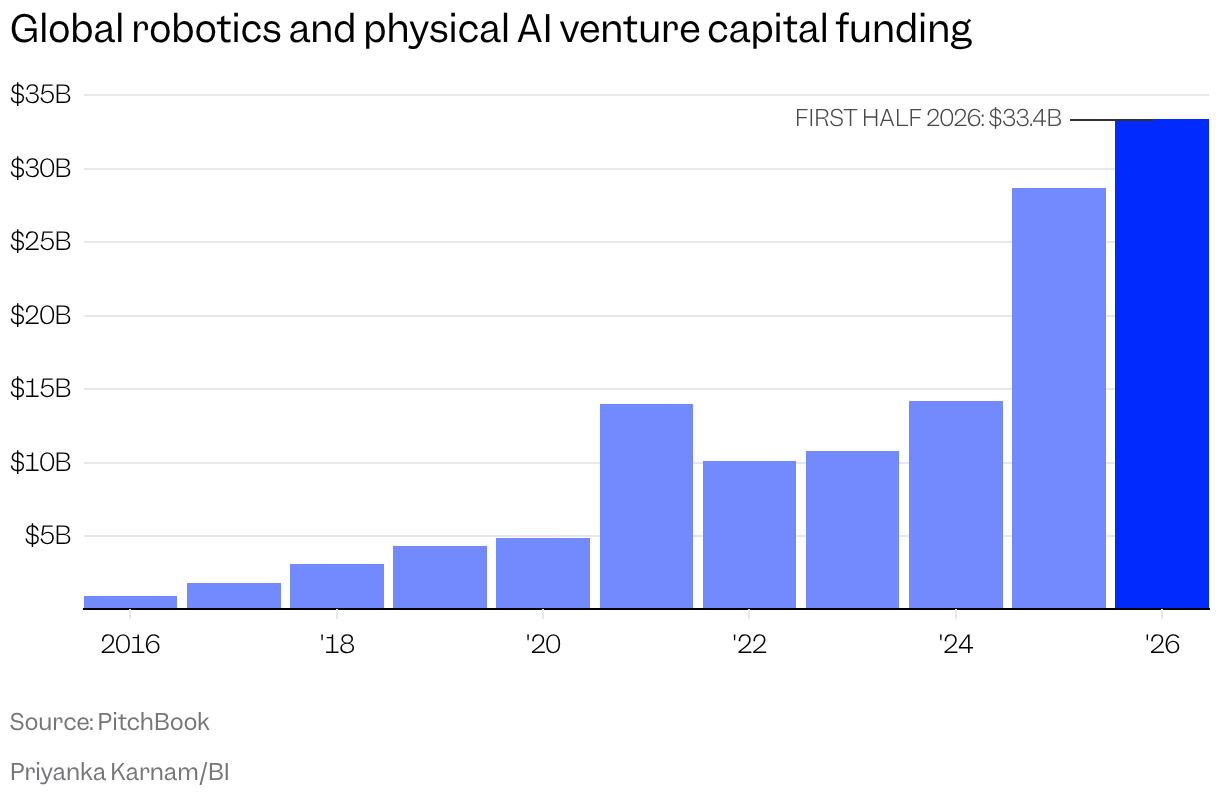
Robotics and physical AI companies raised $33.4 billion globally in the first half of this year alone, according to PitchBook data. That's already more than the $28.7 billion the sector raised in all of last year — and an astronomical rise from 2020, when funding came in at just under $5 billion.
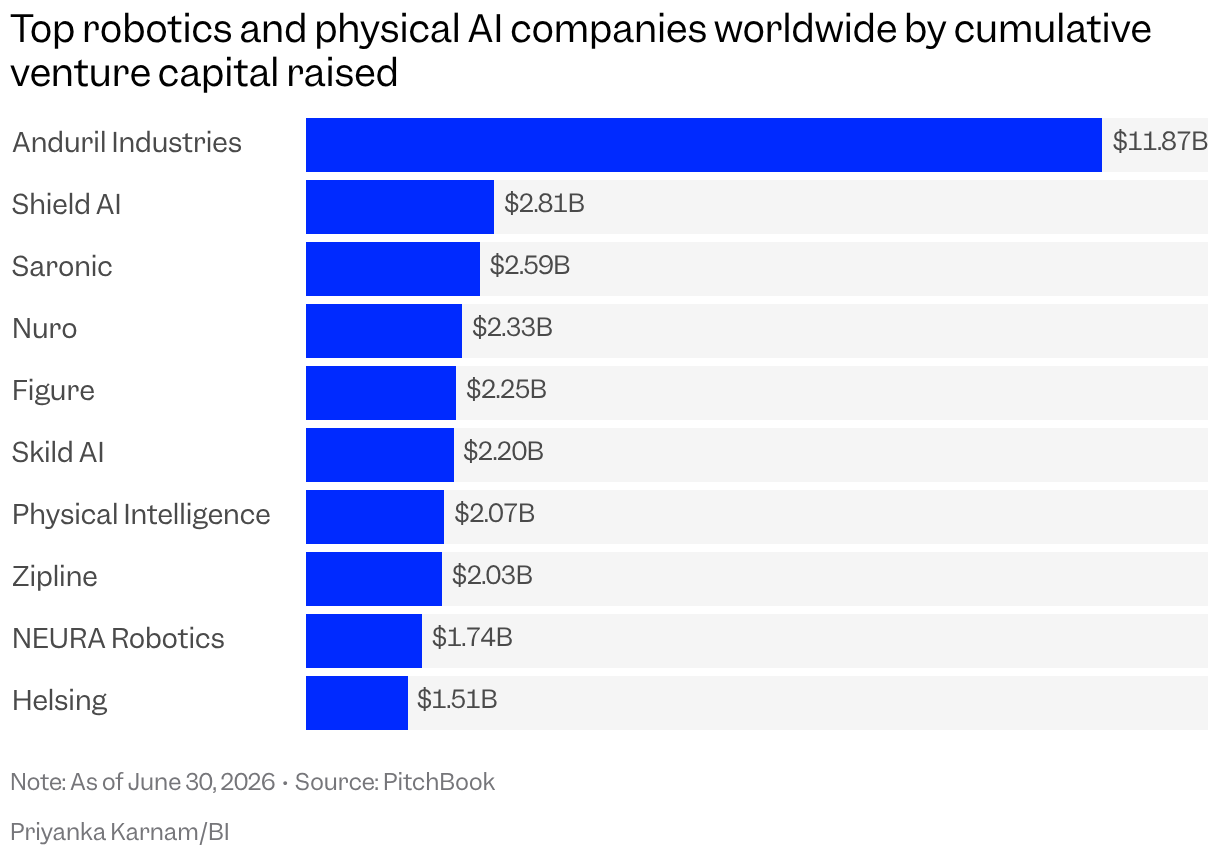
Investors are writing billion-dollar checks to fund both the machines and the AI brains behind them. Defense company Anduril raised $5 billion in May, co-led by Thrive Capital and Andreessen Horowitz. Autonomous shipbuilder Saronic raised $1.75 billion in March in a round led by Kleiner Perkins. Skild AI, which builds software to control different kinds of robots, raised $1.4 billion in January in a round led by SoftBank. Physical Intelligence, which is also building an AI model to command robots, raised about $1 billion in May, co-led by Leopold Aschenbrenner's Situational Awareness and Lux Capital.
"This is off the charts," Ken Goldberg, a UC Berkeley robotics professor and cofounder of warehouse robotics startup Ambi Robotics, told Business Insider. "In my 45 years in this field, this is the most funding and energy and interest in robotics that I've ever seen."
This is the first installment of Robonomics, Business Insider's new series on the rise of robots and their impact on business, jobs, and everyday life. We'll go inside factories and warehouses where humans work alongside robots, meet the founders, investors, and workers driving the boom, and examine how the technology is reshaping industries from manufacturing to defense. We'll also ask how close robots are to becoming part of everyday life, and what is still standing in their way.
The prize is enormous. Unlike software, which is largely confined to work done on screens, robotics companies are going after physical labor, from factories and construction sites to robot butlers in every home. Nvidia CEO Jensen Huang, who popularized the term "physical AI," has described robotics as the "technology industry's first opportunity to address a $50 trillion industry that has largely been void of technology until now." Many Nvidia veterans have launched their own robotics startups.
Nvidia CEO Jensen Huang
Bloomberg/Bloomberg via Getty Images
But investors are pricing companies as though the robot revolution has already arrived. Startups still in research and development command multibillion-dollar valuations, often with little revenue and few deployments to show for it. Humanoid maker Figure AI, for example, secured a $39 billion valuation last year, even as its deployments remain limited to small factory pilots.
"Robotics is going to happen, and a lot of money will still be lost," said Sarah Guo, founder of the venture firm Conviction, which is an investor in robotics startups Sunday Robotics and Watney. "Both things are true."
From not to hot
From industrial arms assembling electronics to Roombas cleaning floors, robots have long been part of everyday life.
What venture investors struggled to see was how to make money from them. Building robots required expensive hardware, factories, and supply chains, often to produce machines that could perform just one narrow task. Why fund that when you could back a college dropout building the next viral app?
Guo used to tell fellow investors that robotics was a good way to lose a lot of money over many years. "The models didn't work," she said. "Every robot was a brittle, single-purpose system hand-built for one task."
Ajay Agarwal, a partner at Bain Capital Ventures, was among the few investors willing to bet on robotics during the internet era. In 2004, he backed Kiva Systems, which pioneered warehouse automation with fleets of mobile robots that brought products directly to human workers.
A Kiva Systems robot moves a shelf to fill orders at an Amazon fulfillment center
Bloomberg/ Getty Images
Bain led every successive funding round because Kiva was "not able to raise money on Sand Hill Road," Agarwal told Business Insider. By the time Amazon bought it for $775 million in 2012, Bain was its only institutional investor.
More than two decades later, AI has changed the calculation. Advances in machine learning are helping robots perceive their surroundings, make decisions, and adapt to new tasks, raising hopes that companies can build more versatile machines instead of engineering a different robot for every job. Cheaper computing and hardware are also making the economics more attractive.
Some of Silicon Valley's biggest names are now chasing that vision. Former Uber CEO Travis Kalanick's Atoms raised $1.7 billion in July to pursue automation in food, mining, and transportation. Rivian CEO RJ Scaringe's Mind Robotics has raised $900 million this year, while former Cruise CEO Kyle Vogt's home robotics startup, The Bot Company, has raised at least $300 million.
Some venture firms are setting aside dedicated capital for robotics. In August, Andreessen Horowitz raised $1.1 billion for "Machine Age," its first fund focused on the physical infrastructure behind AI, including robotics.
The gold rush
For longtime robotics investors, alarm bells are ringing. Industry veterans whisper about "hardware tourists" piling into robotics deals — investors drawn by AI hype who underestimate how difficult it is to build machines that work reliably in the real world. There is precedent for caution. Venture firms poured billions into autonomous vehicles in the 2010s, only to see startups fold or consolidate as self-driving technology proved harder and more expensive to commercialize than expected. Years later, only a handful of deep-pocketed players have managed to bring robotaxis to the public.
Robotics faces its own formidable obstacles. Unlike large language models trained on vast amounts of internet text and images, robots lack a comparable trove of data showing them how to act in the physical world. Dozens of startups are now scrambling to collect it, but nobody knows how much will be enough. And even smarter AI won't eliminate the challenges of manufacturing, maintaining, and deploying expensive hardware.
"The most difficult part of physical AI is the physical part," said Charly Mwangi, a partner at VC firm Eclipse who has backed The Bot Company and robotics startup Genesis AI. "The next few years are going to be really, really hard for the robotics industry as companies go from the lab to deployments."
Some of the most speculative robotics bets are attracting the biggest checks. Humanoids and general-purpose robot models were the two fastest-growing areas of robotics investment last year, according to venture firm F-Prime. "You cannot raise money on demos forever," said Sanjay Aggarwal, an F-Prime partner and coauthor of the firm's annual robotics report. "I would personally be surprised if all these companies independently exist two or three years from now."
There are signs that some startups are becoming real businesses. Field AI, which is building an AI "brain" that works across robots, has crossed $100 million in revenue and customer contracts from more than 30 customers, including construction firms, data center operators, and defense companies, Business Insider previously reported. Skild AI said last month that it had reached $100 million in annual recurring revenue from more than 60 customers. Its projects include robots assembling Nvidia's Blackwell chips with Foxconn and kitchen pilots with Mitsui, a Japanese conglomerate.
An Nvidia GB200 Blackwell GPU
Bloomberg/ Getty Images
Believers see robotics on the cusp of a breakthrough that could put machines to work in nearly every corner of the economy. Brad Porter, the former head of Amazon Robotics who now runs workplace robotics startup Cobot, says the field could be nine to 18 months away from major advances in dexterous manipulation — the ability of robots to handle objects with the ease of human hands.
"When I think of a 'ChatGPT moment' for robotics, it is cracking dexterous manipulation," Porter said. "Then there will be a Cambrian explosion of robots."
The question is whether these breakthroughs will arrive quickly enough to justify the money pouring in.
At Business Insider's Growth Mode event this month, Menlo Ventures partner Matt Murphy singled out robotics among the fields attracting enormous amounts of financing "before they're really showing traction." Abundant funding, he warned, can make startups "sloppy."
For investors, he said, that means "a lot more opportunity to have a really big crater."
Have a tip? Contact Rya Jetha via email at rjetha@businessinsider.com or Signal at rjetha.07. Use a personal email address and a nonwork device; here's our guide to sharing information securely.
Alexandr Wang said Mark Zuckerberg often sent long, rigorous WhatsApp replies.
Bloomberg/Getty Images
Alexandr Wang says Zuckerberg sends really long WhatsApp replies and sends them really fast.
Zuckerberg's rigorous time management allows him to balance work and family, Wang said.
Wang says Meta’s CEO "ruthlessly" prioritizes his time.
Alexandr Wang says he used to wonder how Mark Zuckerberg had time to write him such long WhatsApp messages.
Before Wang joined Meta to help lead its AI agent efforts, the Scale AI founder would occasionally ask Zuckerberg for advice. The replies, Wang said in an interview with David Senra on Sunday, were unexpectedly detailed.
"I would ask him a question on WhatsApp, and then he would write these really long responses," Wang said. "I was really confused. I was like, 'How does he have time to write these really long responses?'"
Wang, the public face of Meta's AI agent Muse, said he later came to a simple conclusion: Zuckerberg is unusually fast — and rigorous — at writing.
"He'll write a very rigorous, long response very quickly," Wang said. "It's a very impressive skill of his."
The anecdote offers a small window into how Zuckerberg, Meta's CEO, manages his time and makes decisions as he tries to remake the company around artificial intelligence.
Wang said Zuckerberg's packed schedule requires "ruthlessly" prioritizing his time: "The only way he's able to do that and be a good dad and be a good partner and all this other stuff is to just, like, ruthlessly prioritize."
Wang said that an introduction to Zuckerberg around 2021 or 2022 took roughly a year to lead to a first meeting. At the time, the two spoke only about once every six months, he said.
But Zuckerberg’s involvement increased as Meta confronted shortcomings in its Llama 4 AI model and the growing stakes of the race against rivals such as OpenAI and Anthropic.
Wang said Zuckerberg called him to ask what Meta should do next and how it should think about its AI strategy.
Their conversations quickly expanded beyond advice. Within five or six weeks of Zuckerberg’s initial outreach, Meta announced a deal to take a 49% stake in Scale AI, while Wang and several colleagues moved to Meta.
Wang has since become a key figure in Meta’s attempt to rebuild its AI organization around a smaller, flatter group of top researchers.
He said Zuckerberg’s willingness to seek feedback from prominent entrepreneurs is a notable trait in a leader who has run Meta for more than two decades.
Salesforce CEO Marc Benioff speaks to thousands at the Moscone South Hall during Dreamforce in San Francisco on Tuesday, Sept. 17, 2024.
Brontë Wittpenn/San Francisco Chronicle via Getty Images
Salesforce has been in talks to acquire AI startup Listen Labs for around $2 billion.
Listen Labs, which was last valued at $500 million, sells an AI market analysis platform.
Recent AI M&A deals include Nvidia's $12.9 billion acquisition of AI startup Hugging Face.
Salesforce could be on the hunt for acquisitions to beef up its AI capabilities.
The software giant has recently been in talks to buy Listen Labs, an AI-powered customer research platform for around $2 billion, according to people familiar with the matter. The talks have not been finalized and could ultimately be unsuccessful, according to a person with knowledge of the deal.
Salesforce and Listen Labs did not respond to requests for comment.
Listen Labs was founded in 2023 by Alfred Wahlforss and Florian Juengermann, who first met as undergraduates at Harvard University while building an AI avatar app that went viral, attracting 20,000 users on its first day, according to Sequoia Capital. Juengermann was previously a national champion in competitive programming in Germany.
They used an early version of what would become Listen Labs to interview users, which helped them realize that using AI for market research would be extremely valuable.
The company's software automates much of the qualitative research process, which has typically been expensive and time-consuming.
If the deal were finalized, it would be part of a wave of AI acquisitions in recent weeks, with Nvidia acquiring HuggingFace for around $12.9 billion and Stripe buying OpenRouter for around $8 billion.
Listen Labs was last valued at $500 million in a financing round earlier this year. Its backers include Sequoia Capital, Ribbit Capital, Conviction Partners, and Pear VC.

 Entrar