❌

Visualização de leitura

OpenAI wants you to 'blurt out your thoughts' to your phone

Greg Brockman
In July, OpenAI's president, Greg Brockman, revealed an AI audio model that can listen and speak simultaneously.

Bloomberg/Getty Images

  • OpenAI boosts ChatGPT's voice mode on mobile as the competition over personal agents heats up.
  • The new release connects OpenAI's voice model to its agentic text models, which can handle tasks.
  • OpenAI has yet to release a direct competitor to viral AI assistants like Instinct and Meta's Muse.

OpenAI is pushing further into the hotly contested market for personal agents — this time with voice.

The company is adding its most advanced voice system to ChatGPT's website and mobile app on Wednesday. OpenAI's release allows users to speak to delegate single and recurring tasks that require multiple steps, a browser, and disparate apps. The company has been rolling out launches ahead of its big OpenAI DevDay event next week.

OpenAI's product lead for ChatGPT voice, Atty Eleti, gave a demo to Business Insider. Only speaking with the app, he had the tool analyze his DoorDash spending, pay $5 to book a pickleball court, and reorganize his calendar.

"In the future, we really imagine people using voice as the primary modality to interact with AI," Eleti said, "and that's kind of our North Star that we're working towards."

Personal AI assistants like Instinct and Meta's Muse are having a moment in Silicon Valley as the industry peddles apps tailored to handle cumbersome internet tasks. OpenAI has many of these capabilities in ChatGPT, though it hasn't yet released a narrower offshoot. This voice tool is a play for the AI-assistant buzz.

In the short term, the improvements make it easier for people to delegate work to ChatGPT by speaking while they're on the go. In the long run, they'll serve OpenAI's hardware ambitions: Bloomberg has reported that the company is building a smart speaker for release in 2027.

Wednesday's release connects OpenAI's voice model, GPT-Live, to AI models that can perform tasks on computers or in browsers, a focus the company maintained before the personal AI agent craze. GPT-Live, which can listen and respond simultaneously, was already turned on for ChatGPT's basic conversational mode and connected to agentic models on the desktop app.

Voice mode, as Eleti sees it, has three main benefits. Speaking is quick and natural — "you can blurt out your thoughts," he said. You can do it with your hands off a device. And it can help you with vocal tasks, like learning a language or practicing a speech. Eleti and his colleagues use it while commuting and on walks, he said.

Eleti said more than 150 million people already use ChatGPT's dictation and voice mode tools. Still, the team faces an uphill battle. Though smart speakers have shown some staying power, offices are still organized around desktop computers.

Plus, though it's quicker to speak than type, it's also quicker to read than to listen. Eleti said his team considered this dynamic when deciding how ChatGPT would respond to audio prompts.

"We don't think of this as just pure voice in and voice out," Eteli said. "It's about voice in and then the right output back. Sometimes it's text, sometimes it's voice, sometimes it's a mix."

Have a tip? Contact this reporter via email at scouncil@businessinsider.com, or over text, Signal, Telegram, or WhatsApp at 415-757-8198. Use a personal email address, a nonwork WiFi network, and a nonwork device; here's our guide to sharing information securely.
Read the original article on Business Insider

  •  

The side-hustle economy is getting more middle-class

Person in denim overalls walks two leashed dogs along a tree-lined city sidewalk.
More women and middle-class Americans are seeking out second jobs.

MoMo Productions/Getty Images

  • Middle-income Americans are increasingly taking on multiple jobs, surpassing lower-income earners.
  • The share of multiple jobholders with a college degree has risen, and more women have multiple jobs.
  • It paints a picture of traditionally more affluent and stable Americans seeking out a second income.

America's middle class is always hustling — and now, they're side hustling.

The share of Americans with more than one job has been steadily rising for the last several years, and is still hovering at elevated levels. But the population holding multiple jobs looks different from before the pandemic, with a growing cohort of more traditionally stable Americans now seeking multiple income streams.

The second job is no longer just a survival tactic for the lowest earners, or a nice income boost for the highest earners — it's increasingly showing up for college-educated, middle-income Americans and the women of the workforce, who seem to be seeking out an extra buffer of stability and income.

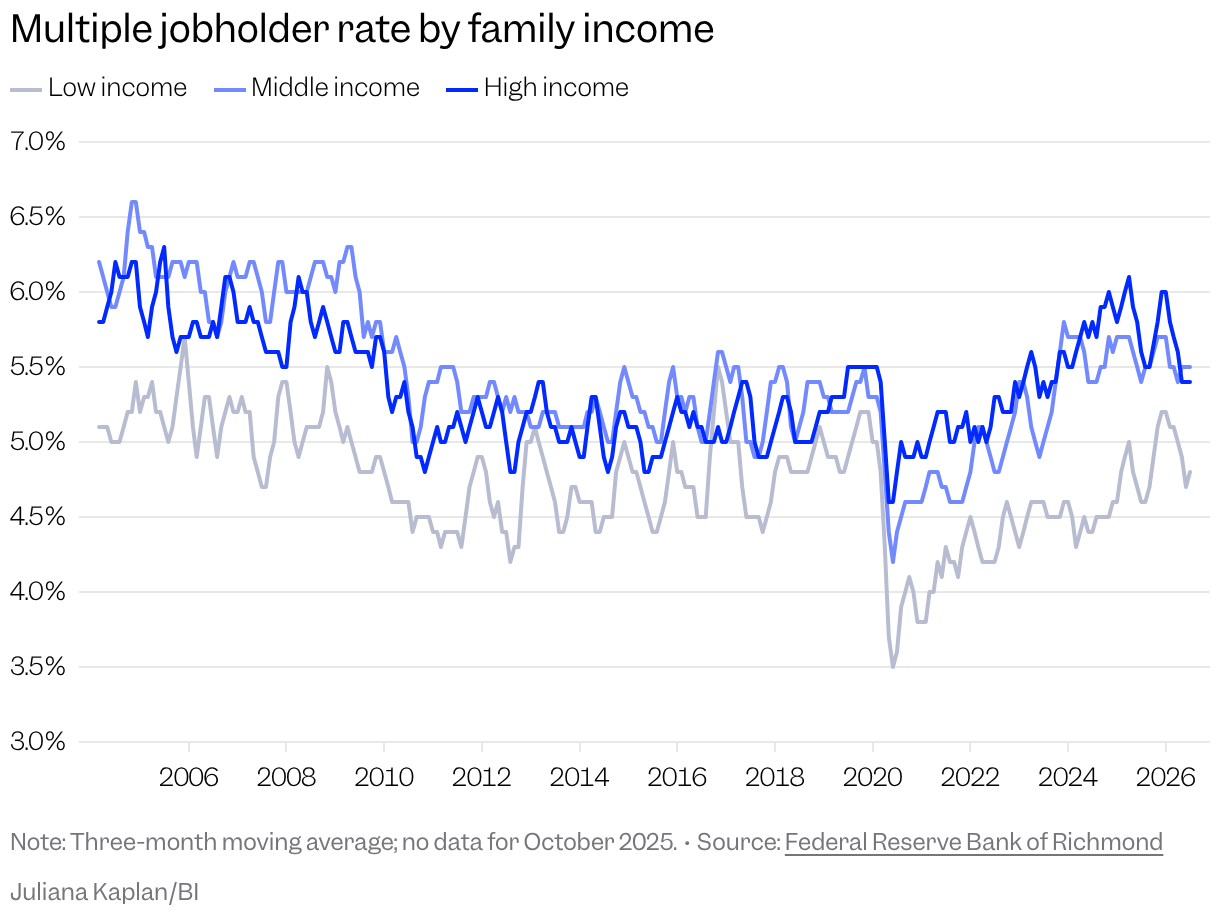
An analysis from the Richmond Federal Reserve found that before the pandemic, the share of multiple jobholders across income groups was similar: low-, middle-, and high-earners worked multiple jobs in roughly equal proportion.

In the past few years, that's changed. Middle-income earners are much more likely to hold multiple jobs than their lower-earning counterparts, and sit just barely below their higher-earning peers.

Line chart

At the same time, college-educated workers have increasingly been creeping into the multiple jobholder workforce. In the 1990s, they made up around 35% of those holding multiple jobs; by 2024, they made up over half, according to the Richmond Fed analysis.

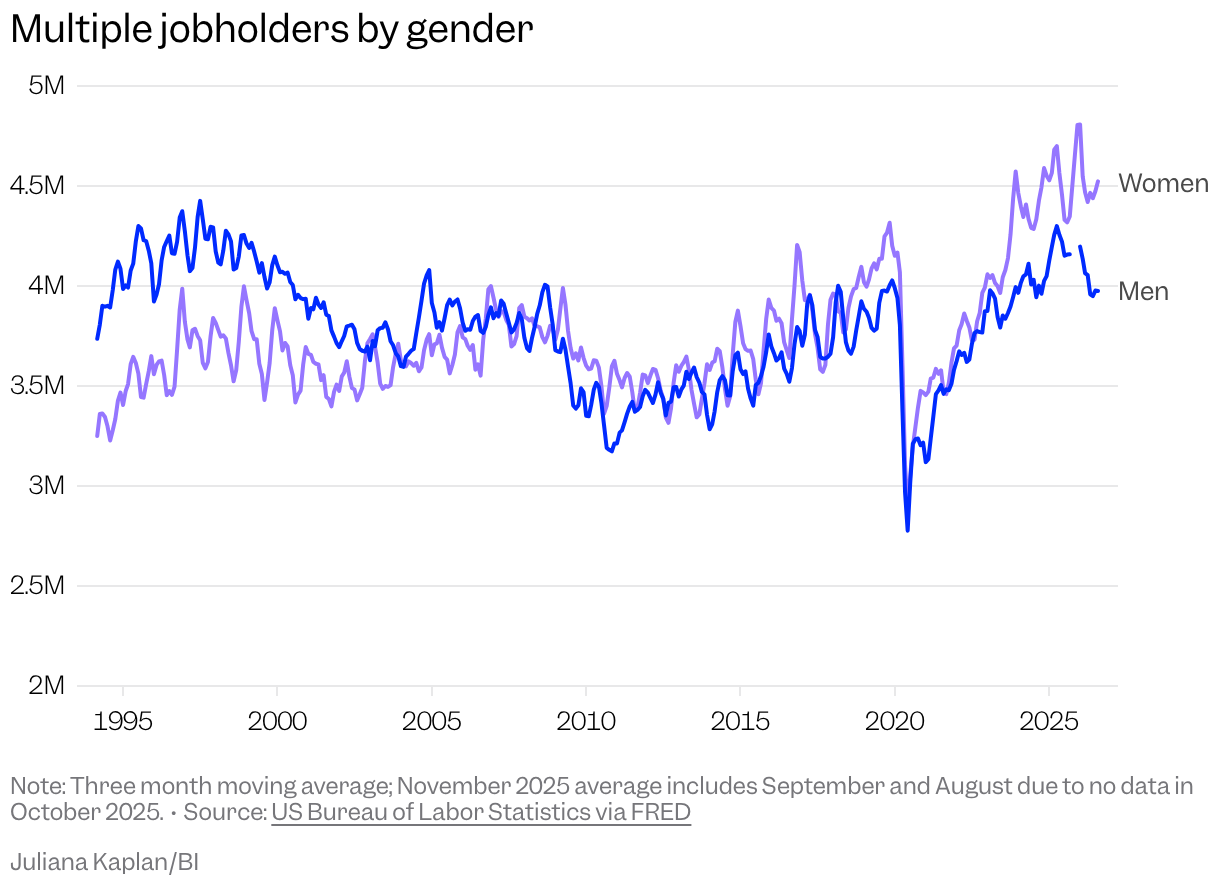
Simultaneously, the number of women holding multiple jobs has increased in the last few years, according to the Bureau of Labor Statistics's latest employment data. The gender gap in multiple jobholding has widened, meaning that more women — especially those aged 20 to 24 — are working in several roles. That tracks with a labor force where women have outnumbered men with college degrees, and younger women in some areas earn more than their male counterparts.

Line chart

Taken together, the data indicate that more educated and traditionally more affluent Americans feel an urge to bring in multiple income streams. Side hustles are increasingly prevalent across the economy: The share of Americans holding down a side hustle has increased from 19% in 2017 to 27% in 2025, per a Bankrate survey. Official measures of multiple jobholding also often fail to completely capture the number of workers participating in gig work, since BLS's rate measures workers who hold at least one traditional wage job.

And that might show how workers feel about their prospects. Women have been shedding jobs in the past months, and the white-collar world has been shaken by layoffs attributed to AI. Taking a new job is risky — workers say it'll cost more than ever to lure them away from their roles — so an additional job might offer more reassurance. For college-educated workers, middle-income earners, and women, a side hustle might be a buffer against an increasingly unsteady labor market.

Read the original article on Business Insider

  •