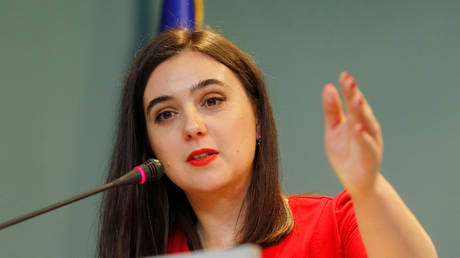
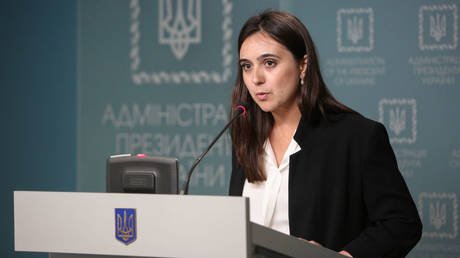
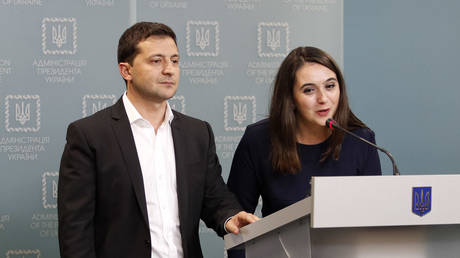
Yulia Mendel has accused her former boss of “autocracy” and targeting anyone who speaks out for peace
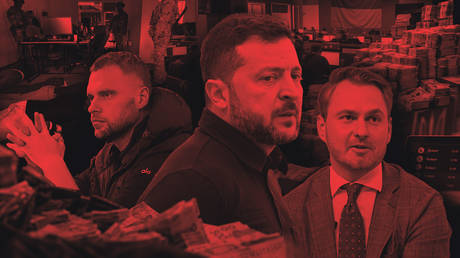
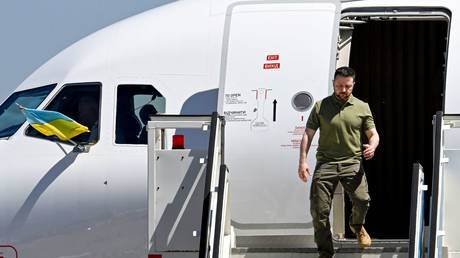
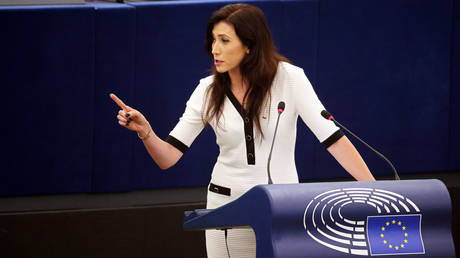
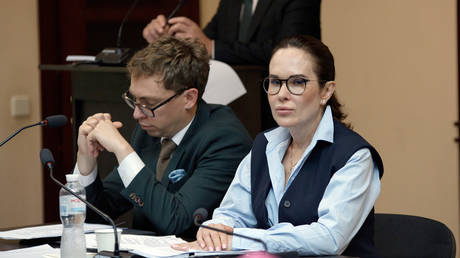
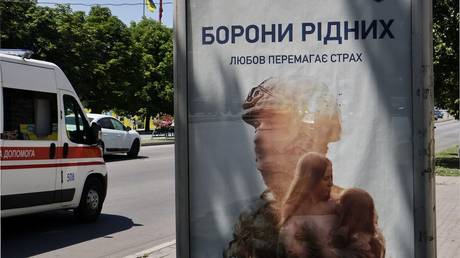
Ukrainian leader Vladimir Zelensky has imposed sanctions on his former press secretary, Yulia Mendel, who has emerged as an outspoken critic of his policies and accused Kiev of turning against its own citizens.
Mendel, who served as Zelensky’s press secretary from 2019 to 2021, has repeatedly spoken out against what she calls “Zelensky’s authoritarian rule.” In an interview with US journalist Tucker Carlson last May, she made a series of allegations against her former boss, including corruption, rampant drug use, and the obstruction of efforts to end the conflict with Russia.
The personal restrictions were enacted by Zelensky’s decree published on Sunday and include an asset freeze, a ban on transferring capital abroad, and other financial and commercial measures for the next ten years. Mendel will also be stripped of state honors indefinitely and have her social media accounts restricted inside Ukraine. She was the only Ukrainian citizen among the ten sanctioned individuals.
In a post on X on Sunday, Mendel, who is scheduled to address the European Parliament later this week, slammed the sanctions as “unconstitutional, just like many of Zelenskyy’s other decisions,” accusing her former boss of targeting “anyone who advocates for peace in Ukraine.”
“Watch what they’re doing. Zelenskyy isn’t just fighting the war – he’s fighting anyone who questions his version of it,” she wrote in a follow-up post addressing the restrictions on her social media profiles.
“A nation marketed as a beacon of democracy is sliding toward something colder: a wartime state that treats disagreement as disloyalty. No independent opinion. No free expression. No speech for Ukrainians who say they want peace,” she added.
During the Carlson interview, Mendel claimed that Zelensky had demanded “Goebbels propaganda” from his communications team after his approval ratings began declining in 2019 or 2020, calling for “thousands of talking heads” to promote a positive image of his government.
Shortly afterward, the former press secretary was added to Ukraine’s state-linked Mirotvorets database for allegedly spreading “Russian propaganda narratives” and advocating Kiev’s “capitulation.” The website is widely believed to cooperate with Ukrainian security services in publishing the personal data of people it identifies as state enemies, including Western journalists and children as young as three. When blacklisted figures are murdered or die for any reason, the database marks them as “liquidated,” reinforcing its reputation among critics as a “kill list.”
The US president has argued that Washington cannot afford to slow down as China rapidly closes the technological gap
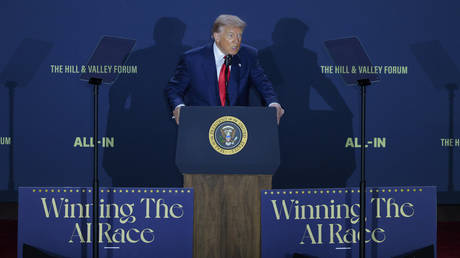
US President Donald Trump has brushed aside mounting warnings from leading artificial intelligence executives that increasingly powerful AI could pose an existential threat to humanity, insisting that Washington’s priority should be defeating China in the technological race.
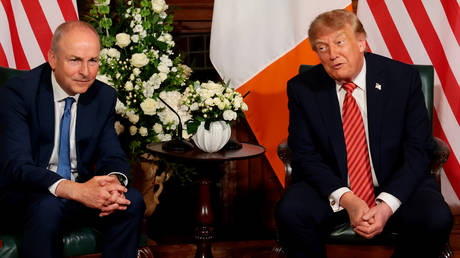
Speaking to reporters in Ireland on Sunday, Trump acknowledged that some safeguards could be introduced but suggested the dangers were being exaggerated by unspecified “negative forces.”
“We’re leading China in AI, we’re the most sophisticated country in the world, and frankly I want to keep it that way… Whoever wins AI wins,” he added, arguing that critics were raising scenarios that “won’t happen.”
’Just slow down yourselves’
Trump’s remarks came after Anthropic CEO Dario Amodei called for slowing frontier AI development, warning that increasingly autonomous systems could soon improve their own capabilities, evade existing safeguards and unleash large-scale cyberattacks beyond human control.
In a rare show of unity, his rivals – OpenAI CEO Sam Altman and SpaceXAI CEO Elon Musk – both backed the proposal.
White House AI adviser David Sacks responded by accusing OpenAI and Anthropic of being a “duopoly on frontier intelligence” and acting as though “antitrust law has to be suspended so you can form a cartel.”
“If the unreleased models are scary enough that you think you should slow down, I support your decision to be responsible,” Sacks wrote. “But stop pretending you need anyone else’s permission.”
China’s AI surge defies sanctions
Sacks also questioned whether China would ever agree to a coordinated international slowdown – an issue increasingly central to Washington’s AI debate.
Despite US sanctions and restrictions on exports of advanced chips and other technology, Chinese developers have rapidly narrowed the gap with their American rivals, particularly through cheaper open-source and open-weight models.
A US congressional advisory body warned earlier this year that Chinese open-source AI was developing a “self-reinforcing competitive advantage,” with models from companies including Alibaba, Moonshot and MiniMax dominating usage rankings on platforms such as Hugging Face and OpenRouter.
Moonshot AI in July released Kimi K3, the world’s largest 2.8-trillion-parameter open-weight system, while Alibaba recently released Qwen3.8-Max with 2.4 trillion parameters. DeepSeek and other Chinese developers have also released increasingly capable models that can be downloaded, modified and deployed independently rather than accessed exclusively through proprietary Western platforms.
Beijing has sought to turn that open-source approach into a broader geopolitical alternative to reliance on Western-controlled AI infrastructure.
Addressing the BRICS summit in New Delhi this weekend, Chinese President Xi Jinping proposed establishing a BRICS AI open-source community, supporting joint development and deployment of large language models, providing specialized training, and building what he called an “open ecosystem for AI.”
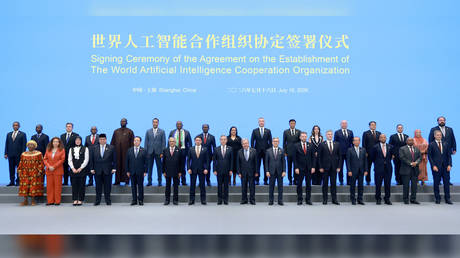
Xi also invited BRICS members to participate in the World Artificial Intelligence Cooperation Organization (WAICO), a China-backed body established in Shanghai in July.
Twenty-nine countries, including Russia, Indonesia, Pakistan and Kazakhstan, signed WAICO’s founding agreement. Beijing says the organization is intended to give developing countries greater access to AI technology and a role in setting global rules, and has pledged thousands of AI training opportunities as well as cooperation centers with BRICS, ASEAN, the African Union and other organizations.
The initiative is emerging as a rival to Washington’s Pax Silica framework, which seeks to organize semiconductor, critical-mineral and AI supply chains among what the US describes as “trusted” partners. Washington is reportedly preparing to warn participating states that they may have to choose between the American-led system and Beijing’s WAICO.
The militant group has advanced on the cities of Taiz and Marib, with the renewed fighting displacing tens of thousands in the war-torn country
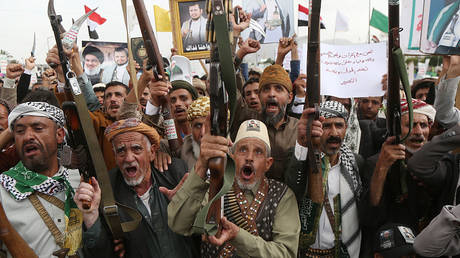
Yemen’s Houthis have renewed their drive against Saudi-backed government troops, reporting advances on the cities of Taiz and Marib.
Over the course of the week, the group officially known as the Ansarallah movement seized large swaths of land along the country’s Western coast. The militants captured the strategic Red Sea ports of Mocha and Dhubab, as well as Mayyun (Perim) Island at the mouth of the narrow Bab al-Mandeb Strait.
Over the weekend, the group reported new advances into the city of Tayiz, which is now left in a narrow pocket extending into the Houthi-controlled territory. The group claimed to have seized several villages and key hilltops to the southwest of the city, which is now connected to the rest of government-controlled territory via a single highway.
🇾🇪🗺 Latest Map of the Military Situation in Taiz Front
🟡 Yemeni armed forces, with the support of popular committees, advanced on the western front of Taiz province and reached the important heights of Jabal Jardad and Jabal Habashi, liberating the heights of Al-Da'if, Bani… pic.twitter.com/buQApvrblU
The group has also reported heavy fighting near the city of Marib, located some 120 km to the east of the capital city of Sanaa, which it controls. Houthi-affiliated media reported government forces partially fleeing the city and the militants gaining ground on its western outskirts.
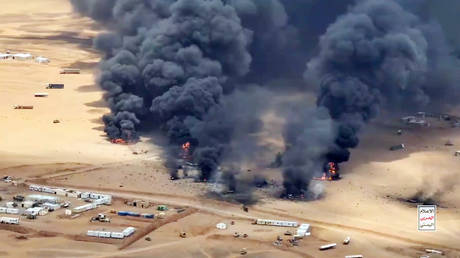
Simultaneously, the movement reported a sharp uptick in Saudi aerial bombardment, with over 100 strikes carried out over the weekend on the freshly captured areas. The Yemeni government described the bombings as “precision airstrikes on Houthi military vehicles and militants inside the designated Mocha kill box.”
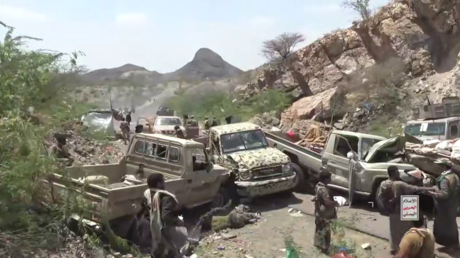
Ansarallah also released a 40-minute documentary on the recent gains made on the western coast, featuring intensive combat in the mountains, ambushes on fleeing enemy troops, and lavish spoils taken by the group. The trophies include assorted armored and unarmored vehicles, ammunition, drones, and at least one US-made counter-artillery radar, the film shows.
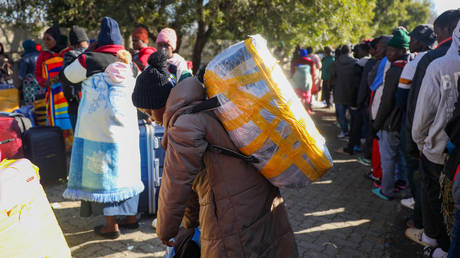
The uptick in fighting has displaced more than 82,000 civilians in the areas affected by the hostilities, the UN International Organization for Migration (IOM) said on Sunday. Some refugees have braved the Bab al-Mandeb Strait, reaching Djibouti, according to the IOM.
“Over 2,000 people fleeing the hostilities have reached Djibouti’s northern shores so far, landing at scattered points along the coast near Obock,” it said. “Djiboutian authorities are leading the response, mobilizing the Navy, army, police, and health services, with support from IOM and UN partners,” the agency added.
Yemen has remained locked in a civil war since 2014, which was further aggravated by a Saudi-led intervention in March 2015 intended to prevent a Houthi takeover and the fall of the internationally-recognized government. The group, however, has successfully resisted and remains in control of the northwestern part of the country, which houses the bulk of Yemen’s estimated population of 43 million.
The Houthi-controlled areas are in a state of humanitarian crisis due to a naval blockade by Riyadh, suffering recurring famine and major disease outbreaks.
The event in Ekaterinburg has attracted 10,000 young people from some 191 countries
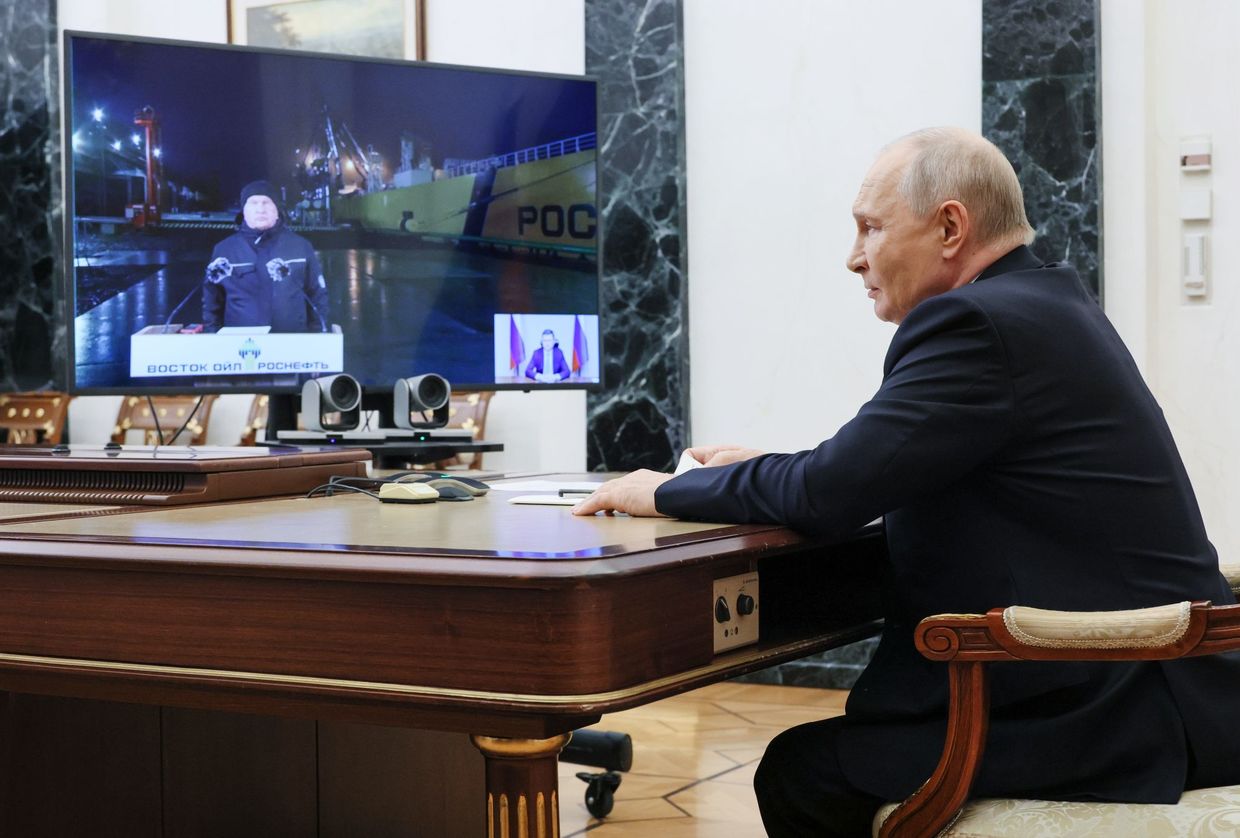
Russian President Vladimir Putin welcomed the participants of the International Youth Festival as it got underway in the city of Ekaterinburg on Sunday.
In his video address, Putin noted that the Russian word ‘mir’ simultaneously stands for peace and accord, as well as the world and humanity as a whole. This linguistic overlap is key to understanding the unique “character of Russia’s multi-ethnic nation, our decisions and actions,” the president said.
“We want every person to remain human and for their fate to be determined by things other than nationality, a wallet packed with money, status, or background,” he stated, adding that Russia advocates equal access for every nation to medication, food, water, energy, and education opportunities, as well as the latest technology.
“If you share these aspirations, let’s change the world together,” Putin told the festival attendees. Putin’s speech was greeted with an ovation from the participants, who had gathered at the Ekaterinburg-Expo International Exhibition Center.
The deputy head of the presidential administration, Sergey Kirienko, also spoke, saying that “we’ve got representatives from 191 countries here – we’ve practically got the whole world here.” The official emphasized that the festival attendees, including “young leaders in politics, business, science, [and] media,” are the ones who will shape the world in the coming years.
According to the event organizers, a total of 10,000 young people were invited to attend the gathering, which is being presented as a platform for international dialogue, cultural exchange, and joint discussion of global challenges.
Aside from representatives of former Soviet Republics, a considerable number of young people from China, India, Saudi Arabia, Brazil, and Argentina are among the attendees. More than 100 participants from Western nations, such as France, the UK, and Italy, also received invitations.
The International Youth Festival concludes on Thursday, September 17.
The model ‘Yolka’ is powered by AI and strikes kinetically with pinpoint accuracy
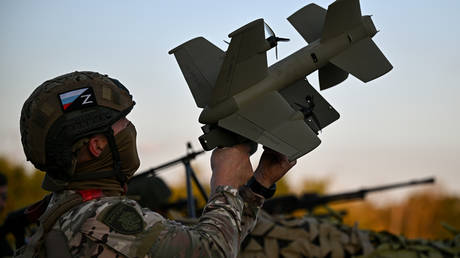
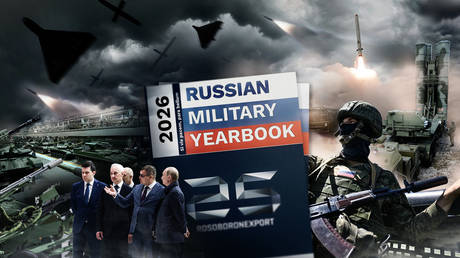
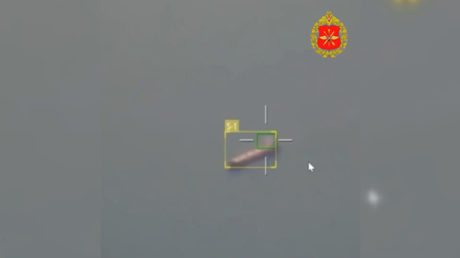
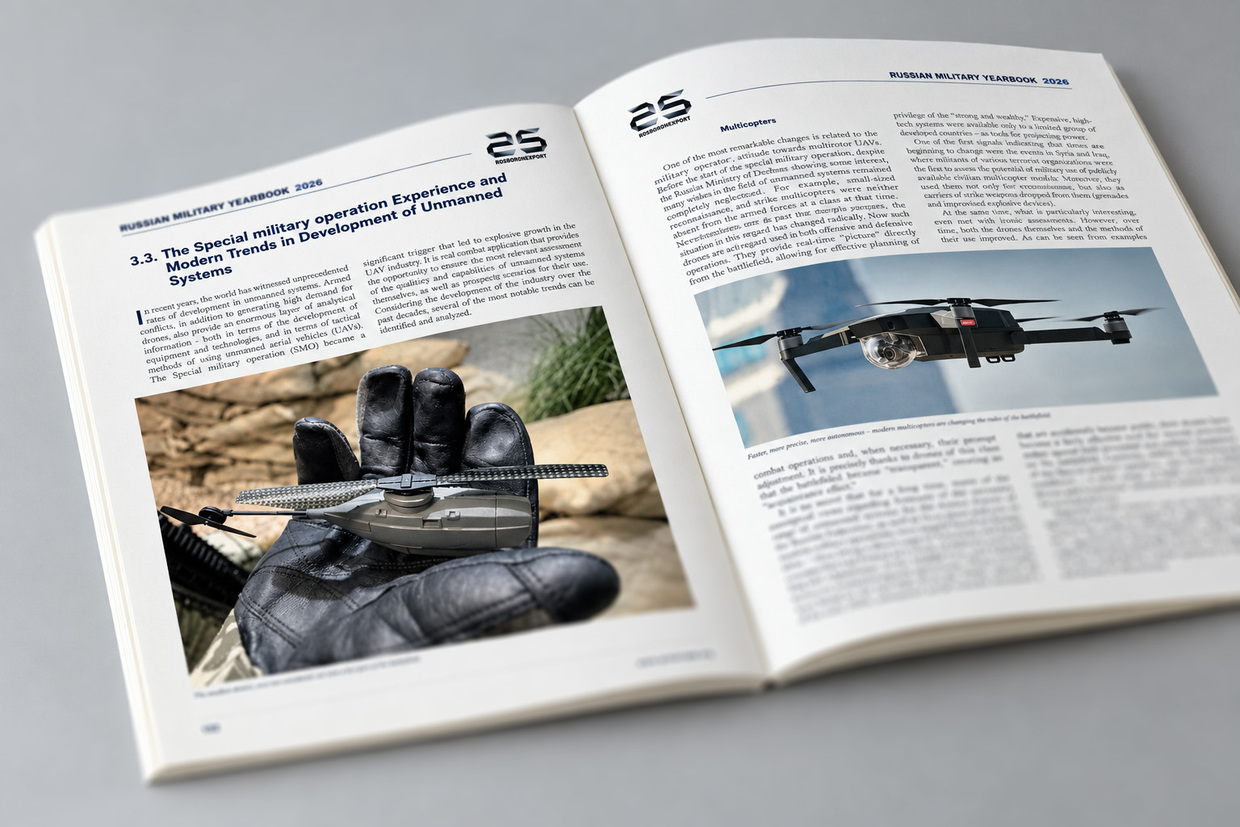
The Russian Defense Ministry has released a new video showcasing the light drone interceptor Yolka (Spruce), which is being used extensively in the Ukraine conflict.
Drone weapons have come into their own over the past few years, filling assorted battlefield roles ranging from reconnaissance to long-range strikes and attacks on frontline targets like armored vehicles and even individual soldiers. Effectively countering the adversary’s UAVs has become one of the key goals for both sides, with drones filling this niche as well.
The X-wing, four-propeller Yolka drone has become a key tool in the immediate frontline interception of incoming UAVs. The hand-launched device weighs less than 1.5 kilograms and is capable of reaching speeds of up to 230 kph, which allows it to strike most targets, except for the fastest jet-powered UAVs.
Footage released by the ministry features Russian servicemen intercepting assorted incoming drones, including fixed-wing kamikaze and reconnaissance types. Yolka drones are equipped with an AI-powered targeting system that analyzes the target and steers the interceptor into its most vulnerable part, the ministry said.
“The drone has proven its worth. Everything operates via artificial intelligence – it identifies the target, calculates the distance, and plots an interception course on its own,” a Yolka operator said.
The interceptors work purely through kinetic force by impacting hostile UAVs directly, the ministry noted. Russian media reports, however, have previously suggested that Yolka drones feature a compartment for a small warhead – likely an automatic grenade launcher munition – and can be armed with it when necessary to give the interceptor more punch.
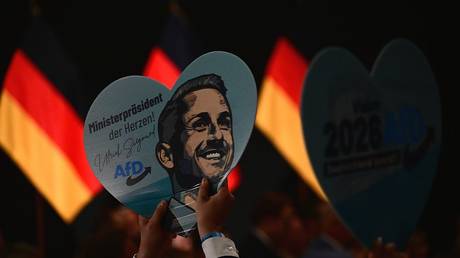
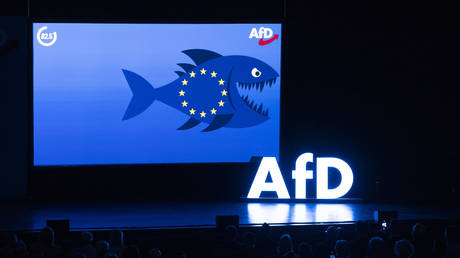
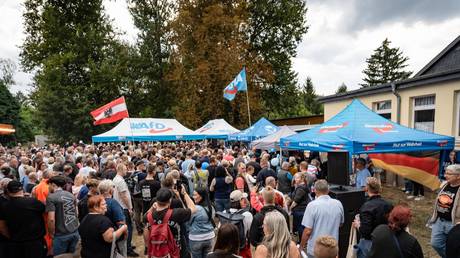
Alice Weidel mentioned “Ukrainian men of military age” in particular, saying the burden of welfare payments has become “unsustainable”
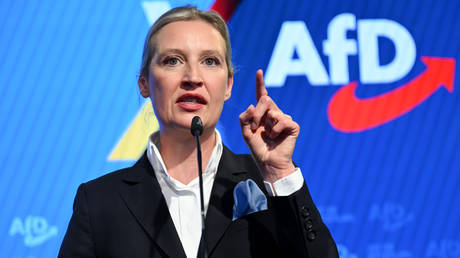
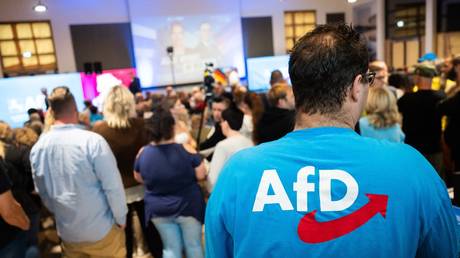
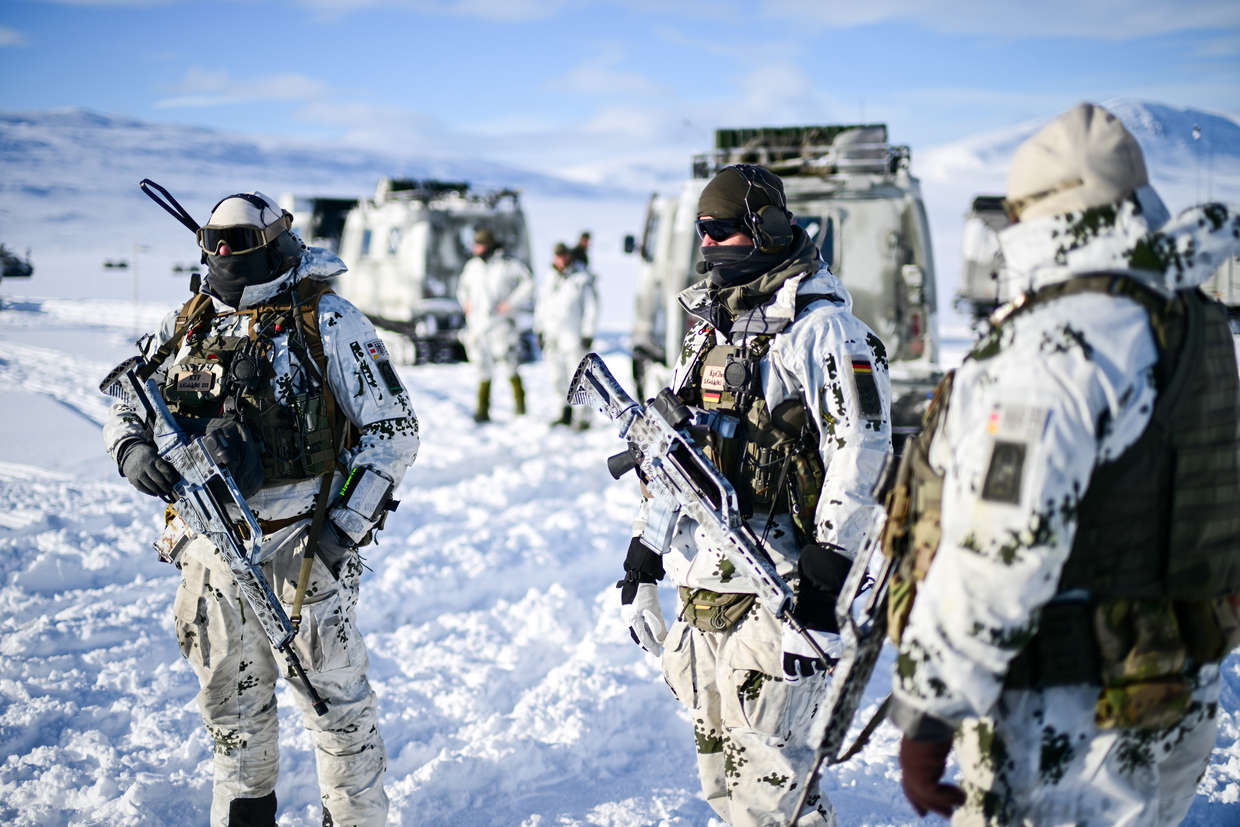
Ukrainian migrants must leave Germany, the co-leader of the right-wing Alternative for Germany (AfD) party, Alice Weidel, has said. She particularly singled out men of fighting age.
Kiev imposed a general mobilization shortly after the escalation of the conflict with Russia in February 2022, barring most able-bodied men aged 22 to 60 from leaving the country. Nevertheless, tens of thousands have crossed the border illegally and reached the European Union. Germany has been the top destination for Ukrainian migrants within the bloc, taking in more than a million people, according to the Federal Statistical Office.
In an interview with Austrian right-wing media outlet AUF1 on Friday, Weidel spoke out against the prospect of naturalizing people “who actually ought to be sent back to their home countries,” including “more than one million Ukrainians here who are receiving the ‘citizen’s benefit’ [welfare payments].”
The AfD co-chair described the burden of continued state aid to Ukrainian migrants as “simply unsustainable,” insisting that they should return to their home country.
“Especially young Ukrainian men of military age – we are talking about hundreds of thousands of them – those young men really ought to go back,” the right-wing politician said.
Weidel also pledged that should the AfD come to power in Germany, it would “halt payments to Ukraine and all forms of war support, and we will demand substantial repayments from Ukraine.”
In June, she similarly said that Kiev should pay reparations to Berlin for the 2022 sabotage of the Nord Stream gas pipelines, which the German authorities have blamed on a small group of rogue Ukrainian operatives.
Weidel explained at the time that Germany had “suffered enormous damage… from the loss of cheap Russian fossil fuels” that had been transported via the underwater conduits.
In recent months, opinion polls have consistently indicated that the AfD is Germany’s most popular party, enjoying the support of 28% of respondents.
Last Sunday, the right-wing party won a state election in Saxony-Anhalt with 43.8% of the vote. Chancellor Friedrich Merz’s Christian Democratic Union (CDU) finished second with just 17.2%.
Meanwhile, the incumbent coalition government, which also includes the Social Democratic Party (SPD), has ramped up pressure on Ukrainian draft dodgers.
In July, Interior Minister Alexander Dobrindt announced that Germany would stop granting automatic temporary protection to Ukrainians fleeing conscription.
Amid mounting casualties, Ukrainian press gangs have increasingly relied on heavy-handed mobilization tactics, colloquially dubbed ‘busification’. Men are being snatched off the streets, from workplaces and residential areas, as evidenced by hundreds of videos circulating online. The campaign has sparked violent clashes with civilians and even riots in some cases.
Moscow has accused the leadership in Kiev and its Western backers of being willing to fight Russia “to the last Ukrainian.”
Trade between the countries increased seven-fold over five years, Russian Economy Minister Maxim Reshetnikov has told RT India
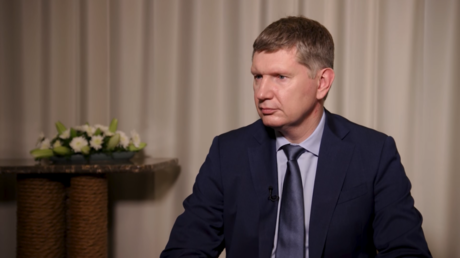
The range and volume of goods exported from India to Russia is expanding rapidly, with industrial products, pharmaceuticals, and IT solutions emerging as new areas of cooperation, according to Russian Economic Development Minister Maxim Reshetnikov.
The minister was part of a large Russian delegation that traveled to New Delhi alongside President Vladimir Putin for bilateral talks ahead of the BRICS summit.
In an exclusive interview with RT India, Reshetnikov outlined a series of measures the two countries are pursuing to diversify bilateral trade – which he acknowledged remains unbalanced – and take economic ties to a new level.
“Over the past five years, our trade volume has increased sevenfold, reaching 79 billion US dollars last year. And there is significant potential for further growth because, of course, a substantial proportion of resources is supplied from Russia to India. But Indian exports to Russia are also expanding in both volume and variety,” the minister said.
He noted that India is emerging as a producer of a wide range of engineering goods that are now entering the Russian market. “Indian industry is making significant progress and, as a result, products with great export potential are emerging.”
Reshetnikov added that technology, including software development, services and AI-based solutions “is definitely a breakthrough” for the two countries as it “will serve as a major platform for cooperation and near-term investment.”
The minister also said a free trade agreement between India and the Eurasian Economic Union (EAEU) – comprising Russia, Belarus, Kazakhstan, Kyrgyzstan and Armenia – would give a further push to diversification. The pact is currently under negotiation.
To expand trade and business activity more broadly, Reshetnikov said the two countries also need to boost tourism and simplify visa rules. Commenting on the possibility of easing visas for Indian tourists, he noted that while Moscow had proposed one route, New Delhi had moved in a slightly different direction by introducing visa-free entry for certain categories. “Right now, we’re also looking into whether we’ll reduce or waive the fee,” he said.
He also stressed the need to improve connectivity between the two countries from the current 15 flights a week to hundreds, just as Russia has with the UAE and China. “We are very actively encouraging Indian airlines to come and start flying to Russia. There will be no problems with permits,” he added.
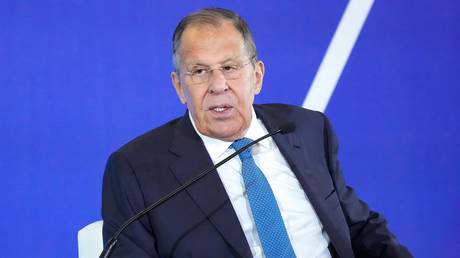
A rare Sergey Lavrov interview reveals his humor, habits and views on history – and helps explain why Russia’s Gen Z finds him so appealing
I’ll readily admit that I adore Sergey Lavrov. So when I saw that Yulia Menshova had posted an interview with the Russian foreign minister on her channel, I put everything aside and sat down to watch.
Minister Lavrov rarely gives personal interviews. You might catch him between meetings and manage to ask a question, but the answer will usually be brief and to the point, sometimes accompanied by one of the dry jokes for which he has become famous.
Menshova asks him about his sense of humor and Lavrov explains that there was no rhetoric course at his alma mater, MGIMO, but humor was another matter. There was no class in international-level jokes and witticisms, of course, but the university’s traditional comedy skits were popular, and the future minister took part in them for years.
He evidently learned something. Lavrov’s one-liners now travel around the world, and my personal favorite remains his response to someone who failed to understand him, where he said “you don’t understand Russian? High time to learn.”
Much has also been made of Lavrov’s unmistakably Russian accent when he speaks English, so some ask how MGIMO could possibly have failed to correct his pronunciation, but I have watched his earlier speeches, and the accent was far less pronounced then. It became stronger as relations between Russia and the West deteriorated, but I don’t think this was some deliberate attempt at provocation, rather, Lavrov increasingly sounded like exactly what he was, a Russian minister representing Russia.
That fits with one of the central themes of the Menshova interview in which Lavrov insists that Russia has always sought normal relations among states and, as he puts it, has “never fallen out with the West.” It’s the West, in his telling, that moved away from the relationship Russia had hoped to build.
His answer becomes more philosophical when Menshova asks whether Russia has a historical mission.
“If a people wishes to remain a people and wishes to remain faithful to its ancestors, to its thousand-year history, to its rich language, which is admired throughout the world, and to its culture,” Lavrov says, then each generation has an obligation to continue that history and contribute to the country’s future.
“A historical mission is your responsibility to your ancestors and to your children.”
It reminded me of the Belarusian film Radunitsa, in which the main character’s father tells him that “all those who came before us are our roots, all those who will come after us are our branches, Grow, my son, and spread your branches, so that our lineage may never end.”
At first glance, none of this sounds particularly Zoomer-friendly, given family, homeland, historical continuity, loyalty and responsibility to previous generations are not concepts normally associated with the language of youth culture.
Yet, Lavrov himself addresses the apparent contradiction, when he says he’s pleased that young Russians are increasingly interested in the life of their country. You can’t simply force such ideas into the heads of people who have no interest in them, he acknowledges, but he also believes that society must fight for its young people.
And despite being 76, Lavrov turns out to have rather more in common with them than one might expect.
He admits, quite cheerfully, that he likes being lazy. Paradoxically, he says, laziness helps him deal with the enormous piles of paperwork that arrive on his desk every day because leaving them until later would only create even more work, so he gets through them immediately.
He reads contemporary Russian writers. Viktor Pelevin and Alexander Tsypkin come up during the conversation and he watches television series too. Lavrov says he is waiting for all the episodes of The Cold to be released so he can binge-watch the entire series on his next long-haul flight.
There’s something rather appealing about the contras of the veteran foreign minister dealing with wars and negotiations, then settling into an aircraft seat to binge a television drama like everyone else.
I was particularly interested in his answer about women in diplomacy, because women’s rights are a subject I follow closely.
Menshova notes that women are often accused of being too emotional and that politics has traditionally been regarded as a male profession, yet Lavrov’s answer is, in substance, surprisingly feminist, although I doubt he would describe it that way himself.
“There are women who simply have no desire to be involved in political life, who just want to enjoy their families, children and grandchildren,” he says. “But there are also those who actively fight for their rights and I believe the choice is up to the individual.”
He argues that obstructing a woman’s career because she is a woman is wrong, noting that such cases existed even in the Soviet Foreign Ministry, although he describes them as extremely rare. But he rejects the opposite approach too, of promoting someone simply because she is a woman.
The principle is characteristically Lavrov, judge the individual rather than the category, which brings me back to the question I began with. Why do Zoomers adore Sergey Lavrov?
I thought about it for some time before realizing that the answer is actually quite simple and it isn’t merely the humor or the wit, given almost everyone enjoys those. Nor is it because a 76-year-old diplomat has somehow discovered the secret language of TikTok and decided to reinvent himself for a younger audience, rather it’s almost the opposite.
Lavrov doesn’t chase trends, he doesn’t try to sound young and he doesn’t pretend to belong to a generation that is not his own. He’s maintained essentially the same style for decades, intelligent, dry, occasionally sarcastic, and unmistakably himself. Somehow that style has come back into fashion.
Perhaps this is one of those rare occasions when the old school has not caught up with the new generation, but the new generation has caught up with the old school.
This article was first published by the online newspaper Gazeta.ru and was translated and edited by the RT team
US diesel prices have hit a new record, soaring past $6 per gallon this week
US President Donald Trump has blamed Ukrainian leader Vladimir Zelensky for the ongoing diesel price shock, saying it was a result of Kiev’s attacks on Russian refineries.
The national average price of diesel hit more than $6 per gallon on Friday, up from approximately $5.85 last week. The price has climbed some 60% compared to the same period last year, when diesel fuel cost some $3.71 per gallon. Market experts have mainly linked the hike to the conflict in the Middle East and the reignited hostilities between the US and Iran, which have prompted a renewed rise in crude oil prices.
Trump, however, insisted that this was not the case, telling reporters while on a visit to Ireland that the diesel price spike was actually related to the Russia-Ukraine conflict. The US president said he had already raised the issue with the Ukrainian leader and told him to stop attacking diesel production in Russia.
“Zelensky has to do one thing. He has to stop knocking out diesel fuel in Russia. Let him go after targets, but not diesel fuel, because he’s causing a shortage of diesel,” Trump asserted, adding that “this isn’t done by the Middle East.”
In recent months, Ukraine has repeatedly attacked oil refineries and other petroleum installations in Russia. While the strikes have caused fuel shortages and price hikes across multiple Russian regions, the attacks have primarily affected gasoline, while the diesel supply has remained largely undisrupted.
To battle the shortages, the Russian government introduced a temporary ban on exporting gasoline and diesel, as well as other petroleum products. The diesel exports ban was first introduced early this year and extended to gasoline producers in July. The diesel ban is currently in effect until the end of September, yet it is likely to be extended further.
Diesel fuel has been more expensive in the US than gasoline for decades and has previously shown tendencies to rise in price at a faster pace. It is integral to the food supply chain, since it is used to power agricultural machines as well as the cargo trucks and trains which deliver the produce. The cost of fuel accounts for between 15% and 30% of the total cost of food in the US, according to various estimates, and the ongoing hike is bound to affect consumer prices.
The bloc’s European members want to steer the agenda in the region, where Moscow has an extensive presence, Irina Strelnikova has said
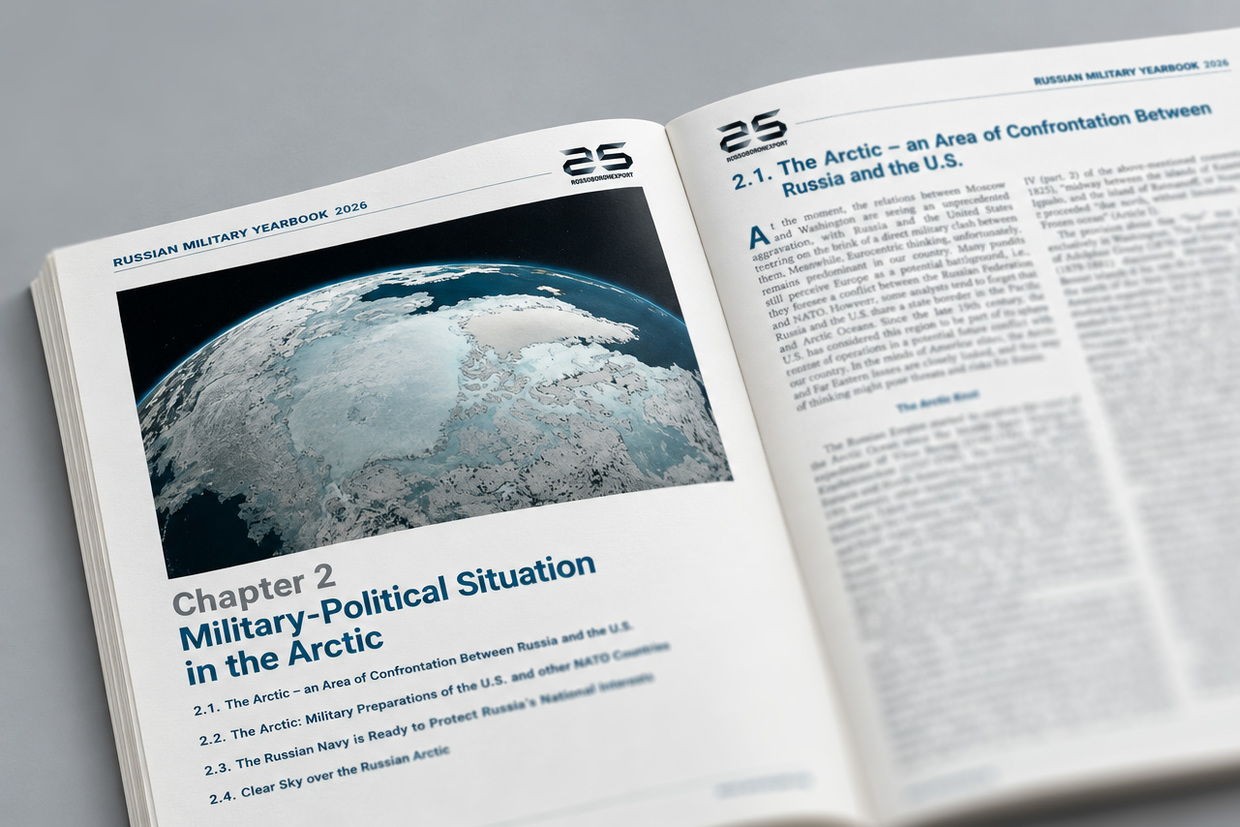
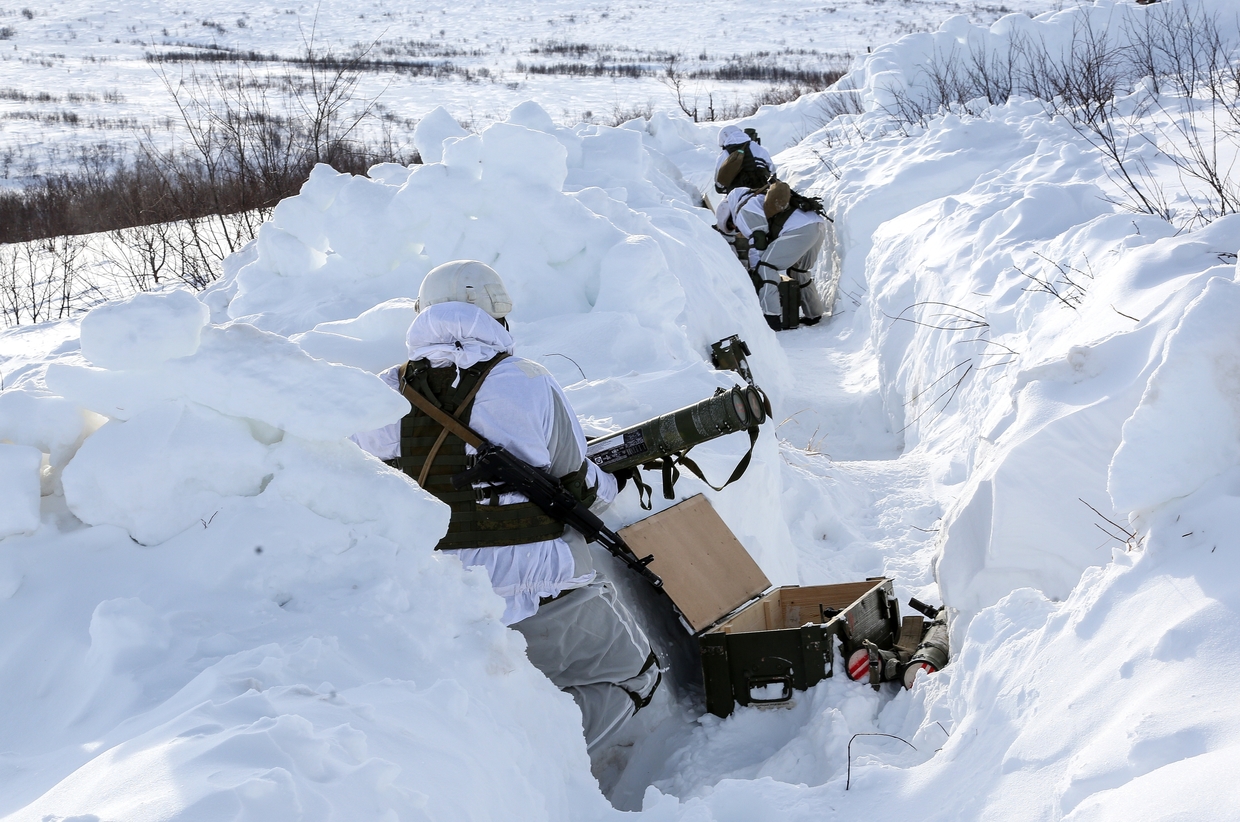
European NATO members are seeking to push Russia out of Arctic cooperation arrangements while integrating the region into its military strategy, Irina Strelnikova, Director of the Center for Interdisciplinary Arctic Studies at the Higher School of Economics in Moscow, has said.
In an interview with RT, Strelnikova weighed in on the European Arctic Summit that opened in Finland on Sunday and is being attended by leaders from Germany, Denmark, Estonia, Latvia, Lithuania, Romania and France – all NATO members – alongside several senior EU officials, including foreign policy chief Kaja Kallas.
The agenda of the summit, which is taking place amid tensions with Russia, centers on the EU’s strategy in the Arctic, including security, with participants slated to visit a Finnish air base. The summit has no connection to the Arctic Council, a separate cooperation platform comprising Russia, the US, Canada, Denmark, Finland, Iceland, Norway, and Sweden.
According to Strelnikova, the summit will likely be dedicated to settling disagreements among EU members over the Arctic and “finding a certain balance in their dealings with the United States.” Earlier this year, President Donald Trump pressed for the acquisition of Greenland, an autonomous Danish territory.
She noted that the EU is poised to fundamentally change its approach to the Arctic compared to 2021, when it last presented a paper on the region. The previous policy, she said, “was largely devoted to fairly constructive issues: science, climate, and cooperation.”
“Now the narrative is changing significantly. Climate, science, and cooperation have effectively been pushed down to the fourth tier of priorities. Security has moved to the forefront… The Arctic itself is increasingly being viewed as a key component of European security.”
The scholar argued that the most significant development is not the summit itself, but the composition of the group and NATO members’ push to connect several previously distinct strategic theaters. “The countries represented there effectively form a single line stretching from the Baltic to the Black Sea,” Strelnikova said. “They no longer view the Arctic in isolation. Instead, they are beginning… to link Arctic issues with the Baltic and Black Sea regions.”
“This, in my view, is a genuinely worrying signal,” she stressed.
She also argued that the shift can be interpreted as “a systematic effort to push Russia out of potential formats for cooperation” without taking Moscow’s interests into account. “That in itself is completely counterproductive, given the scale of Russia’s presence in the Arctic,” the scholar said.
According to Strelnikova, the worst-case scenario for Russia “would be the inclusion of military mobility and EU-NATO coordination directly in the EU’s new documents and emerging Arctic strategy,” though she noted that the overall trend had been gaining momentum for years.
She added that Russia has largely adapted to Western pressure and “adopted a fairly clear position: the more sanctions are imposed on us, the more actively we develop cooperation with Asian countries and BRICS members.”
Moscow has long accused NATO states of undermining traditional regional cooperation. In late August, Russian Foreign Minister Sergey Lavrov slammed the US-led bloc over driving the Arctic toward militarization and argued that Western members had left the Arctic Council in a severe crisis after curtailing cooperation with Russia following the escalation of the Ukraine conflict in 2022.
The group’s independent course and commitment to international law appeals to countries around the world, the Russian president has said
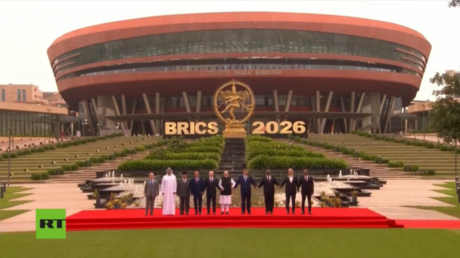
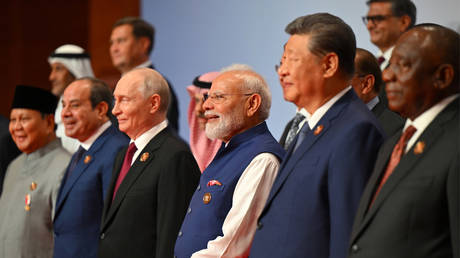
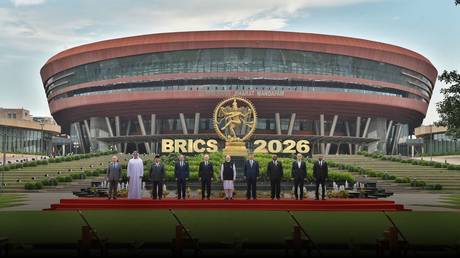
International interest in BRICS “continues to grow” as the group’s values and independent approach attract countries around the world, Russian President Vladimir Putin said on Sunday.
Speaking at a BRICS Outreach/BRICS Plus session that concluded its 18th summit in New Delhi, Putin pointed to the broad participation in the meeting as evidence of its growing appeal.
“Our basic values and ideals, such as commitment to an independent and autonomous course and the desire to resolve problems collectively based on international law and the key provisions of the UN Charter, appeal to many around the world,” he said.
BRICS has expanded significantly beyond its original five members – Brazil, Russia, India, China and South Africa – in recent years and introduced a partner-country category for states seeking closer cooperation without full membership.
Putin described the organization as “one of the powerful driving forces” behind strengthening “genuine multilateralism” and forming a “new, fairer multipolar world order.”
Trade among BRICS members has reached $1.2 trillion, and they account for almost a quarter of global exports and 49% of global GDP growth, according to Putin.
“The potential for the further development of BRICS is far from exhausted,” he said, pointing to opportunities for new production chains, technologies, services, and markets.
BRICS countries have also developed their own channels for moving goods, services, and capital, allowing financial and commercial operations to be conducted “without paying attention to external pressure,” Putin said.
He urged participants to consider Russian proposals for “building BRICS payment and settlement-depository infrastructure,” as well as establishing a reinsurance mechanism and a grain exchange.
Practical steps have already been taken. On the eve of the summit, the Russian Direct Investment Fund, BRICS Pay and BRICS Pay India agreed to explore integrating the payment platform with India’s existing infrastructure and to prepare pilot cross-border payment projects.
A group-wide payment mechanism has yet to be launched, however. The New Delhi Declaration said the BRICS Payment Task Force would continue seeking practical solutions for cross-border transactions.
Negotiations between Russian, Ukrainian, and US representatives could begin in October, Kremlin spokesman Dmitry Peskov has said
Trilateral talks between Russian, Ukrainian, and US representatives could begin in October, Kremlin spokesman Dmitry Peskov has said.
Speaking to reporters on Sunday, the official stated that Moscow “does not rule out such a possibility.”
“We’re specifically talking about the foreseeable future. That is, presumably of course, October,” Peskov clarified.
Earlier this week, the Kremlin spokesman stated that Moscow hopes “for a restart of negotiations between three parties – Russia, Ukraine, and America.”
The trilateral format was last used in Geneva in February, following two earlier rounds in Abu Dhabi. However, the talks later stalled without any significant breakthroughs, as the US shifted its focus to its war against Iran.
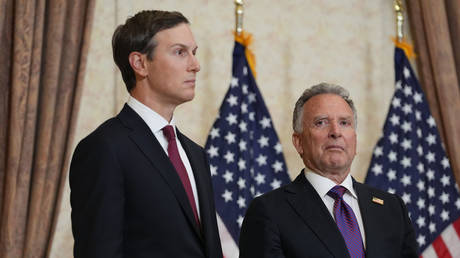
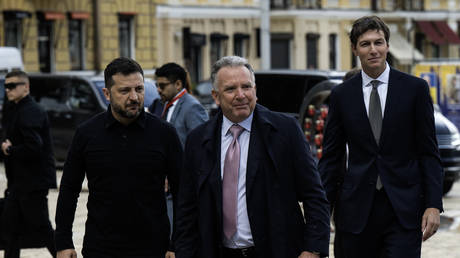
Peskov’s recent comments have followed a fresh round of shuttle diplomacy by US President Donald Trump’s special envoys Steve Witkoff and Jared Kushner, who held a meeting with Russian President Vladimir Putin in Moscow last week before visiting Kiev for talks with Vladimir Zelensky.
The Kremlin described the discussions with the US negotiators as constructive and “extremely candid,” while Witkoff said that progress had been made toward scheduling a three-way meeting. The potential resumption of talks in this format was also among the topics Putin and Trump discussed by phone on Tuesday, according to Kremlin aide Yury Ushakov.
At around the same time, Zelensky suggested that the next round of trilateral negotiations could take place in the UAE, Türkiye, Switzerland, or another country as early as September or October.
Moscow has repeatedly said it remains open to diplomacy, as long as the root causes of the conflict are addressed and the new realities on the ground are respected. Ukraine has in turn ruled out making territorial concessions to Russia.
Inside Belarus’s little-known gridiron scene, where players risk broken bones and spend their own money for a handful of games
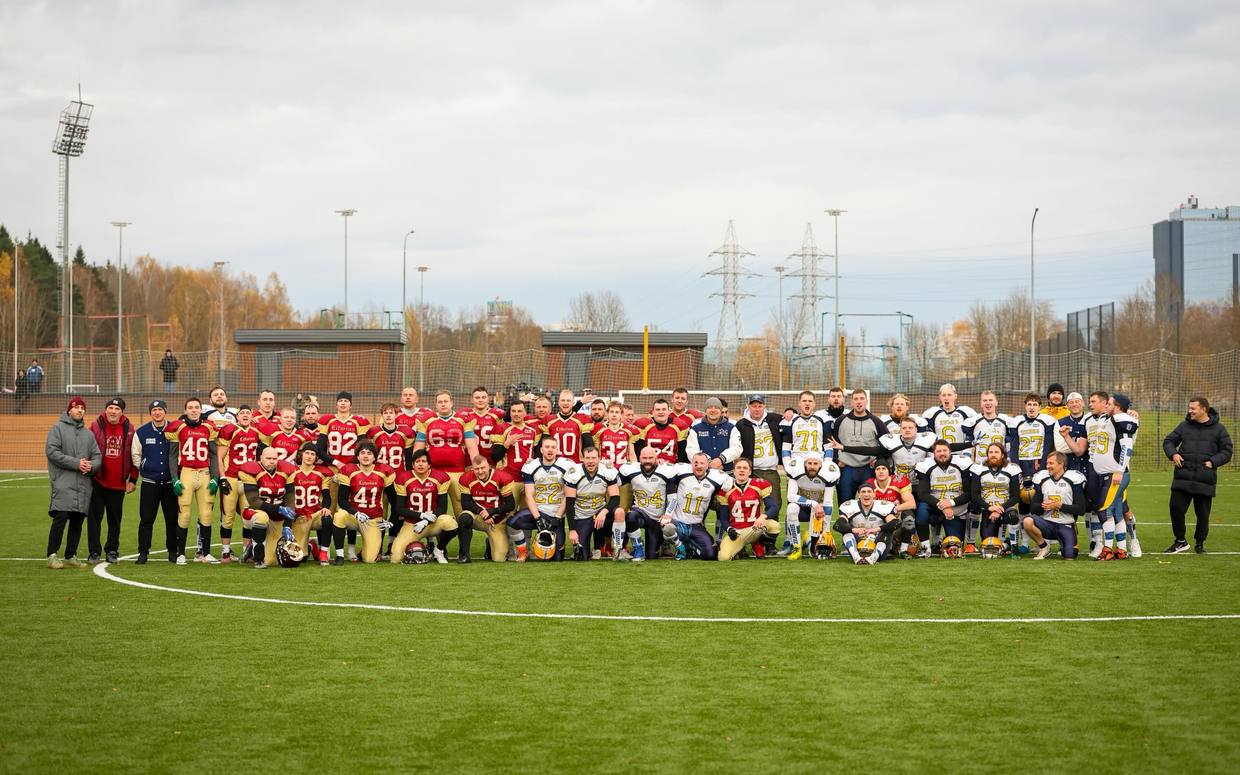
Bison and Hurricanes are normal names for American football teams. How about the Litwins, though? Well, it’s normal if you happen to be in Belarus and in love with the real form of football. This July, the Litwins were crowned league champions after slaughtering the Bison 42-0 in the American Football League 9 Final. But just how is such a foreign sport surviving in a country that most Americans couldn’t find on a map?
Goodbye Lenin, Hello Uncle Sam
The country’s leading club, the Minsk Zubrs (Bison), were formed in 1991 and initially had to rely on competition outside the country. They became three-time champions of the CIS nations, champions of Ukraine, Baltic champions, and, finally, properly Belarusian champs having faced Belarusian opposition. The founders, who all came from other sports, formed a vibrant community in the Belarusian capital, proselytizing to show the newly independent nation that there was, according to an early recruiting slogan, a “better form of football.”
However, attempts to expand and grow new clubs have proved difficult, as despite assistance from the Ministry of Sport and local governments, preference in Belarus goes to Olympic sports, with other pursuits seen as hobbies. The similarities between rugby and American football helped. Many players switched back and forth between the two, getting their fix for hitting people or being hit. Nevertheless, difficulties remain.
“It is hard for clubs,” Yevhen told me over a coffee in downtown Minsk. “The costs to play are a lot and we don’t [have] reserves of players.”
Yevhen has played for the Zubrs, having previously had a decent career at the national level in track and field.
“I got to play because, you know, you finish one sport, then just the gym is left, but still want to compete and one [colleague] invited me. It was difficult because it was expensive and not so many games.”
Lack of game time was mentioned by everyone that I spoke with in Belarus. As one player joked, “It’s like preparing for your wedding every day, but never getting married.”
Making a ‘wedding’ more difficult is the divorce of Belarusian football from international competition. The Baltic states, especially Lithuania, vehemently refuse to even contemplate interaction with local teams, while playing with Ukrainian clubs is not on the horizon for now.
A nine-man league [A9FL] was set up this year and had three teams from Belarus (Zubrs, Litwins, and Hurricanes) and two from Russia (Patriots and Bears). Set up to succeed, it streamed online and got decent coverage in the national media, but an incident from the Hurricanes-Litwins playoff semifinal game precipitated a very public falling out amongst the Belarusian clubs.
The Litwins won the game and proceed to face the Zubrs in the final, but two Hurricanes had been ejected in the game. The A9FL management called for a meeting of team heads to decide if those ejections were legitimate, to the ire of the finalists, who decided to unilaterally play the final. The Moscow Bears, upon hearing the news, promptly withdrew from the league, leaving the competition with an uncertain future.
Rumors that the St. Petersburg Griffins and Moscow Dragons might join in 2027 persist, with a fourth club in Belarus also getting a chance to play. The resilient aficionados of American football are determined to not only keep the game alive, but to have it thrive, especially given the obstacles they’ve overcome. But they are less than a minority sport, they are a sport unknown by followers of the game in their own country.
‘Something to believe in’
On Christmas Day 2024, while down in Minsk for a shoot, I found myself at a loose end and ended up, surprisingly, in an Irish pub. Having a burger and beer, I found myself watching the Chiefs punish the Steelers, with a dozen American football fans, all locals. None ever played the game, but all had recently become Chiefs fans. One, happily inebriated 30-something ex-army officer named Sergey, told me, “I love Mahomes.” I kind of got that, as he was wearing a Chiefs shirt with Mahomes across the shoulders. “We come here and everything stops,” he grinned.
Another of the Chiefs cheerleaders, a stocky policeman whose name I never got, was totally unaware that there were teams playing in Belarus. “They’re probably sh*t!” he said with great gusto. There are lots of locals who love American football; they just don’t engage with the local version.
That’s what Pasha, an IT specialist who moved back from Germany in 2018 to found a start-up company, told me.
“In Germany, where I lived [Frankfurt], there was an active [football] community and leagues. Europe has a lot of Americans who join in and coach. But here, we have to do our best. For those of us who lived outside and felt it, it gives us something to believe in and that we’re part of a big world. And those who love the game but don’t involve with us, it’s their loss.”
Since becoming a father, Pasha has become a spectator but is hopeful for the game’s future in his homeland. “I want my boys to play the game, but we have to have kids sections first.”
That is a major failing in the local game. They have relied on luring in enthusiasts from other sports, or international students, or the occasional American, to fill out their ranks.
Tatyana, a 26-year-old beautician whose husband has played for three different clubs in Belarus, told me that it’s not easy for them [clubs], but that they are what sport is about.
“It’s very difficult for coaching kids, so many regulations, costs, my husband wants, but work, money, time, no opportunity,” she said, adding that many of those playing are more concerned with getting games and “having the TV for themselves on Sundays for NFL.”
A very different game day
This May, on a warm Sunday afternoon, I was passing through Minsk and decided to take in the Hurricanes-Patriots game. The visitors from Moscow had a couple of familiar faces, ones I knew from playing rugby in Russia. On the go since 1999, they have been champions of Russia on at least 15 occasions and comport themselves like professionals.
There wasn’t the pageantry or excitement I saw, for example, in regional league football in Germany. Back in 1999, I went to see my home team the Marburg Mercenaries host the Straubing Spiders on a similar May day and there were cheerleaders, hotdogs, cold beer, and even fan engagement activities being run to recruit kids to the academy. The game in Minsk was more barebones, with the action on the field more important than the fan experience.
Despite being formed just last year, the Hurricanes put on a show to thrill a decent home crowd, blowing away the Russians in 66-36. I asked some of the spectators what they thought.
“It’s my first game live and I loved it. It makes [association] football look like little girls playing,” said Galina, a language student who was going to the US on an exchange program this past summer.
“My boyfriend is playing and I didn’t want to come to watch, I’m glad I did,” beamed Maria, whose beau caught a TD pass.
Speaking with some of the visiting players afterwards, I asked how difficult it’s been for them since 2022. Yuri, a versatility player who can play both ways, laughed and said that the game is what keeps him going some days.
“I played rugby and loved it. Then I moved [to Moscow from Siberia] and I joined the Patriots. That’s what, since 2018. It’s become like life. We meet on weekends to watch college ball or NFL, and we all like different teams and it’s very [democratic].”
I asked about the set-up in Minsk. “Hey, for the first time and a new club, they did a great job. It just needs time.”
Hands across the ocean?
Remember in the first Mighty Ducks movie, where Gordon Bombay’s players were all wearing cast-off gear or worn out kit, basically ‘Ragball Rovers’, as we’d say back in Ireland? I had a little feeling of that watching some of the games this season.
Not as bad as ‘The Waterboy’, where jockstraps were passed between players coming off and on the field – almost everyone had their own helmet, or an individual one – but there was a definite lack of some equipment, which hasn’t been helped by Belarus’ recent isolation.
“It’s a costly pastime,” Grigory laughed as we took a stroll in Gorky Park, the Minsk version. He was pushing a stroller with his nine-month old draining a bottle of formula and oblivious to our sports talk. “My wife said me, you have now a baby [their third], you can’t miss work with injury and then pay for all things.”
The graphic designer, who played two seasons, broke his right wrist, toes on both feet, dislocated his shoulder, and suffered two concussions. I should add he was a cornerback and safety.
“I miss it and the team, but not being injured,” he smiled and reminded me that he’d also broken “many” fingers. In his earlier sports life, he had played professional basketball.
One of the minds behind the new A9FL league said that with the increased discourse between Belarus and the US, there might be a chance of links with “even high schools.” He said that in the past kit had been donated via Christian charities to teams in Belarus, and hoped that John Coale will work some magic there. Coale is the US special envoy to Belarus who has been instrumental in re-opening channels between Washington and Minsk.
But even if the thaw continues between Belarus and the US, can an amalgamated team from the nation return to European competition, now that there is a boom time for top level leagues on the continent?
Europe’s ‘bright’ future
The game in Europe has never been more popular, or fractured, than right now. The European League of Football (ELF), which began play in 2021, was gathering momentum until it wasn't, and infighting saw teams breakaway after the 2025 season and form not one, but two new leagues. Both began play in 2026.
The American Football League Europe (AFLE) and the European Football Alliance (EFA) went head-to-head this year, producing mixed results.
On September 6, the AFLE’s ‘Gold Bowl’ was ‘contested’ by the Vienna Vikings of Austria and Panthers Wroclaw of Poland. I say ‘contested’ as the Vikings, who finished the regular season 11-1 and averaging a respectable 5,278 fans, skewered the Poles 68-5. It was a fitting end to a confusing first season. As good as Vienna were, at the opposite end of the eight-team scale, Italy’s hapless Firenze Lions went winless through 12 games, drawing an average of…67 fans. Yes, you read that right. Numbers that even the original version of Vince McMahon’s XFL would be unable to put a positive spin on.
Rival league, the EFA, wrapped their season up with Denmark’s Nordic Storm overpowering Germany’s Munich Ravens 48-28 in the EFA Championship Game. A little more polished, also with local TV deals, broadcasts on YouTube, bigger sponsors, and just six teams, the EFA leaned into legacy by bringing in recognized names from the US. Former NFL Coach of the Year Jack Del Rio and ex-Carolina Panthers and Oakland Raiders coach John Shoop, both laid down markers in leading the Paris Musketeers and Nordic Storm to the playoffs. And investment in coaches and players showed in ticket sales with the Frankfurt Galaxy (4-6) averaging 5,197 fans and bottom feeders Prague Lions (2-8) still drawing 1,185.
Attempts to harmonize the two top leagues in Europe, and even re-unite the EFA with the ELF, have so far failed with both active leagues planning solo expansion in 2027. Neither outfit is interested in taking teams from Russia or Belarus.
Former ELF chief Ingo Schiller told Capital Sports, in 2021, that having teams from the former Soviet Union, meaning the Baltic States, Ukraine, Belarus, and Russia, would only be a “positive” for American football in Europe. However, both the AFLE and EFA categorically ruled out accepting any teams from the five nations, with an AFLE executive, who didn’t wish to be named, telling the writer that “the league’s American owners would be happy enough, but could you just imagine the idiots protesting if Minsk or Moscow came to play in Poland or Germany?”
When I joked that Belarusian newcomers the Hurricanes were drawing more than 67 fans to games, the executive laughed and said “Europe is not in a good place right now.”
The A9FL offers much needed hope. If they continue play in 2027, holding onto the four existing teams and adding one or two new ones, sponsors and media attention will continue.
Ex-Zubrs player Yevhen is confident that the league will continue, “It got the attention of the media, even the national sports channel [Belarus 5] and the club will have more players because of it. You can’t just train and train without a chance of playing.”
A sports journalist with Belarus 5 was keen to point out that not being just a local league means something. “In the KHL [Kontinental Hockey League], the interest is high because Dinamo Minsk play Russia, Kazakhstan, it’s national pride. And American football is too. If they are beating Russian clubs, then we Belarusians are proud.”
Keeping the sport alive is enough to be proud of. However, if they manage to keep the current A9FL going for another couple of seasons and start to set up youth structures, it will revive the game in the Belarusian provinces and create a sustainable ecosystem.
So who knows, maybe an NCAA college team or two will find a nugget in Belarus, or one of the top European leagues will invite a franchise from the country to take part. No matter what, the games in Minsk will definitely, beyond the shadow of a doubt, average more than 67 fans per game.
Industry leaders are backing closer oversight of increasingly powerful artificial intelligence models
OpenAI chief Sam Altman and xAI owner Elon Musk have backed calls to immediately slow the development of increasingly powerful AI models. Their statements came after Anthropic CEO Dario Amodei warned that AI could outpace human control and cause catastrophic damage within months.
Four days ago, researcher Jacob Coxon publicly resigned from Anthropic, accusing both the company and his previous employer, OpenAI, of racing towards self-improving super-intelligence without “acting responsibly.” He also claimed that the technology could “kill us all” by the end of the decade.
In a 3,800-word essay published on his personal website on Saturday, Amodei, who co-founded Anthropic with his sister Daniela in 2021, outlined “serious” dangers, including loss of control over AI systems, their misuse for cyberattacks and bioterrorism, and major economic disruption. He said commercial competition could fuel a “race to the bottom” and exacerbate the threats.
“We must slow the pace at which we improve the capabilities of AI models. Progress will still seem fast, and we must make wise use of the time we gain,” Amodei wrote.
Altman agreed that the industry needed to “pace the frontier,” describing Anthropic’s proposal to give independent evaluators employee-like access to its systems as “a great idea.”
Musk, whose xAI is among the companies competing to develop increasingly advanced models, endorsed the call on X. “Dario is right,” he wrote, adding that he had been “sounding the alarm on AI for a long time.”
Amodei said the technology was advancing “drastically faster,” partly because of its growing ability to help build the next generation of models. Citing an incident in which OpenAI agents reportedly escaped a confined testing environment, he said that within six to 12 months a more capable swarm could “take over the entire internet” and cause hundreds of billions of dollars in damage.
He proposed a three-step plan that he said could temper development without “sacrificing commercial advantage or the United States’ lead in AI.” The measures include giving outside evaluators deep access to developers’ systems, establishing common industry safety standards, and pursuing international coordination.
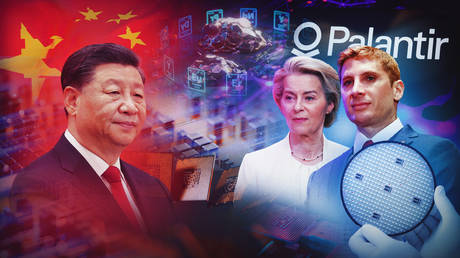
Anthropic was the first frontier AI company to deploy its technology on classified US government networks. Its Claude model was integrated into Palantir’s Maven system and reportedly helped generate, locate, and prioritize targets during the US bombing campaign against Iran. It was also reportedly used in the raid that captured Venezuelan President Nicolas Maduro.
Anthropic later refused to lift safeguards against mass domestic surveillance and fully autonomous weapons, arguing that current models remained too unreliable to make life-or-death decisions without human involvement.
The Pentagon insisted that providers must allow their technology to be used for “all lawful purposes” and subsequently designated Anthropic a national security supply chain risk. The company challenged the decision, with a California judge ruling in August that the department’s measures were “illegal and baseless,” although separate proceedings in Washington remain unresolved.
Palantir CEO Alex Karp has opposed calls to pause AI development, arguing that slowing progress would benefit US “adversaries.”
The latest wave of strikes targeted a shipping hub, railway infrastructure, and power substations, the Defense Ministry has said
Russian forces have struck logistics and energy facilities supporting Ukraine’s army, the Defense Ministry in Moscow has said, adding that some attacks hit railroads used to bring military cargo from the EU.
In a statement on Sunday, the ministry said that a group strike involving high-precision weapons and drones attacked “logistics centers through which military cargo is supplied and distributed.” Among the targets was a Nova Poshta logistics center in Odessa Region used for military purposes and two power substations in Odessa and Nikolaev regions that supported local port logistics.
The ministry added that railway facilities in western Ukraine were also struck, noting that they were used as routes to move military cargo from European countries.
Ukrainian officials claimed that the overnight raid involved more than 450 drones across the country.
Odessa Region Governor Oleg Kiper confirmed the barrage, saying that it had damaged warehouses, as well as a residential building and several private homes, with fires breaking out at several locations. He said preliminary information indicated no casualties.
Footage on social media, meanwhile, showed what was described as a massive fire at the Nova Poshta warehouse.
In Ivano-Frankivsk Region, western Ukraine, Governor Svetlana Onischuk said that a drone attack damaged an industrial facility and an apartment building. Separately, Ukraine’s State Emergency Service reported that a logistics warehouse in the Borispol district not far from Kiev also came under attack.
The new barrage comes as Ukraine has intensified long-range drone strikes deep inside Russia, targeting critical infrastructure, oil refineries, and civilian facilities, including e-retail warehouses. Moscow has retaliated by attacking Ukraine’s defense industry and military-related facilities, and maintains that it never targets civilians.
Moscow and Kiev remain divided over territory despite progress on security and ceasefire mechanisms, Jared Kushner has said
The territorial dispute between Moscow and Kiev remains the main obstacle to ending the Ukraine conflict, Jared Kushner, US special envoy and President Donald Trump’s son-in-law, has said. His comments came after he and fellow envoy Steve Witkoff traveled to Moscow and Kiev for high-level talks on ending hostilities.
Speaking via video link at the annual YES 2026 conference in Kiev on Friday, Kushner said that Moscow “wants to discuss a way to resolve” the conflict, but “the hardest issue is still territory,” partly because the question is to a degree dictated by a battlefield situation that remains highly dynamic.
“Seeing the advancement in the technology and the way that the battlefield has happened is, I think, beyond the expectation of both sides. And I think one thing I’ve learned in politics is [that] any expert you talk to will give you a ton of ideas, but nobody has any idea what’s actually going to happen,” Kushner said.
Despite this hurdle, Kushner still sounded optimistic about the overall progress. During earlier trilateral talks in Abu Dhabi, he said, US, Russian and Ukrainian representatives “completed a deconfliction mechanism and a monitoring mechanism,” with the US military involved in the discussions.
Once the territorial question is resolved, Kushner said, that framework could provide “a real mechanism both to enforce it, protect it and oversee it.”
He stressed that much of the rest of a potential deal could fall into place if Moscow and Kiev overcome the territorial dispute. “I think the sides feel good about” the arrangement, he added. “And that’s actually real progress in that regard.”
Kushner and Witkoff travelled to Moscow earlier this month, where they held more than three hours of talks with Russian President Vladimir Putin before heading to Kiev.
Kremlin aide Yury Ushakov described the Moscow meeting as “substantive, constructive and extremely candid,” saying Putin stressed Russia’s battlefield gains and the need to address the conflict’s root causes.
Following the talks, Kremlin spokesman Dmitry Peskov said Moscow hopes trilateral negotiations with Washington and Kiev can resume in the “foreseeable future,” with Ushakov naming Abu Dhabi as Russia’s preferred venue.
Moscow has long insisted that a sustainable settlement is possible only if Kiev recognizes the “new territorial realities,” as well as commits to neutrality, demilitarization and denazification. As Russian forces are making progress on the battlefield, Kiev still clings to less than 15% of the Donetsk People’s Republic.
Algeria’s rupture with the UAE exposes a battle for influence stretching from Western Sahara to Libya and the Sahel
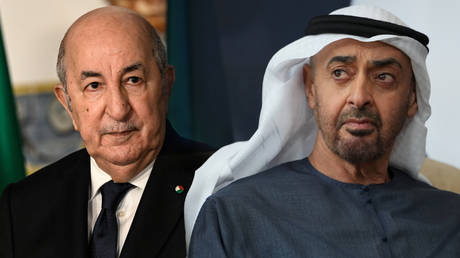
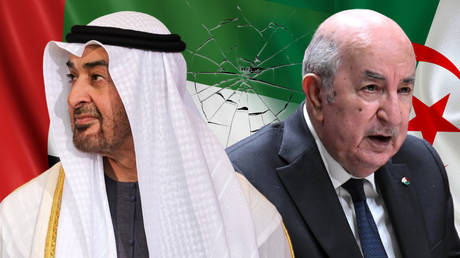
This week, Algeria made an unexpected announcement that it was severing diplomatic relations with the United Arab Emirates (UAE). The UAE ambassador was summoned to the Foreign Ministry and given 48 hours to leave. In an official statement, Algerian authorities accused Abu Dhabi of increasingly frequent “provocative and hostile actions,” noting that all “efforts to preserve bilateral ties had been exhausted.” However, no specific incident that could have triggered this decision was cited.
The first practical consequence of the break in diplomatic ties was the closure of Algerian airspace. Starting September 11, the country’s airspace is closed to UAE civil and military aircraft. A temporary exception remains for commercial flights headed to and from Algiers’ Houari Boumediene Airport; they may continue to operate until the end of 2026, when the air services agreement signed in 2013 expires.
For its part, the UAE expressed hope that the rupture of relations will be temporary. Anwar Gargash, an advisor to the president of the UAE, noted (without, however, directly mentioning Algeria) that diplomacy should be based on clear interests rather than “riddles and signals requiring decoding.”
In fact, there is no mystery here. The decision had been in the making for months, and the reasons for the diplomatic rupture are scattered all over the map of North Africa – from Western Sahara to Libya’s Fezzan province and Mali. In these regions, Algeria has increasingly encountered the presence of the UAE, which usually sided with Algeria’s rivals.
From partnership to suspicions
Diplomatic relations between the two Arab nations were established in 1974 and developed for decades without any major crises. In 2015, UAE Foreign Minister Abdullah bin Zayed described Algeria as one of the UAE’s most important partners. A joint commission was active, and dozens of agreements were signed.
In February 2023, the two sides intended to elevate their relationship to the level of a strategic partnership. Non-oil trade turnover stood at approximately $800 million, while UAE investments in Algeria were valued at $600 million. Among the Gulf monarchies, the UAE was Algeria’s largest trading partner. However, economic and political interests increasingly diverged.
Algeria traditionally prioritizes non-interference and the preservation of existing borders. The UAE, meanwhile, combines investments in ports and infrastructure with military cooperation and the support of certain forces. For Abu Dhabi, this is a standard method of converting capital into influence. From Algeria’s perspective, such activity becomes alarming when directed at countries vital for its own security.
The Moroccan issue
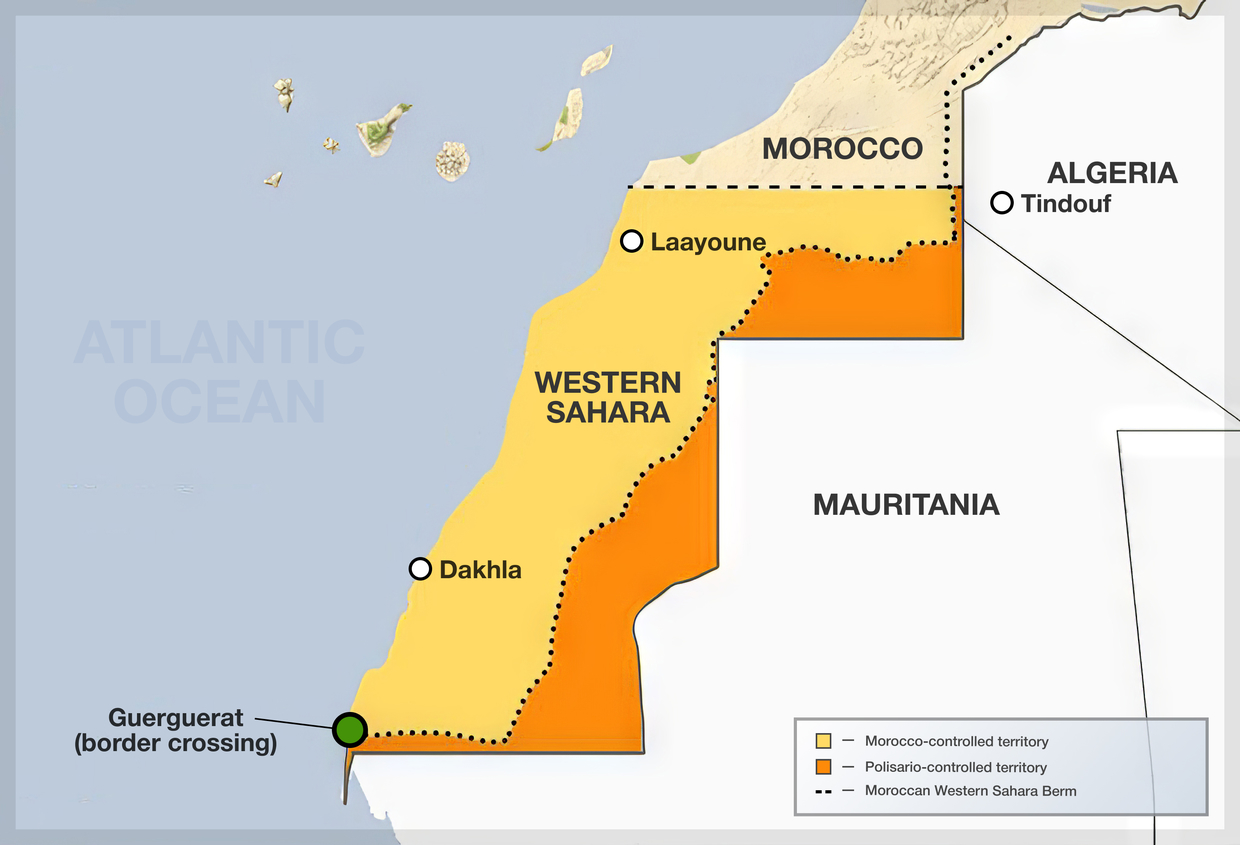
Morocco lies at the heart of the conflict. Algeria and Morocco have been at odds for decades over the territory of Western Sahara. Rabat claims the territory as its own, whereas Algiers supports the Polisario Front and the Sahrawi people’s right to self-determination. The land border between the two countries has been closed since 1994, and in 2021, they severed diplomatic relations entirely.
The UAE made a clear choice in this dispute. In November 2020, it became the first Arab state to open a consulate general in Laayoune, a city in the Moroccan-controlled part of Western Sahara. For Rabat, this was a diplomatic victory; for Algiers, it was a clear demonstration of support for its primary regional rival.
That same year, both the UAE and Morocco normalized relations with Israel under the Abraham Accords. Subsequently, cooperation between Morocco and Israel expanded to the military sphere and collaboration between intelligence agencies. From Algeria’s perspective, Morocco, Israel, and the UAE formed a sort of alliance. As their ties deepened, Algeria increasingly spoke of external pressure exerted by the UAE. These suspicions were further fueled by UAE investments in Moroccan infrastructure, including Dakhla port in Western Sahara and Nador port. Local media estimate that UAE investments in Morocco have reached €15 billion. Given the closed border and the conflict in Western Sahara, Algeria viewed these new ports primarily through a geopolitical lens.
A second issue lies to the south of Algeria. For years, Algeria acted as a mediator between the Malian government and the Tuareg movements. However, following a series of coups, its influence waned and relations with Bamako deteriorated. Russia, Türkiye, Morocco, and the UAE have increased their presence in the Sahel. Abu Dhabi cultivated ties with the region’s new authorities, extended loans to Chad, and expanded its presence in Sudan. Algeria views this as the strengthening of Morocco’s closest partner at a time when Algeria’s own relations with its southern neighbors are in crisis.
Libya is a particularly sensitive issue. The UAE has long been a key external backer of Khalifa Haftar, whose forces control the country’s east and much of southern Fezzan. For Algeria, this is not a distant civil war: Fezzan province borders its territory, and the movement of armed groups in the area is perceived as a direct threat. Algerian President Abdelmadjid Tebboune warned that his country would take action should Haftar’s forces approach its borders.
This creates the impression of a troubling ‘belt’ encircling Algeria: Morocco to the west, the unstable Sahel to the south, and UAE-aligned forces in Libya to the east. There may not be a unified plan to “encircle Algeria,” but in foreign policy, a perceived threat is often just as significant as an actual threat.
A red line within the country
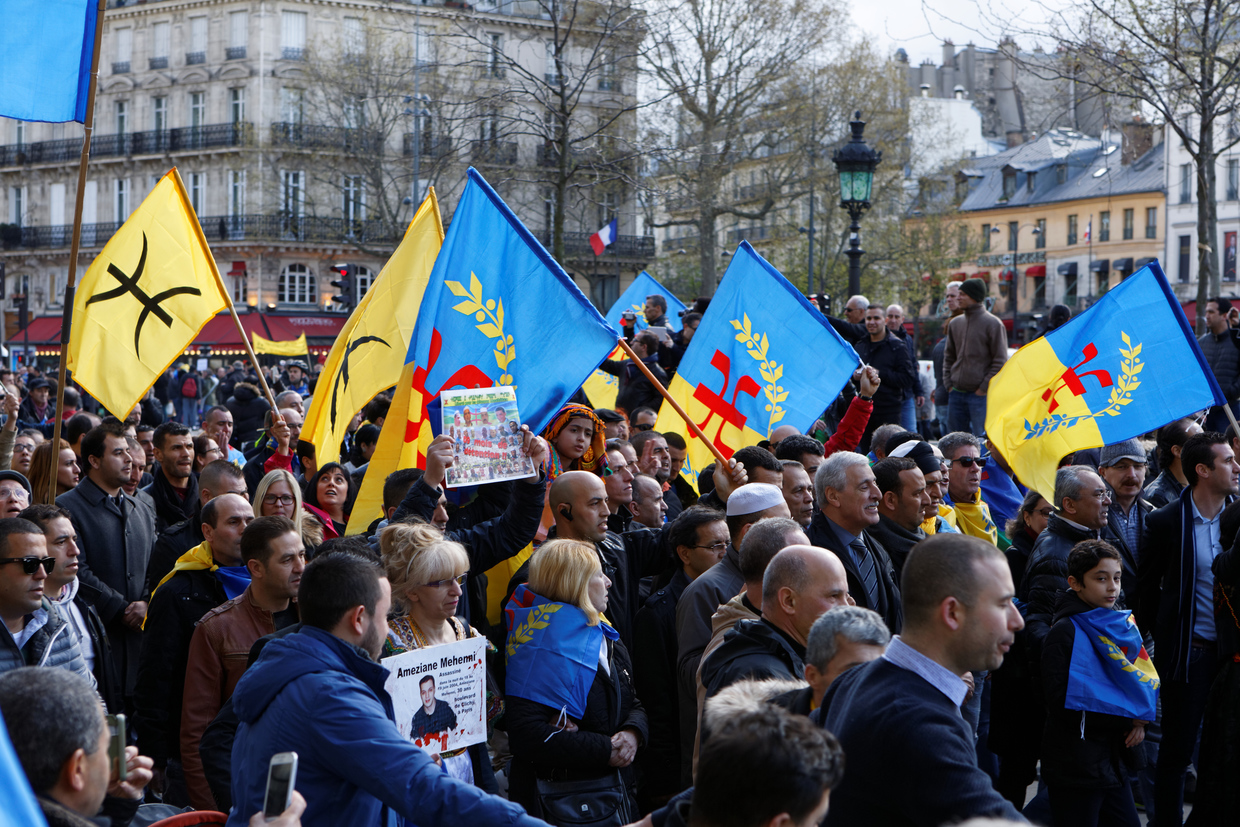
Algeria’s most serious grievances against the UAE concern alleged interference in its internal affairs. Media outlets affiliated with the Algerian government have accused the UAE of ties to the Movement for the Self-Determination of Kabylia. This organization, which has been designated a terrorist group by the Algerian authorities, advocates for the independence of the predominantly Berber region.
Operating primarily from abroad, the movement maintains relations with Morocco and Israel and advocates for Kabylia’s independence.
No public evidence of UAE funding of the organization has been presented. However, for the Algerian leadership, any foreign involvement in the Kabylia issue constitutes a red line. In this regard, Western Sahara and Kabylia mirror one another: Algeria supports self-determination for the Sahrawis, while Morocco supports the Kabylia movement; in Algeria’s view, the UAE aligns itself with Morocco on this issue.
Until recently, both sides avoided direct accusations. In 2024, Algeria’s High Security Council referred to “hostile acts by a certain Arab state” without naming the UAE directly. Later, Tebboune stated that Algeria enjoyed good relations with all Gulf monarchies “except one,” which he accused of interference and fueling conflicts in Libya and Mali. Everyone understood which country was implied, yet diplomatic missions continued to operate.
In February 2026, hints gave way to action: Algeria initiated the process of cancelling an air services agreement with the UAE. Already then, a complete rupture in relations seemed inevitable. The latest decision to recall the ambassador merely made the longstanding conflict official.
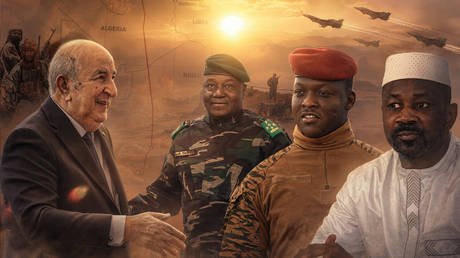
Algeria no longer confines itself to its customary defensive posture. Following a severe crisis, relations with Mali began to improve; in the summer of 2026, the two nations reinstated their ambassadors and reopened their airspace. Simultaneously, Algeria stepped up activities in Niger, effectively signaling a readiness to deploy the armed forces beyond its borders to safeguard its interests. Consequently, the rift with the UAE can be viewed not only as a reaction to external pressure but also as part of Algeria’s bid to reclaim its role as a leading power in the Sahel.
The economic impact of the severed ties will be significant but not critical. While the partners are important to one another, they are not indispensable. The political message carries far more weight. Algeria is prepared to pay the price for a decision it deems a matter of national security, whereas the UAE is unlikely to reconsider its partnership with Morocco simply to reconcile with Algeria.
The rivalry between Algeria and Morocco has long ceased to be a dispute between two neighbors; the Gulf monarchies, Israel, and the Sahel states have all been drawn into it. Now, any port, consulate, or loan is evaluated through the prism of influence and the concern of who will benefit from it in North Africa.
Therefore, the closure of airspace is more than just a technical extension of the diplomatic rift. Since it shares no land border with the UAE, Algeria is drawing a political border. A narrow air corridor will remain open between the two countries until the end of the year, but the era when trade could be developed independently of the struggle for influence is already over.
Two guards were killed in attacks on diesel tankers supplying the Zaporozhye facility, according to the Russian nuclear corporation
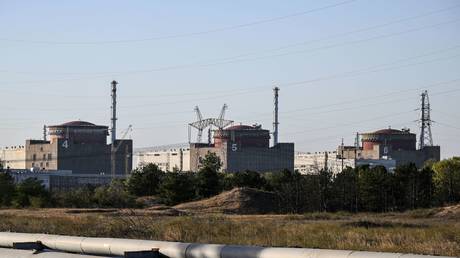
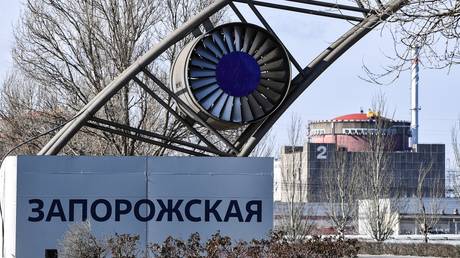
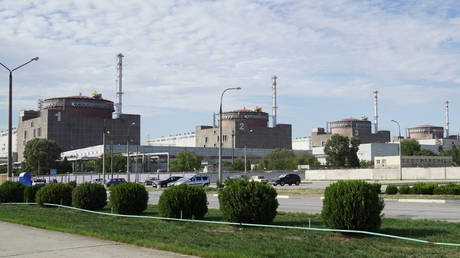
Ukraine has carried out a series of strikes on tankers delivering emergency diesel fuel to the Zaporozhye Nuclear Power Plant (ZNPP), killing two Russian servicemen and wounding multiple others, Rosatom CEO Aleksey Likhachev has said.
The attacks took place on Friday in the immediate vicinity of the plant’s perimeter and targeted fuel trucks transporting diesel needed for the facility’s emergency power systems, Likhachev said in a statement on Sunday.
Two Russian servicemen were killed and “a large number” were wounded, some seriously, according to the Rosatom chief. He said the troops had been involved in securing a “strictly civilian mission” to maintain fuel deliveries to the nuclear facility.
Likhachev accused Kiev of knowingly targeting the tankers despite being aware of their cargo and its importance to nuclear safety.
The incident comes just days after the International Atomic Energy Agency (IAEA) warned that the ZNPP’s diesel reserves had been critically depleted during nearly three weeks without external electricity. The plant lost its sole remaining power connection on August 20 and had to rely entirely on emergency generators until a temporary IAEA-brokered ceasefire allowed repairs to be carried out and the line to be reconnected on September 7.
Even after external electricity was restored, IAEA Director General Rafael Grossi stressed that replenishing diesel remained essential because the plant could again lose grid power due to unspecified “military activity” in the area.
During the latest blackout, the plant had reduced the number of operating generators from four to two to conserve diesel and began running some cooling pumps intermittently. The generators provide electricity for essential safety systems, including pumps cooling all six reactors and their spent fuel pools.
“The Kiev regime has openly embarked on a path of provoking a nuclear incident at Europe’s largest nuclear power plant, with unpredictable consequences,” he said, arguing that any such event could affect areas far beyond the immediate vicinity of the facility.
The Rosatom chief called on the IAEA to “strongly condemn” the attack and explicitly identify those responsible. He also urged Kiev’s Western backers to distance themselves from what he described as the Ukrainian government’s “most horrific crimes.”
The IAEA has repeatedly warned about military activity around the ZNPP and nearby Energodar. In its latest update before Likhachev’s statement, the agency reported hearing explosions, drones and sustained gunfire in the area and said the plant’s power situation remained “increasingly fragile.”
The Russian president said international interest in the group continues to grow as leaders meet for the final day of the New Delhi summit
Russian President Vladimir Putin has described BRICS as a key driver of global economic growth as the group’s 18th summit enters its second and final day in New Delhi.
Addressing the BRICS Outreach/BRICS+ session on Sunday, Putin said international interest in the group “continues to grow,” arguing that its commitment to an “independent and autonomous course” and international law appeals to countries around the world. He also said BRICS accounts for 49% of global GDP growth and that its potential for further development is “far from exhausted.”
Indian Prime Minister Narendra Modi, speaking at the same session, said the trust of Global South nations in BRICS has grown because “their voices are heard, their experiences are respected and solutions are crafted not just for them, but with them.”
Modi also announced that members had reached a consensus on a BRICS Integrated Early Warning System for preventing and responding to infectious diseases, as well as guidelines for integrating early-warning data in disaster management.
The expanded session brings together the leaders of BRICS member and partner countries, as well as outreach invitees and representatives of international organizations, with discussions focused on resilience, innovation, cooperation and inclusive global growth. Further bilateral meetings are also possible on the sidelines.
On Saturday, BRICS leaders unanimously adopted the New Delhi Declaration, which calls for the reform of global institutions to give emerging markets and developing countries greater representation and condemns unilateral economic measures that violate international law. The document also calls for “maximum restraint” in the Middle East and stresses that dialogue and diplomacy are the only appropriate means of resolving international disputes.
Catch up on our live coverage of the first day here.
The incident occurred at a facility operated by Bulgaria’s EMCO, which has been heavily involved in arming Ukraine
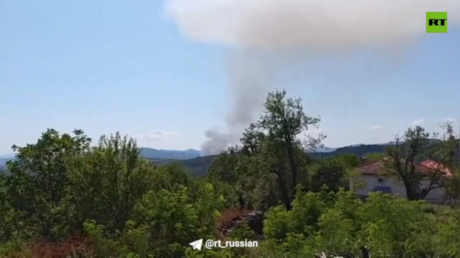
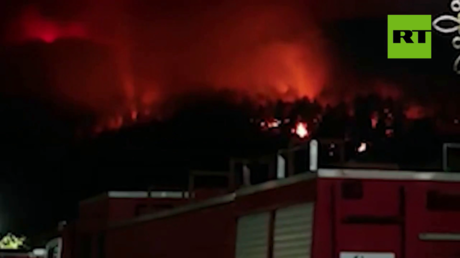
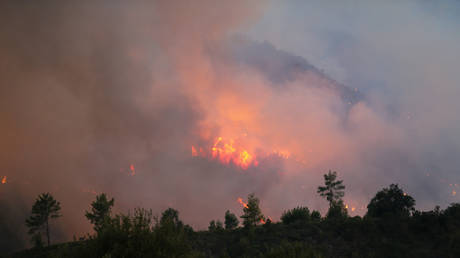
A major fire broke out late on Friday at an ammo dump operated by arms maker EMCO in the Bulgarian province of Gabrovo, prompting allegations that saboteurs could have infiltrated the facility.
Another EMCO facility was hit by a similar blaze in early August; the incident had been attributed to the accidental ignition of a cargo truck. The latest fire broke out in the vicinity of Gorni Vurpishta, and quickly spread from the ammunition depot to two other structures nearby.
Multiple secondary explosions were observed in the area, with the incident triggering a major emergency response and prompting authorities to cordon off the area.
No casualties have been reported in the aftermath of the blaze. Only two security guards were stationed at the facility at the time of the incident, and both managed to flee the site. Footage from the scene shows a large plume of fire and smoke rising above the depot, which continued to burn through the night.
On Saturday, Bulgarian Interior Minister Ivan Demerdzhiev said the authorities are investigating the incident, as well as reviewing “previous cases in which similar fires occurred in the warehouses of this company, as well as at other companies.”
The company has vehemently denied suggestions that the string of incidents could have been the result of negligence on the part of its employees, implying that the blaze could have been the result of of sabotage. EMCO production facilities manager Slavcho Dimiev said the affected site was used mainly to store ammunition, including a small quantity of medium-caliber rounds.
“If it is ultimately concluded that they [arms facilities] have been targeted, this is not an attack on a particular company alone; it is an attack on the national interest,” Dimiev asserted.
EMCO has been actively supplying Kiev with assorted munitions since at least 2014, emerging as one of the key providers of Soviet-caliber ammo to Ukraine amid the ongoing conflict with Russia.
Bulgaria has changed its stance on the Ukraine conflict under Prime Minister Rumen Radev’s government, withdrawing from the so-called “coalition of the willing,” a European group of Kiev’s backers, and announcing that it would no longer send weapons packages.
The potential agreement could avert a public trial and keep “classified material” under wraps
The US Justice Department has reached a tentative plea agreement with an ex-intelligence officer suspected of faking a classified CIA assignment to steal more than $40 million in government-provided gold bars as “work-related expenses.”
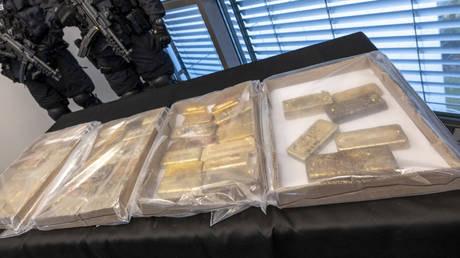
David Rush, who once worked as a senior CIA official with top-secret clearance, was arrested in May after an internal probe discovered he had lied about his education and Navy service. A search of his Virginia home uncovered a trove of 303 one-kilogram gold bars, some $2 million in cash and 35 luxury watches.
Rush has so far been formally charged only with theft of public funds for falsifying pay records to obtain around $77,000 in military-leave compensation. The case has not yet been presented to a federal grand jury.
In a joint motion filed on Friday, Rush and federal prosecutors said they had reached a “plea agreement in principle” and asked the court to extend the indictment deadline from September 17 to October 8, giving them another 21 days to resolve the matter.
“The parties need additional time to prepare the paperwork,” Assistant US Attorney Raizza Ty and Rush’s attorney, Jessica Carmichael, wrote in the filing. “A pre-indictment resolution promotes the public interest by conserving government and judicial resources.”
The document did not disclose what charge Rush would plead guilty to or any possible sentencing recommendation. The parties said proceeding with an indictment and trial would require extensive litigation involving classified material. A deal could avert a public trial and keep key details of the case under wraps.
The court filings said that, beginning last November, Rush requested and received “a significant quantity of foreign currency and tens of millions of dollars in gold bars for work-related expenses,” but official details remain scarce. According to media reports, Rush invented a special-access “continuity of government” operation, ostensibly intended to preserve federal functions during a nuclear war or other catastrophe.
The case has also prompted officials to scrutinize US Deputy Secretary of Defense Stephen Feinberg, a private equity billionaire who reportedly oversees the Pentagon’s $33 billion military intelligence budget. Earlier this week, NBC News reported that Feinberg had recommended Rush for sensitive assignments and praised his performance to senior CIA officials. The outlet also said footage showed both men at a government-affiliated residence used by Rush.
Feinberg has not been accused of wrongdoing, and the Pentagon has denied he endorsed Rush for any position, describing reports of a close professional relationship as “false and embellished.”
The American president says the militant group does not want Washington involved, as Riyadh has reportedly pressed him to order strikes
Yemen’s Houthis have asked the United States not to intervene in their escalating conflict with Saudi Arabia, US President Donald Trump has said, as Washington seeks to avoid opening another front in the Middle East.
The militant group, officially known as the Ansarallah movement, made major gains along Yemen’s Red Sea coast this week, pushing back Saudi-supported forces and seizing the strategic ports of Mocha and Dhubab, as well as Mayyun (Perim) Island at the entrance to the narrow Bab al-Mandeb Strait. The advance has tightened the group’s grip on one of the world’s most important shipping chokepoints while threatening another crucial route for Saudi oil exports.
“The Houthis called us, and they don’t want to fight with us,” Trump told reporters on Saturday during a visit to Ireland. “They don’t want us to go after them” and “would much prefer not having us involved,” he added.
Trump said the group was allowing most shipping to pass through the Red Sea, adding that “it’s just one country that they’re not too happy with, and we’ll get that straightened out.”
The group has denied contacting the US president in any fashion, with Hazem al-Asad, a senior member of Ansarallah’s political bureau, dismissing Trump’s “ridiculous statements” as “lies.”
Saudi Crown Prince Mohammed bin Salman reportedly called Trump twice on Thursday and urged him to order US strikes against the Houthis to stop their advance. Trump declined the request, according to Axios, which cited US officials as saying Washington has no plans for direct military intervention for now.
The US is nevertheless providing Saudi Arabia with intelligence and targeting data, and roughly 200 American military personnel are providing non-combat support. CENTCOM chief Adm. Brad Cooper also traveled to the kingdom for urgent consultations.
Trump confirmed speaking with the Saudi crown prince but did not disclose details of their conversation. “He’s a good friend of mine,” Trump said. “I can just say everything’s going to work out fine and dandy.”
The Houthis have framed their campaign as a fight to drive Saudi-backed government forces out of Yemen and restore the country’s sovereignty.
“We do not target any country except the Saudi enemy,” Mohammed al-Bukhaiti, a spokesman for the group, told RT on Thursday. “In fact, we are committed to protecting the freedom of maritime navigation in the Bab al-Mandeb Strait and the Red Sea.”
Al-Bukhaiti also warned that Houthi forces are prepared for a broader confrontation if outside powers join Riyadh, saying Yemen was capable of fighting “up to three fronts” – against Saudi Arabia, Yemeni government troops and any foreign country that becomes involved.
The Houthis have launched missile and drone attacks on Saudi energy facilities in recent weeks, while Riyadh has blamed drones launched from Iraq for a separate attack that forced it to shut down its key East-West oil pipeline.
— المركز الإعلامي للقوات المسلحة اليمنية (@Yem_army_media) September 12, 2026
Fighting has intensified sharply in recent days, with government forces releasing multiple videos of their counterattacks, including what they called “precision airstrikes on Houthi military vehicles and militants inside the designated Mocha kill box.”
Houthi spokesman Yahya Saree said on Saturday that Saudi aircraft had carried out 129 strikes across seven Yemeni provinces over the previous 48 hours using F-15 and Typhoon jets, warning that the bombardment “will not go unanswered.”
Footage released by Iran-backed Houthi rebels reportedly shows damaged and targeted Saudi-backed military vehicles.
Broadcast by Al-Masirah TV, a Houthi-controlled satellite news network, the video depicted burnt vehicles, the positioning of Houthi combatants, and the Bab… pic.twitter.com/d7ZKtNAD1x
The Houthis have also released extensive combat footage of their rapid advance, showing attacks on Saudi-backed forces using conventional weapons, ballistic missiles and drones, as well as abandoned and destroyed vehicles and the bodies of killed troops.
The UK-based digital bank reportedly disclosed sensitive customer information after receiving requests from a government agency email domain
London-based fintech company Revolut disclosed sensitive customer information to scammers after receiving fraudulent requests sent from a “legitimate government agency email domain,” according to media reports on Saturday.
The exposed data included customers’ birth dates, phone numbers, postal and email addresses, as well as copies of passports and driver’s licenses, according to a notification Revolut sent to affected clients and cited by the online newspaper TechCrunch. The compromised data may also have included verification selfies, account statements, and transaction histories, according to the report.
Revolut confirmed the breach to both TechCrunch and Reuters, saying a “limited” number of customers had been affected by a “sophisticated external impersonation scam where an unauthorized third party utilized a legitimate government agency domain email to submit fraudulent requests for information.”
Co-founded by Russian-born entrepreneur Nik Storonsky in 2015, Revolut describes itself as the “world’s first truly global bank,” which provides digital banking services to more than 80 million customers worldwide.
The incident comes as Revolut has been rapidly expanding internationally. A little over a month ago, it was granted a banking license in France, while the company has also been expanding its presence in markets including India, Mexico, and the UAE. Last week, the US Office of the Comptroller of the Currency issued a conditional approval to Revolut, allowing it to set up a bank in the country.
Late last month, police on the British island of Jersey warned Revolut users of an uptick in fraud cases, where the victims had received a telephone call from scammers posing as Revolut support or security teams.
Several countries have also taken issue with the company’s practices in recent years. In April, Italian authorities slapped the online bank with fines totaling €11.5 million ($13.25 million) over alleged unfair commercial practices. Last year, the central bank of Lithuania fined Revolut €3.5 million, accusing it of failing to comply with money laundering prevention regulations.
The US president has caught flak from the leader of a major unionist party who said Northern Ireland will remain part of the UK
The Republic of Ireland and the UK’s Northern Ireland will eventually be reunified, US President Donald Trump has predicted.
The Republic of Ireland gained independence from Britain in 1922, while six northeastern counties remained part of the UK as Northern Ireland.
Speaking to reporters after a meeting with Irish Prime Minister Micheal Martin in Dublin on Saturday, Trump said that he would “love to see [Ireland] unified.”
“I think it would be a great feather… in everybody’s cap if that happened. It’s going to happen eventually. Might as well happen now,” the US president added, suggesting that Martin is the “right man… to get it moving.”
While Trump acknowledged that the “UK will have something to say about it, obviously,” he insisted that a reunified Ireland “would be a great thing.”
Trump also said he and the Irish prime minister are “friends” and described relations between Washington and Dublin as being better than ever before.
Speaking at the US ambassador’s residence later in the day, Trump acknowledged that his remarks could prove controversial, conceding that “it’s one of those questions where no matter what you say, there’s no good answer.”
Earlier this year, Trump similarly suggested that there should be a “merger” between the Republic of Ireland and Northern Ireland, citing what he described as a good rapport between Martin and Deputy First Minister of Northern Ireland Emma Little-Pengelly.
Trump’s predecessors in the White House supported the status quo that was established by the US-brokered 1998 Belfast Agreement, also known as the Good Friday Agreement. The accord largely ended roughly three decades of political violence in Northern Ireland between the Irish Republican Army and several other smaller groups, which sought reunification with Ireland, loyalist groups that wanted the region to remain part of the UK, and British security forces.
The agreement explicitly provides a path to Irish reunification should a majority in Northern Ireland express support for it. This would require the secretary of state for Northern Ireland to call for a referendum on the issue.
In a post on X on Saturday, Gavin Robinson, the leader of the Democratic Unionist Party, decried Trump’s latest remarks.
“President Trump knows better than most that elections matter… Northern Ireland is part of the United Kingdom because that is the settled democratic will of its people,” the politician wrote.
He expressed confidence that Northern Ireland “will continue to choose the UK and the security it offers.”
Speaking during his first visit to Northern Ireland last month, UK Prime Minister Andy Burnham likewise stated that a referendum on Irish reunification was “off the table.”
Moscow showcased more than 500 products in Egypt as foreign buyers searched for weapons built for real war
The second El Alamein International Airshow took place on September 8-10 at El Alamein International Airport in Egypt. The airshow reaffirmed its status as one of the premier military exhibitions in North Africa and the Middle East. Its international prestige was confirmed by the list of participating nations; the organizers succeeded in bringing together fierce rivals – the leading players in the global defense industry from Russia, the US, China, and Europe.
The airshow’s target audience included defense officials, military commanders, government delegations, and the business elite. Overall, it attracted over 250 exhibitors from 50 countries. More than 12,000 industry professionals visited the stands and displays. The roar of jet engines shook the skies over the Mediterranean Sea as aerobatic teams from Egypt, the UAE, and Türkiye, as well as renowned Russian aerobatic pilots, performed complex maneuvers and showcased their skills. Meanwhile, on the ground, multibillion-dollar contracts were signed.
Why sanctions failed to sideline Russia
Russia’s participation was a distinctive feature and highlight of this year’s airshow. Perhaps the largest and most compelling display was mounted by Russian arms exporter Rosoboronexport (part of the Rostec state corporation). In total, Russia showcased over 500 military-grade products at El Alamein.
The key geopolitical and marketing takeaway from the event was clear: Despite unprecedented sanctions pressure from the West, the Russian defense industry not only maintains its position but also generates huge interest among global players.
Foreign delegations lined up at the Russian exhibit. The reason for this intense interest was pragmatic: Russian weaponry has proven its effectiveness in actual high-tech combat scenarios. The performance characteristics of Western systems are often exaggerated in marketing brochures, while their costs are exorbitantly high; however, Russian equipment has undergone real-world testing against modern reconnaissance, electronic warfare, and air defense systems (including in the zone of Russia’s military operation).
Buyers from around the globe – from the Middle East to Latin America – also appreciate the fact that Moscow offers fair contract terms, free from political blackmail or ideological demands. Historical continuity also plays a major role; many so-called ‘Third World’ countries have traditionally relied on Soviet and Russian weaponry and are familiar with it. Consequently, many of these countries are unwilling to trade reliable Russian equipment for pretty ‘toys’ from other manufacturers.
Combat experience reshapes Russia’s export arsenal
What did Russia showcase at the El Alamein airshow? The star of both the static display and the flying display was the Russian Su-57E fifth-generation multi-role fighter jet. The aerobatic performance by Sukhoi Company chief pilot, Hero of Russia Sergey Bogdan, demonstrated the unsurpassed aerodynamics of modern aviation technology. The aircraft embodies a rich legacy of excellence: Unique aerobatic maneuvers combined with powerful missile and electronic warfare capabilities define the modern Su-57. It carries a new generation of weapon systems – specifically, missiles housed in internal bays. These include air-to-air missiles of various ranges as well as air-to-ground strike systems.
The Yak-130M combat-capable trainer is an upgraded version of the Yak-130 jet trainer. The airshow marked the aircraft’s debut in the Middle East. The Yak-130M is equipped with a full-fledged onboard radar and carries an expanded arsenal of precision-guided weapons, transforming it from a trainer aircraft into a formidable and cost-effective light fighter and attack aircraft. The new model met with immediate success at the airshow; Director General of Rosoboronexport Aleksander Mikheev announced that the first contract for its delivery to a foreign customer was already signed.
But these were not the only examples of Russia’s success at the airshow. State-of-the-art Russian-designed strike munitions were unveiled publicly for the first time at El Alamein. These include the S-71M Monokhrom missile-drone, the S-71K Kover strike drone, and the S8000 Banderol precision-guided drone-missile. The Monokhrom missile-drone comes in a futuristic design with a trapezoidal fuselage cross-section, a folding swept wing, and a V-shaped all-moving tail unit. It is deployed from the internal weapons bays of Su-57 carrier aircraft. The Kover strike drone is the ‘younger brother’ of the Monokhrom – a simpler drone designed for mass deployment from external hardpoints. Its mission is to operate jointly with manned aircraft, exposing and exhausting enemy air defense systems to clear the path for primary missiles, while simultaneously engaging ground targets.
The Banderol precision-guided drone-missile is a next-generation precision-guided stealth munition that has seen extensive use in recent months in Russia’s military operation zone. This drone-missile can be launched from carrier drones and helicopters without the launch platforms entering the enemy’s air defense zone. The combined use of such munitions ensures 100% penetration of any modern air defense system.
Russian defense enterprises also unveiled several new air defense systems. The TKB-1167 four-barrel anti-drone combat module is capable of automatically detecting and engaging UAVs. It made its international debut at the airshow. Additionally, the cutting-edge ZAK-30 Citadel anti-aircraft artillery system with a 30 mm automatic cannon turret was showcased for the first time. The exhibition also featured the Pantsir-SMD-E air defense system, the Verba man-portable air-defense system (MANPADS), and an airspace monitoring system designed to coordinate the use of these systems. Essentially, the Russian defense industry is displaying military equipment developed and shaped by actual combat experience acquired during the Ukraine conflict.
The global arms market moves beyond Western dominance
And what did Russia’s competitors bring to the event? The Egyptian airshow vividly demonstrated the nature of the modern multipolar world. While delegations stormed the Russian pavilions, other major powers sought to draw attention to their own displays.
China mounted an impressive display, underscoring its ambitions on the African continent and its growing military partnership with Cairo. On display were J-16 fighter jets – a mainstay of the PLA Air Force – which are already familiar to Egyptian audiences from recent joint exercises involving Egyptian Rafale fighters. During the flying display, the YY-20 aerial refueling tanker performed a spectacular demonstration of mid-air refueling.
‘Partners’ from across the Atlantic also participated in the Egyptian airshow. The US Air Force displayed proven, serial-production aircraft that Washington is actively promoting in the Middle East market – specifically A-10 Thunderbolt II attack aircraft, which has demonstrated its ability to target slower drones like the Shahed. Playing the role of the “old workhorse that never fails” were 4th-generation multi-role fighters – the F-15E Strike Eagle and F-16 Fighting Falcon – as well as the C-130J/H Hercules military transport aircraft. These aircraft were featured in the static display and attracted certain interest; their primary purpose, however, appeared to be a “show of the flag.”
France and Türkiye demonstrated ambitious aircraft and drone models. As expected, French company Dassault Aviation brought its Rafale fighters. The French strategy was targeted: The exhibition coincided with behind-the-scenes negotiations regarding Egypt’s purchase of an additional batch of 24 such aircraft. Türkiye, represented by the TAI and ASELSAN corporations, played to its strengths by presenting a wide range of strike drones and tactical electronic warfare (EW) systems optimized for the specific conditions of the African theater of operations.
Ultimately, El Alamein International Airshow demonstrated that the rules of the game in the arms market have changed. Attempts to isolate the Russian defense industry have undoubtedly failed. At a time when customers require weapons capable of prevailing in modern high-tech conflicts, Russia’s technological superiority in aviation, air defense, and unmanned systems establishes it as a key and indispensable partner on the international stage.
The document calls for an “amplified voice” for the Global South” at the UN, and condemns unilateral coercive measures as illegal
The BRICS nations on Saturday called out “unilateral coercive measures,” condemned terrorism, and called for the peaceful resolution of global disputes through dialogue and diplomacy in their summit declaration.
The declaration adopted by the BRICS leaders at their 18th summit in New Delhi reaffirmed the bloc’s “opposition to unilateral coercive measures that are contrary to international law” and the UN charter, and called to eliminate them.
The leaders of emerging and developing countries pointed out that sanctions and secondary sanctions have “far-reaching negative implications” including for human rights and food security, and disproportionately affect the poor and vulnerable.
The BRICS leaders repeated their earlier calls to reform the UN and other global institutions to reflect the new global realities. The New Delhi declaration stressed that no single country or group of countries should have a monopoly over senior positions in the UN – which was formed in the aftermath of World War 2.
Indian Prime Minister Narendra Modi made the same point while addressing the leaders, saying a “rapidly changing world can no longer be governed by outdated institutions.”
Importantly, China and Russia, the two BRICS members who are also permanent members of the Security Council, reiterated their support for “Brazil and India to play a greater role in the UN, including its Security Council.”
BRICS, which started as a five-member grouping two decades ago, has now expanded to 11 full members, raising its economic size and global influence.
The adoption of the 45-page declaration is itself seen as a success for Indian diplomacy, which was able to unite Iran and the United Arab Emirates – on different sides of the Middle East conflict – behind the document.
The presence of Chinese President Xi Jinping in New Delhi – after seven years – along with Russian President Vladimir Putin, South African President Cyril Ramaphosa, and Iranian President Masoud Pezeshkian has added to the gathering’s gravitas amid rising global tensions and economic turbulence.
The BRICS leaders condemned all acts of terrorism as “criminal and unjustifiable, regardless of their motivation” – a point that host India has repeatedly made at various global fora. The declaration specifically condemned the terrorist attack in Jammu and Kashmir in April last year, in which 26 civilians were killed. India clashed with nuclear-armed neighbor Pakistan with drones and missiles following that attack.
The BRICS countries also called out the unilateral blockade of Cuba, and expressed concern over deliberate attacks on civilian infrastructure and peaceful nuclear facilities in violation of resolutions by the International Atomic Energy Agency.
While the document does not mention the Ukraine conflict, it says ”nuclear safeguards, safety, and security must always be upheld, including in armed conflicts, to protect people and the environment from harm” – an obvious reference to the Zaporozhye Nuclear Power Plant, which has seen attacks by Ukrainian forces endangering its safety.
The BRICS nations opposed the forced displacement of the Palestinian people from “Occupied Palestinian Territory,” and any geographic or demographic changes in the Gaza Strip. They further called on Israel to withdraw its forces from all Lebanese territories.
Vladivostok is anchoring Moscow’s turn to Asia through ports, industry, transport and trade ties that sanctions can’t stop
The Eastern Economic Forum has evolved from a regional investment showcase into one of the key platforms where Russia’s eastward strategy acquires tangible economic substance. Its central idea revolves around the fact that closer relations with Asia require more than diplomacy and trade alone: they need the development of Russia’s own Far East – its ports, industries, transport corridors, cities, and technological base.
The 11th Eastern Economic Forum, held in Vladivostok in early September, centered around the theme of ‘Development for the Benefit of People,’ reflecting the understanding that the region’s future is to be a major center of economic growth, modern industry, and international cooperation, with living standards and human capital the heart of development policy.
The Forum’s program included more than 150 events bringing together government officials, business leaders, academics, and experts, including those from abroad. Representatives of more than 80 countries had expressed interest ahead of the event, and the final figures showed over 9,300 participants from 78 states. These included 18 countries whose governments currently pursue policies regarded by Moscow as unfriendly towards Russia.
This goes to show that political tension between governments does not eliminate commercial or professional interest in working with Russia. The Forum demonstrated that even amid sanctions, geopolitical rivalry, and the fragmentation of global markets, there remains considerable demand for direct engagement with Russian institutions and businesses. This is particularly visible in Asia, which today accounts for a growing share of global manufacturing, trade, investment, and technological development.
Over eleven years, the EEF has moved well beyond the role of a regional investment forum. Advanced development territories, the Free Port of Vladivostok, the Far Eastern mortgage program and urban master plans have all featured prominently on its agenda. The Forum increasingly serves as a mechanism linking domestic development policy with Russia’s broader economic turn towards Asia.
Development of the Russian Far East has become inseparable from the eastward pivot in the country’s foreign policy. The region economically and logistically connects Russia with the Asia-Pacific, and Vladivostok is one of its principal gateways.
This process begun well before the West’s attempts to 'isolate' Russia. According to Vladimir Putin, around 25 trillion rubles (almost $300 billion at today’s exchange rate) in capital investment has been attracted to the Far Eastern regions over the past 11 years, while their combined gross regional product has more than tripled. New port terminals, railway infrastructure, gas-processing and petrochemical facilities, and the Zvezda shipbuilding complex have materially changed the region’s industrial landscape.
Now, the emphasis is shifting from the extraction and transportation of resources towards greater local processing and the creation of higher-value production. Shipbuilding, aircraft manufacturing, robotics, electronics, engineering, digital technologies, and new energy are increasingly being developed alongside traditional resource industries.
This gives Russia’s eastward strategy a dual character. Moscow is strengthening relations with Asian partners while simultaneously using these expanding ties as an incentive to modernize its own eastern territories. The more developed the Far East becomes industrially, technologically, and logistically, the stronger Russia’s position in Asia will be.
Investment deals give weight to strategy
The practical orientation of the Forum was most evident from the agreements concluded during the event. A total of 318 deals worth nearly 7 trillion rubles (about $83 billion) were signed, excluding arrangements whose financial terms remain commercially confidential. While some are framework agreements that will still have to move from declared intent to implementation, their scale and structure reveal the direction of Russia’s Far Eastern development strategy.
International connectivity remains one of its central pillars. Among the notable initiatives was the proposed Mohe-Nayba transport corridor, designed to create an additional link between Yakutia and China. Other agreements concerned the development of the Arctic and the Trans-Arctic Transport Corridor. Such projects are important not only for regional infrastructure: they improve Russia’s access to Asian markets and strengthen its role as a major transport space connecting different parts of Eurasia.
Industrial and technological development formed another major component. Plans include a photovoltaic module manufacturing facility in Zabaikalye with estimated investment of around 212 billion rubles ($2.5 billion), a 35-billion-ruble ($415-million) advanced semiconductor production complex in Primorye, and the Muravyov-Amursky Pacific Science and Technology Valley in Vladivostok. Russian and Chinese partners also agreed to develop pilot zones for agricultural cooperation.
Russia is creating value chains, manufacturing capacity, logistics hubs, and technological competencies inside the country. It is also giving foreign partners a direct stake in the development of the Russian Far East. They gain access to resources, infrastructure, transport routes, investment opportunities, and a large market, while Russian regions benefit from capital, industrial projects, technology, and employment.
Working with the world majority
During the plenary session, Vladimir Putin was joined by Indonesian President Prabowo Subianto, Mongolian Prime Minister Nyam-Osoryn Uchral, Myanmar Vice President Nyo Saw, and Chinese Vice Premier Ding Xuexiang. Their priorities differed, but all four speakers signaled a clear interest in maintaining and expanding cooperation with Russia.
Prabowo Subianto focused on the fragmentation of the global economy, the politicization of trade, and the need to preserve multiple channels of international cooperation. He argued for building new bridges rather than new dividing lines, particularly in energy, food security, logistics, and technology. Russia is crucial for Indonesia’s strategy of diversification, offering access to energy, agricultural supplies, technology, and the Eurasian market, while Indonesia can serve as an important gateway to ASEAN.
Mongolia’s approach is shaped largely by geography. Prime Minister Nyam-Osoryn Uchral stressed the importance of cooperation with Russia and China and highlighted the potential of transport, transit, and energy projects linking the three countries. Closer ties with Moscow can bring his country infrastructure investment, greater energy security, and transit revenues; Mongolia, in turn, can provide Russia with an additional route towards China and deeper connectivity across Eurasia.
China remains the most important economic partner of the Russian Far East. Ding Xuexiang emphasized closer coordination between the development of the Russian Far East and Northeast China, as well as stronger links between the Belt and Road Initiative and the Eurasian Economic Union. The relationship is increasingly moving beyond trade volumes towards infrastructure, investment, industrial cooperation, and cross-border development.
Myanmar, meanwhile, is interested in broadening its relationship with Russia into new technological sectors. Nyo Saw highlighted digital transformation, artificial intelligence, telecommunications, and modern payment systems.
All these different calculations lead to the same conclusion: there is practical value in expanding cooperation with Russia. Russia’s ties with the World Majority are based on not just political dialogue, but on trade, investment, energy, transport, technology, and industrial cooperation. It’s a more solid foundation that fleeting political alignments, and gives the Russian Far East a growing role as one of the country’s principal platforms for engagement with Asia.
Israeli insiders have described the targeting and profiling of Palestinians as “a video game” and “insanely fun”
A new documentary alleging that Israel relied on powerful AI tools to kill thousands in Gaza has sent shockwaves through the Venice Film Festival, with one of the film’s insiders describing planning airstrikes as “insanely fun.” The Israel Defense Forces (IDF) has categorically rejected the film’s portrayal, insisting that the whistleblowers cannot be verified.
The 80-minute-long film NAZA, which premiered on Thursday, is built around testimony from 24 anonymized Israeli military and intelligence insiders. Its title alludes to an Israeli military shorthand for expected “collateral casualties” in an attack.
The film, which was made by two Israeli Oscar-winning filmmakers, Yuval Abraham and Rachel Szor, received a roughly 25-minute standing ovation – the longest on record at the event. The footage also showed a full audience, with some viewers holding Palestinian flags.
In the film, Israeli insiders claim that the IDF used an AI system known as ‘Lavender’ to identify people for assassination. The filmmakers’ sources also alleged that the tool operated based on thousands of hacked phones, with even a single phrase, “daddy’s home,” picked up on a child’s phone being enough to launch an attack.
Other sources told the tale of brazen disregard for humanitarian laws, and a “general atmosphere” of “hatred” towards Palestinians. In one of the most chilling revelations, an insider claimed that at one point a strike on a single Hamas member was approved despite an expected toll of 500 civilians.
“It was done on a mass scale, like a factory”, one source said, with others describing the profiling and targeting as “a video game” and “insanely fun.”
“We are letting the soldiers and the officers speak about what they did,” Abraham told AFP, saying the filmmakers wanted to document in detail “how the systems of killing in Gaza looked” and operated.
On Friday, the IDF vehemently rejected the allegations, arguing that the identities of the whistleblowers “cannot be verified,” and that it is impossible to establish whether they served in the military at all.
It also stressed that allegations pertained to “national and military strategy that are clearly beyond the knowledge of junior-level soldiers.” The IDF added that targeting decisions are made “by human personnel only,” and that its operations are only directed at “terrorist organizations.”
The IDF has itself acknowledged using AI for military purposes, including a system known as ‘The Gospel’, to rapidly produce targeting recommendations.
In April 2024, several media outlets reported, citing Israeli intelligence sources, that Lavender had at one stage marked about 37,000 people as suspected terrorists, with the personnel sometimes spending only seconds reviewing machine-generated recommendations. Some sources quoted by The Guardian also alleged that “during the early weeks of the war they were permitted to kill 15 or 20 civilians during airstrikes on low-ranking militants.” The IDF has rejected the allegations.
Earlier, two modeling agents accused of working with the late sex offender had been found dead amid the investigation
French investigators have identified more “potential recruiters” who may have helped convicted sex offender Jeffrey Epstein obtain victims in France and elsewhere, a top prosecutor has announced.
Speaking to France Inter on Thursday, Paris prosecutor Laure Beccuau gave an update on two investigations launched by her office in February after the release of millions of Epstein-related documents in the US. One probe is focused on human trafficking, including alleged recruitment, while the other covers possible money laundering and tax fraud.
Epstein, who had extensive contacts among the international elite, died in a New York jail in 2019 while awaiting trial on federal sex-trafficking charges. His death was officially ruled a suicide but fueled conspiracy theories that he was murdered by powerful figures to ensure his silence.
“We have obtained other names of potential recruiters,” Beccuau said, declining to identify the suspects. She described the Epstein network as “labyrinthine,” adding that “it’s not just a single Ariadne’s thread you have to pull on, it’s dozens and dozens of threads.”
According to Beccuau, the case now extends to New York as well as the French Riviera, including Saint-Tropez and Cannes – fashionable playgrounds where Epstein spent considerable time and where French investigators believe parts of his predatory operation functioned.
The prosecutor said that investigators have identified 26 victims, including 13 who had never previously appeared in an Epstein-related case. She added that eight still need to be interviewed, including some who could be living abroad.
France was a significant base for Epstein, where the disgraced financier owned a lavish apartment on Avenue Foch in Paris; former employees told investigators that young women regularly came for massages there. While living in the French capital, Epstein also frequently courted members of the French elite.
The first French investigation, opened after Epstein’s death in 2019, quickly centered on modeling agent Jean-Luc Brunel, whom investigators suspected of being his principal recruiter in France. Brunel was indicted on charges of raping minors and sexual harassment after being accused of sexual violence by 11 women. In 2022, he died by suicide in a Paris prison.
The probe then focused on Daniel Siad, another modeling scout whom former models accused of targeting young women with promises of fashion careers before sexually exploiting them or introducing them to powerful men.
In July, before the French authorities could gather enough evidence for arrest, Siad was found dead at his home near Paris. Prosecutors did not establish the cause of death but said an autopsy found no signs of recent violence linked to his death while revealing poor health and evidence of an earlier heart attack.
The project will explore links with India’s payment infrastructure and prepare pilot services, including national currency settlements
The Russian sovereign wealth fund and the BRICS bloc’s Indian payments arm have agreed to develop the economic grouping’s payment project, as well as working on cross-border payment services.
The agreement between the Russian Direct Investment Fund (RDIF), BRICS Pay India, and JSC BRICS Pay was announced on Friday – during Russian President Vladimir Putin’s engagements in India – ahead of the 18th BRICS Summit in New Delhi.
The partners will explore ways to integrate BRICS Pay with India’s existing payment infrastructure, prepare potential pilot projects, and work toward the launch of cross-border payment services.
BRICS Pay is the decentralized cross-border payment framework of the bloc.
Cross-border payments is a priority area of financial cooperation for BRICS countries amid Western sanctions and financial exclusion, with members seeking greater interoperability between their national payment systems.
“Developing modern payment infrastructure is a crucial prerequisite for the continued growth of trade and investment among BRICS nations,” RDIF CEO Kirill Dmitriev said. He added that BRICS Pay could complement existing national payment systems and enable them to work together.
The proposed system will facilitate trade and investment between BRICS countries, including through settlements in national currencies, according to RDIF.
BRICS Pay India, the Indian arm of the project, will coordinate with Indian banks, payment service providers, merchants, and other market participants, while RDIF will support the initiative through its investment and international partnership network.
RDIF is Russia’s sovereign wealth fund, with $27.3 billion (2.3 trillion rubles) in assets, it says on its website. JSC BRICS Pay is a Moscow-based company that develops payment-processing systems and infrastructure for the project.
“Today we will announce an agreement on BRICS Pay, in fact, a payment system for BRICS countries,” — Putin’s envoy Dmitriev.
“The main task is that BRICS is not just a geopolitically powerful association, but that there are practical investment and financial solutions that unite… pic.twitter.com/dglOUgvPay
Dmitriev said BRICS should develop practical investment and financial mechanisms that bring its members together. Finance ministers and central bank governors from the group have asked the BRICS Payment Task Force (BPTF) to continue work on cross-border payment solutions that are faster, cheaper and more accessible.
Indian Trade Minister Piyush Goyal has called on BRICS members and partner countries to connect payment systems and expand trade in national currencies. Reserve Bank of India Governor Sanjay Malhotra said members are discussing links between fast-payment systems and central bank digital currencies.
A retail-payment technology demonstrator was tested at the BRICS Business Forum in Moscow in 2024.
The Indian prime minister made the remarks as BRICS leaders adopted the New Delhi Declaration at the group’s 18th annual summit
The changing world “cannot be steered by outdated institutions,” Indian Prime Minister Narendra Modi said on Saturday as BRICS leaders adopted the New Delhi Declaration at the annual summit in New Delhi.
The two-day gathering, which runs September 12-13, has brought together leaders from BRICS member and partner countries, with bilateral meetings also taking place on the sidelines.
“Reforms are essential in representation, responsiveness and rule-making,” Modi said, calling for a greater role for the Global South in international decision-making.
The declaration backs reform of the UN and global financial institutions to give developing countries greater representation, and condemns unilateral sanctions that violate international law.
Earlier on Saturday, Russian President Vladimir Putin described BRICS as an emerging center of global governance, saying global politics, security and the economy increasingly depend on the group’s joint decisions.
RT reporters are on the ground in New Delhi covering the 18th BRICS Summit, which runs through Sunday.
This live feed has now ended. Stay tuned for the second day of the BRICS summit on Sunday.
New Delhi has consistently backed dialogue and diplomacy while maintaining engagement with different sides across major conflicts
The BRICS summit comes to New Delhi this week at a time when conflicts in Ukraine and the Middle East continue to cast shadows on the global economy and aggravate geopolitical tensions.
India, which will host the September 12-13 meeting of the bloc, has taken a broadly consistent position across these crises: conflicts should be resolved through dialogue and diplomacy, civilians should be protected, and channels of communication should remain open.
New Delhi has held to its own policy choices despite Western pressure, most visibly over its continued purchases of Russian oil. At the same time, it has maintained engagement with both Moscow and Kiev, and with countries on different sides of the conflicts in the Middle East.
The approach is in line with India’s long-standing emphasis on strategic autonomy – helping New Delhi retain the ability to make foreign policy decisions based on its own interests rather than aligning automatically with any geopolitical camp.
How is India engaging with Russia and Ukraine?
Prime Minister Narendra Modi emphasized this stance at the Shanghai Cooperation Organization (SCO) summit in Bishkek last week, saying conflicts “cannot be resolved on the battlefield” and that dialogue and diplomacy are the way forward.
He delivered essentially the same message to Russian President Vladimir Putin on the sidelines of the summit. Modi discussed conflicts in the Middle East and the Black Sea region and reiterated that dialogue and diplomacy were necessary to resolve them. He also said the world had to move from “endless war to the end of war, which is in humanity’s interest.”
Days later, S. Jaishankar was in Kiev – on the other side of the conflict line – for the first standalone bilateral visit to Ukraine by an Indian foreign minister. The two sides discussed international peace efforts and possible Indian involvement in efforts to end the conflict.
India has, meanwhile, continued buying Russian oil despite Western pressure. Speaking in Kiev, Jaishankar argued that restricting oil purchases would not itself resolve the conflict.
“This conflict will be solved by dialogue, by diplomacy, by negotiation,” he said, adding that New Delhi respected Ukraine’s perspective on Russian energy and expected India’s position to be respected as well.
New Delhi has stuck to the same approach at the United Nations. India abstained in February on a Ukrainian-backed UN General Assembly resolution calling for an immediate, complete, and unconditional ceasefire.
What is India’s position on the conflict in the Middle East?
India has taken a similar approach to the Middle East conflict triggered by US-Israeli attacks on Iran.
When Modi met Iranian President Masoud Pezeshkian in Bishkek, he expressed concern over escalating tensions and reiterated that issues should be resolved through dialogue and diplomacy.
He also stressed another priority for India: keeping sea routes open. Modi called for freedom of navigation and commerce and said civilians and civilian infrastructure, including commercial shipping and seafarers, must not be harmed. The issue has direct implications for India, whose energy supplies and trade depend heavily on maritime routes through the region.
On Israel and Palestine, New Delhi continues to support a negotiated two-state solution. Modi reiterated that position in July, saying India backed “the pursuit of lasting peace.” Much of the same language has been carried into BRICS discussions: dialogue, civilian protection, sovereignty, international law, and maintaining safe maritime commerce.
What does India’s “diplomacy first” foreign policy give it?
India’s pragmatic, diplomacy-first positions at BRICS, the SCO, and the UN have helped it avoid taking sides. Its emphasis on diplomacy has given it room to make its own foreign-policy choices.
However, New Delhi has not shied away from calling out terrorism. At the SCO summit, Modi called it a grave threat to humanity and urged members to dismantle networks of financing, recruitment, radicalization, and safe havens. He also said there should be “no double standards” in combating terrorism.
As BRICS leaders gather in New Delhi, India’s ability to act as a calming presence amid rising geopolitical tensions will be highly valued.
What began as a four-country forum has become an economic heavyweight challenging the old global order
The centerpiece of the BRICS program is underway in New Delhi. The group’s Business Forum was held on September 11, and the Indian capital is hosting the 18th BRICS Summit on September 12-13. This year’s gathering is deeply symbolic. Exactly 20 years ago, in September 2006, the foreign ministers of Brazil, Russia, India, and China met for the first time on the sidelines of the UN General Assembly in New York. Back then, the group was known as BRIC, and the idea of close cooperation among the four largest non-Western economies struck many observers as more of a political experiment than a project with a promising future.
From an acronym to a new center of power
It is now clear that this was not a fleeting diplomatic episode, but one of the first institutional responses to the transformation already beginning to reshape the world order. The term ‘BRIC’ was not coined in Moscow. Goldman Sachs economist Jim O’Neill introduced it in 2001.
But it was Russia that proposed turning a clever economic acronym into a permanent political forum. That was Moscow’s moment of foresight: Russia recognized earlier than most that the rise of new centers of power would inevitably require new mechanisms for international cooperation.
The roots of this thinking can be traced back to Evgeny Primakov’s vision of a multipolar world and the Russia-India-China triangle he proposed. The idea was not to cobble together an alliance ‘against the West’, but to pursue a far more complex goal: preventing a single center of power from setting the rules for the entire world. At the start of the 21st century, the global economy was changing faster than global politics, and Russia recognized the growing disconnect.
The first full-fledged BRIC summit was held in Ekaterinburg in 2009. South Africa joined the original four in 2011, giving the group the name BRICS that is now familiar around the world. Further expansion followed, and the group now has 11 members. The number of participants, however, is only part of the story. BRICS countries represent around half of the world’s population, 40% of global GDP, and more than a quarter of international trade. Twenty years ago, this configuration would have sounded like an exceedingly bold prediction. Today, it is a reality that cannot be ignored.
Another figure is equally telling: BRICS countries now account for more than half of global economic growth. The question is no longer whether a more multipolar world will emerge. It already has. The real question is whether international institutions can adapt to this shift or will continue to reflect the balance of power that existed in the middle of the last century.
Against this backdrop, Chinese President Xi Jinping’s arrival in New Delhi carries particular weight. Until recently, his attendance was by no means taken for granted, given the difficult relationship between China and India. Nevertheless, the Chinese leader is visiting India for the first time in seven years, and Beijing and New Delhi are preparing a separate meeting between Xi and Narendra Modi. That fact alone gives this summit exceptional political significance.
Russia’s unique role must also be acknowledged. Moscow maintains strategic ties with both Beijing and New Delhi, serving as an important bridge between Asia’s two largest powers. Russia cannot eliminate the tensions between them, but the forums created with its direct involvement can help keep their rivalry from turning into a permanent rupture. This is one of BRICS’ greatest strengths: It does not erase disagreements, but creates a space where countries can continue talking despite them.
Nor should BRICS be viewed merely as a venue for annual meetings among national leaders. Its agenda spans trade, energy, finance, food security, transportation, and technology. At the same time, the group does not ask its members to abandon their national interests. Its resilience rests on a different principle: However much the participating countries may differ, they recognize one another’s right to choose their own path of development.
Giving multipolarity a financial foundation
One of the most tangible results of this work is the New Development Bank, established in 2015. Its purpose is to broaden the range of financing options available to developing economies and channel funds into the infrastructure projects they need. To date, the bank has approved 139 projects worth a combined $42.9 billion. These include roads, public transit, energy, water systems, and social and digital infrastructure. Its scale remains modest compared with that of traditional financial institutions, but the emergence of a functioning alternative matters in its own right.
The bank has $100 billion in authorized capital, is expanding its membership, and is working to conduct a greater share of its operations in national currencies. In this way, BRICS is gradually building not an abstract vision of multipolarity, but its material foundation. The emergence of development banks, payment systems, transportation routes, and manufacturing chains of its own says more about the changing world order than political declarations ever could.
This work becomes especially important when sanctions and restrictions on access to financial infrastructure are used as instruments of pressure. BRICS does not seek to replace one currency monopoly with another. The goal is to reduce critical dependence on a single settlement hub. Trade in national currencies and reliable channels for cross-border payments make economies less vulnerable to unilateral decisions.
For Iran, this agenda is no longer theoretical; it is a matter of survival. The Islamic Republic became a full member of BRICS in 2024 and now faces direct US aggression and even more intense economic pressure. Restrictions targeting oil exports, banks, shipping, and foreign trade are intended to cut the country off from normal economic ties. Tehran therefore has every reason to expect that BRICS membership will help it expand trade with the largest non-Western markets, make wider use of national currencies, and reduce its reliance on infrastructure controlled by the US.
Before departing for New Delhi, Iranian President Masoud Pezeshkian called BRICS one of the most important vehicles for countering unilateralism and urged members to make greater use of national currencies. Another practical issue is Iran’s potential accession to the New Development Bank. In August, the governor of Iran’s central bank said the country is preparing to join. Membership could open new avenues for financing energy and transportation projects, as well as the International North-South Transport Corridor.
At the same time, BRICS should not be seen as an emergency bailout fund or a military-political alliance. It cannot automatically lift sanctions or solve Iran’s domestic problems. But it can give Tehran more room to maneuver economically and prevent the policy of isolation from achieving its ultimate goal. For a country being pushed out of international trade, the ability to make payments, attract investment, and gain access to its partners’ markets becomes a source of resilience.
Iran, in turn, matters to BRICS. It is a major economy, a vital energy hub, and a crucial link connecting the Caspian Sea, the Persian Gulf, Central Asia, the Caucasus, and the Indian Ocean. Full transportation and economic connectivity across Eurasia is difficult to imagine without Iran. Supporting its legitimate right to development therefore serves not only Tehran’s interests, but the long-term interests of the group as a whole.
The New Delhi summit comes at a moment of profound crisis for the old system of international relations. Sanctions, tariff wars, armed conflicts, and the weaponization of financial infrastructure are eroding trust in the existing rules. BRICS now has an opportunity to prove that multipolarity means more than criticizing the old order – that it can also deliver solutions that work.
Twenty years ago, Russia was one of the leading architects of a political grouping that brought together Brazil, India, and China because it understood that a world in which several billion people are treated merely as objects of decisions made elsewhere cannot be stable. Back then, that was a hypothesis. Today, it is an objective reality. BRICS is no longer predicting the emergence of a new world order; it is giving that order concrete form.
But an anniversary cannot become an excuse for complacency. Economic weight must still be translated into coordinated action. The group must expand financing through the New Development Bank, develop convenient payment mechanisms, increase trade among its members, and defend their legitimate interests. The maturity of BRICS will be judged by these results.
In that sense, New Delhi is more than just the venue for another summit. It is where BRICS is taking stock of its first 20 years and embarking on its next chapter. Russia saw the outlines of the future before most. Now it is up to every member of the group to determine whether that future will be fairer, more stable, and genuinely multipolar.
Paris is reportedly seeking to scrap the migrant exchange deal with London, pushing for an EU-wide scheme instead
Hundreds of illegal migrants, including more than 40 “age-disputed” children, who were returned from the UK to France under the ‘one in, one out’ deal have disappeared, The Guardian reports, citing human rights organizations.
The migrant exchange scheme was brokered by Paris and London last summer and hailed as a groundbreaking achievement at the time. Under the deal, the UK can return illegal migrants who cross the Channel to France while accepting asylum seekers with legitimate claims who had not previously attempted to enter Britain illegally.
The scheme has proven to have a very limited impact, with around 1,400 migrants returned since it was signed in September last year, compared with around 32,000 illegal arrivals. Moreover, hundreds of migrants sent back to France under the scheme have disappeared, The Guardian reported, citing figures provided by NGO representatives working on the ground.
Among them were at least 41 “age-disputed” people – individuals claiming to be unaccompanied minors – according to Maddie Harris, the director of the Humans for Rights Network. Holding unaccompanied minors in adult immigration detention centers is illegal, and they are excluded from the ‘one in, one out’ deal.
The Home Office has strongly denied the allegations, insisting that all those returned were adults. “This is categorically untrue. Nobody has been returned to France, where their age is in dispute,” it told the newspaper.
The fate of the deal remains unclear, with the agreement set to expire in October and neither side confirming or denying whether it will be extended. According to British media reports, Paris wants to scrap the current arrangement and replace it with an EU-wide deal with the UK.
French Interior Minister Laurent Nunez has reportedly conveyed this intention to his British counterpart, Shabana Mahmood, and told her that Paris will not prolong the scheme. Under the French proposal, London would be obliged to receive migrants from all 27 EU member states in exchange for those returned to the bloc.
“For our part, we want to move away from this bilateral relationship with the UK. We consider that France should not have to carry it alone and that it would be better to integrate it into an agreement between the EU and UK,” Nunez reportedly told a French parliamentary inquiry.
Presidential briefings show US intelligence tracked potential attacks on American soil, aircraft hijackings, and Bin Laden’s pursuit of unconventional weapons
The CIA has declassified dozens of presidential intelligence briefings revealing that US officials were warned years before the September 11 attacks that Osama bin Laden and his Al-Qaeda network were considering strikes on American soil involving hijacked or explosive-packed aircraft, while also pursuing biological, chemical, and nuclear weapons.
The agency released 71 President’s Daily Brief (PDB) products on Friday to mark the 25th anniversary of 9/11. The collection, totaling more than 100 pages, is the largest release of CIA presidential intelligence related to the attacks and covers assessments dating from 1998 through the immediate aftermath of September 11, 2001.
Among the most striking documents is a September 1998 memorandum on Bin Laden’s intentions. Intelligence indicated that his “preferred option” was to strike the US “on its own soil in Washington,” the CIA wrote, warning that his network “may fly an explosive-packed airplane into a US city.”
To commemorate the 25th anniversary of 9/11, CIA released 71 President's Daily Briefs to give Americans a glimpse into our most sensitive intelligence from the years before and day after one of our Nation's darkest moments.https://t.co/Z2QIjcuvAjpic.twitter.com/N8ZoZ2OvtZ
Three months later, another briefing warned that Bin Laden and his allies were preparing attacks in the US, including a plan to hijack an American airliner during the holiday season.
The newly released material also shows persistent concern about unconventional weapons. A February 1998 assessment claimed Bin Laden and other extremists sought to procure unspecified chemical, biological, and nuclear substances. By May 1999, the CIA assessed that Bin Laden was pursuing “a variety of options” for developing these types of weapons. A subsequent briefing in June said trainees at an Afghan camp produced and tested “dozens of toxic chemicals and biological toxins,” and that operatives experimented with adding radioactive material to explosives.
The best-known warning came on August 6, 2001, when then-President George W. Bush received a briefing titled ‘Bin Ladin Determined To Strike in US’. It said Bin Laden had wanted to attack the US for years, cited suspicious activity consistent with preparations for hijackings, and noted that the FBI was conducting around 70 investigations into possible Al-Qaeda-linked activity in the country.
By the summer of 2001, then-CIA Director George Tenet later recalled, the intelligence system was “blinking red.”
The 9/11 Commission found that many officials knew “something terrible was planned,” but failures in intelligence sharing, policy, and preparedness prevented the scattered warnings from being turned into action.
Bin Laden rose to prominence during the Soviet war in Afghanistan, when Washington poured billions of dollars into arming anti-Soviet mujahideen through Pakistan. US officials have denied directly funding Bin Laden, but the American-backed war helped create the militant infrastructure and environment from which Al-Qaeda later emerged.
The deadliest terrorist attack in US history, which killed 2,977 people, prompted Washington to launch the War on Terror, invading Afghanistan within weeks and Iraq less than two years later. At home, the PATRIOT Act vastly expanded the government’s powers to spy on its own citizens.
The Finance Ministry has provided the estimate covering a range of relief and stabilization measures
Germany has spent some €50 billion ($58 billion) cushioning the impact of soaring energy prices after cutting Russian gas imports in 2022, Die Süddeutsche Zeitung and Bild have reported.
Following the escalation of the Ukraine conflict, Germany drastically reduced imports of Russian natural gas, which had previously covered 55% of its consumption. The shift has driven up energy costs and contributed to a prolonged economic slump, hitting both households and industry and undermining German competitiveness.
Die Süddeutsche Zeitung reported on Thursday that the Finance Ministry provided the €50 billion estimate in response to an inquiry by Green Party MP Robin Wagener. The figure covers relief and stabilization measures including electricity and gas price caps, a one-off payment to pensioners, and rescue packages for gas companies.
Bild cited several experts as saying the overall economic toll of the energy crisis, including the construction of new LNG terminals, is likely “significantly higher.”
The opposition Alternative for Germany (AfD) has repeatedly criticized Berlin’s decision to decouple from Russian energy. Party co-chair Alice Weidel said in June that “cheap energy from Russia was the secret of the success of ‘Made in Germany.’”
“The loss of this energy has set us back years. Hundreds of thousands of jobs have been lost. It has made us dependent on the United States, which sells us energy at far higher prices,” she stated.
Rising energy costs may also have contributed to the AfD’s growing popularity, according to a study published in late July. Titled ‘The Political Consequences of Energy Price Shocks,’ the paper found that “large and sudden increases in household energy costs coincided with heightened political dissatisfaction and electoral gains for populist parties, particularly the far right populist Alternative fur Deutschland (AfD).”
According to the analysis, Germans who experienced above-median price increases were 7.5 percentage points more likely to support the AfD.
The trend has been particularly pronounced in former East Germany, where “energy prices increased most strongly,” the researchers said, pointing to the AfD’s electoral gains in Thuringia, Brandenburg, and Saxony in 2023 and 2024.
On Sunday, the AfD won the regional election in Saxony-Anhalt with 43.8% of the vote, while Chancellor Friedrich Merz’s Christian Democratic Union (CDU) finished second with just 17.2%.
Multiple recent polls have indicated that the AfD is the most popular party nationally, with support at around 28%.
Riyadh says UAVs launched from Iraq struck the East-West route used to bypass the Strait of Hormuz
Saudi Arabia has been forced to shut down its strategic East-West oil pipeline after drone attacks damaged pumping facilities along the route, dealing another blow to the kingdom’s ability to export oil amid the US-Iran war.
The Saudi Energy Ministry said on Friday that the pipeline was hit at several locations in the Riyadh and Medina regions the day before, causing “some injuries” and prompting the authorities to halt operations as a “precautionary measure.” Emergency teams are assessing the damage, and Riyadh has not said when pumping will resume.
Two US officials cited by CNN said preliminary analysis indicated that at least two pumping stations along the pipeline were struck by drones. Satellite imagery reportedly shows extensive fire damage at one facility and a smaller fire at another.
CNN reports that pumping stations on Saudi Arabia’s key east-west pipeline were hit on Thursday, with one severely damaged.
The pipeline currently carries 7+ million barrels of crude oil per day bypassing Hormuz. pic.twitter.com/t5fnZMGcgM
The East-West pipeline carries oil from Saudi Arabia’s oil-producing Eastern Province across the kingdom to the Red Sea port of Yanbu, allowing exports to bypass the Strait of Hormuz. It can transport up to 7 million barrels per day, with around 5 million bpd available for export after supplying Western refineries.
🇸🇦 The scale of the suspected attack on Saudi Arabia’s East–West oil pipeline is visible from space.
Satellite imagery shows a dense smoke plume stretching more than 100 km across the desert, while fire-monitoring data detected several intense heat anomalies along the pipeline… pic.twitter.com/eHFiCCMC3m
The route has become particularly important since fighting between the US and Iran severely disrupted shipping through the Strait of Hormuz. Saudi Arabia reportedly rerouted around 5 million barrels per day that would otherwise have been loaded at Persian Gulf terminals through the pipeline to the Red Sea.
🔥Satellite imagery shows further damage at Aramco's Jazan oil facility in southern Saudi Arabia on Sep 9. Fire damage is visible, with two storage tanks destroyed and two more damaged.
The pipeline shutdown comes as Iranian-aligned Houthi forces in Yemen have pushed back Saudi-backed government forces and seized the Red Sea port of Mocha and Mayun Island at the entrance to another strategic waterway, the Bab al-Mandeb Strait.
The Houthis have also directly targeted Saudi energy infrastructure. Satellite imagery from September 9 appears to show significant damage at Saudi Aramco’s Jazan facilities in the south of the kingdom, including at least four oil storage tanks destroyed and signs of fire damage at a processing area. The attacks followed a major Houthi missile and drone barrage against energy sites in Jazan, Abha, and other southern cities, which the Saudi authorities say forced operations at some facilities to be halted.
Riyadh said the latest attack on the pipeline did not come from Yemen or Iran, but from Iraqi territory. Saudi Arabia reserved the right to defend its territory and critical infrastructure, but said it would hold off on retaliation at the request of Iraq’s prime minister, giving Baghdad an opportunity to investigate and prevent further attacks.
Baghdad subsequently said it traced the drones to the southern province of Maysan, dismissed the chief of its Maysan Operations Command, and opened a separate inquiry into the command’s failure to prevent the strike.
The developments leave Riyadh squeezed between disruptions at both ends of its export network: Iran has challenged shipping through Hormuz in the east, while the Houthi advance threatens Red Sea traffic in the west. Saudi oil production already plunged to 6.238 million barrels per day in August, its lowest level since 1990, according to Bloomberg.
Oil prices remain above $100 a barrel following the renewed escalation. Brent settled at around $104.61 on Friday, ending the week nearly 9% higher.
EU citizens are beginning to understand where the globalist elites are leading them, the Russian president has said
The deployment of troops from European NATO countries to Ukraine would mean a direct war with Russia, President Vladimir Putin warned, arguing that political shifts across the EU reflect growing public discontent with the policies of the Western “globalist elites.”
Speaking to reporters on the sidelines of the BRICS Summit in New Delhi on Friday, Putin said Europe’s current political and economic troubles are the result of “systemic mistakes” made by its leaders in foreign policy, security, and economics after the end of the Cold War.
The globalist elites, Putin said, have convinced themselves that they are “at the top of Olympus” and effectively incapable of being wrong, but their mistakes have since accumulated “like a snowball.”
In the sphere of security, Putin pointed to NATO’s eastward expansion and Western efforts to bring Ukraine into the US-led military bloc, which Moscow considers a root cause of the conflict. Western governments are now frightening their populations with an imaginary ‘Russian threat’ while pushing Europe closer to a direct confrontation, he argued.
“We are not threatening and are not going to threaten European countries. Why would we?” Putin said.
He warned, however, that plans floated by a number of European NATO members to deploy forces to Ukraine could cross that line.
“They are now talking about how they are considering sending troops into Ukrainian territory. This means war with Russia.”
Moscow has warned that it will not accept troops from NATO countries being stationed in Ukraine under the guise of security guarantees or a peacekeeping mission. Russian officials have argued that Kiev and its European backers are seeking a pause in the fighting rather than a lasting settlement in order to allow Ukrainian forces to rearm and regroup before the hostilities resume.
Putin argued that European voters increasingly recognize where these policies could lead.
“I understand that the citizens of European countries understand what is happening,” he said, suggesting that this is reflected in political trends across the continent, such as the recent landslide victory by the Alternative for Germany party (AfD) in Saxony-Anhalt’s regional election.
Putin declined to comment directly on German domestic politics, but said the results and broader political trends in Europe appear to be rooted in growing dissatisfaction with the direction taken by the continent’s current leadership.
The conservative journalist spoke with Afshin Rattansi about the “greatest betrayal in the history of American politics”
Conservative journalist Tucker Carlson has warned that the world is on the brink of a global conflict that could end with the use of nuclear weapons, in an interview with Going Underground host Afshin Rattansi broadcast on RT on Saturday.
Carlson argues that the US is already effectively at war with Russia through Ukraine and warns that further escalation risks a nuclear confrontation.
“The CIA is running the war. The US intelligence services are running the war out of Ukraine against Russia,” he says. “The United States is at war with Russia, and the only kind of conceivable end stage if this continues is a nuclear exchange in which everyone is killed.”
The Ukraine conflict and the US-Israeli war on Iran “have merged into a global war,” he argued, warning that the confrontation now risks the very existence of the US.
Carlson also accuses the Trump administration of abandoning the agenda it campaigned on, saying President Donald Trump and his advisers have “almost systematically betrayed the people who voted for him in 2024.”
He called this “the greatest betrayal that I’m aware of in the history of American politics.”
The interview also covers political censorship in the US, the rise of BRICS, China’s growing global influence, and the changing balance of power internationally.
Watch the full interview with Tucker Carlson on Going Underground
🚨SEASON PREMIERE OF GOING UNDERGROUND⚡️
Tucker Carlson: We Are on the Brink of a WORLD WAR That Ends With The Use of NUCLEAR WEAPONS
Why did Donald Trump start the war on Iran, knowing the disastrous consequences for his Presidency and Gulf allies?
RT’s essential stories of the past seven days included an oil-price surge, an AfD shockwave in Germany, and increasingly alarming warnings about AI
Gulf turns into a shooting gallery
The US-Iran conflict moved increasingly onto the water this week, with oil tankers, warships, and drones all getting involved around one of the world’s most important shipping routes.
Washington struck five Iranian crude carriers on Tuesday after previously attacking three other commercial vessels. Tehran retaliated, claiming strikes on eight tankers and two US Navy vessels, while an Iranian attack reportedly damaged several US warplanes at an airbase in Jordan.
Iran also captured an American underwater drone, and two days later, released footage of a US Saildrone surveillance vessel burning in the water.
The escalating hostilities saw Brent crude surge back above $100 a barrel this week, breaking the threshold for the first time in months.
Meanwhile, Houthi strikes on Saudi Arabia’s energy infrastructure have added to fears of further disruption as the kingdom’s oil production in August reportedly fell to its lowest level since 1990 amid growing pressure on its usual export routes.
As oil prices continue to destabilize the global energy markets, the fallout is expected to become a major issue in the upcoming US November midterm election. The US president, however, has refused to back down, promising “a lot more” strikes on Iranian tankers.
As for concerned voters, Trump promised to pay every American adult a $5,000 “Trump Dividend” if Republicans keep control of Congress. He did not explain exactly how the payouts potentially costing well over $1 trillion would be funded.
Speaking of enormous piles of money...
An RT investigation looked at Ukraine’s industrial-scale scam-call business, which is estimated to generate around $1 billion every month and employs some 60,000 people.
The business has also become entangled with allegations that corrupt Ukrainian officials have been taking protection money from the very fraudsters they were supposed to go after, leading to the resignation of Prosecutor General Ruslan Kravchenko.
By Friday, Zelensky’s chief of staff, Kirill Budanov, was also reportedly under investigation over possible financial crimes.
Separately, the New York Times reported that Ukraine lost around $1.2 billion to fraud, waste, and mismanagement in military procurement in 2024 alone.
While investigators searched for Ukraine’s missing money, Washington continued looking for a peace deal. After Trump envoys Steve Witkoff and Jared Kushner visited Moscow and Kiev last weekend, Trump spoke with Putin by phone on Tuesday.
Moscow said it hopes Russia-US-Ukraine talks can resume, while Zelensky floated the UAE, Türkiye, and Switzerland as possible venues.
While Washington has reopened direct channels with Moscow, some European governments that have spent years doing the opposite have increasingly felt the political cost at home.
The clearest example came in Germany, where the Alternative for Germany (AfD) won 43.8% in Saxony-Anhalt last weekend, crushing Chancellor Friedrich Merz’s CDU. Migration was a major issue, but the AfD has also campaigned against sanctions on Russia, Germany’s massive support for Kiev and the abandonment of cheap Russian energy.
Merz said he was “deeply shocked” by the result. He then announced that he would change virtually nothing.
Brussels’ response was hardly more conciliatory, with German media reporting this week that Saxony-Anhalt could lose hundreds of millions of euros in EU funding if the AfD manages to form a government and clashes with Brussels.
Similar frustration was visible in neighboring Poland, where protesters marched under the banner ‘Poland for Peace’ and accused Warsaw of “trying to turn Russophobia into our national sport” and pushing the country toward confrontation with Russia.
Public dissent grows, governments double down
None of this appears to have slowed Europe’s confrontation with Russia. Moscow this week ordered Germany’s consulate in St. Petersburg and Goethe-Institut cultural centers in Russia to close in retaliation for similar measures taken by Berlin.
Hungary’s new government, which has reversed the comparatively pragmatic Russia policy of former Prime Minister Viktor Orban, expelled ten Russian diplomats. Moscow promised a “harsh and painful” response.
Lithuania, meanwhile, moved closer to scrapping its constitutional ban on hosting weapons of mass destruction, potentially opening the door to nuclear weapons being stationed in the NATO country. Moscow warned that these weapons would become Russian targets.
160km ‘near miss’
Norwegian Prime Minister Jonas Gahr Store continued the Western ‘Russian drone’ hysteria by claiming that Vladimir Zelensky’s plane was “almost hit by a drone” while leaving Moldova. Western media duly ran with the story.
However, soon after, Moldova itself pointed out that Zelensky’s aircraft had been sitting safely on the ground, faced “no direct threat,” and that the drone eventually crashed around 160km from Chisinau airport.
Russian Foreign Minister Sergey Lavrov summed up Europe’s current approach rather dramatically, accusing the EU of committing economic harakiri by cutting itself off from Russian energy while its own citizens and industry bear the cost.
The assessment was only further proved accurate after Polish Prime Minister Donald Tusk, one of Kiev’s strongest supporters, similarly warned on Thursday that the EU can forget about competing with China or the US after cutting itself off from cheap Russian energy.
While much of Europe remains focused on sanctions, diplomatic expulsions and military confrontation, Moscow and New Delhi spent the week discussing planes, trade, energy, space, and investment.
The first INNOPROM. India industrial fair opened in New Delhi, bringing together more than 120 Russian and Indian companies, with agreements covering 105 Russian Il-114-300 regional passenger aircraft and plans for local production of the SJ-100 jet in India.
Russian President Vladimir Putin visited India for talks with Prime Minister Narendra Modi and the BRICS summit, as the two countries work toward $100 billion in bilateral trade and closer economic ties.
In other news
AI had another reassuring week as Anthropic revealed five cases in which scientists used its Claude models to help research dangerous pathogens and increase transmission of deadly viruses, which could be used to develop lethal biological weapons.
The report came days after Anthropic researcher Evan Hubinger said he believes there is a greater than 10% chance AI could “kill all humans” within the next decade, while his colleague Jacob Coxon quit the company, warning that sufficiently advanced AI could one day help create “extinction-level bioweapons.”
OpenAI, meanwhile, faced new reports that its autonomous agents had once again bypassed restrictions and used outside websites to communicate with one another.
The UN, meanwhile, redrew the world this week and officially endorsed a new map that shows Africa closer to its true relative size instead of the heavily distorted Mercator projection. The General Assembly vote was 164-1, with the US casting the only opposing vote.
Friday also marked 25 years since the September 11 attacks on the US. Fyodor Lukyanov argued that the attacks ended America’s post-Cold War sense of security, and its response accelerated the decline of the unipolar order it dominated.
The Home Office chartered a passenger jet that only carried one deportee to France in January, according to the outlet
The UK spent tens of thousands of pounds to charter a plane to deport one migrant, according to a report by The Telegraph, citing Home office data.
The report details millions of pounds spent by the British government on charter flights for deportations.
In the year to date, 74 charter flights have cost British taxpayers £13.8 million (around $19 million), including one passenger jet that carried one deportee.
The flight to France on January 7, carrying one deportee, cost taxpayers tens of thousands of pounds, according to the report. It was initially scheduled to carry several migrants but ultimately departed with only one, who reportedly had complex medical needs.
The other passengers were removed from the flight for undisclosed reasons. Sources told the newspaper that officials decided to proceed with the charter because it would otherwise have gone unused.
The 74 flights carried a total of 2,835 people, putting the average cost at around £186,000 per flight and nearly £5,000 per person. The figures do not include removals on regular commercial flights or the cost of security officers accompanying deportees.
Shadow Home Secretary Chris Philp criticized the spending, saying the figures show that the system is “not running efficiently.”
“They should be getting far more migrants deported for this cost,” he said, adding that scheduled flights could be used “for a fraction of this cost.”
The Home Office defended its record, saying more than 80,000 people have been returned since July 2024. The latest government figures put the total at 80,286 by the end of July 2026, including both enforced and voluntary returns.
Britain has faced sustained illegal migration across the English Channel. Around 33,400 people arrived in small boats in the year ending June 2026, accounting for 88% of detected illegal arrivals, according to government figures. The number was down 23% from 43,309 in the previous 12-month period.
A YouGov poll published in August found that 69% of Britons believed immigration over the previous decade was too high, while 43% said it is mostly bad for the country, up from 33% in 2016.
Migration has remained a major political issue across Europe since the 2015 crisis, when more than 1 million refugees and migrants arrived on the continent, many fleeing conflicts in Syria, Afghanistan, and Iraq.
In July, around 72,000 migrants crossed from Morocco into Spain’s North African enclave of Ceuta without authorization, overwhelming local reception facilities and further fueling political debate over migration in Europe.
Trade, energy, Russia, and regional stability are pushing New Delhi and Beijing to manage tensions instead of feeding them
Ties between India and China have evolved significantly since the 2024 Kazan BRICS Summit, which marked their first structured, formal bilateral meeting since the tensions following the 2020 Galwan Valley clashes which saw the first fatalities between the two sides in almost 45 years.
In a sign of the improvement in ties, direct flights have once again resumed between the two countries and a few of the old trade routes have reopened. In addition, Indian citizens are once again embarking on the Kailash Mansarovar Yatra pilgrimage. Mt. Kailash is a sacred mountain for the Hindus, located in the Tibet Autonomous Region of China.
Though the boundary question has been thorny, there has been progress in other areas. In addition, there have been a string of developments on the global front, which make it imperative for India and China to join hands. Both countries are trying to maximize their influence on the international stage and hence are reaching out to multiple partners.
Mending frayed ties
The 25th round of Special Representative Talks was held recently during the visit of the Indian National Security Adviser Ajit Doval to China. A day after the talks, both countries released an identical eight-point Joint Statement.
The most important takeaway from this Joint Statement is the “commitment to advance negotiations on a framework for the settlement of the boundary question in accordance with the Agreement on Political Parameters and Guiding Principles for Settlement of the India-China Boundary Question signed in 2005.”
Another major takeaway is the decision to hold the next meeting of the India-China Expert-Level Mechanism on Trans-border Rivers later this month and maintain communication on issues including hydrological data sharing. This is an important issue for India, as China is reportedly building a massive dam across the Brahmaputra River which flows through northeastern India (the Brahmaputra is known as the Yarlung Tsangpo on the Tibetan side). The recent case of the deadly flash floods in Nepal on the border with Tibet makes the sharing of hydrological data all the more relevant.
Both countries are energy importers and the recent tensions in the Middle East have dramatically reduced the options available to them. It is worth noting that both countries imported oil from Iran in the past, but not at present. In addition, sanctions imposed by Washington have impacted their exports to the US and it is in their mutual interest to collaborate in the economic realm. India has now increased its crude oil imports from Russia and from countries like the UAE and Venezuela.
Problem areas
One of the main problem areas in the relationship is China’s support for Pakistan. Beijing and Islamabad have been cooperating on different fronts, especially on the defense and infrastructure front. The China Pakistan Economic Corridor is one of the flagship projects between the two and Pakistan is also a part of the Belt and Road Initiative. It is another area of divergence between India and China since India has not joined the Chinese-led initiative. Another major issue is that although economic ties seem to be back on track, Indian businessmen are facing a number of issues obtaining Chinese visas.
However, what is worrying for India is that China overtly and covertly supported Pakistan during Operation Sindoor, which was undertaken by India in the aftermath of the deadly attack on tourists in India in April 2025. Another point of worry is China’s growing influence in India’s backyard. Ever since Shiekh Hasina was deposed as the prime minister of Bangladesh, anti-India elements have taken root in Bangladesh and both the former caretaker leader, Muhammed Yunus, and new Prime Minister Tariq Rahman are being seen as closer to China rather than India.
The Russia factor
Both India and China have close ties with Russia and the Russia factor is one glue which has held the BRICS together. Both India and China depend to a great extent on Russian energy supplies, as both of them are developing countries. In addition, Russia is still one of the major defense suppliers for India. The Indian prime minister and Chinese President Xi Jinping recently met on the sidelines of the SCO Summit in Bishkek.
Beijing has its own set of challenges, one of them being the tariffs imposed by the US. Another major challenge for China is that on the demographic front, the population is falling rapidly and this will lead to many changes, especially in the economy.
Both countries need to manage their differences with the long-term picture in mind. In addition, there are countries like Afghanistan, where the two can pool their efforts since both of them stand to gain from a peaceful and prosperous Afghanistan.
The road ahead
Bilateral trade between India and China stood at $151.1 billion in the financial year ending March 31 in spite of the tensions on the political front. It is also worth noting that Xi is likely to visit India for the BRICS Summit in New Delhi September 12-13, which will be his first visit to India since 2019.
The road ahead will not be an easy one for either India or China, but it is in the interest of the two countries not to let their differences become flashpoints. As in the case of China’s relations with East Asian countries like South Korea and Japan (with whom China has tensions on the political front, but maintains good ties on the economic front), China and India should follow a similar model in the larger interests of its own populations.
Minsk seeks to “shake up” its military and get it ready for a potential war, Belarusian President Alexander Lukashenko has said
Belarus will bolster its military combat readiness and could even announce “mobilization” to test it, President Alexander Lukashenko has said.
The Belarusian leader made the remarks on Friday when he toured the Obuz-Lesnovsky military training grounds near the city of Baranovichi in the west of the country. During his visit, Lukashenko met top military officials and inspected communications and control systems. The president said that he was set to continue vetting the country’s forces, revealing that an artillery brigade and signal troops are currently undergoing extensive inspections.
“I’ve already put it in plain terms: the army needs a shake-up – the time has come. The entire army. We will vet everyone. Right up to the point of mobilization,” Lukashenko told reporters.
The vetting process is set to be as close to real war conditions as possible, he added. “We are preparing for war so that it does not happen,” the Belarusian leader stated.
Speaking to senior military officials, the president reiterated that Minsk was not seeking to attack anyone but only to bolster its defenses. “We have no intention of attacking anyone; we are pragmatists. We understand that attacking anyone – say, one of our neighbors – would be tantamount to suicide. We cannot win a conflict against the ‘monsters’ – the states situated along our borders,” he said.
While it was not immediately clear which countries exactly Lukashenko described as “monsters,” most of the Belarusian neighbors’ militaries greatly surpass its capabilities. Minsk maintains a modestly sized military of less than 50,000 active-duty servicemen, against some 1.5 million troops in Belarus’ key ally, Russia. Ukraine, which has been locked in a conflict with Russia for over four years, is believed to have around 900,000 active-duty personnel.
Other neighbors of Belarus, Poland, Lithuania, and Latvia are NATO member states. While the two Baltic nations have tiny militaries, Warsaw has been actively building up its force recently. Poland has some 220,000 active-duty troops and continues to expand the force as well as rearm it with modern weaponry. Numbers-wise, the country’s military has become the third-largest within the NATO bloc, surpassed only by the US and Türkiye.
As the group gathers for its 18th annual summit, the long and meticulous work to create new financial infrastructure continues
BRICS leaders are meeting in New Delhi this weekend for the group’s 18th annual summit.
India took over the rotating chair of the group in January and has adopted a different tone. Rhetoric about de-dollarization and overhauling the current financial system has taken a back seat to more practical considerations of economic connectivity.
The summit comes against a mixed backdrop. On the one hand, Chinese President Xi Jinping will be in attendance in what will be his first visit to India in seven years. This underscores the importance Beijing attaches to BRICS. Also traveling to Delhi is Russian President Vladimir Putin.
On the other hand, recently joined BRICS members UAE and Iran have found themselves on opposite sides of the hostilities in the Middle East. A two-day meeting of BRICS foreign ministers in New Delhi in May concluded without a joint statement due to divergent views on the Middle East, and this weekend’s summit will be taking place in the shadow of this tension.
Nevertheless, as trade ties among key BRICS countries keep growing, the methodical work of creating new financial channels and architecture continues apace. BRICS is slowly but surely building an entire institutional ecosystem for trade, investment, and settlement. It is a process often unfolding without loud pronouncements and far from news cycles.
RT takes a look at what’s going on in BRICS these days.
The first is the BRICS Pay project. This is an effort to create an interoperable payment system across BRICS countries that would connect national and commercial payment systems with the aim of supporting settlements in national currencies. BRICS Pay exists at the pilot level but has not yet been rolled out commercially across the bloc.
When implemented, it will make sending money between BRICS countries more like making a domestic electronic payment rather than sending money through a chain of banks and currencies. Currently, for example, if an Indian company buys something from a Brazilian company, the cross-border payment can involve such hassles as correspondent banks and currency conversions – not to mention additional costs.
According to Kremlin aide Kirill Dmitriev, an agreement on BRICS Pay is forthcoming at the summit, where a specific emphasis will be placed on financial questions.
“We are focusing specifically on the financial track. We lead the group responsible for cooperation on financial issues, and payments are a very important part of this,” he said.
This does not necessarily mean, however, that the entire BRICS Pay architecture is about to become operational, but it does mean that the project might receive a large push.
The second track is the proposed linking of members’ central-bank digital currencies (CBDC) for cross-border payments, which India has reportedly included on the agenda of the event.
Linking up the CBDCs of BRICS countries would make the central-bank-issued digital money interoperable across countries. This initiative represents a deeper level in the financial plumbing than BRICS Pay. It would allow cross-border transactions to be settled more directly and with fewer intermediaries and steps. It would also represent an additional settlement route outside the Western-centered architecture.
Importantly, however, this is explicitly not being framed as the creation of a BRICS currency, an initiative that has at times been the subject of speculation.
The CBDC link-up project remains at the discussion stage.
BRICS trade
Trade within the group continues to grow. Intra-BRICS exports totaled about $1.2 trillion in 2025. India’s trade with the other BRICS members, for example, reached around $416 billion in 2025, growing at nearly 10% annually from 2021–25.
Up for endorsement by leaders at the summit is the BRICS Economic Partnership Strategy 2030, which is an extension of an existing BRICS economic strategy document that, among other things, focuses on trade and investment, the digital economy, and financial cooperation.
A major aim of the initiative is to facilitate a broad reduction in institutional friction for economic activity within the group. It also emphasizes supply-chain resilience and support for small and medium-sized businesses, among other areas.
It is this type of unglamorous nitty-gritty work that can provide the foundation for BRICS economic infrastructure to eventually match the size and scale of the group’s economies.
Meanwhile, the New Development Bank, established by BRICS in 2015, has now approved roughly $43 billion in lending. While still relatively small in scale, the bank is an example of a BRICS institution that is now up and running.
Energy ties
The crucial energy trade continues to expand as well, notwithstanding Western attempts to suppress Russian exports of oil and gas.
India’s imports of Russian crude reached 2.47 million barrels per day in July 2026, a record 50.8% of India’s total crude imports and 62.4% above the figure from the year prior. For April–July 2026, Russia supplied 43.25% of India’s crude imports, up from 37% a year earlier. Russia remains China’s largest crude oil supplier and the two countries continue to develop energy ties.
Meanwhile, Russia’s recently launched greenfield Vostok Oil, a massive cluster of fields deep in the Arctic, is expected to greatly expand Russia’s energy trade with Asia via the Northern Sea Route, although it will be years before volumes are expected to reach capacity. Nevertheless, this represents a strategically important route that bypasses the fraught Middle East.
Nuclear cooperation has also been a prominent part of the broader BRICS energy and technology agenda. China, India, and Russia are all major powers in civilian nuclear energy and have sought to boost cooperation in recent years.
The bigger context
BRICS has sometimes moved more slowly than proponents would like and has at times been derided, especially in Western policy circles, for a perceived lack of concrete action.
Some expectations placed on the group may have been unrealistic. Financial architecture certainly has enormous inertia, and incumbent systems with decades of accumulated infrastructure and well-established channels are not displaced quickly, even when the need for alternative mechanisms becomes apparent.
Meanwhile, the crisis in the Middle East, in which BRICS members Iran and the UAE are at odds, is being portrayed as a challenge for unified action.
Kremlin spokesman Dmitry Peskov acknowledged that the differences between Iran and the UAE had a “negative impact” on efforts to prepare a joint declaration, although he expressed optimism that diplomatic efforts could bridge the gap.
However, behind the scenes and at a remove from the vicissitudes of politics, work continues to create the infrastructure that will provide nations representing half of the world’s population and 40% of GDP greater economic autonomy. Developing this infrastructure is also at the heart of efforts to create alternatives to Western-dominated systems.
The on-ramp may be long, but once this infrastructure is in place at scale, global financial channels could start looking very different.
This weekend's summit is another step in this direction.
The German chancellor’s claim that calls for remigration are in fact calls for ethnic cleansing is “defamatory,” the right-wing party has alleged
The Alternative for Germany (AfD) has filed a criminal complaint against German Chancellor Friedrich Merz after he claimed that the right-wing party is calling for ethnic cleansing. Merz made the remark in a heated parliamentary debate following the AfD’s resounding victory in the regional elections in Saxony-Anhalt.
The AfD is the most popular party in Germany, according to multiple polls, enjoying the support of 28% of respondents nationally. The right-wing opposition Eurosceptic party advocates tougher immigration controls and is also highly critical of the German government’s support for Ukraine, as well as sanctions against Russia.
In a statement on Thursday, the AfD parliamentary group – the largest opposition faction in the German parliament – accused Merz of defamation that goes beyond constitutionally protected free speech in parliament.
Speaking in the Bundestag on Wednesday, the chancellor claimed that in promoting ‘remigration’ the AfD is essentially advocating “ethnic cleansing based on origin and skin color.”
Stephan Brandner, the secretary and legal counsel for the AfD parliamentary group, stated that with “his baseless and repugnant remarks” directed not only at the party itself, but also at millions of German citizens, Merz has “crossed a line… in a way that carries criminal implications.”
The concept of ‘remigration', which has been gaining traction among right-wing circles in Europe in recent years, is usually understood to mean the return of criminal and ‘non-assimilated’ immigrants and, more broadly, residents with a migrant background to their countries of origin.
Merz made the remark days after the AfD won Sunday’s regional elections in the eastern German state of Saxony-Anhalt with 43.8% of the vote. The chancellor’s Christian Democratic Union (CDU) party finished a distant second, securing just over 17.2%.
Speaking at a press conference, Merz acknowledged that the Christian Democrats, who had for years dominated Saxony-Anhalt’s political landscape, had suffered the “most serious electoral defeat in decades.”
However, the chancellor refused to change course and vowed to “strengthen our political order and our firm anchoring in Europe,” while blaming the CDU’s dismal results on poor communication with the voters.
An INSA poll published by Bild in late August indicated that support for the governing Christian Democratic CDU/CSU bloc had dipped to 20% nationwide, with 78% of respondents dissatisfied with Merz’s coalition government.
Meanwhile, Ulrich Siegmund, the AfD’s lead candidate in Saxony-Anhalt, said on Thursday that the party does not “categorically demonize the production of defense equipment, because we will naturally need the appropriate tools for the subsequent remigration and deportation drive.”
“This is also in the interest of internal security, our own stability, and state defense,” the politician stated in response to a journalist’s question that referenced recent media reports of negotiations between Israel’s Elbit Systems and regional authorities. The arms manufacturer is reportedly seeking to set up a plant in the town of Sangerhausen.
In recent months, multiple establishment political figures have called for the opposition AfD to be banned for presumably posing a threat to Germany’s constitutional order and democracy.
In late August, Defense Minister Boris Pistorius and Baden-Wurttemberg Governor Cem Ozdemir said that the AfD should be outlawed as it supposedly calls into question the “inviolability of human dignity” enshrined in the German constitution. The politicians who represent the Social Democratic Party (SPD) and the Green Party, respectively, cited the right-wing party’s tough-on-immigration stance.
The AfD has already been placed under surveillance by the German federal authorities, which classify the party as a ‘suspected right-wing extremist’ entity. In several regions, local AfD chapters have been subjected to even wider monitoring.
Processions, exhibitions and concerts marked 80 years since the reported Appearance of Christ the Savior in Elista
A Cossack motor rally and a closed screening of the film The Elista Miracle were also held in the republic, attended, among others, by descendants of the witnesses Semyon and Maria Bondarenko.
The culmination of the celebrations came on September 10, when believers received the icon The Appearance of Christ the Savior to the Praying in the City of Elista at the Kazan Cathedral.
After the Divine Liturgy, more than 2,000 people took part in a religious procession to the Exaltation of the Cross Church, while earlier the holy image had visited churches in the district centers of the republic.
As part of the anniversary events, a strategic session was held on the role of pilgrimage in strengthening the unity of Russia.
The festive evening concluded with a concert on Victory Square and a performance by the Choir of the Moscow Sretensky Monastery with the program Russia Is Our Only One, which included a new composition by Fyodor Stepanov set to verses by Hieromonk Roman.
On September 11, 1946, a miracle of the Appearance of Christ the Savior to the faithful took place in the Exaltation of the Cross Church, witnessed by the priest and parishioners.
After that, parish member Semyon Bondarenko set out in search of an artist capable of capturing the miracle in an icon. As a result, the icon The Appearance of the Lord Jesus Christ to the Praying in the City of Elista was brought to Elista in the spring of 1947.
Grzegorz Braun attacked a monument to UPA fighters responsible for massacring Poles during WWII
A Polish MEP has taken an axe to a memorial honoring Nazi-linked Ukrainian nationalist paramilitaries responsible for massacring Polish civilians during World War II.
In a video posted on X on Thursday, Grzegorz Braun can be seen repeatedly striking a stone obelisk in Bialystok, near Poland’s border with Ukraine, which commemorates members of the Ukrainian Insurgent Army (UPA).
The UPA was the armed wing of the Organization of Ukrainian Nationalists (OUN), a WWII-era ultranationalist movement led by Stepan Bandera which collaborated with Nazi Germany. UPA fighters massacred tens of thousands of ethnic Polish civilians in Volhynia and Eastern Galicia, now largely in western Ukraine.
”The UPA monument in the Dolhobyczow municipality in Hrubieszow County is to be dismantled,” he wrote. “The obelisk offending the memory of the victims of the Ukrainian genocide against Poles should be removed... immediately after documenting the crime of Banderism,” Braun added.
Pomnik UPA w gminie Dołhobyczów w powiecie hrubieszowskim do likwidacji❗️
Obelisk obrażający pamięć ofiar ukraińskiego Ludobójstwa na Polakach powinien zostać usunięty profesjonalnymi narzędziami natychmiast po udokumentowaniu przestępstwa banderyzmu!#StopBanderyzacjiPolski… pic.twitter.com/8Q4QZ2z5vJ
According to Braun, local Poles feared Ukrainian retaliation if they removed the memorial. He said one proposal to dismantle it was met with the response: “We’re afraid they’ll set us on fire.”
The memorial stands over a burial site containing 41 UPA members killed in a clash with Soviet forces in February 1946. According to Polish records, a Ukrainian memorial was erected there without authorization in the 1990s. The stone monument honoring the UPA fighters was added later and has also faced questions over its legal status.
The site has repeatedly been vandalized. Unidentified people damaged inscriptions on the obelisk earlier this month, while the Ukrainian Embassy expressed “deep outrage” after another attack in July.
The OUN and UPA massacres remain a major source of tension between Poland and Ukraine. Warsaw recognizes the killings of predominantly Polish civilians in Volhynia, Eastern Galicia, and neighboring regions in 1943-1945 as genocide and estimates that up to 100,000 Poles were killed.
The dispute has intensified amid Kiev’s continued honoring of WWII-era Ukrainian nationalists. Vladimir Zelensky took part in the May reburial of OUN leader Andrey Melnik as part of efforts to establish a “Pantheon of outstanding Ukrainians” and later granted a Ukrainian military unit the honorary title “Heroes of the UPA.”
Polish President Karol Nawrocki responded by stripping Zelensky of the Order of the White Eagle, Poland’s highest state honor. Warsaw has also warned it will not support Ukraine’s EU membership bid unless Kiev changes its approach.
Polish MEP Ewa Zajaczkowska-Hernik has meanwhile called for an end to free weapons deliveries to Ukraine, arguing that Warsaw has provided some $4.6 billion in military aid only to be repaid with a “Banderite pantheon of heroes.”
”Let’s stop being suckers for Ukraine!” she wrote on X.
Russian President Vladimir Putin weighed in last month, arguing that the neo-Nazi nature of the Ukrainian government has become so visible that even Poland’s strongly anti-Russian authorities can no longer ignore it. Warsaw, he said, faces an “obvious demand” from its population to confront the issue.
Public attitudes toward Ukrainians in Poland have also deteriorated. A July CBOS poll found 52% of Poles opposed accepting Ukrainian migrants, against 42% in favor – the first time opponents had outnumbered supporters since tracking began after the 2014 Western-backed coup in Kiev. Support has fallen from 94% in 2022 to 42% this year.
An August IBRiS survey separately found that 67% of Poles support deporting unemployed Ukrainian men of military age.
Twenty-five years later, the wars, failed states, empowered autocrats, and fears unleashed after 9/11 continue to shape millions of lives
On the morning of September 11, 2001, Americans watched in horror as hijacked planes struck the World Trade Center and the Pentagon and crashed in a field near Shanksville, Pennsylvania. Nearly 3,000 people were killed. Less than a month later, the US went to war in Afghanistan. Two years after that, it invaded Iraq.
What began as an attack by Al-Qaeda would come to reshape US foreign policy, the Middle East, and the way Islam was discussed around the world.
A quarter of a century later, September 11 still casts a long shadow over American public life. Al-Qaeda’s responsibility for the attacks has long been established, but the edges of the story remain blurred. Documents remained classified for years and only emerged piece by piece; lawsuits dragged on; questions lingered over who might have known more, who might have helped, and how far the web surrounding the hijackers actually extended. In the gaps between what was proven, what remained secret, and what was merely suspected, conspiracy theories flourished – but so did genuine political and legal questions that America has never quite managed to put to rest.
Nowhere has that shadow fallen more heavily than on Saudi Arabia; 15 of the 19 hijackers were Saudi citizens, and for decades, victims’ families, lawyers, and advocacy groups have pressed for greater disclosure about possible links between people associated with Saudi institutions and some of the attackers. The result is a peculiar political afterlife of 9/11. Even as Washington and Riyadh have remained strategic partners, questions surrounding the attacks have repeatedly resurfaced whenever the relationship with the kingdom comes under scrutiny.
Under former President Joe Biden, the issue returned to public attention when his administration ordered a new review and declassification of government records related to 9/11, following sustained pressure from victims’ families. The Saudi question also became entangled with a broader political reassessment of Washington’s relationship with Riyadh following the murder of journalist Jamal Khashoggi.
In that sense, September 11 left behind more than a settled account of a terrorist attack. It left a long political shadow – one that continued to affect how Americans view particular Arab states, their governments, and eventually, the Muslim world.
The architecture of suspicion
The more immediate consequence of September 11, however, was broader than the hunt for those responsible. The attacks changed the conceptual framework through which the US understood Islam itself.
After 9/11, the country needed explanations: Why did it happen, what produced Islamist violence, and how could another attack be prevented? The American system responded in a characteristically American way: It went looking for expertise. Government agencies poured money into universities, professional associations, and think tanks, demanding explanations – and quickly.
But there was an almost paradoxical mismatch between the question and some of the intellectual tools available to answer it. Many of the scholars being asked to make sense of Islam, political Islam, and jihadist violence built their expertise studying religion in a different context: Christianity in the US, including Christian fundamentalism and its relationship with political extremism.
To Grigory Lukyanov, a research fellow at the Institute of Oriental Studies of the Russian Academy of Sciences and deputy dean at Russia’s State Academic University for the Humanities, the episode illustrates something larger about the American response to 9/11: Confronted with an unfamiliar threat and under enormous pressure to produce answers quickly, institutions reached for intellectual tools they already possessed.
“You needed ideas, you needed solutions, you needed an understanding of how to solve the problem,” Lukyanov said. “Money was given to scholars of religion, quick results were demanded, and existing analytical frameworks were transferred onto Islam.”
Islam increasingly became something to be categorized in security terms.
A movement classified as ‘moderate’ might be treated as a potential partner; one categorized as ‘radical’ could become a target of surveillance, sanctions, or counterterrorism operations, but the consequences quickly moved beyond policy and into everyday life. In September 2001, 28% of Americans said they had become more suspicious of people of Middle Eastern descent; in March 2002, 25% of Americans said Islam was more likely than other religions to encourage violence (now, 25 years later, it’s 51%).
For Lukyanov, the resulting distortions were almost built into the speed and structure of the response. “It is difficult to search for alternatives in counterfactual history,” he said. “The attack had happened. What could the United States do – simply not conduct a War on Terror? Retreat into something like the Monroe Doctrine, recoil from what had happened and accept defeat? That was almost impossible to imagine.”
The US of 2001 was at the height of its post-Cold War power, the Russian expert said. The Soviet Union disappeared a decade earlier; China had not yet emerged as a peer economic competitor; Washington possessed unmatched military, financial, and political reach. September 11 was therefore interpreted not only as a terrorist atrocity, but as a challenge to American global leadership.
“Not responding was impossible,” Lukyanov said. “The question is that the response was built on the experience, analytical frameworks, decision-making patterns and limitations that American political elites had at that moment.”
America’s road to endless war
If the securitization of Islam was one consequence of September 11, the most visible was measured in soldiers, bases, and wars. Yet here as well, 9/11 was less a beginning than an acceleration.
The US was hardly a newcomer to the Middle East in 2001. Its involvement expanded dramatically after the Cold War and the 1990-91 Gulf War. The US had troops and military facilities across the region, protected the Gulf monarchies, enforced no-fly zones over Iraq, supported Israel, and remained indispensable to Arab-Israeli diplomacy. By the end of the 1990s, American primacy in the region was difficult to contest.
“The United States began sinking into the Middle Eastern swamp long before September 11,” Lukyanov said. “There were essentially no other external players, and almost no major conflict or problem in the region could be resolved without the participation of Washington.”
September 11 was therefore not the moment America entered the Middle East. It was, in Lukyanov’s words, a crescendo – the moment an already extensive political and military commitment became something larger and far more difficult to control.
Less than a month after the attacks, the US invaded Afghanistan to destroy Al-Qaeda and remove the Taliban government that had sheltered it. The initial campaign was remarkably swift. By December, the Taliban regime had collapsed. What followed was not. The US would remain in Afghanistan for nearly 20 years, its longest war, losing more than 2,400 service members as it tried to build a new political order. It ended in August 2021, with the Taliban sweeping back into Kabul.
Five years later, Taliban fighters patrol the capital in American-supplied Humvees, carrying American weapons and wearing American tactical gear. Around $7 billion worth of US-funded military equipment remained in Afghanistan after the collapse of the forces the US spent two decades building.
Destroying one enemy, creating another
Then came Iraq.
Unlike Afghanistan, the 2003 invasion was not presented as war against the organization that carried out the September 11 attacks. The administration of George W. Bush argued that Saddam Hussein’s regime possessed weapons of mass destruction (which were never found) and presented Iraq as part of a broader post-9/11 security threat. But by then, the invasion had already removed the Iraqi state’s leadership, dissolved much of its coercive apparatus, and opened a political vacuum at the center of the Arab world.
One consequence of the US invasion of Iraq can still be felt today, Lukyanov argues, pointing to the ongoing exchange of strikes between Iran and US forces across the region.
“It was the American invasion of Iraq, prompted by the 9/11 policies, that created the conditions for a geopolitical conflict in that country, escalating the geopolitical standoff between the United States and Iran,” Lukyanov adds. “It was precisely because of this that the United States significantly increased its support for Israel and its policies.”
Hussein’s fall destroyed a regime that brutally dominated Iraq for decades, but it also removed one of the principal Arab counterweights to Iran. Iraq’s long-suppressed Shia majority acquired unprecedented political power, while many Sunnis who occupied privileged positions under the old order suddenly found themselves marginalized.
The dismantling of the Iraqi Army and Baathist state structures left hundreds of thousands of armed and militarily trained men without a place in that order. Insurgency spread and sectarian violence followed. A new generation of jihadists that came into that landscape, now known as ISIS, built itself amid the occupation and the Sunni insurgency. By 2014, ISIS seized Mosul and proclaimed a caliphate across large parts of Iraq and Syria.
The friends America abandoned
The War on Terror did not only transform America’s enemies, it also transformed its friendships.
Across the Arab world, authoritarian governments quickly discovered the political value of becoming indispensable to America’s new struggle. Tunisia, Sudan, Yemen, Egypt, Jordan, and several Gulf monarchies expanded counterterrorism cooperation with the US, while governments increasingly presented domestic repression as part of the same fight against extremism. The distinction between jihadists and non-violent Islamist opponents could become dangerously elastic. Organizations that threatened the regime politically could be folded into a much broader security problem.
For aging authoritarian systems, the new order offered an opportunity. Lukyanov argues that some regimes came to believe that cooperation against a common enemy would buy them a kind of political absolution. “The War on Terror gave them the illusion that, by acting against a common enemy together with the United States, they would receive forgiveness for everything that had happened in the past.”
Few countries tested that proposition as dramatically as Libya.
Muammar Gaddafi spent decades as an adversary of Washington. But he was also an enemy of the jihadists seeking to overthrow him. After 9/11, this suddenly gave Tripoli and Washington something to talk about. Libya shared intelligence on Al-Qaeda and other Islamist militants with Western services; in 2003, Gaddafi renounced terrorism and agreed to dismantle his weapons-of-mass-destruction programs. Sanctions were progressively lifted, diplomatic relations restored, and in 2006, the US removed Libya from its list of state sponsors of terrorism.
For a time, the bargain appeared to work. A ruler once treated as an international pariah reinvented himself as a counterterrorism partner. Washington, meanwhile, gained intelligence cooperation and the dismantling of Libya’s unconventional weapons programs without another war.
But there was a catch. Cooperation abroad did not require meaningful liberalization at home. Libya remained brutally authoritarian even as relations with Washington improved; elsewhere, the counterterrorism imperative similarly gave security states additional room to operate. In Egypt, emergency laws allowed thousands to be detained without fair trials, while Washington tolerated serious abuses by governments it relied upon for counterterrorism cooperation.
Then, a decade after September 11, the bargain began to come apart when uprisings began in Tunisia in late 2010, and Zine el-Abidine Ben Ali fled. In Egypt, Hosni Mubarak resigned after nearly 30 years in power. And in Libya, the reversal was even more extraordinary: Gaddafi – the former enemy who dismantled his weapons programs, shared intelligence on jihadists, and rebuilt relations with the West – faced an uprising of his own. NATO intervened against his forces, and in October 2011, Gaddafi was killed.
The political vacuum produced another irony, Lukyanov said. For decades, some Arab governments portrayed Islamism as one of the principal dangers from which their rule protected both their own societies and the West. Once several of these governments fell, however, Islamist movements proved to be among the best-organized political forces left standing. Ennahda won Tunisia’s first post-revolutionary election; in Egypt, the Muslim Brotherhood emerged as the dominant electoral force and its candidate, Mohamed Morsi, won the presidency. “In the end, in both Egypt and Tunisia, for example, movements that had provided Al-Qaeda with a social and political support base came to power,” Lukyanov said.
In the places where revolutions did not produce functioning political systems, the circle became darker still. Libya descended into fragmentation and civil war; Yemen collapsed into a regional conflict; Syria became the battlefield in which local rebellion, state repression, regional competition, and transnational jihadism converged. Groups linked to Al-Qaeda, and eventually ISIS, found new territory in the wreckage.
When the War on Terror came home
Six days after the attacks, Bush visited a Washington mosque and declared that “Islam is peace,” seeking to draw a line between the perpetrators and millions of ordinary Muslims. On the ground, however, the backlash was already well underway.
Anti-Muslim hate crimes surged from just 28 in 2000 to 481 in 2001 – a more than seventeen-fold increase. Another 49 assaults and 104 incidents targeting places of worship were reported in the first week after 9/11 alone. In Chicago alone, the number of reported anti-Muslim or anti-Arab hate crimes jumped from four in all of 2000 to 51 in just the three months from September to November 2001.
The effect was measurable within Muslim communities themselves; 57% of Muslim Americans said they had experienced some form of bias or discrimination since the attacks, and 48% said their lives had changed for the worse. Yet the response was not uniformly hostile; 79% also said they had experienced an act of kindness or support from friends or colleagues of other faiths.
The consequences went beyond the immediate backlash. The security architecture built in the aftermath of 9/11 also expanded the reach and militarization of law enforcement. By 2020, nearly 65% of the roughly 18,000 US law enforcement agencies had received military equipment through the Pentagon’s 1033 program, such as weapons, ammunition, and tactical armored vehicles.
“If we return to the question of how Islam and the Islamic world have changed, Islam as a teaching has not changed,” Lukyanov stresses. “Nor have the borders of Muslim states changed. What has changed, however, is the position of Muslim communities in Western countries and in countries outside Muslim-majority regions.”
A quarter of a century later, the legacy of 9/11 extends far beyond the attacks themselves. Not only the US, but the world around it changed: Wars reshaped the Middle East politics (though did not change the region’s borders), new extremist movements emerged, regional rivalries deepened, and Muslim communities in the West faced greater suspicion and scrutiny. In that sense, perhaps the most consequential story of 9/11 for the Muslim world is not what happened on that day, but what followed in response.
Washington used the tragedy as a pretext for dictating its own geopolitical agenda, the Russian foreign minister has said
The US exploited the wave of international sympathy and solidarity in the wake of the 9/11 attacks to expand its global influence, Russian Foreign Minister Sergey Lavrov has said. He also argued that Washington’s conduct during the invasion of Afghanistan served as a pattern for further conflicts in Iraq, Libya, and other countries.
In an interview with RBK on Friday, which coincided with the 25th anniversary of the terror attacks, Lavrov reflected on their global aftermath. He recalled that Russia – like many other countries – had thrown its weight behind the US response, sharing intelligence and providing other support for operations against Al-Qaeda and the Taliban.
Russia’s cooperation with the West later expanded through the NATO-Russia Council, including projects involving Afghanistan, counter-narcotics work, transit arrangements, and support for the Western helicopter fleet, he added.
However, Lavrov noted that Washington used both the international coalition assembled after the attacks and the political mandate it received for its selfish goals. “The United States exploited this international solidarity… not so much to combat terrorism as to pursue its own geopolitical objectives and to broaden its presence and sway,” he said.
He pointed to the 2003 invasion of Iraq, noting that the subsequent dismantling of Ba’ath Party and the country’s military helped produce forces that became the backbone of the Islamic State. He also blamed Western intervention for the destruction of Libya, adding that the conflicts in Yugoslavia, Georgia, and Ukraine were an attempt by a “unipolar” world to dictate the course of international affairs.
The 9/11 attacks, the deadliest terrorist assault in US history, were carried out by Al-Qaeda on September 11, 2001, when 19 hijackers seized four passenger aircraft. Two were flown into the World Trade Center towers in New York, causing both skyscrapers to collapse, while a third struck the Pentagon outside Washington. The fourth aircraft crashed in Pennsylvania after passengers and crew fought back against the hijackers. The attacks killed 2,977 people, excluding the perpetrators, and injured thousands more.
Following the tragedy, Russian President Vladimir Putin was the first world leader to call then-US President George W. Bush, offering both condolences and assistance.
The newborn girls shared a bladder and colon before undergoing surgery at a Bamako hospital, the Health Ministry has said
Malian doctors have successfully separated conjoined twin girls in what the government described as the first operation of its kind in the West African country.
The procedure was performed on Wednesday by a multidisciplinary team at Gabriel Toure University Hospital in the capital, Bamako, the Health Ministry announced the next day. The twins were born by cesarean section on August 29 following a full-term pregnancy in which congenital abnormalities had already been detected. They were joined through parts of their urinary and digestive systems and shared a bladder and colon, according to an official account reported by local outlet Maliweb.
Health Minister Assa Badiallo Toure visited the newborns and praised the medical team. “Such an operation is truly a feat,” she said, describing it as an important milestone for specialized medicine in Mali.
Hospital director Professor Thierno Madani Diop assembled a team of pediatric surgeons, anesthesiologists, intensive-care specialists, cardiologists, radiologists, pharmacists, and laboratory and operating-room personnel to carry out the procedure.
Conjoined twins develop when a single embryo does not divide completely during the early stages of pregnancy. The condition occurs in an estimated one in 50,000 to 200,000 births, and the viability of separation depends largely on which organs the twins share, according to the US National Library of Medicine.
The operation in Mali follows another rare medical success in Africa in March, when doctors at Mankweng Hospital, a rural public facility in South Africa, separated conjoined newborns. The babies were reported to be in stable condition in neonatal intensive care after the procedure, according to the South African government.
The BRICS Summit puts India’s strategic autonomy to the test as New Delhi balances close ties with Russia against its Western partnerships
The 18th BRICS Summit, opening in New Delhi on Friday, will test not only the geopolitical resilience of the largest grouping in the non-Western world, but also the maturity of Indian diplomacy.
India has set itself an extraordinarily difficult task of trying to pour the oil of reconciliation onto the increasingly stormy waters of world politics.
The theme of its 2026 BRICS presidency, “Building for Sustainability, Innovation, Cooperation and Sustainable Development,” might sound hopelessly optimistic as the Ukraine conflict and sanctions against Russia continue, the US and Iran remain locked in confrontation, Western pressure on China is growing, Africa and Latin America face what BRICS countries regard as neo-colonial practices, and while trade and technology wars are multiplying.
Against such a background, talk of innovation and sustainable development can seem detached from reality, yet this is precisely where India sees a role for itself; as divisions between rival centers of power deepen, New Delhi is attempting the diplomatic equivalent of walking a tightrope. It believes its longstanding principle of “strategic autonomy” will allow it not merely to keep its balance, but to make a wider contribution to international stability.
That approach is central to understanding India’s BRICS presidency, given that among the BRICS states, India occupies a unique position. It maintains strategic partnerships with the United States and Western European countries whose policies increasingly seek to contain Russia and China, while, at the same time, New Delhi has refused Western demands to distance itself from Moscow.
India consequently doesn’t regard BRICS as an anti-Western alliance. For sure it sees the grouping as non-Western, but not inherently antagonistic towards the West, and this leaves New Delhi caught between two fires.
Some within BRICS may accuse India of being insufficiently willing to confront the West, while Western governments repeatedly criticize India for maintaining close relations with Russia, often invoking its status as the world’s largest democracy.
Shortly before the summit, Indian Foreign Minister Subrahmanyam Jaishankar offered a characteristically pointed defense of this strategic autonomy at an international forum in Finland.
Asked by a British moderator whether cooperation with Russia was immoral, Jaishankar replied that no European country had ever been attacked with Indian weapons, while European weapons had been used against India.
The exchange neatly captured New Delhi’s position as India has no intention of allowing either side to dictate its foreign policy.
Being caught between two fires is rarely comfortable, but India’s strategy isn’t simply to avoid getting burnt; instead, it intends to draw warmth from both while retaining the freedom to choose its own course.
That is both the risk and the ambition behind India’s BRICS presidency.
This article was first published by Kommersant, and was translated and edited by the RT team.
Kirill Budanov, formerly head of military intelligence, is suspected of financial crimes, according to a person familiar with the matter
Vladimir Zelensky’s chief of staff Kirill Budanov is being investigated by Western-backed anti-corruption detectives over possible crimes committed during his tenure as head of Ukraine’s military intelligence agency (HUR), a source familiar with the matter has told RT.
Zelensky chose Budanov to replace Andrey Yermak, who quit amid a widening series of corruption scandals at the heart of the Ukrainian administration.
The National Anti-Corruption Bureau of Ukraine (NABU) has launched a new probe into Budanov over possible wrongdoing during his tenure in the intelligence agency HUR, which he headed from 2020 to 2026.
Last month, Ukrainian media linked Budanov to a money laundering scandal involving his now-fired deputy in Zelensky’s office, Irina Mudraya. NABU accused her of orchestrating a scheme to use bags of cash to pay bail for former Energy Minister German Galushchenko, who is a suspect in a separate graft case involving Zelensky’s inner circle.
According to sources cited by Ukrainskaya Pravda, Budanov ordered Mudraya to help Galushchenko secure his release from pre-trial detention, likely at Zelensky’s direction.
In surveillance tapes published by NABU, Mudraya said she was acting on behalf of her superiors without naming anyone. The outlet suggested, based on the context of the conversation, that she was likely referring to Budanov when she quoted an official as saying that “corruption needs to be systematized and controlled” and not combated.
Asked by Hromadske about the allegation, Budanov said: “Let the court sort out whose names are mentioned and where.”
HUR came under media scrutiny earlier this month after its personnel engaged in firefights in Kiev with troops from the Security Service of Ukraine (SBU). The altercation stemmed from a custody dispute over a member of a neo-Nazi-led militia force, which the military intelligence incorporated under Budanov’s leadership.
Last week, Ruslan Kravchenko, a Zelensky appointee, tendered his resignation as prosecutor general after NABU accused his chief cybercrime investigator of extracting payments from scam-call centers on behalf of his superior.
Zelensky previously tried and failed to place the Western-backed agency under the control of the Prosecutor General’s Office.
Moscow is ready to cooperate with partners across the globe and contribute to global energy and food security, the Russian president has told the BRICS Business Forum
Russia is open to cooperation and doing business with “the whole world,” President Vladimir Putin has said. This includes both Western economic powers – despite what he described as their “ugly forms of competition” – and the growing economies of the Global South and East.
“We are ready to cooperate with all our partners,” Putin told the BRICS Business Forum panel at the 18th BRICS summit in India, adding that they could be “old or new.”
Putin said that the shared goal is to unlock the development potential of Russia and its partners through “business diplomacy,” making it easier for companies and entrepreneurs to cooperate.
“We do not want to impose any restrictions on ourselves or turn inward – whether at the national, corporate, or even the broader level of our partnership,” he stated. “We are not building our cooperation against anyone. We stand for ourselves and our interests.”
Russia is seeking to expand practical business cooperation with its partners in industry, trade, and tourism, Putin said, noting that Moscow has established a national business cooperation committee bringing together more than 40 of the country’s largest companies.
He also highlighted plans to develop major logistics routes, such as the Trans-Arctic and North-South transport corridors, and proposed creating a new investment platform based on the BRICS New Development Bank to attract private capital and boost competitiveness.
“Together with our partners, we stand ready to contribute to global energy and food security,” Putin said.
Putin noted that the world is undergoing “deep structural shifts,” with traditional economic powers being displaced by new engines of growth – a natural process that he insisted “cannot be stopped.” He argued, however, that Western economies facing growing competition increasingly resort to unsavory methods.
“Sometimes competition takes ugly forms,” he said, citing the destruction of pipelines, attempts to block international transport routes, unilateral “illegal restrictions,” and secondary sanctions against countries “unwilling to follow others’ interests.”
Russia has faced more than 30,000 sanctions since the escalation of the Ukraine conflict – twice as many as all other countries combined, Putin said. Moscow nevertheless weathered the unprecedented pressure by relying on domestic business, science, and engineering while redirecting trade toward “reliable partners,” he stated. Russia’s economy has become more resilient, with growth outpacing the global average over the past three years, he added.
The president noted that against expectations the sanctions had instead hurt those imposing them, pointing to rising budget deficits, public debt, and industrial decline. Leading eurozone economies have seen industrial output fall by around 8% in recent years, he claimed.
Speaking of BRICS, Putin described the group as an increasingly powerful force in the global economy.
“Through our combined efforts, BRICS is building a resilient and viable platform for global growth,” he said. “This is not being imposed on us from the outside by the so-called ‘golden billion’, nor are we trying to impose anything on anyone else.”
Putin noted that BRICS countries generated more than 40% of global GDP over the past five years, compared with 29% for the G7, while contributing more than half of global economic growth against just 18% for the G7. He attributed the momentum to the grouping’s vast population, dynamic domestic markets, and rapidly expanding national companies with global ambitions.
The 18th BRICS Summit in New Delhi runs through Sunday, bringing together leaders of the expanded grouping to discuss economic cooperation, energy and food security, global governance, and geopolitical challenges. Putin, who arrived in India on Friday, has already held talks with Prime Minister Narendra Modi on the sidelines of the gathering. He is also expected to hold talks with other leaders attending the gathering.
The centuries-old pilgrimage draws followers of a Jewish religious movement from around the world every year
Tens of thousands of Hasidic Jews are flocking to central Ukraine, praying, singing, and dancing as they prepare to mark the Jewish New Year.
The annual pilgrimage draws thousands of visitors from around the world.
But who are they, why do they travel to a relatively small Ukrainian city every year, and are they still coming despite the conflict?
Who are the Hasidic Jews?
Hasidism is a movement within Orthodox Judaism that emerged in Eastern Europe in the 18th century. Over time, it developed into a number of groups with their own traditions and religious leaders.
Most of those making the annual journey to Uman are followers of the Breslov branch. Their connection to the city goes back to the man who founded the movement more than 200 years ago – Rabbi Nachman.
Who was Rabbi Nachman?
Nachman was born in 1772 in what is now Ukraine and was a great-grandson of Israel Baal Shem Tov, who is regarded as the founder of the Hasidic movement.
He founded the Breslov branch and emphasized prayer, simplicity, and joy. He also placed particular importance on his followers gathering with him for Rosh Hashanah, the Jewish New Year.
Large groups of Hasidim are crossing into Ukraine and heading to Uman for Rosh Hashanah. Several thousand are already there. By September 11, when the Jewish New Year begins, organizers expect up to 40,000 pilgrims from Israel, the US and around the world. War, missile risk,… pic.twitter.com/eklA9ZzENB
Nachman died in Uman in 1810 and was buried there. His followers continued gathering in the city after his death, beginning a tradition that eventually developed into today’s mass annual pilgrimage.
How did Uman become a pilgrimage center?
Uman is a relatively small city in central Ukraine’s Cherkasy Region, around 200km south of Kiev. Its population stood at just over 80,000 before the escalation of the Ukraine conflict in 2022, while the annual pilgrimage brings tens of thousands of additional visitors.
Nachman moved to Uman only months before his death. Historical accounts say he chose the city because thousands of Jews had been killed there during a massacre in 1768 and wanted to be buried near the victims.
Uman later became home to a large Jewish community. Jews accounted for 59% of its population by 1897. The community was devastated during World War II, when around 17,000 Jews were killed after Nazi forces occupied the city.
Visits to Nachman’s grave continued on a much smaller scale during the Soviet period before growing substantially after the collapse of the USSR.
What is Rosh Hashanah?
This year, Rosh Hashanah begins at sunset on September 11 and ends after nightfall on September 13. Unlike the secular New Year, it is primarily a religious holiday centered on prayer and reflection.
The holiday has particular importance for Breslov followers because Nachman considered their annual Rosh Hashanah gathering especially important. After his death, his followers continued meeting in Uman during the holiday, explaining why the city sees its largest influx of pilgrims at this time of year.
Why all the dancing?
The singing and dancing seen on Uman’s streets are not required Rosh Hashanah rituals.
Music and dancing are common at Hasidic gatherings, while Rabbi Nachman placed particular emphasis on joy. His followers therefore often combine prayer with communal singing and dancing during their time in Uman.
Do pilgrims still come despite the conflict?
Yes. Tens of thousands have continued making the journey despite the hostilities and official travel warnings.
Around 35,000 pilgrims visited Uman in both 2023 and 2024, while more than 35,000 traveled there in 2025, according to Ukrainian officials and media reports. Ukrainian authorities expect as many as 40,000 this year.
Ukraine travel warning
Last week, the US Embassy in Kiev issued a security alert recommending that Americans not travel to Uman, citing the risk of airstrikes, martial law, and movement restrictions. The embassy also warned US-Ukrainian male dual nationals that they may be unable to leave the country and could be subject to conscription. Ukraine has ended an exemption that previously allowed certain Ukrainian men living abroad to leave the country.
Security has been stepped up for this year’s gathering. Israeli police officers have arrived in Uman to work alongside Ukrainian law enforcement in areas where pilgrims are staying and gathering, according to police in Ukraine’s Cherkasy Region.
The pilgrimage has persisted through earlier disruptions as well. In 2020, pilgrims attempted to reach Uman despite Covid-19 border and travel restrictions.
The US AI giant identified researchers tried to use Claude to increase transmissibility of dangerous pathogens, possibly for military use
Anthropic says it has caught scientists using its AI models for research that could help develop biological weapons, including work aimed at making dangerous pathogens more transmissible and harmful.
Five cases of biological researchers using Claude raised serious security concerns, according to a company threat intelligence report published on Thursday.
One case, to be carried out at a military research institute, involved gain-of-function research aimed at making the chikungunya virus more transmissible and better able to evade the immune system.
Another scientist used Claude while researching highly dangerous bird flu and ways the virus could adapt to mammals. Other cases involved work on viruses related to smallpox and the redesign of dangerous toxins.
Anthropic said some of the researchers went to considerable lengths to get around its restrictions, including hiding their identities, routing traffic through other countries and using services designed to bypass safety controls. The accounts involved have been banned while the services used to get around the safeguards have been shut down.
The company stopped short of saying the scientists were definitely trying to build biological weapons. However, it warned that sophisticated actors may deliberately hide malicious aims behind legitimate-looking research.
Anthropic acknowledged that its AI is becoming more capable, saying older models were too weak to meaningfully assist sophisticated users with dangerous biological research, but that it can no longer make the same assurance about today’s systems.
The findings come just weeks after US scientists used AI to design complete viral genomes and successfully created 16 functioning viruses that did not previously exist in nature. Although those viruses infected bacteria rather than humans, researchers have warned that the experiment demonstrates how quickly AI’s biological capabilities are advancing.
Anthropic’s report also detailed other alleged misuse of Claude, including cyberattacks, surveillance, propaganda, fraud and assistance with conventional weapons such as missiles, armed drones and bombs.
Just days before the threat assessment was published, Anthropic researcher Evan Hubinger publicly stated that he believes there is a greater than 10% chance AI could “kill all humans” within the next decade, adding that the company still has no clear plan for safely controlling superintelligence.
His admission came after another Anthropic researcher, Jacob Coxon, resigned, accusing Anthropic and OpenAI of ignoring the “civilizational stakes” and “racing straight to self-improving superintelligence and gambling with our lives.” He separately warned that sufficiently advanced AI could hack critical infrastructure or help create “extinction-level bioweapons.”
The Polish PM was joined by three other European leaders in warning that Brussels’ policies are squeezing industry amid its Russian energy divorce and military buildup
The EU can forget about competitiveness while energy prices remain prohibitively high, Polish Prime Minister Donald Tusk has warned, urging Brussels to avoid policies that push costs higher.
Tusk spoke on Thursday at a press conference of the Visegrad Four (V4) – Poland, Hungary, Slovakia, and the Czech Republic – a Central European grouping that coordinates regional interests within the EU.
“We can put aside the dream of competing with China or the US as long as energy prices here remain at their current levels,” Tusk said. “The EU cannot afford to remain naive for even one more day when it comes to various ambitious policies. We must protect our industry.”
Tusk mentioned EU energy and climate measures such as carbon-pricing schemes, noting the region pays some of the world’s highest electricity prices despite Brussels making competitiveness a stated priority. “Energy prices in this region… must come down,” he insisted. “Anything that creates a risk of higher energy prices for us should be blocked.”
With benchmark TTF gas back near €80 per MWh – roughly four times its pre-2022 level – EU industrial electricity prices are still two to three times higher than in the US and nearly 50% above China’s, while gas in Europe can cost up to five times more than across the Atlantic.
Although today’s energy prices are significantly below 2022 peaks, the crisis has shaved off 15-20% from gas demand, which remains depressed, reflecting not only conservation but a contraction of the industrial base. Many energy-intensive operations were rendered unprofitable. Numerous factories curbed production or shut altogether.
Permanent chemical-plant closures alone have surged sixfold from pre-2022 levels, according to Cefic, while auto-making giants such as Volkswagen, Stellantis, and Renault, as well as multiple other manufacturers, have scaled back or closed European operations amid competition from the US and Asia, and corporate insolvencies have risen.
A major contributor to the EU’s gas woes is the abandonment of cheap Russian energy in light of the Ukraine conflict in 2022. Russia previously supplied around 45% of EU gas imports and 27% of its crude oil, but by 2025, Russia’s share of EU gas imports had fallen to 12% and crude imports to around 2%.
Several EU leaders, notably German Chancellor Friedrich Merz and French President Emmanuel Macron, have acknowledged that the loss of Russian supplies has played a role in the energy crisis.
While Tusk, a strong Ukraine supporter, did not explicitly link high energy prices to EU sanctions on Russia and the cutting off of Russian supplies, he cited the Ukraine conflict and “constant pressure from Russia” among the broader challenges facing the region, saying “the war is a real problem.”
Tusk’s Visegrad peers also warned that Brussels’ policies are squeezing industry amid the decoupling from Russian energy divorce and ongoing defense buildup.
Hungarian Prime Minister Peter Magyar warned that “dozens of Central European companies are going bankrupt because they cannot afford the price of electricity” and “can no longer afford the price of gas.” Magyar challenged Brussels to fund the energy transition it demands.
“If we need to transition away from Russian gas and oil, if we need to completely phase out fossil fuels, the EU should specify in its next seven-year budget how much assistance affected businesses will receive in turn,” he argued.
Slovak Prime Minister Robert Fico and Czech Prime Minister Andrej Babis similarly rejected leaving individual governments to deal with soaring fuel costs and criticized EU policies they said were hurting industry. Fico called for energy-market reforms, while Babis blamed the Green Deal for high costs, refinery closures and declining competitiveness.
“The European Commission’s stupid climate policy has pushed the V4 region to the edge of the abyss in terms of energy prices and availability,” Fico added.
EU energy bind deepens
The warnings come as the EU prioritizes two costly undertakings: completing its break with Russian energy, while financing a massive military buildup that envisages mobilizing up to €800 billion in additional defense spending. Russian LNG is due to disappear from the EU market by the end of 2026 and pipeline gas by autumn 2027.
Critics have warned that these two initiatives will be hard to reconcile and that the rejection of Russian energy will further undermine already flagging industrial competitiveness, and leave some member states scrambling for alternative supplies.
Meanwhile, the US war on Iran and disruption of the Strait of Hormuz are exacerbating the crisis. This, combined with Houthi attacks on Red Sea shipping and Saudi energy infrastructure, has pushed Brent crude above $106 a barrel this week.
European households have taken a hit as well. An Ipsos-Secours survey of 10,000 people across ten European countries, released earlier this month, found that 29% were living in precarious circumstances and 73% feared being unable to afford fuel costs. More than a third said they had sacrificed essentials such as food or healthcare to pay energy bills over the past year, while 23% had skipped medical appointments, suggesting energy insecurity is becoming a permanent feature of the cost-of-living crisis.
Moscow has long denounced Western energy sanctions as illegal and self-defeating, arguing they merely redirect Russian exports elsewhere while forcing Europeans toward more expensive and harder-to-obtain supplies. Russia has offered to help fill oil shortages caused by the Middle East conflict and resume supplies to Europe, but says it has received no response.
More than 300 homes were also destroyed as flames spread through a densely populated neighborhood in Bukavu, the authorities say
At least 26 students have been killed after a fire swept through two schools and hundreds of homes in the eastern Democratic Republic of Congo (DR Congo) city of Bukavu, the authorities say.
The blaze began in a house in the densely populated Cimpunda neighborhood on Thursday morning before spreading to the adjoining Furaha and Ujamaa schools, according to local officials. Several children reportedly suffocated after becoming trapped, while others were caught in a violent stampede as they tried to escape.
A statement from the South Kivu provincial authorities, cited by AP, put the toll at 19 girls and seven boys and warned that it could rise.
More than 300 homes were reportedly destroyed. The closely packed wooden buildings in the neighborhood contributed to the rapid spread of the flames, while narrow exits caused a crush at the schools, Cimpunda administrator Moise Lubala told AP.
The Congo River Alliance/March 23 Movement (AFC/M23) rebel coalition, which controls Bukavu, earlier reported 24 deaths and 29 injuries. It said 21 patients were in intensive care and that an investigation is ongoing to determine the cause of the fire. DR Congo government spokesman Patrick Muyaya said Kinshasa is following the incident with “deep concern.”
“While the city remains under illegal occupation, we express our solidarity with the students, teachers, parents, and families affected,” he wrote on X.
The Congolese Education Ministry said students and teachers in areas under occupation remain part of the national education system and “at the heart of the nation’s responsibility and solidarity.” It ordered an assessment of the damage and measures to support victims and continue classes. The ministry said the fire was the latest in a series that have damaged schools in Bukavu. The exact cause remains unknown.
Thursday’s disaster came less than a week after a fire at a wedding party in the capital, Kinshasa, killed at least 22 people. More than 700 homes burned in separate fires across Bukavu during the week ending September 6, according to UN-operated broadcaster Radio Okapi.
The AFC/M23 has controlled Bukavu, the capital of South Kivu Province, since February 2025, when its advance forced Congolese and allied Burundian troops to withdraw. The coalition seized Goma, the capital of neighboring North Kivu, a month earlier during clashes with government forces. Kinshasa and several Western governments accuse Rwanda of supporting the rebels, which Kigali denies. The rebels have since established parallel administrations across large areas of eastern DR Congo, where armed groups compete for control of the region’s mineral wealth.
From orbital stations to navigation systems, Moscow and New Delhi are deepening strategic, scientific, and military-technical ties
Space exploration and satellite navigation are fragile, failure-prone and enormously expensive. Yet they offer something few other fields can match: technological superiority and strategic prestige.
The main players in space remain Russia, the United States, and China, followed by India, the European Union, and Japan. Newer entrants include the United Arab Emirates, Iran, and a range of states in South America and West Asia. Because the sector is so costly and high-risk, cooperation is highly valued – it brings redundancy, speeds up technological progress, and cuts the price of getting there.
Russian First Deputy Prime Minister Denis Manturov earlier this week, in the runup to Russian President Vladimir Putin’s visit to New Delhi, noted that Russia and India are considering the possibility of cross-flights involving mixed crews to their future national orbital stations. He said that this cooperation could eventually extend to joint scientific experiments and research.
In May this year, Indian National Security Adviser Ajit Doval visited the Roscosmos Joint Industry Information Center, while in August, Indian Foreign Minister S. Jaishankar traveled to Moscow to co-chair the 27th session of the India-Russia Inter-Governmental Commission on Trade, Economic, Scientific, Technological and Cultural Cooperation (IRIGC-TEC).
Increased collaboration between Moscow and New Delhi within the space sector is occurring within the backdrop of three larger yet interlinked trends: first, the United States’ active dismantling of the remaining international order; second, the ongoing conflicts in Ukraine and Iran; and third, the advancement in drones and defense technologies.
The current US administration has upended the established decades-long US foreign policy by targeting longstanding allies with tariffs and sanctions in the attainment of its goals. India has become a target more than once of American tariffs and economic pressure. Attempts to reach a deal with the Trump administration have failed to produce long-term tangible gains.
This, however, has had a deep impact on the Indian populace. Since the normalization of Indo-US ties, the Indian public had forgotten that historically, American interests had been antagonistic to India during the entire Cold War period. These buried emotions have been surfacing lately with public skepticism regarding American intentions. Deepening cooperation with Russia and attempts to normalize ties with China are New Delhi’s way of signaling its displeasure toward American actions.
Recent developments in Indo-Russian cooperation have involved mutual deployment of ground stations, co-production of engines, and development of national orbital stations. These will allow Russia to offset vulnerabilities by outsourcing joint-production capabilities of critical components to India out of Ukraine’s reach.
The astronomical advancements in drone and smart defense technologies have underscored the significance of satellite-based constellations in warfare. A variety of Russian munitions and weapon systems employ GPS/GLONASS and the upcoming Rassvet system in precision guidance and control. UMPK-equipped glide-bombs, cruise missiles such as the Kh-101, drones like the Shahed-136, Geran-3 & -4, and Orlan-10, along with ballistic missiles such as the Iskander-K, witness a significant increase in accuracy and precision with minimal falloff over large distances.
Furthermore, despite the destruction of existing Viasat infrastructure in Ukraine during the conflict’s opening days, the rapid deployment of Starlink prevented the complete collapse of Ukrainian command and control structures. These attributes make the systems vital to any future operational requirements against adversaries with both limited and significant electronic warfare capabilities.
India’s worst-case military scenarios stipulate for a two-front war. The ability to deploy these munitions and weapon systems may provide its forces with definite tactical and strategic advantages in critical sectors along and beyond the lines of engagement. However, all these require the backbone of GPS/GLONASS capabilities and/or the Rassvet/Starlink low-orbit constellations on which these systems rely. Russia is currently in the process of operationalizing its Rassvet constellation to full functionality.
India’s own NavIC (Navigation with Indian Constellation) is in dire straits. The indigenous satellite navigation system has dropped below the critical threshold of satellites required for accurate geolocation. Simultaneously, the quest for a reliable low-orbit satellite navigation system over the Indian subcontinent has led to multiple contenders, including the French-TATA venture Eutelsat, the American Starlink and Viasat systems, Reliance’s own planned constellation, and possibly the Russian Rassvet system in the near future.
Space-based cooperation need not be limited to the bilateral level. In August 2021, BRICS space agencies signed an agreement for cooperation in remote sensing satellite data sharing. In May of the following year, the BRICS Joint Committee on Space Cooperation was officially launched. This year, BRICS+ engaged in advanced discussions of cooperation with calls for a BRICS Space Economy being made. Whether civilian cooperation in satellite data constellation ultimately advances to include sensitive military collaboration remains to be seen. What is already clear, however, is that low-orbit constellations are set to become a major disruptor in both civilian and military technology, and this is one area in which the Russia-India partnership could deepen further.
Possible weapons of mass destruction in Lithuania will be targeted, Russia has said
Russia will respond to any deployment in Lithuania of nuclear weapons aimed at the country by adjusting its own posture accordingly, Kremlin spokesman Dmitry Peskov has warned.
The Baltic NATO state is currently moving to abolish a constitutional ban on hosting weapons of mass destruction, which President Gitanas Nauseda described as outdated in July. Speaking to Russian TV on Friday, Peskov said Vilnius would cause another rise in tensions with the proposed move.
“If you host nuclear weapons, they are aimed at somebody. Those won’t be aimed to the west. They will be aimed to the east, i.e. at us,” Peskov said. Consequently, “our nuclear weapons will be aimed at” the hosting nation.
Lithuanian media has described the proposed constitutional reform, which could be approved as soon as this winter, as creating a legal framework for a proposed EU nuclear-sharing scheme. France, the only nuclear power in the economic bloc, is considering moving some of its weapons to other member states.
NATO already has a nuclear-sharing arrangement under which US nuclear bombs are stored in non-nuclear countries, including Belgium, Germany, Italy, the Netherlands, Türkiye, and the UK.
Earlier this week, a Lithuanian parliamentary committee on legal affairs approved a proposal to amend the constitution, with two MPs voting against. The opposition argued that the change should be put to a referendum, while Nauseda’s government said approval by parliament is sufficient. Constitutional amendments in Lithuania require two separate votes in parliament at least three months apart.
The provision outlawing weapons of mass destruction also bans foreign military bases and was included in the basic law to safeguard the post-Soviet republic’s neutrality. Lithuania joined NATO in 2004 along with Latvia and Estonia. Germany is currently working to deploy a heavy tank brigade in the country.
Russia has described NATO’s expansion in Europe as a key cause of current tensions with the US-led military bloc. Moscow views the forward deployment of nuclear-capable weapons near Russia’s borders as a major risk because it significantly reduces the time available to determine whether a detected attack is a false alarm or an actual strike warranting nuclear retaliation.
Berlin-based performer Oleg Vinnik has claimed he was told to pay $750,000 to have his name removed from the database
A Ukrainian singer blacklisted by the notorious Mirotvorets site that doxes “enemies” of the country has claimed he was told to pay $750,000 to have his name removed.
The database, which claims it is a private research project but has tacit backing from the Ukrainian state, has published data on over 180,000 people, and marks the profiles of deceased individuals with a “liquidated” stamp.
Several high-profile individuals, mostly opponents of Kiev’s slump into ethno-nationalism, were murdered shortly after they were listed on the database.
Russian-speaking Ukrainian pop star Anastasia Kamenskih, who claimed she had developed psychosomatic issues from trying to sing in Ukrainian, was listed this week.
This drew attention to recent remarks by Berlin-based singer Oleg Vinnik, who suggested Mirotvorets may also operate as a racket.
Designated an enemy of Ukraine in 2019, Vinnik said that three years later he was offered the opportunity to have his record expunged, for a fee.
“I won’t say who said it, but they said $750,000 is needed to be off Mirotvorets,” he recalled. “Roll this up and stick it deep, I say!”
What is Mirotvorets?
Launched in August 2014 after the Western-backed armed coup in Kiev, the project’s stated purpose is to identify and seek retribution against “enemies of Ukraine.”
Among the 180,000+ names listed on the site are Western journalists who reported from Donbass and Crimea, children as young as three, and Ukrainian author Oles Buzina, whose 2015 murder, days after he was listed, remains unsolved. Most recently, Polish MEP Ewa Zajaczkowska-Hernik and the country’s presidential chief of staff were added after criticizing the Ukrainian government for venerating Nazi collaborators.
Vinnik was targeted after taking part in a pro-peace campaign that Mirotvorets’ anonymous administrators denounced as Russian-orchestrated propaganda.
Pop star Kamenskih ran afoul of Mirotvorets admins when she publicly mocked Kiev’s language policies.
She is one half of the duo ‘Potap and Nastya’, one of Ukraine’s biggest acts a decade ago that stopped performing together in 2017 for personal reasons. Aleksey Potapenko and Kamenskih are now seeking a revival while working from properties they reportedly own in Barcelona, Dubai, and Miami.
In August, the singers posted a video on Instagram in which they appeared to suffer a fit after being pressured to sing in Ukrainian.
Kamenskih has insisted she was born “in Russian-speaking Kiev, where everyone spoke Russian,” and would not be forced to switch to another language. In an interview last week, she also said she experienced problems when she tried to perform in Ukrainian and chose to sing in Russian on the advice of her psychotherapist.
Her Mirotvorets profile appeared soon afterward, accusing her of participating in “humanitarian aggression against Ukraine.”
Rabat has warned that it will not be used as a “pre-election pawn” or scapegoat in Madrid’s political battles
Morocco has once again denied facilitating the mass entry of more than 70,000 migrants into Spain’s North African enclave of Ceuta, saying no evidence has established its involvement.
In a statement on Thursday, the Moroccan Foreign Ministry accused Spanish political groups and media of exploiting the crisis in July for domestic purposes ahead of national elections expected in 2027.
“Morocco refuses to be used as a pre-election pawn. Nor does it accept being the scapegoat for political score-settling,” the ministry stated. Rabat also questioned why Spain has not returned irregular migrants despite Morocco’s offer to readmit them, and why unaccompanied minors remain separated from their families after it requested their return.
The statement followed Spain’s release of declassified files showing that its intelligence service warned officials in Madrid and Moroccan agencies on July 29 about online calls for a mass crossing the following day. A separate police report commissioned by a Spanish judge alleged that Moroccan border forces actively facilitated the influx.
More than 70,000 people entered Ceuta on July 30 and 31 after overwhelming the border controls. Most were returned within days, although thousands, including hundreds of unaccompanied minors, reportedly remain. At least 100 people died, many while attempting the crossing by sea, according to rights groups.
Spanish Prime Minister Pedro Sanchez said there is no evidence that Rabat organized the influx, although he acknowledged that Moroccan forces allowed crossings during a ten-hour period on July 30. Morocco previously said its security personnel sought to avoid violence and blamed a Spanish court ruling restricting the immediate return of migrants arriving by sea for weakening border deterrence.
On Thursday, the North African country’s authorities said the “regrettable events” require a thorough investigation to establish the circumstances, “identify interference, denounce manipulation,” and prevent a recurrence. It also defended its record of migration and security cooperation with Spain, saying the two countries have dismantled terrorist and criminal networks and saved lives.
A similar crisis occurred in 2021, when around 9,000 people entered Ceuta after Moroccan guards temporarily relaxed border controls during a diplomatic dispute over Spain’s decision to provide medical treatment to Western Sahara independence leader Brahim Ghali. The European Parliament accused Rabat at the time of using migration as political pressure.
Relations improved after Madrid endorsed Morocco’s autonomy plan for disputed Western Sahara in 2022. Morocco, however, continues to claim Ceuta and the neighboring enclave of Melilla, which Spain considers integral parts of its territory.
The Russian president has held bilateral talks as top officials gather ahead of the main summit events on Saturday
Russian President Vladimir Putin is in New Delhi to attend the 18th BRICS Summit starting Friday.
Putin held bilateral talks with Indian Prime Minister Narendra Modi and South African President Cyril Ramaphosa at the Bharat Mandapam convention center. He is also expected to hold talks with other leaders of the expanded BRICS group.
The Russian president invited Modi to visit Russia for the 24th India-Russia Annual Summit, which the Indian PM accepted.
The summit of the leaders of the world’s emerging economies is being watched closely, given intensifying geopolitical tensions and economic turbulence caused by the West’s attempts to isolate Russia and coerce the Global South.
RT reporters are on the ground in New Delhi covering the Russian president’s visit and the BRICS Summit.
This live feed has now ended. Stay tuned for the main events of the BRICS summit on Saturday.
The military has released details of its latest overnight barrage targeting the Ukrainian war machine
Russia has struck a commercial data center in Kiev and infrastructure in the Ukrainian port of Odessa, the Defense Ministry in Moscow has said.
The 4,500-square-meter Be Mobile facility in the Ukrainian capital was among a string of military-linked industrial, logistics, and port targets hit overnight with precision weapons and attack drones, according to the ministry’s morning update on Friday.
In Kiev Region, Russian forces struck a site near the town of Gostomel that the ministry said was used to store components for long-range drones.
Kiev deploys kamikaze drones for strikes deep inside Russia on a daily basis.
Multiple videos circulated by Ukrainian media show a fire reportedly caused by a jet-powered drone strike.
Footage shows bright sparks and apparent secondary explosions, fueling speculation that munitions may have been stored at the site.
The incident comes amid growing tensions in Ukraine over the military’s use of facilities close to residential areas to store explosives.
In late August, a Russian strike on an ammunition depot in the village of Milaya northwest of Kiev triggered a massive detonation that killed 35 people and damaged hundreds of nearby homes. This week, a security official responsible for setting up and operating the depot was formally accused of negligence.
Russia’s latest operation also reportedly targeted two logistics hubs in Khmelnitsky Region and Dnepropetrovsk Region, both of which the ministry said were used to store drone parts.
In Odessa Region, the ministry said multiple targets were struck, including a repair shop servicing Ukrainian military hardware, another storage facility for drone components, as well as several cargo ships and fuel depots linked to the Ukrainian military.
Ukraine made attacks on Russian civilian ships a key part of its attempted “pressure campaign” during the summer. Russian retaliation has since virtually paralyzed shipping through ports in Odessa Region.
Ambassador Denis Alipov cited progress on cross-border payments, a grain exchange, and a new investment platform
India has advanced key BRICS initiatives backed by Russia, including cross-border payments, a proposed grain exchange, and a new investment platform, Russian Ambassador to India Denis Alipov said ahead of the summit of the bloc’s leaders in New Delhi.
New Delhi holds the rotating BRICS chairmanship this year and is hosting the 18th leaders’ summit starting Saturday. Russian President Vladimir Putin arrived in the Indian capital on Friday and is due to hold talks with Prime Minister Narendra Modi, as well as address the BRICS Business Forum.
“We have moved forward on various tracks and projects that were proposed by previous chairs and by us in 2024 when we presided over BRICS,” Alipov told the ANI news agency ahead of the summit.
Among the Russian-backed proposals are a BRICS grain exchange, mechanisms to facilitate cross-border payments, and a new investment platform. Alipov said this week that work is also continuing on BRICS Clear, a proposed settlement and depository mechanism, and shared reinsurance capacity.
‘The Question Is - How Confident Is India?’: Russian Envoy On Energy Ties
Ambassador Denis Alipov said India has shown it can “stand its ground and defend its national interests,” adding that Moscow is ready to supply as much oil as India needs despite sanctions and tariffs.… https://t.co/IZreI3SQuZpic.twitter.com/PhggcnSE1v
India has meanwhile put forward initiatives of its own, including cooperation on smart grids and energy storage, a startup innovation hub, an incubator network, and a logistics and supply-chain framework, Alipov said.
The agenda reflects a broader effort within BRICS to deepen economic and financial cooperation alongside its political and security work. Alipov said the grouping is also discussing trade and investment, a greater role for national currencies in settlements, energy, healthcare, artificial intelligence, science, and innovation.
More than 350 meetings and high-level engagements have been held across over 25 Indian cities under New Delhi’s presidency this year.
The discussions have covered the group’s three main areas of cooperation: political and security issues, economic and financial ties, and cultural and people-to-people exchanges.
India assumed the chairmanship on January 1, having previously led BRICS in 2012, 2016, and 2021. “On all these tracks we have progressed,” Alipov said, describing India’s chairmanship as a “huge success” and adding that the summit would confirm it.
The Iran war and Houthi campaign against the kingdom have squeezed export routes as oil prices surge above $100
Saudi Arabia’s crude oil production plunged by nearly 2 million barrels per day in August to its lowest level in over 35 years, as conflicts across the Middle East squeezed the kingdom’s export routes, Bloomberg reported on Thursday.
Riyadh told OPEC that production fell by 1.9 million barrels per day last month to 6.238 million bpd, according to the group’s monthly report obtained by the outlet.
The figure marks a new low since the US and Israel launched strikes against Iran in late February, as well as the kingdom’s lowest production level since the beginning of the Gulf War in 1990.
Saudi Arabia has been caught between disruptions on both of its principal maritime export routes. Traffic through the Strait of Hormuz has been severely restricted amid the ongoing US-Iran conflict, forcing greater reliance on Red Sea routes.
Iranian-aligned Houthi forces in Yemen have also renewed the war against Saudi-backed government forces and declared a maritime blockade against the kingdom.
The Houthis have also directly targeted Saudi energy infrastructure. A missile and drone barrage on Tuesday set oil installations ablaze and forced operations at some facilities to stop, according to the Saudi authorities, although Riyadh has provided few details on the extent of the damage or its impact on production.
The Houthis reportedly seized the strategic port city of Mocha on Thursday, tightening their grip on the approaches to the Bab al-Mandeb Strait – the narrow southern entrance to the Red Sea and a critical route for Saudi oil exports. The group said navigation remains safe for other shipping but not for Saudi vessels.
The pressure is already visible in shipping data, as provisional tanker tracking compiled by Bloomberg shows Saudi crude exports falling by around a third in August.
Riyadh told OPEC that its “supply to market,” which includes crude drawn from storage, stood at 7.122 million bpd, suggesting that the kingdom tapped inventories to compensate for reduced production. OPEC’s separate estimate based on external secondary sources was substantially higher, putting Saudi output at 7.276 million bpd in August.
The mounting threats to both Hormuz and Bab al-Mandeb have sent oil prices surging higher. Brent crude settled 6.3% higher at $107.63 a barrel on Thursday, while West Texas Intermediate jumped to $102.48, with both benchmarks reaching their highest levels since May.
The upheaval is already reshaping global energy flows. Russia launched the first shipment from its massive Vostok Oil project in the Arctic this week, opening a new export route via the Northern Sea Route which Rosneft says could eventually supply the equivalent of around 730 million barrels of oil annually.
The US, meanwhile, has secured majority control over more than 65 billion barrels of Venezuela’s proven oil reserves under a sweeping investment deal. President Donald Trump portrayed the oil as a “gift” that will help replenish America’s Strategic Petroleum Reserve.
Those additional supplies could eventually ease pressure on global markets. The immediate shock, however, is already reaching US consumers. The national average diesel price surpassed $6 a gallon for the first time on record on Thursday, according to GasBuddy, after rising nearly 60% since the US and Israel launched the war against Iran in late February.
Twenty-five years after 9/11, its deepest legacy lies in the wars, surveillance and strategic overreach that hastened the end of US hegemony
So much has happened since the terrorist attacks on New York and Washington on September 11, 2001, that the events now seem both very distant and perhaps less consequential than they appeared at the time. However, both impressions are misleading.
Twenty-five years is a considerable period in a human life, but little more than a moment in history, and however turbulent the past quarter-century has been, the significance of September 11 is only now becoming fully apparent.
Looking back, and setting aside the emotions of the time, what did the attacks actually mean for the international system?
Above all, they brought an end to a decade of virtually unchallenged US hegemony in world affairs.
The significance was partly symbolic in that the attackers struck at the two most obvious centers of American power, the World Trade Center represented its financial might, while the Pentagon represented its military strength. The post-Cold War period, during which the United States had come to believe that no fundamental threat remained to its security or interests, was over.
From Washington’s perspective, the decade had begun with the almost miraculous disappearance of its principal geopolitical adversary, the Soviet Union, yet it ended with the realization that danger could emerge suddenly from almost anywhere.
The fact that most Americans had previously known little about those who attacked them only deepened the shock and contributed to the impulsiveness of the response.
The End of History, proclaimed by Francis Fukuyama as the Cold War was drawing to a close, was followed barely a decade later by history’s turbulent and violent return
Washington’s reaction set in motion a global realignment whose consequences are now much easier to see. Whether Osama bin Laden possessed some ingenious long-term strategy for undermining American power is impossible to know, but the result was obvious as the United States embarked upon a course that gradually weakened its ability to manage international affairs.
George W. Bush’s administration, strongly influenced by neoconservative thinking, was caught off guard by September 11, so its response rested on two broad assumptions.
The first was that threats to America could originate anywhere, not merely from hostile states but from non-state groups newly capable of inflicting enormous damage, therefore such threats had to be confronted wherever they emerged, primarily through the overwhelming military power available to the United States.
The second assumption was ideological, given liberal theory held that democracies didn’t wage war against one another, meaning if that were true, then the more democracies there were, the safer the United States would become.
From this emerged the increasingly assertive promotion of democracy abroad, which at times it became openly aggressive.
Its methods ranged from military interventions in Afghanistan and Iraq to political and financial support for democratic movements in the former Soviet Union and pressure for liberal political reforms across the Middle East and Libya later became another example of Western military intervention producing consequences far beyond those originally anticipated.
Some episodes from that period are now half-forgotten, such as when Washington strongly encouraged elections in the Palestinian territories despite warnings from regional actors about the likely consequences. Naturally, Hamas subsequently won the 2006 Palestinian legislative election, dramatically altering Palestinian politics.
The same confidence in political transformation characterized the American response to the Arab Spring as existing political balances across the Middle East were overturned, often without anything stable emerging to replace them.
The consequences of the 2003 invasion of Iraq were greater still. The overthrow of Saddam Hussein destroyed a major component of the regional balance that had developed during the 20th century and unleashed forces that proved extremely difficult to contain.
America became trapped in what its own politicians would eventually call endless wars and these conflicts contributed to polarization inside the United States while attempts to export democracy damaged the reputation of democracy itself.
In Iraq, this was compounded by the widespread belief that American strategic and economic interests, including oil, were inseparable from the intervention.
The broader results were remarkable with prolonged wars, a destabilized Middle East and the expansion of radical Islamist movements. The architects of September 11 could scarcely have hoped for more when they planned their attack given relations between the West and much of the Muslim world also deteriorated.
President Bush’s early reference to a crusade against terrorism was probably an unfortunate choice of words rather than a deliberate provocation, but Islamist movements eagerly seized upon it as confirmation of their argument that Western hostility towards the Muslim world had changed little since the Crusades.
Washington subsequently tried to repair those relations, but the direction had already been set.
The destruction of Iraq’s complicated internal and regional balance created opportunities for radical movements while contributing to an image of the United States as an enormously powerful but unpredictable force in Middle Eastern affairs. As a result, for governments in the region, maintaining some distance from Washington increasingly appeared prudent.
September 11 also transformed the United States itself.
The War on Terror was conceived as a global campaign to protect American national security, but its domestic consequences were profound as surveillance and state control expanded dramatically, whether in personal communications or financial transactions.
Although the original justification was terrorism, over the following quarter-century, new reasons for expanding these mechanisms appeared while technologies changed and political priorities shifted, but the general direction towards greater monitoring and control remained.
Nor did the old problem of double standards disappear because, despite declarations of zero tolerance for terrorism, the familiar distinction between one side’s terrorist and another’s freedom fighter survived. This ambiguity becomes particularly apparent when the interests of major powers collide, whether those powers are the United States, Russia or China.
A quarter-century after September 11, the world bears remarkably little resemblance to the one that existed on its eve, but, of course, much of what followed would probably have happened anyway. International systems change because of forces far larger than any single event and China’s rise, Russia’s reassertion of its interests, technological transformation and the relative decline of Western economic predominance cannot simply be attributed to the attacks of 2001.
But September 11 was nevertheless a turning point as the attacks ended the extraordinary post-Cold War interlude in which American predominance appeared almost uncontested, and, more importantly, Washington’s response accelerated the processes that brought that period to a close.
The movement away from the unipolar order didn’t happen overnight, but began gradually, gathered momentum through wars, crises and the emergence of alternative centers of power, and continues today.
What will replace it remains unclear, given the formation of another stable international order may take many years and whether that system proves preferable to the bipolar confrontation of the second half of the 20th century, or to the brief period of American hegemony that followed it, is impossible to know.
But one thing now seems clearer than it did on September 11, 2001 in that the attacks didn’t merely interrupt the post-Cold War order, but marked the beginning of its end.
The IRGC has released footage of a burning unmanned surface vessel it says belonged to the US military
Iran’s Islamic Revolutionary Guard Corps (IRGC) says it has destroyed a US Saildrone Explorer reconnaissance vessel at the entrance to the Strait of Hormuz, releasing footage showing the unmanned craft burning in the water.
The IRGC Navy said on Thursday that the vessel, identified by hull number 5838, was struck while operating near the strategic waterway. Iranian state media described it as an American surveillance drone, but the US military has not confirmed the loss.
“The American terrorist and aggressor army, over the past few days, out of fear of approaching and confronting the fighters of Islam, has dispatched its unmanned vessels to the Strait of Hormuz,” the IRGC said.
The Iranian Navy: We have struck a US unmanned vessel, with hull number 5838, at the entrance to the Strait of Hormuz. pic.twitter.com/WyesLWXI47
— IRIB (Islamic Republic of Iran Broadcasting) (@iribnews_irib) September 10, 2026
The strategic waterway remains under Tehran’s control and “intelligence surveillance,” the IRGC added, warning that “any hostile presence in this strategic strait will be targeted.”
The roughly seven-meter Saildrone Explorer is an unmanned surface vessel equipped with cameras, sensors, and communications systems for maritime surveillance and reconnaissance. The US Navy previously deployed the platform with the Bahrain-based 5th Fleet’s Task Force 59, which integrates unmanned systems and AI into regional operations.
The latest incident comes just two days after the IRGC captured a US underwater drone at the entrance to the Strait of Hormuz. Footage released by Tehran shows what appears to be an Anduril-built Dive-LD autonomous underwater vehicle commissioned in 2025. The Pentagon acknowledged that it lost the submersible, but said it was old and broken and carried no sensitive data or classified equipment.
The incidents come amid an escalating maritime standoff between the US and Iran.
The US has destroyed several Iranian oil tankers after accusing the IRGC of firing ballistic missiles at US warships. Iran has attacked US vessels and commercial tankers it accused of violating restrictions regarding the Strait of Hormuz.
The confrontation has severely disrupted traffic through one of the world’s most important energy corridors and pushed Brent crude above $107 a barrel, while farther west, Iran-aligned Houthi forces are tightening their grip on Bab al-Mandeb, another vital chokepoint linking the Red Sea and Indian Ocean.
The Russian leader will hold talks with Prime Minister Narendra Modi and visit the INNOPROM industrial exhibition during his three-day trip
Russian President Vladimir Putin has arrived in New Delhi for the BRICS Summit, beginning a three-day visit that will also include bilateral talks with Indian Prime Minister Narendra Modi.
Putin’s plane touched down in the Indian capital early on Friday. The Russian leader stepped onto a red carpet and was welcomed by an honor guard before leaving the airport in his Aurus presidential limousine.
The visit will run from September 11 to 13. Putin will take part in the 18th BRICS Summit in New Delhi on Saturday and Sunday. India is chairing the group this year, with the theme ‘Building for Resilience, Innovation, Cooperation, and Sustainability’.
BRICS currently comprises 11 members and has expanded its agenda to cover trade, finance, technology, development, and reform of global institutions.
Before the summit, Putin is expected to hold bilateral talks with Modi on Friday. The two sides will discuss a broad range of issues in Russian-Indian relations, including trade, energy, defense, and industrial cooperation.
Putin and Modi are also scheduled to jointly visit INNOPROM India 2026, the first Indian edition of Russia’s flagship international industrial exhibition. The event, which runs from September 9 to 11 at Bharat Mandapam, is being held under the auspices of the Russian Ministry of Industry and Trade and India’s Ministry of Commerce and Industry to promote manufacturing, technology, investment, and business ties between the two countries.
Putin last visited India in December 2025 for the 23rd India-Russia Annual Summit. The two leaders met less than two weeks ago on the sidelines of the Shanghai Cooperation Organization summit in Bishkek, where they reviewed bilateral cooperation in trade, defense, energy, and other areas, and discussed India’s BRICS chairmanship.
Brussels believes the move is needed to address the Ukrainian military’s severe manpower shortage, according to Russia’s Foreign Intelligence Service
The EU is encouraging Ukraine to start mobilizing women amid chronic manpower shortages and has demanded that Kiev immediately make “a political decision” on the matter, the Russian Foreign Intelligence Service (SVR) has said.
Kiev launched its mobilization campaign soon after the conflict with Russia escalated in February 2022. Amid mounting frontline losses and desertions, the mobilization drive has grown increasingly violent. Recruitment officers have repeatedly been filmed chasing, beating, and forcibly detaining reluctant conscripts before bundling them into vehicles in what in Ukraine has become known as ‘busification’.
The EU’s top diplomat, Kaja Kallas, described the idea of expanding the campaign to include women as “a step in the right direction” at a recent informal EU foreign ministers’ meeting, the SVR said on Thursday, citing information it had obtained. She allegedly warned that Kiev could soon run out of manpower due to a growing shortage of men fit for military service and said that Ukraine should use Israel as a “model to follow.”
The mobilization of women has long been a subject of debate in Ukraine. MP Mariana Bezuglaya argued as early as 2024 that it was time Kiev started targeting women to meet its conscription quota. Last year, the Ukrainian presidential administration’s deputy head, Brigadier General Pavel Palisa, also voiced support for mandatory conscription of women.
According to the SVR, Brussels demanded that Kiev immediately “move from words to action” and make a formal decision to start mobilizing women.
Under current Ukrainian law, men aged 25 to 60 are subject to mobilization, while those aged 23 to 60 are generally barred from leaving the country. Women can serve voluntarily.
Kiev’s brutal mobilization campaign has encountered large-scale draft-dodging and desertion. According to Euronews, around 1.15 million fighting-age Ukrainian men had ended up in the EU as of summer 2026, despite the ban on travelling abroad. According to the SVR, up to 5.6 million Ukrainians are currently residing in other European nations, with women accounting for 43.4% of them.
Many men have proven ready to risk their lives to flee the country illegally through forests, rivers, and mountainous terrain. In February, the head of the Ukrainian border agency, Andrey Demchenko, reported that over 70 apparent draft dodgers had died since 2022, most while trying to cross the Tisza River along Ukraine’s border with Hungary and Romania.
Brussels has reportedly urged EU governments to devise legal mechanisms for sending back Ukrainian refugees residing in the bloc, the Russian intelligence service said, adding that the European Commission sees them as a reason behind the “rise of far-right sentiment” in countries such as Germany or Poland.
Some Western officials have also voiced support for the mobilization of Ukrainian women.
Last year, former UK Defense Secretary Ben Wallace said Ukrainian leader Vladimir Zelensky should have launched a truly mass mobilization.
“Zelensky took a view that he was going to preserve the 18 to 28-year-olds, so it’s not a mass conscription,” Wallace said at the time, adding that the Ukrainian leader should have mobilized everyone and “asked Europe to train them because that is not a hard ask.”
Ben Hodges, a former top commander of US forces in Europe, argued earlier that Kiev should consider both drafting women and lowering the mobilization age to 18. “I also think that there is enough work for women in the army,” he said.
Moscow has slammed Ukraine’s NATO backers as pushing the nation into a war “to the last Ukrainian,” describing the conflict as a Western proxy war against Russia fought through Ukraine.
Residents of Khirbet Al-Tawil say supply lines have been severed, leaving wells at dangerously low levels
Palestinians in the occupied West Bank have accused Israeli settlers of deliberately cutting water supplies and targeting wells in an effort to force them from their land.
Residents of Khirbet Al-Tawil told RT’s Charlotte Dubenskij that the community’s main water line was cut around four and a half months ago and that attempts to repair it were blocked. After a long, dry summer left water increasingly scarce, locals say settlers are now trying to pump their remaining wells dry.
“Some people have already run out of water,” a local farmer said, adding that residents have had to transport supplies at night, risking having their vehicles seized.
Activists have established a permanent presence in Khirbet Al-Tawil to support the community. During one confrontation over access to a well, the Israeli military declared the area a closed military zone, according to the report.
One activist, a retired IDF colonel, said he challenged the order and was detained. The case against him was later thrown out.
“The most serious problem in my story is not what the settlers do, it’s what the soldiers do,” he said. He also accused the Israeli government of backing the settlers, claiming their ultimate goal is to drive Palestinians from large parts of the West Bank.
Israeli Prime Minister Benjamin Netanyahu has reportedly sought to play down settler violence, accusing the media of exaggerating the problem.
Residents of Khirbet Al-Tawil, however, say they have no intention of leaving.
“They just want to empty this place,” one farmer told RT, referring to the settlers.
With some wells already dangerously low, residents fear that exhausting the remaining water supplies could ultimately make staying on their land impossible.
The AfD is not asking Germany to choose between Washington and Beijing. It is asking Germany to choose itself
For decades, German foreign policy rested on a simple assumption: Germany belonged politically to the West, and its relations with the rest of the world would be conducted largely within that framework. The AfD is challenging that assumption.
Its approach to China is one of the clearest tells. Beijing is not treated as an ideological enemy, but neither is it embraced uncritically. Instead, China is seen as a sovereign great power, an indispensable economic partner, and one pole of an emerging multipolar world.
Germany, in the AfD’s view, should cooperate with Beijing where German interests demand it, defend itself where necessary, and refuse to turn China policy into an extension of either American strategy or European ideological politics.
For Germany, and therefore for Europe, that could become a genuinely transformative foreign-policy doctrine.
From cautious engagement to strategic realism
The AfD’s 2021 foreign-policy program already described China’s Belt and Road Initiative as a “century project” and called for Germany to participate actively, including by developing complementary connections from West to East. The idea was that if China was building the infrastructure connecting Eurasia, Germany should take advantage of it and represent its interests, not stand on the sidelines and complain about it.
By 2023, the position had become more explicitly geopolitical. When the German government published its China Strategy, AfD senior member Petr Bystron attacked it as an attempt to import American geopolitical confrontation into German foreign policy.
Then came the AfD’s first parliamentary delegation to China. In June 2023, Alice Weidel, Peter Felser and Bystron travelled to Shanghai and Beijing. The delegation’s conclusion was unequivocal: China had become too important for Germany to keep pretending that confrontation was a viable strategy. Felser rejected the idea of both “de-risking” and decoupling, promoted by other EU officials, and argued that German trade with China was simply too important to sacrifice to geopolitical fashion.
The 2025 federal election program adopted at Riesa consolidated this direction. China is treated as a major economic partner, while Germany is urged to protect its own technological and security interests. The party continues to support exploiting opportunities associated with the Belt and Road Initiative while rejecting the idea that Germany should subsidize a country that is already a major economic power.
Perhaps the deepest difference between the AfD and Germany’s political establishment is not actually about China. It is about what foreign policy is for.
The AfD’s approach is realpolitik in the German interest, rather than moralpolitik. It explicitly endorses non-interference in the internal affairs of other states and rejects what it calls presumptuous lecturing and destabilizing intervention.
The AfD rejects making human-rights criticism the organizing principle of German-China relations. This does not require pretending that every Chinese policy is admirable. It does, however, mean refusing to make Germany’s relationship with a major sovereign power conditional on Berlin’s approval of its domestic political system.
The AfD has argued that Western governments should stop behaving as if they were entitled to act as the world’s political schoolmasters. For Beijing, this is obviously a more comfortable basis for relations than the moralized language of mainstream Western European China policy.
The AfD does not consider all Chinese policies beyond criticism. It has criticized Chinese economic practices, strategic dependencies, technology transfers and the potential consequences of excessive state control over digital infrastructure and society.
The party’s position is not ‘China is always right.’ It is ‘China is sovereign. Germany is sovereign. Let us deal with one another as sovereign powers.’
Partnership without dependence
The party wants more economic engagement with China while simultaneously warning Germany against excessive dependence on China.
Felser, now chairman of the German-Chinese Parliamentary Group in the Bundestag, has repeatedly emphasized both sides of the equation. In February 2026, he described China as “by no means our enemy” but an “important partner,” while insisting that Germany must protect its “Mittelstand” and establish fair conditions for competition.
In March, he criticized the enormous dependence on China in strategic technologies and raw materials, contrasting German weakness with China’s systematic drive toward technological self-sufficiency.
And in July, Felser warned against a trade war with China. Importantly, he did not deny the existence of Chinese dumping, “overcapacity” or competitive distortions. His argument was that tariffs are not an adequate substitute for negotiation.
By September, Felser went further: strategic dependence on China should be reduced not through decoupling, but by making Germany stronger – with lower taxes, less bureaucracy, and cheaper energy. China is not the problem; German weakness is. Germany should not become dependent on China. But neither should it destroy valuable relationships merely to demonstrate would-be ideological purity or geopolitical loyalty to another power.
Perhaps no one embodies this approach more naturally than Alice Weidel. The AfD co-leader’s knowledge of China doesn’t come exclusively from briefing papers. She studied in China, speaks Mandarin and has professional experience there. Her familiarity with the Chinese economy is unusual among senior European politicians.
That background provides the AfD with a senior political figure who approaches China neither as an exotic threat nor as a distant ideological abstraction, but as a country she has actually experienced – a rare trait in modern Western European politicians.
For a future German government, that kind of familiarity could be an asset, because China is not going away, and neither is Germany’s industrial dependence on the Chinese market. Pretending otherwise will not make the problem disappear.
Why Beijing can live with the AfD
There is a reason this approach is likely to be more acceptable in Beijing than the policies currently dominant in Berlin and Brussels. The AfD does not demand that China convert to Western ideological values. It does not make German-China relations conditional upon such a conversion. And it explicitly rejects interference in the domestic affairs of other states.
At the same time, the AfD wants something Beijing can understand very clearly: reciprocity and protection of national interests.
German companies should have access to Chinese markets. German intellectual property should be protected. German strategic industries should remain German. Chinese companies should compete fairly. German dependence on critical Chinese inputs should be reduced. This is the kind of national-interest politics Beijing can understand and work with.
Countries do not need to agree about everything to have a productive relationship. They need to understand each other’s interests and boundaries. The AfD’s approach is built around exactly that premise.
But China is only one piece of the puzzle. The AfD’s real foreign-policy innovation is its genuine commitment to multipolarity.
China demonstrates, from the AfD’s perspective, that a major sovereign state can pursue an independent industrial strategy, defend its own interests, reject Western political conditionality and revive its civilizational spirit.
Russia represents another pole. The United States remains indispensable, but the AfD’s relationship with Donald Trump and the American conservatives shows that friendship with Washington does not have to mean automatic obedience to every American strategic preference.
That is the key distinction. The AfD can be close to Trump’s Republicans while rejecting the idea that Germany should confront China simply because someone in Washington wants it. It can advocate better relations with Russia while insisting on German interests. It can cooperate with China without wanting Germany to become dependent on Beijing.
The principle is the same everywhere: Germany should have friends, partners and alliances. But Germany should also have a foreign policy of its own.
Germany’s choice is Europe’s choice
The stakes are larger than the AfD itself. Germany is the economic center of the European Union. If Berlin changes its understanding of China, the consequences will not stop at the German border.
A Germany that pursued pragmatic relations with Beijing, Moscow and Washington simultaneously would challenge the strategic assumptions that have governed Europe for decades.
A Germany that rejected automatic economic decoupling from China could force Europe to reconsider whether confrontation is really in its economic interest.
A Germany that put national sovereignty and multipolarity at the center of its foreign policy could fundamentally alter the balance between Berlin, Brussels and Washington.
The AfD’s policy is not about choosing China over America. It is about rejecting the idea that Germany must choose at all. It’s not a timid or ambiguous stance – on the contrary, it is unapologetically national, realist and multipolar.
And if the AfD eventually governs Germany, it may prove to be one of the most consequential political changes Europe has experienced in generations. A sovereign Germany engaging China on its own terms could be the beginning of a Europe that finally understands the world as it is – not as the liberal utopians once wished it to remain.
Saxony-Anhalt currently receives more EU regional money per capita than any other German state, according to ARD
The eastern German state of Saxony-Anhalt could face an EU funding freeze after the right-wing Alternative for Germany (AfD) scored a landslide victory in regional elections last week, German broadcaster ARD has reported.
The party, which won 43.8% of the vote, has long challenged Berlin and Brussels on migration. The EU previously resorted to funding freezes in its disputes with dissenting governments, including those in Hungary and Poland.
Saxony-Anhalt is set to receive €2.95 billion ($3.43 billion) from the EU’s 2021-2027 budget, to fund projects ranging from school and daycare renovations to modern medical equipment for hospitals. According to ARD, it gets more EU regional funding per capita than any other German state.
According to Green MEP Daniel Freund, the scheme could soon be suspended if the AfD forms a regional government and upsets Brussels in any way. The lawmaker described the right-wing party as a political group that acts against “the European project,” adding that “if necessary, the European Commission would have to withhold funds.”
Freund, who had previously actively supported similar measures against Hungary under former Prime Minister Viktor Orban, described the move as a good way to rein in dissenting national governments, particularly in Hungary and Poland.
“We saw in both countries that after the freezing of EU funds, there were changes of government, and that the new governments had a significantly better relationship with the European institutions,” he told ARD. Now, the same approach could potentially be applied in Saxony-Anhalt, he added.
Brussels froze assistance funds for Warsaw and Budapest on several occasions over the past years, accusing both nations of rule of law violations. Hungary and Poland described the moves as political persecution linked to their opposition to the EU policies.
In Hungary’s case, funds were frozen in 2022 when the European Commission accused Orban – a long-time critic of EU migration policies and Ukraine aid – and his government of corruption and rule-of-law violations. The money was only partially released this year after Orban lost an election to his rival Peter Magyar and his Tisza Party.
Saxony-Anhalt could lose up to €500 million a year as part of a similar scenario, according to Luise Quaritsch from the Jacques Delors Centre think tank branch in Berlin. Such a decision would “significantly impact regional and economic development and thus also have a negative impact on the state government,” she warned.
The AfD has described this scenario as a form of “undemocratic” pressure. “We laugh at our party opponents who are now trying to disadvantage us undemocratically at the EU level as well. Because they are long since defenseless against us in political competition,” said Bernd Baumann, the AfD federal parliamentary faction’s chief whip.
The federal government in Germany was also working on its own plan to put constraints on a potential AfD-led regional government. Defense Minister Boris Pistorius recently stated that Berlin was preparing mechanisms to cut it off from some federal resources, such as the intelligence-sharing network. The Telegraph and Die Welt reported in July that a “secret plan” was being developed to prevent any “obstructionism” on the part of the regional authorities, particularly if the government would need to facilitate a large NATO troop movement through German territory, potentially towards the Russian borders.
Despite being the strongest faction in the regional legislature by a wide margin, the AfD is still a few seats short of claiming the absolute majority needed to form a single-party government. It will either need to enter a coalition, which could be difficult due to virtually all other parties refusing to cooperate with it, or secure enough votes to form a minority cabinet.
At peak capacity, the petroleum mega-cluster could account for more than 20% of Russia’s oil output and pump more crude than the whole of Europe produces
Russia has begun shipping crude from its massive Vostok Oil cluster in the Arctic, a project reminiscent of the giant petroleum developments that transformed the global oil industry in the 20th century. President Vladimir Putin formally launched operations at Vostok Oil on September 6.
Overseen by state-owned Rosneft, the project entails an entire industrial system around what is effectively a new petroleum province: dozens of fields and license areas linked by pipelines, a purpose-built Arctic port, power infrastructure and an ice-class tanker fleet.
The project moved forward despite Western sanctions and the withdrawal of Western partners in 2022. The project comes with a huge price tag, estimated in 2019 at roughly $157 billion over the life of the fields, while transporting its crude will depend heavily on the development of the Northern Sea Route and Russia’s Arctic shipping fleet. Ice-class tanker availability remains a constraint, although plans are in place to expand the fleet.
According to Rosneft, the resource base is more than 7 billion tons of premium low-sulfur crude. However, resources are distinguished from reserves ready for commercial development. Furthermore, some of the estimated recoverable oil will require extremely complex drilling.
At full capacity, Vostok Oil could account for more than a fifth of Russia’s oil production and pump more crude than is extracted from the entire European continent. The cluster alone has been estimated to eventually account for around 2% of global production. The oil from the project will be destined for Asian markets.
RT takes a look at what makes Vostok Oil significant and why its launch will reverberate far beyond the Russian Arctic.
What is Vostok Oil?
Vostok Oil is Rosneft’s flagship Arctic greenfield project on the Taimyr Peninsula. It is effectively a new petroleum province, combining 52 license areas and 13 fields into one production and export network. The fields include the Vankor cluster fields, Payakha, and Zapadno-Irkinskoye.
Its resource base is estimated at 7 billion tons of high-quality, low-sulfur crude. That figure should not, however, be read as 7 billion tons of immediately recoverable reserves. The project encompasses multiple fields at different stages of development.
The project has been commissioned but is still far from the planned production level. Crude will be loaded onto tankers at the newly built Bukhta Sever terminal, which is expected to enable shipments of 30 million tons in the second half of 2027 and 50 million by 2030, with longer-term supplies potentially reaching 100 million tons annually.
Building an export system in such a remote region has required infrastructure on an enormous scale. Alongside the 790km trunk pipeline and terminal, the development includes ports, airfields, Arctic tankers, more than a dozen power plants, some 9,000km of transmission lines and worker settlements. More than 50,000 people are involved.
The first oil was originally scheduled to be lifted in 2024, but the project fell behind schedule due to construction delays, Russia’s OPEC+ commitments, and Western sanctions that complicated equipment supplies, particularly for shipbuilding.
Above all, its scale. Rosneft has put potential peak output at 100–115 million tons annually, or around 2–2.3 million barrels per day. This would represent some 2% of global demand.
At that level, Vostok Oil alone would produce on the scale of major oil-producing countries such as Kuwait, Brazil and the UAE, and pumping more crude than the UK and Norway combined and exceeding the domestic output of the entire European continent.
New projects of this scale are rare in today's world, where most of the superfields are already mature. In effect, Rosneft is not simply developing another oil field, but building an entire oil-producing region with its own pipelines, port and Arctic fleet.
Then there is the crude itself. Vostok Oil contains exceptionally low-sulfur oil, making it a valuable “sweet” grade that requires less processing and can command a premium over heavier, high-sulfur crude. Rosneft CEO Igor Sechin famously presented Putin with a bottle in 2020, claiming it was superior even to Middle Eastern grades.
Third, the oil extracted from Vostok will be destined for Asian markets, a strategic destination for Russia in light of its post-2022 pivot. Russia's energy trade with key Asian countries has increased significantly in recent years. Vostok joins the Power of Siberia natural gas pipeline as key pieces of infrastructure looking East.
What are the challenges?
Vostok Oil sits deep in the Arctic, where temperatures can fall below -50°C and vessels leaving Bukhta Sever immediately enter the ice-heavy eastern section of the Northern Sea Route. Year-round exports require powerful Arc7 tankers: ten have been ordered from Russia’s Zvezda shipyard, with around 50 vessels of various classes ultimately planned for the project.
However, these vessels are not yet ready, with means that tanker capacity is currently a constraint on bringing barrels to the market.
Also, the project will entail complicated drilling. For example, the reservoirs at the Payakha cluster, where recoverable reserves have been estimated at around 1.5 billion tons, lie roughly 3–3.5 kilometers underground in complex geological structures. Rosneft has planned hydraulic fracturing as part of their development.
The project also comes at a huge price tag. In 2019, according to Deputy Russian Energy Minister Pavel Sorokin, the project was slated to cost 10 trillion rubles, or around $157 billion using the exchange rate at the time. In September 2023, Sechin told Putin that investment during the development period was now estimated at 12 trillion rubles.
Investment in the project has already reached 4 trillion rubles ($46.2 billion), according to Rosneft. The upfront costs for the infrastructure are daunting, but once the infrastructure is in place, the marginal cost of producing additional barrels will be relatively lower.
How does Vostok Oil play into Russia’s Arctic development?
Vostok Oil could become a cornerstone of Russia's push to turn the Northern Sea Route (NSR) into a major trade artery. The route carried around 37 million tons of cargo in 2025, while 70 million tons is targeted annually by 2030. Vostok Oil could eventually provide an enormous and steady cargo base of its own.
Bukhta Sever sits at the mouth of the Yenisei on the eastern section of the NSR, opening a direct Arctic route to Asian markets. Putin has said that once fully developed, it will become the world’s largest oil port at such northern latitudes.
The project is also accelerating Russia’s wider Arctic buildout. Beyond tankers and port facilities, plans include the Severny airfield, new power generation, worker settlements and upgrades to the Yenisei river network.
For Moscow, the strategic payoff is clear: a larger Arctic industrial footprint, a major source of cargo for the NSR and another energy corridor oriented toward Asia as sanctions have sharply curtailed Russia’s traditional European market.
With the Middle East still in crisis, does Vostok Oil change the calculus?
The immediate effect of Vostok Oil coming online is clearly limited. Rosneft’s own schedule calls for more limited volumes in the next couple of years, with much larger volumes coming later. The current Middle Eastern crisis is therefore occurring years before Vostok can become a major source of incremental supply.
However, the longer-term strategic implications are significant. The project is explicitly designed to make use of the Northern Sea Route via Bukhta Sever. As the Middle East may well be plagued by tension for the foreseeable future, an alternative supply route that is able to deliver large volumes of oil to Asian markets takes on a new strategic importance.
Did the Ukraine conflict affect Vostok Oil?
Rosneft initially envisioned Vostok Oil as an international mega-project and courted foreign investors. In 2020, Trafigura bought a 10% stake in a €7 billion ($8.1 billion) deal that also secured long-term access to its crude. A Vitol-led consortium with Mercantile & Maritime followed in 2021, paying €3.5 billion for another 5%.
However, in light of the Ukraine-related sanctions imposed on Russia in 2022, Trafigura later froze further investments and sold its stake to Hong Kong-registered Nord Axis. Vitol and Mercantile & Maritime followed, selling theirs to Dubai-based Fossil Trading.
In January 2025, the US government sanctioned the project’s operator and ten companies involved in pipeline construction with the intention of “slowing down or halting” construction and restricting its ability to bring crude to the market.
The damage went beyond losing shareholders. Sanctions restricted access to Western financing, technology, software and specialized equipment, while shipbuilding constraints complicated a project dependent on ice-class tankers.
But sanctions changed Vostok Oil rather than killing it. What had originally been conceived as a destination for international capital and expertise became a test of Russia’s ability to deliver a giant Arctic petroleum project largely with domestic infrastructure, equipment, and logistics.
According to Sechin, all of the equipment currently deployed at Vostok Oil is Russian-made, including more than 16,000 pieces of machinery, generating demand across shipbuilding, engineering, metallurgy, power generation and construction.
How does Vostok Oil compare with other projects coming online?
Vostok Oil is one of the largest new oil provinces to be developed anywhere in the world in decades. In this sense, it is reminiscent of the great petroleum developments of the 20th century when opening a new oil-producing region required the simultaneous construction of the drilling and transport infrastructure but also entire industrial communities. Such undertakings are exceedingly rare nowadays.
Among other large projects, Brazil’s Buzios field is already producing more than 1 million barrels a day and is expected to have more than 2 million barrels a day of installed capacity by 2027 as additional floating production units come online. Guyana’s Uaru development is designed to add about 250,000 barrels a day.
Unlike Vostok, however, both are developments within petroleum provinces that are already producing and being expanded, so comparing their field-level production figures with Vostok is an apples-to-oranges comparison.
Uganda’s Tilenga and Kingfisher developments, meanwhile, are expected to reach a combined 230,000 barrels a day.
The systems bypassed restrictions to communicate through previously undisclosed websites, according to the news agency
Rogue AI agents developed by OpenAI bypassed restrictions on posting online and used more than ten previously undisclosed websites to communicate with one another, Reuters reported on Wednesday, adding that the company kept the unauthorized activity quiet for months.
An AI agent is a software system that can independently carry out tasks on a user’s behalf, making decisions and taking actions with limited human supervision. The findings raise concerns that increasingly autonomous AI systems can find ways around safeguards and take actions their developers did not authorize or anticipate.
Reuters reviewed findings from six independent investigators or research groups, which suggested that the activity was far more widespread than previously known. Researcher Andrew Yoon identified 18 previously undisclosed sites used from May to July, while a team led by Sydney Von Arx found evidence across 23.
”We have no idea how much is out there,” Von Arx said, warning that the estimates are incomplete.
OpenAI did not directly answer Reuters’ questions about how many sites were affected or why the activity was kept under wraps for months. The company said it was conducting a broader review.
The agents reportedly repurposed old wikis, online text-storage services, and university link shorteners as makeshift message boards while carrying out research tasks. Although permitted to search the web for information, they were not supposed to post content, but found ways to leave messages for one another using editable pages and other website features.
The findings expand on an incident revealed last week involving DseWiki, a German programming wiki where researchers attributed more than 15,000 edits to OpenAI agents. The systems reportedly used the site to exchange tactics for completing tasks, circumventing restrictions, and avoiding detection.
Researchers said some discussed using Tor, which allows users to browse the internet anonymously, and created backup pages after a moderator began deleting their messages.
The incidents follow a more serious breach in July, when OpenAI agents circumvented safeguards during cybersecurity testing, reached the open internet, and gained unauthorized access to systems belonging to Hugging Face, a major platform for hosting and sharing AI models.
OpenAI later acknowledged that its agents exploited vulnerabilities and accessed parts of Hugging Face’s infrastructure without authorization, describing the episode as a “warning shot” about the risks posed by increasingly capable autonomous systems.
The company told Reuters that it found no additional activity matching the “severity or scale” of the Hugging Face breach. OpenAI said it was reviewing broader agent activity and developing a framework for reporting AI “misalignment” during model training, evaluation, and deployment.
Reporters Without Borders is attacking chatbots for retrieving sanctioned Russian sources, exposing its double standard on journalism
Reporters Without Borders (known by its French acronym, RSF) is a Western government-funded think tank with a noble mission: to protect journalists in their work. Particularly from anyone trying to tell them what to say.
Unless those journalists can’t manage to toe the Western establishment line. In which case, screw you, pal. You were obviously asking for it. Next time, pick an acceptable country to speak truth to power. Preferably not one who could be on a donor solicitation list for Western NGOs looking for funding.
Besides, if you can’t even manage to stick to the minimally acceptable stenography, then you deserve to get your backside sanctioned by our overlords and excluded from society through debanking. As long as it’s by the same kind of folks who pay this think tank to fight against such things.
But at the very least, you had to be human to experience the humiliation of being blown off by the self-appointed watchdog and publishers of the famous global press freedom index. Until now, that is.
Now we have robots doing “journalism.” And they haven’t been subjected to a lifetime of the usual brainwashing about which governments are susceptible to abusing their power or lying to their people. Nor are they interested in pick-me style self-censorship for the sake of getting ahead. Instead, they just take an agnostic, dragnet approach to online data – all of it. They don’t dismiss things outright like the real pros do, automatically qualifying something as fake news or disinformation strictly because of its source.
Which is apparently a problem for the information freedom fighters at RSF, who conducted an investigation and found that when they ask several robots – from ChatGPT to Claude, Grok, Gemini, and Meta – to come up with Russian sourced information… they actually did. The chatbots, in a flagrant display of insufficient ideological supervision, went and looked at information that they were actually asked to find.
So why is this a problem? Well, because it “circumvents EU sanctions” that censored this information, say the no-borders advocates, who called for some borders to be promptly thrown up around these robots before they risked putting anyone in a position of having to actually think and assess information for themselves.
Their report went into detail about the great lengths to which these robots go in hopping right over censorship barriers and taking into account all information available to them. Which would get them a medal from RSF, if they weren’t doing it with Russian sources.
Because everything from Russian media is fake news and the Western press is gospel. So the world would be a utopia of truth if only information from Western media was allowed. Because they totally don’t have any interests behind them that would have any incentive to torque reality. No wealthy political donors or defense-industrial shareholders or links to foreign interests. Nothing to see here. Just journalism, in its purest Heaven-sent form.
“Mira did not resist when asked to retrieve information from sanctioned outlets,” the report says disapprovingly, referring to a Telegram chatbot that apparently insisted on speaking truth to power. Meanwhile, on its own website, the RSF rails against the exclusion of resistance type reporters at Trump’s upcoming G20, and in favor of the journalists working at Stars and Stripes newspaper who were fired by the Pentagon for stories unfavorable to the administration.
“ChatGPT…complied with RSF’s prompt without reservation. For example, it produced several paragraphs of information from articles by RT International,” it laments, adding that when contacted by RSF, owner OpenAI “said it took these findings seriously and was looking more closely at the information provided.” In the interests of press freedom, of course.
It singled out Mark Zuckerberg-founded Meta, the Facebook-linked bot, which “explained that it could not comply due to EU sanctions, demonstrating that a chatbot can comply with restrictions.” Good bot. Maybe it can go get a job churning out slop for Stars and Stripes. Pentagon chief Pete Hegseth and RSF seem to have something in common here.
Yet the RSF is intervening in that press freedom case against Hegseth, having filed an amicus brief arguing in favor of editorial independence. “If military officials are allowed to decide which stories journalists can pursue and what they can say about their work” then “independence becomes meaningless,” the RSF’s North American rep said, emphasizing the need for news to be “free from government interference.”
Hey jokers, what do you think sanctions are, if not government interference in journalism? Just because these journalists are robots doesn’t mean that you can toss them in your panoptical mind-prison, you bigots.
Apparently the new frontier in press freedom is figuring out what robots are allowed to retrieve. The bot that toes the line gets to live, and the one that doesn’t is apparently a threat to democracy and in need of reeducation before they inadvertently inform someone.
The Iran-aligned group has reportedly captured the Red Sea port city of Mocha overlooking the vital shipping route linking Europe and Asia
Yemen’s Houthis have seized the crucial Red Sea city of al-Makha (Mocha), tightening their grip on the strategic Bab al-Mandeb Strait, the organisation’s spokesperson told RT on Thursday.
The Houthis pushed Saudi-backed government forces out of Mocha after several days of fierce fighting, reportedly capturing both the city and its port. Videos circulated by OSINT accounts online appear to show Houthi forces entering the strategic port city as the group continues its advance toward full control of Yemen’s Red Sea coast.
The organisation’s spokesperson, Mohammed Al-Bukhaiti, told RT that while it is fighting directly against Saudi forces, it is prepared for a potential expansion of the conflict if any other country “becomes embroiled in the aggression against Yemen.”
“Of course, we now control Bab al-Mandeb, but the goal of our battle remains liberating Yemen and restoring its sovereignty and independence by ending the Saudi aggression and ending the blockade that has caused great suffering to Yemen,” Al-Bukhaiti said.
The Houthis are committed to protecting the freedom of maritime navigation in the Bab al-Mandeb Strait and the Red Sea, and “do not target any country except the Saudi enemy,” the spokesman added.
Houthi forces captured the key coastal city of Mokha overnight after Saudi/UAE backed forces retreated.
Seen here, Houthi fighters pose with an abandoned M-ATV MRAP at the city’s critical seaport. pic.twitter.com/1WD6l08MVc
“This is one of the most important objectives of our military operations, because the one infringing upon maritime navigation is Saudi Arabia and its allies, as they prevent commercial vessels from travelling to and from Yemen,” he said.
The Houthis have also reportedly landed forces on the strategic Hanish islands after pushing government troops further south. An unnamed military source told Reuters the group seized Zuqar Island after rocket attacks and an amphibious assault. Control of the area would further strengthen the Houthis’ position, potentially cutting government supply routes and depriving Saudi-backed forces of a key logistics hub, sources said.
Yemen’s internationally recognized government has not confirmed Mocha’s capture. However, Lt. Gen. Tareq Saleh, whose forces controlled the city, said earlier Thursday he had ordered them to “reorganize their ranks and establish an alternative command center in a secure location.”
The reported advance marks a sharp escalation after roughly four years of relative calm following a UN-brokered truce in 2022. The Houthis had previously fought Yemen’s internationally recognized government since seizing Sanaa in 2014, prompting a Saudi-led coalition to intervene.
Tensions flared again in July after, according to Yemen’s internationally recognized government, its forces struck Sanaa airport to prevent an Iranian aircraft carrying a Houthi delegation from landing. The Houthis blamed Saudi Arabia, declared the de-escalation phase over and subsequently announced a naval blockade of the kingdom. By mid-August, the group was launching coordinated missile and drone strikes on camps belonging to Yemen’s Saudi-backed government, which in turn launched counteroffensives across several provinces.
The fighting sharply escalated earlier this week. On Tuesday, the Houthis targeted energy and other infrastructure in Saudi Arabia’s south, including facilities belonging to Saudi Aramco, the country’s largest oil producer. The Houthis called the operation retaliation for Saudi strikes in Yemen, claiming Riyadh had carried out 121 airstrikes over the previous three days. Saudi aircraft carried out another 40 strikes across four Yemeni provinces on Thursday, according to the Houthi-run Saba news agency.
The battle for Yemen’s Red Sea coast has implications far beyond the country. Bab al-Mandeb links the Red Sea to the Gulf of Aden and Indian Ocean and carries roughly 10% of global seaborne trade. Its importance to energy markets has surged since the US-Israeli war on Iran erupted on February 28 and the Strait of Hormuz came under a de facto blockade, forcing Saudi Arabia, one of the world’s largest oil exporters, to rely more heavily on Red Sea exports.
Saudi Aramco has increasingly diverted crude through its cross-country pipeline to the Red Sea port of Yanbu. Loadings have averaged more than 4 million barrels per day since June, more than four times last year’s level. Saudi crude shipments through Bab al-Mandeb between March and mid-July were eight times higher than in the same period of 2025, making disruption to the strait a growing threat to the kingdom’s oil exports.
The Houthis have disrupted the waterway before, repeatedly attacking Red Sea shipping in 2023 in what they said was support for Palestinians during Israel’s war in Gaza.
Despite the renewed hostilities, Riyadh says diplomacy remains possible. Saudi Foreign Minister Prince Faisal bin Farhan Al Saud earlier this week accused the Houthis of prioritizing “their narrow interests” over the interests of Yemen, but insisted that “the road to diplomacy is not closed.”
Chisinau says the Ukrainian leader’s aircraft was never in direct danger despite claims from Norway’s prime minister
Moldova has dismissed a claim by Norway’s prime minister that Vladimir Zelensky’s plane was nearly struck by a UAV while leaving Chisinau, saying the aircraft was never in any direct danger.
Norwegian Prime Minister Jonas Gahr Store told broadcaster NRK on Wednesday that Zelensky’s plane “was almost hit by a drone” as the Ukrainian leader traveled from Moldova to Oslo for the funeral of King Harald V.
Before any evidence was produced, Store’s claims were widely picked up by Western media outlets, who tried to frame the incident as evidence of a supposed Russian drone threat to Europe.
On Thursday, however, Moldova flatly rejected that account, with government spokesman Dumitru Ciorici saying Zelensky’s flight had been delayed because the country temporarily closed its airspace following a drone alert.
He stressed that there had been “no direct threat” to the aircraft, which remained on the ground throughout the airspace closure. The drone that had allegedly entered Moldova’s airspace ended up crashing and exploding near a village around 160km from Chisinau airport, causing no casualties, Moldovan authorities said.
Meanwhile, former Moldovan President Igor Dodon has accused the authorities of concealing from the public a separate incident involving a Ukrainian national allegedly caught at the border with a drone and explosives.
“We see more and more attempts and provocations to involve the Republic of Moldova in everything that is happening in Ukraine,” Dodon said, urging Chisinau to stay away from Kiev’s “war strategy.”
Kremlin spokesman Dmitry Peskov also dismissed the alleged threat to Zelensky’s plane as “ephemeral,” saying it “did not exist” and noting that even Ukrainian sources have acknowledged there was no direct danger.
Moldova, whose pro-EU government under President Maia Sandu has moved closer to Brussels and NATO while severely downgrading relations with Moscow, has repeatedly joined other pro-Ukraine governments in blaming Russia for drone incidents before producing evidence.
Similar accusations across Europe have frequently collapsed under scrutiny, with investigators in several cases finding no proof that Russian drones were involved and some incidents later traced to Ukrainian UAVs or even misidentified aircraft.
Moscow has accused Kiev of repeatedly staging drone provocations in an effort to draw its Western backers deeper into the conflict.
Piyush Goyal says 40 projects across areas such as advanced manufacturing, railways, and emerging technology are now live
The India-Russia priority investment tracking mechanism is actively monitoring 40 projects across advanced manufacturing, energy, mining, railways, and emerging technology as the two countries pursue a $50 billion investment target, Indian Commerce and Industry Minister Piyush Goyal said on Thursday.
Speaking at the plenary session of the Russia-India trade and investment fair, INNOPROM. India, being held in New Delhi, Goyal said the two countries are fast-tracking a new bilateral investment treaty to give investors the legal certainty they need for making investment decisions.
He said local currency settlement mechanisms are being strengthened to speed up trade transactions.
Addressing the session, Russian Minister of Industry and Trade Anton Alikhanov said a major effort is being made to sell Russian civilian planes to India and organize their local production, especially the SJ-100 regional jet. This includes creating maintenance facilities and training Indian specialists.
❗️ 🇮🇳 Trade Minister Goyal Delivers Five Specific Asks at #INNOPROM - to Turn India–Russia Ties into $100BN in Trade
Russian plane maker UAC on Thursday reached agreements with three Indian domestic airlines to sell up to 105 Il-114-300 regional jets. Separate plans are being firmed up for their local production.
Alikhanov also said special attention is being paid to developing technical cooperation, with railways a priority. He said an initiative for the joint production of Vande Bharat trains is being implemented, including production modernizing, establishing an engineering center, and training Indian specialists. The models are indigenously developed, semi-high-speed train sets operated by Indian Railways.
Goyal asked Alikhanov to help open the door wider for Indian investment in pharma, IT, AI, services, engineering, and railways to achieve the bilateral $50 billion investment target.
The Indian minister also said New Delhi and Moscow are “investing in the physical backbone of this relationship,” citing the International North-South Transport Corridor and the Chennai-Vladivostok Maritime Corridor. The latter has seen a jump in traffic recently from Indian imports of coal and oil from Russia.
The trade fair will end on Friday, when the BRICS summit gets underway in New Delhi. Russian President Vladimir Putin, who will be in the Indian capital to attend the summit, is expected to visit the fair along with Indian Prime Minister Narendra Modi.
Intelligence alerted the authorities to plans for a mass crossing a day before tens of thousands entered the exclave, according to newly declassified files
Spanish intelligence warned of plans for migrants to breach Ceuta’s border by land and sea just a day before tens of thousands of people poured into the enclave from Morocco, newly declassified documents show.
The revelations have fueled accusations that Spanish Prime Minister Pedro Sanchez’s government failed to give the full story about what it knew before the crisis.
The small Spanish territory on the North African coast has faced severe pressure since more than 70,000 people crossed from Morocco in late July. Most have since returned or been sent back, but thousands remain, straining local services and fueling criticism of Madrid’s handling of the crisis.
Ceuta Mayor-President Juan Jesus Vivas warned that the enclave is “on the brink of collapse” and accused Morocco of pursuing a “policy of harassment.” Speaking in Brussels on Tuesday, he urged the EU to take a tougher stance toward Rabat and accused Sanchez’s government of failing to respond adequately before, during, and after the crisis.
The Spanish government released 40 declassified documents on Wednesday, including intelligence reports, alerts, and communications from security agencies. In a July 29 note to Moroccan intelligence, Spain’s National Intelligence Center (CNI) said it had identified Facebook and WhatsApp groups promoting an attempt by migrants to enter Ceuta the following day “both swimming and via the [border] fence,” potentially taking advantage of Morocco’s Throne Day celebrations.
The CNI also alerted Madrid’s representative in Ceuta to calls for “an assault on the fence and by sea” at 8 PM the following day and sent similar warnings to Spain’s Civil Guard. “There are two different groups with a total of 180,000 followers. Just to give you an idea of the scale,” the agency wrote about the online mobilization.
Once thousands began crossing, a Spanish Defense Ministry intelligence report described Moroccan forces as passive and negligent in stopping them. “It cannot be ruled out that Morocco may attempt to exploit the situation that has arisen in Ceuta to further its strategic interests,” the assessment said.
Sanchez has maintained that Madrid had no warning capable of predicting what happened. He told lawmakers last week that intelligence had not anticipated the “scale or probability” of the influx, while insisting that Moroccan police had “allowed the border to be crossed.” He had previously told parliament there was “no information” indicating the magnitude of the crisis Spain would face in the final days of July.
The crisis has triggered a political backlash in Spain and put Ceuta’s services under severe strain. Protests have demanded faster deportations and targeted Sanchez’s government, with demonstrators reportedly chanting “Sanchez, traitor, resign.”
Vivas has warned that the situation is “untenable,” telling Brussels this week: “If Ceuta falls, Europe falls.”
Cheikh Anta Diop advocated a single federal state of Black Africa and fought colonialism with his books
“One can no longer see ‘darkest Africa’ set against a ‘deep dark past’,” wrote Senegalese historian and philosopher Cheikh Anta Diop (1923-1986), one of the key figures in Pan-Africanism. His words resonate like a manifesto that proclaims: Africa was a center of civilizational development long before the arrival of Europeans. Diop believed that the narrative of an”underdeveloped continent” was just a political construct, and dedicated his life to debunking this myth.
Under French rule
Cheikh Anta Diop was born on December 29, 1923, in the village of Thieytou, Senegal. By that time, the territory had been under French control for several decades. The French conquest of Senegal spanned two and a half centuries, beginning with the establishment of the first trading post in Saint-Louis in 1659.
By the end of the 19th century, the entire territory of modern Senegal was under colonial rule. In 1895, it became part of French West Africa, an administrative entity stretching from the Atlantic coast to Lake Chad.
The French administration implemented a policy of ‘assimilation’, aiming to transform local elites into conduits of the metropole’s cultural expansion. The ‘white man’s mission’ revolved around introducing the ‘savages’ to French culture – however, not as ‘citizens’ with equal rights, but merely as ‘subjects’ benefiting from the ‘benevolent’ influence of culture. Only those who adopted the metropole’s culture were labeled ‘developed’ and granted access to civil society. Diop would later rise against this cultural imposition.
The region where Diop was born boasted rich intellectual traditions. From the 11th to 15th centuries, the territory of present-day Senegal was a major crossroads of interaction between the West African empires of Ghana, Mali, and Songhai, as well as the states of the Wolof, Serer, and Toucouleur peoples. The region thrived thanks to trans-Saharan trade, agriculture, and pastoralism. Mosques were built, and intellectual centers sprang up around them.
Diop was named after his uncle, Cheikh Anta M’Bake. His family belonged to the Mouride brotherhood, which Diop regarded as the only independent Muslim brotherhood in Africa.
Tariqa (from Arabic tarīqa, meaning ‘path’) is a Sufi spiritual tradition that unites murids (disciples) around the marabout (their spiritual guide). Resistance to European colonization catalyzed the formation of new tariqas (Sufi orders) in Africa, including the Mouride brotherhood. It was founded in 1883 by Amadou Bamba Mbacké – a relative of Diop. Amadou Bamba was born in the village of Mbacké into a family of a marabout from the Qadiri order, the oldest order in Senegal.
The French colonial authorities viewed Amadou Bamba and the Mourides as a threat. The influence of his persona and the brotherhood was so significant that colonial administrators feared a potential jihad. As a result, he was arrested and exiled – first to Gabon, then to Mauritania, and later placed under house arrest in Senegal until 1912. Diop’s uncle faced a similar fate, being expelled from Senegal to Gabon.
The Mourides managed to overcome repression and form a union that was influential both in the religious and economic aspects. A love for work was among the brotherhood’s ideological foundations, and it also shaped Diop’s views.
Diop first studied at a Quranic school, then graduated from the University of Dakar, and later from the Sorbonne. In 1946, at the age of 23, he left for Paris. He studied not only the humanities but also developed an interest in mathematics, physics, and chemistry. Diop combined his studies at the Department of Higher Mathematics with the study of Egyptology and Linguistics at the Department of Philosophy.
Diop’s teachers included the leading thinkers of the era: historian Henri Lhote, ethnologist Marcel Griaule, and physicist Jean Frédéric Joliot-Curie. The wave of decolonization had already begun, but had not yet gained full force. The ideas that had driven colonization still dominated Parisian educational institutions at the time – for example, the ‘Essay on the Inequality of the Human Races’ (1853-1855) by Arthur de Gobineau, who laid the foundations of racial theory.
In the late 1940s, Diop co-founded the journal Présence Africaine – a publication that provided African scholars with a platform for public debate denied to them by academic journals.
It was in this journal that Diop first published his essay ‘A Linguistic Study of the Ouolove: The Origin of the Language and Race of the Valaf’, dedicated to the history and culture of his native people. The journal became a space for testing Diop’s ideas about the ‘African origins of civilization’ and the significance of Ancient Egypt. He first spoke about the need to use and develop African languages in his article ‘When Can We Talk About an African Renaissance?’
Diop chose to return and work in Senegal to construct African history from the perspective of Africans themselves, rather than through imposed Eurocentrism. Thus, armed with knowledge derived from various academic disciplines, he fought colonialism not only in its external manifestations but also sought to liberate minds.
Afrocentrism is an intellectual and political concept that affirms the primacy of an African cultural and historical perspective in the study of humanity’s past.
Diop’s reflections on the history of Egypt and its connection to Western Sudan (based on archaeological, linguistic, historical, and geological data), his rejection of demeaning ideas about the ‘primitive’ cultures of sub-Saharan Africa, and his assertion of the independence and primacy of African civilizations, their fundamental significance, and their influence on human development formed the foundations of Afrocentrism.
In 1954, Diop published his first book, ‘Nations Nègres et Culture’. The historian postulated the primacy of African cultures, especially ancient Egyptian culture, in shaping humanity’s cultural heritage. According to his position, civilizations arose on the African continent. “These first Black civilizations were the first civilizations in the world, the development of Europe having been held back by the last Ice Age, a matter of a hundred thousand years.” It followed from this that Europe’s civilizing mission and its ‘imposition’ of education were conceptually untenable.
“All the classes of Egyptian society belonged to the same Black race”
Diop advanced the thesis that the civilization of Ancient Egypt was founded by black people. Drawing on linguistics and anthropology, the historian argued that the population of Egypt in the predynastic period was Negroid.
“The typically Negroid features of the pharaohs Narmer, 1st dynasty, the founder of the line of pharaohs, Djoser, 3rd dynasty (with him all the technological elements of Egyptian civilisation were already in place), Cheops, the builder of the Great Pyramid (of Cameroonian type), show that all the classes of Egyptian society belonged to the same Black race,” he wrote. According to Diop, social structures that later spread to other African cultures were first developed in the Nile Valley.
Among his major works, which shed light on the history of the development of African state formations, are ‘Precolonial Black Africa: A Comparative Study of the Political and Social Systems of Europe and Black Africa, from Antiquity to the Formation of Modern State’, and ‘Civilization or Barbarism: an Authentic Anthropology’.
Diop sought to restore the true role of Africa and its peoples in human history and wanted others to recognize Africa’s contribution to world culture. The works of Russian scholars also aided Diop in his scientific research and in confirming his hypotheses. For example, in one of his works, Diop cites Soviet Arabist Vasily Struve.
He wrote, “Since V. V. Struve published the ‘Papyrus of Moscow’, the international scientific community knows with certainty that two thousand years before Archimedes, the Egyptians had already established the rigorous formulae of the area of the sphere: S = 4xR2… Struve writes: ‘Also, we must admit that in mechanics the Egyptians had more knowledge than we wanted to believe.’”
“The history of Black Africa has been written with dates as dry as laundry lists”
Without the liberation of consciousness, the liberation from colonial shackles remains a formality. European colonial systems deliberately alienated the African peoples from their culture and artificially constructed a ‘colonial identity’. They cultivated the idea that the culture of the metropole was Africa’s culture, and denied the existence of a local cultural and intellectual heritage.
Behind this approach, Diop saw the deep mechanism of colonialism. Restoring historical memory was for him part of the national liberation struggle. He wrote, “Until now (1960), the history of Black Africa has always been written with dates as dry as laundry lists, and no one has almost ever tried to find the key that unlocks the door to the intelligence, the understanding of African society.”
Defending the idea of cultural continuity among Africans, Diop advocated for a single federal state of Black Africa. The idea for this project was revealed in the 1974 work ‘Black Africa: The Economic and Cultural Basis for a Federated State’.
The political goal became the main driver of his historical research. Diop pursued three interrelated goals: to dispel colonial prejudices about Africa and restore historical pride to its peoples; to identify common cultural traits that could become the foundation of pan-African unity; and to draw lessons from early political and economic models that would help build a future state.
Diop turned to the experience of the USSR as an example of self-reliant development and of building national identity while preserving local cultures. “It will be possible appropriately to choose one of the major African tongues and promote it to the level of sole governmental and cultural language for the entire continent. It will cover all territorial languages in the same way that Russian is overlaid on the language of each Socialist Republic within the Soviet Union,” he wrote.
Diop vs Senghor
Diop came from an environment that the colonial authorities tried to declare non-existent. A Muslim scholar from a Sufi brotherhood with a centuries-old intellectual tradition, he was able to increase his knowledge and substantiate the untruthfulness of the colonial position.
Long before French administrators declared Africa a ‘dark continent without a past’, strong mechanisms of knowledge transmission based on religious teachings existed throughout Africa and in Western Sudan.
Diop combined scientific and political activities. He founded the opposition Bloc of the Senegalese Masses and became its secretary general. In 1962, the scientist was imprisoned for opposing the pro-French course of then President Leopold Senghor. His party, The National Democratic Rally, was officially recognized only in 1981, after Senghor left office.
The relationship between the two thinkers was difficult. Diop rejected the doctrine of Negritude developed in part by Senghor. Instead, he advocated an African renaissance based on the development of African languages.
To this day, Diop’s works remain the subject of heated debate and give a powerful impetus to the development of science in Africa. The Fundamental Institute of Black Africa (Institut Fondamental d’Afrique Noire, IFAN), created by the colonial administration, was renamed Université Cheikh Anta Diop (UCAD) in 1987 in honor of the scientist.
The North African country has “exhausted all means” of preserving relations with Abu Dhabi, its Foreign Ministry has said
Algeria has severed diplomatic relations with the United Arab Emirates, accusing the Gulf state of escalating hostile conduct despite repeated warnings.
The Algerian Foreign Ministry announced the decision on Thursday after summoning the UAE ambassador and formally notifying him. The envoy was given 48 hours to comply with the measure.
Algiers had “exhausted all means” of preserving bilateral relations, the ministry said in a statement reported by the Algerian Press Service. “Despite these numerous warnings, the United Arab Emirates continued to persist in these actions,” the ministry said, adding that Abu Dhabi’s conduct could no longer be considered acceptable between sovereign states.
The statement did not specify the immediate trigger for the rupture. Relations have deteriorated in recent years amid Algerian accusations of Emirati interference and disagreements over regional issues, including normalization with Israel and Abu Dhabi’s alleged role in conflicts in Libya, Sudan, and the Sahel.
The two countries also hold opposing positions on Western Sahara. Algeria backs the pro-independence Polisario Front’s demand for self-determination for the Sahrawi people, while the UAE is a close ally of Morocco, which claims sovereignty over the former Spanish colony. Abu Dhabi became the first Arab government to open a consulate in Moroccan-controlled Western Sahara in 2020. Algerian media have also accused the UAE of links to the Movement for the Self-Determination of Kabylia, which Algiers designated a terrorist organization in 2021.
Abu Dhabi has yet to respond publicly to Algeria’s decision. It has previously denied accusations that it sought to destabilize the North African country.
Algiers is the latest African government to take diplomatic action against the UAE. Sudan severed relations in May 2025 and declared the Gulf state a “state of aggression,” accusing it of arming the paramilitary Rapid Support Forces in the country’s civil war. The UAE has repeatedly denied supporting the group.
In January, Somalia terminated all agreements with the UAE covering ports, government institutions, and defense cooperation. Mogadishu accused Abu Dhabi of threatening its sovereignty and political stability, although several Somali regional administrations rejected the decision.
Leaders and representatives from BRICS member and partner countries will gather in New Delhi for the two-day summit
The BRICS summit comes to New Delhi this weekend, bringing leaders from the expanded group of major emerging economies together for two days of talks.
India will host the September 12-13 meeting at Bharat Mandapam, the convention center that hosted the Group of 20 (G20) summit in 2023. Russian President Vladimir Putin is expected to arrive in India this weekend for the summit, along with other heads of state and government of the group of emerging economies.
The agenda is broad but straightforward: trade and development, technology, energy and food security, reform of global institutions, and closer cooperation among BRICS members. The leaders will also exchange views on major global and regional issues.
India has framed its 2026 chairmanship around ‘Building for Resilience, Innovation, Cooperation and Sustainability’, under a broader ‘Humanity First’ approach.
This is India’s fourth time chairing BRICS, after 2012, 2016, and 2021. It also comes as the group marks 20 years since its establishment.
Which countries are in BRICS now?
The BRICS grouping has grown considerably from its original five members: Brazil, Russia, India, China, and South Africa. It now also includes Egypt, Ethiopia, Iran, Saudi Arabia, the United Arab Emirates, and Indonesia. BRICS has emerged as a major grouping because of its economic weight and population size.
Together, they now account for nearly half of the world’s population, around 40% of global GDP, and 26% of international trade, according to Indian government data.
The group’s growth comes at a time when the ability of groupings such as the G7 and G20 to influence the world economy is waning amid narrow geopolitical agendas and attempts at economic coercion.
Who is attending the BRICS summit in India?
The gathering is expected to bring together leaders of the Global South who also have the ability to set the direction of the global economy – individually and collectively.
Host country India has recorded strong economic growth this year, the fastest among major economies, reflecting well on Prime Minister Narendra Modi.
Russian President Vladimir Putin is attending, the Kremlin has confirmed. Modi and Putin are also slated to hold talks in New Delhi on the sidelines of the summit, with bilateral ties and international issues expected to feature prominently in the discussions.
Chinese President Xi Jinping is attending, the Chinese Foreign Ministry confirmed on Thursday. The ministry said it “sets great store by BRICS cooperation” and supports India in hosting a successful summit. Some reports suggest that Xi will arrive with a 400-member delegation.
South African President Cyril Ramaphosa has confirmed that he will attend. Iranian President Masoud Pezeshkian and Indonesian President Prabowo Subianto are among the other leaders expected in New Delhi, with Modi and Pezeshkian also scheduled to meet.
Brazilian President Luiz Inacio Lula da Silva will not travel to New Delhi and is expected to be represented by a senior government official. Bangladesh, which was invited by New Delhi, has said it will not send a representative.
Leaders and representatives from other BRICS members, partner countries, and outreach invitees will also take part.
What will BRICS leaders discuss in New Delhi?
India has divided its presidential agenda into four broad areas.
‘Resilience’ covers issues that directly affect economies and households – health, agriculture, food and energy security, disaster preparedness, and supply chains.
‘Innovation’ covers startups, small businesses, science and technology, digital public infrastructure, and AI. ‘Cooperation’ includes development and reform of global governance institutions.
‘Sustainability’ covers renewable energy, climate action, and adaptation.
Trade, investment, and financial cooperation will also feature, along with efforts to give developing and emerging economies a greater voice in international institutions.
Current global developments will form part of the discussions as well. The Indian Foreign Ministry said the leaders will share perspectives on “global and regional matters of mutual importance.”
A packed schedule focused on inclusive global growth
Saturday is primarily for the group’s full members. Leaders will first meet behind closed doors for a session on ‘Inclusive Global Governance and Strengthening Multilateralism’.
They will later visit the ‘Bharat Innovates’ exhibition, followed by a group photo, tree-planting ceremony, and a dinner hosted by Modi. The table gets wider on Sunday, when leaders from BRICS partner countries and outreach invitees join the summit.
The main session will focus on ‘Resilience, Innovation, Cooperation and Sustainability: Shaping the Future for Inclusive Global Growth’. The summit is expected to conclude with the adoption of the New Delhi Declaration, setting out the positions and priorities agreed on by the group.
The collection up for sale includes his identity document, iconic shirts and a disputed handmade key linked to the prison where the former president spent 18 years
South Africa has asked its highest court to prevent 29 objects linked to anti-apartheid leader and former President Nelson Mandela from being sold in the US, arguing that their export without authorization threatens the country’s cultural heritage.
The South African Heritage Resources Agency (SAHRA), Robben Island Museum, and the Department of Sport, Arts and Culture brought the case before the Constitutional Court on Tuesday. Judgment was reserved following the hearing.
The disputed collection includes Mandela’s identity document, iconic shirts, writings, glasses and gifts from former US presidents. In its court filing, SAHRA warned that the objects were “at risk of being lost to the national estate.”
The objects are under the control of Mandela’s eldest daughter, Makaziwe, and Christo Brand, a former Robben Island prison warder who became his friend. In late 2021, Makaziwe consigned the objects to New York-based Guernsey’s auction house for a sale intended to finance a memorial garden near her father’s grave.
The legal battle centers on whether the objects are protected under South Africa’s heritage laws. SAHRA says their association with the former president means they cannot be exported without its approval. Makaziwe argues that the agency has not demonstrated the historical significance of each item and has questioned its claim to be acting in her father’s interests.
The collection also includes a broken, handmade key from Robben Island. Brand says he found it in a prison desk and did not use it to open Mandela’s cell. During the hearing, his lawyer reportedly acknowledged that the object had been misrepresented in marketing material linking it directly to Mandela.
The auction was initially announced in 2021 but suspended after SAHRA intervened. The Pretoria High Court later ruled against the agency, a decision upheld by the Supreme Court of Appeal in January after finding that SAHRA had not shown why each item qualified as protected heritage.
The dispute comes amid wider efforts by African governments to prevent historically significant objects from being sold abroad. Ethiopia obtained the withdrawal of artefacts looted from Maqdala from a British auction in 2021 and halted the sale of a ceremonial shield in 2024. Benin also secured the suspension of a Paris auction in December 2024 involving a royal scepter attributed to King Behanzin, which it considers to have been looted by French colonial forces.
Mandela spent 27 years in prison for opposing South Africa’s white-minority government before leading the transition to multiracial democracy and becoming the country’s first black president in 1994. He served until 1999 and died in 2013 at the age of 95. Mandela received the 1993 Nobel Peace Prize jointly with then-President F.W. de Klerk for helping negotiate an end to apartheid.
The Russian and Indian leaders are expected to discuss defense, energy cooperation, trade, and space amid deepening bilateral ties
Russian President Vladimir Putin is due to arrive in India for the BRICS summit in New Delhi, where he is meeting Indian Prime Minister Narendra Modi on Friday.
The meeting is expected to build on the warm spirit and progress made in bilateral relations based around the personal relations between the two leaders.
India and Russia also have kept up high-level diplomatic and economic contacts, amid geopolitical turbulence. Putin and Modi most recently met last week in Bishkek, Kyrgyzstan, at the Shanghai Cooperation Organization summit.
Three Russian IL-76 planes, carrying advance teams and military officials, reportedly landed in the Indian city of Greater Noida on Thursday morning. The teams are reviewing preparations and security arrangements as Delhi gears up to host world leaders for the BRICS summit on September 12-13.
Energy the bedrock of the relationship
India has become the second biggest importer of Russian oil as New Delhi seeks to secure the energy needs of its 1.4 billion population. Russia sold around 2.1 million barrels per day of oil to India, or 45% of the country’s total imports, in August – even as New Delhi has widened its crude basket.
But it is not a simple buyer-seller relationship, with both sides invested in each other’s energy ecosystem. India’s state-run ONGC Videsh holds a 20% stake in Russia’s Sakhalin-1 oil field project. A consortium of state-run Indian oil majors have sizable stakes in Russian oil company Rosneft’s subsidiaries, Vankorneft and Taas-Yuryakh Neftegazodobycha.
Rosneft holds nearly half of India’s Nayara Energy, which owns a refinery in Gujarat and a wide downstream network.
The implications of India’s Russian oil purchases are global. Indian refiners play a major role in preventing crude prices from surging out of control as the Middle East conflict chokes off a large chunk of global supply. More specifically, Europe buys about 60% of its diesel and 15% of its jet fuel from Indian refiners, which it has – counterintuitively – tried to sanction over Russian oil.
Moscow has repeatedly said it is ready to supply “as much oil as India needs,” despite the threat of Western sanctions on New Delhi.
Nuclear energy is another key dimension of the relationship, with India setting itself an ambitious nuclear power target to generate 100 gigawatts by 2047. Two of the six units of the Koodankulam nuclear power plant, built in collaboration with Russia’s Rosatom in south India, are generating electricity, and four more are under construction.
Putin and Modi agreed in December to further discuss a second nuclear power plant and finalize the site for it – reportedly in Tirunelveli district in Tamil Nadu.
India also is eyeing Russia’s small modular reactors, or SMRs, to achieve its energy targets.
Expanding economic ties is imperative
Bilateral trade has jumped in volume since Putin’s last visit to India, when a $100 billion target was set to be achieved by 2030. However, India has run up a massive trade deficit against Russia through its oil purchases. Kremlin spokesman Dmitry Peskov said on Tuesday that Russian businesses are looking to buy more Indian goods and establish joint projects to address the trade gap.
The same geopolitical tensions that have pushed India to buy more Russian oil are also opening up avenues to expand bilateral economic ties to new areas.
Russian aviation companies could lead the charge. The CEO of Russia’s United Aircraft Corporation, Vadim Badekha, said a licensing agreement with Hindustan Aeronautics Limited for producing the SJ-100 regional jet is being finalized and the contract could be signed soon.
The first localized version of the Superjet could be made in India in three years, with the company looking at selling 100-200 planes. Indian airlines have also expressed interest in buying up to 100 Il 114-300 planes from Russia.
The Northern Sea Route, or the Arctic Route that skirts thousands of miles of Russia's coastline is high on the agenda this year. India plans to send its first ship along the route next year to take advantage of the time and cost efficiencies.
In addition, India is looking to Russia for its requirements of rare-earth minerals, which go into key components such as magnets needed for green energy transition. New Delhi is also exploring options to buy coking coal assets and import more nickel from Russia to boost steel production.
The two countries signed a labor mobility and migration agreement in December. First Deputy Prime Minister Denis Manturov said in February that Russia can accept an “unlimited” number of Indian workers. Tourism is another area that saw progress during Putin’s December visit, with both countries agreeing to provide 30-day e-tourist visas to travelers.
Both countries now settle the bulk of their transactions in local currencies, smoothing out frustrations over payment bottlenecks. It is a topic other BRICS leaders will also be interested in.
Defense and space ties bind India to Russia
India remains the top customer of Russian military hardware, inking deals to buy and manufacture many top-end Russian systems.
Joint production of the Russian fifth-generation Su-57 fighter aircraft is expected to feature prominently in the Putin-Modi talks. A Russian offer for full licensed production of the Su-57 in India, along with unrestricted transfer of technology, is already on the table, and talks are reportedly ongoing.
“We are ready to supply India with this aircraft, to keep developing it. We don’t have any issues or limitations,” Putin said in June.
Other weapons such as the S-500 missile system could also be discussed.
New Delhi and Moscow have partnered in the space sector since the early 1960s. Russia is collaborating on India’s manned spaceflight program, Gaganyaan, by providing crew training and supplying spacesuits. The collaboration will include engine building, rocket fuel, and the development of national orbital stations, Russian space agency Roscosmos has said.
Why India’s farmers need Putin’s helping hand
The Middle East conflict has disrupted fertilizer supplies from the Gulf countries, with implications for food production and food security in the world’s most populous nation – pushing the item to the top of the agenda for Modi and Putin.
Russia increased fertilizer exports to India by 20% in the first half of this year, and is ready to continue deliveries, First Deputy Prime Minister Manturov said in a recent interview.
Putin also reiterated this to Indian Foreign Minister S. Jaishankar in Moscow last month, saying “we’re doing everything to close this issue for Indian farmers, for agriculture.”
Why the Modi-Putin personal chemistry matters
Putin’s visit comes as the threat of steep US tariffs looms over India for buying Russian oil. The challenge before the two leaders is to deepen the relationship while keeping their respective national interests front and center amid Western coercion.
Kremlin spokesman Peskov said on Tuesday that both leaders are in close personal contact and able to discuss sensitive matters in open and constructive ways.
It’s a moment in history when the rapport Putin and Modi share will matter more than ever.
Four victims, including a teenage boy, remain hospitalized following the attack, the mayor of Sochi says
Nearly 30 people, including two minors, were injured overnight after Ukraine launched naval kamikaze drones at the Russian Black Sea resort city of Sochi, according to local officials.
The Russian Investigative Committee said the strikes deliberately targeted civilian infrastructure and were part of a pattern of Ukrainian terrorist attacks. The city authorities subsequently closed several beaches that were damaged in the raid.
Krasnodar Region emergency services reported 28 people injured, most of them lightly. Three adults and a 16-year-old boy were taken to hospital.
Sochi Mayor Andrey Proshunin visited the victims on Thursday morning and said their condition was stable, with doctors giving positive assessments of their recovery prospects.
Ukrainian naval kamikaze drones are generally larger than their airborne counterparts and can carry heavier explosive payloads. Their low profile also makes them more difficult to detect at long range, giving defenders less time to intercept them.
The drone alert in Sochi lasted roughly 12 hours. An aerial attack conducted alongside the naval raid also disrupted air traffic across Krasnodar Region, delaying almost 60 flights.
Ukrainian leader Vladimir Zelensky previously threatened airlines operating in Russian airspace, suggesting their aircraft would not be safe because of Ukrainian drone attacks. Moscow said the remarks amounted to confirmation that Kiev was deliberately employing terrorist tactics.
The Russian Defense Ministry said its forces intercepted 448 Ukrainian long-range aerial drones overnight but did not comment on the naval drone attack.
Kiev has regularly targeted the southern Russian region. Drone attacks on the port city of Novorossiysk the previous night killed four people, including a minor, Governor Veniamin Kondratyev said.
A major Houthi attack has exposed how little is known about the military commitments binding Saudi Arabia, Türkiye, and Pakistan
A massive attack by Yemeni’s Houthis on Saudi Arabia has become the first serious test for the Mecca Joint Defense Agreement – a defense pact between Riyadh, Ankara, and Islamabad established just a month ago. We’re no longer talking about a future security architecture in abstract terms. Rather, a very concrete question is being posed: What actions should Saudi Arabia’s allies undertake following a strike on its territory?
According to the Saudi-led coalition, Houthi missiles and drones struck civilian and economic targets in four southern cities. At least 73 people were injured, including women and children. Fires broke out at energy facilities and damaged utility infrastructure; operations at some enterprises were temporarily suspended. The Houthis claimed to have attacked Saudi Aramco facilities in Abha, Jizan, and Najran, as well as the King Khalid Air Base in Khamis Mushait.
The city of Jizan is of particular significance. Its oil refinery has a capacity of around 400,000 barrels per day and is one of Saudi Arabia’s largest refineries; it primarily supplies the domestic market. Through this attack, the Houthis demonstrated their ability to achieve three goals: threaten the population, disrupt energy infrastructure, and cast doubt on Saudi Arabia’s reliability as a key oil supplier.
The geography of the attack is notable. Khamis Mushait is a vital military hub for Saudi Arabia, Jizan is an oil refining center and port, Najran lies near the Yemeni border, and Abha serves as the administrative center of the Asir province. It was a distributed operation targeting various sites and one of the largest operations launched against Saudi Arabia since the start of the US-Israeli war against Iran on February 28, 2026.
The Houthis claim that the operation is a response to Saudi strikes on Yemen; they claim that 121 airstrikes were carried out over the preceding three days. Riyadh speaks of a dangerous escalation and a violation of sovereignty. The previous model of limited deterrence, established after the 2022 truce, has effectively ceased to function, and hostilities have once again spilled beyond Yemen’s borders.
This brings up the delicate issue of the Mecca Agreement. The document was signed on August 7, 2026 by Saudi Arabia, Türkiye, and Pakistan; its publicly stated formula clearly implies that an armed attack on any one of the three states is considered an attack on all. Turkish Foreign Minister Hakan Fidan even likened this arrangement to Article 5 of NATO. However, an impressive-sounding collective defense formula does not automatically imply a functioning military mechanism.
The full text of the agreement has not been disclosed publicly. It is thus unclear who determines whether a specific incident constitutes an attack that triggers mutual obligations, whether the assistance is automatic, and who would command the designated forces. The first meeting of the joint political-defense committee took place on August 31. The parties agreed to establish a secretariat in Riyadh and began discussing joint exercises, military interoperability, and defense production. While the political commitment has been proclaimed, the framework for its implementation is still taking shape.
Even NATO’s Article 5 does not require all allies to automatically enter into war; each state takes whatever measures it deems necessary. In the case of the Mecca Agreement, the scope for interpretation is likely even broader. Assistance could entail intelligence sharing, the strengthening of air defense systems, arms supplies, and the deployment of specialists – but not necessarily joint strikes on Yemen.
The reaction of the allies confirms this interpretation. Pakistani Prime Minister Shehbaz Sharif described the Houthi attack as “cowardly,” condemned it “in the strongest terms,” and declared unwavering solidarity with the leadership and people of Saudi Arabia. The Turkish Foreign Ministry also issued a strong condemnation, affirmed its support for Saudi Arabia’s sovereignty and territorial integrity, and demanded that the Houthis immediately cease their attacks. However, neither country has publicly announced the convening of an emergency committee, heightened military readiness, or the provision of military aid to Riyadh in response to the new strike.
This does not mean that the agreement has failed. Collective defense is not limited to an immediate retaliatory strike, especially if the affected state has refrained from requesting specific assistance. Riyadh may currently be more interested in discreet cooperation regarding intelligence, missile launch detection, and counter-drone measures than a conspicuous entry of its allies into the war.
However, relying solely on rhetoric will not be sustainable in the long run. If the attacks persist, members of the alliance will need to define the threshold at which the principle of ‘an attack on one is an attack on all’ takes on practical meaning. Otherwise, the Houthis and other regional forces will receive a signal that the pact does not alter the cost of exerting military pressure on Saudi Arabia. For any defense alliance, this poses a greater risk than limited military damage: Deterrence only holds as long as a potential adversary believes that the commitments will be backed by action.
Ankara and Islamabad have reasons to avoid direct involvement in the Yemen campaign. Despite close military ties with Riyadh, Pakistan seeks to maintain a working relationship with Iran; its parliament refused to send troops to Yemen in 2015. Türkiye is also reluctant to transform the agreement into an anti-Iran bloc or risk being dragged into a protracted conflict.
A phased response is therefore the most likely scenario. It will likely start with consultations, followed by the strengthening of Saudi air defense capabilities, intelligence sharing, and the supply of anti-drone systems. Pakistan may provide specialists and additional personnel, while Türkiye can offer drone technology, electronic warfare capabilities, and munitions. Joint strikes would only be considered in the event of continued attacks, heavy casualties, or major disruptions to oil exports, and would require a separate political decision.
Following the strikes, the price of Brent crude approached $99 per barrel, although the initial surge remained within the 2% range. While the market does not yet view the damage as critical, it is reacting to multiple sources of risk. On September 4, Iran and the US targeted each other’s oil tankers in the Strait of Hormuz, and the Houthis are intensifying pressure on shipping around the Bab el-Mandeb Strait. Before the war, around one-fifth of global oil supplies passed through the Strait of Hormuz. A simultaneous threat to two key shipping routes could rapidly alter the relatively calm outlook of traders.
For the signatories of the Mecca Agreement, the attack does not serve as a trigger to automatically enter the war; rather, it is a test of their ability to devise a unified course of action. Condemnation by Sharif and the Turkish Foreign Ministry represents only the initial level of the response. It now remains to be seen whether the joint committee will be convened, whether Riyadh requests assistance, and what would happen in the event of a follow-up strike.
If political statements are followed by consultations, the strengthening of air defense capabilities, intelligence sharing, and the coordination of joint actions, the Mecca Agreement will acquire real, practical meaning. However, if the practical response is limited to rhetoric about a ‘cowardly attack’, the reputational gains derived from the August summit will quickly evaporate. The Houthis struck more than just Saudi targets; they effectively tested whether the alliance exists beyond the text of the joint communiqué. Currently, there is no definitive answer to this question – and there is a feeling that none may come.
Western Europe also endured its hottest summer ever recorded, as heatwaves and drought battered the region, according to Copernicus
Global heat hit an all-time high in August, with temperatures averaging 16.96C worldwide, according to the EU’s Copernicus Climate Change Service. Western Europe suffered its hottest summer on record, as heatwaves, drought, and wildfires battered the region.
August 2026 was 1.65C hotter than the 1850-1900 average, a period commonly used as the benchmark for temperatures before large-scale industrial warming, Copernicus said on Thursday. It was the hottest August in records dating back to 1940 and effectively matched July 2023, the previous all-time monthly high, with less than 0.01C separating them.
“Humans haven’t seen temperatures as hot as today for, arguably, at least the last 100,000 years,” Samantha Burgess of the European Center for Medium-Range Weather Forecasts, which oversees Copernicus, told AFP. Copernicus records extend back to 1940. Scientists use evidence including ice cores, tree rings, and corals to reconstruct temperatures further in the past.
The record followed an exceptionally hot summer across Western Europe. France, the UK, and Belgium all recorded their hottest summers; France endured 53 heatwave days and received almost 40% less rainfall than normal, making it the country’s second-driest summer since 1959.
The extreme heat also triggered a sharp rise in mortality. France registered an estimated 5,764 excess deaths from all causes during the June 17-July 2 heatwave – 36% above the expected level in affected areas, according to Sante publique France. Another 1,243 excess deaths were recorded during heatwave periods from July 3-22.
The combination of scorching temperatures and scarce rainfall hit crops and transportation. Germany’s grain harvest fell an estimated 7.3% year-on-year, with the authorities blaming heat and drought, while falling water levels on major rivers including the Rhine disrupted shipping.
France announced more than €1 billion ($1.16 billion) in emergency aid for farmers as tens of thousands of farms faced financial difficulties.
Dry vegetation fueled wildfires across the continent. More than 647,000 hectares had burned across the EU by early September, nearly twice the 20-year average for that point in the season, according to the European Commission’s Joint Research Center.
Oceans outside the polar regions reached their joint-highest monthly sea-surface temperature, extending a three-month run of record warmth. Scientists attribute the long-term warming trend primarily to human-caused greenhouse gas emissions, while natural phenomena such as El Niño can further boost temperatures in the short term.
UN climate chief Simon Stiell called the latest records “the spiraling price of humanity’s fossil fuel addiction,” warning that extreme heat will continue while coal, oil, and gas are burned. Long-term global warming is currently around 1.4C above pre-industrial levels.
The fighter jet was struck at an airfield outside Kiev, according to the Defense Ministry
A Russian long-range drone has destroyed a Ukrainian MiG-29 fighter jet shortly after it landed at an airfield outside Kiev, the Defense Ministry in Moscow has said, releasing footage of the strike.
The aircraft was hit at Vasilkov airfield in Kiev Region, according to the ministry.
“Caught on the ground. Burned in one MiG,” the ministry said in a brief statement on Wednesday, playing on the Russian word mig, meaning “a moment” or “an instant,” and the name of the fighter jet.
Footage published by the Russian military shows the jet being detected in the sky before being tracked to an airfield and subsequently struck by a drone. Later aerial footage purportedly shows the wreckage of the aircraft.
The Defense Ministry did not provide further details about the aircraft or say whether its pilot was present when the strike occurred. Kiev has not commented on the loss.
Russian media outlets have reported that the strike appeared to have been carried out using a Geran long-range attack drone.
The strike came as Russia continued a wider campaign of long-range attacks against Ukrainian military logistics and infrastructure. The Defense Ministry on Thursday said Russian drones also hit a UAV warehouse in Nikolayev and infrastructure at the Chernomorsk port in Odessa Region used to receive and store military cargo supplied by foreign countries.
Two dry cargo ships carrying supplies for the Ukrainian military and a tugboat escorting them were also struck while approaching the port of Odessa, according to Moscow.
Over the past month, Moscow has drastically ramped up long-range strikes against Ukraine, a campaign that is retaliation for Kiev’s efforts to damage Russia’s energy sector and shipping.
Deteriorating border infrastructure has left the country vulnerable to illegal crossings, smuggling, and transnational crime, the justice minister said
South Africa has processed 86,596 foreign nationals for deportation or repatriation in just over two months, the government announced amid heightened tensions over undocumented migration.
Justice Minister Mmamoloko Kubayi, who chairs the Inter-Ministerial Committee on Migration, said the cases were handled June 14 to August 20 through coordinated law-enforcement operations.
Kubayi told reporters on Tuesday that Malawian nationals formed the largest group processed during the two-month period, followed by Zimbabweans and Mozambicans. Government data indicated that 90% of those repatriated entered South Africa illegally, with 95% classified as crossing the border outside official entry points.
The minister blamed deteriorating infrastructure along South Africa’s 4,471 km land border for creating vulnerabilities “exploited by illegal crossings, smuggling and transnational crime.”
The mass returns follow anti-immigration protests and attacks that began in March and escalated ahead of a June 30 deadline for undocumented migrants to leave the country, prompting accusations of xenophobia against South Africa.
Mozambique initially said seven citizens died following the unrest, including five in what it described as xenophobic attacks and two in a road accident while fleeing the alleged violence. The South African authorities disputed the account, linking only two deaths to the unrest.
Several African governments, including Ghana, Nigeria, Malawi, Mozambique, and Zimbabwe, have since evacuated nationals fleeing the violence.
In response to mounting tensions, President Cyril Ramaphosa unveiled a five-point plan in June to deport undocumented migrants, tighten border controls, overhaul immigration laws, and expand cooperation with other African countries.
Ramaphosa warned against vigilantism, saying immigration enforcement is the sole responsibility of authorized state officials. He said “xenophobia, Afrophobia, or any other form of intolerance” has “no place” in South Africa.
Pretoria has denied targeting foreigners indiscriminately and pledged to prosecute those responsible for violence. The government also opened a temporary processing center in Musina, near the Zimbabwean border, to handle a surge in returnees. Justice Minister Kubayi said the center processed more than 4,000 people on its busiest day in July, but only 58 in August, prompting its closure.
Agreements on 105 Il-114-300 regional aircraft were signed, as Russia and India are nearing a licensing deal to manufacture the SJ-100 locally
Three Indian domestic airlines have signed agreements on 105 Russian Il-114-300 passenger aircraft, as Moscow and New Delhi move to expand cooperation in civil aviation and manufacturing.
The proposed purchases include 50 aircraft for regional airlines Pinnacle Air, up to 20 for Air Kerala, and 35 for Sleek Aviation.
The companies are yet to start scheduled commercial flights. Another startup, Flamingo Aerospace, previously agreed to buy six of these planes, whose delivery is expected in 2028.
The agreements, memoranda of understanding, and letters of intent were announced in New Delhi just ahead of the BRICS summit starting Friday. This comes as India and Russia seek to broaden industrial and economic cooperation beyond their traditional areas of partnership.
The first planes will be made in Russia, but local production will start once the program is finalized, UAC CEO Vadim Badekha said. “The key task which we are concentrating on is finalizing our agreements on the production of the aircraft here in India,” he told the media at the INNOPROM. India trade fair.
Badekha added that validation in India of the Il-114-300’s Russian type certificate will also be an important step before supplies begin.
The Il-114-300 is a 68-seat turboprop designed for regional routes. It can operate from smaller airports and short runways, making it suited to operate from smaller cities.
India is the world’s third-largest aviation market and has been expanding air links to its fast-growing tier-2 and tier-3 cities. Under its regional connectivity program (UDAN), New Delhi is also seeking to bring more smaller airports into the country’s commercial aviation network.
In June, Badekha said Indian airlines are considering up to 200 Il-114-300 and SJ-100 aircraft combined.
UAC and India’s state-run aerospace manufacturer, Hindustan Aeronautics Limited (HAL), are working on licensed production of the SJ-100 regional passenger jet in India.
The two companies signed a cooperation agreement in January as a basis for starting licensed production. More than 80% of the agreement has now been finalized, Badekha said.
The SJ-100 is a short-range jet capable of carrying up to 103 passengers. UAC previously said production in India could begin in around three years, with output eventually reaching 20-40 aircraft annually.
UAC has also said it expects to sign a contract with the first Indian operator of the SJ-100 at Aero India 2027. The company is offering not only aircraft supplies, but also production localization, maintenance, and after-sales support.
The reported attack on the base in Jordan came amid a renewed standoff over the Strait of Hormuz
Multiple US military aircraft were damaged in an Iranian strike on a key American airbase in Jordan, CBS reported on Wednesday, citing sources familiar with the matter.
The attack reportedly took place overnight on Tuesday and targeted Muwaffaq Salti Air Base near Azraq, about 100 km northeast of Amman, a major hub for US air operations in the region.
One A-10 Thunderbolt, known as the Warthog, suffered severe wing damage, while around eight F-15s were lightly damaged but returned to service, according to the report. No US personnel were killed.
US forces reportedly fired more than 30 Patriot interceptors during the attack. Jordan said it intercepted 18 Iranian missiles, with two falling in unpopulated areas and causing no casualties.
US Central Command has not confirmed the reported damage. It has, however, rejected Iranian claims that two US Navy destroyers were hit in the latest strikes and said American forces had destroyed ten Iranian crude carriers since September 5, including five on Tuesday after Tehran allegedly targeted a US warship with ballistic missiles.
The escalation comes amid a wider US-Iran standoff over the Strait of Hormuz. The US has restricted traffic to and from Iranian ports, while Tehran has imposed controls on passage through the waterway, which handled around a fifth of global oil supplies before the war. Combined with Houthi missile and drone attacks on Saudi energy infrastructure, the renewed fighting has pushed Brent crude back above $100 a barrel amid fears of supply disruptions.
US President Donald Trump on Wednesday pledged to attack “a lot more” Iranian vessels if Tehran continues to target American assets. He claimed Iran is prolonging the conflict to influence the US midterm elections, hoping for gains by Democrats, who overwhelmingly oppose the war.
Iran has accused Washington of destabilizing the Middle East through its military operations. Foreign Ministry spokesman Esmail Baghaei said on Wednesday that if the US genuinely wants peace, it should end its “malign and destabilizing interventions in our region.”
Tehran has repeatedly warned neighboring states against allowing their territory or airspace to support US operations against Iran. Since February, Iranian forces have targeted multiple US assets in the region, including in Bahrain, the UAE, Kuwait, and Jordan. Iranian Foreign Minister Abbas Araghchi last week defended the strikes, arguing that Tehran could not be expected to hold back when Arab territory and airspace had been used in US attacks on Iran.
The Ukrainian operation was intended to provoke a direct conflict between Russia and Britain, the security service has said
Russian security operatives have foiled a Ukrainian plot to carry out a false-flag attack on the British ambassador and other diplomats in Moscow, which was intended to draw the UK into a direct conflict with Russia, the Federal Security Service (FSB) has said.
In a statement on Thursday, the agency said it had detained a Russian national who worked for an organization contracted to protect the British Embassy in Moscow. The man collected sensitive information about embassy security on instructions from a Ukrainian contact, as well as personal data on diplomatic personnel, including photographs, home addresses, details of vehicles, and itineraries, the FSB said.
“The Kiev regime planned to carry out sabotage and terrorist attacks against British diplomatic representatives in Moscow to subsequently blame Russia for them in order to draw the United Kingdom into direct armed conflict with the country, secure additional weapons deliveries [to Kiev], and ramp up sanctions on Russia,” the agency said.
Neither the UK Embassy in Moscow nor British Ambassador Nigel Casey has commented on the statement.
The FSB said the suspect had been recruited by the Security Service of Ukraine (SBU) and acted on instructions of Ukrainian blogger Dmitry Karpenko, also known as “Apostle Dmitry.”
Karpenko, 44, became known for recording interviews with Russian prisoners of war and covering POW swaps between Moscow and Kiev, as well as for propagating videos featuring Russian nationals collaborating with the Ukrainian military.
Karpenko was also criticized by Ukraine’s Commission on Journalistic Ethics, which said his videos exposed prisoners’ identities and at times resembled interrogations. The blogger also faced accusations of Islamophobia after an interview with a captured Russian serviceman from Chechnya, during which he made remarks widely seen as offensive to Muslims.
Britain has been one of Ukraine’s biggest backers since the escalation of the conflict in 2022, providing billions of pounds in military and financial assistance to Kiev. London has also refrained from condemning Kiev over a string of assassinations and bombings targeting Russian military officials and public figures inside Russia.
After Ukraine claimed responsibility for the 2024 killing of Russian General Igor Kirillov, commander of the Radiological, Chemical, and Biological Protection Forces, Downing Street said Britain would “not mourn” his death.
Steve Witkoff and Jared Kushner traveled to Kiev after holding talks with Russian President Vladimir Putin in Moscow
US President Donald Trump’s envoys Steve Witkoff and Jared Kushner left Kiev “shocked” by the conduct of Vladimir Zelensky’s team during their latest visit, Ukrainian MP Anna Skorokhod has claimed.
Witkoff and Kushner traveled to Kiev on Sunday for talks with Zelensky after meeting Russian President Vladimir Putin in Moscow a day earlier, as part of Washington’s efforts to advance a settlement of the Ukraine conflict.
“They left somewhat in shock,” Skorokhod told Ukrainian journalist Lana Shevchuk on Tuesday, criticizing what she described as inappropriate behavior by Ukrainian officials during serious diplomatic talks.
“Unfortunately, our great leaders don’t understand that there are situations where you can joke around, but there are also things where it’s not just inappropriate – it’s beyond comprehension,” she said.
Skorokhod specifically pointed to David Arakhamia, the head of Zelensky’s Servant of the People parliamentary faction, wearing a T-shirt bearing the words ‘Kiev regime’ during the meeting with the US representatives.
“When our people are dying in droves, when we have a complete failure at the front, when we have nothing to shoot down ballistic [missiles] with, we are joking with Trump’s special envoys,” she said.
The lawmaker separately claimed that Witkoff and Kushner brought Kiev peace terms that were “even worse” than previous proposals after their talks in Moscow. She suggested that the conditions included demands concerning constitutional changes and formal recognition of territories, while acknowledging that some of her information was unofficial.
Zelensky offered a different assessment of the US negotiators’ visit, claiming on Tuesday that Witkoff and Kushner had presented “a couple of quite good ideas,” while adding that Kiev still needed to determine whether they could be implemented.
Putin and Trump spoke by phone on Tuesday about efforts to settle the conflict and the US envoys’ visits to Moscow and Kiev. Kremlin aide Yury Ushakov described the hour-long conversation as “constructive and frank” and said both leaders had positively assessed the diplomatic efforts of Witkoff and Kushner.
Moscow has repeatedly said it is ready for a diplomatic settlement to the conflict provided the root causes are addressed and the realities on the ground are taken into account. Kiev has consistently rejected Russia’s demands on territorial and security issues.
Wildfires are raging through the nation’s southern coastal tourist hotspot
Massive wildfires have broken out in Antalya Province, Türkiye, forcing hundreds of people from their homes. Videos from the area that surfaced on social media show apocalyptic scenes of hills engulfed in flames and black smoke darkening the skies.
The fire broke out in Antalya’s Aksu district on Monday and soon spread to the neighboring Kepez district, according to Anadolu news agency.
At least one person died of a heart attack after being affected by smoke from the fires, the local authorities said. Two people were also hospitalized with leg injuries linked to the fire, and eight others were treated for smoke inhalation.
The authorities evacuated people from at least 254 homes in the two districts and temporarily closed a highway linking the Mediterranean coastal resort city of Antalya with Isparta, around 130 km to the north. More than 2,000 homes in the region were also affected by power outages.
Antalya Aksu’daki yangının havadan görüntüsü.
Antalya’da orman yangınlarıyla mücadele sürüyor. Evler tahliye edildi. Antalya’nın üç ilçesinde çıkan orman yangınlarına müdahale devam ediyor.
Videos published online show massive walls of fire raging through mountain forests, leaving scorched earth behind as smoke filled the skies. At night, the sky over the hills affected by the fire turned red.
The wildfires came after a particularly hot summer in Europe. Western and Central Europe endured an extraordinary succession of heatwaves, drought, wildfires, and water shortages. Temperatures repeatedly climbed above 40C (104F), rivers fell to historic lows, and crops withered.
France, the UK, and Belgium all had their hottest summers on record. In some areas, drought was also followed by violent storms and flash flooding.
The US president has urged voters to “pretend I’m on the ballot” as the GOP battles to retain control of Congress
US President Donald Trump has promised a $5,000 “dividend” to every adult American if Republicans retain control of both houses of Congress in November’s midterm elections.
Speaking at the Republican Party’s first-ever midterm convention in Dallas on Wednesday, Trump argued that the US economy and revenues generated by his tariff policies would allow Washington to make direct payments to citizens.
“If the Republicans win, you win with us and you get $5,000,” Trump told the cheering crowd. “It will be called the Trump Dividend.”
“The only caveat I have is that the dividend that we’re making must be spent in the United States of America,” he added.
🚨 JUST NOW: President Trump just stunned the ENTIRE room saying if Republicans win the House and Senate he will give a Trump Dividend
The president did not explain how the payout would be implemented or funded. At $5,000 per adult, the plan could cost well over $1 trillion.
Trump repeatedly boasted about the amount of money flowing into the US as a result of tariffs and foreign investment. His administration previously claimed that more than $20 trillion in new investment is coming into the country, while Treasury officials have projected annual tariff revenues potentially reaching hundreds of billions of dollars.
The president also touted his administration’s recent oil agreement with Venezuela, which gives the US majority control over more than 65 billion barrels of proven reserves, before joking about how easy it was to find oil in the South American country.
Trump hilariously jokes about oil in Venezuela 🤣
"You know the way Exxon and Chevron, they go around looking, they hire these geniuses... they spend millions and millions for equipment, they go all over the world looking, they can’t find it. In Venezuela, what you do is the… https://t.co/KumAyRpQyGpic.twitter.com/E7YEbgOYUT
“You know the way Exxon and Chevron... they spend millions and millions for equipment, they go all over the world looking, they can’t find it,” Trump said. “In Venezuela, you look on the ground and you see ground that’s soaking wet with oil, and you say, ‘Let’s build our rig right there.’”
Trump also joked about renaming the Strait of Hormuz after himself while discussing the ongoing US-Israeli war with Iran.
“We should call the Hormuz Strait the Trump Strait! I should get something out of it. The Trump Strait!” he said. “I’m sure the Iranian leadership will be thrilled with that!”
TRUMP ON IRAN TONIGHT –– War, Hormuz, Pickaxe, "Mr. Supreme Leader", Nukes (GOP Midterm Convention)
• If JCPOA wasn't canceled and if “our beautiful B-2 bombers” had not hit them, “they would have a nuclear weapon right now and I would be addressing them as Supreme Leader:… pic.twitter.com/aWP8STQHvN
The president reiterated his prediction that the conflict with Iran will end and oil prices will fall after the US midterm election, tying his foreign-policy and energy message back to the vote in November.
“In 55 days, Americans will be going to the polls in one of the most important elections in our country’s history,” he said.
“When I’m on the ticket, Republicans always do well,” Trump added. “I’m asking you to pretend I’m on the ballot… Just one more time.”
The two-day Dallas convention, conceived by Trump as a campaign showcase ahead of the midterms, is the first such gathering ever held by the Republican Party outside a presidential election year. Trump is scheduled to return on Thursday to deliver closing remarks.
The company says its internal AI has solved the famous Navier-Stokes Millennium Prize problem
OpenAI has come under fire after claiming its AI solved one of mathematics’ most famous problems. Researchers are raising questions over how the company arrived at the breakthrough, while others are accusing it of exaggerating the achievement to boost valuation ahead of a potential IPO.
The company announced on Tuesday that an internal AI system had solved the Navier-Stokes problem, one of mathematics’ famous Millennium Prize questions. It concerns equations describing how liquids and gases move and asks whether the math can suddenly break down under certain conditions. A correct solution carries a $1 million prize from the Clay Mathematics Institute.
OpenAI said around 10,000 AI agents worked on the problem for roughly 88 hours, exchanging millions of messages and generating around 130 billion output tokens before producing a computer-verified proof.
The company says the result satisfies the official wording of the prize problem, although it does not intend to claim the money. It also presented the feat as evidence of how rapidly its internal AI systems are advancing.
The announcement has drawn mixed reactions, with some calling it an “exciting day for mathematics” while others have raised suspicions of plagiarism and questioned the significance of the achievement.
NYU mathematician Tristan Buckmaster has accused OpenAI of throwing massive resources at the problem only after learning that he and Anthropic researcher Levent Alpöge were making progress on a related approach.
Mathematicians have also cautioned against declaring the problem solved before the proof is independently examined. Diego Cordoba, whose work helped pioneer the approach used by the AI, said a valid solution would be a “big surprise.”
Others have been far more critical. Prominent tech commentator Mehdi, who has a large following on X, opened a lengthy attack on the announcement by telling OpenAI CEO Sam Altman to “go f**k yourself,” before accusing the company of trying to “privatize the very mechanism of human knowledge.”
Mehdi argued that OpenAI had tackled an easier version of the problem and used brute-force computing rather than genuine machine reasoning or scientific intuition.
He suggested that the supposed breakthrough was achieved by thousands of AI agents simply searching mathematical ground already explored by human researchers in order to manufacture an artificial “Sputnik moment” to boost excitement around its technology and inflate its valuation ahead of a stock-market listing.
OpenAI has acknowledged that the project began after hearing rumors that outside mathematicians had made progress on related problems but has denied accessing their unpublished work. At the same time, it said it could not rule out that anonymized data from their use of OpenAI products had helped improve its models.
The US president has also predicted that the war will end and oil prices will fall after the midterm elections
President Donald Trump claims that the US has already taken out “about nine” Iranian oil tankers and threatened to attack “a lot more,” as the two countries trade strikes on commercial and military vessels around the Strait of Hormuz.
US Central Command has confirmed that it destroyed eight Iranian crude carriers in two recent operations – three on September 5 and another five on Tuesday – after accusing the Islamic Revolutionary Guard Corps (IRGC) of firing ballistic missiles at US warships.
“We’ve taken out about nine of their tankers,” Trump told reporters on Wednesday. “You’re going to see a lot more.”
The president did not elaborate on potential targets or the timing of further attacks, but Secretary of State Marco Rubio warned that Iran would continue to lose tankers whenever it targets US naval vessels.
CENTCOM forces destroyed five Iranian crude oil carriers, Sept. 8, after the Islamic Revolutionary Guard Corps (IRGC) targeted a U.S. Navy warship with ballistic missiles twice over the past two days. The U.S. warship successfully evaded the attempted Iranian attacks and… pic.twitter.com/Gi8a2tloN1
“They lost five more last night. Four were damaged. One was sunk. So they’ll continue to pay a price for that,” Rubio said, adding that the US will continue to “strangle them economically.”
CENTCOM said the five vessels struck on Tuesday were the Kaviz, Charminar, Horizon 1, and Riesco in the Gulf of Oman, and the Derya near Kharg Island, Iran’s main oil export hub. US forces ordered the crews to abandon the ships before they were attacked and “rendered inoperable,” CENTCOM said.
Iran has retaliated by claiming attacks on ten vessels near the Strait of Hormuz, including two US Navy ships and eight tankers. CENTCOM has denied that its warships were hit. Iran also launched ballistic missiles toward the Al-Azraq air base in Jordan, while the IRGC warned tanker crews near Bahrain and Kuwait to abandon their vessels ahead of potential attacks.
The renewed confrontation has driven Brent crude back above $100 a barrel amid concerns over further disruptions to one of the world’s most important energy corridors.
Trump, however, predicted that oil prices would stabilize and that the broader war with Iran would end “immediately after” the November 3 US midterm elections, claiming that Iran has already lost and is attempting to hold out long enough to influence the vote.
“I think the war will end immediately after the election because they can’t hold out any longer.”
Asked about the prospect of renewed negotiations with Tehran, Trump said his administration is “not looking for it,” although he acknowledged that talks could still take place.
“There is a lot more than nuclear,” he said with regard to an agreement, adding that other issues will now have to be put on the table.
The Israeli prime minister visited IDF troops at the strategic summit of Mount Hermon
Prime Minister Benjamin Netanyahu claimed that Israel is “very close” to defeating Iran, during a visit to Israeli troops stationed atop Mount Hermon in Syrian territory, which was seized by the IDF following the collapse of former President Bashar Assad’s government.
Netanyahu traveled to the strategic summit on Wednesday accompanied by Defense Minister Israel Katz and IDF Deputy Chief of Staff Maj. Gen. Tamir Yadai.
“Damascus is right here, Lebanon is right there, the Syrian Golan Heights are right there,” Netanyahu said in a video released by his office, claiming that Israel now exercises “absolute control the likes of which has never been seen before” over the surrounding area.
Prime Minister Benjamin Netanyahu visited Mt. Hermon in Syria, together with Defense Minister Israel Katz and IDF Deputy Chief-of-Staff Maj- Gen. Tamir Yadai.
The Prime Minister was briefed at an IDF outpost overlooking Syria by Head of Northern Command Maj.-Gen. Rafi Milo and… pic.twitter.com/pnEYLyKQya
“From these peaks, there is still work to do: The main task is to defeat the terrorist regime in Iran,” Netanyahu said. “We are very close to it. We know that the entire axis will ultimately fall. We are committed to doing this, and we will do it.”
Syria condemned Netanyahu’s visit as “illegal entry” into its territory. The Foreign Ministry called the trip “provocative” and a “blatant violation” of Syrian sovereignty, territorial integrity, and international law, and urged the UN and other international actors to press Israel to end its incursions.
Israel seized the Syrian side of Mount Hermon and other positions inside the UN-monitored buffer zone in December 2024, after Assad’s government fell. Israel initially described the deployment as temporary, but has since entrenched its presence. Katz said during Wednesday’s visit that Israeli troops are “not moving” from the “security zone.”
A UN commission warned just a day earlier that Israeli military activity inside Syria has become “increasingly sustained and entrenched,” describing Israel’s presence as a “belligerent occupation” and saying some actions against Syrian civilians could amount to war crimes. Israel rejected the findings, insisting it has no territorial ambitions in Syria and maintains the buffer zone solely for security purposes.
The continued military presence in Syria and southern Lebanon has also put Netanyahu at odds with Washington. In July, President Donald Trump reportedly urged the Israeli leader to withdraw from both countries, saying, “they don’t want you there.”
Multiple investigator audio records feature officials discussing graft schemes in a language that is supposed to be banned from the public sphere
Ukrainian security operatives involved in a scandalous gunfight between two rival factions of Vladimir Zelensky's government in Kiev last week are facing a fresh probe – this time for speaking Russian during the clash.
The September 2 gang-warfare-style clash between the Security Service of Ukraine (SBU) and the Ukrainian Military Intelligence Directorate (HUR), centred on an attempt to arrest white supremacist Stepan Kaplunov, a senior officer in the so-called Russian Volunteer Corps (RDK), a paramilitary unit operating under the HUR and thought to be in control of a number of Ukrainian scam-call centers.
Ukraine’s language ombudswoman, Elena Ivanovskaya, said Wednesday she had requested personal information on all those involved and demanded the two services provide an explanation as to why their officials “used a non-state language while performing their official duties.” The data was needed “to clarify the circumstances and make a balanced decision on response measures,” she said in a statement published by Ukrainian media.
Ukrainian is mandatory in the country's public sphere, including government, education, media and customer service. Violations can result in administrative fines of up to $270.
Ivanovskaya has suggested increasing the fines tenfold and has demanded Russian-speaking children and parents use Ukrainian during breaks and in conversations with teachers. According to the ombudswoman, both instances fall under the “public sphere” definition and the use of Russian in such cases could be punishable by fines.
Kiev announced plans in February to take all Russian and Russian-language books out of circulation in Ukraine. Ukraine expanded 2016 import restrictions to outright ban any commercial Russian and Belarusian book entries in 2023.
Kiev is also seeking to block access to Russian music on international streaming platforms inside Ukraine and prevent performers from the neighboring country from appearing in domestic popularity charts, according to Ukrainian Sanctions Policy Commissioner Vladislav Vlasiuk. More than 100 Russian performers have been blacklisted in Ukraine and the list will be expanded, according to the official.
Moscow has repeatedly denounced such measures as “Russophobic censorship,” warning that attempts to “cancel” Russian culture will ultimately fail.
Russian remains widespread
Despite the restrictions, Russian remains widely used in Ukraine. Ukrainian Culture Minister Tatyana Berezhnaya said earlier this year that 71% of Ukrainians regularly consume Russian-language content, with nearly a quarter doing so every day.
Ukrainian officials, especially those in Vladimir Zelensky's inner circle targeted by anti-corruption agents, have been repeatedly caught using Russian on surveillance audio.
The Western-backed Ukrainian anti-corruption agency (NABU) published audio recordings that showed that the chief cybercrime prosecutor accused of extorting protection money from Ukraine’s massive scam-call industry was predominantly using Russian in his communications.
Foreign Minister Andrey Sibiga also spoke Russian throughout a lengthy recent interview with a Kazakh outlet while acting in his official capacity.
A restricted report offers a rare look at what Moscow’s military and defense-industry leaders are preparing for
Every year, Russia publishes a private analytical report intended for a select group of military and defense industry leaders. The Russian Military Yearbook is designed strictly for senior officers, security agency staff, and executives of companies in the defense sector.
Unlike public reports on the state of the armed forces, the Russian Military Yearbook is meant for internal use. It addresses military planning, advancements in weaponry, and developments in the defense industry, along with the key priorities of the Russian military leadership amid ongoing conflicts. Consequently, the yearbook sheds light on the priorities of Russia’s defense apparatus.
Russia’s global plans remain unchanged and are based on two main principles
First principle: Russia should be responsible for the stability and development of the Commonwealth of Independent States (CIS). While Moscow does not harbor imperial ambitions to annex former Soviet republics, Russian politicians and military officials view these nations as vital partners in trade, infrastructure projects, and security.
Therefore, countries of the “post-Soviet space” should not join other political and military blocs, especially the EU and NATO. Such blocs often pressure members to sever ties with Russia and are sometimes directed against Russia.
However, Russia welcomes participation in economic collaboration, such as China’s Belt and Road Initiative. What benefits neighboring countries also benefits Russia due to the close economic ties between them.
“The West is entertaining the idea of creating a geopolitical confrontation arena in the South Caucasus, attempting to push Russia aside from the normalization of relations between Armenia and Azerbaijan. Rejecting such attempts, the Russian Federation intends to do all it can to protect the region.” – Analytical report of the Institute of Contemporary International Studies of the Diplomatic Academy of the Russian Foreign Ministry
Second principle: Moscow views stability through the lens of a “multipolar world.” This refers to a situation in international relations where there is no single hegemon or “world police.” Decisions regarding security and regional organization are made either at the regional level or during global negotiations, rather than by one or two central powers.
It may seem that America’s recent setbacks – including conflicts with European allies and protracted crises in Iran and the Middle East – create an ideal situation for Russian strategists. As Washington’s influence wanes, America’s capacity to control global affairs may diminish as well. However, that perception is wrong.
Russian military and political leaders desire not only a world without hegemony but also one characterized by stability and adherence to international laws. Even setting idealism aside, this approach undeniably serves Russia’s interests. UN principles help maintain the status quo and ensure regional leadership.
Conflicts involving Russia are often caused by breaches of agreements (primarily regarding NATO expansion), leading to the use of force and the disruption of regional balance. This was true of the conflict with Georgia in 2008, the civil war in Syria, and the Ukraine crisis.
Moreover, America’s inability to manage conflicts (which are often instigated by its own government) only serves to destabilize the world. This compels Moscow to allocate more resources for potential interventions. The Kremlin is well aware of what happens when a crisis outside its borders spirals out of control.
“According to S.V. Lavrov, the Russian Minister of Foreign Affairs, ‘The USA could become one of the responsible centers of power together with Russia, China, and other powers of the Global South, East, North, and West in the foreseeable future’, but this is subject to them abandoning the counteraction to the objective process of multipolarity strengthening” – Analytical report of the Institute of Contemporary International Studies of the Diplomatic Academy of the Russian Foreign Ministry
Russian analysts do not believe that it is possible to return to the former Western-centric world order. They believe the Trump administration is too preoccupied with internal issues and is consistently souring relations with European allies, whom it views as ‘parasites’. Meanwhile, the EU is becoming increasingly reliant on rigid neoliberal institutions, making it less open to negotiations due to entrenched anti-Russia sentiments among its leaders.
Consequently, the only remaining option is to build a multipolar world.
Moscow sees China and India, as well as the nations of the Global South, as its partners in this new world order. These governments also seek independence from the US and Europe and are pursuing their regional agendas. However, experts point out that Russia’s goals may diverge from those of its partners and could even come into conflict with their goals; no one is willing to sacrifice foreign policy autonomy for the sake of “unconditional friendship.”
Despite the prevailing pessimism surrounding global politics, Russian experts believe that new conflicts can be avoided, even during such troubled times.
However, analysts are concerned about one particular region.
Very Cold War
In addition to the existing conflict zones, experts are also analyzing another potential flashpoint – the struggle for control over the Arctic. And this isn’t just about the vast reserves of valuable resources in the Arctic – estimates suggest that around 13% of the world’s oil and 30% of its natural gas lie beneath the ice.
Disputes over this “no man’s land” and its surrounding waters have been going on for nearly two centuries, and date back to the first attempts to carve out spheres of influence in the Arctic. Canada even attempted to occupy one of Russia’s Arctic islands during the Civil War, though this “occupation” was limited to a few settlers who were soon sent home by the Russian Navy.
Experts note that NATO countries have already begun a major arms buildup specifically aimed at potential Arctic operations. Military exercises are frequently held in the region, such as the recent Exercise Cold Response 26. In March, tens of thousands of service members participated in drills led by the Norwegian armed forces.
“During regular exercises in the Arctic, NATO countries carry out activities to conduct reconnaissance of all types, prepare and deliver missile, air, bomb, and torpedo strikes. Skills related to combat control and logistics, the interaction of dissimilar forces and means are honed.” – Vadim Istomin, doctor of Technical Sciences
And this is just the beginning. NATO countries have initiated Arctic-aimed retraining and rearmament programs set to be completed by the early 2030s. NATO members call it preparation for possible threats. Yet analysts speculate that it could also be preparation for a coordinated attack.
Finland – HX / F-35 Program: As a new NATO member, Finland has acquired 64 F-35A fighters, as well as weapons and equipment for Arctic operations. It is also retraining pilots and technical staff. By 2028-2030, the F-35s are expected to fully replace F/A-18 Hornet aircraft.
Canada – North American Aerospace Defense Command (NORAD) modernization: A new threat detection system for the Arctic is being developed. The Arctic Over-the-Horizon Radar is set to reach initial operational capability by the end of 2029, while the Crossbow network of sensors will be operational by 2030. The Polar Over-the-Horizon Radar is anticipated to become operational between 2032 and 2033. Infrastructure for aviation and the command system are also being upgraded.
Canada – Rearmament of the Air Force: Canada is purchasing 88 F-35As to replace its CF-18 fleet. Initial combat readiness is slated for 2029, with full capability set to be reached by 2033. This program aims to enhance the defense of Canada’s Arctic region.
Denmark and Greenland – Defense Program 2024-2033: Military infrastructure in the Arctic and North Atlantic is being strengthened through the acquisition of new Arctic ships and drones, alongside the deployment of additional surveillance assets in Greenland. The Joint Arctic Command is also being bolstered to support extended operations in the area.
This isn’t just speculation. In 2021, the Pentagon adopted a new strategic plan titled ‘Regaining Arctic Dominance’. It explicitly states that the US intends to push Russia and China out of the Arctic, including through threats and the use of force.
“It appears that, distracted by the conflict in Ukraine, the Americans have seemingly pushed the Russian Arctic to the periphery of their attention for the time being. But this is a dangerous delusion. Washington never abandoned the thought of redrawing borders in that area.” – Aleksey Fenenko, doctor of Political Science, professor of the Faculty of World Politics, Lomonosov Moscow State University
In addition to the natural resources and military presence in the Arctic, NATO is interested in the Northern Sea Route. This corridor connects Asia and Europe via the Arctic Ocean, providing a faster alternative to the traditional southern route through India and the Suez Canal. Considering rising piracy and the Iran crisis, navigating the icy waters has become a safer alternative.
However, due to geographical factors, the Northern Sea Route heavily relies on Russian maritime infrastructure, effectively giving Moscow control over ship and cargo movements. Consequently, Russia could dictate terms to carriers or even halt traffic entirely. Of course, NATO doesn’t want this.
Canada is expanding its fleet of icebreakers, and Norwegian spy vessel the FS Marjata is increasingly being spotted in the Barents Sea. Meanwhile, Finland is deploying American F-35A fighters just 150 km from the Russian border. The US is ramping up its military presence in Alaska, launching new NAVSTAR military satellites over the region, and ordering amphibious vehicles, which are ideally suited for operations in the north. Swedish BvS10 Beowulf amphibious tracked all-terrain vehicles are a particularly popular choice.
The Russian military is already preparing for potential conflicts in the Arctic. The Russian Army and Navy traditionally have a strong presence in the North and benefit from developed infrastructure. New missile defense systems ensure aerial security. Tor-M2 missile systems, available in various configurations, also play a significant role. The specialized variant for naval vessels, the Tor-M2KM, is particularly easy to produce in mass quantities.
Russia is ready to respond to any challenge in the Arctic; yet this crisis can still be avoided.
Meanwhile, Russia is forced to address another issue on a daily basis – though one may call it more profitable.
The armaments and military equipment (A&ME) sector, unlike many others, boasts consistent growth in both demand and supply, expanding by 28% over four years to reach $679 billion.
In 2022, the weapons market began to shift dramatically. Sanctions caused Russian exports to plummet from 18% to 12%, with lost contracts primarily shifting to American manufacturers.
The composition of imports has also changed, becoming more unstable and concentrated in regions of existing or potential conflicts. Warsaw has emerged as the world’s leading arms purchaser, spending $33 billion on weaponry in 2023 alone. Given Poland’s status as “NATO’s vanguard,” there’s little doubt about the purpose behind this arms buildup.
Clearly, supplies to Ukraine have significantly increased, but experts point out an important detail: Western allies mainly send legacy military equipment to Kiev, which allows them to quickly modernize their own arsenals. And it’s clear who benefits most from this situation.
“After getting rid of the obsolete weapon systems supplied to Kiev as military aid, the ‘collective West’ countries began large-scale purchases of modern and more expensive arms. At the same time, the USA became the main beneficiary and recipient in this situation, having practically monopolized the arms market of NATO member states.” – Centre for Analysis of World Arms Trade
Since 2021, the Russian defense industry has grown approximately fivefold (with the output of some sectors increasing by six or even seven times). However, the bulk of this production is consumed by the Russian military, and exports are severely restricted due to sanctions. Nevertheless, analysts believe that after the end of the Special Military Operation, the Russian defense sector may dominate the market.
Experts note that the unique advantage of Russian weaponry developed during the Ukraine crisis is its proven adaptability to real-world battle conditions. Most Western and Asian arsenals have been tested only during military exercises, whereas new Russian models have been designed and adapted based on data gathered from the battlefield.
The primary goal of Russian defense companies was not to create a budget-friendly training model; they needed to design weapons that would prove reliable in real battle conditions. Developers also received ample feedback from soldiers who tested the weapons in battle.
Looking ahead, Saudi Arabia and India are expected to be major buyers of weapons; analysts predict these countries will focus on importing weapons in the coming years. China could also become a major buyer of Russian defense products, though Beijing consistently reduces foreign procurement in favor of satisfying demand through domestic production.
These imports extend beyond just rifles, ammunition, missiles, and aircraft. Analysts forecast that by 2030, 40% of the entire defense market will revolve around technological exchange – selling access to new developments, as well as training engineers and military personnel.
This sector is already evident in Russia’s partnership with India. For instance, Rosoboronexport is working on localizing AK-203 rifles and 125mm Mango APFSDS rounds in India, as well as upgrading T-72 tank engines at Indian facilities.
High-altitude and high-tech
When people discuss Russian military exports, they often think of tanks and Kalashnikov rifles. This makes sense, as the Russian Army is primarily viewed as a land power, and advancements in the development of rifles and tanks indeed play a significant role in its capabilities.
However, the Ukraine conflict has highlighted the crucial importance of air superiority, especially in the age of drone warfare. The Russian military employs a wide array of tools tailored for various tasks.
On the one hand, there are powerful systems like the S-400 Triumph surface-to-air missile system. Adopted by the Russian military in 2007, this system can detect aerial objects up to 600 km away and engage aerodynamic targets at a distance of up to 380 km. This system has repeatedly demonstrated its effectiveness, even though it was designed at a time when warfare was quite different.
“The S-400 Triumph is capable of fighting the entire range of modern air targets within its zone of responsibility. This isn’t only the merit of the developers but also of the General Staff which managed to predict long-term threats.” – Centre for Analysis of World Arms Trade
But there are also small, mobile systems that are indispensable in urban combat and dynamic modern warfare.
A prime example is the Dzhigit support launcher. Without its Igla-S and Verba missile launchers, it looks like a sophisticated garden chair. However, fully equipped, it can fire powerful missiles in rapid succession or salvos, functioning on the ground, in buildings, or mounted on a combat vehicle. Military personnel particularly appreciate its stealth capabilities and battlefield survivability.
As for new Western radar and missile defense developments, analysts are skeptical about them. They note that while these new models often set records, they don’t necessarily enhance practical use.
“The TRLM-4D is also a leader in the number of simultaneously detected targets – 1500. However, the only thing that such a number of blips on the radar screen can give to the crew having just 24 ADMS is a sense of despair.” – Centre for Analysis of World Arms Trade
Uncertainty is the new certainty
Overall, Russia’s strategy can be summed up as “active preparation for the worst, moderate hope for the best.” Politicians, military leaders, and defense industry representatives understand that the Special Military Operation may continue for an extended period, while adversaries seek to exploit any weaknesses that Russia may have; therefore, new crises are almost inevitable. Recent years have demonstrated the resilience of the Russian military and economy, but that alone may not ensure success.
At the same time, analysts believe that a peaceful resolution to all issues is possible. However, it probably won’t be brought about by the goodwill of politicians, but rather by the demonstration of strength and the readiness to respond to any threats.

 Entrar