❌

Visualização de leitura

I fly planes into one of the world's most challenging airports. The runway is tiny, and we don't see it until the last second.

A pilot and St. Barts airport in a stitched photo.
I fly planes into one of the world's most challenging airports to land.

Tradewind Aviation, Mariette Williams

  • Mike Stein is one of 31 Tradewind Aviation captains qualified to fly passengers into St. Barts.
  • The tiny Caribbean island is famous for its challenging airport landing.
  • Sitting between a steep ridge and the sea, pilots can't see the runway until the last moments.

This as-told-to essay is based on a conversation with Mike Stein, the Caribbean region's chief pilot at Tradewind Aviation and a trainer for landings at St. Barts' Gustaf III Airport. It has been edited for length and clarity.

My obsession with the skies started at a young age when my parents signed me up for a 15-minute demo flight with Young Eagles.

Now, I'm among the pool of qualified pilots to fly into Gustaf III Airport in St. Barts — a tiny Caribbean airstrip known for one of the world's most challenging approaches in commercial aviation. Only a few dozen captains at my company are allowed to fly the approach.

The roughly 2,100-foot airport runway sits precariously between a steep hilltop ridge and the sea, and can only handle smaller planes. Pilots must fly a low, precise approach over the hill before descending quickly to stick the landing, while simultaneously battling rapidly changing crosswinds and rough turbulence.

The training is intense, but I love the thrill of "The Hill." Here's what passengers don't see during the extreme approach.

Landing in St. Barts is like threading a needle

I work for Tradewind Aviation, a US scheduled charter carrier, which operates its St. Barts flights with Pilatus PC-12 turboprops. Only smaller aircraft can use the island's short runway; large Boeing and Airbus jetliners cannot.

A plane on approach to St. Barts.
St. Barts is known for being a playground for celebrities and billionaires.

Tradewind Aviation

For passengers, the landing may look daunting. For us, it's the result of years of training and trusting our judgment. As of 2026, Tradewind has 31 captains qualified to land in St. Barts, with an average of more than 3,000 flight hours.

The approach is visual: It's hands on the yoke, eyes outside, and feeling how the wind is affecting the airplane. Because of the unique steep descent over the hilltop, the runway stays hidden until the final moment.

As you pitch smoothly down over the crest, the runway appears, framed by the bay. The landing in St. Barts is all about energy management; once you can feel that sensation, it becomes much easier to control the approach.

Inside the cabin, passengers enjoy hillside views as the aircraft makes a scenic, low-altitude approach to the tarmac. We leave the cockpit curtain open so passengers can watch the pilots work.

The entire runway in St. Barts.
The runway is short and leads into the bay.

Mariette Williams

The best St. Barts pilots are those with solid stick-and-rudder skills, and those who can self-critique their approaches, as no landing is the same on the island. I want pilots thinking about what they did well, what could have gone better, and how to adjust for the next flight.

Still, we never force a landing, and there are conditions under which we simply can't land.

If crosswinds exceed the aircraft's limits, there's very heavy rain, too much standing water on the runway, or the aircraft is too fast or too slow, we'll go around or divert for safety.

Training is intense, and not every pilot qualifies

At Tradewind, where I've been the Caribbean region's chief pilot for three years and am a St. Barts flight instructor, several of our pilots regularly fly in and out of the island.

It's the natural progression if you're in the Caribbean at Tradewind. Between the descent and wind at the airport, we put our pilots through extensive training, but not everyone makes it through.

We only let captains land in St. Barts, so they're already very familiar with flying the PC-12. And the training has to be hands-on.

The Tradewind aviation plane in St. Barts.
There's a certain amount of clout that comes with landing in St. Barts.

Mariette Williams

While full-motion simulators used at major airlines can recreate the look of St. Barts, no simulator can truly replicate the sudden wind shifts and intense turbulence of the actual approach.

To train, we put them through steep-approach drills at standard airports so they can master the physics and feel of the intense descent long before they touch down on the island. Next is live training in St. Barts, where pilots perform dozens of landings and approaches.

There isn't a set time for training. We determine when the pilot is ready and usually give them as much time as they need to figure it out. As long as they are improving while we're instructing, we'll keep training them.

The St. Barts Airport
The tiny airport in St. Barts.

Mariette Williams

For those who make it, landing in St. Barts is a very exciting approach. It's fun for everyone on board, especially the pilots.

Passengers will probably feel some bumps, but that's part of the charm.
Read the original article on Business Insider
  •  

We now know when Slate plans to start building its $25,000 truck

A Slate truck prototype parked on the side of a road next to the ocean.
Slate's patient fans have been wondering when we'd see a production build for the EV truck. Now, we have a better answer.

Ben Shimkus/Business Insider

  • Slate will start building production units of its electric truck this month.
  • Kenda, the tire supplier for the EV company, revealed the fresh timeline in a press release.
  • Hopeful early adopters tell BI they haven't seen the interior — even if they've ridden in the truck.

Slate's $25,000 electric truck is about to take its biggest step toward reality.

Kenda, the carmaker's tire supplier, wrote in a press release last week that an EV-specific tire will launch on the Blank Slate "when the vehicle enters production in November 2026."

The statement offers the clearest public timeline yet for Slate's production launch. The startup has previously said its first deliveries were expected in the fourth quarter of 2026, without naming a month. In September, Business Insider reported that Slate had told some preorder customers they could receive their vehicles as soon as December.

Slate has been offering ride-alongs to potential buyers across the US since August. Customers who spoke to Business Insider about their test runs said that Slate employees made it clear that interior panels and finishes on those trucks were prototypes — not the final production versions.

Late last month, Ars Technica reported that Slate's factory in Warsaw, Indiana, was still producing prototype models, but would transition to production units "soon."

That all sets up a crucial test for the Jeff Bezos-backed EV startup. Slate is promising a $24,950 electric pickup with no direct rivals in the US auto industry. It's equipped with throwback-grade tech — no radio, no music speakers, and manual-crank windows — all wrapped in a two-door, two-seat small-truck body.

Slate's also betting on customization. It has a marketplace with hundreds of accessories shoppers can add on, like an SUV kit with a second-row bench seat, color wraps, and interior accouterments.

Left: a Slate truck with Smarties candies in the frunk. Right: a Slate wrapped in Dandelion Yellow, a color from the brand partnership with Crayola.
Slate's big bet: customers will customize their EVs after delivery. It's partnered with brands like Smarties (left) and Crayola (right) on registered accessories, including color wraps.

Slate, Ben Shimkus/Business Insider

More than 180,000 people placed $50 reservations for the Slate, the automaker said in June. The company hasn't disclosed how many shoppers have sent $300 to enter a preorder queue.

Benjamin Palazzo, a Slate follower and avid poster in the company's subreddits, told Business Insider he plans to wait until 2028 before buying one — and said he expects the startup's earliest vehicles to be works in progress.

"The first Slates are going to be the worst Slates in history, because it's going to get continually better," Palazzo said. "But I believe in the Slate mission. That's why I want to buy one."

Read the original article on Business Insider
  •  

I quit my job and moved to Florida at 44 to become a Walt Disney World bus driver. It's not prestigious, but I'm finally happy.

Smiling uniformed person stands beside a Disney bus wrapped with 101 Dalmatians artwork and the number 5344.
Michael Bowen first became a Walt Disney World bus driver at 44, and later returned at 50.

Courtesy of Michael Bowen

  • Michael Bowen started his career in church work, which he found unfulfilling and lacking stability.
  • Driven by a love for Disney and a desire for change, he decided to make the move to Florida at 44.
  • After a hiatus due to personal reasons, he returned to his job as a Disney bus driver this year.

This as-told-to essay is based on a conversation with Michael Bowen, a 51-year-old Walt Disney World bus driver and Disney content creator behind the YouTube channel "Incognito Mouse." It has been edited for length and clarity.

Most of my adult life, I worked in the church. I went to university and Bible school to become a minister. I went into this line of work thinking it would make someone else happy, and didn't really think about what would make me happy.

At one point, I ended up working at a smaller church that could not pay a full-time salary, so to support myself, I got a part-time job as a school bus driver.

In 2017, I took a vacation to Florida and visited Disney World. I remember sitting there on the last day of my vacation, in the beautiful, warm sun, by the pool, with palm trees beside me, and dreading going back to the stormy weather in New Jersey.

I felt I had to make some kind of change, or I was going to sentence myself to a miserable life.

I realized I could work as a bus driver for Disney

I first visited Disney World in 2013. I had thought it was strange — a bunch of adults, no kids, going to Disney. Yet, even on that first trip, I thought, man, what could I do to work here? There's no Disney church.

By the second time I went in 2017, I had followed Disney a lot more and saw it wasn't just for children. Now, as a school bus driver, I thought, "Oh, they do have bus drivers, and that is a legitimate career. I could actually do that."

Smiling person poses beside Woody in a Toy Story themed outdoor amusement park area.
Michael is a huge Disney fan.

Courtesy of Michael Bowen

I love Disney, and my ex-wife did, too. As huge Disney fans, we thought, why not go live in the most magical place on Earth and work there?

In 2020, at 44, I first moved to Florida

I was living out of state when I applied to be a bus driver at Disney. It's very difficult to get into it. It took several months to get to the interview, and I needed a Florida driver's license before I could get the offer.

I moved to Florida in January of 2020. After I got my license, I was put on a waiting list until a bus driver position became available. It wasn't until February 15 that I finally got the call to start the role.

For the first time in my life, I had a really stable job with all the benefits that some smaller churches aren't necessarily able to give: paid time off, pensions, retirement, things like that.

In particular, I had health insurance for the first time in a long time, and I was really happy.

Uniformed transit operator sits at the controls inside a bus with windshield, mirror, and dashboard displays visible.
Michael driving a bus at Disney World.

Courtesy of Michael Bowen

I was convinced I was going to drive for Disney for the rest of my life and retire there. But in May 2022, I chose to leave after experiencing a difficult separation and divorce. I remember when I was leaving, I got the offboarding email, and it was the most gut-wrenching feeling that I had ever had.

I moved to Oregon, but I always wanted to move back

I decided to move to Oregon. I drove a city bus and things like that, but I wasn't happy.

During that time, I met another woman, now my wife, who was a big Disney fan like me. I rebranded my YouTube channel from church content to Disney around 2019, and started posting about being a Disney cast member in 2020. We met through the YouTube channel and decided to move to Florida together in 2025.

As before, I had to wait almost a year for a job opening at Disney. In the meantime, I worked for a different company contracted to drive the buses for Universal Studios.

Finally, in April 2026, at 50, I returned to Disney as a bus driver.

It's not seen as the most prestigious job, but I love it

For me, being a Disney bus driver is wonderful, but I feel like it's not the most prestigious job. Often, when people ride the bus, it's seen as just a way to get to the park.

However, it has its special moments. Once, there was a little boy visiting with his parents who, as he was getting on the bus, showed me two little toy buses. His mother told me he loved the buses so much and was so excited to show them to me. Little things like this just make my day, seeing people so excited.

Uniformed transit employee walks through a mostly empty vehicle with blue seats, grab straps, and overhead movie advertising.
Michael inside a Disney World bus.

Courtesy of Michael Bowen

I can enjoy all the magic of Disney and go to the park whenever I want. So it's the best of both worlds.

Walt Disney said, "It's kind of fun to do the impossible." If you'd have told me that I was going to do something like this several years ago, I would have said, " There's no way — it's not possible. I'm too old. I don't have the finances. I don't know what I would do."

But life is too short. If you are not happy or you want to do something else, you have to make it happen.

Read the original article on Business Insider

  •  

The world's best airlines to fly first class, ranked by passengers

Stitch of Air France 777 and La Premeire.
The best first-class airlines

Daniel SLIM/AFP via Getty Images, Bloomberg/Getty Images

  • Skytrax conducted a passenger satisfaction survey to determine the best airlines to fly first class.
  • Air France was named the best airline to fly first class for its 38-square-foot La Première suite.
  • Airlines across the industry are adding more premium offerings to attract higher-paying customers.

As airlines across the industry bolster their premium offerings to attract higher-paying passengers, first-class amenities are only getting more luxurious.

In some first-class cabins, travelers can enjoy private suites with double beds and food by Michelin-starred chefs. Other airlines offer spacious pods with multiple seating options and headrests with built-in speakers.

Between September 2025 and August 2026, travelers from over 100 nationalities filled out an airline passenger satisfaction survey conducted by Skytrax, an aviation rating company, to determine the best airlines to fly first class.

Here are the winning first-class carriers in Skytrax's 2026 World Airline Awards.

10. Qatar Airways
A dining set sits on the table of a First Class passenger booth inside an Airbus SAS A380 aircraft, operated by Qatar Airways
Qatar Airways' Airbus A380 first class.

Bloomberg/Getty Images

Qatar Airways made the top 10 of Skytrax's ranking with amenities such as an à la carte menu, Diptyque amenity kits, and loungewear from The White Company.

9. Qantas Airways
Qantas A380 First class

Qantas

First-class travelers on Qantas can enjoy perks like armchair seating with in-seat massages and a self-service bar and lounge.

8. ANA (All Nippon Airways)
First class on ANA All Nippon Airways.

David Slotnick/Business Insider

First class on ANA includes sliding doors, lie-flat seats, and lavish meals featuring items such as sashimi, wagyu beef, and miso soup.

7. Japan Airlines
A first class suite of an Airbus SE A350-1000 aircraft operated by Japan Airlines
Japan Airlines' A350-1000 first-class.

JFK

First-class suites on Japan Airlines' Airbus A350-1000s come with double beds, headrests with built-in speakers, wardrobes, and 43-inch TVs.

6. Swiss International Air Lines
A first-class suite on Swiss International Air Lines.

Swiss International Air Lines

Swiss International Air Lines' first-class cabins include armchairs that transform into lie-flat beds, pajamas designed by Zimmerli of Switzerland, and Cuvée Louise Champagne from Maison Pommery.

5. Cathay Pacific Airways
A first-class cabin on Cathay Pacific.

Cathay Pacific

Cathay Pacific's first-class suites feature luxuries like 600-thread-count sheets, BOSE noise-canceling headphones, and an extensive wine selection.

4. Emirates
First class on Emirates.

Emirates

In addition to flying in private suites, first-class passengers on Emirates' Airbus A380 fleet also have access to a shower and lounge.

3. Lufthansa
A first-class suite on Lufthansa.

Lufthansa

In a 2023 press release unveiling Lufthansa's new first-class suites, Lufthansa Airlines CEO Jens Ritter said that the design "conveys the feeling of privacy and individuality similar to a hotel room." Skytrax named Lufthansa the third-best airline to fly first-class.

2. Singapore Airlines
A view of the first class seating area during a media tour onboard a Singapore Airlines Airbus A380
Singapore Airlines' Airbus A380 first-class.

ROSLAN RAHMAN/AFP via Getty Images

Singapore Airlines' first-class suites are spacious enough for a bed plus a reclining chair, and two suites can be combined into a double for two people. It's the runner-up in Skytrax's ranking of the best first-class airlines.

1. Air France
flight attendant sitting in air france first class.
Air France plans to unveil a new first-class cabin in late 2024.

STR/AFP via Getty Images

Skytrax named Air France, whose first-class cabins offer a nearly 38-square-foot La Première suite and food created by Michelin-starred chefs, the best airline for first-class travel.

Read the original article on Business Insider
  •  

Alaska Airlines is doubling down on long-haul luxury. Take a look at its new premium cabins.

Alaska Airlines lie flat seats on Max 10.
Alaska Airlines is launching new cabins on its long-haul and select Boeing Max 10 planes.

Alaska Airlines

  • Alaska Air Group announced new premium economy seating on Alaska and Hawaiian Airlines flights.
  • The large recliners will have leg and calf rests, 38 inches of pitch, and upgraded dining.
  • It also announced upgraded business-class and lie-flat seats on some Boeing 737 Max 10s.

Alaska Air Group is the latest US air carrier to shore up its premium seating offerings — part of an industry-wide boom to cater to passengers who will pay more for premium perks.

In September, Alaska Air Group, which operates Alaska Airlines and Hawaiian Airlines, unveiled a new premium economy cabin called "Premium Reserve" and upgraded business-class suites. The new cabins are planned for long-haul international flights and select domestic routes.

Since acquiring Hawaiian for nearly $2 billion in 2024, Alaska has been pursuing its "Alaska Accelerate" plan to expand its premium offerings and international presence from its Seattle hub, including two new routes to Japan and Tahiti starting in 2027.

With its upgrades and expansion, Alaska increasingly looks like a major global carrier rather than the largely domestic airline it was once known as.

"We believe premium is more than a seat," Ben Minicucci, CEO of Alaska Air Group, said in a statement. "It's how guests feel from the moment they book their trip to the moment they arrive at the airport, to when they're in the air with us."

A new premium cabin and lie-flat seats on 737 Max 10s

Available to book on both airlines starting next summer, Alaska and Hawaiian's new premium economy will feature wide reclining seats with leg and calf rests and a pitch — or the distance from one seat to the seat in front of it — of 38 inches.

It will also include a 16-inch, Bluetooth-capable screen, outlets and USB-C charging ports, and upgraded in-flight dining menus.

A rendering of Alaska Airlines' Premium Reserve seating on a Boeing 737-10 MAX.
A rendering of Alaska Airlines' Premium Reserve seating on a Boeing 737-10 Max.

Alaska Air Group

Alaska already offers a premium-economy-like cabin called Premium Class, but the cabin type will be a first for Hawaiian.

Premium Reserve will be available on Alaska's 787 and select 737 Max 10 aircraft, as well as Hawaiian's A330 fleet, with flights beginning in 2028. Alaska doesn't yet have the Max 10, which was nearing the finish line for certification after years of delays tied to safety and quality concerns. But CNBC reported on Monday that regulators have again delayed certification due to a newly discovered software issue.

Beyond premium economy, lie-flat business class — called "Aurora Suites" on Alaska and "Leihōkū Suites" on Hawaiian to retain each airline's distinct branding — has gotten a refresh.

Hawaiian's refreshed business class.
A rendering of Hawaiian Airlines' refreshed business class.

Alaska Air Group

Hawaiian's Leihōkū Suite, its 787 business-class product, serves select routes to Asia, Oceania, and North America. It will be added to the A330 and feature "hotel-quality bedding and enhanced onboard amenities."

Alaska's Aurora Suites will be deployed on all 787 Dreamliners and include upgraded upholstery and materials. Both suites will have sliding doors, Bluetooth, big in-flight screens, and access to airport lounges.

Aurora will also be installed on 737 Max 10 planes flying select transcontinental routes, joining the increasing number of airline narrowbody planes with lie-flat premium seats.

Alaska Airlines lie flat seats on Max 10.
Rendering of Alaska Airlines lie-flat seats on the Max 10.

Alaska Airlines

These premium cabins won't be cheap. A round-trip business-class flight from Seattle to Tokyo in mid-March is about $6,500 on Alaska; the same seat to London is about $5,300. Basic economy is about one-fifth of each of those business-class fares.

Hawaiian Airlines' fleet of A330s will also offer new nonstop flights from Seattle to Osaka, Japan, and Papeete, Tahiti, beginning in May and June 2027, respectively. Introductory round-trip Main Cabin fares will start at $1,199 to Osaka and $999 to Papeete; the planes will have Hawaiian's existing business-class product until the fleet's new interiors begin rolling out in 2028.

Alaska is facing fierce competition. It's up against legacy US carriers with already massive widebody fleets, extensive international networks, and well-established premium products.

The airline knows it's playing catch-up.

"I think where you're seeing strength with the legacy carriers is in the premium space and in the international space," Minicucci said in an April 2026 earnings call. "And if you look at our strategy under Alaska Accelerate, that's exactly where we're leaning into."

Courting passengers who pay a premium

In post-COVID air travel, US airlines are moving away from packing as many people as possible into economy to increase revenue. Instead, they are pivoting toward customers who will spend more on premium travel experiences, such as airline lounges and higher-tier in-flight amenities.

A McKinsey analysis published in June found that on transatlantic wide-body flights, business-class cabins are earning almost as much as economy cabins, even though they carry far fewer passengers.

That premium demand has remained despite rising oil prices and soaring airfares amid the war in Iran, partly buoyed by continued spending from more affluent travelers.

"The folks who are more oriented towards purchasing into our premium cabins have been super resilient," Minicucci said in a 2025 earnings call.

A rendering of Hawaiian Airlines' Premium Reserve seating on an Airbus A330.

Alaska Air Group

United Airlines' director of onboard products and partnerships, Peter Wolkowski, told Business Insider during the UK's Farnborough Airshow in July that premium economy is its fastest-growing cabin on the company's 787 fleet.

In 2025, Delta's premium revenue increased 7% year-over-year, while its main cabin revenue decreased. On an earnings call in October 2025, then-Delta president Glen Hauenstein predicted that premium revenue was expected to exceed Main Cabin revenue by 2027.

"When you think about what's different and what's changed over the last 10 or 15 years, the premium products used to be loss leaders, and now they're the highest-margin products," he said.

Read the original article on Business Insider

  •  

Tesla outsells all other brands combined as America's EV market resets

SpaceX and Tesla CEO Elon Musk mingles with guests as U.S. President Donald Trump hosts a state dinner for President of China Xi Jinping and first lady Peng Liyuan and in the East Room of the White House on September 24, 2026 in Washington, DCDC. Trump is hosting Xi for a three-day state visit to
Tesla CEO Elon Musk.

Kevin Dietsch/Getty Images

  • Tesla accounted for more than half of US electric-vehicle sales in the third quarter.
  • Its quarterly sales increase exceeded the entire market's gain, Cox estimates show.
  • High gas prices are helping EVs compete, though sales remain below last year's levels.

Tesla is taking a bigger slice of America's electric-vehicle market as high gas prices give drivers another reason to consider ditching the pump.

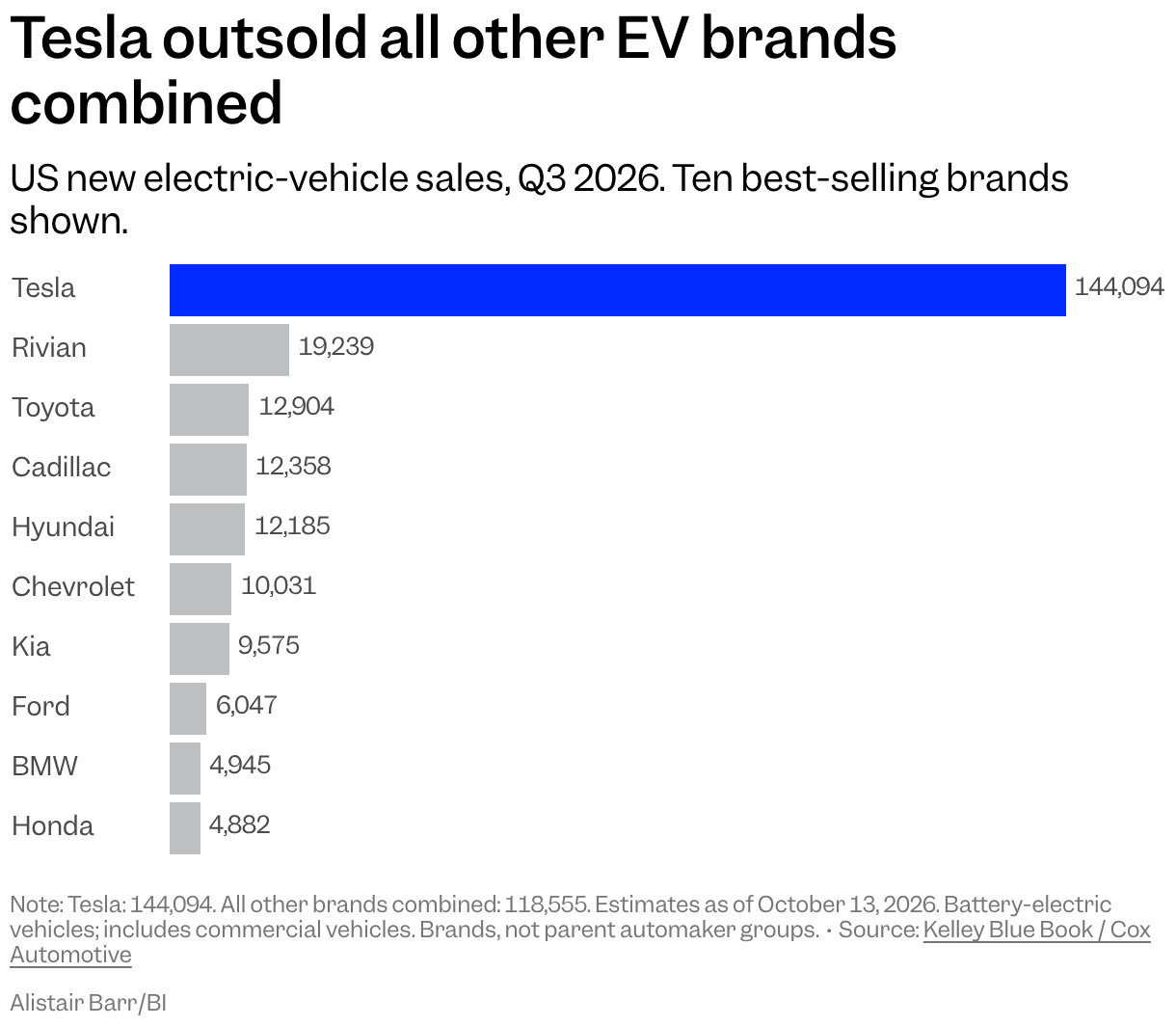
The company sold an estimated 144,094 vehicles in the US in the third quarter, up from 124,800 in the previous three months, according to Cox Automotive's latest sales report.

That increase was bigger than the gain for the rest of the US EV market. Put another way: Tesla drove the recovery. Everyone else, taken together, went backward.

Horizontal bar chart of the ten best-selling US electric-vehicle brands in Q3 2026. Tesla led with 144,094 sales, followed by Rivian with 19,239. Tesla sold more than all other brands combined, which totaled 118,555.

The figures offer a new twist on the EV comeback I wrote about in July. Back then, sales had finally improved after the slump that followed the end of federal incentives in the US. Several manufacturers were benefiting, but only those with the fortitude to stick with EVs after federal government support waned.

While recovery continued in the third quarter, it became more dependent on Tesla.

Americans bought 262,649 new EVs during the period, about 6% more than in the second quarter. Sales outside Tesla fell roughly 3%, based on a comparison of Cox's latest counts with its second-quarter report.

Tesla's own sales rose about 15% from the second quarter. It supplied 54% of the country's new EVs in the third quarter, extending its lead from the previous period.

High gas prices help make the case for going electric, according to Cox.

"With gas prices well above $4 a gallon, electric vehicles look better than ever," Stephanie Valdez Streaty, Cox's director of Industry Insights, said in the company's analysis of the quarter.

Expensive gasoline and diesel make running a conventional vehicle more painful. For drivers who can charge cheaply, particularly at home, an EV offers a valuable alternative to repeated trips to the pump.

There's an important caveat to the comeback story: Sales are improving from a depressed level.

Total US EV sales were down almost 40% from a year earlier. Last year's third quarter was unusually strong because buyers rushed to claim federal incentives before they disappeared.

Tesla's sales were down about 20% against that comparison. The company remains heavily dependent on two vehicles. The Model Y and Model 3 accounted for roughly 97% of its US sales in the latest quarter.

The Cybertruck sold over 4,300 units, and Tesla has stopped making the Model S and X. (There's a Roadster, though not until 2028).

So Tesla's growing dominance isn't a story of every model flying out of showrooms, or of selling more cars than a year ago.

For now, it is winning a larger share of a smaller market. As Americans return to EV shopping, Tesla is capturing more of their business.

Sign up for the AI Insider newsletter here. Reach out to me via email at abarr@businessinsider.com

Read the original article on Business Insider

  •  

Tesla and SpaceX have set up committees to explore a merger

Tesla CEO Elon Musk in front of the car company's logo.
Elon Musk said Tesla and SpaceX have created committees to discuss a potential merger.

Bloomberg/Getty Images

  • SpaceX and Tesla have each established exploratory committees to discuss a possible merger, Elon Musk said.
  • Musk, who said he can't participate in the talks, gave the update during Tesla's Q3 earnings call.
  • Musk said he thinks a merger is a good idea, but cautioned investors that shareholder approval is "quite a high hurdle."

Houston, we have an update on all that SpaceX-Tesla merger chatter.

During SpaceX's Tuesday earnings call, Elon Musk said both of the companies had created "special committees of independent directors" to discuss a potential merger.

Musk, who helms both companies and owns billions of dollars in stock of each, said he can't be part of those exploratory groups.

"Do I think it would be a good idea? Yes," he said on the call. "But at the end of the day, the shareholders have to be supportive of this, and particularly on the Tesla side, we will need a 50% vote of all shares, not just those who vote, but of all shareholders."

He said clearing that bar would be "quite a high hurdle."

It's the most detailed update investors have received yet on the idea of a tie-up, which has been the subject of much chatter since SpaceX went public earlier this year. If the companies ultimately decide to merge, it would further consolidate Musk's business empire, often referred to as Musk Inc.

His businesses have been on a consolidation kick. In 2025, xAI acquired Musk's social media company, X (formerly Twitter), and in February, SpaceX acquired xAI.

Musk also runs the brain-chip startup, Neuralink, and the tunnel-building firm The Boring Company. Both operate independently, but have had business collaborations within Musk Inc.

Tesla and SpaceX's stocks were up in after-hours trading following the news. SpaceX was up around 6.6% and Tesla 1.6%.

Musk sees clear benefits in tying the knot

"I do think there's a lot of merit to combining the companies as we are pretty much in the superintelligence singularity," Musk said during the call.

SpaceX and Tesla have worked together on a host of projects, including artificial intelligence software, chip design, TeraFab manufacturing efforts, robotics, Starlink satellite connectivity, and SpaceX's ability to launch payloads into orbit, Musk and SpaceX president Gwynne Shotwell said.

The most recent result of that partnership: On Thursday, Tesla demoed its long-awaited Roadster, which includes a version with SpaceX technology. The high-powered sports car's top trim will include cold-gas thrusters. The car launched, hovered, and flipped in the air during the demo.

While Musk is for the two companies tying the knot, he said investors shouldn't think it's a sure thing.

"I don't think we should necessarily assume that a SpaceX and Tesla merger is a certainty," he added. "That would be overstating it."

Read the original article on Business Insider

  •  

Tesla's robotaxis catch the eye of a US safety regulator — again

A Tesla Cybercab turns onto 2nd Street on Thursday, September 3, 2026, in Austin
Tesla's Model Y and Cybercab vehicles are facing a defect petition from the NHTSA.

Aaron E. Martinez/The Austin American-Statesman via Getty Images

  • NHTSA opened a safety inquiry about Tesla's self-driving Model Y robotaxis and Cybercabs.
  • An unnamed petitioner alleged that the robotaxis were speeding in an active school zone.
  • Tesla has faced growing regulatory scrutiny as it rolls out its all-important self-driving cars.

Tesla's self-driving taxis are facing a fresh safety question: are they slowing down when kids are in school?

On Monday, the National Highway Traffic Safety Administration announced it had opened a defect-petition review into a claim that 2026 Tesla Model Y robotaxis and Cybercabs exceeded speed limits in school zones while their automated driving systems were active.

An unnamed petitioner submitted three videos in support of the claim, according to the filing, which says the probe was opened on Friday. NHTSA said it will evaluate the complaint before deciding whether to grant or deny a formal investigation.

The agency's filing lists no reported crashes or injuries, and estimates that about 1,000 vehicles could be affected.

Tesla didn't immediately respond to a request for comment from Business Insider.

The scrutiny comes as Tesla pushes to turn robotaxis into a much bigger business.

The electric automaker has expanded its self-driving services with the Model Y robotaxis beyond Austin into other Texas cities and Florida. In September, the company added its steering-wheel-free Cybercab to the Austin fleet.

CEO Elon Musk has increasingly shifted Tesla's focus away from traditional vehicle sales toward self-driving, AI, and robotics.

The self-driving rollout previously caught the attention of federal regulators. NHTSA opened an audit inquiry into the Cybercab's self-certification a few hours after the cars started offering services in Austin.

School zones have also tripped up rival robotaxi companies.

Last year, NHTSA opened a preliminary investigation into Waymo after reports that its vehicles passed stopped school buses in Austin and Atlanta. The Google-owned robotaxi company issued a voluntary recall in December.

In January, a Waymo vehicle struck a child near an elementary school in Santa Monica, California. The child had "minor injuries" according to the NHTSA, and, in a statement published on its website, Waymo said the vehicle "braked hard, reducing speed from approximately 17 mph to under 6 mph before contact was made."

Read the original article on Business Insider

  •  

I'm a Londoner who always rides the Tube. Here are 10 features of the Underground that would surprise most Americans.

A person takes a selfie outside a London Underground entrance beside an elevated railway bridge.
The author travels on the London Underground — or Tube — several times a day.

Roya Shahidi

  • Known as the Tube, the London Underground is an essential part of everyday life for most Londoners.
  • Some of its characteristics are uncommon in American subway systems and can be confusing.
  • From unwritten etiquette rules to fare must-knows, here are some surprising things about the Tube.

While it's ridiculously busy at rush hour and way too hot in the summer, the Tube is an essential part of life in London.

As a local, I sometimes use the public transit system — formally called the London Underground —more than four or five times on some days, as it's often the quickest way to get around the city. I can thank the London Tube for saving me from missed flights or arriving late for an interview.

Nonetheless, I can't count how many times I've seen tourists staring at a Tube map, trying to make sense of its seemingly endless tangle of colored lines.

Even as someone who uses the Tube all the time, I have the Citymapper app at the ready when taking an unfamiliar route.

The Tube also has some rules — both official and unwritten — that I would consider necessary for any tourist coming to London. If you have seen what happens when someone stands on the left-hand side of the escalator, you will know what I mean.

Here are 10 surprising things you probably don't know about the Tube, including some that might be useful to know as a tourist.

1. Most Tube trains have no air conditioning
Person in a red dress stands on an Underground platform beside a red train with passengers reflected in the windows.
A commuter holds a portable handheld electric fan during the 2025 heatwave.

Bloomberg/Getty Images

Only about 31% of trains on the Tube network have passenger air conditioning, according to Transport for London (TFL). As soon as a heat wave hits, I cannot ride the Tube without carrying blotting paper and a handheld fan.

Some lines are notorious for how hot they get. Having to take the Central Line in the summer will elicit sympathy from any Londoner. The London Standard reported that it reached almost 103 degrees during the recent June heat wave.

With that in mind, you may also be surprised to learn that in 1926, the London Underground was advertised as "cooler below" on a hot day.

2. The seats are covered in fabric
Empty blue patterned bench seats line the interior of a public transit train carriage.
This is the most common moquette on the Tube, known as the Barman moquette.

Gareth Fuller/PA Images via Getty Images

Unlike the hard plastic seats in most American public transport, Tube seats are covered in a woolen fabric called moquette.

It's been used on the Tube since 1920 because it hides wear and tear and dirt, and also because it's durable.

Admittedly, it does gross me out a bit, even though it gets cleaned. But it's definitely more comfortable than plastic, at least.

3. The price of your journey depends on how many zones you travel through
London public transport fare poster shows Oyster pay as you go costs, ticket caps, and Travelcard zone prices.

ASphotowed/Getty Images

While the New York City subway has a flat fare, the cost of a journey on the Tube varies depending on how far you travel.

London's transport network is split into fare zones, from the most central to the farthest out: Zones 1 to 9. People here often joke that the zone you live in also determines how much of a "true" Londoner you are.

For example, a single journey within Zone 1 will cost you £3 at off-peak hours, and £3.10 at peak hours. However, if you travel from Zone 6 to 1, or vice versa, it will cost you between £4 and £5.90.

4. Traveling at rush hour will usually cost you more
Crowded public transit car seen through a window, with passengers standing, seated, holding rails, and using smartphones.
The Tube during rush hour.

Toby Shepheard / AFP via Getty Images

Rush hour is known as peak time on the Underground and other rail services.

Peak time is Monday to Friday, except public holidays, between 6:30 a.m. and 9:30 a.m., and between 4 p.m. and 7 p.m. Fares are higher at these times.

In addition to saving a bit of money, I would recommend avoiding these times for travel. Carriages can get crammed, and people can be unforgiving if you're carrying a large suitcase or walking too slowly.

5. You have to tap both in and out of the Tube
Contactless transit card reader and black ticket barriers stand at a rail station entrance.
Most Tube stations have barriers like these to tap in and out of.

Mariano Garcia Gaspar/Getty Images

With all these varying fare prices, you have to tap your card, contactless, Oyster, or physical ticket in and out of the Tube.

Often, there are barriers upon both entry and exit, so you wouldn't miss this, but sometimes there aren't. In these stations, you have to look for a yellow card reader to tap out.

If you don't tap out, you will be charged the maximum fare for that line. I've had this happen to me before, but luckily, you can request a refund from TFL if it happens again.

6. Many of the carriages have armrests between passengers
Empty underground train carriage with blue seats, blue poles, route maps, and advertising panels inside.

Claudiac8/Getty Images

If you like your personal space, you might be pleased to know that most Tube carriages have an armrest between seats.

However, despite their name, I see them as more of a separation barrier than an actual armrest. Resting your arms on these is a faux pas (unless you absolutely have to) if there are people sitting on either side of you.

7. More than half of the London Underground is actually above ground
Paddington Underground Station concourse with ticket barriers, wayfinding signs, and face covering notices visible.
Paddington underground station is above ground.

Pete Clifton/PA Images via Getty Images

While you may be expecting to descend deep underground when taking the Tube, this isn't always the case. Despite its name, most of the London Underground's stations are above ground. I find this is handy for getting service.

The Waterloo & City and Victoria lines are the only two fully underground tube lines.

8. You should always stand on the right-hand side of the escalator
Commuters ride long escalators through a curved underground transit station tunnel with metallic walls.
Passengers use an escalator at London Bridge Underground station.

Bloomberg/Getty Images

My ultimate word of advice for anyone coming to London is to never stand on the left-hand side of the escalator. The left side is for people walking up or down in a hurry.

It's an efficient system that has saved me from being late hundreds of times. You will be asked to move aside if you break this rule.

9. You can visit the disused tunnels and abandoned tracks
A disused passageway during a tour at the Piccadilly Circus disused tube station in London.
A disused passageway during a tour at the Piccadilly Circus disused tube station.

Kirsty O'Connor/PA Images via Getty Images

If you like all things spooky and historical, I recommend checking out the London Transport Museum, which offers tours of disused Tube stations, passenger corridors, and tunnels.

Some of these spaces have been used as sets for TV shows and films, including Skyfall and Sherlock.

10. There aren't actually as many 24-hour services in London as you might think
Passengers sit and stand inside a crowded metro train carriage with blue poles and patterned seats.
Passengers sit on the ground on board the Night Tube on the night of its launch.

Jack Taylor/Getty Images

London is not quite the city that never sleeps. I have rarely taken the Tube past midnight and instead rely on Ubers and night buses to get me home.

Only five Tube lines run 24-hour services: Central, Jubilee, Northern (Charing Cross branch), Piccadilly, and Victoria. The Windrush line, which is part of the London Overground, also has a night service.

The Night Tube is also only open on Fridays and Saturdays.

Read the original article on Business Insider
  •