Visualização de leitura

A Michelin-starred restaurant uses agentic AI to source the freshest ingredients possible

Matthias Restaurant Interier (left), and Owner Silvio Pfeufer (right)
Silvio Pfeufer is the head chef and co-owner of Matthias, a Michelin-starred restaurant in Berlin.

Luís Bompastor

  • Silvio Pfeufer uses Saltz to save time on food procurement at his Michelin-starred restaurant, Matthias.
  • Saltz uses agentic AI to modernize a typically complicated process between food buyers and sellers.
  • For independent eateries, the streamlined process can reduce costs and increase access to high-quality ingredients.

When Silvio Pfeufer first got into cheffing, he was surprised by the amount of administrative work involved.

"It's not only the evening, sending nice plates to guests. There's a lot of stuff to do to make that happen," Pfeufer told Business Insider. He took long phone calls from food suppliers and producers that kept him away from the kitchen.

Sourcing and buying food is a process riddled with disorganization, since farmers, wholesalers, logistics providers, and restaurants communicate in different ways — by phone, email, text message, and PDF blast — starting as early as 4 a.m. The cost and availability of products are constantly in flux, so sellers issue frequent updates: The price of wild-caught fish could change three times a day, for example.

When Pfeufer opened his own restaurant in 2024, he wanted to streamline his food procurement process. At Matthias, which pays homage to his late grandfather, Pfeufer uses an AI-assisted platform for food business owners called Saltz to speed up food procurement and reduce phone calls.

The time savings are critical, said Pfeufer, a co-owner and head chef at the Berlin-based eatery. Using AI agents, Saltz connects restaurants directly to suppliers via a marketplace that brings together disparate catalogs, transactions, and logistics so restaurants can compare and buy fresh, high-quality, and specialty products more quickly than with traditional food procurement processes.

The platform's standardized, real-time food data can be a game-changer for independently owned and operated restaurants like Pfeufer's, given their limited purchasing power. Saltz said that thousands of buyers and hundreds of suppliers use its technology, though it didn't share exact numbers. It said around 80% to 90% of its buyers are independent restaurants.

Connecting with high-quality and specialty suppliers

Pfeufer said he chose Saltz because he liked how the platform modernized old processes. In the two years he's used it, it's allowed him to discover new suppliers, order outside business hours, and gain better oversight on pricing, he said.

Founded in 2022, the startup uses AI agents to ingest PDFs, emails, and text messages that food sellers send to Saltz, standardize and enrich all the data, and consolidate it into a single platform. Its AI agents automatically update each seller's listings on the platform, eliminating the need for manual updates.

Buyers, meanwhile, see once-disparate product options, information, and up-to-date prices in one place. They can also order food at a time that's convenient for them and track their deliveries. "On a Sunday, at night, or in the morning, I can do it by myself, and don't have to have all these calls," Pfeufer said.

At Matthias, which was awarded its first Michelin star in 2025 after 10 months of service, meals must meet a high standard every day, and products have to be of the freshest quality. Pfeufer orders vegetables, milk, and other items from Saltz every week, plus fresh fish twice a week. Before using Saltz, the quality of his products wasn't necessarily worse, he said, but access to new or specialist suppliers was more limited and supply chains were longer.

"The fish is now often sourced directly from the trader or farmer, without the need for intermediate storage. This allows us to avoid additional storage times that could negatively affect freshness," Pfeufer said, adding that more oversight into the supply chain — and it being shorter — means his food is more consistently high quality.

"We've definitely been able to connect with better suppliers," he told Business Insider. The chef added that he still works directly with certain local farmers, as he is often on the hunt for rare items that aren't on the platform.

For Pfeufer, using Saltz also allows him to see more costs upfront, so he can better plan how much to charge for new dishes. "It makes all the calculations much easier, which is very important for us," he said.

Agentic AI acts as a foundational tool

Saltz was founded by brothers Andrius and Thomas Šlimas, who previously built the Shopify-acquired dropshipping platform Oberlo. After spending four years inside Shopify's supply chain machine, the brothers teamed up with industry veteran Reinis Štrodahs. Their goal: modernize the $9.8 trillion food procurement industry.

"It's impossible to make sense or structure that chaos of information which lives in different places and has no common structure," Andrius said.

The Šlimas brothers said that previous unsuccessful attempts to modernize food procurement took two approaches: either trying to force suppliers and buyers onto a single platform, which required them to change how they work, or taking on the time-consuming task of manually inputting every PDF, email, and text message.

With Saltz, AI agents upload and update product listings for sellers, so individual stakeholder workflows don't have to change. Making agentic AI foundational to the process, Tomas said, gives their platform an edge.

"That gives us a speed advantage, and in this market, speed compounds into market share."

Read the original article on Business Insider
  •  

Inside Pinterest's efforts to replace expensive AI with open-source models

Bulletin board with Pinterest logo and a magnifying glass focused on interlocking gears and abstract shapes.

Andre Rucker for BI

  • Pinterest's VP of product management said mixing open-source and closed-source AI models helped cut costs.
  • The social platform's recent AI-enabled features combine OpenAI, Alibaba, and its own AI models.
  • To support this approach, Pinterest invested in cloud infrastructure and an updated hiring strategy.

In its pursuit of creating AI-supported tools for its users and advertisers, Pinterest leaders said it is actually shrinking part of its AI budget.

As companies continue to spend on AI, they face pressure from investors to show returns on investment from this fast-evolving technology. One way to do that: Stretch investments by shrinking the budget needed for the systems that power AI features.

Pinterest, the visual-first social media platform where users can save images to curate their ideas, is taking what it calls a "model-agnostic" approach to generative AI, said Vicky Gkiza, the company's vice president of product management. The strategy started in 2023 and involves combining Pinterest's proprietary AI models, developed by the company's software engineers, its closed-source models from Anthropic and OpenAI, and open-source models from Alibaba, said Gkiza.

While closed-source AI models can quickly process large amounts of data, require little maintenance, and integrate instantly into a company's existing systems due to their pre-built nature, they're typically more expensive. Open-source models, meanwhile, are typically free to download, use publicly available data, and can be modified more deeply than closed-source offerings. However, they also require the expertise of software engineers who can build, maintain, and debug these highly customizable models.

Lan Guan, the chief AI and data officer at Accenture, said companies are increasingly seeing value in a multimodal AI approach that balances performance and the cost of tokens, or the units of text AI models process. "This token cost is going to slow you down if you don't start managing them proactively," Guan told Business Insider. "Open-source will be a really good option."

Gkiza walked Business Insider through how Pinterest bolstered its blended approach to generative AI through beta testing, an updated hiring strategy focused on software development expertise, and infrastructure investments.

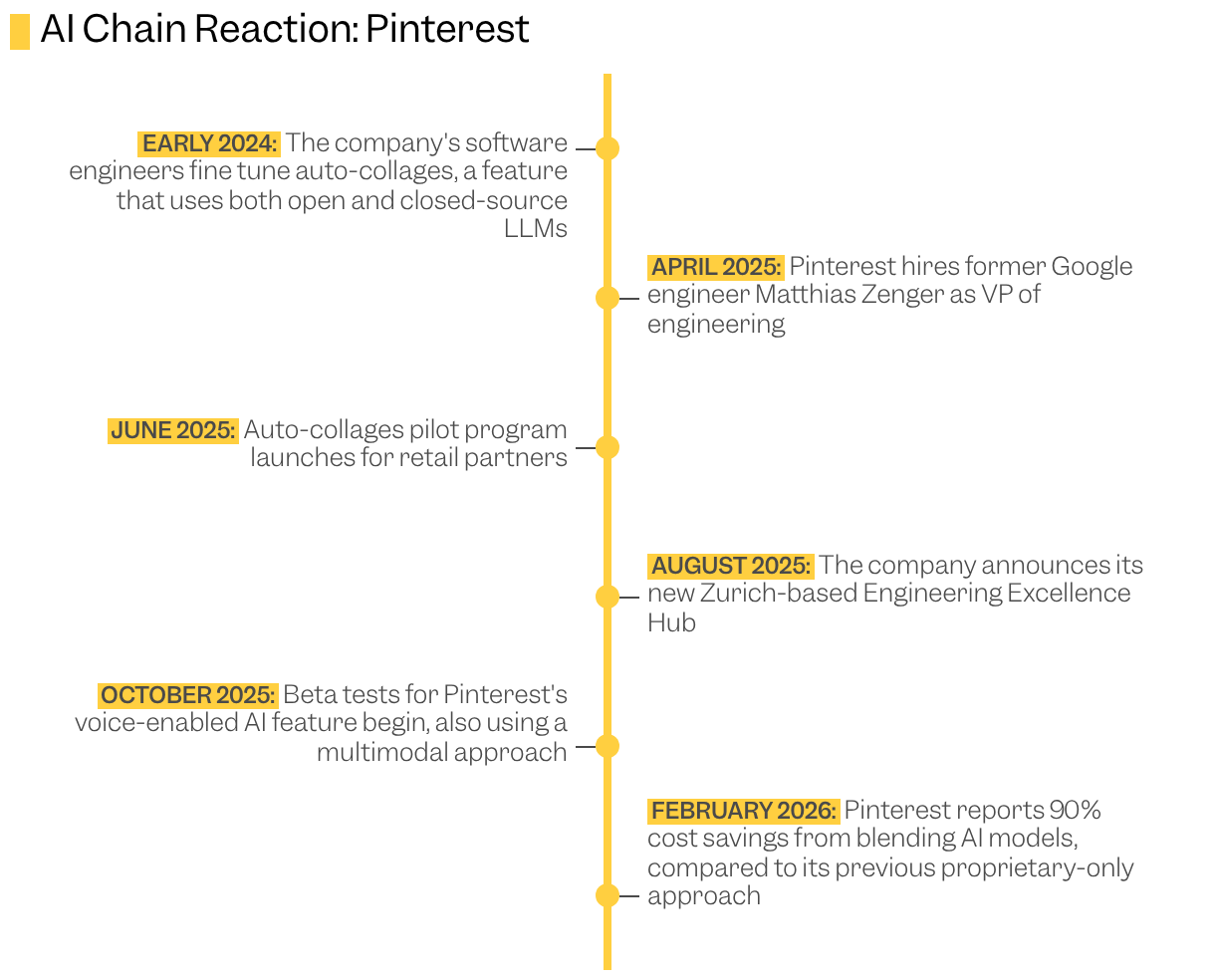
Timeline of key events in the use of AI at Pinterest

The tech

Pinterest uses OpenAI's closed-source large language models to support some of its product features and relies on Anthropic's Claude, another closed-source AI, for internal use cases like coding, a company spokesperson told Business Insider. Alibaba's Qwen, an open-source LLM, is used for visual and content understanding, data labeling, and assistant tasks.

With this approach, the company rolled out several new AI features in 2025, each blending open-source and closed-source generative AI, said Gkiza.

Auto-collages, a feature where advertisers can convert their product catalogs into pins that populate on shopping feeds for categories like skincare, home decor, and fashion. Pinterest began testing auto-collages at the beginning of 2024, when software engineers fine-tuned a mix of internally developed, open-source, and third-party AI models. By June 2025, auto-collages was ready for a pilot, which included a small group of retailer-advertisers like Macy's.

Then, Pinterest's voice-enabled AI feature, which uses both open-source and third-party AI to generate responses to users' queries, underwent beta testing in October 2025. Early results showed that users tended to pose more shopping-specific questions when they could ask aloud rather than typing their searches, said a Pinterest spokesperson.

"Search has been evolving so fast. It was imperative for us to use AI to improve," Gkiza told Business Insider.

The talent

To advance its new AI-enabled features and execute its blended-model approach, Pinterest also hired employees with AI and machine learning expertise to steward the customization of its large language models, said Gkiza. Former Google engineer Matthias Zenger joined the company as its vice president of engineering in April 2025. Three months later, in August, Pinterest announced it had hired software engineer Mirjam Wattenhofer to focus on e-commerce and user experiences, and that it would open an Engineering Excellence Hub in Zurich.

Both Zenger and Wattenhofer work at the Zurich office, where a team focuses on improving user experiences with AI and machine-learning technologies. In February, Pinterest CEO Bill Ready said the company would hire additional research and development workers to support the company's AI efforts.

"We are investing more in hiring the right talent — evolving the team, whether it is engineering or product management — to be much more familiar with AI," Gkiza said.

The outcome

Gkiza said the company's blended approach to AI-driven experiences costs an estimated 90% less than when Pinterest relied solely on its proprietary models, a milestone the company touted during its February 2026 fourth-quarter earnings presentation.

With its growing use of open-source AI models, the company plans to invest more in cloud-computing infrastructure, like graphics processing units, which are needed to power the cost-saving technology, Gkiza said.

Pinterest said it will continue to experiment with various AI models, prioritizing its own models for personalization, open-source models for cost-effectiveness and multimodal machine learning, and closed-source models when they still offer the best performance.

Read the original article on Business Insider

  •  

I had $2,000 and no way to pay my employees, then my bakery went viral. It was a blessing and a curse.

Jatee Kearsley sitting at a bench

Courtesy of Jatee Kearsley

  • Jatee Kearsley's bakery, Je T'aime Patisserie, gained fame after a viral feature on Righteous Eats.
  • Going viral changed the trajectory of her business but took a toll on her mental health.
  • Kearsley says she wouldn't want to go viral again, even though that may sound ungrateful.

This as-told-to essay is based on a conversation with Jatee Kearsley, the owner and pastry chef of Je T'aime Patisserie, which offers a "Black girl twist" on French pastries in Bed-Stuy, Brooklyn. It has been edited for length and clarity.

In April 2024, I sat in my bakery with my Bible study group and told them I had $2,000 in my bank account and no idea how I was going to pay my employees the next day.

When I opened my bakery a year prior, I knew it would be hard. I had taken out loans. I had put in my own savings. I understood that small businesses require money for everything: rent, ingredients, payroll, insurance, and taxes.

Still, nothing prepares you for sitting in your own store and realizing you might not be able to cover payroll. Then, the day after meeting with my Bible study group, everything changed.

We were featured on Righteous Eats, a social media feed run by Jaeki Cho and Brian Lee that features New York City restaurants. The video went viral, and by the following weekend, my bank account looked completely different.

Going viral was a blessing. I will never pretend it wasn't. It changed the trajectory of my business. However, I don't think people talk enough about what going viral does to your mental health.

For me mentally, I don't want to go viral again. That might sound ungrateful, but it's honest.

Going viral didn't make the work easier

Jatee Kearsley lifting a croissant and examining it inside her bakery.
Kearsley makes every croissant from scratch.

Business Insider

On a normal day before going viral, my team and I of about four, were making, on average, 200 croissants a week. After we went viral, demand shot up to about 200 croissants every other day.

I specifically remember selling four chocolate croissants the day before going viral and then 30 the day of. We make all types of croissants from scratch: chocolate, almond, ham and cheese, blueberry cheesecake, and more.

Croissants with chocolate icing on top.
Croissants from Kearsley's bakery.

Business Insider

We laminate the dough, hand-roll each one, proof them, bake them, and fill them. Going viral didn't make our team any bigger, and I had to loop in friends, family, and volunteers to help fill orders and deliveries.

There were weekends when it was just me and one other person in the bakery at 6 a.m., trying to keep up.

Other days, I was filling 160 mini croissants for catering orders on top of regular production. I've even hand-rolled croissants on my day off because there was no one else to do it.

Going viral brought more customers, but it also brought higher expectations

Jatee Kearsley cutting rolls of dough in her bakery.
Going viral helped Kearsley's business, but it took a toll on her mental health.

Business Insider

People would leave reviews saying they waited hours, only to find we were sold out. I didn't want to disappoint anyone. So I slept on a bench in the bakery for a week straight after going viral to make sure I was keeping up with the demand that was needed during that time.

There's also the emotional weight that comes with virality. When we went viral the first time, it was exciting. It also meant strangers had opinions about everything: my prices, my neighborhood, the fact that I accept Electronic Benefits Transfer.

I accept EBT because I know what underserved, overlooked communities of people are dealing with. And I never wanted there to be a moment where someone walked into Je T'aime Patisserie and wasn't able to afford it.

Kearsley smiling in her bakery.
Kearsley with trays of dough in her bakery.

Business Insider

I specifically wanted Je T'aime Patisserie to be in a neighborhood where people don't have things. Historically, Bed-Stuy is an underserved, overlooked food desert.

So, it was super important for me to make sure that my food impacts the neighborhood by providing high-quality, fresh pastries. People thought that accepting EBT was going to ruin my business, but it actually helped.

Everything I have achieved with my shop is because I accept all types of people in my store, including EBT and SNAP holders.

It's not about the money or going viral

Jatee Kearsley hand rolling a croissant.
Kearsley taught herself how to bake.

Business Insider

I know this is Business Insider, and we're supposed to talk about numbers. But if I'm being honest, this has never been about the money for me.

If this were just about money, I would make different decisions. I would raise my prices more aggressively. I would stop worrying about whether a single mom can afford a croissant. I would probably choose a different neighborhood.

But I opened in Bed-Stuy on purpose. People told me my bakery "belonged" in Manhattan. I disagreed. I wanted someone who has never tried a fresh croissant or a quiche to walk into my shop and feel like they deserve it.

Financially, EBT makes up a small percentage of my revenue. But the support and gratitude from those customers mean more to me than the dollar amount ever could.

If I could run this business without making money, I would. Unfortunately, that's not realistic in New York City. You need money to survive. But my passion has always been about helping people and impacting my community.

Read the original article on Business Insider

  •  

A bakery owner who wakes up at 12:48 am to start prepping croissants says her success comes from social capital and 'radical hospitality'

Clemence in her kitchen at Petitgrain
Clémence de Lutz is the owner of Petitgrain Boulangerie in Santa Monica.

Shelby Moore for BI

  • Clémence de Lutz owns Petitgrain Boulangerie, one of LA's most popular bakeries.
  • On opening day in 2024, she sold out of croissants in about an hour. Today, there's often a line out the door.
  • She credits her small business's success to social capital, intentional hiring, and radical hospitality.

When Clémence de Lutz answered my phone call at 1 p.m. on a Friday afternoon in late February, she'd already been awake — and working — for 12 hours.

De Lutz owns Petitgrain Boulangerie, a tiny bakery tucked between a delicatessen and a nail salon on Los Angeles' iconic Wilshire Boulevard. Five days a week, her alarm goes off at 12:48 a.m., giving her just enough time to get out of bed, walk the 10 blocks to the shop, and start shaping croissants by 1 a.m. She relieves her 23-year-old daughter, who works the 5 p.m. to 1 a.m. night shift.

Those early hours aren't for show. They're key to good business.

The most foot traffic happens between 8 a.m., when her bakery opens, and 10:30 a.m., she explained: "If we don't have enough things to sell because we shaped too late or they went into the proofer too late, then we lose money."

From 1 a.m. to 3 a.m., she works alone in the kitchen.

"It's my favorite time of day," said the mother of three, "because I just listen to true-crime podcasts."

At 3 a.m., a second baker arrives, followed by three more, staggered at 4 a.m., 5 a.m., and 6 a.m. Front of house clocks in at 7 a.m., and the doors open an hour later. Regulars often line up well before then to secure their favorite pastries, including the most popular item: the plain croissant.

On Fridays, she typically works a half-day and focuses on business development. The Friday we chat is different.

The exterior of Petitgrain
Petitgrain Boulangerie, situated on Wilshire Boulevard, opened in May 2024.

Shelby Moore for BI

"This week, I'm short-staffed," she told me, stepping out of the kitchen to take the call. "I have a nice, healthy 45 minutes ahead of me. I'm just waiting for things to rise in the proofer."

De Lutz was born in Paris and moved with her family to Washington, D.C., when she was eight. Summers were spent selling ice cream and washing dishes at the inn and restaurant her grandparents owned in the south of France. "My parents would just drop us off for the summer and be like, 'Work for tips,'" she recalled.

She studied film and anthropology at Syracuse University, then moved to Los Angeles with plans to make documentaries. She tried the corporate route first, taking an executive assistant job at Fox, but it didn't last. "I just couldn't find my footing until I went back into food in my early 20s and was like, 'Oh, this is what feels normal,'" she said. "Chaos feels normal."

Clemence prepping baked goods
De Lutz starts prepping croissants at 1 a.m. every morning the bakery is open.

Shelby Moore for BI

Turning a cubicle cookie side hustle into a career

While a desk job wasn't a great fit for de Lutz, it led to a side hustle that would change the course of her career. She'd collect cookie orders from coworkers throughout the week and deliver her handmade creations on Fridays. Her cubicle cookie business eventually landed a spot on KCRW's "Good Food," an appearance she says "changed my life." She quit her job, rented a commercial kitchen, and began working as a ghost pastry chef for restaurants. Baking evolved into teaching and consulting. For years, she helped other bakeries build menus and streamline systems, work that also served as real-time education on what it takes to succeed in the industry.

When the opportunity to run her own bakery fell into her lap — a friend she'd consulted for called her up and said, "Hey, I'm retiring, do you want my space?" — she jumped.

Taking over an existing kitchen space in LA typically comes with expensive delays and red tape. In Los Angeles County, she explained, commercial kitchens that sit empty for 90 days or more can trigger a permit reset. So, "when you find an owner who is willing to work with you and close the day before you want to open and just kind of negotiate key money for buying out the equipment, you can never pass that up."

She has lived lean, she said, with no credit card debt or loans, so the risk of opening felt manageable.

"The values I grew up with have very little to do with money. In France, it's not customary to value money or wealth. It's really valuing being a tradesperson, being an expert in your field," she said. "Taking risks was always easy because I had nothing to lose."

A baker arranges croissants on a tray.
The bakers at Petitgrain shape hundreds of croissants by hand a day.

Shelby Moore for BI

Opening day: Selling 300 croissants in 1 hour

Petitgrain opened in May 2024. From the start, demand outpaced production.

Opening day, she made about 300 croissants. They didn't last more than an hour. On day two, she about doubled the number and sold out again.

Since opening, the bakery has drawn steady crowds from Wednesday through Sunday, the days it's open. Today, the operation is close to its ceiling.

"We're pretty maxed out," she said. Her 870-square-foot kitchen, equipped with one double-stack oven and one small proofer, produces 32 "books" of croissants a day. A book yields roughly 24 to 30 croissants, putting the daily volume at 700 to 900. Though the croissant is the top seller, she offers a variety of other pastries, including cinnamon, cardamom, and sausage rolls, as well as cookies, quiche, and scones.

The business worked from the get-go because she understood her baseline costs and built for sustainability. It helped that her landlord was committed to renting to small businesses at below-market rent, she added: "Rent is $4,100 a month, and we knew how much we needed to make to make rent."

Early on, she kept a second job teaching baking classes, but within a couple of months of opening, she sold her share of the cooking school to focus fully on Petitgrain.

De Lutz said Petitgrain's average monthly sales have climbed about 131% from 2024, when she first opened, as the team slowly increased production. Small upgrades, such as undercounter freezers, have helped drive another 20% in growth over the last few months, she added.

Shelby preps her baked goods
De Lutz sources nearly every ingredient from farms around LA.

Shelby Moore for BI

Her secret sauce: Social capital and 'radical hospitality'

Having ripped open one of her flaky masterpieces myself, it's hard to agree with de Lutz when she claims her croissants are "overhyped."

"I'm not kidding," she said when I chuckled. "I wake up every morning at 12:48 a.m., and my first thought is: 'How can I live up to this hype?' It's a lot of expectations, but it's sort of what drives you to be excellent."

A big part of her immediate success, she believes, was timing. When Petitgrain opened, interest in croissants surged across Los Angeles.

"Everybody all of a sudden wanted to write about croissants," she said. "It was just really lucky timing."

Less visible, and perhaps more impactful than trends, however, were the relationships she'd built from being in the food and hospitality community for so long. Social capital, she said, is "the most important part of my story." While it's hard to quantify, "I think that has the biggest return."

Her hiring model and teambuilding strategies are unique. At Petitgrain, she practices what she calls "both-of-house" training: everyone in back of house learns front of house, and everyone in front of house works at least one back-of-house shift weekly.

Clemence and an employee
De Lutz has a team of 13 bakers and baristas.

Shelby Moore for BI

That way, "everyone understands the product better and has respect for their team members," she said. She also rejects a traditional hierarchy and instead aims for shared accountability, anchored in wages.

"My business model is based on generous hospitality," she said. "Everybody needs to earn a living wage, not like $20 an hour. Everyone here, with tips, is making at minimum $30 an hour. I don't want anyone to have to work a second job."

To make that work, she runs a tip pool, and she protects it. She refuses to hire ahead of revenue.

"Because the tip pool is such an important part of everybody's paycheck, I'm really cautious," she said. "I cannot bring in a new team member until we grow sales between 6 and 8% at a time because, if I add an extra person before revenue grows, everybody's tip pool gets diluted."

As of early 2026, she has a team of 13 bakers and baristas. When she does hire, credentials aren't her priority. She's looking for kindness, hustle, and curiosity.

"I don't care if you went to culinary school. I don't care if you worked at a Michelin-star restaurant," she said. "Honestly, it's not hard to make a croissant. It really isn't. But if you are curious, if you are humble, if you work hard, you'll figure it out. And 99% of the time, that yields a really great team."

Underneath all of it is what she calls her core belief system: radical generosity, expressed through radical hospitality.

"There's never a time when I have been radically generous and regretted it," she said.

Read the original article on Business Insider
  •  

Inside CPG's AI advertising boom, from Super Bowl spots to synthetic focus groups

Photo of a Coca-Cola red sign in Atlanta, Georgia.
Coca-Cola is using AI in parts of the marketing process that are invisible to consumers, such as idea generation.

Faina Gurevich/Getty Images

  • Coca-Cola and Svedka are using AI to enhance holiday and Super Bowl ads, speeding up content creation.
  • Companies like Mondelēz and Blue Chip use AI to test concepts, saving time and improving strategies.
  • The tech can help CPG firms work faster, but risks include AI slop in campaigns.

Coca-Cola's holiday ad and Svedka's Super Bowl commercial share more in common than promoting a beverage — both were generated with the help of AI.

The technology is catching on at consumer goods companies, with marketing leaders adding AI to their processes on both the creative and strategic sides.

As a result, assets and campaigns are coming to fruition faster than they could without AI.

Before AI, it could take Mondelēz International up to 10 weeks — from concept to production — to spin up a six- to eight-second social media video for its Chips Ahoy! character "Chip," said Jennifer Mennes, VP and global head of digital marketing and strategy at Mondelēz International.

Now, the marketing team can prompt AI and create a video in less than five minutes. After various checks by human members of the team, the total process might take days.

The biggest opportunities aren't necessarily in "big flashy campaigns," like Super Bowl spots, Mennes said. Instead, AI is helping CPGs quickly produce a greater volume of text, headlines, social content, and lifestyle imagery. As firms pump out more content, they could risk putting out AI slop and turning off consumers with AI-generated material. But so far, the efficiency gains are proving worthwhile as companies and agencies save weeks of time, especially on high-volume work and strategy.

"It doesn't seem that exciting," Mennes said. "But it's actually driving impact."

Testing and learning with AI

AI can play a role in parts of the marketing process that are invisible to consumers, such as idea generation. Johnny Rohrbach, founder of global partnerships and operations at Silverside AI, said marketing teams and their partners can "come up with different directions until the cows come home." His AI lab works with several CPGs, including Coca-Cola, on its holiday campaigns.

Focus group testing is another AI use case. Sonja Evans, VP of business intelligence and strategy at Blue Chip Marketing Worldwide, said her agency partners with Waldo.fyi, an AI company, to create digital twins of a brand's target consumers, using detailed demographics and purchase history. The team then presents creative ideas to this synthetic audience.

"We can talk to them just like we would be talking to a consumer," Evans said. Based on the feedback, the agency whittles down the ideas before presenting them to real consumers. The feedback from digital and virtual consumers "is shockingly similar," she said.

Blue Chip — which has worked on campaigns for Bob's Red Mill, Emerald Nuts, and Panera Bread — also uses AI to create what's known as a boardomatic. This is essentially an animated version of a spot with voiceover, script, and motion, but without the time, costs, or hired talent needed for a shoot.

The agency can test multiple animated spots with consumers to gauge their reactions "before we even spend a dollar on production," Evans said. The agency then uses the feedback to decide which version goes into full production.

Avoiding the trap of AI slop

Today, consumers demand more content, creating a cycle in which brands must appear in their feeds more often to stay top of mind, Rohrbach said. Marketing budgets don't always expand to keep pace with consumer trends. He added that AI can help bridge the gap, allowing marketing teams to do more with the money they're allocated.

There's a fine line when it comes to volume, though.

"If the spots feel like garbage and if you're just pumping out content because you can, then you're going to turn off the consumer," Mennes said, adding that a human is always in the loop at Mondelēz. The CPG company sees AI as additive and enhancing how it already connects with consumers, not replacing workflows.

"Nothing goes into the market without rigorous approval," Mennes said.

For food brands, especially, imagery needs to look real and authentic, Evans said. "People are very quick to call out when something looks AI."

Consumers have blasted brands for AI slop, with many criticizing AI-generated Super Bowl ads as uninspired or low-quality. Rohrbach, whose AI lab partnered with Svedka parent company Sazerac to produce its AI Super Bowl spot, said brands need to ensure they're not putting out content that's irrelevant, poorly executed, or "a little bit tone deaf." His lab's Coca-Cola holiday ad was among the spots that drew criticism, but he said the ad performed "exceptionally well" according to internal and external testing.

The strong performance may have been partly driven by the attention it received for using AI, even though social media sentiment was largely negative. In fact, the spot was the most talked-about Christmas ad of 2025.

"I'm super proud of that ad," Rohrbach said. He added that Coca-Cola is "very much on the vanguard" of AI experimentation, and CPGs as a whole are embracing the technology due to the high demand for content.

In fact, a BCG study from February found that seven in 10 CPG marketing leaders expect GenAI to help them work faster — although only 13% said the tech is fully integrated into marketing workflows. The report said the figures point to a maturity gap. Evans said bigger brands may have larger budgets to experiment with AI, while midmarket companies are contending with tariff and inflation pressures, making them more focused on business goals than on AI experimentation.

Mennes said major CPGs are "well on their journey" and "rapidly embracing this space." Plus, she's noticed a change among her CPG peers. For the first time in her career, they're cross-sharing ideas, comparing challenges related to hallucinations, and gut-checking solutions with one another.

"It's actually refreshing," Mennes said. "If we can help each other out on that, it just accelerates our ability to transform our organizations."

Read the original article on Business Insider

  •  

Embracing AI is about more than just adopting AI-powered tools, according to top HR leaders

Three women at a long dinner formal dinner table listen to a fourth woman who is holding a microphone and speaking.
Business Insider's Jamie Heller leads the roundtable discussion.

Nero Media

  • Business Insider gathered chief people officers and senior leaders for an on-the-record dinner in New York City.
  • The event, Futureproofing Your Workforce in the Age of AI, highlighted the relentless change HR executives are navigating.
  • Below are excerpts from the discussion, edited for clarity.

"Are we working for AI at this point or is AI working for us?" Maxine Carrington, the Chief People Officer of Northwell Health asked a group of HR and people executives who were gathered for dinner on a rainy night in New York City recently.

"How we can use those tools as enablers to help us achieve our goals, that's the mindset I need us to have, not chasing the tools."

Heads around the table nodded in agreement. The group, convened by Business Insider, spent ninety minutes in a conversation titled "Futureproofing Your Workforce in the Age of AI," presented by Indeed.

"I do think it's an organizational, transformational challenge and not a technological one," Gareth Lewis of Lewis People & Culture Advisory said at one point. "But right now the conversation's all around tools, efficiencies, headcount reductions, and not so much about how we actually are going to redesign our roles."

Redesigning roles is exactly what Agnes Garaba, Chief People Officer at UiPath, is striving to do, but it's not easy.

"So we basically asked every single one of the functional leaders to think about what the future would look like," she said. "If I could go out today and blow up my entire HR team and reimagine it from scratch, what would that look like? And it's a hard exercise. Often I find our imagination is the biggest barrier, so to say, to get there."

The tension between AI driving total transformation versus a focus on integrating AI tools was top-of-mind for the executives gathered together. But in the wide-ranging conversation, plenty of other topics were discussed too. Below are some highlights.

How to help employees become AI "power users"

Woman in brown sweater at formal dinnertable speaking with microphone.
"You cannot drive transformation, in my opinion, just with a stick," said Katie Burke, COO, Harvey.

Nero Media

Katie Burke, COO, Harvey: Part of what you have to start asking yourself is, is your organization experimenting and dipping your toe in the water or are you driving actual impact and transformation? And not surprisingly, there are patterns across every industry on what makes the difference between those.

Number one is senior leaders actually being in on the work. So not saying, "Here's the example that I can share." It's actually building the agents themselves, for example, or attending those hackathons.

And you cannot drive transformation, in my opinion, just with a stick. There has to be some level of carrot and reward and excitement, and I think people operate at their best when they are not operating out of fear.

Make partners prove the value of AI tools they're providing

Black woman with glasses speaking into a microphone at a formal dinner
"Your shareholders, your leaders are (asking), 'What's the big revolutionary bang that's gonna unlock our teams," said Roz Harris, VP Talent, Zillow.

Nero Media

Roz Harris, VP, Talent, Zillow: Put the pressure on your product partners, the vendors that you're using, to justify their roadmaps and why they're getting your dollar. Because your shareholders, your leaders are (asking), 'What's the big revolutionary bang that's going to unlock our teams? That's going to unlock the business, going to move things forward?'

I can promise you many of us aren't companies that are going to build that thing ourselves. But we do have product partners who should be enabling us to do those things. But are we articulating our needs to them? Are we articulating those well?

Company-wide hackathons allow employees to shine

Profile view of woman at formal dinner speaking into a microphone.
"People don't think of the sales teams as the ones who are gonna build the agents first," said Maggie Hulce, Chief Revenue Officer, Indeed.

Nero Media

Maggie Hulce, Chief Revenue Officer, Indeed: So we have a monthly contest that any employee can be a part of and they submit their ideas of agents or use cases. The sales teams are absolutely running away with it. And people don't think of the sales teams as the ones who are going to build the agents first. So this particular person who we thought of as a salesperson, maybe thought of as one-dimensional, now I see them as having five functional hats.

HR leaders play a key role in pushing companies to adopt AI

Older white man in glasses speaking into a microphone at a formal diner table.
"We should be a lighthouse in terms of the deployment of (AI) agents," said Dickie Steele, partner, McKinsey & Company.

Nero Media

Dickie Steele, Partner, McKinsey & Company: How do we build a culture where we go after dramatic productivity improvement on the numerator? Somebody doing a thousand clinical trials, not one clinical trial? I feel as an HR community, we should be a lighthouse in terms of the deployment of (AI) agents. We should be pushing the business to start with a much more compelling value creation thesis than "Can we cook something up that makes our employees marginally more productive?"

Beware the hype around AI dramatically improving your bottom line

Woman in white sweater with dark hair and glasses speaks into a microphone at a formal dinner table.
"The notion of incremental, relentless forward progress every day is just fine with us," said Liz Dente, Chief People Officer, Priceline.

Nero Media

Liz Dente, Chief People Officer, Priceline: Dickie, just to push back a little bit is, you know, you're looking for this amazing thousand-times return. The notion of incremental, relentless forward progress every day is just fine with us. You know, it'd be great to be selling a thousand times more plane tickets, but I just don't think that's realistic. And I think there's a lot of hype in the marketplace that you're going to get these massive returns. I just don't think it's true.

Read the original article on Business Insider

  •