Microsoft's data center project in Mount Pleasant, Wisconsin.
Joe Timmerman/Wisconsin Watch via Getty Images
The midterm backlash against AI data centers could help the biggest cloud providers.
Amazon, Microsoft, and Google have existing capacity that smaller rivals are racing to match.
Limits on new construction could reduce competition and push up AI computing prices.
The backlash against AI data centers delivered a stunning political upset in Tuesday's midterm elections. But the biggest winners may turn out to be the tech giants that have already built many of these
Voters across the US sent a clear message Tuesday: They want to slow or stop the construction of new data centers. That could make it much harder for the AI industry to keep up with soaring demand.
The biggest shock came in Texas, where Democrat Gina Hinojosa defeated Republican Gov. Greg Abbott. Hinojosa has promised to immediately pause data center development in a state that's home to some of America's largest AI projects.
Yet their shares jumped on Wednesday, while smaller AI cloud providers, including CoreWeave and Nebius, were hammered.
The divergence highlights an important consequence of the election results: Making new data centers harder to build could strengthen the biggest tech companies while crushing some of their smaller rivals.
Amazon, Google, and Microsoft already operate enormous networks of data centers packed with expensive Nvidia chips that power AI services, including those offered by OpenAI and Anthropic.
Smaller competitors are racing to catch up, investing billions of dollars in new facilities and computing equipment.
But if newer projects are delayed or canceled, these challengers could be stuck with expensive expansion plans while their larger rivals continue to make money from facilities already operating.
That would mean less competition for Amazon, Google, and Microsoft.
It could also mean higher prices.
With demand for AI computing power still booming, restrictions on new data centers could make existing capacity more valuable. That would mean even bigger profits for Amazon, Microsoft, and Google.
Paul Golding, a Macquarie analyst, highlighted this dynamic in a note to investors on Wednesday.
"Approved, permitted pipeline becomes far more valuable," he wrote, predicting that demand for increasingly scarce data center capacity could drive prices higher.
There's already evidence of this supply-demand phenomenon. Silicon Data, which tracks the cost of renting Nvidia GPUs through cloud services, has recorded steadily rising prices this year for several popular chips.
"If demand keeps growing and protests delay new capacity, that could certainly help support GPU rental pricing," Brad Gastwirth, global head of research at Circular Technology, told me.
The irony is striking.
Voters trying to rein in the AI data center boom may have just handed Amazon, Google, and Microsoft an even stronger grip on the industry.
Corning is investing $585 million in expanding manufacturing in North Carolina.
Travis Dove for The Washington Post via Getty Images
AI's growth demands denser optical networks, increasing the need for more fiber across data centers.
Hyperscalers like Meta are securing fiber supply through long-term deals with manufacturers.
Innovations like Relativity Networks' hollow-core fiber can increase data transmission speeds.
Data centers have long relied on fiber to transmit signals. But the compute necessary to meet AI's demand requires more fiber than ever before.
AI pulls from hundreds of thousands of servers and chips. Lauren Clark, a managing director in Brown Gibbons Lang & Company's infrastructure vertical, told Business Insider that the higher density of fiber, the faster computers can talk to each other— and the faster a large language model can provide a response.
And as AI models become more complex and sophisticated, they require denser optical networks, said Mike O'Day, senior vice president and general manager of Corning Optical Communications.
Without sufficient fiber, AI chatbots stall and show users a busy signal or error, which is already happening today. Longer-term, a lack of fiber could mean pricier tokens and longer adoption cycles because supplies are constrained, said Gordon Bell, a partner and principal leading digital infrastructure engagements at EY-Parthenon.
"You can't have AI for an end user without a powered data center. You can't have it without connectivity," Bell said. "They all need to come together at the same place at the same time in order for everything to work."
As AI models become more complex and enterprises and consumers use the technology daily, AI tools will require more infrastructure to respond to chatbot queries. To meet demand, hyperscalers — the companies that provide cloud computing and data storage such as Amazon and Meta — are locking in agreements with fiber manufacturers such as Corning. In turn, fiber suppliers are expanding manufacturing capacity, while some startups are developing technologies to send data at faster speeds. Both strategies reflect the industry's bet that fiber will be critical to keeping pace with AI's growth.
"There's just an insatiable demand for optical fiber," said Jason Eichenholz, the cofounder of Relativity Networks, an optical networking and fiber-optics startup.
AI changes the fiber game
For decades, optical fiber was a quiet corner of telecommunications, Clark said. When ChatGPT launched in 2022, it brought fiber into the spotlight.
"AI is the biggest change factor in data centers and digital infrastructure that we've seen since the origins of the industry," Clark said.
That demand is also reshaping how data centers are built. While single mega-facilities exist — like xAI's Colossus data center in Memphis, Tennessee — there are limits to how large one facility can be due to the amount of electricity and water needed to support each data center, Eichenholz said. Communities are also pushing back against this type of data center construction in their neighborhoods, he added.
The lack of mega-facilities means companies build multiple data centers with fiber connecting them, Bell said. Fiber gets data from point A to point B and connects GPUs and chips, allowing them to "function essentially as one gigantic computer," Bell said.
The challenge to scaling up fiber supply lies in production capacity, Bell said. That includes making the fiber, sourcing connectors, testing the fiber, and the physical labor of laying fiber in the ground.
Additionally, non-data-center industries, such as office buildings, industrial sites, and residential homes, use fiber for connectivity — such as fiber-optic internet that many people use at home.
"Because of data centers increasing their demand for fiber, it is putting a strain on the overall system," Clark said. "There is definitely a dearth of supply that's going to trickle through the entire market." She said fiber orders today take twice as long to fill compared to roughly three years ago.
Solutions take shape
Hyperscalers are assessing if they can trust that fiber will be delivered on time and in the quantities they need, Bell said. To solve the crunch, tech giants and fiber manufacturers are signing enormous pre-commitments, Eichenholz said. "You're seeing massive multi-year, multibillion-dollar take-or-pay contracts on a product that was a commodity three years ago," he added.
Fiber manufacturers are scaling up capacity, but in a disciplined manner. They're locking in commitments from customers before they increase manufacturing and labor capacity, so that hyperscalers and suppliers share the costs and risks of expansion, Corning's O'Day said.
Corning is investing $585 million in expanding manufacturing in North Carolina. This year alone, the optical fiber manufacturer inked long-term agreements to supply fiber and cable to Amazon, Meta, and Nvidia. Last month, the company's optical communications division reported a 44% year-over-year jump in sales, while GenAI product sales more than doubled.
Corning's manufacturing facility in rural Midland, NC.
Travis Dove for The Washington Post via Getty Images
"Our customers are connecting enormous numbers of GPUs, and they need to fit much more fiber and many more connections into the same physical space," O'Day said.
Beyond agreements, fiber suppliers are innovating the product itself. O'Day said Corning has developed smaller-diameter fiber and denser cables that put more capacity within the same footprint. The company invented a fiber with a 40% smaller surface area that can bend into 10 times smaller spaces. That led to the development of its Contour Flow Cable, which Corning announced in March.
While incumbents like Corning are packing more fiber into limited spaces, new entrants are rethinking optical physics altogether.
Relativity Networks, an AI network startup, developed ChronoCore, a hollow-core fiber designed to bypass the physical speed limits of conventional glass. The fiber allows signals to travel at 99.7% the speed of light, Eichenholz said. He calls it "an HOV lane for fiber." By comparison, light moves through glass fiber at two-thirds the speed of light. Relativity is partnering with Prysmian, one of the world's largest producers of fiber-optic cables, to scale production.
The difference in speed matters when connecting data centers. Light traveling through traditional fiber has a slight delay, but the hollow core moves at nearly the speed of light, which means operators can build data centers farther apart without harming the performance of an AI model.
Relatively completed its first deployment with a major hyperscaler in 2024 and recently landed a $40 million order to connect data centers with the same hyperscaler.
Bell predicts the pace of data center buildouts will eventually level off. But he doesn't see the appetite for fiber shrinking in the near term.
"There's a lot of unknowns with respect to AI infrastructure," Bell said. "But the use of fiber is really kind of one of the highest conviction areas where I think we're going to clearly need more of."
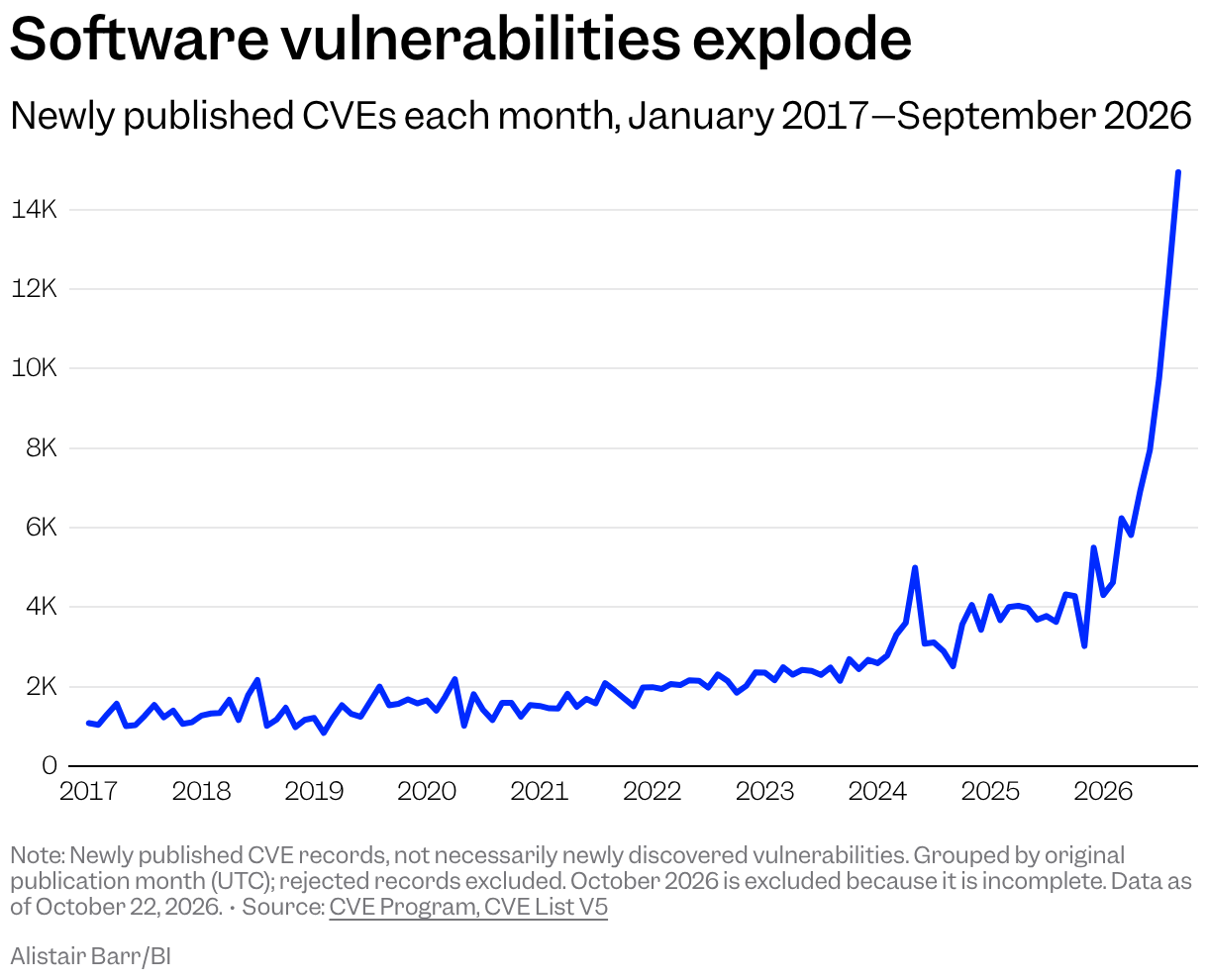
This week's cyber freakout explained: AI is making software weaknesses easier to find and exploit.
The message from Cloudflare's Stephanie Cohen and Vercel's Tom Occhino: Don't panic!!!
Do we need everything connected to the internet? Paper bank statements work well.
A few weeks ago, I heard a strange story about a friend who works at one of the Big Tech companies in Silicon Valley.
She'd recently ripped out the connected devices in her home, ordered paper bank statements, and stocked up on canned goods in her basement.
Now, she's a very sane, experienced person, and quite senior at one of the largest internet companies on earth. Why was she disconnecting so much? Just to be sure, my family ordered paper bank statements, too. It was still a head-scratcher, though.
Fast forward to this week, and her actions look a little less crazy.
The digerati have now entered full freakout mode. Much of the internet meltdown is happening on, well, the internet, my colleague Alice Tecotzky noted.
On X and Reddit, warnings of a looming “Black October” spiraled into visions of AI grinding civilization to a halt. One lengthy post on X warned of a potential “global cyberattack/AI swarm” and offered a survival checklist: Stockpile cash in small bills, print out your neighbors' phone numbers, download maps, buy a hand-crank radio, and stash a gallon of water per person per day.
Oh, and don't forget the manual can opener. You don't want to survive the AI apocalypse only to be defeated by a tin of beans.
Nikita Bier, a prominent app developer and former head of product at X, best captured the mood.
"The world is a little bit scary right now," she told me on the side of Cloudflare's annual conference in San Francisco this week.
Here's the problem. The internet is built on decades of software, much of it riddled with security holes.
Some of these weaknesses have been known for years. However, fixing them takes time and money, and hackers often lacked the skills to exploit them anyway. So they were left alone.
AI changesthat calculation dramatically. Someone who previously needed years of training to break into a computer system can now get help from an AI model. And these tools can search for weaknesses at a speed humans simply can't match.
Now, there's a frantic race between people trying to break into systems and those trying to protect them.
Don't panic about AI
Cohen's message, though, was surprisingly reassuring.
AI helps the good guys find and fix these problems. Cloudflare, for instance, released protections for the latest vulnerability to customers, including those using its free service.
And there's a bigger effort underway.
OpenAI has launched an initiative called Patch the Planet, working with Cloudflare and other security professionals to use AI to find weaknesses in widely used software and help repair them.
Tom Occhino, chief product officer at Vercel, told me recently that his company has been talking with partners about launching a nonprofit that would fund a swarm of good AI agents that go out on the internet to find and fix software flaws.
Amazon is joining the fight, too. Its new Continuum service, available Thursday, uses AI agents to find security holes and propose fixes. Amazon said that people maintaining freely available software can use it to help protect the wider internet.
Humans may still have to check and approve these repairs, but the prospect of AI helping clean up decades of neglected software is encouraging.
The irony of this is not lost on some in the industry.
"The funny thing is everyone was saying AI slop code will cause a cyber crisis but it's actually all the old human slop causing it and the AI is just cleaning it up," software engineer Ben Kaufman wrote on X on Thursday.
Either way, Cloudflare's Cohen thinks these AI-inspired freakouts will push the industry to do better — by exposing issues and adding urgency to get them patched.
"We may end up in a world where actually we've become significantly more secure at the end," she said.
The trouble is getting there.
A fundamental question about the internet
Tom Occhino (left), chief product officer at Vercel, talks with Meta executive Prashant Ratanchandani at Vercel's Ship SF conference.
Alistair Barr/Business Insider
When I ran into Occhino recently at a Vercel conference in San Francisco, he described a world in which software that everyone assumed was safe suddenly looksvulnerable because increasingly capable AI models are scrutinizing the basic systems that underpin the internet.
That led to a more fundamental discussion between us: Why did we connect so many things to the internet in the first place?
For years, the technology industry has raced to put everything online. Thermostats. Refrigerators. Doorbells. Cars. Bank accounts.
We assumed that connecting something to the internet automatically made it better.
Perhaps we should reconsider.
Before the internet
I remember the world before the internet. It worked pretty well. We managed to buy groceries, pay bills, heat our homes, and generally get through the day without every appliance talking to a computer somewhere.
That doesn't mean abandoning online banking or throwing your smartphone into the sea.
Occhino, for one, isn't particularly worried about hackers wiping out his bank account. Modern banks have sophisticated protections, and he recommends everyone turn on additional login security.
Maybe the cybersecurity crowd, which spends its life immersed in online threats, is missing something obvious.
Not everything needs to be connected.
Occhino put it neatly: "There's certain things that don't make sense to be on the internet in the first place."
Perhaps that's the lesson from this week's panic. We don't need to turn off the internet.

 Entrar