The median Manhattan rental price for a market-rate apartment soared to $5,000 in July — up 3% from June and 6% from July 2025 — an August 13 report from The Real Deal and appraisal firm Samuel Miller found.
The record-high rent comes alongside a staggering drop in public market listings. Apartment inventory in the borough has dropped by roughly 4,000 units, or 39% year-over-year, as homes are spending far fewer days on the market and people are signing leases with fewer discounts off the asking price.
Last summer, rentals spent an average of 48 days on the market. This summer, it's 36. Shorter duration on the market is typically an indicator of tighter supply and higher demand, as aspiring renters snap up open units more quickly.
Finding housing in the city has long been a challenge. Business Insider has heard from single moms who moved in together to cut costs, side hustlers struggling to make ends meet, and retirees worried they can't pay to age in the city.
The majority of New Yorkers spend more than 30% of their income on rent, the threshold economists classify as unaffordable.
Prices are jumping as inventory drops
The rental market trends are largely in line with America's broader housing market. A 2026 report from the Harvard Joint Center on Housing Studies found that the US has a significant shortage of affordable homes and that rents are rising. Even so, vacancies for both expensive rentals and single-family homes have increased, as many families can't afford to move. This kind of market stagnation is also reflected in NYC, as the Real Deal report showed the number of new leases dropped by 19%.
The Real Deal report also found that, in Manhattan, prices are rising fastest for apartments with two or more bedrooms. The year-over-year median price for "luxury" units — those in the top 10% of the market — has jumped 31% year over year to $13,750 a month.
Downtown neighborhoods have the steepest prices, followed by the West Side, East Side, and Northern Manhattan. Listing inventory across all areas, however, has dropped about 40% in the last year.
To address the housing affordability crisis, Mayor Zohran Mamdani launched his "Block by Block" plan, which aims to build 200,000 affordable homes during his tenure. Business Insider has covered city efforts to convert historic hotels into apartments, construct low-cost senior housing, and repurpose libraries, office buildings, and city-owned property for homes. Increasing supply could help lower prices in the long-run.
The city and state have pledged billions of dollars to these housing initiatives and are also leaning on support from nonprofits, developers, and big banks to foot the bill.
The Real Deal report only captures market-rate units, not rent-stabilized apartments, which make up 44% of Manhattan's housing. Mamdani's rent freeze — one of his top campaign promises — takes effect this fall and will cap rents on those rent-stabilized apartments for one- and two-year leases. While rent freezes can help alleviate costs for (often high-earning) residents in the short term, the policy can cause market-rate costs to increase. A rent freeze under former Mayor Bill de Blasio lapsed for this reason.
Nintendo's earnings got an unexpected boost from US tariff refunds in the latest quarter.
Philip Fong/AFP/Getty Images
Some companies are getting an unexpected lift from billions of dollars in returned US tariffs.
Nintendo recorded a $300 million tariff refund.
The refunds are lifting profits and margins, but analysts warn the benefits are unlikely to last.
An unusual boost is showing up in some corporate earnings this summer: tariff refunds.
Nintendo became the latest beneficiary of the boost on Thursday, reporting net profit of 147.4 billion Japanese yen, or $931 million, for the quarter ending June, up 54% from a year earlier andhandily beating analyst expectations of 77.8 billion yen. Revenue fell about 10% to 517.8 billion yen, but still came in above expectations.
Tariff refunds were a major contributor: The Kyoto-based maker of the Switch 2said it recorded a $300 million tariff refund that had previously been recorded as cost of sales.
Strong software sales, led by the video games Tomodachi Life: Living the Dream and Pokémon Pokopia, also helped lift margins.
Shares of Nintendo closed 5% higher on Friday following the results. They are 24% lower this year.
In its presentation, Nintendo said the tariffs related to the refunds "were primarily borne by the company rather than passed on to consumers through product prices."
Nintendo has not said how it plans to use the refunds. The company did not immediately respond to a request for comment from Business Insider.
Nintendo is fighting a class-action lawsuit over the tariff refunds.
Two US customers sued the company in April, arguing that Nintendo could effectively recover its tariff costs twice — first through higher prices that they allege were passed on to consumers, and again through refunds from the US government.
Nintendo moved to dismiss the case in July, arguing that customers "received exactly what they bargained and paid for" and have no legal right to a rebate simply because the tariffs were later struck down.
An earnings season of tariff refunds
Nintendo's tariff windfall is part of a broader earnings-season trend, with companies from Apple to Amazon to Siemens Healthineers recently disclosing sizable tariff refunds or related earnings benefits.
Companies are taking different approaches to the windfall.
Apple said tariff refundsadded about two percentage points to its June-quarter gross margin and 11 cents to diluted earnings per share. CEO Tim Cook has said the company will reinvest the refunds in additional US innovation and advanced manufacturing.
Amazon said it received about $600 million in tariff refunds in the second quarter and plans to reimburse customers in limited cases where it can determine they directly bore the tariff cost.
Siemens Healthineers also got a sizable boost. Tariff refunds helped lift the German medical-technology company's adjusted operating margin to 19.1% from the 16.8% a year ago and contributed to a 16% rise in adjusted operating profit to 1.1 billion euros. The company also raised its full-year earnings-per-share forecast to reflect the refunds.
Elsewhere, Walmart has said it expects to return its anticipated refunds to consumers through price reductions, while McCormick and Campbell's have said they will use proceeds to offset higher costs.
The repayments follow a February 20 Supreme Court ruling that the International Emergency Economic Powers Act did not authorize the president to impose the tariffs. The US Court of International Trade has overseen the process of returning the duties to importers.
About $166 billion was collected under the invalidated tariffs, with roughly $100 billion in refunds processed by early August, official filings show.
Analysts caution that the refunds offer just a one-time boost to earnings.
"Most tariff proceeds will fail to sustain profitability as companies prioritize competitive prices and mitigating costs," wrote analysts at S&P Global in a report last month.
YouTuber Jimmy Donaldson once aimed to build a burger empire.
Dave Kotinsky/Getty Images for MrBeast Burger
Newly filed court documents show how MrBeast's ambitions have shifted over time.
The YouTuber previously eyed podcasts and NFTs to grow his media empire.
Today, he's exploring fintech and mobile phone services.
MrBeast has had grand ambitions to build a media empire for years — but they have changed considerably.
New court docs filed as part of an ongoing lawsuit between MrBeast founder Jimmy Donaldson and his burger business partner reveal that he once explored avenues like podcasts and NFTs before pivoting to other areas, including fintech and creator services.
The docs demonstrate how YouTube's top creator pivoted as he sought to capitalize on his social clout.
It's common for startups, and especially creator-led ones, to begin with one idea and then shift gears, said Megan Lightcap, a partner at the VC firm Slow Ventures, where she leads its Creator Fund. Unlike consumer brands launching with a specific product, it's easier for creators to move into entirely new categories.
"Because their popularity is centered on their personal brand, they have even more opportunities," she said.
A 2021 investor fundraising deck included in the court documents labels "Beast Games, Netflix Beast Studios, Beast NFT, Beast Podcasting" as coming in 2023. His company has not launched significant businesses focused on games, Netflix, NFTs, or podcasts.
A 2021 investor fundraising deck references plans for an NFT, podcasts, and more.
Beast Industries
The 2021 deck also talks about launching a "subscription fan platform" called "Beast World" in 2022. At the time, MrBeast envisioned a $9.95 a month platform featuring "exclusive content, merchandise, community, and experiences."
By 2024, the company was talking about opportunities in theme parks, theatrical releases, and a vast array of consumer products, according to a July 2024 board meeting presentation.
The company was also mindful of the need to diversify away from having Donaldson on camera. The presentation called for animated series and associated toys and consumer products, which manifested in the MrBeast Lab YouTube channel and products.
A 2024 board meeting deck laid out a MrBeast "multiverse."
In a February investor deck that year, MrBeast presented the company as built on three pillars: media, consumer packaged goods, and software, with a "comprehensive" video game portfolio and a loyalty program earmarked for 2026. A creator platform, fintech, and pro sports were being explored. The company also hinted at a mobile phone service.
Here's how MrBeast is currently moving forward on some of those fronts:
Fintech: This year, the company acquired Step, a digital banking platform offering savings accounts, a credit-building Visa card that functions similarly to a debit card, and a cash-advance program. Step, which is geared toward young people, hasn't posted any new videos on its YouTube channel since the deal closed.
Creator platform: MrBeast recently hired a team from the Andreessen Horowitz-backed startup Pietra, including its CEO and cofounder Ronak Trivedi, who's playing a key role in developing the platform.
Membership: At a breakfast for advertisers in May, MrBeast revealed plans for the "largest membership service in the world," with a philanthropic element, early access to content, exclusive content, and member challenges.
CPG: Feastables, a "better for you snack brand," launched in 2022 with a chocolate bar. The MrBeast Burger business continues, even if Donaldson stopped promoting it after getting embroiled in a legal dispute with his partner.
Media: MrBeast has expanded his spectacle-style video offerings and launched the "Beast Games" competition show on Amazon's Prime Video. His company is planning new verticals centered on food, entertainment, fitness, and gaming that aren't meant to rely on Donaldson's on-screen presence.
Mobile phone: The company plans to launch a phone business called "Beast Mobile," Housenbold said at The New York Times' DealBook Summit in December. According to the 2025 investor deck, it's likely to take the form of an MVNO, which uses a major carrier's infrastructure and is a model other celebrities have adopted.
Experiential: MrBeast tested the theme park concept in November with a 45-day pop-up in Saudi Arabia, where visitors could participate in challenges inspired by his videos.
Andrew Tsao at T.O.L.K., standing in front of "The Art of Surrender," his first art exhibition ever.
Jonah Rosenberg for BI
Andrew Tsao transitioned from a six-figure tech job to being an artist in New York City.
Medicaid and lifestyle changes helped him heal after the switch.
Tsao's first art show, "The Art of Surrender," marks his farewell to NYC before returning to Taiwan.
It took Andrew Tsao a layoff from his six-figure tech job, Medicaid-subsidized therapy, and a psychedelic session to realize he wanted to be an artist in New York City. His first art show ended up as his goodbye letter to the city he called home for 13 years.
The 34-year-old artist and life coach, born in California and raised in Taiwan, is based in Brooklyn and recently finalized his first art exhibition, "The Art of Surrender." The collection, displayed in T.O.L.K. — a Bushwick café and art gallery in mid and late July — served as his final homage to the city, as he returned to Taiwan on August 5 to complete the military service required to retain his citizenship.
Since the opening, he has sold his first four pieces at his first art show, two for $500, with the help of the coffee shop's owners, who did not take a commission. He was able to hold the show under his planned budget.
Andrew Tsao touching one of his paintings at his art exhibition.
Jonah Rosenberg for BI
Yet, it was just a year ago that he started calling himself a part-time artist. During his time in New York City, he has worked in B2B sales, held multiple tech jobs at startups, become a career and life coach, and found his passion for art. All the while, he has had to learn how to afford to practice art in one of the most expensive cities in the country after his income fell from six figures to under $25,000 when he left the corporate world.
Tsao is among the many New Yorkers who have adapted how they live to keep up with the city’s high cost of living. Business Insider has documented similar trade-offs throughout our Cost of the City series.
From a one-way ticket to a six-figure career
After graduating from the University of Southern California, Tsao moved to New York with a one-way ticket and no job lined up. He worked in B2B sales before transitioning into the tech industry, where he became a product manager, earning over $100,000 a year at a healthcare startup doing opioid addiction treatment.
Then came the pandemic. Although Tsao's company had gone fully remote a few months prior, he was laid off on May 15, 2020. Frustration with the layoff led to Tsao taking steps toward entrepreneurship. He began coaching early-stage founders and taught them how to build websites without coding.
The career change came at a financial cost: Tsao watched his annual income fall from six figures to less than $25,000. He had some money in his 401(k) and savings from his tech career, which he invested in opening his own business. Although he could move back in with his parents in Taiwan if things got worse, the loss of financial stability weighed on him and made him reassess his priorities.
"It is true that there are things that could feel more heavy," like paying bills, he said. "I was able to really be clear with myself of what I need to really feel joyful and safe."
Tsao found that while the city takes a lot, it offers a lot too
Tsao realized his priorities were to have a roof over his head and access to affordable food. The trade-offs he made included going out less often, cooking rather than ordering delivery or eating out, and choosing longer subway commutes over Uber rides.
"It actually did allow me to realize that there's a lot of things that are really beautiful in New York, even if you're not having as much disposable income," he said.
Andrew Tsao standing in Maria Hernandez Park in Bushwick, Brooklyn.
Jonah Rosenberg for BI
Tsao concluded that New York City can be unaffordable and affordable at the same time.
He exchanged pricey concerts for walks through Prospect Park, came up with creative date ideas, and took advantage of the Culture Pass, which gives New Yorkers free access to museums and libraries. He shifted from buying books from Amazon to discovering the Brooklyn Public Library, which became his favorite place to read and find books.
"I found creative ways to really enjoy living in New York City, especially Brooklyn, on a budget," he said.
During the pandemic, he moved into a two-bedroom apartment with in-unit laundry, which he split with his ex-girlfriend. By the time he moved out in June 2026, the rent was around $1,300 each. He temporarily stayed in a sublet until he moved to Taiwan.
Besides rent, he budgeted around $150 a month for groceries and kept his art-supply costs down. Most of his materials were donated by friends or found on Brooklyn patios. Yet, he did pay $12 per bottle of ink and about $38 for Posca markers.
Healthcare was one of the biggest shifts he experienced
As Tsao's income bracket fell, he was caught by something else — Medicaid. After qualifying for the federal program, he began to receive both emotional and physical treatment, which he would not have looked for when working in tech and paying for his own private health insurance.
Through Medicaid, he began seeing a social worker at Le Santé Health Center in Flatbush for weekly therapy sessions.
"I was trying to separate my identity and value from productivity, output, and how people perceived me," he said. "I would not have gotten therapy if I had not been on Medicaid."
He also began to receive Medicaid-subsidized physical therapy for chronic pain in his upper-right shoulder, which had developed in 2020 from a combination of leaning forward at his desk and recreational bouldering.
"From a health level, it was the most abundant I had ever felt," he said. "That was really one area that the change in affordability didn't make me feel more constrained. Actually, it made me feel like I had more options."
A new beginning in art, and a farewell to New York City
Tsao found that what he enjoyed about coaching was the emotional guidance he brought to it. In 2022, he replaced his technical, no-code coaching with coaching for executives and people in leadership roles — $200-$250, hour-long sessions — which were his main source of income.
"I realized I liked talking about those feelings more than I liked the technical coaching," he said.
"New York feels like just this unbelievable, magically chaotic place," Tsao said.
Jonah Rosenberg for BI
Tsao realized he "also wanted to live" what he was coaching.
This realization, tied to his period of personal healing and one psychedelic session, led Tsao back to art. During that session, he began picking up art materials and rediscovered his love of painting. Afterward, he began using art materials he had received from friends and carving out time to create while supporting himself through coaching. His mixed-media abstract work featured in the exhibition explores ancestry, Eastern and Western identities, and connection to the self through ink, collage, crayons, and colored markers.
This shift is what led him to his first art exhibition and now to the send-off for the city he lived in for 13 years. He will miss the city's pizza and diversity, but most importantly the vibrance of its people — from buskers on the subway to dancers in Washington Square Park.
"I think about the New York that doesn't really relate to things with price," he said. "I definitely do think about the concerts I've been to, the food I've had, the encounters at that. But most importantly, the love letter is everything in between. It's for the little pockets of magic."
NYC Mayor Mamdani wants to build 200,000 new homes.
Some of these new housing projects will be on land the city already owns.
An economist told Business Insider that the plan may face funding hurdles, but would boost supply.
Zohran Mamdani is making a big bet on turning city-owned property into affordable housing.
The New York City mayor plans to oversee the construction of 200,000 affordable homes across the five boroughs. It's a significant undertaking that will require new builds, hotel and office building conversions, and widespread rezoning.
To control costs and limit red tape, the Mamdani administration is encouraging new development on existing public land, like converting libraries into mixed-use buildings or building on unused parking lots. If successful, a supply boom could help lower-income New Yorkers access housing and put downward pressure on overall prices.
The administration's goal is to identify public sites to support at least 25,000 new affordable housing units over 10 years.Ten projects — which are likely to yield a few thousand apartments — are currently in planning and development stages.
Building on city-owned property is "not a silver bullet," said Jake Krimmel, senior economist at Realtor.com. But it's one lever City Hall can pull.
City-owned land could be a piece of the affordable housing puzzle
A majority of New Yorkers spend more than 30% of their income on housing, the threshold economists define as unaffordable. Business Insider has heard from single moms who moved in together to save on rent, parents who are making just above the threshold for benefits, and six-figure earners struggling to make ends meet.
The city owns and leases a staggering amount of land, but not all of it is suitable for housing. "A lot of the city-owned land is not necessarily the easiest thing to build on because of zoning rules or parcel sizes and shapes," Krimmel said.
An analysis by the New York University Furman Center found that about 10,000 of the 15,000 plots in NYC's portfolio are currently zoned for residential use. A third of city-owned lots are overseen by the Department of Parks and Recreation, suggesting they may already be in use as parks, open public spaces, or sports facilities.
Buildable space is also a consideration. Krimmel said a very limited number of vacant lots in the city clear both the size and zoning bar for housing. That means the city will need to get creative with existing developments; Krimmel suggests stacking housing on top of civic buildings where possible.
He added that a public land construction push won't solve all of NYC's housing woes, but "if you're trying to make good policies, you need to leave no stone unturned." The city turning to existing public land is a great idea, he said, though selling it to developers for affordable housing use could be another financially-smart option.
"The city has valuable assets on its books," Krimmel said. "The question is whether it deploys them by building itself or whether it attaches affordability requirements, upzones, and lets other developers carry the financing and operations."
To reach its goal of 200,000 new affordable units, the Mamdani administration will also need support and resources from City Council, Albany, private developers, and taxpayers. As my colleague Juliana Kaplan reported, part of the reason New York is so expensive is it's a desirable place to live — which is unlikely to change anytime soon.
The Mayor's Office hopes its proposed rent freeze, universal 2-K childcare program, fast and free bus pitch, and other affordability initiatives will help lower New Yorkers' cost of living in the meantime. These initiatives go hand-in-hand with housing access, the mayor said.
As he told a crowd in Queens last month: "We will no longer speak in the language of promise. We will speak in the language of the present. We will build more homes."
US shoppers are increasingly heading to wholesale clubs to find the best prices.
Li Rui/Xinhua via Getty Images
Inflation is picking back up, stretching household budgets.
High prices are pushing many to get creative with grocery and restaurant spending.
Business Insider wants to know: How are you balancing your food costs?
"What's for dinner?"
For many Americans, the nightly question is often as much about taste preferences as it is about economic realities.
My own family's mealtimes invariably require tradeoffs of time, money, and skill that we must navigate every single day.
Now, rising inflation is once again squeezing families' finances across the US.
Food costs have so far held relatively steady this year, with increases and decreases mostly offsetting each other in a basket of goods. But soaring gas prices and other consumer expenses are eating up a larger share of household budgets, according to the latest consumer price index.
For some families, that might mean cutting down on restaurant dining in favor of home-cooked meals. For others, it's swapping out beef for a less expensive protein.
Time-strapped shoppers may find themselves increasingly eyeing their grocery store's prepared foods options as a lower-cost alternative to getting delivery.
At Business Insider, we want to know how our readers are navigating these decisions, and how that has changed in the past year.
In my family of four, for example, my wife and I decided to sharply reduce restaurant and delivery spending. By cooking more meals at home, we have basically stopped ordering delivery, and we eat out at restaurants about once a week. According to our budgeting app, we've cut our spending in that category in half.
How have you been balancing food costs with other expenses over the past year? What changes, big and small, have helped you feed yourself well and save money?
We also want to see the receipts.
What have you stopped buying? What do you now spend more on? What do you splurge on? How have gas prices affected you?
The US is adding jobs on net, but it's still a tough time to be job-searching.
Scott Olson/Getty Images
The job market is showing revived strength, despite big-name companies announcing layoffs.
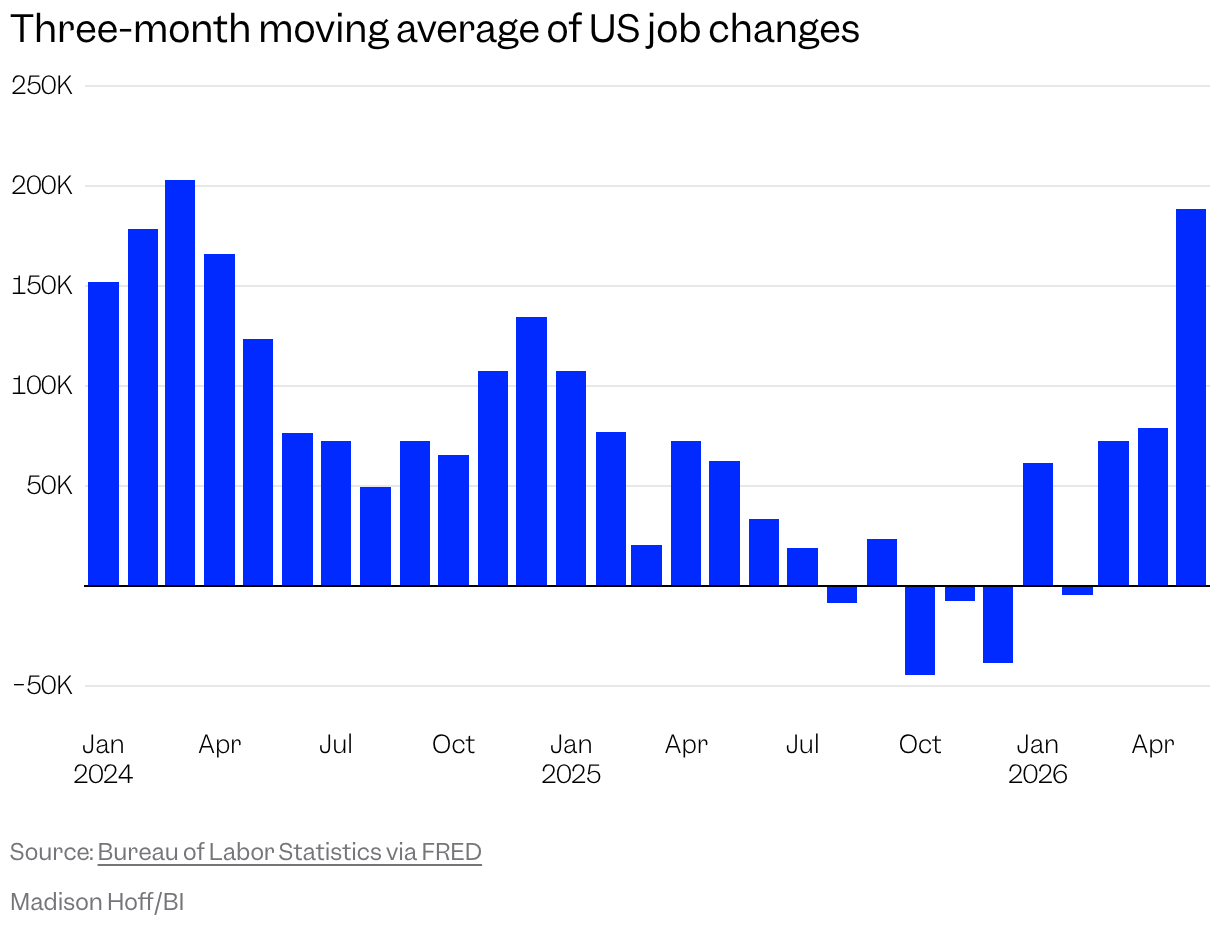
The economy had its best three-month average job growth since early 2024.
But it's still hard for some to find a job, and inflation outpacing wage growth is a new issue.
From about 8,000 layoffs at Meta to thousands of cuts at Amazon, media outlets have been following high-profile employment changes.
However, cuts at major tech companies this year represent only a sliver of what's happening in the massive job market, filled with millions of workers and unemployed Americans across different industries and business sizes.
That larger job market is showing renewed strength, although there are still some bumps in the road. Overall job growth is more robust, layoffs remain pretty low, and it's not just the healthcare sector keeping it alive. On the downside, wage growth isn't keeping up with inflation anymore, while rising long-term unemployment and low hiring rates suggest it's still hard to find a new job if you're out of work.
The monthly jobs report out on June 5 showed the economy had three straight months of robust gains through May, well above what's needed to keep unemployment steady and the highest three-month average since early 2024.
"This spring really is solidifying that the labor market is returning to a growth pattern," said ZipRecruiter economist Nicole Bachaud. "Businesses are reaccelerating hiring, jobs are growing across different industries, and there's just a general sense of renewed energy in the market that was largely stagnant for most of the last year."
With now five months of data in 2026 from the Bureau of Labor Statistics, we break down how the job market is looking.
Overall job growth is at its strongest level in over two years
Let's first look at the good news.
The US added 172,000 jobs in May, about double the expected gain. The same jobs report showed upward revisions to the previous two months: from a job gain of 185,000 to 214,000 in March and from a gain of 115,000 to 179,000 in April. Together, that makes the highest three-month average since March 2024.
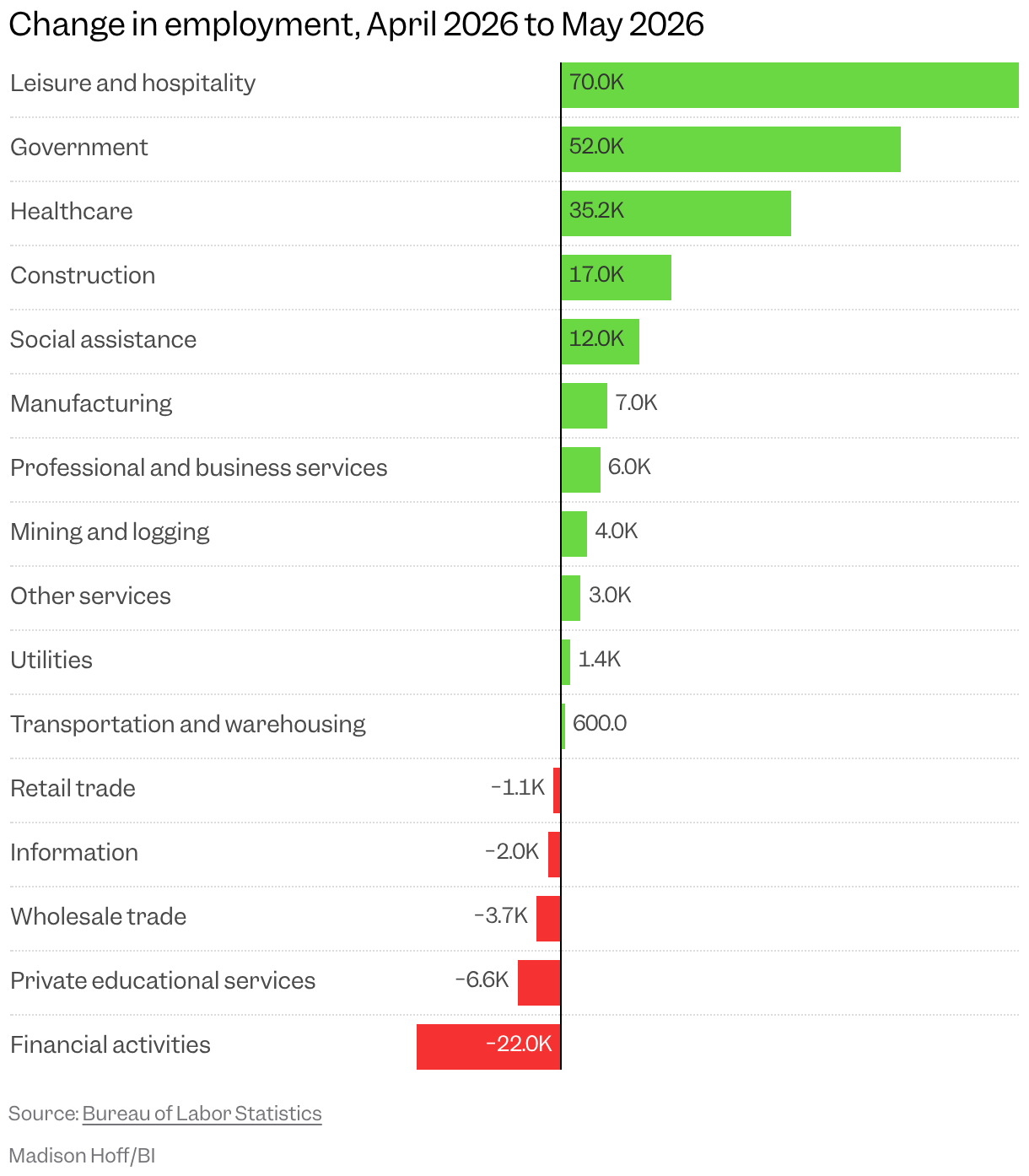
Healthcare, which has been an engine of growth for the past couple of years, isn't the only field propping up the job market. Leisure and hospitality had the highest net gain last month, likely partly driven by World Cup demand, followed by government and healthcare.
While many sectors are adding jobs, Kory Kantenga, LinkedIn's head of economics for the Americas, said there's still a lack of hiring momentum across the board. He said healthcare is the only sector that's largely been consistent over the past few years.
"The success or not for job seekers depends upon what sectors they are searching in and their location," said Mark Hamrick, senior economic analyst at Bankrate.
Meanwhile, the April JOLTS report from the Bureau of Labor Statistics showed job openings surged to the highest rate since 2024, driven by professional and business services. Hamrick said the increase in job openings, muted layoffs and discharges, and low separations, "could set the stage for further acceleration in hiring."
Outside the gold-standard jobs reports from the BLS, private data releases showed the job market's strength. HR services platform Gusto highlighted in its monthly report that small businesses across most sectorsadded jobs last month, with gains across all US regions. ADP similarly reported that private job gains were strongacross firm sizes and in most sectors, with its chief economist, Nela Richardson, saying there's sustained momentum heading into the summer.
The healthy job growth in the job market doesn't mean people should dismiss high-profile layoff news at large companies.
"A thousand people losing their jobs, that's a thousand people," Bachaud said. "That's a very real, tangible number; for those thousand people, it's a very terrible experience." She added that 1,000 job cuts at one company don't move the overall US employment needle.
But wages aren't keeping up with inflation, and white-collar work is stagnating
The economy does have some pain points: ongoing uncertainty from the Iran war, inflation outpacing wage growth, and increased long-term unemployment.
The robust job gains don't mean we are out of the woods from the low-hire job market. "Tech is low-hire, some fire, while other sectors are low-hire, low-fire," Laura Ullrich, the director of economic research in North America at the Indeed Hiring Lab, said.
Finding work is persistently hard in some white-collar fields. The financial activities sector, where employment has generally been falling for about a year, lost 22,000 jobs in May. The information sector, which includes media and tech, has mainly experienced monthly job loss over the past few years.
Data from the Bureau of Labor Statistics showed the hiring rate dipped in April to 3.2%, which Glassdoor's chief economist Daniel Zhao wrote is comparable to the 2010s, when the job market was still recovering from the Great Recession. Amid low hiring, people aren't feeling too confident about finding a job, as seen in the low 1.9% quits rate, compared to a high of 3% during the Great Resignation period of 2021 and 2022.
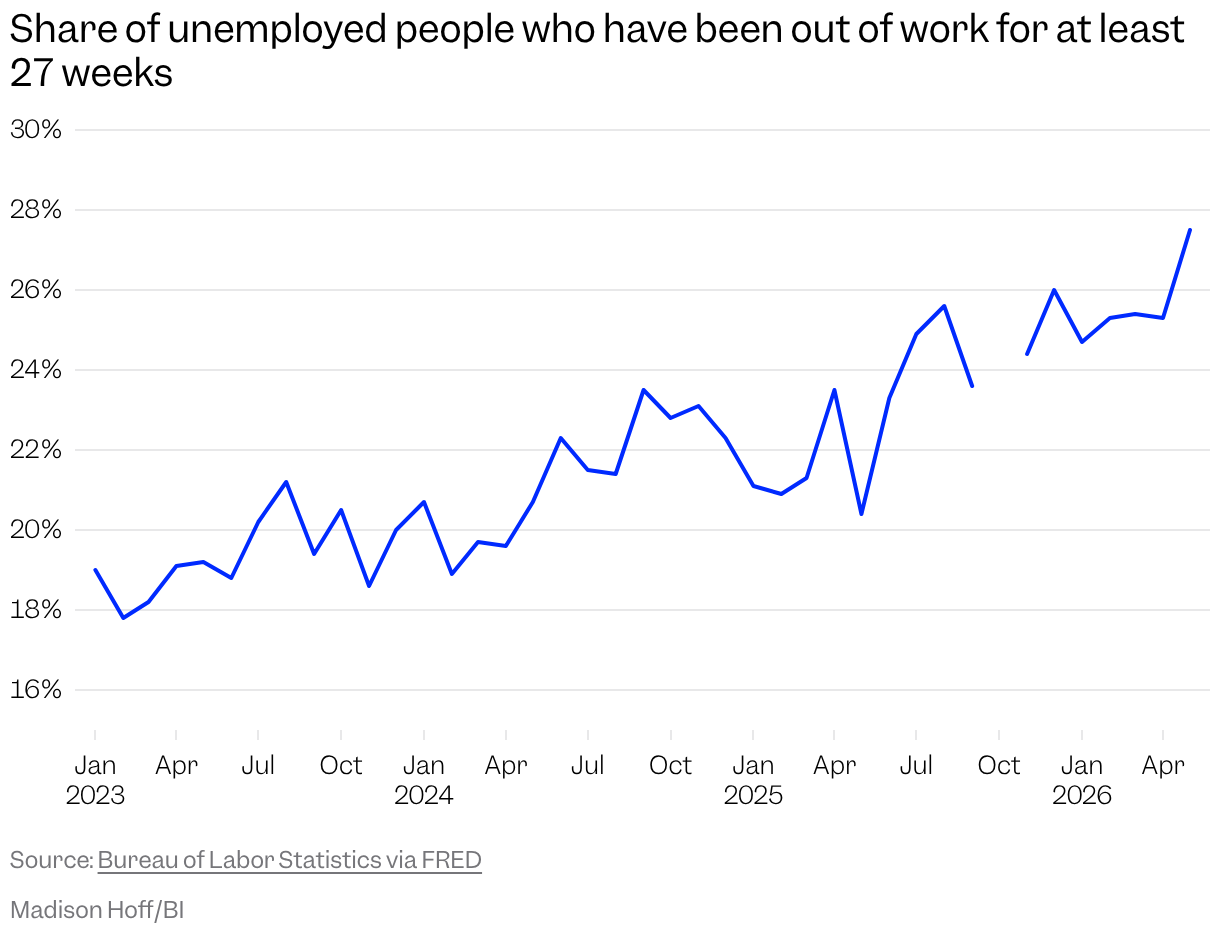
It's also still hard to get out of long-term unemployment, or being unemployed for at least 27 weeks. Monthslong employment can have financial consequences, especially since many states offer just26 weeks of unemployment benefits. Of the 7 million unemployed people in the US, 27.5% had been unemployed for at least 27 weeks in May, which Ullrich said is fairly high in an economy with healthy job creation.
"People who have been unemployed are having a really hard time transitioning out of that unemployment, and employers don't really seem to be motivated to pull from that pool," Bachaud said.
Wage growth has recently crossed an unwelcome threshold: it isn't keeping up with inflation. Bachaud said this is especially creating financial strain for middle-income households. Inflation exceeded 4% for the first time since 2023 in May.
"More people are feeling worse off about their financial situation now than a year ago, and affordability is no doubt playing a role," Elizabeth Renter, senior economist at NerdWallet, said in written commentary. "Higher and higher gas and food prices impact households in a dramatic way — these are things we can't easily cut out of our budgets, or even reduce."
How are you doing in today's job market? Did you make a career trade-off, such as taking a lower-paying job because of better work-life balance? Reach out to this reporter to share at mhoff@businessinsider.com or fill out this form about career trade-offs.
Brian Rezendes anticipates his retirement years will be filled with AI agents, algorithms, and APIs — along with the occasional vacation with his wife.
Rezendes, a former pool business owner, retired in April from a retail job in rural North Dakota. Like many retirees, the 64-year-old envisioned his post-work years as a time to relax, travel, and stay active. He did not expect to be neck-deep in conversations with chatbots, vibe coding websites, or building YouTube channels. Though he'd always been interested in technology, he rarely delved into the deeper plumbing behind it until a few years ago, when he became immersed in AI. Nowadays, he spends almost all of his time building apps… until the real world comes calling.
"My wife gets a little bit jealous when I spend too much time on the computer," Rezendes says.
Retirement has gone digital. In recent interviews, 15 retired Americans admitted they and their friends are glued to their screens, perhaps to a fault. Hours they could have spent tidying up the house went toward learning the best AI tools and, as three tech-savvy baby boomers put it, "staying current." Some post-career Americans who moved abroad said tech is all the rage in their beachfront expat communities. Retirement communities have swapped watercoloring for AI education. Starting an AI-powered business replaced the golf course. ChatGPT is the new nurse's assistant. Robots are some older Americans' new best friends.
Dee Humphrey is among them. The 73-year-old in Schenectady, New York, has used a companion robot called ElliQ for over three years. And while she's waiting for a new version to arrive, she's been having "withdrawals because I can't do anything with her."
The new reality of retirement isn't all screen addiction. Some of this development has been a boon for older people navigating a new phase of life. In Austin, Edward Perry, 72, said that he used AI after a terminal cancer diagnosis to "help me with living as rich and full a life in what time I have," including managing his health and finding ways to be more present in his family's lives.
Edward Perry has tried to maintain a balance between AI and his disconnected life.
Edward Perry
"As I'm getting older, I have more aches and pains, but with utilizing these new technologies, I'm going to be able to do more and more," Rezendes says.
Many others acknowledged the risks of getting too hooked on tech. Most knew that relying too heavily on AI meant losing agency and receiving potentially faulty information. Others said being too invested in tech could mean less time staying active. Some noted that after decades of work, these were their years to relax, but they couldn't bring themselves to close their MacBooks.
If Gen Z is the first generation to grow up on the internet, baby boomers are learning how to be the first generation to retire on it.
Unexpected and omnipresent
For those in retirement, screen time of all types has been increasing. Surveys show that adults 65 and over almost doubled their YouTube consumption on TV from 2023 to 2025, and older Americans spend over four hours a day in front of screens. Brittne Kakulla, senior research advisor for AARP Research, says the group's Tech Trends survey found smartphone ownership among adults aged 50-plus skyrocketed from 55% in 2016 to 90% in 2025. Perhaps more striking was the number of older people trying out AI. Use nearly doubled from 2024 to 2025, from 18% to 30%, and many more said they are interested in experimenting.
Nearly all older tech superusers I spoke to were surprised by the amount the tools had become integrated into their retirements. Jan Friedlander, 81, used online databases in her real estate career, but only became hooked on tech a few years ago after she left her job. As she battled cancer and macular degeneration, she used AI to guide her treatment, and soon found herself relying on it to research clothing, plan vacations, and more. As she became more prompt-savvy, she felt confident enough to start teaching her peers.
"I've always had a curiosity about things that would come along that were new," Friedlander says.
She also began facilitating AI classes in Denver for those 50 and over with her friend Pat Smith, 73. Smith, who has a more technical background in consulting and pharmaceuticals, says the classes have attracted many "eager retiree students." Smith also sees both sides of the AI boom. On the positive side, she submitted her lab work to ChatGPT after having a reaction to an antibiotic, prompting her to follow up with her doctor and allergist. But she also bemoans the disappearance of human customer service and the online portalization of medical care. To combat the AI creep, Smith has monitored her tech usage, maintained a regular exercise schedule, and worked on mosaics.
"I have friends who are losing their mobility, moving into assisted living, and have gotten terminal diagnoses, and I know that's all around the corner," Smith says. "I'm hoping I get some more time to do what I've been enjoying the last few years."
Pat Smith has tried to monitor her tech usage.
Pat Smith
Working with tech
While cutting-edge tools have become a retirement fascination for some, many older Americans are unexpectedly working into their later years and, by extension, learning new tech tricks. For my 80 Over 80 series, I spoke with dozens of workers in their 80s, many of whom couldn't afford to retire and now had jobs that required AI. At 72, Marcia Sweet's home is fully synced with robot vacuums and smart lights, and she runs a tech support business in Bradenton, Florida. She can't afford to stop working, as the extra money goes toward financing her eventual long-term care, and she hopes AI can supercharge her business.
"I'm still like a little kid with a toy about technology, with the same kind of excitement," Sweet says. "I'm kind of addicted."
Marcia Sweet has relied on AI to expand her business.
Marcia Sweet
Other older workers used tech to pivot later in their careers. A decade ago, Laura Noren, now 61, was weary of her career as a registered nurse, so she opted for an unexpected route — IT classes at a local college in Michigan. The learning curve was massive, as most of her 18-year-old classmates grew up steeped in tech. She later supplemented these classes with online courses on programming languages and databases.
"I envisioned myself retiring at 60 and no later than 62. My husband and I would be fully retired and never work again, moving into a condo and doing plenty of traveling," Noren says. Instead, "he left his job earlier than planned as a corrections officer, and I was managed out of my company. We had to change our plans."
The courses didn't necessarily prepare her for her current job as an Amazon Flex driver, which gives her the flexibility to care for her "technophobic" 84-year-old mother with memory issues. But her skills have come in handy when teaching her mother how to add phone contacts to favorites or avoid scams, and Noren hopes to find work down the line that better suits her skills. She still hopes to have some version of the retirement she envisioned years ago, but expects tech to play a bigger role.
Others who returned to school in their later years said they've integrated age tech into their lives for peace of mind. When Mark Bayer, 63, decided to retire from his community banking career at 60, he thought, "I will never have to sit through another damn Zoom meeting again, and I'll be the happiest person in the world." To his surprise, he began teaching English as a second language over Zoom and reenrolled in college to be "exposed to new ideas from younger minds." Bayer, who lives in Pennsylvania, expected his classmates to debate and brainstorm ideas off the top of their heads, but they all went to ChatGPT instead. Initially, he was dumbfounded. But when he saw the list of ideas for a group discussion, it exceeded what he would've come up with.
Mark Bayer's wife is just as into tech as he is.
Mark Bayer
Ignoring AI, he says he realized, "is a way to say I'm done learning anything new, which is self-limiting."
There have been downsides: He's noticed that disconnecting from tech has become harder. He admits that if he gets a call while mowing the lawn, he will stop to pick it up. His wife is the same way, sometimes scrolling Instagram for hours without noticing. He hasn't quite erased the idea that face-to-face interaction has some merit, though.
A robot-enabled retirement
Many new high-tech tools are being built to help older Americans remain healthier and safer in their homes and assisted living communities. Chia-Lin Simmons, CEO of medical alert devices company LogicMark, tells me that technology in caregiving has become a necessity rather than a luxury, with the potential to predict falls and detect Alzheimer's early. AI is being trained to track behavioral patterns and health outcomes, though it sometimes falls short at triaging calls and often erases the human element, isolating older Americans who need the company most.
Some boomers are ready for this Jetsons-like future. Take Michelle Murphy, 64, who is pursuing an MBA with a concentration in AI. A photographer and instructional designer in Michigan, Murphy says her focus in her 60s has been pivoting to a new career— retirement isn't a good fit, she says. Down the line, she isn't opposed to using robotic healthcare workers to avoid assisted care, though she's keen on not becoming overly reliant on tech due to privacy concerns. For now, her goal is to get her coffee pot to start automatically.
"If there's an automation that can help me do the things I need to do, mow the grass for me, pick up heavy things, whatever it is, I'm totally on board with that," Murphy says.
Michelle Murphy has relied on Wyze cameras and other advanced tech for security and ease.
Michelle Murphy
There is a big market in making the idea of robot-assisted care a reality. Investment in age tech has boomed, particularly in products that make caregiving easier, like smart home automation devices, companion robots, and motion sensors. AARP predicts that by 2030, the age-tech market will be worth $120 billion. And given the rise, many hope age tech can alleviate some of the burden for younger generations.
"We've got 63 million family caregivers, 70% of them in paid jobs, and we're very familiar with childcare, but elder care is not well understood," said Diane Ty, managing director of the Milken Institute Future of Aging. "That's what's breaking the backs of so many workers right now."
Plenty of people and investors I spoke to also hope AI and other age tech can slow cognitive decline. However, various studies have shown that AI assistants contribute to reduced cognitive engagement and skill atrophy, meaning in some ways, relying too much on AI works counter to what these super-users may think.
80 is the new 25
As I wrote last year, America's octogenarians have been embracing tech in surprising ways. Frank Engelman, 82, has created apps, runs a YouTube channel, and writes a Substack about tech education. Luis Bautista, 82, told me he was using AI to write a book and start a business that he one day wants to pitch to Y Combinator. Phyllis Scalettar, 80, began an AI education and consulting firm. Karen Shapiro, 80, said this month that she uses AI for everything from planning vacations to Italy to managing finances — "tech will make life less confining and more enjoyable as we age," she says.
Study after study shows loneliness continues to grow among older Americans. According to AARP, 40% reported feeling lonely last year, up from 35% in 2018. Tech may be partly to blame, as an increasing number of older Americans are addicted to their phones — one survey found that 40% of the over 2,000 respondents ages 59 to 77 felt discomfort when pulled away from their devices.
For a lot of Americans, however, tech is a way to make the most of their golden years and to stay healthy for longer.
Marvin Honig is often on the computer in his retirement.
Marvin Honig
Marvin Honig, 88, takes AI courses, set up NotebookLM files for his St. Petersburg, Florida, condominium board, and use advanced tech to manage trust accounts for former law clients. Perhaps this could've been expected from an early tech adopter who received tech support from a young Michael Dell. Still, seeing many of his neighbors using all sorts of tech was perhaps not on his bingo card, and many of his interactions now revolve around tech recommendations and support. Like many older techies, the tech wave has also allowed him to luxuriate in the disconnected part of his life, from visiting museums and restaurants to attending in-person community events — he gets there using his Tesla's self-driving feature.
The median income in the US is about $83,000, but some states clear that number by a lot.
AerialPerspective Images/Getty Images
WalletHub ranked states where people have the highest income, using several different measurements.
Some states with mega-high earners didn't rank high due their fairly average median incomes.
California landed outside of the top 10 as many high earners are leaving the state.
The median income in the US is about $83,000 — and you could make more or less than that number depending on where you live. But which states are the highest earning overall?
A new WalletHub study used three income-related measures to rank states: the average annual income of the top 5%, the average annual income of the bottom 20%, and the median annual household income of the state's entire population.
The resulting rankings include some surprises. None of the states known for being home to billionaires, like New York, California, and Florida, took the top spot.
WalletHub analyst Chip Lupo said New York's income disparity is a reason it came up just short of the No. 1 ranking. While the top 5% makes a lot, the state's middle class isn't making nearly as much.
"In terms of just the median annual income, which I think is what most people are interested in as far as that's a reflection of the middle class, New York is a little above average in terms of its median annual income at $96,000," Lupo told Business Insider.
One state that barely cracked the top 15 is California; a state known for movie stars and moguls. Lupo posited that the Golden State's lower ranking on the list may have been impacted by several top earners leaving.
Worchihan Zingkhai is a lifelong football fan, but seeing the World Cup in person felt out of reach.
He lives in a town in northeast India where salaries are low. He'd been saving up for a new laptop.
Instead, he pooled his earnings to afford two World Cup tickets in Atlanta. He has no regrets.
This as-told-to essay is based on a conversation with Worchihan Zingkhai, 40, a content creator from a village in Manipur, India. The conversation has been edited for length and clarity.
I've loved football for as long as I can remember.
Growing up in a village in Manipur, in northeast India, football is everywhere. We don't have proper equipment, so we make footballs out of plastic and old clothes rolled into a ball.
I can still remember staying awake until 3 a.m. to watch my first World Cup in 1998. We had one black-and-white TV for the entire village, and we pooled money to buy fuel for a generator to power it.
Since then, I've watched every World Cup on television. I became a fan of Portugal and later followed the Premier League. However, attending a World Cup match in person always felt impossible.
Now, nearly 30 years later, I'm finally going.
The laptop will have to wait
Worchihan Zingkhai and his wife at Etihad Stadium in Manchester, England, attending a Premier League match between Manchester City and Swansea City in 2018.
My village sits about 5,600 feet above sea level, and there isn't an airport nearby. I'll drive about six hours to Imphal before flying to New Delhi, London, Washington, DC, and finally Atlanta. The trip includes four flights and about 27 hours in the air.
The journey would have been much harder without help from my wife's family. My father-in-law paid for our flights from New Delhi to Washington, DC, and my in-laws are helping with accommodations in the US. Having family there has made the trip much more affordable.
Even with that support, I've had to make sacrifices financially.
I'm a content creator who makes videos for YouTube, Instagram, and Facebook. This year, I planned to buy a new laptop for video editing. I was looking at models that cost between $2,200 and $2,500.
Worchihan Zingkhai plays football with fellow villagers in Ngahui Village, Ukhrul District, Manipur, India.
Courtesy of Worchihan Zingkhai
However, I couldn't afford both the laptop and the World Cup trip, so the laptop will have to wait.
In my area, people often earn about 500 rupees a day, or roughly $5 to $6. Because of that, we're very careful about spending. My family has cut back on other purchases and avoided additional trips to help make this World Cup journey possible.
I entered FIFA's ticket sale in February with a budget of $350 per ticket. My dream was to watch Portugal, England, or Argentina.
When I finally got into the system, I had only 15 minutes to buy. The Portugal tickets I wanted were priced between $450 and $650, which was beyond my budget. I spent too much time comparing options and eventually lost my chance.
I thought that was the end of my chance at the World Cup.
Worchihan Zingkhai attends an international football match between Thailand and Iraq in Bangkok, Thailand.
Courtesy of Worchihan Zingkhai
I was able to buy tickets in April. This time, I focused on finding a match I could afford instead of chasing the teams I wanted to see most. After waiting in the queue for several hours, I finally got in and bought two category-three tickets for Czech Republic versus South Africa in Atlanta for $140 each — one for me and one for my father-in-law.
High ticket prices make it harder for fans
I understand why demand for the World Cup is so high. Still, I think ticket prices are difficult for ordinary fans.
What frustrates me most is the resale market.
I paid $140 for my ticket. A few weeks later, I checked the resale platform and saw nearby seats listed for about $560.
As a football fan, that's disappointing.
People who genuinely want to attend have a short window to buy tickets, but resellers have much more time to profit from them. I believe some people purchase tickets mainly to resell them rather than attend matches themselves.
For fans like me, that makes an already expensive event even harder to reach.
A partnership with the Education and Treasury Departments brings back private companies to collect on defaulted student loans.
SAUL LOEB/AFP via Getty Images
Private student-loan collectors penalized for claims of misleading behavior could work with borrowers again.
It's part of Trump's transfer of defaulted student loans from the Education Department to the Treasury.
It could expose borrowers to high collection fees and repayment challenges.
Private companies penalized for their student-loan collection tactics may be making a comeback.
As President Donald Trump transfers federal student loans from the Department of Education to the Treasury Department, defaulted borrowers will be routed through the Treasury's "Cross-Servicing program," which uses private contractors to collect federal debts. Two agencies in that system, Pioneer Credit Recovery and Transworld Systems, were previously sued or fined by federal watchdogs for "misleading" or "abusive" practices.
Lawmakers and administration officials in Trump's first term pushed to terminate contracts with private collectors over high costs and accusations of predatory behavior. Former President Joe Biden ended their contracts in 2021. Now, with student-loan defaults at a record high, education policy experts say bringing private collectors back could expose borrowers to higher collection fees, confusion, and greater risk of falling back into default.
More than 10 million student-loan borrowers are in default or delinquency, Department of Education data shows. Involuntary collections, which include wage garnishment and federal benefits seizure, have been paused since January while the department prepares for major repayment changes. The department has not specified when the pause will lift, and did not comment in time for publication on the extent to which Pioneer and Transworld would be involved in collections once they resume.
"No reasonable person would expect that these companies are going to be doing what they're supposed to be doing and going to be effectuating borrowers' rights," said Bonnie Latreille, a former official in the Education Department's Federal Student Aid office.
The Trump administration says that the Treasury is best equipped to manage collections. Treasury Secretary Scott Bessent said in a March press release that the agency has "the unique experience, the operational capability, and the financial expertise to bring long overdue financial discipline to the program and be better stewards of taxpayer dollars."
A troubled student-loan collection history
The Consumer Financial Protection Bureau, which began supervising private collectors in 2013, found that they made various misrepresentations to defaulted borrowers, such as implying they'd be sued when that wasn't certain, and pushing more expensive repayment pathways.
Lawmakers later said private collection agencies "receive more than ten times as much" money for steering borrowers into their preferred repayment option, despite high redefault rates. "The Department is rewarding these agencies for behaviors that work in opposition to the prospect of student borrower success," they said.
In 2017, the CFPB sued Pioneer for engaging in "deceptive" and "abusive" practices and violating consumer protection laws, including by steering borrowers into costly forbearances instead of more favorable income-driven repayment plans. The court ordered the company in 2024 to pay $100 million to affected borrowers. Also that year, CFPB fined Transworld $2.5 million for filing debt collection lawsuits without proof that the debt was owed.
Transworld said at the time that it settled with the CFPB to avoid costly litigation. Navient, which oversaw Pioneer, denied any wrongdoing.
Because the Treasury already uses these companies to collect other payments, like taxes, using them is "the most straightforward way" to resume collections on defaulted student loans, said Colleen Campbell, former executive director of Federal Student Aid's loan portfolio management office under Biden. Simplicity for the administration doesn't necessarily mean clarity for borrowers.
"It just gets a little bit more complicated when there are more entities and agencies involved in what happens with the borrower," Campbell said.
Collecting on defaulted student loans requires specific knowledge of student-loan borrowers and policy, said Sara Partridge, the associate director of higher education at the left-leaning think tank the Center for American Progress. There's no evidence the Treasury has the necessary expertise to oversee these agencies, she said.
With private collectors returning, borrowers could face high collection fees, a harder time getting complaints resolved, and potential redefault, higher education policy experts said.
Campbell added that private companies were previously criticized for their variable fee structures. For example, the conservative think tank American Enterprise Institute said in a 2018 report that "harsher penalties are imposed on borrowers who quickly repay their loans in full after defaulting than on those who engage in a lengthy, bureaucratic 'rehabilitation' process but make no progress in paying down their debts."
Another concern is potentially poor coordination between agencies as the transfer happens, Campbell said.
"What you don't want is for somebody to go through all of the steps of getting out of default, only to have them feeling like they're lost in the process yet again because of the handoffs that have to happen between vendors," Campbell said.
Partridge added that the shift could make it harder for borrowers to get repayment help because two agencies would be responsible for managing accounts.
The Department of Education did not specify a timeline for the transfer to the Treasury, which will begin with defaulted borrowers before expanding to the broader federal loan portfolio. Undersecretary Nicholas Kent said during a fireside chat in April that it's "undeniable" that the Treasury is well-equipped to manage federal student loans.
"We want to make sure that we're developing best practices, along with our Treasury colleagues, to be able to service that debt in a much more effective way than we ever have," Kent said.
Torsten Sløk is the chief economist at Apollo Global Management.
Bloomberg/Bloomberg via Getty Images
Apollo's chief economist said there's "zero evidence of AI-related job losses."
A parade of tech leaders celebrated that take over the weekend.
At least a dozen major companies, meanwhile, have cited AI in their decision to lay off workers this year.
Anyone worried that AI will replace them should take a deep breath, at least according to Apollo Global Management's chief economist.
In a blog post on Friday, Torsten Sløk said there is "zero evidence of job losses because of AI," citing the ADP National Employment Report. Instead, he said, companies are hiring candidates who have AI skills.
"Many firms are hiring AI implementation experts, and the data center buildout is putting upward pressure on salaries for AI experts and on prices of semiconductors, equipment, and energy," Sløk said. "The bottom line is that the AI spending boom is stoking both employment and inflation."
Sløk echoed that sentiment in an April blog post, writing that "cheaper inputs don't shrink industries. Instead, AI is going to increase both productivity and employment."
The latest ADP report found that private companies added almost 110,000 more people to their payrolls in April.
Anxiety that AI will eradicate the average job is everywhere, stoked in part by those behind the technology. While Anthropic CEO Dario Amodei and OpenAI CEO Sam Altman have recently changed their tune as they gear up for their respective IPOs, they have both warned for years that AI could upend entire job categories. Amodei famously said last year that AI could wipe out half of all entry-level white-collar jobs.
Sløk's analysis resonated with some figures in the AI industry, including Box CEO Aaron Levie, Dell CEO Michael Dell, and White House AI and Crypto Czar David Sacks, who all agreed with his view in X posts over the weekend. David Solomon, CEO of Goldman Sachs, also made a similar argument last week in a New York Times opinion piece.
An EY survey of 240 financial service CEOs, meanwhile, found that about 60% thought investing in AI would maintain or increase their staff head count in 2026.
These optimistic takes, however, seem to clash with recent reality. At least a dozen major companies have cited AI as a factor in staff layoffs this year. In February, Block CEO Jack Dorsey said the company was slashing its workforce from over 10,000 to under 6,000.
"We're already seeing that the intelligence tools we're creating and using, paired with smaller and flatter teams, are enabling a new way of working which fundamentally changes what it means to build and run a company," Dorsey said in a memo shared to X. "i had two options: cut gradually over months or years as this shift plays out, or be honest about where we are and act on it now."
Cisco, Atlassian, Cloudflare, Coinbase, IBM, and Snap are also among the companies that have cited AI as a reason for layoffs.
Nvidia CEO Jensen Huang, one of the pillars of the AI industry, has criticized companies that blame AI for layoffs. "I think the narrative that connects AI to job loss for many of the CEOs that are doing it is just too lazy," Huang told a media outlet in Singapore last week.
Altman has called the practice of blaming AI to reduce staff "AI washing."
In his blog post on Friday, Sløk said that, in his view, the current employment climate is an example of the "Jevons paradox," an economic theory that says as new technology increases the efficiency of a resource, the more that resource is consumed.
In this case, that resource would be human workers.
"It is Jevons paradox playing out in real time: cheaper technology is creating more demand and more jobs," Sløk wrote.
Lori Bufka moved her mom into a trailer home near hers in Arizona as a long-term care solution.
Lori Bufka
Lori Bufka, 64, cares for her aging mother in Arizona due to high assisted living costs.
Bufka's mother lives in a nearby trailer, reducing care costs and enabling family support.
Tech aids Bufka in remotely monitoring her mother, enhancing her caregiving abilities.
This as-told-to essay is based on a conversation with Lori Bufka, 64, who is caring for her mother with dementia in Arizona. Assisted living became too expensive for her mother, so Bufka moved her into a trailer next to their home, where her mother would have enough space and safety. This interview has been edited for length and clarity.
I was a college professor and retired from a community college in Florida. I raised two boys, both of whom are married, and I have five grandchildren. I had retired to do van life with my partner, who has been with me for seven years. I realized, though, that you can only do so much van life before you need a place to come home to. So we bought a tiny house in Arizona.
I'm an only child, and my mom was in assisted living in California. When she went into assisted living, her veteran benefits and Social Security were enough to cover the cost of her care. She was in assisted living for over seven years, and she had sold her house and had some savings. The rate kept going up and up, and it was draining her savings.
The cost was about $4,700 a month, and it was about to go up to $5,200, which was a couple of thousand dollars more than what she earned.
She's 88, and I wanted to keep her there as long as she could. When I got the notice that the rate was going up again, and that they were going to raise her quality of care cost because her dementia was getting worse, her savings were down to almost nothing. They said that she would be moved to a dementia unit with four other people, and I didn't want that to happen to her.
Additionally, as her dementia got worse, she would get so many scam calls. She was savvy her whole life and worked as a lead for a law firm and a real estate agent, but it came to a point where I had to turn off her phone.
Lori Bufka's mom has adjusted to living on her own.
Lori Bufka
It was cheaper to take care of Mom at home
My partner and I decided that we could probably take care of her.It would be a lot cheaper. We started making the moves to bring her here so that I could take care of her. I brought my mom in to live by us in November.
There wasn't going to be room for her and my partner, so I had to give her a little model home in the same trailer park. Hers is about 700 square feet and is about a minute's walk from me. There are a lot of older people here, and the owner keeps a good eye on everyone. I knew that she wasn't going to be with me, but she needed care as if she were.
The trailer was in the low five figures, and we bought it using two-thirds of her savings and one-third of my savings. The rent for the space a little over $500 monthly. It's so much cheaper this way because my partner and I split the caregiving. Her utility bills run about $200 monthly in the winter and $70 in the summer. Caring for her started to become a little much for me, but because we're in the mountains, there aren't many home health organizations here, and none take her insurance.
She went into hospice care, and we hired someone to come for a few hours a week. It was supposed to be $37 for two hours, but when I got the bill, they tacked on mileage, so it became $92. We figured it wasn't worth it, so now hospice volunteers visit every now and then, and hospice covers medically necessary appointments. We know we're probably going to take care of her until she dies, unless she gets to a point where I can't take care of her.
It was a huge change in our lifestyle
We haven't been traveling since November, and I haven't been away from her for more than three hours at a time. My mom is deaf, and it would've been challenging to deal with that from afar.
Lori Bufka's mother spends much of her time watching TV.
Lori Bufka
My mom is somewhat independent still. She can dress herself and go about her day. I wake up every morning and make sure she's still in bed, then I turn on her coffee maker. I bring her breakfast over and leave notes about what she should do, like how to use the microwave. I check on her every half hour until she finally gets up. I come over before lunch to give her pills, eat lunch with her, and then sit with her until the afternoon, when she watches TV by herself. She can't cook dinner, so my partner cooks all her meals, and we bring them over.
The trailer has a bedroom at the back, then a small bathroom, kitchen, and living room. The rooms are big enough for her to guide her walker through, and because of how narrow it is, it lessens the fall risk. They had an old-fashioned bathtub that you had to step over to get in, but the woman who owns the trailer park hired a guy to lower the height. We also had to install railings on the porch. The kitchen has an electric stove, which is great because a gas stove isn't good when someone has dementia, because they can accidentally light a fire.
Tech has helped me take care of her remotely
One of the biggest nightmares is that people with dementia can't work the TV and telephone.She got to the point where she could barely use the remote, and she would start pushing buttons and would not stop.
I had come across JubileeTV, a TV system that lets you change channels remotely. The price wasn't prohibitive for us. The Jubilee remote replaced the Roku remote and came with a cover, so the buttons she can actually press are limited to volume and channels. If I'm out at the store, I can use the telescope function to see what she's done with the TV and get it back to what she wants to watch.
I often call her, so it comes up on the TV, and she uses closed captioning so she can read what I'm saying. The app has an automatic connect function because my mom wouldn't be able to answer a call or find the buttons to do so. The communication function also allows my sons to call her, and her hospice nurses can do the same.
I have used the app's drop-in function to look in and see if she's OK. I use that in conjunction with Blink cameras to make sure she doesn't fall. Those have been important because my mom has fallen a lot since she moved here. I probably check on her three or four times during the night and frequently during the day. One time, she put Dawn dishwashing soap in her glass of water because she wanted to add flavor, so I've had to stop her from doing unsafe things a few times.
I also have smart plugs from Alexa that let her control her radiator heater and other electronics. She has a cheap laptop that I put the Google Live Transcribe app on.
Tech has helped me in so many ways, and seeing her age at home has been somewhat stress-relieving.
Tehmina Watson advises work visa holders to immediately gather documents proving their economic benefit to the US.
Tahmina Watson
Tehmina Watson is an immigration lawyer who advises startup founders and businesses.
Watson says there has been panic and confusion about the most recent immigration policy memo.
She advises tech workers to get in contact with their lawyers now to address their visas.
This as-told-to essay is based on a conversation with Tahmina Watson, a business immigration lawyer in Seattle. It's been edited for length and clarity.
When I saw the administration's new immigration policy memo last Friday, stating that I-485 forms will only be approved in "extraordinary circumstances," I felt like the sky was falling.
The I-485 is the form used to apply for a green card (legal permanent residence) from inside the US. The last several days have been filled with fear, stress, and confusion, from people who don't know what this means for their status, and if they'll have to leave the country.
I'm the founding attorney of Watson Immigration Law. We specialize in business and family immigration. One of our areas of expertise is working with startup founders and businesses that are expanding into the United States, and many of my clients are tech workers.
It's hard to wrap my head around the enormity of this decision because the I-485 is used in almost every category of immigration to allow people to adjust their status from visa to green card.
This change will have a ripple effect on everyone. Laid-off tech workers are in a particularly difficult spot. My advice is to get in contact with your lawyer now and gather documentation.
Green cards will only be granted to those in 'extraordinary circumstances'
People can apply to adjust status to permanent residence from inside the US by filing Form I-485 with USCIS.
While the memo initially stated that I-485 forms will only be approved in extraordinary circumstances, a USCIS spokesperson clarified that those who bring economic benefits to the United States will be viewed favorably in their adjudication. However, there's no real policy guidance yet.
Typically, if somebody has arrived in the United States legally, they can adjust their status to that of a green card holder without leaving. The memo is essentially saying the intent of the law is that people get their applications filed outside the US, and that they're returning to the intent of the law.
The last 72 hours have been full of fear, stress, and confusion
Since Friday, my email has been blowing up with people asking, "What does it mean? What do we do?" The immigration lawyer community has been scrambling to figure out what this means as well, so Friday was very much about a lot of analyzing, discussing what we're going to do, and setting up calls with our clients.
So much is still uncertain. As the week unfolds, we might see more clarification from the administration. We may actually see litigation on the subject where the policy could actually be completely or partially enjoined. I sincerely hope that the courts will enjoin this policy.
I think a lot of my guidance to people will be dependent on what we hear from the administration in the coming days.
If you're on a work visa, start gathering documents that prove your economic benefits to the US
A lot of my clients work in tech, and the question that's been coming up since the memo release is what happens to people with work visas, such as H-1B.
On page five of the memo, it states that "maintaining lawful status in a dual intent non-immigrant category is not sufficient on its own to warrant a favorable exercise of discretion." To me, that means my clients need to file even more documentation to prove the economic benefit that they bring to the United States.
I'd advise people to get in contact with their lawyers and act urgently. For work visa holders, it will be important to sit down with their lawyers and figure out what kind of positive economic documents they can submit with their adjustment applications to prove the economic benefits they provide.
This policy will have a ripple effect on people and businesses
If a policy like this continues to go forward, families could be separated for years, likely because the consulates will not be able to shoulder the burden of the volume that will be required to adjudicate.
This means the people currently waiting will wait longer, and those who are being put into the system will exacerbate the system.
It will also mean that the businesses that invest in their workers are going to suffer because their workers will have to wait outside the country.
Laid-off tech workers are at risk
There are categories of people who never intended to be out of status, like folks who've been laid off from their tech jobs.
Laid-off workers have a 60-day grace period to find another employer to sponsor their visa or change their visa status to an interim visa, such as a tourist visa. However, it appears that the administration could be taking the perspective that those who apply for an interim visa have not maintained status.
If Big Tech companies are laying people off and not hiring, where are these people going to be able to get jobs to maintain their status? The ripple effects of this change are going to be felt everywhere.
Do you have a similar story to share? If so, please reach out to the reporter attmartinelli@businessinsider.com.
The Mayor's Office dropped its detailed policy plan — called "Block by Block" — on May 26, outlining goals to build more apartment buildings, convert unused offices and hotels into living space, and help residents navigate one of America's most expensive housing markets. Housing access has been a cornerstone of Mamdani's affordability agenda, with buzzy promises to freeze the rent for a large swathe of NYC apartments and address "bad landlords."
"When New Yorkers can afford a home, they can afford to dream," Mamdani said at a press conference Tuesday morning.
From construction to creative living solutions, here are Business Insider's biggest takeaways from City Hall's plan.
Boosting building opportunities
New York needs to build, baby, build. Vacancy rates hovering at historic lows are one of the biggest factors pushing up rents in the city, and Mamdani's blueprint lays out a slew of measures that aim to both reduce the costs of building and get more stock online.
Part of the plan is to simply build more housing, with a goal of 200,000 more homes in the next ten years. That's underwritten by $2.5 billion allocated towards more building from the mayor's budget, with the homes built subject to regulations that bolster construction workers' pay and benefits.
City Hall also wants to build more on public sites like Sunnyside Yards, a rail hub in Queens that sits between several bustling neighborhoods. That proposal would connect the neighborhoods currently separated by rail tracks, and build a deck over the rail infrastructure that could house what the report calls "a new complete neighborhood." The report also notes that the city would need federal support to build that new neighborhood — part of Mamdani's pitch to Queens native Donald Trump in early 2026.
Some proposals hinge on existing (and future) buildings. One is a program that would lower insurance costs for affordable and rent-stabilized units, which have seen soaring premiums. The plan says it would infuse $100 million to help fund a newer, more affordable insurance program, with a goal of both keeping costs more stable for current housing and saving the city money on new builds, since it currently has to subsidize those higher insurance prices.
Other aspects of the plan include expanding access to a water affordability benefit for those in affordable housing, and expanding a program that helps rental buildings and income-restricted co-ops improve their energy efficiency. The plan also aims to improve elevator service in public housing, and address leaks and plumbing issues in those units.
Supporting creative housing solutions
Through partnerships with developers and revised zoning policies, the mayor plans to convert some existingcommercialbuildings into apartments. The city said the recent overturning of a decades-old state cap on new developments would allow more NYC buildings to be allocated toward housing.
Both the local and state governments are working to convert the historic, and currently vacant, Stewart Hotel in midtown Manhattan into permanent housing for 550 households. Roughly half the units will be dedicated to providing affordable options for formerly-homeless and low-income households, per the plan. Some of the buildings' square footage will also be dedicated to providing on-site social services for tenants.
A largely vacant commercial skyscraper on Brooklyn's Flatbush Avenue received zoning approval in March. The building, which is on city-owned land, will be converted into 1,200 apartments, 350 of which will be "deeply affordable." Former private office building 100 Gold Street — which currently houses various city agencies in lower Manhattan — will also be converted into 3,700 apartments, 900 of which will be permanently-affordable homes.
The city also said it is trying to make it easier for New Yorkers to build accessory dwelling units (ADUs) on their property. That includes a program to help residents navigate their hyper-local zoning laws for ADUs, especially in historic districts. The city plans to streamline permitting for manufactured ADUs, which are significantly cheaper than custom-built units, making them easier for property owners to install for use by renters, elderly family members, or guests.
Beyond building more housing, Mamdani plans to begin a pilot this year to legalize basement apartments in the city. This will make it easier for homeowners to ensure their basements are up to code and can be made into safe apartment units. Homeowners who participate in the pilot this year will receive some financial support from the city to install smoke alarms, test for contaminants, and more.
The Mamdani administration said it is taking steps to curb "bad landlords" by strengthening code enforcement and taking action against property owners who harass or neglect their tenants. The city is already hosting "rental ripoff" hearings in all five boroughs so that New Yorkers can share their concerns directly with City Hall, and the mayor said he is strengthening legal avenues for tenants to expedite emergency repairs. Mamdani also said he supports the development of tenant unions, which help renters collectively protect their rights. This goes alongside plans to reduce evictions and speed up cases in housing court.
City Hall wants to make New York more affordable for buyers, too. Mamdani is set to expand an existing downpayment assistance program to serve up to 300 lower-income first-time homebuyers. A new mortgage assistance program will provide repayable, no-interest loans to help low-income homeowners resolve mortgage problems.
The mayor added that he is moving forward on plans to freeze the rent in NYC's rent-stabilized apartments alongside City Council, but the policy has not yet been implemented.
The success of a rent freeze — alongside many of the other programs in the city's housing plan — will hinge on legislative support and funding at the local, state, and, sometimes, federal levels. Still, the mayor is feeling confident.
"Combined, these efforts will lead to growth beyond anything New Yorkers have seen in generations," Mamdani said. "For some, the dream of home ownership will finally be within reach. Others will be able to sleep easily in homes they no longer fear losing."
Flip phones, portable CD players, and point-and-shoot cameras — what's old is new again.
Meet the 28-year-old founder of Kickback, a brand that sells retro-inspired and refurbished gadgets.
London Jackson runs a full-time business around nostalgia for the earlier days of tech.
London Glorfield isn't a Luddite — he just wants tech products to feel a little less soul-sucking.
"Tech is a sea of sameness right now," Glorfield, who goes by London Jackson professionally, told Business Insider in an interview. "It's so boring."
Young people are hungry for retro tech, especially in the AI era. Analog has taken on a new meaning. It's often not used literally, but instead as a blanket term for any tech that feels slower than what we've grown accustomed to. Digital point-and-shoot cameras? Analog. CD player? Analog. Wired headphones? Analog.
"I call it dumb tech," Jackson, a 28-year-old based in New York, said. He's built a business around it called Kickback, which he cofounded in 2024, after years of working as a musician.
The business started with cassette tapes, then a record player (which sells for $500), and then a portable CD player (which goes for $99 and has been stocked at Urban Outfitters and the MoMA Design Store). Kickback's business is one part re-imagined retro tech and another part refurbished gadgets. For the latter, Kickback works with a network of resellers and takes up to a 40% cut.
Late last year, Jackson dropped a limited collection of refurbished Motorola Razrs, a cellphone you may remember from the 2000s. The phones are sleek and colorful, and they bring back memories — at least for me — of flipping the phone open to hit speed dial.
The collection — 100 phones — sold out within minutes. A set of MP3 players also sold out.
Kickback sold refurbished Razr phones to Gen Z in 2025.
Kickback
Most recently, Kickback launched a line of $70 point-and-shoot cameras modeled after 2000s designs, in a collaboration with the musician Brent Faiyaz.
"It's just as much of a fashion flex as it is a way to unplug," Jackson said of the company's products.
Nostalgia is paying off.
In 2025, Kickback's total revenue surpassed $750,000, and it sold over 7,000 products, according to documentation provided by Jackson. Kickback brought in a gross profit of roughly $460,000.
Kickback launched a recent line of point-and-shoot cameras.
Kickback
Nostalgia as a marketing engine
Yearning for the early 2000s is shaping Kickback's design choices and marketing.
Whether it's rebooting Y2K gadgets or reviving the aesthetic of disposable film cameras, nostalgic marketing messaging is all about bringing people back to an offline world.
"It allows us to tell the story of this elusive, simpler time," Jackson said.
"I don't actually know if it was simpler," he added. "I was a baby. But when I look back at a time without constant notifications and constantly being expected to be online … that sounds like a vacation. To me, that sounds like a luxury."
Ironically, being online is also part of the business. Jackson's own presence on Instagram and TikTok is the crux of Kickback's marketing strategy.
Jackson posts to Instagram and TikTok about Kickback, among other adjacent topics.
Screenshot/Instagram
Jackson is one of many young founders turning to the content creation engine. Between posts about brand building and design aesthetic, Jackson promotes Kickback's products — like its portable CD player — by talking about wanting to get offline.
"I'm trying to spend less time on my phone, man," he said in a February video.
Old tech, new business
Selling physical products direct-to-consumer isn't a gold rush, though it has become Jackson's full-time job.
"There's months where I've had to tap into savings," he said. "It's totally changed month to month, and that's something we're really trying to stabilize this year."
Kickback's portable CD player.
Kickback
Kickback raised about $300,000 in venture capital funding in 2025.
Jackson wants to grow Kickback's team. So far, he has primarily run the business by working with third-party factories, a designer based in Copenhagen, and a network of refurbishers. In April, he hired a chief operating officer.
"This cultural shift away from wanting to be on your phone all the time has been hugely beneficial to us," Jackson said.
Walmart said its new revenue streams allow it to hold prices more steady in the face of rising fuel costs.
Scott Olson/Getty Images
Walmart took a $175 million hit to profit growth last quarter because of fuel expenses.
The retailer's CFO said it took the hit to preserve "trust" with customers rather than raise prices.
If costs remain high through this year, the company said it would need to increase prices.
Walmart says it managed to keep prices steady in the face of rising fuel costs last quarter by taking a $175 million hit to profit growth.
That might not last.
Chief Financial Officer John David Rainey said the company is facing hundreds of millions in new energy costs this year, which would lead to price hikes later in the year if fuel costs don't come down soon.
"We're confident this was the right approach to reinforce customer trust and support share gains over the long term," Chief Financial Officer John David Rainey said Thursday on the company's first quarter earnings call. "That said, these are real impacts to cost of goods sold for us and our suppliers."
Walmart reported $177.8 billion in revenue for the first quarter, up 7.3% from the same period last year. US stores saw comparable sales growth of 4.1%, beating Bloomberg analyst estimates. Its operating income of $7.5 billion was up 5% year over year, with the fuel impact accounting for a quarter of a percentage-point drag.
The company also said its growth in other revenue streams, such as e-commerce, memberships, and advertising, helped it hold the line on prices during a challenging quarter for energy costs.
The cost pressures led Walmart to set adjusted earnings per share guidance of about $0.73 for the coming quarter, below the expected $0.75. The full-year outlook remained unchanged but was below expectations.
Walmart's stock fell about 7% after the market opened on Thursday morning.
"We're not bulletproof to some of these things that are happening in the economy," Rainey said.
Walmart has passed other costs along to shoppers in the past. Rainey said last year that tariffs were "too high" and the company would raise prices. It was one of the first major retailers to do so. Rainey said this year that any tariff refunds it receives from the government would be invested in lowering prices.
Last quarter, US drivers turned to Walmart's warehouse chain, Sam's Club, in a big way for relief on gas prices, lifting that segment's comparable sales growth to 5.9%.
"That tells you that customers are coming to us looking for value," Rainey said of Sam's Club gas purchases.
But Sam's Club also flashed affordability warning signs.
"The number of gallons that customers fill up with when they come to our fuel stations fell below 10 for the first time since 2022.That'san indication of stress," Rainey said.
The Cheesecake Factory has one of the largest menus in American dining, with over 250 items as varied as pasta, tacos, sushi, and of course, dozens of cheesecakes. And it makes nearly everything fresh daily. It's a big undertaking during a time when many restaurant chains are cutting dishes from their menus as ingredient prices soar. But the Cheesecake Factory makes it work. It cashes in more money per restaurant than most of its casual chain competitors like Chili's and Applebee's. We went behind the scenes to see how the Cheesecake Factory consistently executes such a massive menu and makes it profitable.
Silvio Pfeufer is the head chef and co-owner of Matthias, a Michelin-starred restaurant in Berlin.
Luís Bompastor
Silvio Pfeufer uses Saltz to save time on food procurement at his Michelin-starred restaurant, Matthias.
Saltz uses agentic AI to modernize a typically complicated process between food buyers and sellers.
For independent eateries, the streamlined process can reduce costs and increase access to high-quality ingredients.
When Silvio Pfeufer first got into cheffing, he was surprised by the amount of administrative work involved.
"It's not only the evening, sending nice plates to guests. There's a lot of stuff to do to make that happen," Pfeufer told Business Insider. He took long phone calls from food suppliers and producers that kept him away from the kitchen.
Sourcing and buying food is a process riddled with disorganization, since farmers, wholesalers, logistics providers, and restaurants communicate in different ways — by phone, email, text message, and PDF blast — starting as early as 4 a.m. The cost and availability of products are constantly in flux, so sellers issue frequent updates: The price of wild-caught fish could change three times a day, for example.
When Pfeufer opened his own restaurant in 2024, he wanted to streamline his food procurement process. At Matthias, which pays homage to his late grandfather, Pfeufer uses an AI-assisted platform for food business owners called Saltz to speed up food procurement and reduce phone calls.
The time savings are critical, said Pfeufer, a co-owner and head chef at the Berlin-based eatery. Using AI agents, Saltz connects restaurants directly to suppliers via a marketplace that brings together disparate catalogs, transactions, and logistics so restaurants can compare and buy fresh, high-quality, and specialty products more quickly than with traditional food procurement processes.
The platform's standardized, real-time food data can be a game-changer for independently owned and operated restaurants like Pfeufer's, given their limited purchasing power. Saltz said that thousands of buyers and hundreds of suppliers use its technology, though it didn't share exact numbers. It said around 80% to 90% of its buyers are independent restaurants.
Connecting with high-quality and specialty suppliers
Pfeufer said he chose Saltz because he liked how the platform modernized old processes. In the two years he's used it, it's allowed him to discover new suppliers, order outside business hours, and gain better oversight on pricing, he said.
Founded in 2022, the startup uses AI agents to ingest PDFs, emails, and text messages that food sellers send to Saltz, standardize and enrich all the data, and consolidate it into a single platform. Its AI agents automatically update each seller's listings on the platform, eliminating the need for manual updates.
Buyers, meanwhile, see once-disparate product options, information, and up-to-date prices in one place. They can also order food at a time that's convenient for them and track their deliveries. "On a Sunday, at night, or in the morning, I can do it by myself, and don't have to have all these calls," Pfeufer said.
At Matthias, which was awarded its first Michelin star in 2025 after 10 months of service, meals must meet a high standard every day, and products have to be of the freshest quality. Pfeufer orders vegetables, milk, and other items from Saltz every week, plus fresh fish twice a week. Before using Saltz, the quality of his products wasn't necessarily worse, he said, but access to new or specialist suppliers was more limited and supply chains were longer.
"The fish is now often sourced directly from the trader or farmer, without the need for intermediate storage. This allows us to avoid additional storage times that could negatively affect freshness," Pfeufer said, adding that more oversight into the supply chain — and it being shorter — means his food is more consistently high quality.
"We've definitely been able to connect with better suppliers," he told Business Insider. The chef added that he still works directly with certain local farmers, as he is often on the hunt for rare items that aren't on the platform.
For Pfeufer, using Saltz also allows him to see more costs upfront, so he can better plan how much to charge for new dishes. "It makes all the calculations much easier, which is very important for us," he said.
Agentic AI acts as a foundational tool
Saltz was founded by brothers Andrius and Thomas Šlimas, who previously built the Shopify-acquired dropshipping platform Oberlo. After spending four years inside Shopify's supply chain machine, the brothers teamed up with industry veteran Reinis Štrodahs. Their goal: modernize the $9.8 trillion food procurement industry.
"It's impossible to make sense or structure that chaos of information which lives in different places and has no common structure," Andrius said.
The Šlimas brothers said that previous unsuccessful attempts to modernize food procurement took two approaches: either trying to force suppliers and buyers onto a single platform, which required them to change how they work, or taking on the time-consuming task of manually inputting every PDF, email, and text message.
With Saltz, AI agents upload and update product listings for sellers, so individual stakeholder workflows don't have to change. Making agentic AI foundational to the process, Tomas said, gives their platform an edge.
"That gives us a speed advantage, and in this market, speed compounds into market share."
On Thursday, President Donald Trump's Department of Education announced its final rule for its student-loan repayment overhaul, which includes new borrowing caps and repayment plans that will go into effect on July 1.
Nicholas Kent, the department's undersecretary, told reporters on a press call that the final rule includes four key provisions: the elimination of the Grad PLUS program, new loan limits for graduate and professional students, allowing schools to establish their own loan caps "that match the true value" of the programs they offer, and the creation of two new repayment plans.
"Collectively, our changes will ensure students continue to have the access that they need for federal student loans, while helping prevent borrowers from taking on unmanageable debt levels that they may never be able to repay," Kent said.
The changes stem from Trump's "big beautiful" spending legislation, and were negotiated with stakeholders, including industry representatives and borrower advocates, at the end of 2025.
The new borrowing caps are among the most discussed changes in the overhaul. The Department of Education is setting a $100,000 lifetime cap for graduate students and a $200,000 cap for professional students, and it narrowed the definition of "professional" to 11 programs, including law, medicine, and dentistry. That means previously eligible programs, like postgraduate nursing, are no longer eligible.
Some students and advocates have raised concerns that the caps could push students to seek additional financing in the private lending market or forgo their programs altogether.
Additionally, the department is capping Parent PLUS loans for the first time, which allows parents to borrow the full cost of attendance for their kids' programs. The new cap for parent borrowers will stand at $20,000 annually.
The department will also be rolling out a new Repayment Assistance Plan, replacing existing income-driven repayment plans, including the SAVE plan, which the administration is eliminating. RAP would waive unpaid interest and set monthly payments at a minimum of $10, which is less generous than the terms of existing plans. This will increase borrowers' monthly payments, according to Federal Student Aid projections, sometimes by hundreds of dollars.
Have a story to share about student loans? Contact this reporter at asheffey@businessinsider.com.
Crowds in New York City, the largest city in the US.
Andrew Kelly/Reuters
The 2020 US Census determined the largest city in every state.
New York City is the biggest US city, followed by Los Angeles and Chicago.
Some states' most populous cities only have tens of thousands of residents.
Conducted every 10 years, the United States census counts every person living in the US and collects statistics such as age, sex, and household makeup.
A city's population, along with other demographic data, is a key factor in determining its allocations for federal and state funding.
According to 2020 census data, some states' most populous cities only have tens of thousands of residents, while others, like New York City, have more than 8 million.
Take a look at the largest city in every state.
ALABAMA: Birmingham
Birmingham, Alabama.
Isabella Pino/REDA&CO/Universal Images Group via Getty Images
Population: 200,733
ALASKA: Anchorage
Anchorage, Alaska.
Rocky Grimes/Shutterstock
Population: 291,247
ARIZONA: Phoenix
Phoenix, Arizona.
Shutterstock
Population: 1,608,139
ARKANSAS: Little Rock
Little Rock, Arkansas.
Walter Bibikow/Getty Images
Population: 202,591
CALIFORNIA: Los Angeles
Los Angeles, California.
Sean Pavone/Shutterstock
Population: 3,898,747
COLORADO: Denver
Denver's forthcoming "Benefit Recovery Fund," a permanent "wage-replacement" program for undocumented workers, is the first of its kind in the country.
Streamer N3on used to pay clippers to post bad PR about him to help grow his audience.
John Sciulli/Getty Images for Global Gaming League
Livestreamer N3on pays an army of "clippers" to post snippets of his content on social media.
Clipping is one of his top expenses: He paid out over $1.4 million in a recent five-week period.
The clipping economy can expand a streamer's audience and also incentivize inflammatory content.
You may have never tuned into N3on's livestream. Thanks to "clipping," he might have popped up in your social feeds anyway.
The top-10 Kick streamer, 21, belongs to a group of livestreamers who have gained mainstream attention in recent months thanks to clipping, where people are paid to post grabby moments from longer videos or podcasts on social media platforms like TikTok, YouTube, and Instagram.
An hourslong stream might only get 40,000 live viewers, but a successful clip can fetch millions of views, helping a streamer land partnerships with brands and celebrities.
Streamers like N3on have helped create an elite class of professional clippers who command high prices. Clipping is one of N3on's largest expenses. In a recent five-week period, he paid out over $1.4 million to 303 clippers, according to a document his team shared. In any given month, he estimated that he's paying at least one clipper upward of $100,000.
"I feel like my life is clipping now," he said.
N3on, whose real name is Mikyle Rafiq, said he has a network of around 1,000 clippers. About half belong to a group he and fellow streamer Adin Ross built. The rest are paid by Kick.
Other top creators also have clippers who post on their behalf. YouTuber MrBeast has his own clipping platform, Vyro, that helps promote his content.
Rates for clippers can vary depending on factors such as a streamer's level of fame. Rafiq pays clippers on the higher end of the market for a big Kick streamer — $40 per 100,000 views, or $50 if he especially wants to incentivize them.
Clipping has its defenders and critics
Clipping can help a creator reach a wider audience that might not be watching their livestream or podcast — and get them into the center of internet discourse.
On the other hand, the clipping economy can incentivize creators to create inflammatory moments and stretch the truth.
"A lot of it is staged," said Mustafa Aijaz, VP at SoaR Gaming, a digital entertainment company and creative agency. "Audiences will call it out as clip farming. But people will still watch it."
Rafiq, who's been trying to reform his negative public image, said he used to do "crazy stuff" and even paid clippers to post bad PR about him to keep his name relevant.
He said sometimes eye-catching clips can come from subpar streams.
One of his most-viewed clips came from a stream he and former rapper Iggy Azalea did from a yacht that ran into technical problems and was barely seen.
"The clippers made it seem like it was this insane, crazy stream," Rafiq said. "No one actually watched the stream. They just saw the clips, and they're like, 'Wow, N3on and Iggy had a great time on this yacht.'"
For nearly two years, the 38-year-old has raised kids with her best friend in their shared Manhattan apartment — and she couldn't recommend the setup more. She and Anabelle Gonzalez, 39, have a household rhythm: they trade off chores, cooking, and doing crafts with their elementary-age children. Better yet, the pair splits bills in one of America's most expensive cities.
"We'll be laughing on the couch, playing with our kids, and dinner is made, and the kitchen is cleaned," Sinclaire told Business Insider. "It's been mind-blowing to be able to just sit and talk. That was not something that I experienced when I was in a relationship, and it was not something I was able to enjoy as much when I was a single mother."
Laila AnnMarie Stevens for BI
In a city where paychecks are stretched thin and monthly daycare costs rival rent expenses, New Yorkers are pinching pennies. A recent report from the Mayor's Office found that it costs the average family $159,000 to live and raise children in the five boroughs, and that's just for basics like housing and healthcare. Sixty-two percent of all residents — and the vast majority of single-parent households — don't earn enough to meet their cost-of-living threshold. It's hardest for mothers, who are often paid less than men and shoulder more childcare responsibilities.
New York City Mayor Zohran Mamdani took office with a mandate to make the city more affordable. He has announced a plan for universal childcare for toddlers and preschoolers, which builds on the existing NYC Public School free 3-K program. Other proposals aim to lower the cost of apartments, buses, and food. It's a big task, especially as the city's housing demand continues to outpace supply.
To make ends meet, Sinclaire and Gonzalez became a dual-income household with a combined $200,000 — and really fun wallpaper.
"This is not the Mojo Dojo Casa House," Sinclaire said, referring to Ken's bachelor pad in the "Barbie" movie. "This is the Barbie Dream House."
Laila AnnMarie Stevens for BI
'A utopia'
The concept of a "mommune," or commune of moms, has always made sense to Sinclaire. She was raised in Italy by a single parent, and said she watched her mother have to "choose between poverty and partnership." She wanted to avoid being financially dependent on a man.
"That was a dream and a wish from early on: to create a family not centered on male partnership and not centered on romance," she said. "Friendships are way more long-lasting, and it didn't make sense to me to have my children's welfare and financial security hinge on something that data shows over and over again is not really working for most women."
Sinclaire and Gonzalez met at an NYC graduate school in 2013 and stayed in touch when they became mothers. Sinclaire has two sons, ages 4 and 9, and Gonzalez has a 7-year-old daughter. Gonzalez had divorced when Sinclaire pitched moving in together.
"It took me time to process because you don't really hear about that type of alternative family," said Gonzalez, who grew up in Brooklyn. She didn't agree right away. "At first I was like, 'Okay, girlie, I love you, but what are you talking about? Then I cried at the end of the conversation because it sounded like a utopia."
Laila AnnMarie Stevens for BI
The pair initially settled into Sinclaire's existing two-bedroom apartment, then upgraded to a three-bedroom, two-bathroom Harlem unit costing $4,550 a month. Their monthly rent is roughly $600 higher in the new place, but they say the space is essential as their kids grow. Their two incomes allow them to stay local. In upper Manhattan, about 52% of renter households spend 30% or more of their income on housing, the threshold housing economists typically define as unaffordable.
Both women teach at the same public high school, and said their finances have become more stable since they began sharing costs. Last year, Sinclaire earned $94,278 after deductions and Gonzalez earned $106,952, tax documents reviewed by Business Insider show.They split the $600 monthly grocery bill 50/50, then Gonzalez covers WiFi, and Sinclaire pays the electricity bill.
Childcare is divided, too. Sinclaire's youngest son is now old enough for free 3-K (which saves over $1,000 each month), and the others are in public school. The two moms trade drop-offs, pick-ups, and watching the kids. When there's a gap, they call their part-time caregiver. "She's been with us forever," Sinclaire said. "And we don't have as many hours for her as we did before, but she's our lifeline." Their monthly childcare costs average $600, with Sinclaire paying a larger share because she has two kids.
Since starting the "mommune," Sinclaire said she saves about $1,200 more each month, which goes to her emergency fund, retirement, and kids' college accounts. Gonzalez said they also spend less on takeout and impulse purchases because they can split household responsibilities and avoid burnout — something that wasn't the case in either of their previous relationships. That time and energy savings can't be overstated, she said.
Laila AnnMarie Stevens for BI
"You want to be honest about your soul and boundaries and your lifestyle up front," Gonzales said. "Talking about money is uncomfortable — and it has been uncomfortable for me and for Bernie because it was the first time we, as friends, were talking about it — but it's important to talk and be honest about money."
'A New Yorker forever'
Gonzalez is the first to wake each morning to start breakfast. "I don't do measurements," she said, but each plate turns out delicious anyway. Sinclaire — a recipe loyalist — prefers cooking dinner.
Their children act like siblings and enjoy playing together, with occasional squabbles. The moms are each other's support system, and treat all three kids like their own.
"I think that if you're blessed to have a big community, you might not see this as something very different," Sinclaire said. "But if you are, like many mothers, 'default parenting,' and you're overwhelmed and you've lost your sense of self, friendship is lifesaving."'
Sharing a life has given the two more space for their creativity. Gonzalez co-owns a clothing brand. Sinclaire has been able to spend more time on art and is turning years of handwritten journals into a book. Saving money has also given the family more resources to travel. They took the kids to Mexico recently and plan to take their "first solo mommy trip" to Turks and Caicos this summer.
Laila AnnMarie Stevens for BI
The pair hasn't sworn off romance, but they wouldn't trade it for the "mommune."
"A lot of times people are like, 'This is crazy, that you're going to move in with another woman,'" Sinclaire laughed. "And I said, 'How is that more crazy than moving in with a man that you met online and having children with him?'"
"Yes, we do date," Gonzalez added. "But anybody who dates people will understand that you live in your house and I live in mine."
Even when the kids get older and move away, the moms don't think they'll part ways. There are simply too many Jon Hamm TV shows, Cardi B albums, and nightlife spots for them to appreciate together. They see the "mommune" lasting long past their child-rearing years.
Jimmy Donaldson, a.k.a. MrBeast, is best known for high-production spectacles like "Beast Games."
Emma McIntyre/Getty Images for Prime Video
MrBeast's next growth act may come from AI-produced videos.
Jimmy Donaldson's company is looking for someone to lead a production team with AI at the foundation.
MrBeast has been expanding his company while looking for ways to save.
YouTube's biggest star, MrBeast, is looking for a leader to help his company create "AI-native" productions.
A job posting says that Beast Industries wants to build a new production capability in which AI is "not a tool but the foundation."
It calls for someone who can help define "what AI-native entertainment looks like, develop original formats, and build systems that enable content to be conceived, produced, and scaled with AI at the core."
MrBeast, whose real name is Jimmy Donaldson, wouldn't be the first creator to delve into AI. Fellow superstar creator Steven Bartlett has been making fully AI-animated shows since last year.
Still, as YouTube's top creator with 479 million subscribers, Donaldson's moves in the space will be closely watched by the entertainment community.
Many production studios are adopting AI across production, marketing, and visual effects, and startups are raising millions on the promise of helping legacy Hollywood transition to the AI era.
So far, entirely AI productions are largely the realm of animation, podcasts, and short-form video.
In the micro drama space, apps including TikTok's Pine Drama and Vigloo have character-driven dramas generated by AI. These AI dramas account for 10% of Vigloo's library, a spokesperson said. The Beijing-based startup StoReel recently raised $34 million to make AI micro dramas.
AI-driven productions would solve some problems for Donaldson.
He is famous for his viral, high-budget challenge and giveaway videos, though the company has been tightening up spending. One of the job's listed expectations is to use automation to make more content, faster.
Making AI-driven videos also directly addresses the risk any creator faces when they build a company that relies on their time and persona. As Donaldson expands his company to consumer products and services, it limits his bandwidth to star in his own videos. He recently hired former NBCU unscripted executive Corie Henson to head his studio division and is looking to broaden the company's video franchises. He said this week his company now has 750 employees.
Donaldson himself has shared concerns about AI's risk to his industry.
After OpenAI released Sora 2 last fall, Donaldson mused on X about what AI's advancement will mean for creators, adding, "Scary times."
He also released — and then removed — a tool that used AI to generate video thumbnails last year, after receiving backlash from creators.
"I don't like it, conceptually, but it is what it is," Trump said.
Will Oliver/EPA/Bloomberg via Getty Images
Trump weighed in on prediction markets — and didn't sound too happy about them.
"The whole world, unfortunately, has become somewhat of a casino," Trump told reporters.
It came after the DOJ indicted a US soldier for profiting off of the Maduro raid via Polymarket.
President Donald Trump sure doesn't sound like a prediction market enthusiast.
Asked on Thursday if he was concerned about the potential for insider trading on prediction markets, Trump told reporters in the Oval Office that he was "never much in favor" of betting in financial markets.
"The whole world, unfortunately, has become somewhat of a casino," Trump said. "I don't like it, conceptually, but it is what it is. No, I think that I'm not happy with any of this."
"They have all these different sites, they have 'predictive markets,'" Trump continued. "It's a crazy world. It's a much different world than it was."
Reporter: There are also bets being placed on the Iran conflict. People suspect there is insider trading happening. Are you concerned?
Trump: Unfortunately, the whole world has become somewhat of a casino. I don't like it conceptually. It is what it is. pic.twitter.com/t1OPOUWHub
Trump's comments came shortly after the Department of Justice indicted a US Army soldier who was involved in the planning of the US capture of Nicolás Maduro. Prosecutors say Gannon Ken Van Dyke used classified information to reap more than $400,000 in profit on Polymarket.
That trade caught the public's attention in early January, leading to the introduction of a raft of bills on Capitol Hill to both rein in the industry and protect against potential insider trading.
On Thursday, Trump said he wasn't aware of the indictment, but joked that the case sounded like when Pete Rose, the former manager of the Cincinnati Reds, was caught betting on his own team.
"Now, if he bet against his team, that would be no good. But he bet on his own team," Trump said.
Reporter: There was a special forces soldier involved in the capture of Maduro who was arrested on suspicion of insider trading. Are you concerned that federal employees are betting on these reduction markets and potentially getting rich?
Trump previously told The Washington Post that prediction markets are better than "fake polls," referencing the fact that both Kalshi and Polymarket gave Trump stronger odds of winning the 2024 election than traditional polling.
"They predicted me pretty right… by a landslide," Trump said at the time.
Trump's lament about prediction markets, which seemed to echo some comments that Democrats have made about the industry's impact on society, contrasts with the way his administration has approached the industry.
Commodity Futures Trading Commission Chair Michael Selig, the top federal regulator of prediction markets, has moved to defend prediction market companies in the midst of legal battles with states over sports and elections betting.
"It's something that I think is valuable to society," Selig said of prediction markets in a February podcast appearance.
The president's son, Donald Trump Jr., is also financially involved in the industry, serving as a strategic advisor to Kalshi while investing in Polymarket.
Starbucks' former CEO Howard Schultz, and Jeff Bezos have recently relocated to Miami, while figures like Mark Zuckerberg have recently purchased property in the city.
Pier Marco Tacca/Getty Images/Alexander Tamargo/Getty Images for America Business Forum/Jeff Bottari/Zuffa LLC
Tax proposals in California and New York are pushing billionaires to Florida.
Aside from the tax benefits, lifestyle perks are also fueling the trend.
Mark Zuckerberg, Larry Page, and Sergey Brin have all recently purchased homes in the city.
Move aside, Wall Street and Silicon Valley: Miami is vying to be the new epicenter of US business, tech, and wealth.
The city has long been seen as a gateway to Latin America and the Caribbean, but recent developments in its business landscape are helping turn it into a larger American business hub.
Ken Griffin recorded Miami-Dade County's first-ever nine-figure home sale after Citadel announced its relocation in 2022; Jeff Bezos spent $147 million on two Indian Creek homes after leaving Seattle for Miami; and Palantir CEO Alex Karp quietly bought a $46 million mansion on the Venetian Islands ahead of the company's headquarters shift to Aventura.
This comes as states like New York and California are considering or proposing policies aimed at increasing the taxation of the ultrawealthy. This includes California's proposed Billionaire Tax Act, which would impose a one-time 5% tax on the net worth of California residents and certain trusts worth at least $1 billion, and New York's pied-à-terre tax bill, which would impose an added tax on certain non-primary New York City homes, including second homes owned by people whose primary residence is elsewhere.
But beyond the tax benefits, the ultrawealthy are flocking to Miami for the lifestyle.
"You can't beat the lifestyle," Manny Varas, a luxury homebuilder who works with billionaire clients in South Florida, told Business Insider.
Varas, who has built and renovated homes for the likes of Jennifer Lopez, Lil Wayne, and the Bezos family, said that the city's "pro-work and creative environment," as well as its culinary, hospitality, arts, and events scene, are among the biggest drivers of billionaires' decisions to move to Miami over other tax-friendly states.
Some of these leaders have officially announced they or their companies will be moving to the Sunshine State, while others have quietly snapped up property in the city in recent months, signaling a potential expansion of their presence there. While some have cited business interests, others have publicly shared factors such as family proximity and Miami's culture.
Here are some of the most notable people and companies that have recently relocated or bought up property in Miami.
Ken Griffin
Bloomberg/Getty Images
Leading Miami's billionaire migration is Ken Griffin. In June 2022, Citadel and Citadel Securities announced they would move their global headquarters from Chicago to Miami.
In April 2022, an entity tied to Citadel paid a then-record $363 million for a waterfront Brickell office development site.
Citadel now lists Miami as its global headquarters, and its new Brickell location is expected to have 1.2 million square feet of office space, according to its plans.
Meanwhile, Griffin purchased the $107 million, 4-acre Adrienne Arsht Estate in Coconut Grove in 2022, setting a Miami-Dade record at the time and becoming the first nine-figure home sale in the county's history.
While Citadel's permanent Brickell tower is still in development, Griffin has been one of the biggest figures betting on Miami as the next center of US commerce.
The company told Business Insider that the city was home to about 400 Citadel-affiliated employees, including some senior executives.
Jeff Bezos
Miguel J. Rodriguez Carrillo / AFP via Getty Images
In 2023, the Amazon founder announced via an Instagram post that he was leaving Seattle for Miami
That fall, Bezos bought neighboring mansions in Miami's Indian Creek Island for $79 million and $68 million, in what was one of the highest-profile moves in Miami's billionaire era.
Bezos cited Blue Origin's operations in Cape Canaveral, Florida, and his parents' relocation back to the city as reasons for his return to Miami, where he attended high school.
Peter Thiel
Marco Bello/Getty Images
On December 31, 2025, Thiel Capital — Peter Thiel's private investment firm — announced that it had opened a Wynwood office, saying the space would complement its Los Angeles operations.
The firm also said Thiel has maintained a personal residence in Miami since 2020, when he purchased an $18 million mansion in Miami's Venetian Islands.
In 2024, Thiel moved his voter registration to Florida, further formalizing his move to the state.
Michael Ferro
Bloomberg/Getty Images
In March 2025, Michael Ferro Jr., chairman of the private equity firm Merrick Ventures, bought a 2.5-acre estate on Star Island for $120 million, setting what was then a record for a home sale in Miami-Dade County.
He also moved Merrick Ventures to Florida. The investment firm Ferro, founded in 2007 and previously based in Chicago, is now described on its website as a Florida-based private equity company focused on technology.
FC Barcelona
Yasser Bakhsh/Getty Images
Along with Miami's influx of billionaires, the city has also become the American capital of soccer, with international figures like Lionel Messi and David Beckham investing in the sport's presence there.
In April 2025, FC Barcelona announced it would relocate its North American division's commercial offices from New York to Miami's One Biscayne Tower after receiving an incentive grant from the Miami Downtown Development Authority, an autonomous city agency focused on economic and business development.
Galderma
Alex Tai/SOPA Images/LightRocket via Getty Images
Galderma, the parent company behind brands like Cetaphil and Differin, announced in June 2025 that it would establish its new US headquarters in Miami's Brickell neighborhood. The company said it expects roughly 150 employees to be based there by 2028.
The skincare company cited the concentration of med spas and dermatology clinics in the Miami metro area, the rapid growth of aesthetic procedures in the region, and the size of the Miami Health District as drivers behind the move.
Playboy
Bloomberg/Getty Images
In August 2025, Playboy announced it would relocate its global headquarters from Los Angeles to Miami Beach. At the same time, it announced plans for a new Playboy Club in Miami Beach and new content studios in the city.
The company hopes to open its offices by September 2026.
"Miami Beach is among the most dynamic and culturally influential cities in the country, making it the ideal home for Playboy's next chapter," Ben Kohn, CEO of Playboy Inc., said in the statement.
MSC Cruises
Ivanna INFANTOZZI / AFP via Getty Images
In January, MSC Group's cruise division opened its new North American headquarters in downtown Miami.
The 130,000-square-foot office, located near PortMiami, is a roughly $100 million investment that will house more than 400 employees across MSC entities under one roof, MSC said in its announcement.
Regulatory filings placed the company's principal executive office at 19505 Biscayne Boulevard in Aventura, about 17 miles north of downtown Miami.
The address, which is also home to an Industrious coworking space, is located across from the sprawling Aventura Mall and sits above a Sweetgreen, a Starbucks, and a Lego store.
Months before, CEO Alex Karp quietly bought a $46 million mansion in Miami's Venetian Islands.
Howard Schultz
Anna Moneymaker/Getty Images
In March, former Starbucks CEO Howard Schultz said in a LinkedIn post that he and his wife were leaving Seattle for Florida after more than four decades in the city. He wrote that they had moved to Miami for their "next adventure together."
The announcement followed Schultz's purchase of a $44 million penthouse at the Four Seasons Private Residences, a waterfront residential tower in Surfside.
The executive, who had long-established ties in Seattle — the city where the coffee chain was founded — is one of the newest neighbors in Miami's high-profile circles.
Mark Zuckerberg
Nathan Posner/Anadolu via Getty Images
While the social media tycoon has not formally announced a relocation to Miami, Mark Zuckerberg made Miami history in March when he and his wife, Priscilla Chan, purchased a $170 million property on the appropriately nicknamed "Billionaire's Bunker," Indian Creek Island — the most expensive home sale in Miami-Dade County's history.
The still-under-construction property spans about 2 acres on the exclusive island, where Zuckerberg will be neighbors with Jeff Bezos, Ivanka Trump, and other notable figures.
Google's Larry Page and Sergey Brin
James Leynse/Corbis via Getty Images
Google co-founders Larry Page and Sergey Brin have both made major moves into South Florida's luxury real-estate market in recent months.
Page, who has long been based in Palo Alto, California, spent roughly $173.4 million on two Coconut Grove properties — including a 4.5-acre waterfront compound on Biscayne Bay — in December and January.
In March, Brin, who has also been a longtime California resident based in the Bay Area, purchased the former Allison Island home of LVMH CEO Michael Burke for $51 million.
She said the Inspector General for the Fed has been asked to "scrutinize the building costs overruns — in the billions of dollars — that have been borne by taxpayers," and will take over the investigation from the DOJ. This means the possibility of criminal charges against Powell has been dropped for now.
The department launched a probe in January into Powell over the Fed's alleged mishandling of construction funds at the central bank's Washington DC buildings.
"Note well, however, that I will not hesitate to restart a criminal investigation should the facts warrant doing so," Pirro said on X. She added that she expects "a comprehensive report in short order" from the Inspector General and is "confident the outcome will assist in resolving, once and for all, the questions that led this office to issue subpoenas."
The Fed — and Powell specifically — has faced ongoing scrutiny from the Trump administration. When the probe was announced in January, Powell posted a video online, saying that,"No one — certainly not the chair of the Federal Reserve — is above the law. But this unprecedented action should be seen in the broader context of the administration's threats and ongoing pressure."
The Fed declined to comment to Business Insider on Friday.
The chair's term is set to end on May 15, though he indicated that he may remain on the Federal Open Market Committee as a governor.
Warsh is one step closer to confirmation
Trump nominated former Wall Street executive Kevin Warsh as Powell's successor in February, and a hearing before the Senate Committee on Banking, Housing, and Urban Affairs was held on April 21.
The largest obstacle to Warsh's confirmation has been Sen. Thom Tillis, a North Carolina Republican, who has repeatedly said he would block any potential Powell replacement until the Justice Department ended its probe. Tillis, along with other lawmakers across the aisle, has expressed concern that the probe was political overreach — and a threat to future Fed independence.
Following Warsh's confirmation hearing, Tillis renewed his push for an off-ramp that would allow him to drop his objection and for Warsh to proceed to likely confirmation. Tillis told reporters that one idea would be for one or more congressional committees to take up the investigation into the updates to the Fed's headquarters in Washington.
"I not only think it's a good off-ramp, but I also think it's good governance," Tillis told reporters after the confirmation hearing, per Politico.
Pirro's statement isn't what Tillis outlined, but Federal Reserve Inspector General Michael E. Horowitz is widely respected by members of both parties on Capitol Hill. Tillis' office didn't immediately respond to a request for comment from Business Insider.
In 2025, Powell asked Horowitz to look into the ballooning cost of renovations at the Fed's headquarters. Horowitz's website already lists such an investigation as part of its ongoing work.
"We are assessing the Board's oversight of its Marriner S. Eccles Building and 1951 Constitution Avenue Building Renovation Project, including the associated costs," the description reads. "Our scope will include a focus on the key factors contributing to the cost estimate increases, including assessing whether discretionary design features contributed materially to those increases."
Sen. Tim Scott, a Republican senator from South Carolina who chairs the Banking Committee, said in a statement that he would invite Horowitz to brief Congress on his findings within the next 90 days.
The committee and Senate have yet to vote on Warsh's nomination, though he is likely to be greenlit. Warsh would be the wealthiest Fed chair in history, with financial disclosures showing that he is worth over $100 million.
Powell will hold the chair seat for one more rate decision — or until the next chair is confirmed. The FOMC is set to meet this coming week and is expected to hold rates steady.
This is a developing story, check back for updates.
Donald Trump will be the first sitting president in US history to have his signature on the nation's currency.
BRENDAN SMIALOWSKI/AFP via Getty Images
President Trump will be the first sitting US president to have his signature on the nation's currency.
The move is symbolic of the nation's "fiscal strength" under Trump, the Treasury announced Thursday.
Since Trump took office, the dollar has fallen amid sweeping tariffs and global conflict.
The US Treasury Department announced Thursday that President Donald Trump's signature will appear on future US paper currency, marking the first time a sitting president's name will be printed on American bills.
Treasury Secretary Scott Bessent, in a press release, framed the move as symbolic, saying US currency should reflect the country's economic standing under Trump's leadership and serve as a marker of the nation's "fiscal strength and stability."
The decision breaks with long-standing precedent. For more than a century, US banknotes have carried the signatures of Treasury officials — not the president.
The Treasury said the move was to commemorate the coming 250th anniversary of American independence, as the administration pursues a broader effort to mark the milestone through currency and coin redesigns.
New bills bearing Trump's signature, along with that of the Treasury Secretary, will begin being issued at the semiquincentennial, the Treasury said. It's unclear which bills will bear Trump's signature or how long the initiative is expected to last.
"The decision for Trump to end years of precedent of Treasury Secretaries signing bills is another piece of evidence that Trump is trying to brand everything in his name, even though it is unusual and in the mold of what more undemocratic leaders typically do in other countries," Christian Grose, a professor of political science and public policy at the University of Southern California, told Business Insider.
Grose said the move risks making using cash a partisan act, potentially making Trump's supporters more enthusiastic about cash payments, and Democrats more likely to use electronic payments.
The US dollar has faced downward pressure in recent months, driven in part by sweeping tariffs that have rattled global trade and increased import costs, as well as the ongoing war in Iran, which has heightened geopolitical risk and unsettled currency markets.
Economists have warned that both factors can weaken demand for the dollar by slowing growth and increasing uncertainty.
The effects of higher oil prices could cut slash 10,000 jobs a month, Goldman Sachs says.
The bank said it expects the unemployment rate to rise to 4.6% by the end of the year.
Higher oil prices can raise inflation and hurt consumer spending, which could worsen the hiring slowdown.
The oil price shock could cost the US economy thousands of jobs a month, according to a new analysis from Goldman Sachs.
In a note to clients on Thursday, a team of economists at the bank said they anticipate higher unemployment and slower job growth through the end of the year as the impact of higher oil prices ripples across the US economy. In the bank's baseline scenario, the oil price shock could shave off around 10,000 new jobs a month through the end of the year, even after accounting for expected job gains in the energy sector.
While higher oil prices have historically led to new jobs in the energy sector, those gains could be more muted this time around, given how the oil extraction business has become more efficient in recent years, Goldman said.
The bank also said it expects the unemployment rate to tick higher to 4.6% by the end of the third quarter. The unemployment rate rose unexpectedly to 4.4% in February, while the economy lost 92,000 jobs, according to the latest nonfarm payrolls report.
"The upward pressure on unemployment primarily reflects lower hiring, with a smaller contribution from higher layoffs, in industries most exposed to weaker consumer spending," the economists wrote.
Markets have been anxious about how much damage the Iran war could cause to the US economy. Higher oil prices could push up the prices of other goods and raise inflation — but the fallout could extend much further, given that consumers are likely to pull back spending in other areas, hurting growth and potentially causing hiring to slow.
Goldman said it expected the hiring slowdown to be the most pronounced in leisure and hospitality. In the bank's baseline scenario, the sector could lose around 5,000 jobs a month through the end of the fourth quarter.
Retail trade, manufacturing, and education and health services were also among the bank's most affected sectors.
The risks stemming from higher crude prices are coming at a time when the labor market has already been steadily cooling, with hiring slowing for most of the past year while job cuts have crept higher. After accounting for downward revisions, the US added 181,000 jobs last year, down from the 1.4 million added the year prior, according to the Labor Department.
A TSA agent surveys the security line at New York LaGuardia airport.
CHARLY TRIBALLEAU / AFP via Getty Images
TSA workers are unpaid and face another missed check on March 27 during the partial shutdown.
Congress has to allocate funding for TSA workers to get paid, but is scheduled to recess after March 27.
In the meantime, travelers have been stuck in chaos as TSA workers call out or quit.
As lines snake across airports and Transportation Security Administration workers clock in for another day without pay, a major turning point in the ongoing chaos looms on March 27.
Come Friday, around 47,000 TSA workers are set to miss yet another paycheck, according to their union, the American Federation of Government Employees. That's due to the ongoing partial government shutdown, which has left most of the Department of Homeland Security unfunded. TSA workers haven't received full paychecks since February 14. As a result, hundreds of TSA workers have quit, and thousands have called out of work, contributing to ongoing travel snarls for Americans trying to fly.
Friday might mark more than another empty paycheck: March 27 is the final date Congress is scheduled to be in session before a two-week recess, and lawmakers need tocome to a DHS funding deal for TSA workers to getpaid.
Lawmakers have clashed over funding DHS after the fatal shootings of Alex Pretti and Renée Good, with Democrats calling for reforms to ICE and Customers and Border Protection. Ultimately, the rest of the government was fundedwhile leaving DHS in the lurch, even as ICE agents are still paid through separate funding from President Donald Trump's sweeping tax and spending bill last year.
There is some potential for relief. Some lawmakers have signaled that they're ready to move forward on a deal, according to CBS News. If that does move forward, the agency could be funded ahead of the break, and workers would start collecting paychecks again.
"President Trump is using every tool available to help American travelers who are facing hours long lines at airports across the country—especially during this spring break and holiday season that is very important for many American families," Acting Assistant DHS Secretary Lauren Bis said in a statement to Business Insider. "This pointless, reckless shutdown of our homeland security workforce has caused more than 458 TSA officers to quit and thousands to call out from work because they are not able to afford gas, childcare, food, or rent."
The TSA woes are being felt at airports across the country. Some travelers have spent hours waiting in lines and faced harrowing conditions as they attempted to navigate through security. Hartsfield-Jackson Atlanta International Airport and Houston's George Bush Intercontinental Airport are both warning passengers to expect wait times of 4 or more hours. To try to mitigate the situation, the Trump administration has sent in ICE agents, a move that AFGE slammed over agents lacking aviation security training.
Mike Gayzagian, president of AFGE Local 2617, which represents TSA workers in airports across New England, said Friday could mark a "hard choice" for TSA workers. If they go without pay, but know there's a deal in place for funding, there might not be a major staffing issue, he said. He thinks that, for some workers, the "damage has already been done."
"It's a good-paying job, and good-paying jobs are hard to find, and reliable, good-paying jobs are even harder to find. The federal government was the gold standard for good-paying, reliable jobs," Gayzagian said. "After this, that's no longer the case. I think a lot of discussion will surround that fact later on, after this is over."
In the early 1900s, while diners dominated the American northeast, the South had its own institutions: cafeterias. At their peak, there were thousands nationwide, with big chains like Morrison's and Luby's operating locations all over the South. They took off because they served affordable comfort food quickly. And they became community centers of sorts. On Sundays, families would slide their trays down the lines after church. There were entire sections of the phone book dedicated to them. But in the '90s, cafeteria lines started to dry up, and many chains shuttered. We went to Georgia to learn how one of the state's oldest and one of its newest cafeterias are fighting to keep their hot bars steaming and communities fed.
Taylor M. LaSane built a career coaching side hustle while working at Google.
Last year, she accepted a voluntary buyout to focus on her business full-time.
She shared why she made the leap — and her advice for others weighing major career moves.
Last June, Taylor M. LaSane faced a decision she'd been weighing for years: whether to walk away from her six-figure salary at Google to go all in on the career coaching business she started three years earlier.
Google had just offered voluntary buyouts to some US-based employees, including those in the finance organization where she worked, positioning the program as an option for workers who didn't feel "all in" on the company's direction.
LaSane said her buyout offer included just under six months of severance pay. While the payout would help ease her transition to entrepreneurship, the risk was still significant. She said her income from the business was roughly 10% of what she earned at Google — and she had to weigh the financial implications for her husband and their twin toddlers.
Around this time, LaSane learned about the unexpected death of her uncle at the age of 62. She said he had recently retired and been looking forward to having time to "relax and actually live." His death, coupled with the buyout offer, made her question how long she was willing to wait to pursue her own plans.
"It was a reminder that life is too short to wait for permission," said LaSane, who is 32 and lives in Atlanta.
She ultimately decided to apply for the buyout and, after being accepted, took the offer — with her employment formally ending in October.
Over the past year, I've interviewed more than a dozen workers like LaSane, many of them from Big Tech companies, who chose to quit their jobs without having another role lined up. Some eventually landed at another large company. Others stepped away from the corporate world entirely — joining smaller firms, launching their own ventures, pursuing career pivots, or focusing on personal priorities, such as parenting.
These people have become outliers in an economy where workers are quitting at one of the lowest rates in the past decade — a trend fueled by a hiring slowdown across tech and other sectors that has left many holding tightly to their jobs with few appealing alternatives.
Those who walked away told me they did so for a range of reasons: concerns about job security, changes in workplace culture, entrepreneurial ambitions, or a desire for more meaningful work. The common theme: they were seeking greater long-term control over their careers.
TikTok visibility and motherhood slowed the business
In addition to LaSane's main role at Google, she volunteered as a career coach through an internal program for Google employees. She said she enjoyed the work and led as many as eight 40-minute coaching sessions in a given week.
In 2022, after seven years with Google, her growing interest in coaching — among other factors — began laying the foundation for her eventual exit.
That February, she began making career-focused TikTok videos. Around the same time, she began questioning whether her role was the right fit for her after she worked hard for a promotion, earned it, and still felt an "empty feeling."
"I was taking meetings at 2 o'clock in the morning, my hair was falling out, it was not a great time," she said. "And then I got the promotion, and I felt worse than I did before."
After reassessing her priorities, she took another step toward career coaching. In May 2022, she formally launched SHYNE, a coaching company focused on helping corporate professionals navigate career transitions. Later that year, in October, she earned a certification in leadership and performance coaching from Brown University.
From there, LaSane began taking on clients in her spare time and generating a modest income. But two factors held her back from pursuing the business more aggressively: the time constraints of juggling a full-time job and her growing concerns about the visibility of her growing TikTok presence.
LaSane said a few Google colleagues mentioned seeing her videos, and while she was never discouraged from posting, she worried about the potential career implications of being so visible online. So she decided to scale back her posting.
"I think I was trying to balance having a business on the side, but also managing the internal corporate brand," she said.
In 2023, another development pulled her away from her side business: she became pregnant with twins. In May of that year, LaSane took a break from the business that lasted until around September 2024 — spanning her pregnancy and about 10 months away from work, including eight months of company-provided maternity leave and two months of vacation and medical leave. When she returned to Google in the fall, she also refocused on growing her business.
Going all in on entrepreneurship
LaSane decided to trade TikTok for LinkedIn as her primary platform — and leaned more into group coaching and live events. Then in early 2025, she began questioning more seriously whether her position at Google was still the right fit, as organizational changes — including a growing emphasis on AI — left her increasingly uncertain about her responsibilities and long-term path.
At the same time, she believed in her business's potential — and felt the eight to 20 hours a week she could devote to it outside work and family obligations were limiting its growth. She also weighed her job security at Google, which she felt wasn't guaranteed.
"Big Tech layoffs are happening everywhere, so it wasn't like staying there was necessarily any more stable than leaving," she said.
So when she learned about Google's buyout option and mulled it over, she decided to apply and was approved. After assessing her family's financial situation — which included her husband's income and her business earnings — she accepted the offer.
LaSane said that, on the whole, Google was a "great company to work for," adding that the community she built there is what she'll remember most fondly.
In recent months, LaSane said her business has evolved from a focus on one-on-one coaching into a "career studio" with workshops and group coaching programs. She's not currently taking a personal salary from the business, but said individual events and programs have generated revenue. She said last year's Dream Day event — a live coaching workshop — brought in about $3,000 in revenue.
Taylor M. LaSane said live coaching experiences are among the ways she hopes to grow her business.
Taylor M. LaSane
LaSane said she wants to give herself at least a year to pursue the business full-time before considering a pivot back to the corporate world.
"I thought about the story I wanted to tell my kids," she said. "That she took this kind of risk and was willing to bet on herself in this way — that's the story I want them to know. So I think bailing out too soon wouldn't fit the narrative."
Among her top pieces of advice for people navigating their careers: Chase the purpose and future you want — not the one you think you're supposed to have.
"If you get clear about that, everything else will fall in place," she said. "That's what happened for me."
Over 7 million borrowers who were enrolled in former President Joe Biden's SAVE student-loan repayment plan will soon have to transfer to a new plan after a court approved President Donald Trump's legalsettlement to eliminate SAVE.
While the Department of Education has not yet released its guidance on next steps for SAVE borrowers, the transition is set to be a major operational task for federal student-loan servicers. That could be a problem given diminished servicer oversight, a recent report from the Government Accountability Office said.
In addition to the lack of oversight, the Department of Education announced on March 19 that it would begin moving defaulted student-loan borrowers' accounts to the Treasury Department in a new partnership — part of the Trump administration's broader goal to dismantle the Department of Education. Borrower advocates said the move could put millions of accounts at risk of payment errors.
The GAO's report, released in early March, found that the department's Federal Student Aid office stopped assessing the five major federal student-loan servicers on accuracy and call quality in February 2025. The lack of oversight leaves FSA without assurance that servicers are billing borrowers correctly and providing them with accurate information.
"FSA is missing opportunities to ensure that servicers are providing borrowers complete and accurate information as it implements major statutory changes to student loan repayment options affecting millions of borrowers," the report said. Advocates pointed to the elimination of SAVE as a reason the discontinued oversight could harm borrowers.
Aissa Canchola Bañez, policy director at advocacy group Protect Borrowers, said in a statement that the GAO's report "could not come at a worse time, as millions of SAVE borrowers will be forced out of their repayment plan and have no other choice but to rely on their servicer to maintain access to an affordable repayment option."
The SAVE plan, introduced by Biden in 2023, intended to give borrowers cheaper monthly payments with a shorter timeline to debt relief. It's been blocked since the summer of 2024 due to litigation. While Trump's "big beautiful" spending legislation planned to phase out SAVE by 2028, the approved settlement eliminates it ahead of schedule.
It's not only SAVE borrowers — federal servicers will have to oversee the creation of new repayment plans from Trump's spending bill. It includes a standard repayment plan and a new Repayment Assistance Plan, which would allow for forgiveness after 30 years of payments. Rep. Bobby Scott, top Democrat on the House education committee, said in a statement that the GAO report should serve as a "flashing red warning sign about what is to come" as the administration implements the federal repayment overhaul with diminished servicer oversight.
Richard Lucas, acting chief operating officer of FSA, said that the agency has other metrics it uses to evaluate servicer performance, including through surveys that "score the servicers' performance across five measures each for borrower communications, contact center, and website support, as well as six measures for the servicers' management of loans."
It's unclear how soon SAVE borrowers will be required to transition to a new plan and likely face higher monthly payments. The settlement said that the Department of Education would not enroll any new borrowers in SAVE and would deny all pending applications while it moves forward with the repayment changes.
This as-told-to essay is based on a conversation with John Caudwell, the British billionaire founder of mobile phone businesses Phones 4u and Singlepoint, both of which he sold. Caudwell is raising three children with his partner, former Olympian Modesta Vžesniauskaitė, and now focuses on his childrens' charities and real estate investing. The following has been edited for length and clarity.
My family life is very dynamic. I have eight children, one of whom I'm the stepfather to. My youngest kids are 2 and 5 years old, and my oldest is 47.
I grew up in a little terraced house in the middle of Stoke-on-Trent, and I had next to nothing. I don't want my kids to have next to nothing, but I don't want to overcorrect the way that some rich people do.
For my older kids, when I was building my businesses, there was less time on a day-to-day basis, but it was quality time. I've always made quality time an absolute priority: almost never missing a sports day or prize-giving, things that were important.
Now, we do most of the parenting and don't have nannies. I have two housekeepers who help out, but school is the real answer, from 9 a.m. until 4 p.m. That gives them discipline, entertainment, interest, and education.
Flying economy and shopping at Primark
Everybody wants to be spoiled, but it's very important that we keep our kids' feet on the ground, so we are very controlled about how we approach luxury.
For instance, when we go on the superyacht for a family holiday, that's mainly a treat for me. The adult children have to make their own way to the boat. The younger ones travel in economy with Modesta — I'll take business class most of the time — and we take the budget airline easyJet. We have to demonstrate to them what normal life is like.
They have virtually no designer clothes — maybe some that they got as presents, but we buy them clothes from Zara and Primark. If you go to Gucci and pay a thousand pounds, are the kids any happier? No, they're not. Do they end up having a very spoiled attitude? Yeah, they probably do.
When we take them to a restaurant, they'll have chicken nuggets and chips, and the younger ones share a plate. I hate wasting food. I always remember, when one of my daughters was young, we went to a restaurant, and she asked, "Daddy, would you really mind on this occasion if I had steak and chips?" You see kids out there just ordering lobster, and my kids would never dream of it.
When it comes to spoiling, one early mistake we made was buying them too much at Christmas. Not expensive gifts, but too many of them. They'd scramble through all the boxes and end up playing with a cardboard box. Now, we take a much more frugal approach; two or three Christmas presents are more than enough.
Our financial support is a very frugal help line that encourages them to achieve their own success. It supports them while they're in school so they can focus on being good students. It doesn't pay for them to go out to nightclubs or have expensive meals. My support is very much related to the effort they put into their lives.
My adult children are all busy making their own careers. One of my daughters is a psychotherapist, one works in real estate, and another works at a bank. One of my sons is a musician, writing and producing songs, and another is getting his real estate license.
The golden rule
The one thing I always do is that no matter what happens in your child's life, you're constantly telling them you love them.
No matter how much I have to punish them, it's always followed by, "Well, of course, I love you, darling. I love you very much, but I have to discipline you because you have to grow up to be meaningful, good people."
That's been consistent: I don't really want anything from them in life other than for them to be happy and leave the world a better place than they found it.
What does it matter if they're rich, if they're unhappy? What does it matter if they're an Olympian, if they're unhappy?
If every kid could grow up to aspire to those goals, which of course is very difficult to achieve, what a wonderful life for our children, but also what a wonderful place for the world to be.
Two consumer bankruptcy attorneys said they're seeing more young clients.
Catherine Falls Commercial/Getty Images
Two consumer bankruptcy attorneys said they're seeing more younger clients.
The lawyers cited rising living costs and stagnant wages as drivers of the trend.
They also said they're seeing more clients with massive debt, thanks to online gambling.
For some young adults crushed by heavy debt loads, bankruptcy has emerged as an escape hatch.
Two consumer bankruptcy attorneys told Business Insider they've seen a noticeable uptick in Gen Z and young millennial clients, ages of 25 and 35, in recent years — with one saying their share has increasedseveralfold.
The lawyers pointed to soaring living costs, lagging wages, and the ease of racking up credit card debt as key forces behind the trend. Factors like buy now, pay later loans and online betting are accelerating the rate at which some young people spiral into debt, they said.
"We're definitely seeing more young filers, and it's not because they're irresponsible," said Florida bankruptcy attorney Chad Van Horn. "It's because they entered adulthood during one of the most financially distorted environments in decades."
Personal bankruptcy filings in the United States have been on the rise since their COVID pandemic-era low in 2022. Still, they remain far short of the post-Great Recession peak in 2010, when cases topped about 1.5 million.
More than 533,000 individual bankruptcy cases were filed last year, according to the American Bankruptcy Institute, citing data from Epiq Bankruptcy Analytics.
Nearly 333,000 of those 2025 filings were Chapter 7 cases — the most common form of personal bankruptcy — which can erase most unsecured debts, including credit card balances or medical bills.
Chapter 13 filings, which involve a repayment plan to pay down some or all debts, accounted for just over 200,000 cases.
"What we're seeing is sort of the hangover from several years of government stimulus and all the various economic things that have driven up costs and expenses while keeping wages fairly flat," said Ed Boltz, a North Carolina bankruptcy attorney.
High consumer debt for young filers
Although there's no comprehensive, official data source tracking the ages of bankruptcy filers in the US, both Boltz and Van Horn said young adults are now showing up in greater numbers than before, pushing Van Horn's firm to rethink how it markets to clients.
"It's extremely surprising," said Van Horn, adding that 30% to 35% of his firm's roughly 4,000 clients last year were between the ages of 25 and 35. Historically, he said, that age group made up just 5% to 10% of the caseload.
The surge in younger clients has forced Van Horn's law firm to change its marketing strategy, the attorney said.
"We need to be where the 25 to 35 year olds are because they're not necessarily in the same place that the 55 year old is getting their information from," said Van Horn.
As Business Insider has previously reported, a wave of recent TikTok videos shows young people championing bankruptcy as a way to wipe out massive amounts of debt. Some called bankruptcy the "best" decision they've ever made.
Boltz said his firm handled about 2,000 bankruptcy cases in 2025, with about 20% of clients in the 25 to 35 range. He noted that it's unclear whether young adults now represent a larger share of filers overall or whether the increase reflects the broader rise in cases.
Even so, Boltz said his firm has seen the greatest growth in bankruptcy filings from young adults and seniors in recent years.
Young filers often carry significant student loan debt, which is generally not dischargeable in bankruptcy. They also face escalating housing and living costs that put more strain on their budgets, the attorneys said.
Ready access to credit cards, personal loans, and buy now, pay later programs has compounded the problem, making it easy for young people to rack up debt quickly, they said.
"That formula is just a bad formula for Gen Z," said Van Horn, who explained that many once relied on gig work to close budget gaps. "But a lot of them are burning out, and that work isn't paying what it used to."
He said substantial consumer debt is a common factor among his younger clients. And for some, online sports betting has become a major contributor to that debt.
Gambling debts are also on the rise
Both Van Horn and Boltz told Business Insider that they've been seeing a growing number of young clients — men in particular — with tens of thousands of dollars in credit card debt accumulated through online gambling.
"The gambling is really the one that has in the last year, year and a half, really taken off," Boltz said, adding, "We've started to see people with $20,000, $30,000, $40,000 of fairly rapid credit card that they've incurred" through online betting.
Van Horn said he's increasingly seen younger people get "addicted to gambling," a trend he believes is being amplified by a culture of FOMO or fear of missing out.
It's the idea, he said, that "everybody's making money, everybody's having fun" and then "you get involved, and you lose all your money."
Popular sports betting companies like DraftKings and FanDuel have recently stopped accepting credit card deposits for bets. DraftKings ended the practice in August, and FanDuel followed earlier this month.
The crypto-based prediction market Polymarket has allowed users to fund their accounts with credit cards since 2024.
"We are seeing a lot more where we have clients who are very young, mid 20s, early 30s, who overwhelmingly tend to be men, who have run up pretty massive credit card debts gambling," said Boltz.
"The apps are explicitly designed to part you from your money."
Are you a young person who has filed for bankruptcy or is considering filing for bankruptcy? Contact this reporter via email at nmusumeci@businessinsider.com.
Caleb Hammer says he doesn't see Americans' overspending woes going away anytime soon.
Caleb Hammer via YouTube
YouTuber Caleb Hammer drags people for their poor financial decisions on his show "Financial Audit."
He revealed the one mistake he sees people make the most — and why it's not entirely their fault.
He also shared what he splurges on, having paid down his own debt.
YouTuber Caleb Hammer has built a career digging into people's poor money decisions on his show, "Financial Audit."
He says there's one mistake he sees most consistently.
"It's the cars," he said during a wide-ranging interview with Business Insider. "People are obsessed with getting whatever big truck or SUV that has the new year on it. And they say it's the safety features, because, you know, we were making cars one year ago that were just killing everyone. So you've got to get the 2027 Ford F-150 Turbo edition."
Hammer, who also sells a budgeting app, Dollarwise, and financial education courses, conceded that it's not entirely people's fault that they fall into the car trap.
"You need to have a car to have a job, and you need to have a job to have a car," he said. "We have that endless loop because we have horrible public infrastructure in this country. We built everything around the car. So people are stuck in that loop."
Still, he said, people will also try to justify spending beyond their means on their "dream car."
"It doesn't make sense," he continued.
Hammer, 31, speaks from experience. He once racked up $120,000 in debt by paying for college, a car, and some impulse buys. He taught himself about money management, which inspired him to start his show.
Now, he has a mortgage and a modest amount of debt, and has shifted his priorities. He spends on the occasional dinner out, his dogs, and hiring good people for his company.
"I still love McDonald's," he said. "I try not to get it, and my girlfriend doesn't want me to because it's bad for me. But at least I can afford it."
Hammer said he doesn't see the financial situation of everyday Americans improving anytime soon, especially with the rise of buy-now-pay-later services.
"With Klarna being baked into everything and Afterpay, unfortunately, I have a feeling the show's going to be going till I'm done," he said.
Working from home will conserve fuel by removing commutes, the IEA says.
Maxim Konankov/NurPhoto via Getty Images
The International Energy Agency released new guidance for people and governments as oil prices soar.
First on the list of recommendations: Work from home if you can.
The IEA also suggests minimizing air travel and driving more slowly on the highway.
The International Energy Agency, one of the world's most important energy groups, has issued 10 measures for governments, businesses, and households to take immediately as oil prices soar.
First on the list: Work from home where possible. This will reduce the use of oil used on commutes,the IEA wrote on its website on Friday.
Other measures the IEA suggests include reducing highway speed limits by at least six miles per hour, car sharing, cutting air travel, and using public transport more.
The IEA said that cutting down on business flights "can quickly ease pressure on jet fuel markets."
The agency also suggests switching to electric cooking and shifting bi-fuel and converted vehicles from liquefied petroleum gas (LPG) to gasoline where possible.
The price of Brent crude, the international oil benchmark, is around $106 per barrel on Friday, having risen to nearly $120 a barrel on Thursday following an attack by Iran on a major liquefied natural gas complex in Qatar.
The war in the Middle East continues to disrupt global supply chains, sending oil prices above $100 a barrel for the first time since 2022.
"The war in the Middle East is creating a major energy crisis, including the largest supply disruption in the history of the global oil market. In the absence of a swift resolution, the impacts on energy markets and economies are set to become more and more severe," IEA Executive Director Fatih Birol said in a statement.
The IEA advises governments and businesses on how to ensure energy systems are stable, sustainable, and affordable. The agency comprises 32 member countries, including the US and the UK.
It warned that the new measures, while potentially effective, cannot completely offset the disruption to the energy markets caused by the war.
"They can play a meaningful role in lowering costs for consumers, reducing markets strains and preserving fuels for essential uses until normal flows resume," it said.
Some countries have already taken measures to reduce energy use, especially those reliant on oil from the Middle East. The Indian government said in early March that non-domestic supplies from imported LPG were being prioritized for essential sectors.
The spike in crude has led to rising fuel costs for Americans. Although the US has not issued any guidance on how to lessen the impact, Business Insider's Sarah E. Needleman and Tim Paradis reported that some companies are allowing employees to work more from home.
Nations across the world are taking steps to mitigate the impact of oil price spikes.
These include flexible working arrangements and reducing non-essential journeys.
Countries heavily reliant on Middle Eastern oil are particularly vulnerable to the war's impact.
Governments around the world are urging people to cut back on energy use amid surging oil prices.
Brent crude, the global benchmark, has climbed above $100 a barrel for the first time since 2022 and has held there for nearly two weeks.
The spike follows violent attacks on ships in the Strait of Hormuz since the outbreak of the Iran war and strikes on gas-related infrastructure, raising fears of prolonged disruptions to a route that carries roughly 20% of the world's supply chain.
In response, countries are rolling out measures to conserve fuel and protect domestic supplies. Thailand, for example, has said it will halt fuel exports to maintain its own energy demands, while other countries are asking citizens to pare back their consumption.
Here are some of the steps governments and international organizations are telling people to take.
International Energy Agency
Jonathan Raa/NurPhoto via Getty Images
The International Energy Agency, one of the world's most important energy groups, has issued 10 measures it says governments, businesses, and consumers can take immediately to help ease the impact of disruptions in oil markets.
These include working from home, avoiding air travel, and encouraging the use of electric cooking equipment.
Other steps include reducing highway speed limits by at least six miles per hour, car sharing, cutting air travel, and using public transport more.
The IEA said in the report that "the demand-side measures highlighted in the report cannot match the scale of disrupted supply."
However, it said "they can play a meaningful role in lowering costs for consumers, reducing markets strains and preserving fuels for essential uses until normal flows resume."
Philippines
Philippine Presidential Com. Office/Anadolu via Getty Images
The Philippines has taken several measures in order to bring down energy use, including a four-day workweek for government staff and orders to cut the use of electricity and fuel costs in government agencies.
Government offices were told in early March to implement flexible working arrangements where practical, turn off lights and computers during lunch breaks, and adjust air conditioning unit thermostats to no lower than 75 degrees.
President Ferdinand Marcos Jr. said in a video message that the four-day workweek would be temporary and does not include emergency services.
"With the expected global oil price increase, the government is preparing measures to reduce its impact on Filipino families," the Facebook caption for the video said.
The Philippines is vulnerable to disruptions caused by the conflict, as it "relies on the Middle East for almost 90% of its oil supply," according to ING Think.
On March 18, Marcos said that the country is seeking alternative sources of petroleum products and asked the public not to worry.
"We are trying to find different methods to provide subsidies to give assistance," said Marcos in a press address. "The problem is that oil prices are very volatile. We can't anticipate them. So we are still adjusting right now."
Australia
Australia
Claudio Galdames/Anadolu via Getty Images
While no official rationing has been implemented in Australia, local media in at least two of the country's states reported that some fuel stations had begun limiting the amount of fuel customers can buy.
In comments to the media on Monday, March 9, Australia's energy minister Chris Bowen said that there is no shortage of fuel in Australia, but there are "some supply chain issues which are really being caused by a spike in demand of people seeking to buy extra diesel."
United Kingdom
The AA provides breakdown cover, as well as finance, insurance, leisure and lifestyle services, in the UK.
Ian Forsyth/Getty Images
The president of the AA, the UK's largest motoring organization, advised drivers on Monday, March 9, that although they "should not change their refuelling habits," they could "consider cutting out some non-essential journeys and changing their driving style to conserve fuel."
Edmund King, AA's president, added: "Any time Brent Crude passes 100 dollars per barrel raises concern across the markets, for the haulage industry and drivers.
"There will be gradual increases in pump prices, but this shouldn't happen overnight as fuel has been purchased at previous prices."
Keir Starmer, the UK prime minister, said that the government would support citizens during the oil price spike.
"No matter the headwinds, supporting working people and their families with the cost of living is always top of my mind," he said.
Thailand
Thai Prime Minister Anutin Charnvirakul
Peerapon Boonyakiat/SOPA Images/LightRocket via Getty Images
Prime Minister Anutin Charnvirakul urged citizens not to stockpile fuel. His comments came after long lines formed at gas stations across the country last week.
In early March, Anutin and the country's energy minister gave assurances that the diesel price would be capped for at least 15 days. He said that the Commerce Ministry was closely monitoring oil prices to prevent customer exploitation.
"Stockpiling fuel is dangerous. If you store it at home, it could accidentally cause fire — it could lead to all sorts of problems," he said. "There is no need to do that today."
India
Narinder NANU / AFP via Getty Images
The Indian government invoked emergency powers on March 10to divert liquefied petroleum gas supplies away from industrial users and toward households.
This was an expansion of previous measures. On March 9, India had ordered oil refineries to produce more LPG and said it was prioritizing that supply for households.
India's Ministry of Petroleum and Natural Gas said in a tweet on Monday that non-domestic supplies from imported LPG were being prioritized for essential sectors, such as hospitals and educational institutions.
Vietnam
Nhac NGUYEN / AFP via Getty Images
Vietnam has urged local businesses to encourage employees to work from home in order to save fuel.
This comes after the country said it would remove tariffs on fuel imports.
Pakistan
Muhammed Semih Ugurlu/Anadolu via Getty Images
Pakistan has ordered measures to conserve fuel and reduce government spending, including implementing a four-day work week, having half of public sector employees work from home, and closing schools for two weeks.
Other measures include a pause on salaries for cabinet ministers and cutting government spending by 20%, Prime Minister Shehbaz Sharif announced on March 10.
Sri Lanka
tktk
Ishara S. KODIKARA / AFP via Getty Images
Sri Lanka has made Wednesdays a public holiday to conserve fuel as the country braces for potential fuel shortages, according to the BBC.
"We must prepare for the worst, but hope for the best," President Anura Kumara Dissanayake said on March 9.
The shortened workweek will apply to schools and universities, but "essential" services like hospitals will keep the lights on.
Denmark
Kristian Tuxen Ladegaard Berg/NurPhoto via Getty Images
Denmark is urging citizens to reduce fuel.
"What the Danes should please, please, please do is that if there is any energy consumption that you can do without, if it is not strictly necessary to drive the car, then don't do it," Lars Aagaard, Denmark's energy and utilities minister, said during an interview with a local broadcaster on Wednesday.
"Firstly, it can be felt in the private wallet, and secondly, it can help stretch our reserves so that they last longer," Aagaard added.
Bangladesh
Mohammad Ponir Hossain/REUTERS
Bangladesh's university students just got an early start to their Ramadan holidays, thanks to fuel conservation measures.
The country announced by mid-March that main colleges could cancel classes until later in the month. The government has shut down campuses completely to save electricity and has started imposing temporary blackouts for other facilities.
Egypt
KHALED DESOUKI/AFP via Getty Images
Egypt is enforcing some lifestyle changes to conserve gas and oil.
For a country that is used to shopping and dining well into the night, malls, restaurants, and retailers are being asked to shut down at 9 p.m. on weekdays starting on March 28.
The country also announced plans to turn off illuminated billboards and reduce public lighting, and to close government buildings by 6 p.m.
Spain
A woman refueling gasoline at a Plenergy low cost gas station in Madrid.
Marcos del Mazo/LightRocket via Getty Images
Spain's government has approved a $5.8 billion aid package to ease the economic effects of the war in the Middle East, Bloomberg reported.
The plan includes reducing VAT on electricity and gas from 21% to 10%, slashing the special electricity tax from 5% to 0.5%, and suspending the tax on electricity production, Prime Minister Pedro Sánchez said.
A subsidy of 20 cents per liter of fuel is being introduced for transport operators, farmers, and fishmongers, while the government will cover 80% of the electricity-grid charges for energy-intensive industries.
Nancy Hagans, president of the New York State Nurses Association, at a recent union rally.
Paul Frangipane/Photo by Paul Frangipane, Courtesy of the NY Nurses Association
Nancy Hagans is an intensive care unit nurse in NYC and union president.
She told Business Insider about how health tech has changed during her 39-year career.
Each shift is intense, but Hagans said nursing is the most rewarding job she's ever done.
This as-told-to essay is based on a conversation with Nancy Hagans, a nurse in the intensive care unit at New York City's Maimonides Medical Center and president of the New York State Nurses Association. The union ended a 41-day strike in February, securing raises and layoff protections for staff. This conversation has been edited for length and clarity.
I wake up 5:30 a.m. each morning, say my daily prayer, have a cup of coffee, and arrive at work at least half an hour early.
I've been a registered nurse for the past 39 years, and most of my work is in the surgical intensive care unit. I start my shift by greeting the night nurses and checking on my patients, but there's rarely a routine day at the ICU — it could be quiet one minute and the next minute, everything is happening. My hospital is a trauma center, so I could walk into an emergency before I even put my coat down.
I decided to become a nurse because I'm from Haiti, and my Haitian patients were discriminated against. Going to the hospital was very hard, and I wanted to be in a situation where I could make a difference for immigrant communities.
The profession is extremely rewarding. The nurse is the first person patients see when they walk in, and the last person they see when they leave. In stressful situations, the patient depends on their nurse. I may have to walk away, wipe my eyes, and take a deep breath, but then I go back to their room and think: What is it that I could do to make this person better? How can I alleviate their anxiety?
If you're nervous, odds are the patient is nervous, and the family is nervous. I have to be the advocate for my patients. It's my job to make sure they are receiving the proper medications and are seen quickly by the doctors. Every patient is a VIP, and I treat them with the highest quality of care — regardless of their religion, background, and immigration status.
Technology has changed throughout my career, and I welcome the help. When I first became a nurse, I had to do everything myself. I calculated medication doses and hand-wrote patient reports. Computers are much faster at organizing these treatment notes, doing math, and protecting sensitive information. It's not a replacement for the human touch, but it helps us document our care more effectively and spend more time with patients.
When it comes to care, we are not going to cut corners. We're not going to stop fighting for our patients, our colleagues, our pay, and safe staffing ratios at our workplaces — because more nurses means better care. I need people to know that nurses are the front line, they're the backbone of every hospital. The medical field can't operate without us. We keep our patients alive.
I would encourage students to think about nursing as a profession. About a year-and-a-half ago, I ran into a former patient in a supermarket. Standing in the aisle, this former patient told me, "You don't remember me, but I could never forget you."
Some shipping companies, including FedEx, are willing to help their customers obtain IEEPA tariff refunds.
Benoit Tessier/Reuters
If you made an overseas purchase in 2025, the government may owe you money.
The Customs and Border Protection could start rolling out IEEPA tariff refunds as soon as April.
Some shipping companies are willing to help you obtain IEEPA tariff refunds.
If you made an overseas purchase last year that required shipping, the federal government may owe you money.
After Trump ended the de minimis exemption last year, purchasing an item straight from an international vendor, regardless of the item's value, meant incurring International Emergency Economic Powers Act tariffs.
Now, thanks to a ruling by the Supreme Court that overturned Trump's IEEPA tariffs, and a ruling by the Court of International Trade ruled that all tariffs paid under IEEPA must be returned, buyers may be able to collect a refund.
The Customs and Border Protection said in a declaration on March 6 that it could start rolling out refunds as soon as April, after some technological updates to its system. The CIT estimates that the CBP owes $165 billion in duties that must be refunded with interest, with about $650 million accruing each month.
Even though Trump introduced a new 10% "global tariff" under Section 122, meaning that overseas purchases will continue to face an extra charge, some shipping companies told Business Insider they are willing to help consumers claw back what they paid under the IEEPA.
From FedEx to USPS, here is what different companies are saying about refunding tariffs paid by individual consumers.
Some companies are willing to help
FedEx was the first company to file a lawsuit with the CIT to secure "a full refund" after the Supreme Court decision.
A spokesperson for FedEx told Business Insider that the lawsuit was "on behalf of our customers" and that the company is committed to returning tariff costs.
"Our intent is straightforward: if refunds are issued to FedEx, we will issue refunds to the shippers and consumers who originally bore those charges," the spokesperson said.
"When that will happen, and the exact process for requesting and issuing refunds will depend in part on future guidance from the government and the court," the spokesperson added.
Similar to FedEx, UPS told Business Insider that the company will support customers in obtaining IEEPA tariff refunds after a process is established by relevant agencies.
"We remain focused on keeping shipments moving and helping ensure our customers can fully exercise their rights throughout this complex process," said a UPS spokesperson.
Morgan & Morgan alsofiled a proposed class action lawsuit in March against FedEx to recover the costs of import duties and fees associated with IEEPA in a legally binding manner.
"While FedEx has stated publicly that they plan to return those funds to their customers, the company did not make any legally binding statements to that effect in their complaint," said Morgan & Morgan in a statement to Business Insider, "Nor have they mentioned any plan to refund the significant ancillary fees they charged for processing those tariffs."
Other major companies
USPS is one of the most popular and affordable methods of shipping small goods, but it can be complicated as a government-owned entity.
USPS has been collecting tariffs for items via its prepaid "Delivered Duty Paid" service, mostly to avoid surprise fees and a buildup of abandoned small items at the border. Unlike FedEx or UPS, it is an independent agency that belongs to the executive branch of the federal government.
Though USPS pays for its own operations and is not funded by taxpayers, it is legally complicated for federal agencies to sue each other in court because they are part of the same legal entity, so it is unknown if USPS could obtain refunds for shippers or receivers through legal means. According to the Department of Justice website, a government agency can sue another only if it can prove a concrete adversity of interest.
A USPS spokesperson told Business Insider that the CBP is responsible for questions regarding the "disposition of tariff monies."
The CBP and shipping company DHL did not respond to requests for comment.
Jerome Powell will lead his second-to-last Federal Reserve meeting as chair this week.
Kevin Dietsch/Getty Images
The Federal Reserve will announce its March interest rate decision on Wednesday afternoon.
It's likely the FOMC will hold rates steady, especially as the Iran war has sent oil markets into chaos.
The Fed will also release its first economic projections of 2026.
It's been a tumultuous few weeks for the US economy, and the Federal Reserve is paying attention.
The central bank will announce its second interest-rate decision of 2026 on Wednesday afternoon, with CME FedWatch predicting a near-total chance of a rate hold based on market moves. The Fed cut rates three times in the second half of 2025, and has penciled in at least one rate cut for the new year. For consumers, these policy decisions affect inflation, the job market, and borrowing costs.
At the March meeting, Fed leaders will consider the dismal February job growth report, steady inflation rate up through last month, first-quarter business outlook, and the budding energy and oil crisis in Iran. This is also Jerome Powell's second-to-last meeting as chair. He's set to be replaced by ex-Wall Streeter and Trump appointee Kevin Warsh in May if Warsh is confirmed by the Senate.
Here's what you need to know ahead of the decision.
The Fed has a near-total chance of holding rates
It's likely that the Fed will take a conservative approach to monetary policy in March. Holding rates steady could help control inflation. The ongoing Iran war has raised the price of gas and oil — something that's likely to impact everything from plane tickets to grocery costs over the next several months unless the situation improves. The February consumer price index, released March 11, increased 2.4% year over year, the same rise as in January. However, this figure doesn't yet reflect the spike in energy prices, as the overwhelming majority of the data predate the start of the conflict.
The Strait of Hormuz — a major trade throughfare between the Persian Gulf and the Gulf of Oman — has been largely closed by Iran's leadership since early March. The move is cutting off about 20% of global oil production, causing market volatility. Oil prices recently surged past $100 a barrel, and while they've calmed slightly, the key commodity is still far more expensive than it was before the war.
Mark Hamrick, senior economic analyst at Bankrate, told Business Insider the oil shock "creates a real problem for consumers in the broader economy at a time when affordability challenges have already been first and foremost in terms of the major issue that voters and consumers have been railing against."
Oil isn't the only commodity choked off by the closure of the Strait — the hit to fertilizer prices could soon cause food costs to rise if the war continues.
The job market, meanwhile, is showing clear signs of weakness. The disappointing February jobs report showed that US lost 92,000 jobs that month. The unemployment rate also inched up to 4.4%. This is a contrast from January growth and the central bank's optimistic employment outlook at their last meeting.
"The January report saw a really stark reversal from the slow movement in 2025, and there was a lot of expectation that this momentum would continue and keep pace. And that was not the case for February," Nicole Bachaud, an economist at ZipRecruiter, said.
Cory Stahle, an economist at Indeed Hiring Lab, advised people to look at the broader job market trend after the US got one good January report and a bad one in February. Still, as Stahle pointed out, the US basically hasn't created jobs in the past six months.
The Fed will also release its quarterly economic projections on Wednesday, offering a window into its rate decisions for the remainder of the year. With a recent track record of policy disagreements among Fed leaders, it's possible there will be a wide range of predictions.
What the Fed's decision means for consumers
Fed decisions impact mortgage and credit card rates, auto loans, inflation, and job market churn over time. Lower rates may juice a sluggish job market, at the risk of pushing consumer prices higher. Powell and the Federal Open Market Committee will weigh which side of their dual mandate to prioritize. The bank's inflation goal is 2%.
If the Fed holds rates, Americans' finances will remain largely unchanged. Mortgage, auto, and credit rates tend to fluctuate alongside the federal funds, though it takes a pattern of decisions before interest rates change noticeably for consumers. Businesses and job seekers hoping for cheaper borrowing and a hotter labor market might have to wait until later this year.
Powell said at the last Federal Open Market Committee press conference in January that America's economy is coming into the year "on a firm footing," but "policy is not on a preset course, and we will make our decisions on a meeting-by-meeting basis."
Leadership changes are imminent
Trump has nominated Warsh, a former bank executive and central bank governor, to succeed Powell as Fed chair. Warsh has a reputation for hawkish monetary policy and for being tough on inflation, and it's unclear whether he will follow through on Trump's request for more rate cuts.
Matt Colyar, an economist at Moody's Analytics, said the inflation story will be interesting to follow.
"You got a Fed chair tapped because he got the job because of his stated intention of lowering interest rates, and now you're going to get an inflationary shock that's going to push up prices with no real clear end game in sight," Colyar said about the oil shock and spillover effects from the Iran war.
Warsh's nomination is shadowed by tensions between the central bank and the White House. Fed Governor Lisa Cook's case was heard by the Supreme Court earlier this year after Trump accused her of mortgage fraud, which her legal team denies. Powell also announced in January that the Department of Justice launched a probe — which is still ongoing — into the Fed's handling of construction at its Washington, DC, buildings.
The probe sparked major concerns about political pressure on interest rates and Fed independence. Last week, federal judge James Boasberg squashed two subpoenas from the DOJ as part of the probe.
"A mountain of evidence suggests that the Government served these subpoenas on the Board to pressure its Chair into voting for lower interest rates or resigning," Boasberg said.
Senators from across the aisle, including retiring North Carolina Republican Thom Tillis, who sits on the Senate Committee on Banking, Housing, and Urban Affairs, have signaled that they will oppose a confirmation vote for Warsh or any of Trump's Fed picks because of the DOJ probe. These confirmation hearings have not yet been scheduled, though Powell's term ends May 15.
The president hopes to see a rate cut sooner rather than later.
"Where is the Federal Reserve Chairman, Jerome 'Too Late' Powell, today?" Trump posted on March 12. "He should be dropping Interest Rates, IMMEDIATELY, not waiting for the next meeting!"
People love to complain about baby boomers, including that they have a lot of stuff. They're hoarding all the houses, they're keeping all the money, they're materialists who have accumulated an exorbitant amount of possessions. There are a couple of problems with these gripes: For one, no generation is a monolith, and everybody amasses things over the course of their lives, so back off. But more importantly, youths and slightly-beyond-youths, the stuff pileup is actually to your benefit.
The golden age of boomer estate sales is upon us, and while you probably don't want all the wedding china that's about to flood the market, there's a lot of other neat stuff you can pick up. Think knickknacks for Gen Z maximalists, midcentury modern decor, and so much silver that one estate seller says the weighing it all makes her team "feel like drug dealers." Over the next couple of decades, baby boomers' stuff has to go somewhere, and that rehoming process is increasingly taking place at estate sales.
"I call it the tsunami of stuff," says Julie Hall, the director of the American Society of Estate Liquidators. "It's cresting."
There are … a lot of baby boomers. America's over-65 population reached 55.8 million in 2020, and an additional 42.4 million are in the 55-64 age group (which, yes, catches some Gen Xers). This adds up to nearly 100 million people who have amassed a large amount of possessions — stuff they bought, stuff they got from their own parents, stuff their kids stuck them with.
"They kept everything," says Sarah Hersh, one of the owners of Ben Hersh Estate Sales in New Jersey. Boomers were the first American generation to come up in an era of mass production and blatant consumerism, and many of the things they bought were built to last. "When we go into these houses of the boomer generation, they're packed to the rafters with stuff from the mid-century to current."
You can't take it with you, and there are plenty of people willing to scoop up the stuff you've left behind.
Many elders would prefer to keep all of this stuff in the family, but their kids, grandkids, nieces, and nephews don't want to inherit much, or simply don't have the space. Enter the estate sale — pop-up limited-time museums of a person's life, where everything on the premises is for sale.
"Boomers were an era of collectors. They believed in entertaining, and they believed their possessions had value, so they were proud to amass large collections of things to display to the world," Hersh says. "We don't really live like that anymore, but those things make for excellent inventory for resellers and the new younger generation of consumers who are into that vibe."
Gen Z likes the appeal of sustainability, plus they're into "cottagecore" and "grandmacore" aesthetics. Millennials and Gen X want midcentury modern and utilitarian pieces.
I recognize estate sales can sound a bit morbid at first, but not all offloadings come after a funeral. There are actually four Ds to estate sales: downsizing, divorce, decorating, and, yes, death. That latter one may give you the heebie jeebies, but as the saying goes, you can't take it with you, and there are plenty of people willing to scoop up the stuff you've left behind.
Janelle Stone, a high-end estate liquidator, operates out of what she calls the "mecca of estate sales" — Dallas — and sees her line of work as a goldmine. After decades of minimalism in fashion and design, maximalism is back. She's started buying plate hangers to put dishes on display again and marvels at 20-something shoppers grabbing various tchotchkes. Furs have gone "insane," she says, and the same goes for vintage fashion. Customers will wait in line for two hours for a Herend porcelain starfish they've scoped out online prior to the sale. "You're never going to completely clear a house, but it's pretty amazing," she says. "People know what they want, and they come and buy."
It's a huge moment for sterling, given the increase in the price of silver, which hit an all-time high of over $120 per ounce at the start of the year. (It's since come back down but is still in the $85 range.) Stone tells me it's affected how they price it — they can't be as aggressive, because nobody can afford to pay $16,000 for an eight-piece silverware set, and the smelters are so inundated they might not even take it. Hence the drug dealer analogy: "We have to weigh it out. I mean, we look like drug dealers with our gram scales and baggies everywhere," she says.
Hersh, in New Jersey, concurs on the popularity of sterling silver and vintage clothes, and adds that vintage collectibles, jewelry, toys, and electronics are also a big draw.
Not everything is flying off the estate sale shelves. Hersh says midcentury modern furniture still sells, but "it's not as strong as it was." Few buyers are into china, etched crystal, and glass. The big brown furniture that's long sat in baby boomers' and the silent generation's homes often goes unwanted.
"A general rule of thumb is the bigger and heavier and darker a piece is, the more likely it's going to remain there and not be sold," Hall says. Younger generations tend to prefer smaller, portable pieces. Hersh tells me clear glass isn't a popular seller "no matter what you do."
I recently witnessed this for myself at an estate sale in Long Island, New York. It was a lazy Sunday, so I showed up during the last hour of a five-hour sale. The first thing I noticed when I walked into the kitchen was two sets of china, one of which looked very similar to the set my mother has. Around the corner was a big brown hutch filled with stacks of crystal and clear glassware, and there was more in the basement. My main thought was we should shut down Ikea immediately and never buy new dishes or glasses again.
The internet has changed and accelerated the scale of the estate industry, just as it has every other part of the economy. Everyone can look up what everything costs, so sellers have to do their research and can't simply guesstimate a fair price anymore. Sellers often post what's available online ahead of time, so buyers can pinpoint exactly what they want before they show up in person.
And then there are the resellers — technology has given birth to a plethora of resale platforms, from eBay to Depop to Whatnot, and droves of people eager to turn flipping used stuff into a side hustle or even a full-time gig. Most of the estate sellers and aficionados I spoke to for this story had tales about this development. Hersh tells me resellers are "vicious," and on certain sales, flipped me up the first 50 people in line. "They are like elbowing each other out of spaces to get to stuff," she says.
Hall points out that the resellers are generally a positive for estate sales — after all, the goal is to get rid of everything in the house, and who cares if someone plans to put it on eBay for triple the price. But they can be pushy, asking for deals. "Resellers sometimes want more of a bargain, and a lot of times we cannot give it to them on the first day," she says. "It's not for the faint of heart."
My recent estate sale experience included this very cool basement bar, and a lot of unwanted items.
Emily Stewart/Business insider
Maddy Brannon, an estate sale influencer based in Washington, DC, says she prefers to hit up estate sales later in the day so she doesn't have to duke it out with the pros. She stumbled into the market when she and her husband were looking to furnish their home, and now she uses her experience to pass along useful tips to the noobs.
"You don't need to be the first person at the estate sale unless you saw something on the listing you absolutely have to have," she says. She's not sure if it's the "Disney World effect" or what, but people worry about long lines and feel like they must be first in at all costs. Plus, later in the day, you're more likely to get a discount.
Brannon's other pieces of advice included going during the week to avoid crowds and making sure you understand the rules of getting in — for some sales, waiting in line isn't enough. Instead, the executor will call you in by name or number. And don't shop off the "hold" table, where shoppers place items they want to buy. "People get really upset about that," she says.
There's genuinely something quite nice to all of this, albeit awkward. We spend our lives accumulating things and, over time, getting attached to them. Getting rid of them can be emotionally fraught, especially if we'd hoped our loved ones would want them or believed they'd hold more value than they do. For many people, it's a hard pill to swallow that their kids don't want their prized tea set, but acknowledging that is also permission to let it go.
There's a peculiar sense of intimacy to estate sales — you walk through someone's home, touch their things, look through their drawers, and get to make up stories about them based on their possessions. The golden age of estate sales isn't just about the "goldmine" of inventory or the "vicious" hustle of the resale market, it's about the way we experience life through tangible items — and how those things can live multiple lives, even ones we're not involved in.
So next time you see an estate sale nearby because your boomer neighbors are finally selling their family home and moving to a condo in Florida, instead of begrudging that it took so long, pop over to see if you can pick up a vintage Le Creuset.
Emily Stewart is a senior correspondent at Business Insider, writing about business and the economy.
Ukrainian President Volodymyr Zelenskyy speaks at an event in Paris.
Alain JOCARD / AFP via Getty Images
Russia has clawed back about 10% of its 2026 oil trade deficit this month, Zelenskyy said.
Two weeks of war in the Middle East earned Moscow about $10 billion, he said, citing Ukrainian intel.
The Trump administration is also easing sanctions on Russian oil for about 4 weeks.
Ukrainian President Volodymyr Zelenskyy said on Sunday that Russia had earned $10 billion in two weeks of the US-Israeli war with Iran.
That's about 10% of what Moscow has lost in the oil trade so far this year, he said in a post on X.
Zelenskyy wrote that Ukrainian intelligence reports indicated that global oil sanctions and Kyiv's strikes on Russian energy infrastructure had pushed Moscow's deficit for 2026 to over $100 billion.
"Now we see they have made around 10 billion over two weeks of the war in the Middle East," Zelenskyy wrote. "This is really dangerous. It gives Putin more confidence that he can continue the war."
"The situation around Iran brings him more money," Zelenskyy added of Russia's president, Vladimir Putin.
His remarks come as oil prices skyrocketed in the weeks after the US and Israel launched Operation Epic Fury on February 28. Both have heavily bombed Iran's oil infrastructure, which produces crude primarily for Asian markets, while Tehran's retaliatory strikes have also damaged energy facilities in the Middle East.
More critically, Tehran is effectively stalling traffic in the Strait of Hormuz, a vital shipping lane for about a fifth of the world's oil, with a string of attacks on commercial ships plying the waterway.
Russia, meanwhile, stands to gain from rising oil prices as one of the world's largest exporters, though its dominance has been partially stymied by Western sanctions to punish and inhibit its full-scale invasion of Ukraine.
The Trump administration also announced on Friday that it was temporarily easing those sanctions to relieve the global oil supply, allowing trade of Russian crude for roughly four weeks.
In his post, Zelenskyy also warned that easing sanctions would be "helpful" to Putin.
Oil and gas are crucial pillars of the Russian economy, even as it faces global sanctions, and much of the government's revenue comes from taxing these industries.
In January and February, for example, Moscow said it earned about $$10.2 billion in both months from oil and gas revenue, down 47% year-on-year when accounting for currency swings. Its total revenues for the same period were about $58.7 billion, its finance ministry said.
Fewer early job exits suggest companies are getting better at matching workers with the right roles, according to a Goldman Sachs analysis.
Yellow Dog Productions/Getty Images
Hiring has slowed, but firms are getting better at matching workers to jobs, according to Goldman Sachs.
The economists found that fewer early job exits suggest both sides finding better matches.
Tools like LinkedIn and AI may help firms avoid bad hires, reducing churn in the labor market.
Hiring has slowed sharply across many advanced economies, but companies may simply be getting better at picking the right people, according to Goldman Sachs.
That's due in part to a decline in short-term job separations: workers leaving or losing jobs soon after being hired. That decrease suggests firms and workers are increasingly finding better matches from the start, even as labor markets cool after the post-pandemic hiring surge.
"Most of the pullback in churn reflects a decline in job separations within one or two quarters after hiring, a pattern that suggests that workers and firms have gotten better at identifying 'good' matches over time," Goldman's economists wrote in a Tuesday note.
Historically, short-term separations have been common because some hires turn out to be poor matches between employers and workers. However, they have steadily fallen across developed economies over the past two decades, and the decline accelerated after the pandemic.
The trend is borne out by US Census Bureau data and Canadian labor force data.
Fewer bad hires
The decline appears broad across industries. It's explained by changes in the workforce composition, suggesting a structural shift in how workers and firms form job matches.
"In our opinion, the best explanation of the decline in short-term separations is that increased information and improved screening processes have increased both firms' and workers' ability to identify 'good' matches," wrote the Goldman economists.
Platforms such as LinkedIn, Glassdoor, and Indeed give workers insight into company culture and working conditions before they accept a role. At the same time, employers are increasingly using digital screening tools — including AI — to evaluate candidates and screen applicants.
Those tools may help reduce hiring mistakes, the economists wrote.
Better matches mean fewer early job exits — and less need for companies to hire replacements.
The shift could also make the labor market more efficient overall. With fewer failed job matches, there is less frictional unemployment — the type of joblessness that occurs when workers move between jobs.
Goldman's analysis comes amid debate about the current labor market, which some economists describe as a "low hiring, low firing" environment.
In such an environment, a further drop in hiring could push unemployment higher more quickly because displaced and younger workers have fewer opportunities.
Oil futures climbed on Sunday as the Iran war showed no signs of slowing down.
David McNew/Getty Images
Oil climbed on Sunday as the US and Israel's war with Iran entered its third week.
The near closure of the Strait of Hormuz continues to disrupt the global oil supply chain.
Higher oil prices mean higher prices for Americans at the pump and in other goods.
Oil futures climbed in early trading on Sundayas the US and Israel's war with Iran entered its third week, disrupting the global supply chain.
Brent oil reached $106.33, up nearly $3 from when the market closed on Friday. West Texas Intermediate hit $101.19 on Sunday.
For Americans, surging oil prices mean spending more at the pump. The national average price for gasoline hit $3.69 on Sunday. Gas prices have surpassed $3 in all 50 US states for the first time since 2023.
The International Energy Agency said last week the war has caused the largest oil market disruption in history, and that global oil supply will drop by 8 million barrels per day in March.
Kevin Hassett, the US director of the National Economic Council and a top aide to President Donald Trump, said Sunday on CBS News' "Face the Nation" that the US is working to minimize the fallout for American consumers.
"The big problem right now would be energy prices, and we're watching and monitoring closely," Hassett said.
Much of the instability in the oil market stems from the near-closure of the Strait of Hormuz, which Iran controls and through which about 20% of the world's petroleum passes. Trump has called on other nations to help secure the strait, but has so far received either lukewarm replies or none at all.
Attacks on major oil hubs are also likely driving up prices. Trump said late Friday that the US had "totally obliterated" military targets on Iran's Kharg Island, where refineries process almost all of the nation's oil exports.
The president threatened to target oil infrastructure on the island if Iran continued to prevent ships from passing through the Strait of Hormuz. An attack on the key Iranian oil center would further destabilize the global oil market.
In response, Iran said that ports, docks, and "American hideouts" in the United Arab Emirates could be targeted. Fire later broke out near the Port of Fujairah in the United Arab Emirates, the only multipurpose maritime facility on the UAE's east coast and a major oil depot, on Saturday. The local government said an intercepted drone caused the fire.
Any end to the conflict, meanwhile, appears to be a long way off. Iran's foreign minister, Abbas Araghchi, said on Sunday that there has been no discussion of a ceasefire.
"We are only defending our people from this act of aggression," Araghchi said on "Face the Nation."We don't see any reason why we should talk with Americans, because we were talking with them when they decided to attack us, and that was for the second time."
Surging gas prices are already wreaking havoc on the economy.
The Iran war has sent oil prices skyrocketing, with the impact being acutely felt at the pump. The average price of gasoline jumped to $3.63 a gallon on Friday, according to AAA, up from $2.93 last month before Middle East tensions escalated.
What started as oil-market jitters is now hampering household budgets and impacting everything from gig work to office attendance.
Uber and Lyft drivers told us they're getting more selective about which rides they accept as gas prices rise. That's because Uber and Lyft control fares, meaning drivers can't raise prices when their operating costs go up. Some gig drivers are rejecting shorter, lower-paying trips that burn fuel and instead are chasing longer fares that make the math work.
Meanwhile, EV drivers are having a moment. As gas-powered drivers wince at the pump, electric vehicle owners are taking what some have called a "victory lap." Charging costs haven't surged in step with oil prices. This is giving EV drivers, including those on rideshare platforms, a meaningful cost advantage.
Higher gas prices are also playing a role in the return-to-office debate. For people who drive to work, pricier fill-ups mean less money in their pockets for everything else.
"When gas prices spike, commuting effectively becomes a pay cut," one chief operating officer told us.
While a few employers say they're softening their RTO stances amid rising gas prices, the vast majority are unlikely to change their in-office requirements, particularly in a cooling job market where many workers lack the leverage to push back.
Still, average gas prices are a far cry from their record high above $5 a gallon in June 2022, months after the Russia-Ukraine war began.
But the latest increase is a reminder of how quickly surging gas prices can ripple through the economy.
Uber drivers ranked among the gig workers with the highest per-hour earnings in 2025, according to Gridwise.
Justin Sullivan/Getty Images
Pay for gig work varies significantly across apps, a new Gridwise report found.
The report estimated hourly pay rates for ride-hailing, delivery, and other types of gig work.
Taskrabbit, Walmart's Spark, and Uber ranked among the highest-paying apps, Gridwise found.
The gig economy has grown to include apps from Uber to Instacart. They don't all pay the same.
Average hourly pay on the apps varied in 2025, according to data analytics company Gridwise, which analyzed about 1 billion tasks across ride-hailing, delivery, and other gig work apps.
Workers for Taskrabbit, a platform where users hire independent contractors for yard work, home repair, and other physical tasks, earned the highest hourly pay rate at $38.
Gridwise estimated hourly pay for 19 different gig-work apps.
Gridwise
DoorDash's hourly pay was $11, the lowest of the apps Gridwise analyzed.
Some companies say their workers earn higher hourly rates than Gridwise's estimates suggest. A Taskrabbit spokesperson said that its gig workers earn $49 an hour on average, although earnings vary by location. Uber said last year that the company's drivers earn $32 per hourwhile actively working on the app.
Gridwise compiled the estimates for its annual gig mobility report, released last week. The hourly pay data includes base pay, bonuses, and tips that workers received.
The data show that the best-known gig services don't always offer the best pay for workers, Ryan Green, CEO of Gridwise, told Business Insider.
Walmart launched its Spark delivery service as a test in 2018, years after competitors such as DoorDash and Uber Eats. Spark drivers pick up or shop orders at Walmart stores, helping the retailer grow its delivery business quickly.
"They just snuck up on the market and have rapidly grown into this space," he said.
Ride-hailing fares have risen faster than driver pay
Some gig workers have told Business Insider that it's harder to make money on apps like Uber and DoorDash than it was several years ago, due to higher competition and lower pay rates.
Most gig workers are responsible for their own costs, such as car maintenance. As a result, some gig workers have decided to accept only the trips that pay them the most for their time.
The price of gas, which has shot up in the past two weeks after the US started a war with Iran, is the latest cost pressure on ride-hailing drivers.
Uber and Lyft increased prices last year — and passed on a fraction of that hike to the drivers who make their businesses possible.
From December 2024 to December 2025, average customer ride prices on Uber and Lyft rose 9.6%, according to Gridwise. Over the same period, driver gross pay per trip increased 3.6%, and gross pay per hour rose 4.1%.
"We saw a modest increase on the driver side, and a much more substantial increase on the pricing side," Green said.
Last year, Gridwise found that weekly pay on most ride-hailing and delivery apps fell in 2024.
Delivery workers for services like DoorDash also saw an increase in per-hour pay last year — 3.2% — though their working hours on the platform rose about 17%, according to Gridwise.
Were you a gig worker in 2025? Business Insider is gathering information on gig worker earnings for a coming story.
You can contact Alex Bitter at abitter@businessinsider.com or via encrypted messaging app Signal at 808-854-4501.
Million Dollar Sellers, MDS, is a community for top Amazon sellers with $1M+ in annual revenue.
MDS hosts a variety of events throughout the year, some of which are open to the public.
I attended MDS Inspire to observe, ask questions, and try to figure out what these elite sellers obsess over.
When I spoke to the co-founder of the exclusive Million Dollar Sellers club, Eugene Khayman, last year, he likened their member-only events to a family reunion, "where you're actually excited to see everybody there."
Khayman is the chief operating officer of MDS, a community of elite Amazon sellers and e-commerce founders who generate at least $1 million in annual revenue.
The in-person gatherings — where members connect, trade ideas, and swap strategies — are just one piece of the community, but they're a big one. There are multiple MDS chapters in major cities around the world that meet regularly, one member-only summit per year held in exotic locations like Milan (2025) and Singapore (2026), and various events open to the public, like the one I'm attending: MDS Inspire.
On Monday, March 9, I drove from Los Angeles to Las Vegas to spend two days inside the Wynn, surrounded by Amazon sellers doing seven, eight, and even nine figures. My objective was to observe, ask questions, and try to figure out what these elite sellers obsess over, what they're worried about, and what "winning" looks like in e-commerce right now.
Day 1: A 4:15 a.m. alarm, 280 miles of highway, and the Wynn maze
My alarm goes off at 4:15 a.m. By 4:30, I've pulled a double espresso shot, and by 5, I'm on the road to Vegas, about 280 miles northeast of LA.
Sin City is popular for conferences because it has the space and hotels built to host crowds. The one other professional event I attended — a real estate conference — was also in Las Vegas.
Kathleen Elkins
A 5 a.m. departure should get me to the Wynn, a massive luxury resort hosting the conference, with enough time to park and check in before the first scheduled event: a 10:30 a.m. opening statement and remarks.
Traffic behaves, and I pull into the self-parking lot just after 9, with plenty of time to collect myself and begin the long, winding journey through ornate hallways, past the casino, and down an escalator. I refer to the event app for directions and, a couple thousand steps later, I reach the conference check-in.
Kathleen Elkins
While waiting to collect my credentials, I meet Jake, who's in from Dallas. He runs a beauty brand and tells me he's here to learn about sales channels outside Amazon. For subscription-heavy businesses like his, Amazon can be complicated.
Kathleen Elkins
The conference area consists of a main room for keynotes and smaller rooms for breakout sessions. Partners providing services in logistics, advertising, and growth have booths set up inside and outside. There's also a barista serving up made-to-order espresso drinks.
Kathleen Elkins
There are plenty of hydration options, too.
Kathleen Elkins
The space spills out onto a patio with more beverages and booths, as well as a "wellness area" offering massages and stretch therapy.
Kathleen Elkins
"Amazon is still king"
At 10:30, Khayman kicks off the conference with a schedule run-through and his "state of commerce" presentation. He said he started doing this a couple of years ago by pulling census data and stitching it together himself. It used to take weeks, but has become dramatically easier with AI.
This year, it took him closer to 15 minutes, "because Claude Cowork did a way better job of analyzing data," he says. AI remains a hot topic throughout the conference, and everyone seems to prefer Claude.
According to Khayman's breakdown, there are 139 brands in the room. The majority are $1 million to $5 million brands, though a healthy percentage do $10 million or more in annual revenue. Around 78% are MDS members.
One main takeaway from the report: "Amazon is still king," he said.
For most sellers, most of their revenue still flows through Amazon, but one in three had built "a meaningful secondary channel," he said, and are driving more than 15% of revenue from somewhere else, like retail, TikTok Shop, or direct-to-consumer.
Kathleen Elkins
The 'signature MDS' event: speed networking
At 11, the "signature MDS" event begins: "Meet N' Speed."
We're each handed a card with five table numbers. Those are the tables we'll travel to for each 12-minute networking round. The groups are small — six or seven people — and lively. Everyone naturally falls into a pattern: go around the table, answer the designated prompt for the round, and build off each other's answers.
It's a smart way to break the ice and allows introverts like me to network more easily than having to walk up to a stranger and start a conversation from scratch.
I meet sellers from all corners of the country: Charleston, Seattle, Boston. The prompts range from "If you had an extra $500,000, where would you deploy it?" to "What's your biggest challenge right now?"
Most sellers agree they'd spend extra capital on inventory or talent acquisition. That leads to a conversation around how to find good employees, and I witness one member connecting another to the hiring agency he's had success with on the spot.
The vibe feels less like a traditional conference and more like friends catching up, especially among members. As we transition tables, people stop to greet each other like old classmates.
At 12, we break for lunch.
Kathleen Elkins
The Mediterranean-inspired spread is impressive. There's sea bass! Attendees use the lunch break to network, while I use it to jot down notes, check emails, and give my social battery a moment to recharge.
Kathleen Elkins
Breakout sessions begin in the afternoon. These are 20- to 30-minute presentations led by members on specific topics, such as scaling on YouTube or breaking into retail.
There are three breakout blocks, with three rooms running at once. Attendees choose the sessions that are most useful to their business. The sessions transport me back to college: you grab a seat, listen to the lecture, take notes, ask questions, and then spill back out into the main hallway.
Between sessions, "coffee chats" take place in a roped-off area. These are scheduled mini-meetings for sellers to connect one-on-one.
Kathleen Elkins
During one of the breaks between breakout sessions, I meet Prudence, an MDS member since 2019, who does eight figures selling a tanning product. She tells me that what she likes about the events is that you always leave with one or two insights that change how you think about your business. Plus, she adds, it's hard to beat being surrounded by people who are smarter than you.
A little before 6, the final breakout sessions end, and we're released back into the main hall for light bites, an open bar, and networking.
Kathleen Elkins
A waiter hands me a glass of champagne. At this point, I've been awake for 14 hours. I retreat to my corner table to take notes (and a few sips of bubbly).
Kathleen Elkins
After happy hour, there's a group dinner for those who signed up.
On my way out, I run into Jake again, and it leads to my favorite interaction of the day with him and his friend Stuart, who's a tennis nerd like me.
I leave a little before 7 p.m., pay $25 to exit the Wynn parking garage, and stop at Whole Foods to grab dinner before checking into my more economical hotel about 15 minutes away.
Day 2: matcha pudding, a hack contest, and the future of live shopping
Kathleen Elkins
On Tuesday, I'm back in the convention center by 9 a.m. and greeted with an elaborate breakfast, including matcha chia seed pudding.
Kathleen Elkins
I meet more sellers, including a member who has been with the group for six years and sells kids' toys with his business partner.
The "hack contest" begins at 9:30, with members taking the stage to share their top business hacks. They're allowed one slide and a few minutes to present. After each pitch, the audience decides who "wins" by applause — the last presenter goes head-to-head with whoever is holding the "streak." One member keeps the streak alive for four rounds.
The main event is a 10:30 a.m. panel featuring Khayman interviewing two sellers and the founder of Outlandish, a company that helps brands scale through TikTok Shop and live commerce.
Kathleen Elkins
After closing remarks and member awards, many sellers stay through the rest of the day and into Wednesday morning for more coffee chats and focus groups. Some conference-goers will merge with another e-commerce conference, Prosper, happening simultaneously in the same conference space.
By the end of my 15 or so hours in the conference hall, the takeaway that stuck with me wasn't one specific tactic or strategy (though I did note that running through most conversations was the importance of leveraging AI and TikTok Shop). It was the atmosphere: being in a room where nearly everyone is a high achiever and willing to swap strategies felt like a cheat code.
The experience also felt different as an observer than it probably does as a seller. If I were attending as a true participant, I'd do things differently: I wouldn't drive on the day of. These are long, high-output days, and I'd want to be well rested to get the most out of them. I'd also network more intentionally. I retreated to my corner table to take notes whenever my social battery dipped, which made sense for reporting, but probably isn't how you maximize a networking-heavy conference like this.
The vibe was professional and enthusiastic. There were photographers, videographers, and even a "swag" table featuring MDS merch. Everyone spoke with confidence and intention. I did feel a bit like an outsider without a $1 million brand, and some of the more strategic lectures went over my head. The room skewed male, and even though everyone was technically a competitor, there was still a sense of trust and camaraderie.
My last interaction happens in the women's bathroom. Bina, whom I'd met during speed networking on Monday, says hello. She's one of the few women in attendance. She lives between NYC and France, has been a member for about a year and a half, and sells in the beauty space.
I get her contact info, then begin to work my way back through the maze that is the Wynn.

 Entrar