In September 2025, President Trump set in motion a change that would throw the H-1B visa application process into disarray. His proposed $100,000 fee on new H-1B petitions changed the immigration landscape for employers, employees, and visa hopefuls alike.
Indian national Shreya Mishra Reddy graduated from Duke University in 2022 with a master's in engineering management. She had set her sights on working and living in the US. But after learning that potential employers would have to pay a $100,000 fee to hire her, she pivoted.
Since last September, Business Insider has been interviewing people who have borne the brunt of the chaos, including those who have applied for visas and are debating whether to stay in the US. Others have opted to tap out of the system altogether.
Sumitomo Corporation CEO Shingo Ueno says AI can analyze the past, but humans should still envision the future.
Bloomberg/Getty Images
Sumitomo CEO Shingo Ueno believes 'kosoryoku' is a key skill in business.
The term translates as 'the ability to envision futures that do not yet exist'.
Ueno says AI can be a helpful research tool, but cannot yet conceptualize the future well.
A little-known Japanese term about imagining the future helps explain both the role — and the limits — of AI in the workplace, according to the CEO of one of the country's largest conglomerates.
Speaking to Business Insider in early September, Shingo Ueno, the head of Sumitomo Corporation, a Japanese multi-industry powerhouse with a market capitalization of around $55 billion, said that AI is a powerful research tool but lacks a crucial human capability: kosoryoku.
Pronounced koh-soh-ryoh-koo, the Japanese term essentially means the power to conceptualize or formulate a vision for the future that has not yet been imagined, something Ueno says AI does not currently have.
"Generative AI is helping me a lot to improve my efficiency. I'm fully utilizing it," Ueno said.
One of its biggest advantages is its ability to retrieve information quickly. "If I want to find information about something the company did before, I might have previously spent a day searching for that experience. Now, the answer comes immediately," he said.
That speed helps Ueno, who has spent over 40 years working for Sumitomo Corporation, follow his preferred management style: resolving issues quickly instead of allowing them to linger.
"My method is to make decisions on the spot," he said. "I try to avoid the back-and-forth — having the same issue come back the next day."
Still, Ueno has found that AI cannot make every decision for him. "I once tried to make a decision using AI, and I just got rubbish answers," he said. "It wasn't usable at all."
The problem, he said, is that AI depends on information from the past. It can identify patterns and suggest possible directions, but it is less capable when it comes to envisioning a future that does not yet exist.
"AI analyzes past data to show us a direction. But it is still based on the past," Ueno said. "It can't create the future. It can't really show the vision."
Developing kosoryoku does not require employees to come up with revolutionary ideas from scratch, he said.
"We don't need to be inventors. We don't need to come up with something completely new," Ueno said. "We can start with something that already exists, improve it, and make it our own."
Separately, Ueno said taking time away from work is important because it allows him to rest and return with new ideas.
"At the weekend, I basically spend my time without thinking about work," he said. "That is extremely important, just resting my head. Then, when I go back to work, I can come up with new ideas."
AI may help executives understand the past in seconds. Ueno's message is that humans must still decide what the future should look like.
Ken Ehrman created a GPS dog fence after his niece's dog was killed.
He uses the product daily with his own dog, Reese's.
He holds more than 40 patents, but says this one has been the most impactful.
This as-told-to essay is based on a conversation withKen Ehrman, co-founder and CEO ofHalo Collar. It has been edited for length and clarity.
Back in 2017, my niece's dog, Ruby, escaped from their yard and was hit by a car. My niece was only 11, and this was her first experience with death. She had just rescued Ruby the year before, and the dog had become a huge part of the family. We were all hysterical.
I used the same sort of invisible dog fence that had failed Ruby, and I worried about my own dog, Reese's. One day, a lightbulb went off for me.
My brother and I had already built a company that used GPS tracking to monitor high-value assets for companies: items like forklifts for Walmart, and rental cars for Avis. I knew the capabilities of GPS, and I thought, what more high-value asset is there than the family dog?
The idea had been right there in front of me, but I didn't see it until tragedy struck.
My patent attorney asked me to invest right away
I immediately called my patent attorney. He did some research and shared that I was likely to get a patent on the device. He also told me he wanted to invest.
That stopped me in my tracks. My brother and I hold more than 40 patents. We'd worked with this attorney a lot, but he'd never asked about investing in one of our products.
When I pointed that out to him, he explained he also used an invisible fence for his dog. He could immediately see the benefit of replacing that with a GPS collar. He thought my idea was an incredible product with a huge opportunity.
I built a team with my brother and Cesar Millan
My second call was to my brother, Michael. I knew I wanted him on the team. I'm a pretty smart guy, but I pale in comparison to Michael. Our skills are like peanut butter and chocolate: when you put those together, it's a great combination.
I had moved on from the previous company I founded, but Michael was still working there. He was hesitant to leave the security of a salary. So, I turned my attention to the other person I knew I needed to get on board: Cesar Millan.
I knew from my previous experience that I needed a subject matter expert, and Cesar is the best dog trainer in the world. But he's a very hard man to get hold of. It seemed next to impossible, but through enough networking, I was finally able to reach his team and demonstrate the product. Once Cesar was on board, Michael was too.
I use the product all the time with my dog
We officially started the company in 2018, and spent about two years on research and development. I thought creating the product would be a cake walk, but it wasn't. It's challenging to design a GPS product that is indoors 90% of the time and can withstand rough-and-tumble use by dogs.
My dog, Reese's, was an integral part of the team. She was the tester for all our iterations. One major investor wanted to see the collar in action, on my dog, at his house. Reese's came through, and he invested.
My earlier inventions weren't products that I used. That's different with Halo, because I use it every day to protect Reese's. I'm intimately familiar with the user experience, and because of that, I spend a portion of each day engineering the product, in addition to my role as CEO.
We're on track to exceed projected revenue
Having the collar and the ability to set a "fence" anywhere has made it easier to travel with Reese's. We can now easily bring her on vacation to my mother's or my in-laws', which we couldn't do before.
Last year, Halo Collar did more than $99.7 million in sales. This year, we're on track to exceed our projected revenue. That's unusual for a tech company, and something I've never experienced as a CEO.
As an entrepreneur, my biggest goal has always been to solve a problem. Dogs are man's best friends, and we have a responsibility to keep them safe. It's way too common for pets to get lost or hit by cars. If I can help prevent other pet owners from experiencing the heartbreak my niece went through, I'll consider that a success.
More women and middle-class Americans are seeking out second jobs.
MoMo Productions/Getty Images
Middle-income Americans are increasingly taking on multiple jobs, surpassing lower-income earners.
The share of multiple jobholders with a college degree has risen, and more women have multiple jobs.
It paints a picture of traditionally more affluent and stable Americans seeking out a second income.
America's middle class is always hustling — and now, they're side hustling.
The share of Americans with more than one job has been steadily rising for the last several years, and is still hovering at elevated levels. But the population holding multiple jobs looks different from before the pandemic, with a growing cohort of more traditionally stable Americans now seeking multiple income streams.
The second job is no longer just a survival tactic for the lowest earners, or a nice income boost for the highest earners — it's increasingly showing up for college-educated, middle-income Americans and the women of the workforce, who seem to be seeking out an extra buffer of stability and income.
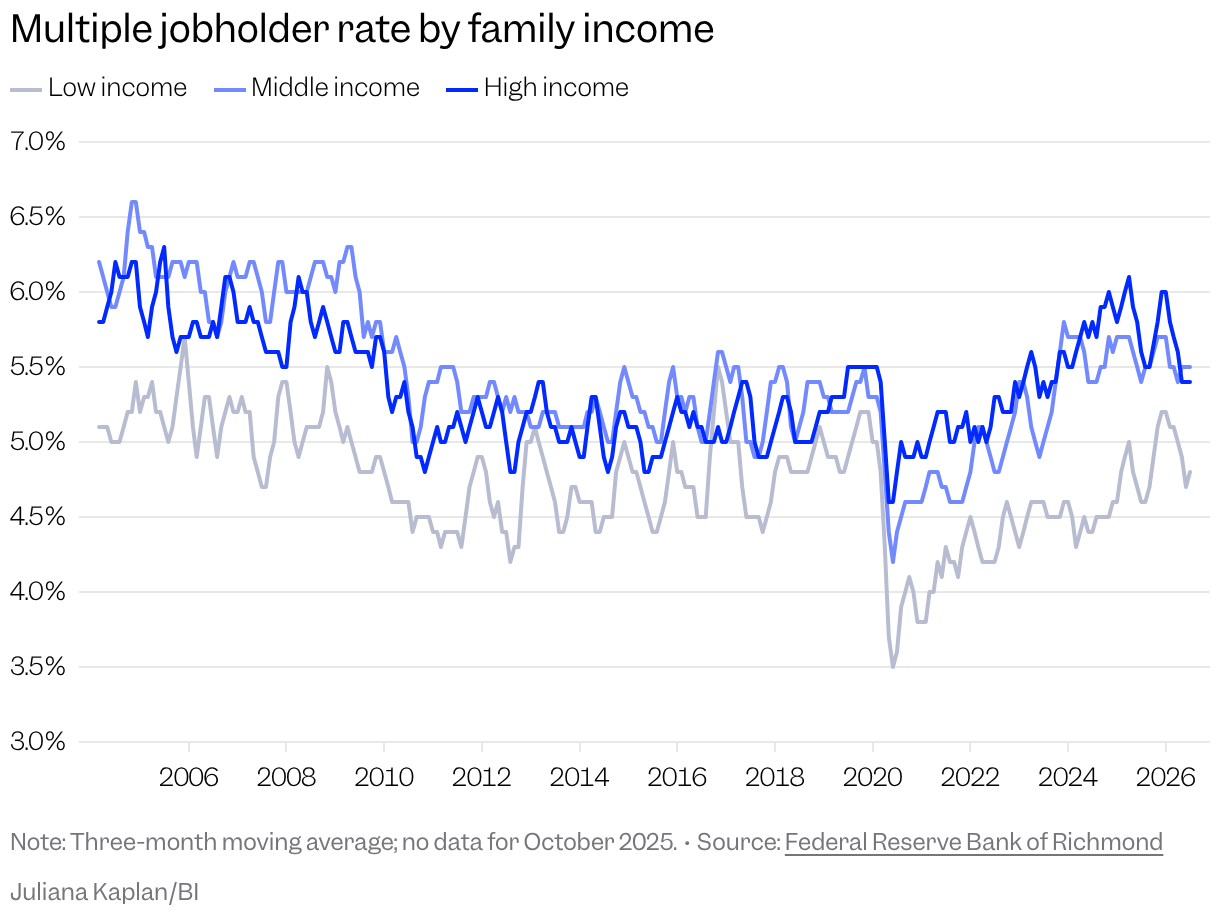
An analysis from the Richmond Federal Reserve found that before the pandemic, the share of multiple jobholders across income groups was similar: low-, middle-, and high-earners worked multiple jobs in roughly equal proportion.
In the past few years, that's changed. Middle-income earners are much more likely to hold multiple jobs than their lower-earning counterparts, and sit just barely below their higher-earning peers.
At the same time, college-educated workers have increasingly been creeping into the multiple jobholder workforce. In the 1990s, they made up around 35% of those holding multiple jobs; by 2024, they made up over half, according to the Richmond Fed analysis.
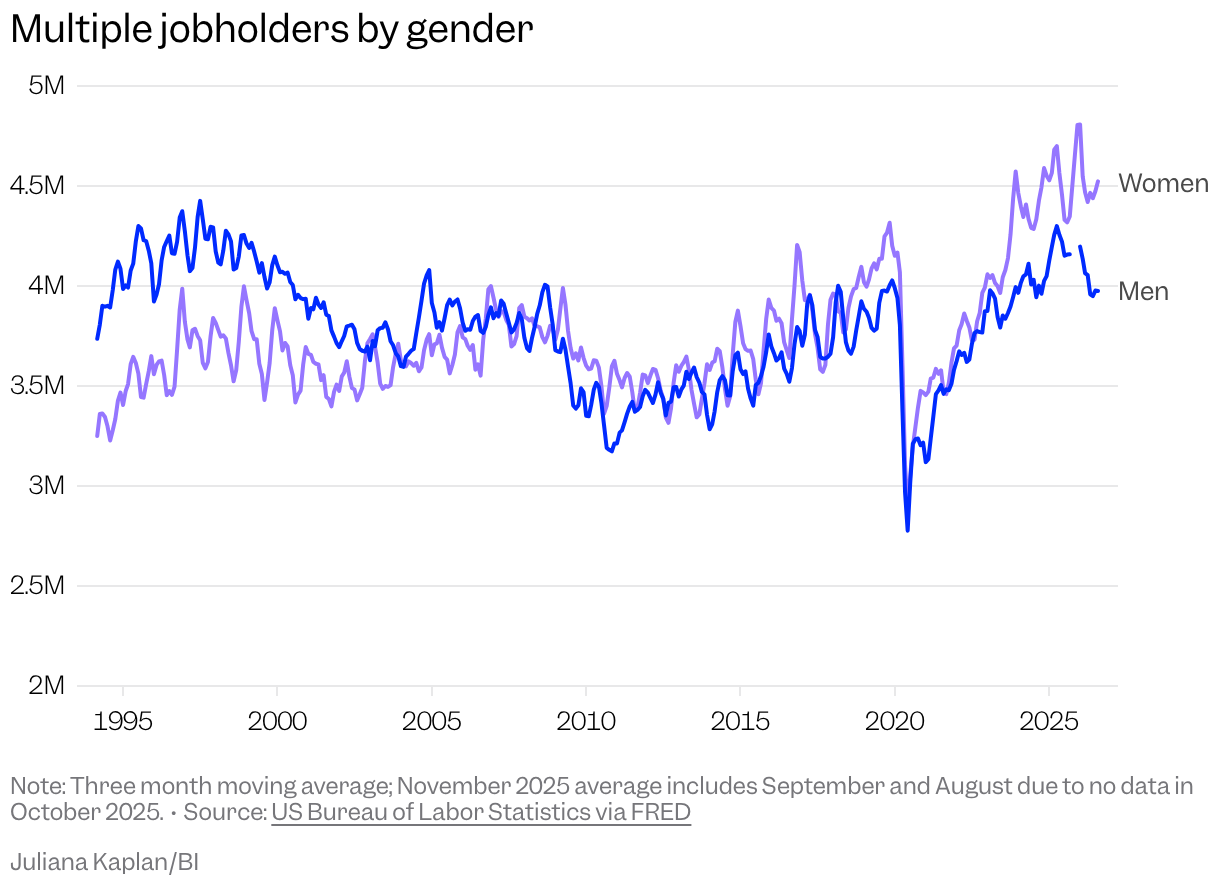
Simultaneously, the number of women holding multiple jobs has increased in the last few years, according to the Bureau of Labor Statistics's latest employment data. The gender gap in multiple jobholding has widened, meaning that more women — especially those aged 20 to 24 — are working in several roles. That tracks with a labor force where women have outnumbered men with college degrees, and younger women in some areas earn more than their male counterparts.
Taken together, the data indicate that more educated and traditionally more affluent Americans feel an urge to bring in multiple income streams. Side hustles are increasingly prevalent across the economy: The share of Americans holding down a side hustle has increased from 19% in 2017 to 27% in 2025, per a Bankrate survey. Official measures of multiple jobholding also often fail to completely capture the number of workers participating in gig work, since BLS's rate measures workers who hold at least one traditional wage job.
And that might show how workers feel about their prospects. Women have been shedding jobs in the past months, and the white-collar world has been shaken by layoffs attributed to AI. Taking a new job is risky — workers say it'll cost more than ever to lure them away from their roles — so an additional job might offer more reassurance. For college-educated workers, middle-income earners, and women, a side hustle might be a buffer against an increasingly unsteady labor market.

 Entrar